
- Home
- »
- Beauty & Personal Care
- »
-
Maracuja Oil Market Size, Share, Trends Report, 2026-2033GVR Report cover

Maracuja Oil Market (2026 - 2033)
Size, Share & Trends Analysis Report By Type (Organic, Conventional), By Gender (Women, Men), By End-use (Household, Commercial), By Distribution Channel, By Region, And Segment Forecasts
Market Size, 2025
$2.6BMarket Estimate, 2026
$2.8BMarket Forecast, 2033
$5.3BCAGR, 2026–2033
9.2%Maracuja Oil Market Summary
The global maracuja oil market size was valued at USD 2.6 billion in 2025 and is projected to grow from USD 2.8 billion in 2026 to USD 5.3 billion by 2033, growing at a CAGR of 9.2% from 2026 to 2033. North America dominated the market, accounting for the largest global share of 32.1% in 2025. Maracuja oil is highly sought after in beauty and personal care due to its rich antioxidant content, which helps protect the skin from environmental damage, and its excellent moisturizing properties, making it ideal for hydrating dry skin.
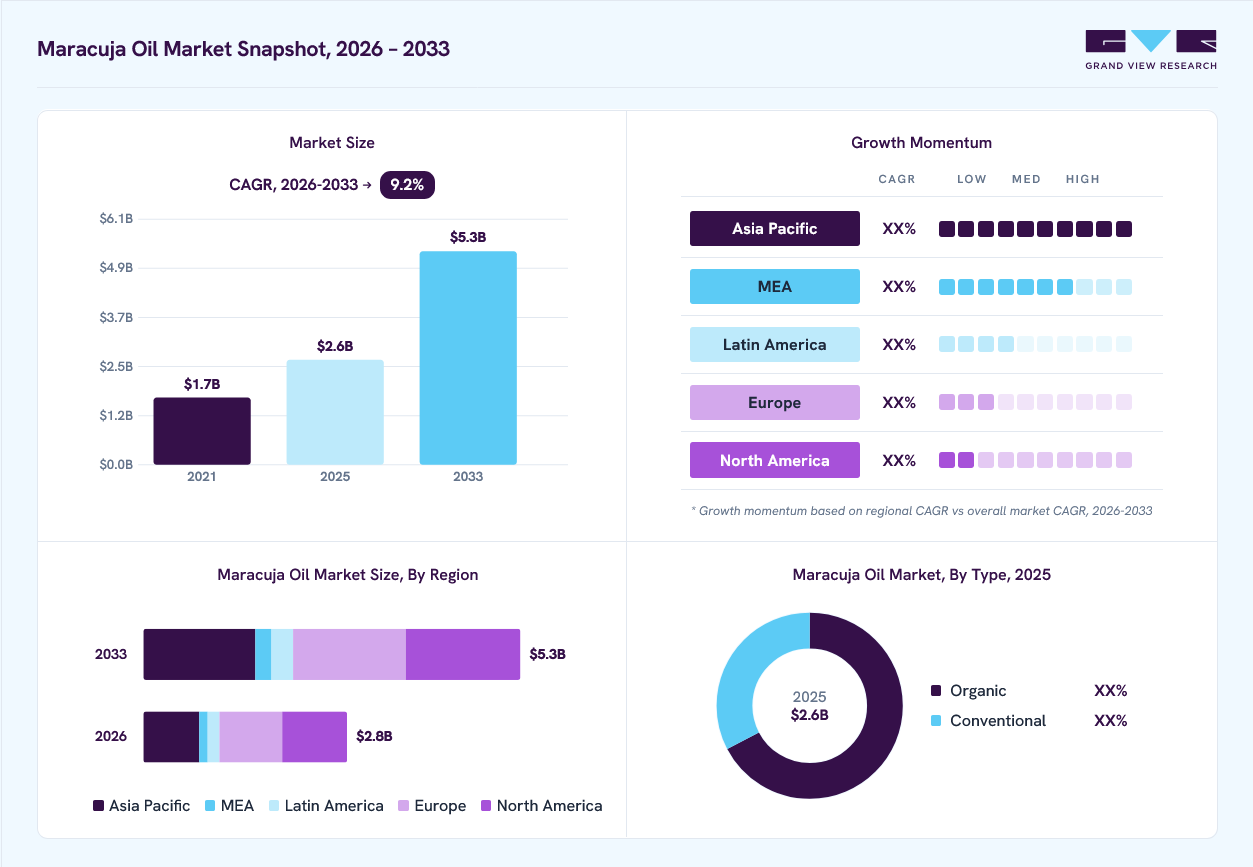 Source: Grand View Research, IR Documents, Primary Interviews, Paid DatabasesTo learn more about this report,
 Download Free Sample Report
Key Market Trends & Insights
- By type: Organic type segment led the market with the largest revenue share of 67.2% in 2025.
- By gender: Women segment led the market with the largest revenue share of 67.0% in 2025.
- By end-use: Household segment led the market with the largest revenue share of 81.9% in 2025.
- By distribution channel: Supermarkets and hypermarkets segment held the largest share of 33.3% in 2025.
Regional Highlights
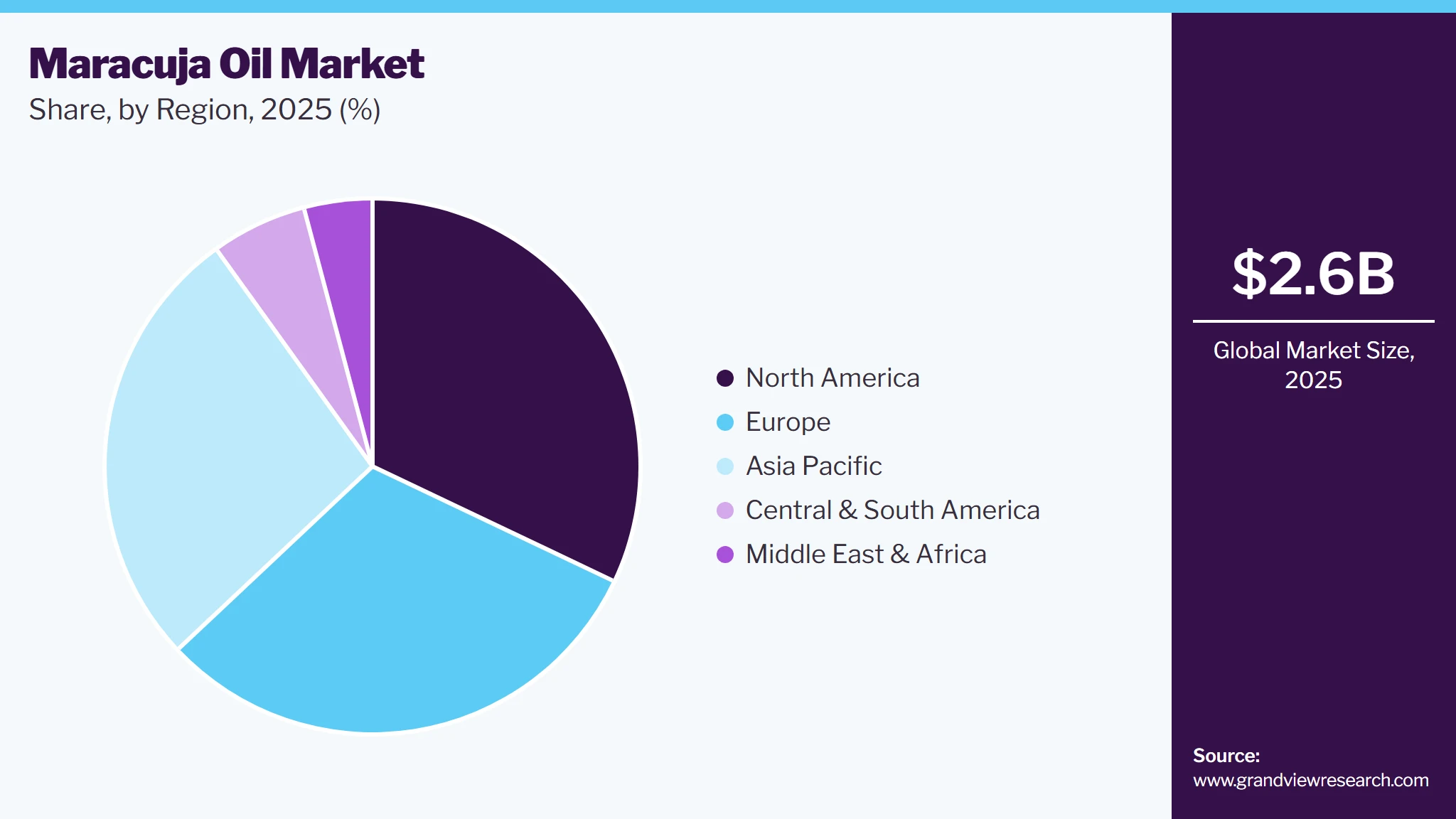
- Largest regional market: North America (32.0% revenue share, 2025)
- By country: The U.S. held the largest share of Asia Pacific in 2025.
Market Size & Forecast
- Market size in 2025: USD 2.6 Billion
- Estimated market size in 2026: USD 2.8 Billion
- Projected market size by 2033: USD 5.3 Billion
- CAGR (2026-2033): 9.2%
Prism AI by Grand View Research Free to tryAsk a question about the maracuja oil marketTry asking✓Every figure cited from GVR research Prefer the report? Download free sample →
Its anti-inflammatory benefits soothe irritated skin, while its lightweight texture suits all skin types. The increasing consumer preference for natural and organic skincare products and the rising awareness of maracuja oil's multiple benefits are driving its demand in the beauty industry.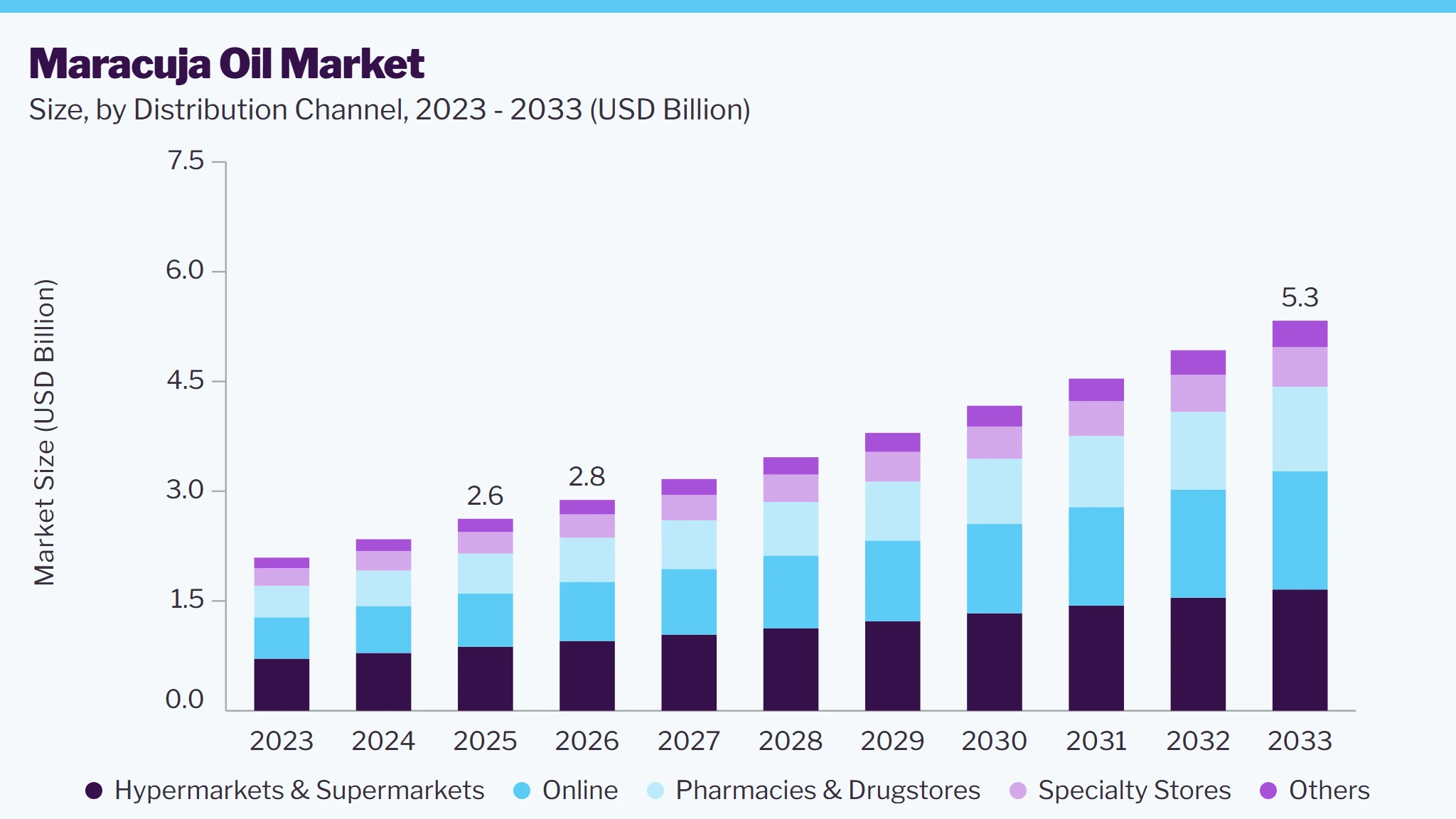 To learn more about this report, Download Free Sample Report
In addition, the growing awareness of the benefits of maracuja oil through social media and beauty influencers has played a crucial role in its popularity. Influencers and dermatologists frequently highlight maracuja oil's ability to soothe inflammation, reduce redness, and improve skin texture. This word-of-mouth marketing, coupled with positive reviews and testimonials, has significantly boosted consumer confidence in the product. As more people turn to online platforms for beauty advice, the demand for maracuja oil is expected to rise further.
Another factor driving its demand is the versatility of maracuja oil in various skincare and haircare formulations. From facial oils and serums to hair masks and conditioners, maracuja oil is incorporated into a wide range of products, catering to different consumer needs. Its lightweight texture and non-greasy finish make it a popular choice for those looking to add moisture and shine without weighing down their hair or skin. This adaptability ensures that maracuja oil will continue to be a staple product in beauty and skincare routines.
The demand for maracuja oil is poised to increase as consumers become more educated about its benefits and as the trend for sustainable and ethical beauty products grows. Brands are increasingly sourcing maracuja oil from eco-friendly and fair-trade sources, appealing to environmentally conscious consumers. Furthermore, ongoing research and product innovation are likely to uncover even more benefits of maracuja oil, solidifying its position in the beauty and skincare industry. As these trends continue, maracuja oil's popularity is set to soar in the future.
The rise of online channels, particularly sales through TikTok and other social media platforms, is significantly boosting the maracuja oil market. Beauty influencers and skincare enthusiasts on these platforms frequently showcase maracuja oil's benefits, creating viral trends and driving consumer interest. The convenience of online shopping, coupled with targeted advertising and user-generated content, has made it easier for consumers to discover and purchase maracuja oil.
Tarte Cosmetics, which offers maracuja oil, has leveraged its strong social media presence to generate significant sales through TikTok Shop, embracing the platform's social commerce capabilities. By hosting regular livestream shopping sessions, Tarte engages viewers with product swatches, tutorials, giveaways, and behind-the-scenes content. This strategy, combined with their open affiliate approach, has resulted in impressive viewership and sales, with 70% of purchases coming from non-followers in 2023. Their successful 12-hour livestream attracted 25,000 viewers and led to a triple-digit lift in wholesale retail products featured on TikTok Shop, demonstrating Tarte’s effective integration of social media and e-commerce.
Market Dynamics
Maracuja oil is gaining popularity in skin and hair care as consumers shift toward natural, plant-based ingredients. Extracted from passionfruit seeds, it offers lightweight hydration, antioxidant benefits, and a non-greasy finish, making it suitable for facial oils, serums, and hair treatments. Growing interest in clean beauty and South American botanical ingredients has expanded their use beyond niche skincare lines. Its non-comedogenic properties also support adoption in acne-prone skin formulations, while rising demand in men's grooming and haircare is broadening its application scope further.
The maracuja oil market is being driven by a broader shift in consumer purchasing behavior toward organic and naturally derived ingredients in skincare and haircare formulations. Growing concerns about synthetic additives and sulfates have prompted consumers to seek out plant-based oils, such as maracuja oil, that deliver functional skin and hair benefits without relying on harsh chemical inputs. As shoppers become more attentive to what goes into their skincare routines and how ingredients are sourced, botanical oils with clear provenance and demonstrated functional benefits, such as hydration, antioxidant support, and non-comedogenic properties, are gaining preference over synthetic alternatives. This trend is particularly visible in premium skincare and haircare lines, where formulators are positioning maracuja oil as a multi-functional, natural substitute for conventional emollients. The continued consumer shift toward informed, ingredient-conscious purchasing is expected to support sustained interest in maracuja oil across both mass and premium personal care segments.
The maracuja oil market faces restraints tied to the limited and geographically concentrated supply of passionfruit seeds, the primary raw material used in oil extraction. Passionfruit cultivation is largely concentrated in a handful of regions, including Brazil and parts of South America, making the ingredient supply chain vulnerable to seasonal harvest cycles, weather variability, and regional agricultural disruptions. This geographic concentration limits the ability of manufacturers to diversify sourcing and increases exposure to supply shortages during off-seasons or periods of crop stress. Because maracuja oil is typically extracted as a byproduct of passionfruit pulp and juice processing, its availability is closely tied to demand for the fruit itself in the food and beverage industry, rather than being cultivated as a dedicated crop for oil production. This dependency can create inconsistent supply volumes and limit scalability for cosmetic and personal care manufacturers seeking to incorporate the oil into mass-market formulations.
The growing consumer shift toward personalized skincare and haircare is creating new growth opportunities for maracuja oil across the beauty and personal care industry. As brands increasingly develop customized formulations tailored to individual skin types, concerns, and climate conditions, maracuja oil's versatility, lightweight texture, high linoleic acid content, and compatibility with a range of skin types position it well for inclusion in personalized serums, facial oils, and hair treatments. The rise of multi-functional beauty products, formulations that combine hydration, antioxidant protection, and barrier support in a single product, also presents an opportunity for maracuja oil to be positioned as a core active ingredient rather than a secondary additive. Additionally, expanding applications beyond facial skincare, including body care, scalp treatments, leave-in hair products, and men's grooming lines, offers brands the opportunity to diversify maracuja oil-based product portfolios. Growing interest in ingredient traceability and single-origin sourcing stories also gives brands an opening to build premium positioning around maracuja oil by highlighting its South American origin and sustainable sourcing practices, appealing to consumers who value transparency and provenance in their beauty purchases.
Analyst Perspective
Maracuja oil has a good future because it works well for skin and hair, it's made using leftover seeds from passionfruit, which keeps costs lower, and more people want beauty products with clear, honest ingredient stories. The brands that will do best are the ones that stop treating maracuja oil as just one item on an ingredient list and instead build products where it's the main, standout ingredient. To do this well, brands need to keep their supply steady and consistent and clearly explain to customers what makes this oil different and useful. If they do this, maracuja oil can become a lasting, trusted ingredient instead of just a short-lived trend.
Type Insights
Based on type, the organic type segment led the market with the largest revenue share of 67.2% in 2025 and is expected to grow at the fastest CAGR over the forecast period. This is due to the rising consumer preference for natural and sustainably sourced products. Increasing awareness about the benefits of organic products, such as the absence of harmful chemicals and pesticides, drives demand. Consumers are willing to pay a premium for organic maracuja oil, which is often associated with higher quality and better environmental practices.
Demand for conventional maracuja oil is expected to grow at a CAGR of about 8.8% from 2026 to 2033. As consumers continue to seek budget-friendly beauty and wellness solutions, conventional maracuja oil presents a viable option. Advances in cultivation and extraction methods also enhance the quality and efficiency of conventional maracuja oil production, making it more appealing. In addition, the growing penetration of maracuja oil in emerging markets, where price sensitivity is higher, contributes to the rapid growth of this segment, catering to a broader audience.
Gender Insights
Based on gender, the women segment led the market with the largest revenue share of 67.0% in 2025. Women represent a large segment of the market driven by their predominant use of skincare and haircare products. Maracuja oil is highly valued for its moisturizing, anti-aging, and nourishing properties, making it a popular choice among women seeking natural beauty solutions. The increasing focus on self-care and the expanding range of beauty and personal care products targeted at women further fuel this demand. Additionally, marketing campaigns and endorsements by influencers and celebrities enhance product visibility and trust among female consumers, reinforcing their share.
Demand for maracuja oils among men is expected to grow at a CAGR of about 10.0% from 2026 to 2033. Increasing awareness about personal care and grooming among men, coupled with the rising influence of social media and fashion trends, drives this growth. Men are becoming more inclined towards using natural and effective products like maracuja oil for skincare and haircare. The introduction of gender-specific marketing strategies and product formulations tailored to men's needs also contributes to the rapid adoption of maracuja oil in this segment.
End-use Insights
Based on end-use, the household segment led the market with the largest revenue share of 81.9% in 2025. Consumers prefer maracuja oil for its versatility and natural benefits, incorporating it into skincare, haircare, and even DIY beauty treatments. The increasing trend towards natural and organic home care products further bolsters this segment. In addition, easy availability through various retail channels and the growing popularity of online shopping makes maracuja oil a convenient and accessible choice for household use, sustaining its market share.
v. This is due to its rising use in spas, salons, and wellness centers. Businesses in these sectors are increasingly incorporating maracuja oil into their treatments and product offerings, driven by consumer demand for natural and effective skincare and haircare solutions. The expansion of these wellness facilities, coupled with the growing trend of self-care and holistic health, contributes to the rapid adoption and integration of maracuja oil in the commercial sector, fueling its significant growth.
Distribution Channel Insights
Based on distribution channel, the supermarkets and hypermarkets segment led the market with the largest revenue share of 33.3% in 2025. Supermarkets and hypermarkets are gradually becoming trusted beauty retail spaces by offering an extensive range of skincare and cosmetics products. These stores prioritize visual merchandising and categorization in order to create a captivating beauty shopping experience. Sainsbury's and other beauty firms partnered to launch AI and AR-powered skincare consultations in more than 100 UK locations in 2022. This technology reflects the increased demand for products such as maracuja oil and the growing interest in skin health. It analyzes customers' faces to deliver personalized skincare recommendations.
Online sales of maracuja oil are expected to grow at a CAGR of 10.4% from 2026 to 2033. The ease of online purchasing, which gives customers quick access to a large selection of skin care goods from the comfort of their homes, is what is driving the market's e-commerce growth. A YouGov survey from 2022 indicates that roughly 10% of worldwide customers prefer to just buy health and beauty products online, while roughly 22% shop online most of the time. The market for maracuja oil is enhanced by an increase in online skincare sales due to the expansion of customer choice and access, which also increases market competitiveness.
Regional Insights
North America dominated the maracuja oil market with the largest revenue share of 32.0% in 2025. Benefits of skincare are becoming more widely known to consumers because to social media and online videos on sites like YouTube and TikTok. Also, the region's thriving skincare industry, which is fueled by high consumer expenditure and a need for efficient, scientifically supported products, adds to the appeal of skincare products that make anti-aging and skin-brightening claims. This trend is further fueled by a growing number of aging consumers looking for efficient beauty solutions as well as younger demographics affected by digital media who are proactive in addressing skincare concerns and preserving a youthful appearance.
 To learn more about this report, Download Free Sample Report
U.S. Maracuja Oil Market Trends
The maracuja oil market in the U.S. accounted for the largest market share in 2025 in the North American market. The U.S. has robust demand for maracuja oil due to increasing consumer awareness of natural and organic beauty products. Maracuja oil's benefits for skin and hair, such as hydration, anti-aging, and nourishment, make it popular among health-conscious consumers. In addition, the rise of wellness trends and the influence of social media and celebrity endorsements further drive its demand in the U.S. market.
Asia Pacific Maracuja Oil Market Trends
The maracuja oil market in Asia Pacific is anticipated to grow at a CAGR of about 10.4% from 2026 to 2033. The Asia Pacific skincare market is expanding due to growing consumer demand for both prestige and mass-market beauty products. This growth is driven by an expanding middle class, increased product accessibility, and a cultural emphasis on beauty. The market for maracuja oil holds significant potential in this context, as more consumers seek powerful and efficient skincare solutions. High-quality, bioavailable products such as maracuja oil are expected to see increased demand, making this a profitable market for cosmetic firms targeting this demographic.
Key Maracuja Oil Company Insights
The maracuja oil market is fragmented. Many brands have recognized the presence of untapped opportunities in their product offerings and have been adopting strategies such as marketing campaigns, mergers & acquisitions, and product launches to gain market share.
Key Maracuja Oil Companies:
TThe following key companies have been profiled for this study on the maracuja oil market.
-
Kosé Corporation
-
H&B Oils Center Co.
-
Mayan's Secret
-
Dr Adorable Inc.
-
Leven Rose
-
Bella Terra Oils
-
Milania
-
Farouk Systems International
-
Magic Sleek
-
PURA D'OR
Competitive Benchmarking
Category
Operating Strategies
Competitive Edge
Weakness
Established Players (PURA D'OR, H&B Oils Center Co., Farouk Systems International, Kosé Corporation)
- Expand product portfolios by integrating maracuja oil into broader hair and skincare lines. Invest in retail and e-commerce distribution through Amazon, brand websites, and specialty beauty retailers, and build brand trust through sustainability messaging.
- Established brand recognition across broader personal care categories, wider distribution network spanning online and offline retail ability to bundle maracuja oil into multi-product regimens (shampoos, conditioners, treatment sets)
- Higher operational costs from maintaining broad product portfolios and quality certifications, slower to pivot compared to niche ingredient-focused brands, maracuja oil is often positioned as a secondary product rather than a core focus
Emerging Players (Leven Rose, Dr Adorable Inc..)
- Focus narrowly on single-ingredient, cold-pressed carrier oils, emphasize direct-to-consumer sales through their own websites and marketplaces, build brand identity around purity claims, and community sourcing.
- Ability to move quickly on formulation and sourcing changes strong niche appeals to natural and clean-beauty consumers, differentiated positioning through origin transparency, and unrefined/undiluted product claims
- Limited financial resources and smaller marketing budgets compared to multi-category brands heavier reliance on a narrow product range tied to a single ingredient category, lower brand recognition outside niche natural beauty communities
Recent Developments
-
In July 2024, Kosé Corporation, a major Japanese cosmetics company, accelerated its North American expansion with the opening of a new flagship store in Los Angeles, branded as Maison Kosé. This move aims to enhance awareness and accessibility of its key global brands in the region. The launch of Maison Kosé underscores Kosé Corporation's strategic initiative to strengthen its presence and grow its business in North America through 2023, leveraging physical retail presence to engage directly with consumers and bolster brand visibility in a competitive market.
-
In July 2024, Kosé Corporation entered a strategic partnership with I Peace, Inc. and Reju, Inc. to develop personalized beauty products containing iPS cell extract tailored to individual customer preferences. This innovative collaboration aims to pioneer a new frontier in beauty by integrating advanced iPS cell technology with cosmetic formulations, ensuring products are uniquely suited to each customer's needs and biocompatibility.
-
In June 2024, Farouk Systems, Inc. showcased its latest innovations and cutting-edge techniques in hair care. Its educators led live demonstrations and education sessions, igniting passion and setting new standards in hair artistry. The company leveraged the prestigious platform of IBS Las Vegas to inspire industry professionals, shape beauty trends, and reinforce their commitment to pushing the boundaries of innovation in the hair care industry on a global scale.
Maracuja Oil Market Report Scope
Report Attribute
Details
Market size value in 2025
USD 2.6 billion
Market size value in 2026
USD 2.8 billion
Revenue forecast in 2033
USD 5.3 billion
Growth rate
CAGR of 9.2% from 2026 to 2033
Base year for estimation
2025
Historical data
2021 - 2024
Forecast period
2026 - 2033
Quantitative units
Revenue in USD million/billion, and CAGR from 2026 to 2033
Report coverage
Revenue forecast, company ranking, competitive landscape, growth factors, and trends
Segments covered
Type, gender, end use, distribution channel, region
Regional scope
North America; Europe; Asia Pacific; CSA; MEA
Country scope
U.S.; Canada; Mexico; UK; Germany; France; Italy; Spain; Japan; China; India; Brazil; Argentina; South Africa; Saudi Arabia
Key companies profiled
Kosé Corporation; H&B Oils Center Co.; Mayan's Secret; Dr Adorable Inc.; Leven Rose; Bella Terra Oils; Milania; Farouk Systems International; Magic Sleek; PURA D'OR
Customization scope
Free report customization (equivalent up to 8 analysts' working days) with purchase. Addition or alteration to country, regional & segment scope.
Pricing and purchase options
Avail customized purchase options to meet your exact research needs. Explore purchase options
Global Maracuja Oil Market Report Segmentation
This report forecasts revenue growth at the regional and country levels and provides an analysis of the latest industry trends and opportunities in each of the sub-segments from 2021 to 2033. For the purpose of this study, Grand View Research has segmented the maracuja oil market report on the basis of type, gender, end use distribution channel, and region.
-
Type Outlook (Revenue, USD Billion, 2021 - 2033)
-
Organic
-
Conventional
-
-
Gender Outlook (Revenue, USD Billion, 2021 - 2033)
-
Women
-
Men
-
-
End-use Outlook (Revenue, USD Billion, 2021 - 2033)
-
Household
-
Commercial
-
-
Distribution Channel Outlook (Revenue, USD Billion, 2021 - 2033)
-
Hypermarkets & Supermarkets
-
Specialty Stores
-
Pharmacies & Drugstores
-
Online
-
Others
-
-
Regional Outlook (Revenue, USD Billion, 2021 - 2033)
-
North America
-
U.S.
-
Canada
-
Mexico
-
-
Europe
-
UK
-
Germany
-
France
-
Italy
-
Spain
-
-
Asia Pacific
-
China
-
Japan
-
India
-
-
Central & South America
-
Brazil
-
Argentina
-
-
Middle East & Africa
-
South Africa
-
Saudi Arabia
-
-
Research Methodology
The maracuja oil market figures in this report are based on a proven research process that combines executive interviews with secondary research from proprietary databases, company filings, and recognized regulatory and institutional sources. Market size is built through value-chain sizing - reconciling supply-side and demand-side estimates - and triangulated with bottom-up and top-down approaches. Every estimate passes multiple levels of expert validation before publication, with each maracuja oil segment quantified using the revenue-capture definitions in the table below.
Segment Definition
Segment - Type
Revenue capture definition
Organic
This segment covers the revenue generated through the sales of maracuja oil that is certified organic, meaning it is derived from passionfruit seeds grown and processed without the use of synthetic pesticides, fertilizers, or genetically modified inputs, and typically verified by third-party certification bodies such as USDA Organic. This segment includes cold-pressed, unrefined maracuja oil positioned around purity, sustainable sourcing, and clean-label claims, often marketed toward premium and natural beauty consumers.
Conventional
This segment covers the revenue generated through the sales of maracuja oil that is not certified organic, meaning it may be sourced from standard agricultural practices without formal organic certification, though it can still be marketed as natural, pure, or cold-pressed. This segment typically includes mass-market and value-tier products where certification costs are avoided, allowing for more competitive pricing and wider retail distribution.
Estimation Model
Ingredient Demand Layer
Retail & Distribution Access Layer
Purchase Behavior Layer
Revenue Realization Layer
Who has a relevant use case?
Who can be reached through existing channels?
Who actively chooses natural, ingredient-led products?
How much revenue is generated?
Identify the base population of skincare and haircare consumers with conditions or needs that maracuja oil addresses, dry or sensitive skin, aging skin concerns, damaged or frizzy hair, oily scalp, to define the functionally relevant user pool across personal care categories.
Apply channel-specific reach factors, e-commerce penetration, specialty and natural product retail presence, and professional/spa distribution access, filtered by regional availability of maracuja oil-based products, to derive the population that can realistically access these products through current distribution infrastructure.
Apply category-specific adoption behavior, including preference for clean-label and single-origin ingredients, willingness to pay a premium for certified organic formulations, and repeat-purchase patterns among natural skincare and haircare consumers, to convert reachable consumers into active buyers of maracuja oil-based products.
Multiply the active buyer base by category-specific average spend per product and layer in B2B revenue from bulk/wholesale supply to cosmetic manufacturers, spas, and private-label formulators, to arrive at total addressable revenue across household and commercial end-use segments.
Delivered Customizations
This report has been delivered with the following In-depth customizations
CLIENT REQUEST
CUSTOMIZATION DELIVERED
VALUE ADDS
Organic vs. Conventional Trends
Conducted a focused analysis of maracuja oil across organic and conventional grades, covering certification standards (e.g., USDA Organic), sourcing and traceability practices, cold-pressing and extraction quality, and positioning differences in premium versus value-tier formulations
Helps stakeholders evaluate consumer willingness to pay for certified organic sourcing, assess certification cost-benefit tradeoffs, and identify commercialization opportunities across both premium and mass-market price tiers.
Women's vs. Men's Product Adoption Trends
Evaluated adoption trends for maracuja oil across women-focused skincare and haircare products (facial oils, serums, multi-use treatments) and men's grooming lines (beard conditioning oils, washes, and balms), including formulation differences and brand positioning strategies.
Provides insights into gender-specific product development opportunities, unmet consumer needs across skincare and grooming segments, and commercially attractive formulation formats to support innovation strategies.
Household vs. Commercial Application Trends
Assessed demand patterns across household use (direct-to-consumer skincare and haircare routines) and commercial use (spa, salon, and bulk/wholesale supply for professional formulators), including packaging formats, bulk supply arrangements, and quality-assurance requirements.
Supports expansion strategies by identifying underserved application segments, evaluating readiness for B2B bulk supply versus consumer retail, and strengthening long-term positioning across both channels.
Frequently Asked Questions About This Report
The global maracuja oil market size was valued at USD 2.6 million in 2025 and is estimated at USD 2.8 million for 2026.
Key players in the maracuja oil market are Kosé Corporation; H&B Oils Center Co.; Mayan's Secret; Dr Adorable Inc.; Leven Rose; Bella Terra Oils; Milania; Farouk Systems International; Magic Sleek; PURA D'OR.
Key factors that are driving the maracuja oil market growth include its high antioxidant content, moisturizing properties, anti-inflammatory benefits, and suitability for all skin types.
The organic type segment led the market with the largest revenue share of 67.2% in 2025.
The women segment led the market with the largest revenue share of 67.0% in 2025.
The household segment led the market with the largest revenue share of 81.9% in 2025.
The global maracuja oil market is expected to grow at a CAGR of 9.2% from 2026 to 2033, reaching USD 5.3 million by 2033.
North America dominated the maracuja oil market in 2025, due to its advanced skincare industry and high consumer awareness and demand for premium skincare products.
About the Author(s)
Beauty & Personal Care Research Team
Consumer Goods · Beauty & Personal CareThis report was authored by the beauty & personal care research team at Grand View Research - comprising two research analysts, one senior research analyst, and one industry expert - with specialized expertise in the beauty & personal care segment of the consumer goods industry. All findings are based on proprietary consumer goods databases, executive interviews, and regulatory analysis, subject to internal peer review prior to publication.
Last Updated:
Speak to Analyst

Customize this report to your needs - add regions, segments, or data points, with 20% free customization.
Or view our licence options:


ISO 9001:2015 & 27001:2022 Certified
We are GDPR and CCPA compliant! Your transaction & personal information is safe and secure. For more details, please read our privacy policy.


