
- Home
- »
- Automotive & Transportation
- »
-
Marine Vessel Market Size And Share Report, 2026-2033GVR Report cover

Marine Vessel Market (2026 - 2033)
Size, Share & Trends Analysis Report By Ship Type, By Deadweight Tonnage (100 DWT To 500 DWT, 500 DWT To 5000 DWT, 5000 DWT To 15000 DWT, More Than 15000 DWT), By Operation (Inland, Seafaring), By Region, And Segment Forecasts
Market Size, 2025
$113.5BMarket Estimate, 2026
$115.2BMarket Forecast, 2033
$150.4BCAGR, 2026–2033
3.9%Marine Vessel Market Summary
The global marine vessel market size was valued at USD 113.5 billion in 2025 and is projected to grow from USD 115.2 billion in 2026 to USD 150.4 billion by 2033, at a CAGR of 3.9% from 2026 to 2033. Asia Pacific dominated the market, accounting for a revenue share of 47.5% in 2025. The market is driven by a combination of rising geopolitical tensions, maritime security concerns, and fleet modernization programs.
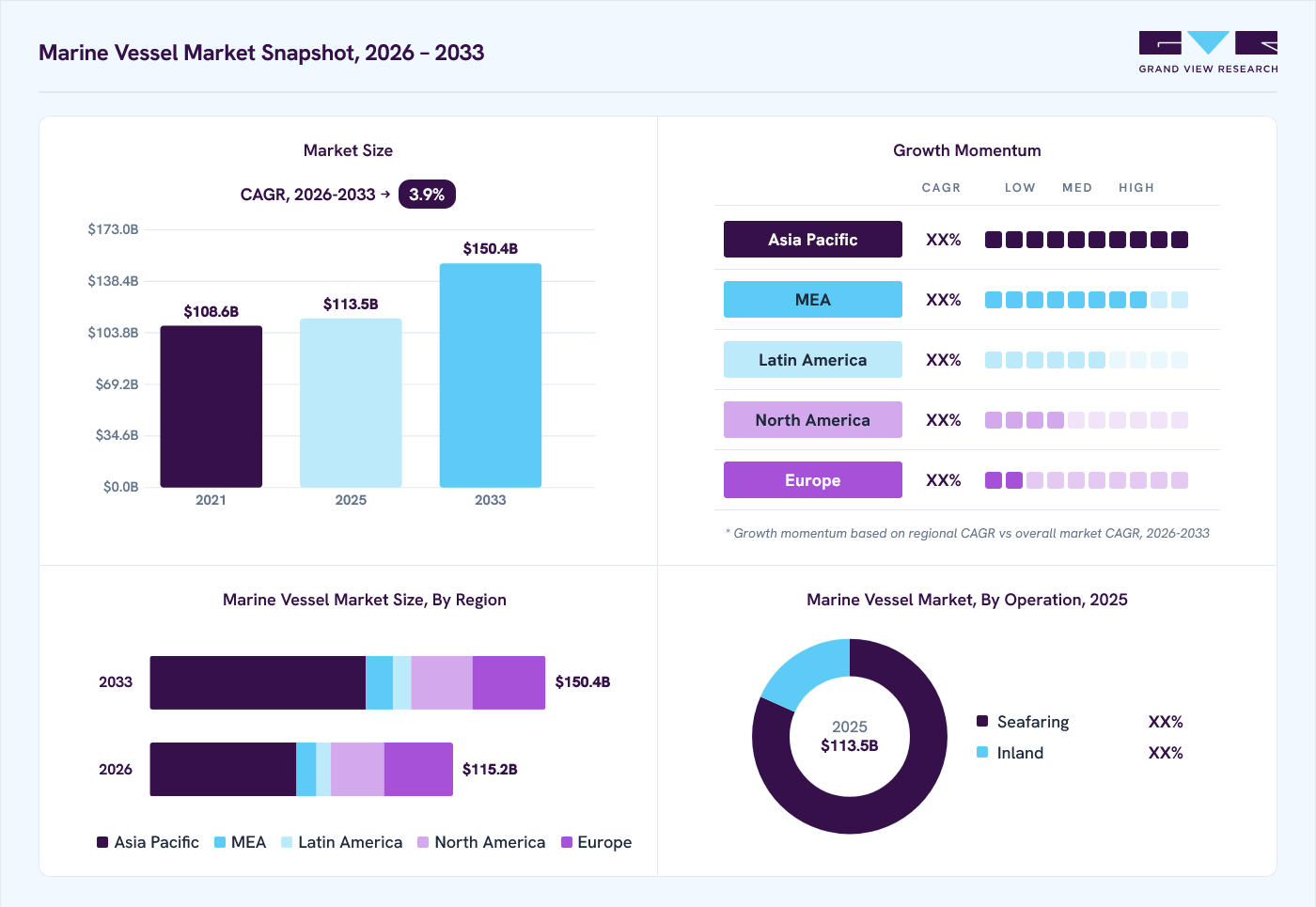 Source: Grand View Research, IR Documents, Primary Interviews, Paid DatabasesTo learn more about this report,
 Download Free Sample Report
 Key Market Trends & Insights
- By ship type: Cargo ships segment led the market with the largest revenue share of 28.3% in 2025.
- By deadweight tonnage: More than 15000 DWT segment held the largest market share of 51.7% in 2025.
- By operation: Seafaring segment accounted for the largest revenue share in 2025.
Regional Highlights
- Largest regional market: Asia Pacific (47.5% revenue share, 2025)
- By country: China held the largest market share in 2025.
Market Size & Forecast
- Market size in 2025: USD 113.5 Billion
- Estimated market size in 2026: USD 115.2 Billion
- Projected market size by 2033: USD 150.4 Billion
- CAGR (2026-2033): 3.9%
Three ways to get this report
Buy it, customize it, or ask a question.Ask an Analyst
Analyst response in 1 business day
- AccessReport author, directly
- Reply timeWithin 1 working day
- No sales callDirect answer only
- FormatEmail reply
- CostFree, no cost
Get the Full Report
What the study covers
- FormatsPDF · Excel · Dashboard
- Timeline2026–2033 annual, 2025 base
- Coverage20+ countries, 5 regions
- Companies10+ key players profiled
Customize the Report
20% free customization
- IncludeCountries, segments, points
- TailorTo your product definition
- ExtendDeeper competitor detail
- OrA fully bespoke study
- Turnaround5–10 working days
Increased emphasis on naval deterrence and blue-water capabilities has led to the procurement of advanced surface and sub-surface vessels by both developed and developing nations. Technological advancements are reshaping the naval vessel market, with a growing focus on automation, stealth, and integrated combat systems. Platforms are increasingly being designed with modular architectures to allow for rapid upgrades and multi-role capabilities. Artificial intelligence, unmanned systems, and sensor fusion technologies are being integrated into new-generation vessels to enhance situational awareness and mission efficiency. Electric and hybrid propulsion systems, along with advanced materials that reduce radar signatures, are also being widely adopted to improve operational sustainability and survivability.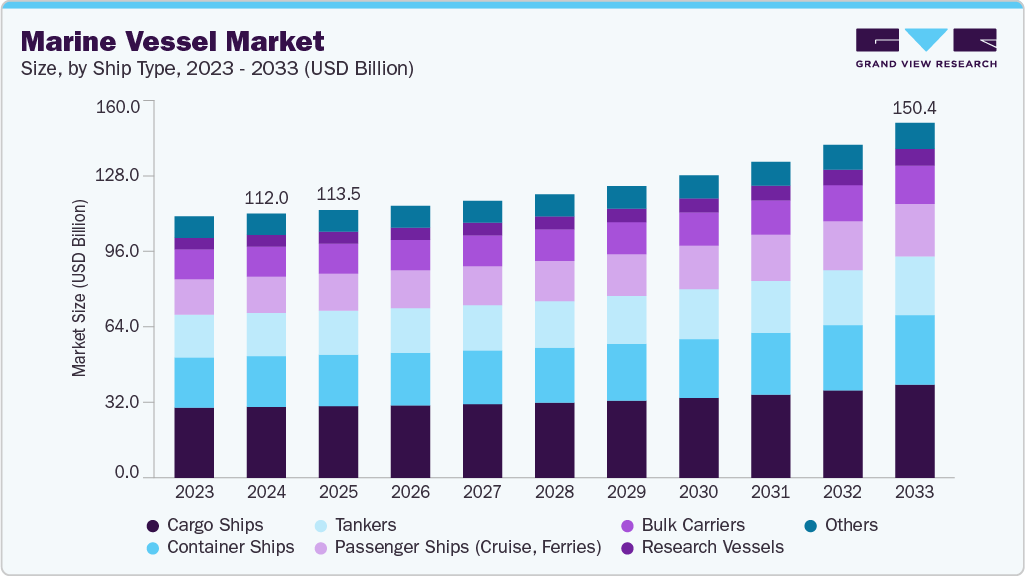 To learn more about this report, Download Free Sample Report
 Governments and defense contractors are allocating significant investments toward research, development, and production of next-generation naval platforms. Budget allocations for naval procurement have been increased across key markets such as the U.S., China, India, and several NATO countries. Strategic partnerships, multi-national shipbuilding programs, and long-term maintenance and support contracts have been formed to enhance industrial capabilities and supply chain resilience. Private sector engagement in naval shipbuilding and upgrades has also been encouraged through offset agreements and public-private collaboration models.
Both national defense policies and international maritime laws influence the regulatory environment governing the naval vessel market. Export regulations, defense procurement standards, and classification society rules are being enforced to ensure vessel integrity, security compliance, and interoperability among allied fleets. Environmental compliance regulations, such as restrictions on emissions and ballast water treatment, are increasingly being applied to military vessels, particularly in peacetime operations. In addition, cybersecurity mandates for critical defense infrastructure are being incorporated into naval vessel specifications.
Despite robust demand, several challenges are restraining the growth of the naval vessel market. High capital expenditure requirements, extended development timelines, and complex regulatory approvals continue to pose entry barriers. Budget constraints in developing countries and economic uncertainty in post-pandemic environments have delayed procurement cycles and modernization initiatives. Furthermore, skilled labor shortages, component supply disruptions, and geopolitical trade restrictions have affected shipbuilding timelines and cost structures. These factors are compelling stakeholders to prioritize selective procurement and platform standardization.
Market Dynamics
The marine vessel market is experiencing steady growth driven by expanding global seaborne trade, rising naval modernization programs, increasing offshore energy activities, and growing investments in sustainable maritime transportation. Shipowners are adopting fuel-efficient propulsion systems, digital vessel management platforms, automation technologies, and alternative fuels to improve operational efficiency and comply with evolving environmental regulations. Government investments in port infrastructure and fleet replacement programs are further supporting new vessel construction. At the same time, technological advancements in autonomous navigation and smart ship systems continue to reshape long-term market development.
Global trade continues to rely heavily on maritime transportation due to its ability to move large cargo volumes at relatively low transportation costs. Expanding international trade agreements, increasing containerized cargo movement, rising demand for raw materials, and continuous growth in e-commerce-driven logistics have significantly increased demand for commercial shipping capacity. Developing economies are also investing in port expansion and logistics infrastructure to support higher import and export volumes, creating sustained demand for modern marine vessels.
Marine vessel manufacturers are responding by developing larger, more fuel-efficient, and technologically advanced vessels capable of handling greater cargo capacity while reducing operating costs. Digital navigation systems, optimized hull designs, and intelligent fleet management technologies enable shipping companies to improve operational efficiency and reduce transit times. Continuous fleet expansion and replacement activities across cargo shipping operators are accelerating new vessel orders, thereby supporting the long-term growth of the marine vessel market.
Marine vessels require substantial capital investment for design, engineering, construction, testing, certification, and delivery. Modern vessels incorporating advanced propulsion systems, digital technologies, and environmental compliance equipment significantly increase overall project costs. In addition, shipbuilding projects often require several months to years to complete, making procurement decisions highly dependent on the availability of financing, freight market conditions, and long-term business confidence.
These challenges particularly affect small shipping companies, regional operators, and emerging economies with limited access to long-term financing. Delays in shipyard capacity, fluctuating raw material prices, and uncertain shipping demand can postpone fleet expansion projects and reduce new vessel orders. The restraint is especially noticeable in commercial vessel segments where investment decisions remain highly sensitive to freight rates and global economic conditions, slowing overall market growth.
The maritime industry is undergoing a significant transition toward low-carbon shipping as governments and international regulatory organizations strengthen environmental requirements. Investments in LNG-powered ships, methanol-fueled vessels, ammonia-ready ships, hydrogen-powered ships, hybrid-electric systems, and battery-powered coastal vessels are increasing as shipowners seek long-term compliance with emission-reduction targets. Technological advancements in alternative marine fuels and the expansion of bunkering infrastructure are creating favorable conditions for sustainable vessel deployment.
Shipbuilders investing in green vessel technologies are well positioned to benefit from increasing fleet replacement programs across commercial shipping, offshore support, and passenger transportation sectors. Companies offering integrated propulsion systems, digital energy management platforms, and future-ready vessel designs are expected to capture significant opportunities. Demand is anticipated to be strongest across Europe and Asia-Pacific, where environmental regulations, government incentives, and shipping decarbonization initiatives continue to accelerate investment.
Analyst Perspective
The marine vessel market continues to benefit from expanding global maritime trade, fleet modernization initiatives, and increasing investments in sustainable shipping technologies. Digital vessel management, automation, alternative-fuel propulsion, and intelligent navigation systems are transforming vessel performance and operational efficiency. Shipbuilders are increasingly focusing on environmentally compliant vessel designs that support future decarbonization objectives. Continued investments in commercial shipping, naval fleet expansion, offshore energy projects, and smart maritime infrastructure are expected to strengthen long-term market opportunities. Competitive differentiation is increasingly shifting toward technological innovation, integrated vessel solutions, and sustainable shipbuilding capabilities.
Ship Type Insights
Based on ship type, the cargo ships segment led the market with the largest revenue share of 28.3% in 2025. The continued expansion of global trade and supply chain globalization is driving the growth of cargo ships. As e-commerce and cross-border trade accelerate, demand for efficient and reliable freight transport has increased significantly, especially for general cargo and breakbulk operations that require versatile vessel capabilities. Fleet modernization programs aimed at improving fuel efficiency and meeting IMO regulations are also encouraging the replacement of older cargo ships with next-generation, low-emission vessels.
The passenger ships segment is expected to grow at the fastest CAGR during the forecast period. The rebound of global tourism and rising investments in marine public transport infrastructure drive growth of the segment. Cruise lines are expanding fleets to cater to increased travel demand, especially in Asia Pacific and Europe, where cruise tourism is gaining momentum among new demographics. Governments and city planners are also investing in ferry systems as a sustainable and congestion-free urban mobility alternative, particularly in coastal and island communities.
Deadweight Tonnage Insights
Based on deadweight tonnage, the more than 15000 DWT segment led the market with the largest revenue share of 51.7% in 2025. The rising demand for high-capacity vessels in global trade and energy transportation fuels growth of the segment. Large container ships, oil tankers, and bulk carriers fall within this category and are essential for transoceanic shipping routes. Growth in energy exports such as crude oil, LNG from the U.S., the Middle East, and Africa to Asia and Europe is fueling demand for Very Large Crude Carriers (VLCCs) and Ultra Large Container Vessels (ULCVs).
The 5000 DWT to 15000 DWT segment is expected to grow at the fastest CAGR during the forecast period. The segment is growing rapidly, driven by the need for flexible, mid-sized vessels that can operate in both regional and global waters. These ships are ideal for short-sea shipping, inter-island logistics, and routes with moderate cargo volumes, making them increasingly important in emerging markets and congested trade corridors. Growing demand for feeder vessels that transport goods from smaller ports to major transshipment hubs is contributing to fleet expansion in this range.
Operation Insights
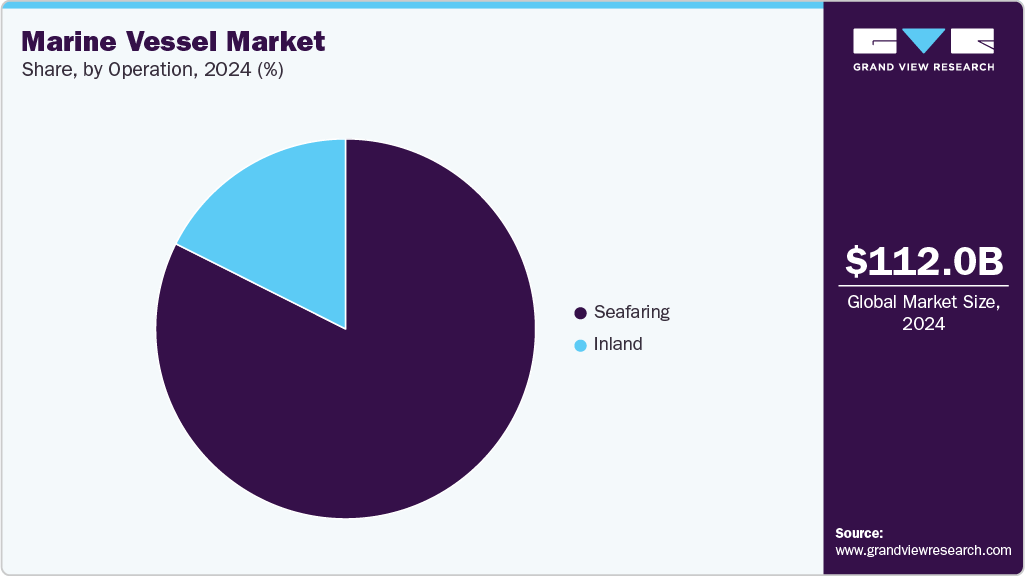
Based on operation, the seafaring segment led the market with the largest revenue share of 81.6% in 2025. Growth in seafaring marine vessels is being driven by the expansion of global maritime trade, increased energy transportation, and growing naval modernization programs. As international shipping continues to handle over 80% of global trade by volume, the demand for large ocean-going vessels, including container ships, tankers, and bulk carriers, remains robust. Rising exports of LNG, crude oil, and raw materials from the U.S., the Middle East, and Africa to Asia and Europe are supporting long-haul maritime transport.
 To learn more about this report, Download Free Sample Report
 The inland segment is projected to grow at the fastest CAGR of 3.9% over the forecast period. Inland marine vessels are experiencing accelerated growth due to government-led infrastructure development, rising adoption of low-emission transport, and regional logistics optimization. Inland waterways are being increasingly utilized as cost-effective and sustainable alternatives to road and rail, especially for bulk commodities and short-haul cargo movement. Significant investments in river port modernization, dredging, and inland navigation corridors, particularly in Asia (India, China), Europe, and Latin America, are enabling smoother, more efficient inland shipping.
Regional Insights
The North America marine vessel market held a significant share in 2025. The growth of the market in the region is driven by the region’s increasing investments in naval modernization and offshore energy infrastructure. The region benefits from a robust shipbuilding industry, advanced defense technologies, and a strong presence of key OEMs and defense contractors.
 To learn more about this report, Download Free Sample Report
 U.S. Marine Vessel Market Trends
The U.S. marine vessel market held a dominant position in 2025 due to the significant defense spending and ongoing fleet renewal initiatives by the U.S. Navy and Coast Guard. The presence of major shipbuilders such as Huntington Ingalls Industries and General Dynamics NASSCO positions the country as a global leader in naval vessel manufacturing.
Europe Marine Vessel Market Trends
The Europe marine vessel industry was identified as a lucrative region in 2025. A focus on sustainability, technological innovation, and naval defense expansion characterizes Europe’s marine vessel market. The region is home to globally renowned shipbuilders such as Fincantieri, Damen Shipyards, and Naval Group, which are driving advancements in electric propulsion, smart vessels, and modular ship designs.
The UK marine vessel market is expected to grow rapidly in the coming years. Defense modernization programs and a growing emphasis on sustainable maritime technologies shape the market in the country. The Royal Navy’s fleet expansion and investments in next-generation frigates and autonomous vessels support demand for advanced naval shipbuilding.
The Germany marine vessel industry held a substantial market share in 2025. The country’s expertise in engineering and precision manufacturing has supported the development of technologically advanced vessels, including submarines, corvettes, and research ships. Companies such as Thyssenkrupp Marine Systems are heavily engaged in both domestic and international defense contracts.
Asia Pacific Marine Vessel Market Trends
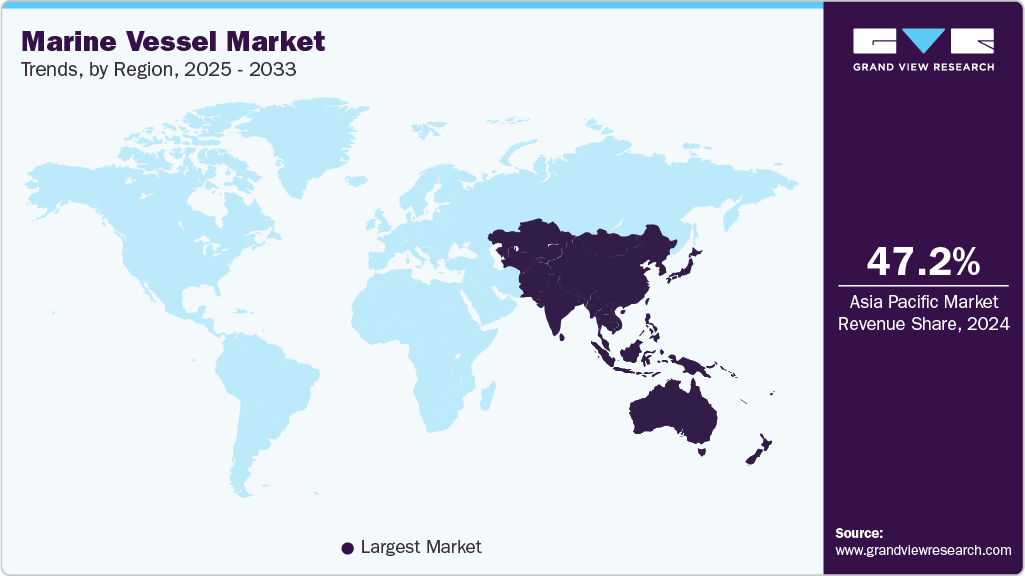
Asia Pacific dominated the global marine vessel market with the largest revenue share of 47.5% in 2025. The region is witnessing significant demand for both commercial and military vessels due to economic growth, defense modernization, and expanding offshore energy activities. Governments in the region are also investing heavily in green shipbuilding technologies and smart vessel integration.
The Japan marine vessel industry is expected to grow rapidly in the coming years due to its long-standing shipbuilding tradition and technological expertise. The country’s shipyards are focusing on building high-value vessels, including LNG carriers, advanced cargo ships, and autonomous vessels.
The marine vessel market in the China held the largest share in the Asia Pacific region in 2025. The country is rapidly expanding its naval fleet while also dominating commercial vessel exports such as bulk carriers, tankers, and container ships. State-owned enterprises such as CSSC and CSIC are investing in green propulsion, smart shipping, and autonomous vessel technologies. China’s strategic maritime policies and its Belt and Road initiative continue to drive shipbuilding growth both regionally and globally.
Key Marine Vessel Company Insights
Some of the key companies in the marine vessel market include HD Hyundai Heavy Industries Co., Ltd., Hanwha Ocean co., Ltd., Samsung Heavy Industries Co., Ltd, FINCANTIERI S.p.A., and others. Organizations are focusing on increasing customer base to gain a competitive edge in the industry. Therefore, key players are taking several strategic initiatives, such as mergers and acquisitions, and partnerships with other major companies.
-
HD Hyundai Heavy Industries Co., Ltd. (HHI), is a shipbuilding company and a manufacturer of heavy equipment. The company operates four core divisions: Shipbuilding, Offshore & Engineering, Industrial Plant & Engineering, and Engine & Machinery, and oversees several subsidiaries, including Hyundai Electric & Energy Systems, Hyundai Construction Equipment, and Hyundai Robotics. It builds a wide range of vessels such as containerships, tankers, bulk carriers, naval ships, LNG carriers, and offshore platforms, serving clients worldwide across the Americas, Europe, Asia, the Middle East, and Africa.
-
Hanwha Ocean Co., Ltd., formerly known as Daewoo Shipbuilding & Marine Engineering (DSME), is a shipbuilding and offshore company headquartered near the Port of Okpo in Geoje, South Korea. It specializes in a wide range of vessels, including commercial ships such as liquefied natural gas carriers (LNGCs), very large crude carriers (VLCCs), container ships, offshore platforms, drillships, and specialty ships such as submarines and destroyers. The company also provides icebreaking research ships and submarines equipped with air-independent propulsion (AIP) and lithium-ion batteries, enhancing underwater endurance and operational capability.
Key Marine Vessel Companies:
The following key companies have been profiled for this study on the marine vessel market.
-
HD Hyundai Heavy Industries Co., Ltd.
-
Hanwha Ocean co., Ltd.
-
Samsung Heavy Industries Co., Ltd
-
FINCANTIERI S.p.A.
-
MITSUBISHI HEAVY INDUSTRIES, LTD.
-
Oshima Shipbuilding co., Ltd.
-
General Dynamics NASSCO
-
Rolls-Royce plc
-
Kongsberg Maritime
-
Damen Shipyards Group
Competitive Benchmarking
Category
Operating Strategies
Competitive Edge
Weakness
Established Players (HD Hyundai Heavy Industries Co., Ltd.; Hanwha Ocean Co., Ltd.; Samsung Heavy Industries Co., Ltd.; FINCANTIERI S.p.A.)
- These players are focused on large-scale commercial and naval vessel construction, global order expansion, investment in LNG and alternative-fuel vessels, digital shipbuilding technologies, and long-term government and commercial contracts.
- These players have extensive shipbuilding capacity, diversified vessel portfolio, strong global customer base, advanced engineering expertise, and established international supply chains.
- High dependence on global shipping cycles, significant capital expenditure requirements, and exposure to raw material price fluctuations.
Emerging Players (Oshima Shipbuilding Co., Ltd.; General Dynamics NASSCO; Damen Shipyards Group)
- These players are focused on specialized vessel segments, regional expansion, customized vessel solutions, niche commercial markets, and modernization projects.
- These players have strong expertise in specialized vessel construction, flexible manufacturing capabilities, and growing presence in selected regional markets.
- Smaller global market presence, comparatively limited production capacity, and lower portfolio diversification than leading multinational shipbuilders.
Recent Developments
-
In July 2025, Cochin Shipyard Limited (CSL), India's largest state-owned shipbuilder, has entered into a strategic Memorandum of Understanding (MoU) with South Korea's HD Hyundai through its shipbuilding arm, HD Korea Shipbuilding & Offshore Engineering Co. Ltd. (HD KSOE). The collaboration is aimed at strengthening India's shipbuilding capabilities and expanding its footprint in the global maritime industry. The partnership is aligned with national initiatives such as the 'Maritime Amrit Kaal Vision 2047' and 'Maritime India Vision 2030', with a focus on fostering growth, innovation, and self-reliance in the Indian maritime sector. Key areas of cooperation include the joint pursuit of shipbuilding opportunities both in India and abroad, the transfer of advanced Korean shipbuilding technologies, productivity enhancement, and workforce skill development.
-
In June 2025, Eureka Naval Craft, a U.S.-based defense company, collaborated with Australian marine technology firm Greenroom Robotics to develop next-generation autonomous naval vessels. Their collaboration has led to the launch of the AIRCAT Bengal, a 36-meter, multi-mission Surface Effect Ship (SES) engineered for fully autonomous operations. The partnership aims to transform the naval sector by delivering vessels that are faster, more cost-efficient, and simpler to construct than conventional ships.
Marine Vessel Market Report Scope
Report Attribute
Details
Market size in 2025
USD 113.5 billion
Estimated market size in 2026
USD 115.2 billion
Projected market size by 2033
USD 150.4 billion
Growth rate
CAGR of 3.9% from 2026 to 2033
Base year for estimation
2025
Historical data
2021 - 2024
Forecast period
2026 - 2033
Quantitative units
Revenue in USD billion and CAGR from 2026 to 2033
Report coverage
Revenue forecast, company market share, competitive landscape, growth factors, and trends
Segments covered
Ship Type, Deadweight Tonnage, Operation, region
Regional scope
North America; Europe; Asia Pacific; Latin America; MEA
Country scope
U.S.; Canada; Mexico; Germany; U.K.; France; China; Japan; India; South Korea; Australia; Brazil; Saudi Arabia; UAE; and South Africa
Key companies profiled
HD Hyundai Heavy Industries Co., Ltd.; Hanwha Ocean co., Ltd.; Samsung Heavy Industries Co., Ltd; FINCANTIERI S.p.A.; MITSUBISHI HEAVY INDUSTRIES, LTD.; Oshima Shipbuilding co., Ltd.; General Dynamics NASSCO; Rolls-Royce plc; Kongsberg Maritime; Damen Shipyards Group
Customization scope
Free report customization (equivalent up to 8 analysts' working days) with purchase. Addition or alteration to country, regional & segment scope.
Pricing and purchase options
Avail customized purchase options to meet your exact research needs. Explore purchase options
Global Marine Vessel Market Segmentation
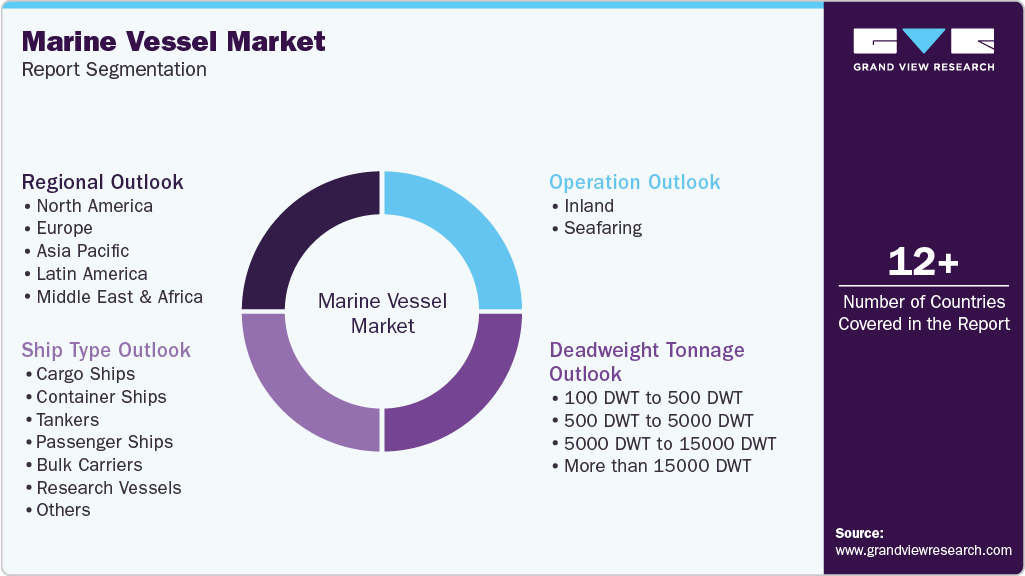
This report forecasts revenue growth at global, regional, and country levels and provides an analysis of the latest industry trends in each of the sub-segments from 2021 to 2033. For this study, Grand View Research has segmented the global marine vessel market report based on ship type, deadweight tonnage, operation, and region.
 To learn more about this report, Download Free Sample Report
 -
Ship Type Outlook (Revenue, USD Billion, 2021 - 2033)
-
Cargo Ships
-
Container Ships
-
Tankers
-
Passenger Ships
-
Bulk Carriers
-
Research Vessels
-
Others
-
-
Deadweight Tonnage Outlook (Revenue, USD Billion, 2021 - 2033)
-
100 DWT to 500 DWT
-
500 DWT to 5000 DWT
-
5000 DWT to 15000 DWT
-
More than 15000 DWT
-
-
Operation Outlook (Revenue, USD Billion, 2021 - 2033)
-
Inland
-
Seafaring
-
-
Regional Outlook (Revenue, USD Billion, 2021 - 2033)
-
North America
-
U.S.
-
Canada
-
Mexico
-
-
Europe
-
Germany
-
UK
-
France
-
-
Asia Pacific
-
China
-
Japan
-
India
-
South Korea
-
Australia
-
-
Latin America
-
Brazil
-
-
Middle East and Africa (MEA)
-
KSA
-
UAE
-
South Africa
-
-
Research Methodology
The marine vessel market figures in this report are based on a proven research process that combines executive interviews with secondary research from proprietary databases, company filings, and recognized regulatory and institutional sources. Market size is built through value-chain sizing - reconciling supply-side and demand-side estimates - and triangulated with bottom-up and top-down approaches. Every estimate passes multiple levels of expert validation before publication, with each marine vessel segment quantified using the revenue-capture definitions in the table below.
Segment Definition
Segment - Ship Type
Revenue capture definition
Cargo Ships
Revenue generated from the sale and delivery of newly built general cargo vessels designed for transporting packaged goods, breakbulk cargo, and mixed freight.
Container Ships
Revenue generated from the sale and delivery of newly built container vessels designed for transporting standardized shipping containers across domestic and international trade routes.
Tankers
Revenue generated from the sale and delivery of newly built tankers designed for transporting crude oil, refined petroleum products, LNG, LPG, chemicals, and other liquid bulk cargo.
Passenger Ships
Revenue generated from the sale and delivery of newly built passenger vessels, including cruise ships, ferries, and other ships designed for transporting passengers.
Bulk Carriers
Revenue generated from the sale and delivery of newly built bulk carriers designed for transporting dry bulk commodities such as coal, iron ore, grain, cement, and other minerals.
Research Vessels
Revenue generated from the sale and delivery of newly built research vessels designed for scientific research, oceanographic surveys, hydrographic studies, environmental monitoring, and marine exploration.
Others
Revenue generated from the sale and delivery of newly built specialized marine vessels, including offshore support vessels, tugboats, dredgers, fishing vessels, patrol boats, naval support ships, and other purpose-built vessels not covered under the above categories.
Segment - Deadweight Tonnage
Revenue capture definition
100 DWT to 500 DWT
Small-capacity vessels are primarily used for coastal transport, harbor operations, inland waterways, fishing, patrol, and local logistics services.
500 DWT to 5000 DWT
Medium-sized vessels are commonly deployed for regional cargo transport, offshore support operations, passenger ferries, and coastal shipping activities.
5000 DWT to 15000 DWT
Large commercial vessels are used for international cargo movement, bulk transportation, container shipping, and specialized industrial applications.
More than 15000 DWT
High-capacity ocean-going vessels, including large container ships, bulk carriers, crude oil tankers, LNG carriers, and other long-distance commercial vessels.
Segment - Operation
Revenue capture definition
Inland
Marine vessels operate within rivers, lakes, canals, reservoirs, and inland waterways for cargo transportation, passenger movement, and industrial operations.
Seafaring
Marine vessels operate across coastal waters and international oceans for commercial shipping, offshore activities, naval operations, and long-distance passenger transportation.
Estimation Model
Layer Name
Key Question
Description
Global Maritime Demand Assessment
What is the overall demand for marine vessels across commercial and government sectors?
This layer evaluates worldwide demand based on international trade volumes, fleet replacement cycles, naval procurement programs, offshore energy activities, and passenger transportation. It identifies macroeconomic and regulatory factors influencing vessel procurement. The assessment establishes the overall addressable market for marine vessel manufacturers.
Vessel Type Demand Analysis
Which vessel categories contribute the highest market revenue?
This layer analyzes demand across cargo ships, container ships, tankers, passenger ships, bulk carriers, research vessels, and specialized vessels. It evaluates fleet expansion trends, replacement demand, and utilization rates across each ship type. The analysis determines segment-level revenue contribution and growth potential.
Technology and Propulsion Evaluation
Which technologies are driving new vessel investments?
This layer assesses adoption of advanced propulsion systems, alternative fuels, vessel automation, digital navigation, energy management, and smart ship technologies. It evaluates regulatory compliance requirements and investment trends supporting technological upgrades. The findings identify areas of increasing capital expenditure within the marine vessel market.
Global Maritime Demand Assessment
What is the overall demand for marine vessels across commercial and government sectors?
This layer evaluates worldwide demand based on international trade volumes, fleet replacement cycles, naval procurement programs, offshore energy activities, and passenger transportation. It identifies macroeconomic and regulatory factors influencing vessel procurement. The assessment establishes the overall addressable market for marine vessel manufacturers.
Delivered Customizations
This report has been delivered with the following In-depth customizations
Client Request
Customization Delivered
Value Adds
Regional Marine Vessel Market Opportunity Assessment
Country/region-wise market sizing and forecasts
Analysis of demand, adoption trends, and regulatory landscape
Identification of high-growth regions and investment hotspots
Identified region-specific growth opportunities
Supported expansion and go-to-market strategy
Enabled informed regional investment decisions
Cross-Segmentation Analysis for the Marine Vessel Market
Criss-cross market analysis by Ship type, deadweight tonnage, and operation
Demand and adoption assessment across key segments
Segment attractiveness and growth potential benchmarking
Identified high-potential market segments
Supported targeted product positioning and marketing strategy
Improved customer and segment prioritization
Competitive Benchmarking and Strategic Positioning in the Marine Vessel Market
Benchmarking of key competitors across products, pricing, partnerships, and innovation
Comparative assessment of market share, capabilities, and strategies
Analysis of competitive strengths, gaps, and differentiation areas
Identified competitive white spaces and growth gaps
Supported strategic positioning and differentiation
Enabled data-driven competitive strategy development
Frequently Asked Questions About This Report
The global marine vessel market size was estimated at USD 112.02 billion in 2024 and is expected to reach USD 113.47 billion in 2025.
The global marine vessel market is expected to grow at a compound annual growth rate of 3.6% from 2025 to 2033 to reach USD 150.45 billion by 2033.
Asia Pacific dominated the marine vessel market with a share of 47.2% in 2024. The region is witnessing significant demand for both commercial and military vessels due to economic growth, defense modernization, and expanding offshore energy activities.
Some key players operating in the marine vessel market include HD Hyundai Heavy Industries Co., Ltd.; Hanwha Ocean co., Ltd.; Samsung Heavy Industries Co., Ltd; FINCANTIERI S.p.A.; MITSUBISHI HEAVY INDUSTRIES, LTD.; Oshima Shipbuilding co., Ltd.; General Dynamics NASSCO; Rolls-Royce plc; Kongsberg Maritime; Damen Shipyards Group.
The naval vessel market is being driven by a combination of rising geopolitical tensions, maritime security concerns, and fleet modernization programs.
About the Author(s)
Automotive & Transportation Research Team
Technology · Automotive & TransportationThis report was authored by the automotive & transportation research team at Grand View Research - comprising two research analysts, one senior research analyst, and one industry expert - with specialized expertise in the automotive & transportation segment of the technology industry. All findings are based on proprietary technology databases, executive interviews, and regulatory analysis, subject to internal peer review prior to publication.
Last Updated:
Speak to Analyst

Customize this report to your needs - add regions, segments, or data points, with 20% free customization.
Or view our licence options:


ISO 9001:2015 & 27001:2022 Certified
We are GDPR and CCPA compliant! Your transaction & personal information is safe and secure. For more details, please read our privacy policy.


