
- Home
- »
- Network Security
- »
-
Maritime Security Market Size, Share & Growth Report, 2033GVR Report cover
![Maritime Security Market (2026 - 2033)Report]()
Maritime Security Market (2026 - 2033)
Size, Share & Trends Analysis Report By Offering (Hardware, Software, Services), By Security Type , By Solution Type (Physical Security, Cybersecurity), By Port Type (Container Ports, Dry Bulk Ports), By End User, By Region, And Segment Forecasts
Market Size, 2025
$32.6BMarket Estimate, 2026
$35.5BMarket Forecast, 2033
$73.6BCAGR, 2026–2033
11.0%Maritime Security Market Summary
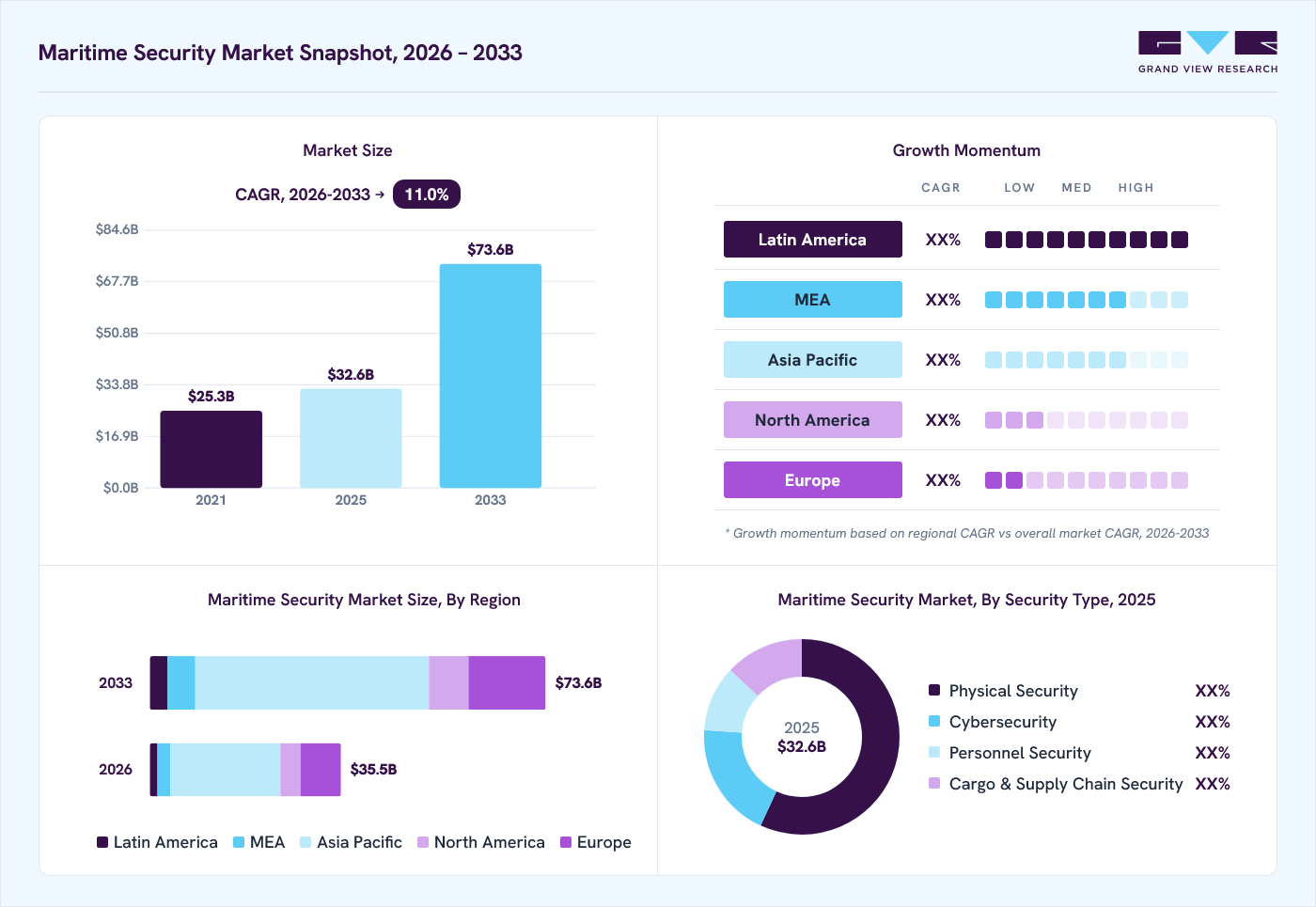
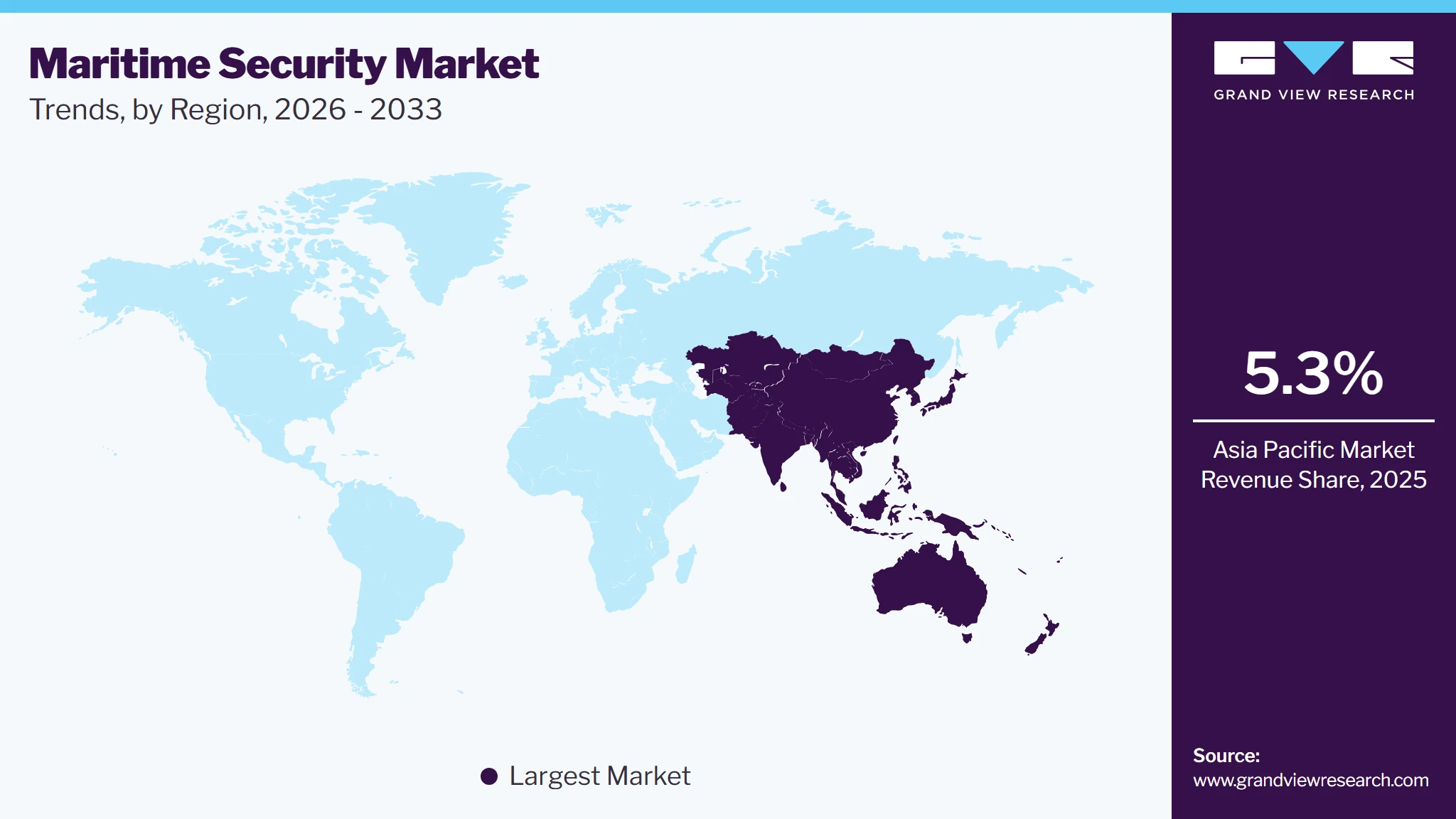
The global maritime security market size was valued at USD 32.6 billion in 2025 and is projected to grow from USD 35.5 billion in 2026 to USD 73.6 billion by 2033, at a CAGR of 11.0% from 2026 to 2033. Asia Pacific dominated the global market, accounting for the largest revenue share of 57.3% in 2025. The global maritime security market is undergoing a significant transformation as geopolitical tensions, piracy, maritime crime, and threats to critical shipping routes increase the need for continuous vessel, port, and coastal protection.
Key Market Trends & Insights
- By Offering: The hardware segment dominated the market, with a revenue share of 62.4% in 2025
- By Security Type: The physical security dominated the market, with a revenue share of 56.9% in 2025
- By Solution Type: The surveillance segment held the largest market share in 2025
- By Port Type: The container ports segment held the largest market share in 2025
- By End User: The shipping companies segment held the largest market share in 2025
Regional Highlights
- Largest regional market: Asia Pacific (57.3% revenue share, 2025)
- By country: China held the largest market share in 2025
Market Size & Forecasts
- Market size in 2025: USD 32.6 billion
- Estimated market size in 2026: USD 35.5 billion
- Projected market size by 2033: USD 73.6 billion
- CAGR (2026-2033): 11.0%
Security investments are increasingly shifting from standalone systems toward integrated solutions that combine surveillance, threat detection, access control, and command-and-control capabilities. Digitalization of vessels and ports is emerging as a major market-shaping trend, with greater connectivity, cloud adoption, automated terminal systems, and IT/OT integration creating new cyberattack surfaces. The U.S. Coast Guard's 2025 CTIME findings highlighted the continued blurring of IT and OT environments and reported that maritime cyber incidents increased in 2025, reinforcing demand for integrated physical and cybersecurity solutions.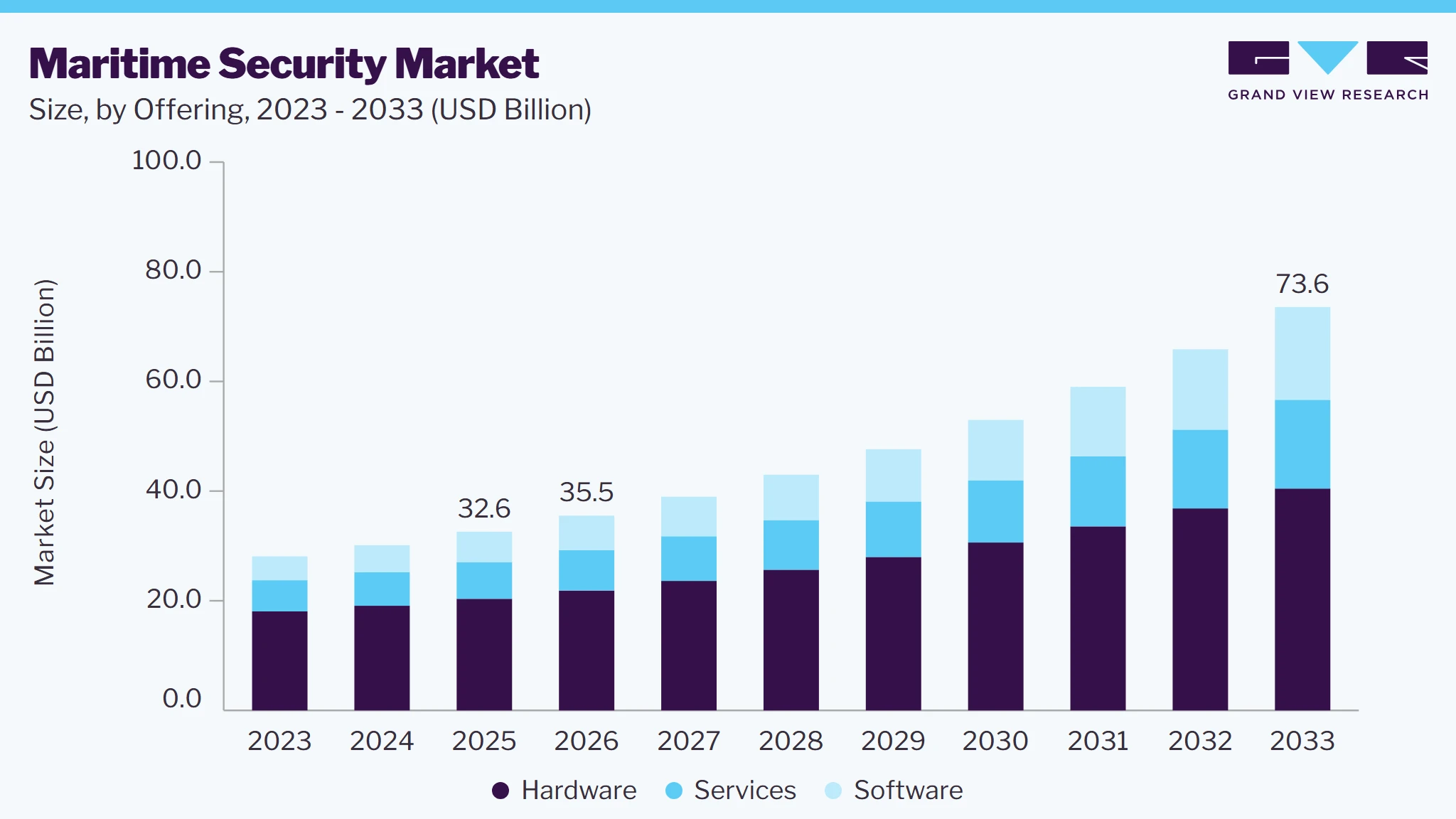
Regulatory requirements are further strengthening demand for maritime cybersecurity and compliance services. For instance, the U.S. Coast Guard's cybersecurity requirements for U.S.-flagged vessels, regulated facilities, and offshore facilities became effective in July 2025, requiring measures such as cybersecurity plans, designated cybersecurity officers, assessments, and incident reporting.
Meanwhile, AI-enabled surveillance, advanced analytics, sensor fusion, satellite connectivity, and unmanned systems are gaining importance for improving maritime domain awareness and enabling faster threat identification and response. The growing adoption of AI-driven cyber defenses and the convergence of physical and cyber security are expected to create opportunities for technology providers, while increasing demand for managed security, risk assessment, maintenance, and compliance services.
Market Dynamics
The maritime security market is being shaped by rising geopolitical tensions, piracy, maritime crime, and growing threats to critical shipping routes and port infrastructure. At the same time, increasing digitalization of vessels and ports is expanding the attack surface across IT, OT, vessel-to-shore communications, and Maritime Single Window systems. The IMO approved its Strategy on Maritime Digitalization in March 2026 and also advanced mandatory cybersecurity measures for Maritime Single Windows, indicating a stronger regulatory push toward resilient and cybersecure maritime operations.
Technology adoption is simultaneously shifting the market toward integrated, intelligence-led security architectures. AI-enabled surveillance, sensor fusion, satellite-based monitoring, UAVs, automated threat detection, and command-and-control platforms are increasingly being used to improve maritime situational awareness and response capabilities. The IMO's adoption of the first global Maritime Autonomous Surface Ships (MASS) Code in May 2026, with explicit emphasis on cybersecurity and remote operations, is also creating new security requirements for autonomous and remotely operated vessels.
Escalating geopolitical conflicts, piracy, armed robbery, terrorism, and attacks on commercial vessels are increasing the need for continuous protection of ships, ports, offshore assets, and strategic waterways. Recent incidents in the Red Sea and Gulf of Aden demonstrate that maritime threats remain active, with the IMO reporting 24 attempted or actual piracy and armed-robbery incidents in these waters over a recent three-month period. This environment encourages shipping companies, port operators, and governments to increase spending on radar, AIS, surveillance cameras, threat detection, anti-piracy systems, maritime domain awareness, and command-and-control platforms.
Maritime security deployments often require the integration of multiple technologies, including radar, AIS, surveillance cameras, communications, access control, cybersecurity, sensors, and command-and-control platforms. The high upfront cost of equipment, installation, system integration, maintenance, and skilled personnel can constrain adoption, particularly among smaller ports and shipping operators. Integration with legacy vessel and port infrastructure can further increase deployment complexity and create interoperability challenges, extending implementation timelines and raising total ownership costs.
The increasing adoption of AI-enabled surveillance, sensor fusion, autonomous vessels, remote operations, and advanced analytics is creating opportunities for more proactive and automated maritime security. AI can help operators identify anomalous vessel behavior, detect unauthorized access, analyze video and sensor feeds, and prioritize potential threats in real time. In May 2026, the IMO adopted its first global Maritime Autonomous Surface Ships (MASS) Code, which places specific emphasis on risk assessment, connectivity, remote operations, cybersecurity, and Remote Operations Centres. This regulatory development is expected to create additional demand for cybersecurity, monitoring, threat detection, and secure remote-operation solutions as autonomous and remotely operated vessels become more prevalent.
Market Concentration & Characteristics
The global maritime security market is moderately concentrated, with participation from established defense and security companies, maritime technology providers, surveillance specialists, and naval systems integrators. Leading players such as Thales, Leonardo, Saab, BAE Systems, Kongsberg, Lockheed Martin, Northrop Grumman, L3Harris Technologies, Airbus, and HENSOLDT are strengthening their presence through maritime surveillance, radar, AIS, command and control, secure communications, maritime domain awareness, and integrated port and vessel security solutions. Specialized providers are also expanding into AI-enabled surveillance, anti-piracy, maritime cybersecurity, autonomous systems, and port security.
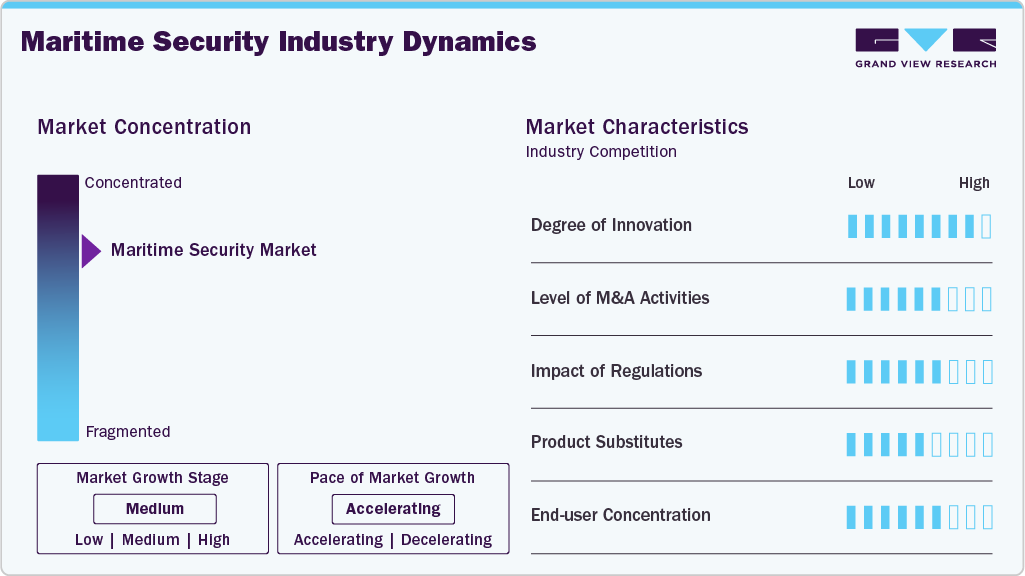
The market is witnessing increasing technological development focused on real-time monitoring, automated threat detection, interoperability, and faster security response. Vendors are integrating radar, AIS, cameras, satellite data, sensors, and AI analytics into unified platforms, while growing digitalization is driving convergence between physical security and maritime cybersecurity. Adoption of AI-powered analytics, sensor fusion, unmanned systems, autonomous vessels, and cloud/edge-based monitoring, alongside evolving cybersecurity regulations, is further shaping competitive strategies and encouraging integrated maritime security architectures.
Analyst Perspective
The maritime security market is transitioning from standalone surveillance and protection systems toward integrated, intelligence-driven security architectures that combine radar, AIS, cameras, sensors, communications, cybersecurity, and command-and-control capabilities. Rising geopolitical tensions, piracy, maritime crime, port digitalization, and growing protection requirements for critical maritime and underwater infrastructure are sustaining investments across commercial and defense applications. At the same time, AI-enabled analytics, autonomous and unmanned maritime systems, sensor fusion, and real-time maritime domain awareness are emerging as key areas of technological differentiation. Established defense and maritime technology providers are leveraging broad portfolios, government relationships, and global installed bases, while specialized and emerging players are gaining opportunities through autonomous surveillance, AI-based threat detection, and underwater security solutions.
Offering Insights
The hardware segment accounts for the largest share of 62.4% in 2025 in the maritime security market, driven by the continued deployment of radar systems, AIS, surveillance cameras, sensors, secure communications equipment, and other physical security infrastructure across vessels, ports, and naval facilities. In addition, growing investments in naval fleet modernization and mission-system upgrades are supporting demand for advanced maritime security hardware, particularly systems capable of improving situational awareness, threat response, and operational readiness. For instance, in August 2026, the U.S. Navy identified industry performers for its MH-60 TALON prototype project to modernize avionics and mission-system architecture, address equipment obsolescence, and enable the fleet to respond rapidly to emerging threats through open-system designs and digital engineering. Such modernization initiatives are expected to sustain demand for advanced hardware and integrated maritime security technologies across naval and defense applications.
The software segment is expected to witness significant CAGR from 2026 to 2033 in the maritime security market due to the increasing adoption of AI-enabled surveillance, maritime domain awareness platforms, predictive analytics, automated threat detection, and integrated command-and-control systems. Growing digitalization of vessels and ports is also driving demand for software that can integrate data from radar, AIS, cameras, satellites, and other sensors to enable real-time monitoring, anomaly detection, and faster security response.
Security Type Insights
The physical security segment accounts for the largest share by security type in 2025 in the maritime security market, driven by the increasing need to protect vessels, ports, terminals, offshore facilities, and other critical maritime infrastructure against unauthorized access, piracy, theft, terrorism, sabotage, and maritime crime. Growing deployment of surveillance cameras, radar, access-control systems, screening equipment, perimeter security, and intrusion detection technologies is further supporting segment growth, particularly as governments and maritime operators strengthen security across strategically important ports and shipping routes.
The cargo & supply chain security segment is predicted to register the fastest CAGR during the upcoming years in the maritime security market, driven by the rapid growth of global maritime trade, increasing movement of high-value and sensitive cargo, and rising risks of cargo theft, smuggling, tampering, and supply-chain disruptions. Increasing digitalization of logistics and port operations is also encouraging the adoption of real-time cargo tracking, automated screening, IoT-enabled monitoring, electronic seals, AI-based anomaly detection, and integrated supply-chain visibility platforms, enabling operators to improve cargo integrity and detect security threats across increasingly complex maritime supply chains.
Solution Type Insights
The surveillance segment dominated the maritime security market by solution type in 2025 due to the growing need for continuous monitoring and real-time situational awareness across vessels, ports, coastal areas, and offshore infrastructure. Increasing deployment of radar, AIS, surveillance cameras, satellite monitoring, unmanned systems, and AI-enabled video analytics is enabling maritime operators and authorities to detect unauthorized vessels, suspicious activities, intrusion attempts, and other potential threats more rapidly, thereby strengthening maritime domain awareness and overall security.
The command & control segment is projected to witness notable growth during the forecast period in the maritime security market due to the increasing need to integrate data from radar, AIS, surveillance cameras, satellite systems, sensors, and threat-detection platforms into centralized security environments. Growing adoption of AI-enabled analytics, real-time maritime domain awareness, and automated decision-support capabilities is enabling port authorities, shipping companies, and government agencies to improve situational awareness, coordinate security responses, and accelerate threat identification, thereby driving demand for advanced command & control solutions.
Port Type Insights
The container ports segment held the largest revenue share by port type in 2025 in the maritime security market, driven by the high volume and value of containerized trade, increasing port automation, and the need to protect critical cargo-handling infrastructure from theft, smuggling, unauthorized access, terrorism, and cyber threats. Growing deployment of AI-enabled surveillance, access-control systems, cargo screening, vessel tracking, and integrated command-and-control platforms across container terminals is further strengthening security investments as ports transition toward smart and digitally connected operations.
The liquid bulk ports segment is expected to grow at a significant CAGR from 2026 to 2033 in the maritime security market due to increasing investments in the protection of oil, LNG, LPG, chemical, and other hazardous liquid cargo terminals, which require stringent surveillance, access control, threat detection, and emergency-response capabilities. Rising geopolitical risks around strategic energy routes, expansion of offshore energy infrastructure, and growing adoption of automated monitoring and security systems are further driving demand for advanced maritime security solutions across liquid bulk port facilities.
End User Insights
The shipping companies segment accounted for the largest share by end user in 2025 in the maritime security market, driven by the increasing need to protect commercial vessels, crews, cargo, and onboard operational systems from piracy, armed attacks, smuggling, theft, and growing cyber threats. Rising geopolitical tensions and disruptions along strategic shipping routes are further encouraging shipping companies to invest in vessel surveillance, AIS, anti-piracy systems, access control, maritime cybersecurity, and real-time threat monitoring, strengthening their focus on comprehensive security solutions.
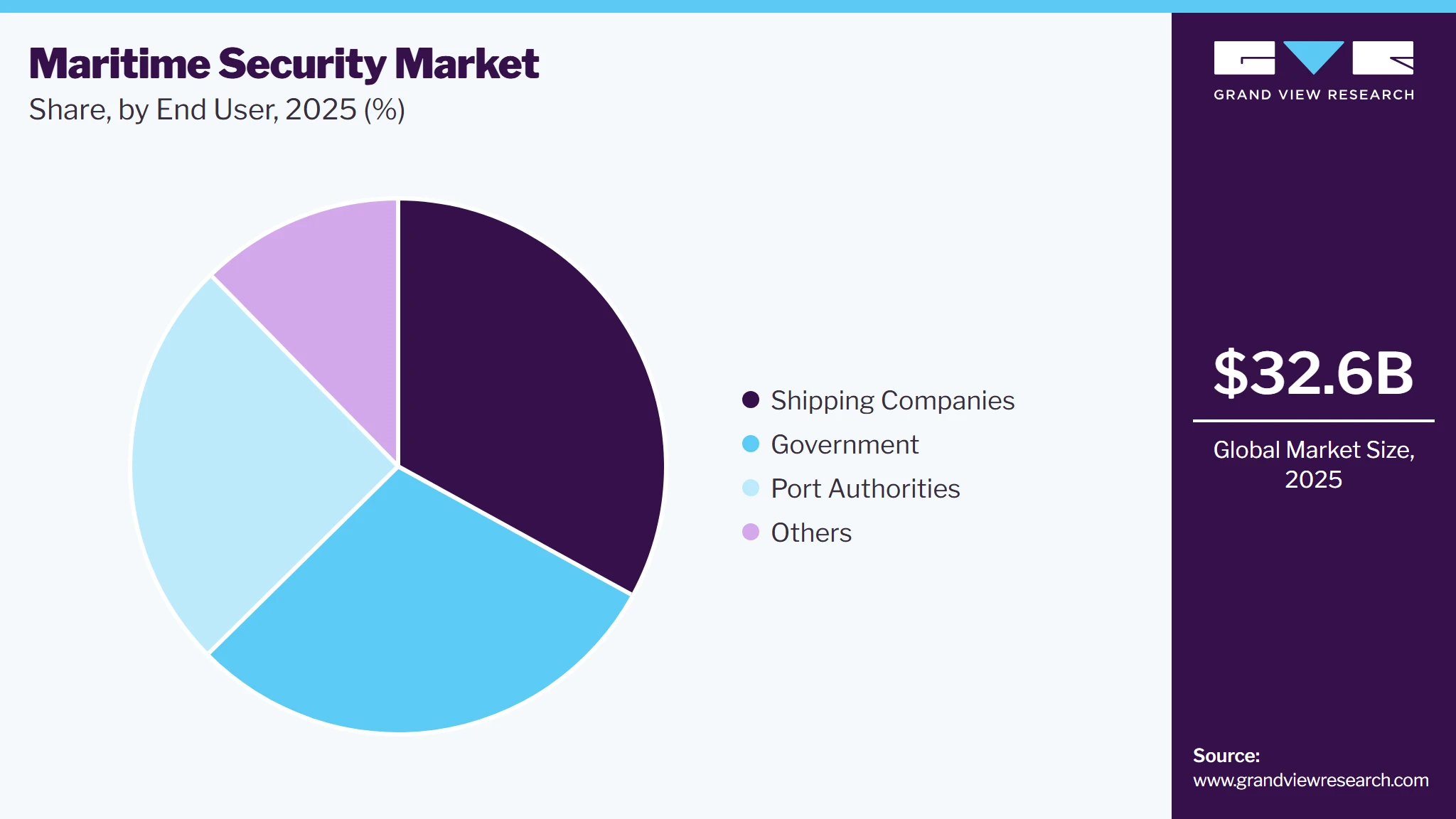
The port authorities segment is expected to grow at a significant CAGR in the maritime security market, driven by increasing investments in port modernization, automated terminal infrastructure, cargo and passenger screening, perimeter surveillance, access control, and integrated command-and-control systems. Rising cyber and physical security threats targeting digitally connected port operations are further encouraging authorities to strengthen security infrastructure, improve maritime domain awareness, and adopt AI-enabled monitoring and threat detection technologies.
Regional Insights
North America’s maritime security market is increasingly shaped by maritime cybersecurity, Arctic surveillance, integrated maritime domain awareness, and protection of critical maritime infrastructure. In the U.S., new cybersecurity requirements for vessels, regulated facilities, and offshore facilities are strengthening demand for cybersecurity planning, monitoring, and incident response, while growing IT/OT connectivity is encouraging convergence between physical and cyber security. In Canada, maritime-security investments are increasingly focused on long-range marine radar, aerial and surface drones, advanced sensors, and integrated operations centers, particularly across Arctic and northern waters. For instance, in May 2026, the Canadian government announced an $816 million investment to strengthen maritime security through a Maritime Domain Awareness Hub, long-range radar sites, and aerial, surface, and subsurface drones. These developments are accelerating adoption of AI-enabled surveillance, sensor fusion, unmanned systems, real-time threat detection, and integrated command-and-control platforms across the region.
The Maritime Security industry in the U.S. is expected to grow significantly from 2026 to 2033, driven by the increasing investments in maritime border security, fleet modernization, maritime domain awareness, and protection of critical ports and waterways. The U.S. Coast Guard received nearly $25 billion in 2025 for modernization, including investments in new cutters, aircraft, shore infrastructure, maritime surveillance systems, unmanned aircraft, and next-generation maritime domain awareness capabilities. In parallel, rising cyber risks across the Marine Transportation System are accelerating demand for integrated physical and cybersecurity solutions, with the Coast Guard reporting growing adoption of AI-driven cyber defenses and increasing convergence between physical and cyber threats. These investments are expected to strengthen demand for advanced surveillance, threat detection, command-and-control, cybersecurity, and unmanned maritime security technologies throughout the forecast period.
Asia Pacific Maritime Security Trends
The Asia Pacific region is expected to grow at the fastest CAGR during the forecast period in the maritime security market, driven by rising geopolitical tensions, expanding maritime trade, increasing naval modernization, and growing investments in coastal and port security across major economies. Rising activity around strategic waterways such as the South China Sea, Strait of Malacca, and Indian Ocean is encouraging governments and maritime operators to strengthen maritime domain awareness, surveillance, vessel tracking, and anti-piracy capabilities. In addition, rapid port digitalization, adoption of AI-enabled surveillance, unmanned systems, and maritime cybersecurity solutions, coupled with increasing protection requirements for critical offshore and port infrastructure, is expected to accelerate regional market growth.
The China maritime security market held a significant share in 2025, owing to the country’s extensive coastline and maritime trade activity, continued naval and coast guard modernization, and increasing investments in maritime surveillance and protection of critical maritime infrastructure. China’s growing focus on safeguarding strategic sea lanes and critical maritime infrastructure is driving demand for advanced radar, AIS, surveillance, threat detection, command-and-control, and maritime domain awareness systems. In addition, the country’s maritime safety system market is expanding rapidly, supported by port infrastructure modernization, regulatory upgrades, and adoption of IoT- and AI-enabled maritime technologies.
The maritime security market in Japan is witnessing strong expansion driven by rising geopolitical tensions in the Indo-Pacific, increasing maritime domain awareness requirements, and continued modernization of Japan’s maritime defense and coast guard capabilities. Japan is strengthening surveillance and security across its surrounding waters while expanding cooperation with regional partners to improve maritime law enforcement and information sharing. Growing adoption of advanced surveillance, persistent ISR, cybersecurity, and integrated command-and-control capabilities is further supporting market demand, as Japan increasingly emphasizes the integration of maritime, cyber, space, and electromagnetic capabilities.
The India maritime security market is experiencing strong growth, driven by increasing investments in coastal and offshore surveillance, naval modernization, maritime domain awareness, and strengthening of indigenous maritime-security capabilities. India’s strategic position in the Indian Ocean Region and growing maritime trade are further increasing the need to protect vessels, ports, offshore assets, and critical sea lanes. For instance, in March 2026, Goa Shipyard Limited delivered ICGS Achal to the Indian Coast Guard and launched INS Shachi under the Navy’s Next Generation Offshore Patrol Vessel program, strengthening coastal surveillance and indigenous maritime capabilities. These developments are expected to accelerate demand for advanced surveillance, threat detection, command-and-control, and other integrated maritime security solutions in India.
Europe Maritime Security Trends
The Europe maritime security industry is growing at a significant CAGR from 2026 to 2033 due to rising geopolitical tensions, increasing hybrid and cyber threats, and growing investments in protecting critical maritime and port infrastructure. The region is also witnessing greater focus on maritime domain awareness, naval modernization, and protection of undersea cables and offshore assets. In March 2026, the European Commission's EU Ports Strategy highlighted the need to reinforce port security against cyberattacks, sabotage, organized crime, hybrid threats, and drone-related risks, while the EU Industrial Maritime Strategy emphasized investments in maritime surveillance, unmanned systems, cybersecurity, and integrated command-and-control capabilities. These initiatives are expected to accelerate adoption of advanced surveillance, threat detection, cybersecurity, and integrated maritime security solutions across Europe.
The maritime security market in the UK is witnessing strong growth due to rising geopolitical tensions, increasing threats to critical maritime and undersea infrastructure, and growing investments in advanced maritime surveillance and defense capabilities. The UK Government has identified maritime security as a strategic priority, with growing emphasis on protecting shipping routes, ports, subsea cables, pipelines, and offshore energy infrastructure. The 2025 Strategic Defence Review further calls for enhanced maritime surveillance and greater use of crewed, uncrewed, and autonomous systems, while the Royal Navy’s Atlantic Bastion initiative is integrating AI-powered acoustic detection and autonomous technologies to strengthen undersea security. These developments are expected to accelerate demand for integrated surveillance, threat detection, command-and-control, cybersecurity, and unmanned maritime security solutions across the UK
Germany Maritime Security market held a significant market share in 2025, supported by Germany’s strategic position in European maritime trade, extensive port infrastructure, naval modernization, and growing investments in maritime surveillance and protection of critical maritime infrastructure. The country’s major ports, including Hamburg and Bremerhaven, handle substantial volumes of international cargo, increasing demand for advanced radar, AIS, surveillance, access control, threat detection, and command-and-control systems. In addition, rising geopolitical tensions in the Baltic and North Sea regions are encouraging Germany to strengthen maritime domain awareness and naval capabilities, while increasing digitalization of ports and vessels is creating additional demand for maritime cybersecurity and integrated security solutions.
Key Maritime Security Company Insights
Some of the key companies operating in the market include BAE Systems, Elbit Systems, HENSOLDT, Indra Sistemas, among others. These companies are some of the leading participants in the maritime security market.
-
In August 2026, Lockheed Martin highlighted its $50 million investment in Saildrone to accelerate unmanned surface-vessel capabilities for U.S. Navy maritime readiness.
-
In July 2026, Saab signed an OCCAR contract to deliver an Interim Mine Neutralisation Solution under the Maritime Mine Counter Measures program, expanding its maritime autonomous and mine-warfare capabilities.
-
In May 2026, Elbit Systems and TKMS signed an MoU to cooperate on the development, integration, and commercialization of advanced naval and defense solutions.
-
In April 2026, HENSOLDT UK secured contracts with SRT Marine Systems for 50 coastal-surveillance radars, strengthening maritime monitoring and situational awareness.
-
In February 2026, L3Harris and Al Seer Marine expanded cooperation on next-generation unmanned surface vessels for defense, security, and government applications across the UAE and GCC.
Key Maritime Security Companies
The following key companies have been profiled for this study on the maritime security market.
-
BAE Systems
-
Elbit Systems
-
HENSOLDT
-
Indra Sistemas
-
Kongsberg Gruppen
-
L3Harris Technologies
-
Leonardo
-
Lockheed Martin
-
Naval Group
-
Northrop Grumman
-
Rheinmetall
-
Saab
-
ST Engineering
-
Thales
-
RTX
Competitive Benchmarking
Operating Strategies
Competitive Edge
Weaknesses
Mature Players: BAE Systems; HENSOLDT; Indra Sistemas; Kongsberg Gruppen; L3Harris Technologies; Leonardo; Lockheed Martin; Northrop Grumman; Rheinmetall; Saab; Thales
- Developing and expanding integrated maritime security portfolios covering maritime surveillance, radar, AIS, command & control, electronic warfare, secure communications, underwater systems, and naval security.
- Increasing investments in AI-enabled surveillance, autonomous maritime systems, unmanned platforms, sensor fusion, and maritime domain awareness to strengthen real-time threat detection and response capabilities.
- Strong global presence, established defense relationships, and extensive installed bases across navies, coast guards, port authorities, and government agencies.
- Ability to integrate multiple maritime technologies including radar, AIS, sensors, surveillance, communications, and command-and-control systems into comprehensive security architectures.
- Large-scale and highly customized maritime security solutions can involve high upfront investment, lengthy procurement cycles, and complex deployment requirements.
- Dependence on government and defense contracts can expose companies to budget cycles, regulatory requirements, geopolitical considerations, and lengthy tender processes.
Emerging Players: Elbit Systems; ST Engineering; Naval Group; Exail; Saildrone; SRT Marine Systems; Ocean Infinity
- Developing specialized solutions around unmanned surface vessels, autonomous underwater systems, maritime surveillance, coastal monitoring, AI-enabled analytics, and underwater security.
- Focusing on emerging requirements such as autonomous maritime operations, seabed infrastructure protection, maritime domain awareness, and persistent surveillance.
- Greater specialization in autonomous, unmanned, AI-enabled, and next-generation maritime technologies enables these companies to address emerging security requirements with greater flexibility.
- Agile development capabilities can enable faster adaptation to requirements related to autonomous vessels, remote operations, sensor fusion, and persistent maritime surveillance.
- Comparatively smaller installed bases and geographic footprints can limit their ability to compete for large, multi-year government and naval programs against established defense contractors.
- Greater dependence on partnerships, pilot programs, and government adoption can increase commercialization and scaling risks.
Maritime Security Market Report Scope
Report Attribute
Details
Market size in 2025
USD 32.6 billion
Estimated market size in 2026
USD 35.5 billion
Projected market size by 2033
USD 73.6 billion
Growth rate
CAGR of 11.0% from 2026 to 2033
Actual data
2021 - 2025
Forecast period
2026 - 2033
Quantitative units
Revenue in USD billion and CAGR from 2026 to 2033
Report coverage
Revenue forecast, company share, competitive landscape, growth factors, and trends
Segments covered
Offering, security type, solution type, port type, end user, region
Regional scope
North America; Europe; Asia Pacific; Latin America; MEA
Country scope
U.S.; Canada; Mexico UK; Germany; France; China; India; Japan; Australia; South Korea; Brazil; UAE; Saudi Arabia; South Africa
Key companies profiled
BAE Systems; Elbit Systems; HENSOLDT; Indra Sistemas; Kongsberg Gruppen; L3Harris Technologies; Leonardo; Lockheed Martin; Naval Group; Northrop Grumman; Rheinmetall; Saab; ST Engineering; Thales; RTX
Customization scope
Free report customization (equivalent to 8 analysts working days) with purchase. Addition or alteration to country, regional & segment scope.
Pricing and purchase options
Avail customized purchase options to meet your exact research needs. Explore purchase options
Global Maritime Security Market Report Segmentation
This report forecasts revenue growth at global, regional, and country levels and provides an analysis of the latest trends in each of the sub-segments from 2021 to 2033. For this study, Grand View Research has segmented the global maritime security market report based on offering, security type, solution type, port type, end user, and region.
-
Offering Outlook (Revenue, USD Billion, 2021 - 2033)
-
Hardware
-
Radar Systems
-
Automatic Identification System (AIS)
-
Long Range Acoustic Devices (LRAD)
-
Antenna
-
Surveillance Cameras
-
X-ray Scanners
-
Others
-
-
Software
-
Services
-
Security Consulting & Risk Assessment
-
Security Training & Certification
-
Managed Security Services
-
Maintenance & Support
-
Emergency Response Services
-
Security Auditing & Compliance Services
-
-
-
Security Type Outlook (Revenue, USD Billion, 2021 - 2033)
-
Physical Security
-
Cybersecurity
-
Personnel Security
-
Cargo & Supply Chain Security
-
-
Solution Type Outlook (Revenue, USD Billion, 2021 - 2033)
-
Surveillance
-
Access Control
-
Threat Detection
-
Anti-Piracy
-
Command & Control
-
Others
-
-
Port Type Outlook (Revenue, USD Billion, 2021 - 2033)
-
Container Ports
-
Dry Bulk Ports
-
Liquid Bulk Ports
-
Passenger & Cruise Ports
-
Naval & Defense Ports
-
-
End User Outlook (Revenue, USD Billion, 2021 - 2033)
-
Shipping Companies
-
Government
-
Port Authorities
-
Others
-
-
Regional Outlook (Revenue, USD Billion, 2021 - 2033)
-
North America
-
U.S.
-
Canada
-
Mexico
-
-
Europe
-
Germany
-
UK
-
France
-
-
Asia Pacific
-
China
-
India
-
Japan
-
South Korea
-
Australia
-
Southeast Asia
-
-
Latin America
-
Brazil
-
-
Middle East & Africa
-
UAE
-
Saudi Arabia
-
South Africa
-
-
Research Methodology
The maritime security market figures in this report are based on a proven research process that combines executive interviews with secondary research from proprietary databases, company filings, and recognized regulatory and institutional sources. Market size is built through value-chain sizing-reconciling supply-side and demand-side estimates-and triangulated with bottom-up and top-down approaches. Every estimate passes multiple levels of expert validation before publication, with each maritime security segment quantified using the revenue-capture definitions in the table below.
Segment Definition
Offering
Revenue Capture Definition
Hardware
Revenue generated from physical equipment and infrastructure used to detect, deter, monitor, and respond to maritime security threats across vessels, ports, offshore facilities, and coastal environments. Includes radar systems, Automatic Identification Systems (AIS), Long Range Acoustic Devices (LRAD), antennas, surveillance cameras, X-ray scanners, sensors, screening equipment, secure communication equipment, and other dedicated maritime security hardware.
Software
Revenue generated from software platforms and applications used to monitor, analyze, manage, detect, and respond to maritime security threats. Includes maritime domain awareness platforms, surveillance and video analytics software, threat detection and analytics, vessel tracking, command-and-control platforms, security information and event management, cybersecurity software, and integrated maritime security management platforms.
Services
Revenue generated from professional, operational, and lifecycle services associated with the deployment and operation of maritime security systems. Includes security consulting and risk assessment, security training and certification, managed security services, maintenance and support, emergency response services, and security auditing and compliance services.
Security Type
Revenue Capture Definition
Physical Security
Revenue generated from solutions and services designed to protect vessels, ports, terminals, offshore facilities, and maritime infrastructure against unauthorized physical access, intrusion, theft, sabotage, terrorism, and other physical threats. Includes perimeter protection, surveillance, access control, screening, intrusion detection, and physical security monitoring.
Cybersecurity
Revenue generated from solutions and services designed to protect maritime IT, OT, communication, navigation, automation, and connected vessel and port systems against cyber threats. Includes network security, endpoint protection, identity and access management, vulnerability management, threat monitoring, incident response, and maritime cybersecurity services.
Personnel Security
Revenue generated from solutions and services designed to verify, monitor, and protect personnel involved in maritime operations and restrict access to authorized individuals. Includes personnel identification, background and credential verification, biometric security, security training, access authorization, and personnel screening.
Cargo & Supply Chain Security
Revenue generated from solutions and services designed to protect cargo, containers, and maritime supply chains against theft, tampering, smuggling, unauthorized access, and other security threats during port handling, storage, and transportation. Includes cargo screening, container inspection, tracking, tamper detection, supply-chain monitoring, and related security services.
Solution Type
Revenue Capture Definition
Surveillance
Revenue generated from solutions and services that provide continuous monitoring, observation, identification, and tracking of vessels, people, objects, and activities across maritime and port environments. Includes radar, AIS-based monitoring, electro-optical/infrared cameras, satellite surveillance, coastal surveillance, and video monitoring solutions.
Access Control
Revenue generated from solutions and services that control and authorize physical access to vessels, ports, terminals, restricted zones, and maritime facilities. Includes biometric systems, identification systems, gates, barriers, electronic access controls, credential management, and visitor management systems.
Threat Detection
Revenue generated from solutions and services that identify, classify, and alert operators to potential security threats across maritime environments. Includes intrusion detection, suspicious vessel detection, anomaly detection, underwater threat detection, AI-enabled analytics, cargo screening, and other automated threat identification technologies.
Anti-Piracy
Revenue generated from solutions and services specifically designed to prevent, deter, detect, and respond to piracy and armed robbery against vessels. Includes vessel protection systems, long-range acoustic deterrence, anti-boarding systems, secure areas, surveillance, alerting, and specialized anti-piracy response services.
Command & Control
Revenue generated from platforms and systems that aggregate security information from multiple sources and enable centralized monitoring, decision-making, coordination, and response to maritime security incidents. Includes maritime command-and-control centers, integrated security platforms, maritime domain awareness systems, common operating pictures, and multi-sensor data-fusion platforms.
Others
Revenue generated from maritime security solutions that do not fall within surveillance, access control, threat detection, anti-piracy, or command-and-control functions. Includes specialized security communications, emergency notification, security coordination, and other niche maritime security applications.
Port Type
Revenue Capture Definition
Container Ports
Revenue generated from maritime security solutions and services deployed at ports and terminals primarily handling containerized cargo. Includes security systems for container terminals, cargo yards, gates, cranes, restricted areas, vessel berths, and associated port infrastructure.
Dry Bulk Ports
Revenue generated from maritime security solutions and services deployed at ports primarily handling dry bulk commodities such as coal, iron ore, grains, minerals, and other bulk materials. Includes surveillance, access control, cargo monitoring, perimeter protection, and security systems for bulk-handling infrastructure.
Liquid Bulk Ports
Revenue generated from maritime security solutions and services deployed at ports and terminals handling liquid bulk cargo, including crude oil, petroleum products, LNG, LPG, chemicals, and other liquid commodities. Includes perimeter security, surveillance, access control, threat detection, and protection of storage and transfer infrastructure.
Passenger & Cruise Ports
Revenue generated from maritime security solutions and services deployed at ports and terminals serving cruise ships, ferries, passenger vessels, and other passenger maritime operations. Includes passenger and baggage screening, access control, surveillance, perimeter protection, and emergency response systems.
Naval & Defense Ports
Revenue generated from maritime security solutions and services deployed at naval bases, military ports, defense facilities, and other ports supporting naval and defense operations. Includes high-security surveillance, restricted-area protection, threat detection, secure communications, intrusion detection, and integrated command-and-control systems.
End User
Revenue Capture Definition
Shipping Companies
Revenue generated from maritime security solutions and services adopted by commercial shipping companies, vessel owners, ship operators, and fleet managers to protect vessels, crews, cargo, onboard systems, and maritime operations. Includes security solutions for container ships, bulk carriers, tankers, Ro-Ro vessels, and other commercial vessels.
Government
Revenue generated from maritime security solutions and services procured by government organizations responsible for maritime defense, coastal protection, law enforcement, border security, and maritime surveillance. Includes navies, coast guards, customs and border agencies, maritime law-enforcement agencies, and other government security organizations.
Port Authorities
Revenue generated from maritime security solutions and services adopted by port authorities, port operators, terminal operators, and port-management organizations to protect port infrastructure, terminals, cargo areas, vessels, personnel, and restricted zones.
Others
Revenue generated from maritime security solutions and services adopted by other maritime organizations, including offshore oil and gas operators, offshore renewable energy operators, fishing and aquaculture companies, cruise operators, ferry operators, maritime logistics companies, and other specialized maritime users.
Estimation Model
Layer
Question
Analysis
Maritime & Port Security Infrastructure Layer (TAM)
Who might require maritime security solutions?
Organizations operating or managing commercial vessels, ports, terminals, naval facilities, offshore assets, and critical maritime infrastructure that require protection against physical, cyber, personnel, cargo, and supply-chain security threats. This includes shipping companies, government and defense organizations, port authorities, offshore energy operators, cruise and passenger operators, and other maritime stakeholders.
Maritime Security Requirement Layer (SAM)
Who can technically adopt maritime security solutions?
Organizations operating maritime environments where surveillance, access control, threat detection, anti-piracy, command and control, cybersecurity, cargo protection, or personnel security capabilities are technically required. This includes container, dry bulk, liquid bulk, passenger & cruise, and naval & defense ports, as well as commercial and government-operated vessels and maritime facilities with established security infrastructure.
Active Maritime Security Adoption Layer (SOM)
Who actively deploys maritime security solutions today?
Organizations actively investing in and deploying hardware, software, and services for maritime security, including radar, AIS, surveillance cameras, access-control systems, threat detection platforms, anti-piracy systems, command-and-control platforms, maritime cybersecurity, and associated security services. Adoption is particularly strong among organizations managing high-value cargo, critical infrastructure, strategic waterways, large vessel fleets, high-traffic ports, and sensitive naval facilities.
Revenue Realization Layer
How is revenue generated?
Revenue is generated through the sale, licensing, subscription, deployment, and operation of maritime security hardware and software, including radar, AIS, surveillance cameras, screening equipment, maritime surveillance platforms, threat detection, access control, anti-piracy, and command-and-control solutions. Additional revenue is generated through security consulting and risk assessment, training and certification, managed security services, maintenance and support, emergency response, and auditing and compliance services directly associated with maritime security deployments.
Delivered Customizations
This report has been delivered with the following In-depth customizations
Client Request
Customization Delivered
Value Adds
Maritime security strategy and security architecture assessment for an enterprise operating vessels, ports, and critical maritime infrastructure
Assessment of vessel, port, coastal, offshore, IT/OT, communication, and surveillance environments to identify maritime security requirements.
Evaluation of surveillance, access control, threat detection, cybersecurity, command & control, and emergency-response requirements across maritime assets.
Developed a maritime security strategy and technology roadmap aligned with operational and security priorities.
Recommended integrated security controls to strengthen vessel, port, and infrastructure protection and reduce exposure to physical and cyber threats.
Maritime security technology and vendor benchmarking
Comparative assessment of maritime security providers based on radar, AIS, surveillance cameras, sensors, threat detection, command & control, cybersecurity, autonomous systems, and system integration capabilities.
Benchmarking of leading vendors across shipping companies, port authorities, government agencies, and naval/defense organizations.
Delivered a structured vendor evaluation and technology benchmarking framework to support technology-selection decisions.
Identified suitable vendors and solutions based on security requirements, geographic coverage, infrastructure maturity, scalability, interoperability, and deployment needs.
Maritime security use-case, threat, and vulnerability assessment
Assessment of key maritime threats, including piracy, armed robbery, terrorism, smuggling, unauthorized access, vessel tracking risks, cyberattacks, and threats to critical maritime infrastructure.
Evaluation of security use cases across commercial shipping, container ports, liquid bulk terminals, cruise ports, naval facilities, offshore assets, and coastal environments.
Provided actionable recommendations for surveillance, threat detection, access control, anti-piracy, cybersecurity, and incident-response capabilities.
Identified high-priority maritime security opportunities based on asset criticality, threat exposure, operational requirements, and security maturity.
Frequently Asked Questions About This Report
The global maritime security market size was estimated at USD 32.6 billion in 2025 and is expected to reach USD 35.5 billion in 2026.
The global maritime security market is expected to grow at a compound annual growth rate of 11.0% from 2026 to 2033 to reach USD 73.6 billion by 2033.
Latin America is the fastest-growing region over the forecast period.
Key factors driving the maritime security market growth include maritime safety awareness, the technological advancements, and increasing marine terrorism-related incidents across the globe.
Some key players operating in the maritime security market include BAE Systems; Elbit Systems; HENSOLDT; Indra Sistemas; Kongsberg Gruppen; L3Harris Technologies; Leonardo; Lockheed Martin; Naval Group; Northrop Grumman; Rheinmetall; Saab; ST Engineering; Thales; RTX, and Others.
Asia Pacific dominated with 57.3% revenue share in 2025.
The hardware segment led with a 62.4% revenue share in 2025, while the software segment is the fastest-growing segment.
The physical security segment led with a 56.9% revenue share in 2025, while the cargo & supply chain security segment is the fastest-growing segment.
The surveillance segment led with a 35.3% revenue share in 2025, while the command & control segment is the fastest-growing segment.
About the Author(s)
Network Security Research Team
Technology · Network SecurityThis report was authored by the network security research team at Grand View Research - comprising two research analysts, one senior research analyst, and one industry expert - with specialized expertise in the network security segment of the technology industry. All findings are based on proprietary technology databases, executive interviews, and regulatory analysis, subject to internal peer review prior to publication.
Last Updated:
Speak to Analyst


Customize this report to your needs — add regions, segments, or data points, with 20% free customization.
Or view our licence options:


ISO 9001:2015 & 27001:2022 Certified
We are GDPR and CCPA compliant! Your transaction & personal information is safe and secure. For more details, please read our privacy policy.


