
- Home
- »
- Advanced Interior Materials
- »
-
Mass Timber Engineering Products Market Size Report, 2033GVR Report cover

Mass Timber Engineering Products Market (2026 - 2033)
Size, Share & Trends Analysis Report By Product (Cross-Laminated Timber (CLT), Glue-Laminated Timber (Glulam), Nail-Laminated Timber (NLT)), By Application, By Building Type, By Region, And Segment Forecasts
Market Size, 2025
$10.3BMarket Estimate, 2026
$10.9BMarket Forecast, 2033
$16.7BCAGR, 2026–2033
6.3%Mass Timber Engineering Products Market Summary
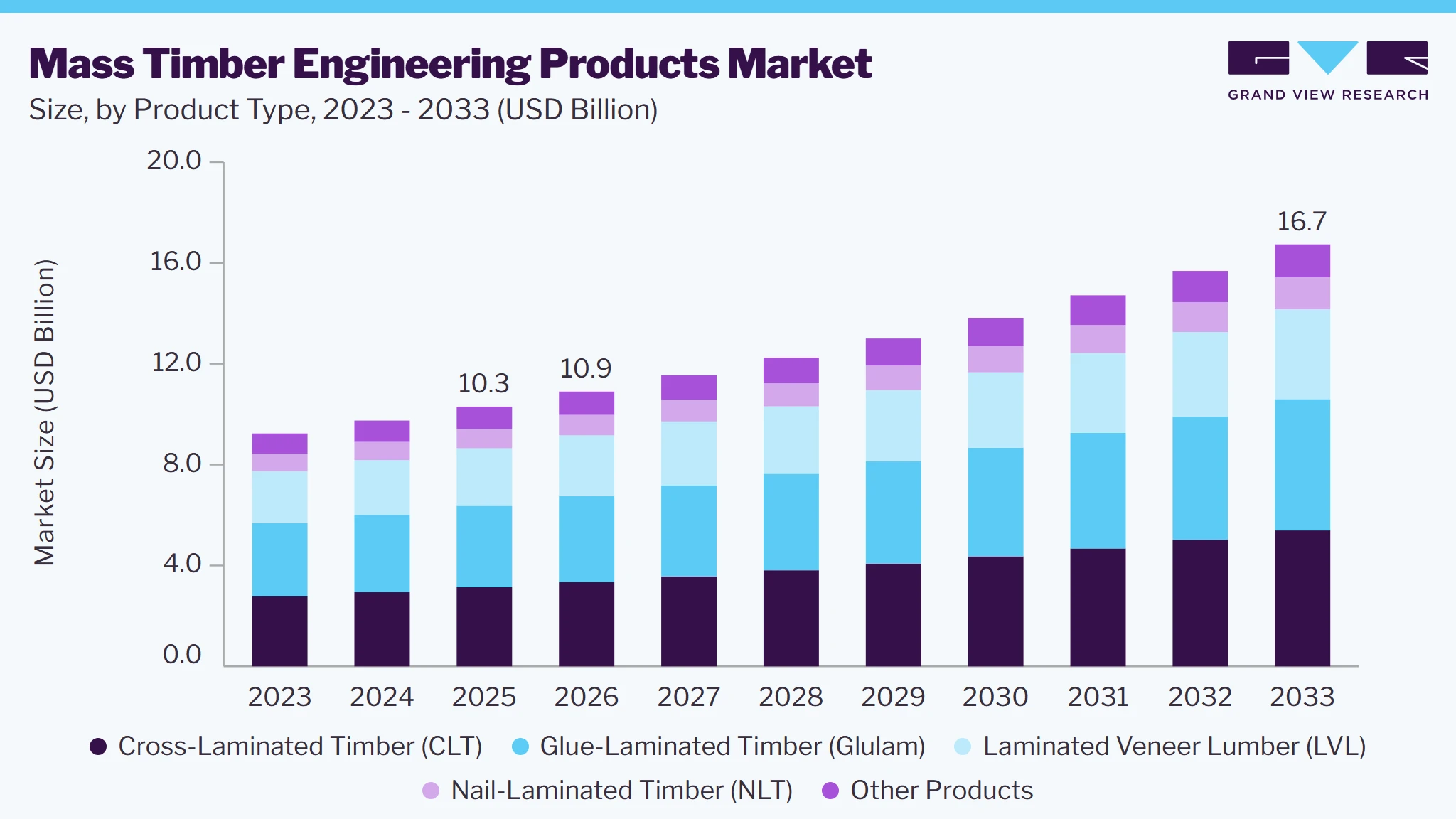
The global mass timber engineering products market size was valued at USD 10.3 billion in 2025 and is projected to grow from USD 10.9 billion in 2026 to USD 16.7 billion by 2033, at a CAGR of 6.3% from 2026 to 2033. North America dominated the market, accounting for a revenue share of 36.4% in 2025. The industry is expanding as construction stakeholders increasingly adopt engineered wood systems as alternatives or complements to conventional concrete and steel structures.
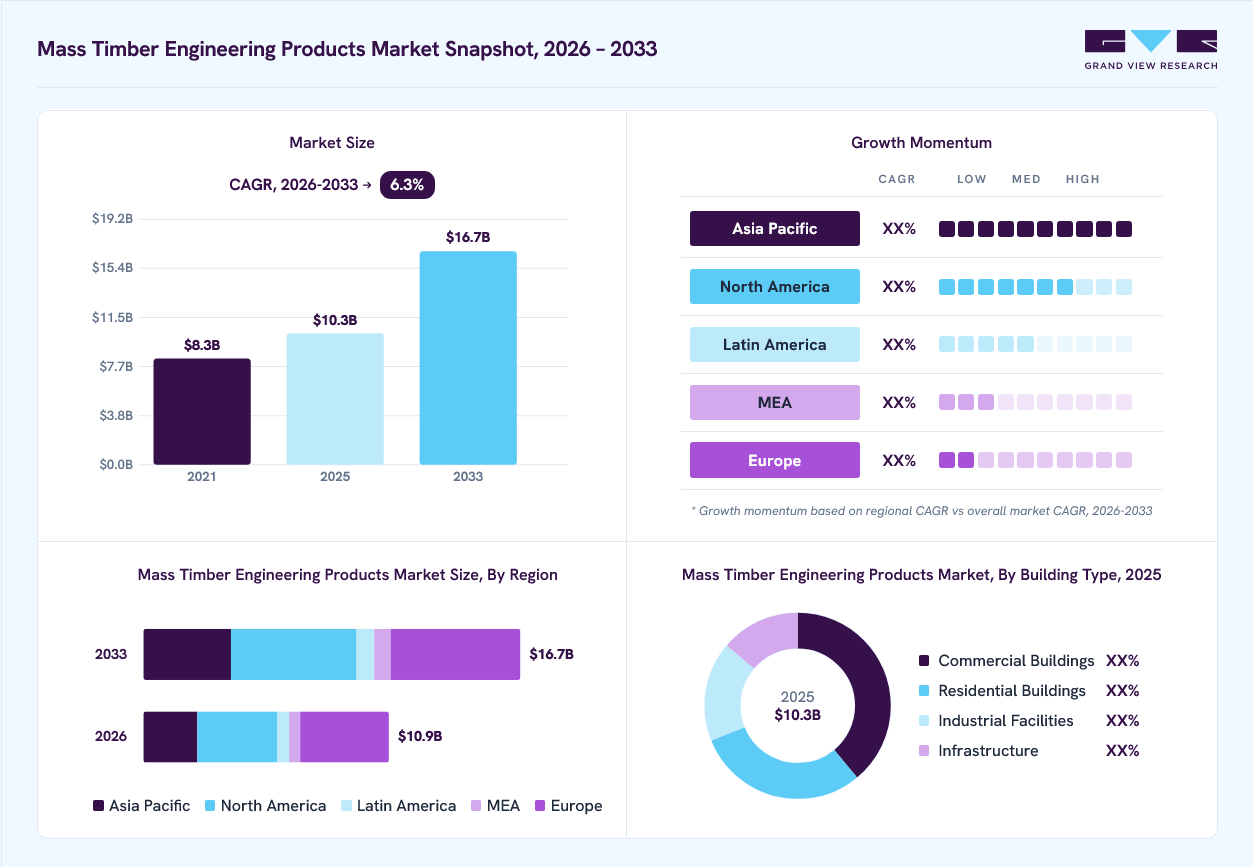 Source: Grand View Research, IR Documents, Primary Interviews, Paid DatabasesTo learn more about this report,
 Download Free Sample Report
Key Market Trends & Insights
- By building type: The infrastructure segment is expected to grow at a CAGR of 6.8% over the forecast period.
- By application: The floor systems segment dominated the market with a revenue share of 28.4% in 2025.
- By product type: The cross-laminated timber (CLT) segment is projected to register a CAGR of 7.1% during the forecast period from 2026 to 2033.
Regional Highlights
- Largest regional market: North America (36.4% revenue share, 2025)
- Fastest-growing regional market: Asia Pacific (highest CAGR, 2026-2033)
Market Size & Forecast
- Market Size in 2025: USD 10.3 Billion
- Estimated market size in 2026: USD 10.9 Billion
- Projected market size by 2033: USD 16.7 Billion
- CAGR (2026-2033): 6.3%
GVR research-powered AIAsk Prism AI about the mass timber engineering products marketGet cited answers from GVR research on market growth, segments, regulations and forecasts.Start with✓ Source-linked answers ✓ Market-specific context ✓ Traceable figuresExplore Prism AI ↗Products such as cross-laminated timber (CLT), glued laminated timber (glulam), laminated veneer lumber (LVL), nail-laminated timber (NLT), and dowel-laminated timber (DLT) provide structural strength, dimensional stability, prefabrication capability, and lower structural weight. Demand is supported by growing interest in reducing embodied carbon, improving construction efficiency, and integrating renewable materials into residential, commercial, institutional, and infrastructure projects.
Market opportunities are increasing as mass timber moves beyond low-rise applications into mid-rise and taller buildings. Expanded building code provisions in major construction markets have improved the feasibility of taller timber structures, while prefabricated panels and digitally controlled manufacturing enable accurate off-site production and faster on-site assembly. The combination of structural performance, reduced construction time, and design flexibility is creating opportunities for manufacturers to provide engineered products alongside fabrication, engineering, and project support capabilities.
 To learn more about this report, Download Free Sample Report
Technology and product development are increasingly focused on automated manufacturing, CNC machining, digital building-model integration, fire-resistant assemblies, optimized connections, and hybrid timber systems. Manufacturers are also investing in production capacity and process automation to improve dimensional accuracy, material utilization, and manufacturing consistency. The growing use of prefabricated mass timber components is further supporting integration with modular and off-site construction approaches.
Market Dynamics
The mass timber engineering products market is being shaped by the transition toward lower-carbon construction, increasing acceptance of engineered timber in larger buildings, advances in prefabrication and digital manufacturing, and improvements in building-code frameworks. At the same time, higher upfront material costs, limited manufacturing capacity in some markets, transportation requirements for oversized components, fire-performance requirements, and shortages of specialized design and installation expertise continue to influence adoption.
Increasing pressure to reduce embodied emissions in the built environment is encouraging developers, architects, and contractors to evaluate timber-based structural systems. Mass timber can store biogenic carbon when responsibly sourced and can replace or reduce the quantity of carbon-intensive materials used in structural applications. This environmental positioning is particularly relevant for commercial, institutional, and residential projects pursuing green-building objectives and lower embodied-carbon footprints.
The prefabricated nature of CLT panels, glulam components, and other engineered timber products also supports faster and more controlled construction. Components can be digitally designed, manufactured, machined, and delivered for assembly at the construction site, reducing the amount of structural work required on-site. Increasing integration of CNC machining, automated production, and digital design workflows is improving manufacturing precision and supporting more complex architectural and structural applications.
Mass timber projects can face higher initial material, engineering, transportation, and fabrication costs compared with conventional construction, particularly where local manufacturing capacity and experienced contractors are limited. Large, prefabricated components also require specialized transportation, storage, lifting, and installation planning. These factors can increase project complexity and restrict adoption in regions where engineered timber supply chains remain underdeveloped.
The expansion of building-code pathways for taller timber structures is creating opportunities for CLT, glulam, LVL, and hybrid timber systems in larger commercial, residential, institutional, and mixed-use projects. Hybrid structures combining timber with concrete or steel can address structural, fire, span, and building-height requirements while retaining the construction and environmental benefits of engineered wood. Continued development of fire-performance solutions, connection technologies, and structural engineering practices can further expand the addressable market.
Market Concentration & Characteristics
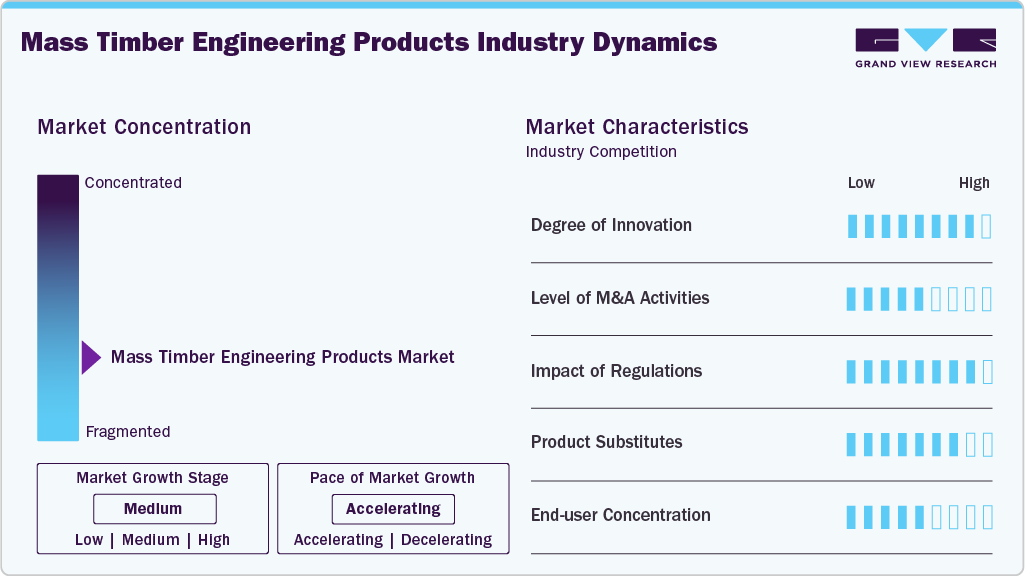
The mass timber engineering products market is fragmented, with competition distributed among large vertically integrated timber companies, specialized mass timber manufacturers, regional engineered-wood producers, and construction-focused suppliers. European producers have established positions in CLT and glulam, while North American manufacturers are expanding capacity and strengthening domestic supply. Competitive differentiation is increasingly based on manufacturing scale, raw-material access, engineering and fabrication capabilities, product certification, project execution, and geographic proximity to construction markets.
 To learn more about this report, Download Free Sample Report
Mass timber engineering products primarily compete with reinforced concrete, structural steel, conventional wood framing, and other engineered wood systems. Concrete and steel remain dominant for many large-scale structures because of established supply chains, contractor familiarity, standardized engineering practices, and broad building-code acceptance. However, mass timber can offer advantages in weight, prefabrication, construction speed, and embodied-carbon performance, supporting its use as either a direct structural alternative or a component of hybrid construction systems.
Analyst Perspective
The mass timber engineering products market is transitioning from a specialized timber construction segment toward a broader structural building-material market, supported by increasing demand for sustainable construction, prefabrication, and efficient project execution. CLT and glulam remain key product categories, while LVL, NLT, and other engineered timber systems are expanding their roles across floor, roof, wall, beam, and column applications. Increasing acceptance of mass timber in residential, commercial, industrial, and infrastructure projects, alongside advancements in digital design, CNC fabrication, and automated manufacturing, is creating new growth opportunities. However, product costs, timber availability, transportation requirements, fire-performance considerations, and regional differences in building codes and technical expertise will continue to influence adoption.
Product Insights
The glue-laminated timber (Glulam) segment held the largest revenue share of 31.4% in 2025, supported by its extensive use in beams, columns, arches, roof structures, and other load-bearing applications. Glulam offers high strength, dimensional stability, design flexibility, and the ability to manufacture large structural members, making it suitable for commercial, institutional, and large-scale timber construction projects.
The cross-laminated timber (CLT) segment is expected to grow at a CAGR of 7.1% over the forecast period, as architects and developers increasingly adopt prefabricated mass timber panels for walls, floors, and roofs. CLT enables off-site manufacturing, rapid installation, and efficient material utilization while supporting sustainable construction objectives. Increasing building-code acceptance and investment in CLT manufacturing capacity are further supporting its adoption.
Application Insights
The floor systems segment dominated with the largest revenue share of 28.4% in 2025, due to the widespread use of CLT panels, glulam, LVL, and NLT in structural floor assemblies. Mass timber floor systems provide structural strength while enabling prefabricated construction and faster installation. Growing adoption across residential, commercial, and institutional buildings is supporting demand for engineered timber floor solutions.
The wall systems segment is expected to grow at a CAGR of 6.9% over the forecast period, as CLT and other mass timber panels gain wider acceptance for load-bearing and structural wall applications. These systems can combine structural performance with prefabrication, thermal efficiency, and reduced on-site labor requirements. Rising demand for sustainable building materials and taller timber structures is creating additional opportunities for engineered timber wall systems.
Building Type Insights
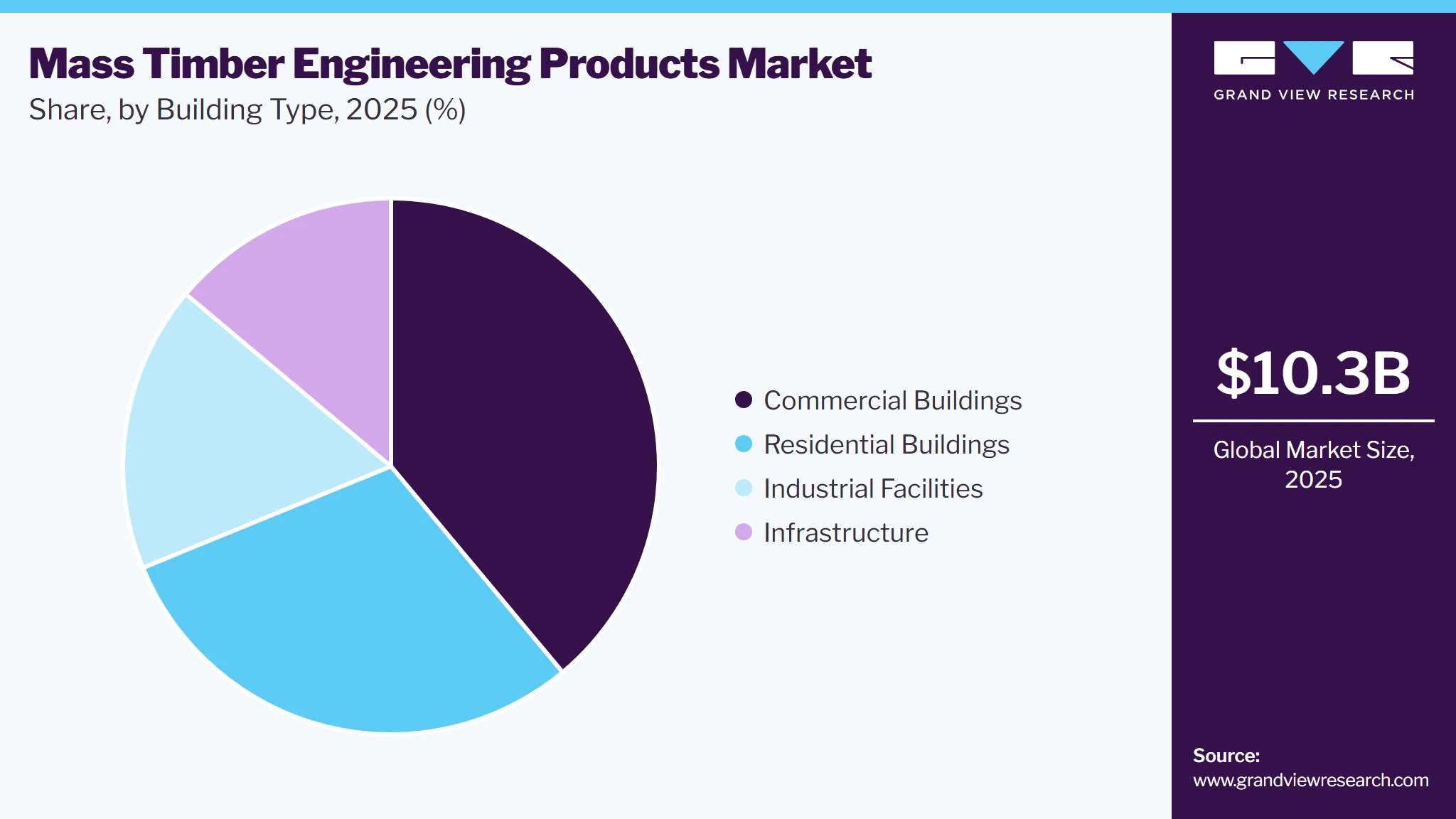
The commercial segment accounted for the largest revenue market share of 38.9% in 2025, supported by increasing deployment of mass timber in offices, hotels, retail facilities, educational buildings, and other large-scale structures. Commercial projects can benefit from prefabricated construction, architectural flexibility, and sustainability credentials, while growing interest in lower-carbon building materials is encouraging developers to consider mass timber for new construction.
 To learn more about this report, Download Free Sample Report
The infrastructure segment is expected to grow at a CAGR of 6.8% over the forecast period, as engineered timber products expand beyond conventional building applications into pedestrian bridges, public facilities, transportation structures, and other infrastructure projects. Glulam, CLT, and LVL can provide lightweight and prefabricated structural solutions, while increasing interest in renewable materials and lower-carbon infrastructure is creating additional opportunities for mass timber engineering products.
Regional Insights
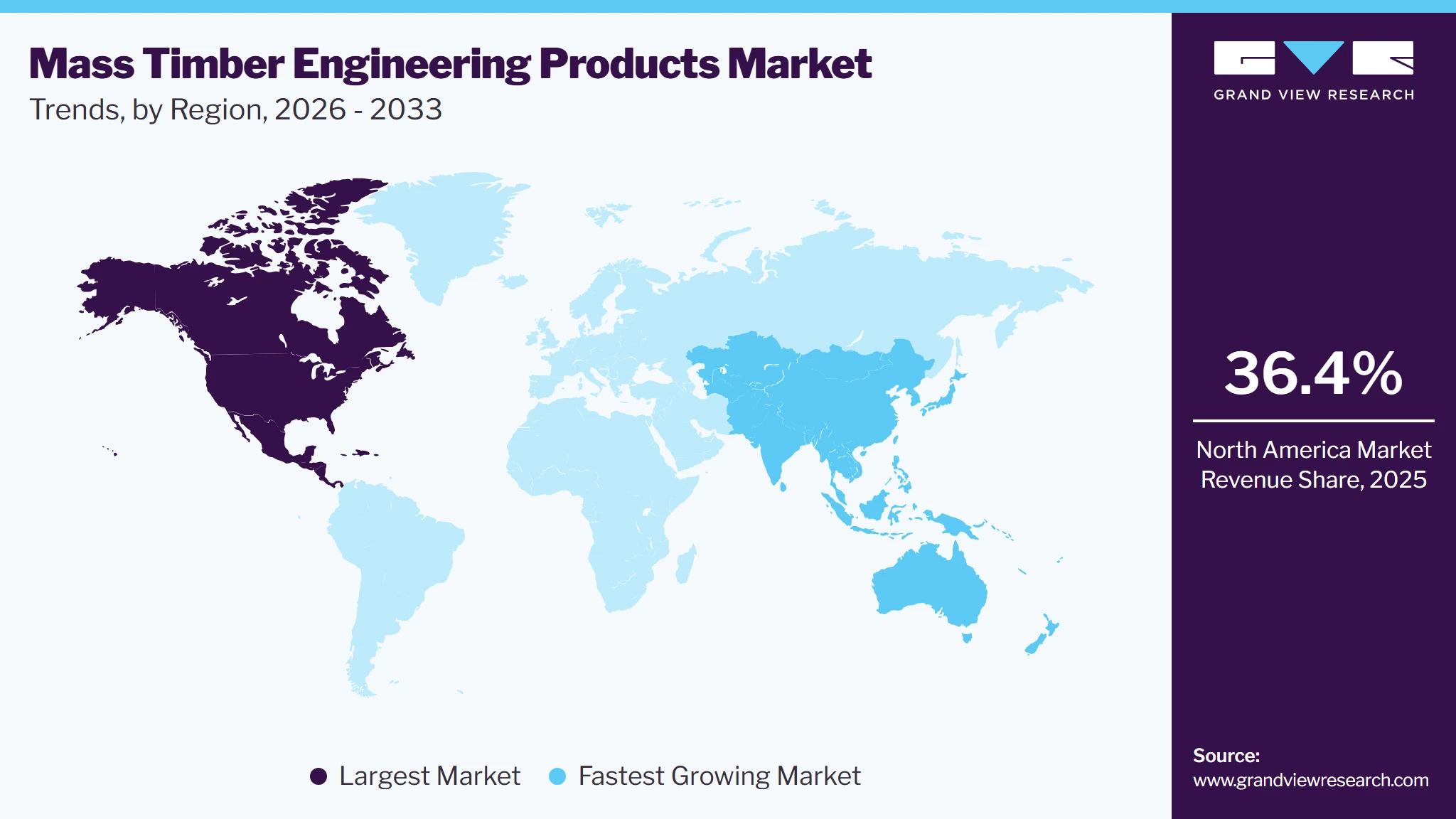
North America dominated the global mass timber engineering products market and accounted for the largest revenue share of 36.4% in 2025, supported by expanding manufacturing capacity, established timber resources, and increasing acceptance of timber-based structural systems. The region has a broad project base covering multifamily housing, offices, educational facilities, hospitality, commercial buildings, and mixed-use developments. The U.S. has benefited from expanded mass timber provisions under the International Building Code, while Canada has incorporated additional mass timber construction pathways into its national building framework.
 To learn more about this report, Download Free Sample Report
U.S. Mass Timber Engineering Products Market Trends
The mass timber engineering products market in the U.S. represents a significant sector, with demand spanning multifamily residential, office, education, hospitality, institutional, and mixed-use construction. The International Building Code provides defined pathways for Type IV mass timber construction, allowing developers and designers to consider timber for taller and larger structures. CLT and glulam are the principal mass timber products, while LVL and other engineered wood products are frequently incorporated into hybrid structural systems. Domestic manufacturing capacity has expanded as producers invest in new CLT, glulam, and automated fabrication facilities.
Asia Pacific Mass Timber Engineering Products Market Trends
The mass timber engineering products market in the Asia Pacific is emerging as an important industry, supported by rapid urbanization, increasing adoption of prefabricated construction, and growing interest in lower-carbon building materials. Japan has established expertise in engineered timber construction and is expanding the use of CLT and glulam in residential, commercial, and public buildings. Australia has developed a growing mass timber ecosystem, particularly for educational, commercial, and multifamily projects. New Zealand also benefits from its forestry resources and growing interest in engineered wood construction.
The China mass timber engineering products market represents a developing, underpinned by its large construction industry and increasing emphasis on prefabricated and sustainable building methods. Conventional reinforced concrete continues to dominate structural construction, limiting mass timber penetration compared with more established timber markets. Nevertheless, CLT and glulam are gaining attention in selected residential, hospitality, commercial, and institutional developments. Government interest in prefabricated construction is creating opportunities for factory-produced timber components and modular building systems.
Europe Mass Timber Engineering Products Market Trends
The mass timber engineering products market in Europe is one of the most established markets, supported by mature timber construction practices, extensive forestry resources, and a strong base of engineered wood manufacturers. Austria, Germany, Switzerland, Sweden, Finland, and other Northern and Central European countries have extensive experience with CLT, glulam, and other structural timber systems. Mass timber is used across residential buildings, offices, schools, public facilities, industrial buildings, and large architectural projects. European manufacturers have also developed advanced capabilities in prefabrication, CNC machining, structural engineering, and project-specific fabrication. Sustainability objectives and efforts to reduce the environmental impact of construction continue to encourage timber adoption.
The Germany mass timber engineering products market is growing due to the country’s established timber construction sector, engineering expertise, and strong engineered wood manufacturing base. The country has extensive experience with timber-frame and solid-wood construction, creating a strong foundation for CLT, glulam, and other engineered timber applications. Residential construction remains an important application, while commercial buildings, offices, schools, public facilities, and industrial structures are increasingly incorporating mass timber. German manufacturers also supply engineered timber products and prefabricated components to other European markets, strengthening the country's position within the regional supply chain.
Central and South America Mass Timber Engineering Products Market Trends
The mass timber engineering products market in Central & South America represents an emerging sector, fueled by substantial forestry resources and increasing interest in sustainable construction. Chile has developed relatively strong capabilities in engineered wood and prefabricated timber construction, supported by its established forestry industry. Brazil also has significant potential because of its large forestry base, although concrete remains the dominant structural material in mainstream construction. CLT and glulam are being introduced through selected residential, commercial, hospitality, and architectural projects, particularly where sustainability and design differentiation are important.
Middle East & Africa Mass Timber Engineering Products Market Trends
The mass timber engineering products market in the Middle East & Africa is at an earlier stage (of mass timber adoption), with opportunities concentrated in hospitality, tourism, commercial, premium residential, and mixed-use developments. Saudi Arabia and the UAE are particularly relevant due to their large-scale construction pipelines and increasing focus on distinctive and sustainable building designs. Mass timber products are primarily imported or supplied through international manufacturers because local CLT and glulam production remains limited. The region's hot and dry climate creates additional requirements related to moisture management, fire performance, and material durability.
Key Mass Timber Engineering Products Company Insights
Some of the key players operating in the market include Stora Enso and Binderholz.
-
Stora Enso is a global renewable materials company offering engineered wood products for modern timber construction. Its mass timber portfolio includes cross-laminated timber (CLT), glulam, and LVL, supporting structural applications across residential, commercial, and infrastructure projects.
-
Binderholz is a European timber manufacturer specializing in solid and engineered wood products. Its mass timber portfolio includes BBS cross-laminated timber, glulam, and other structural timber solutions used in walls, floors, roofs, and load-bearing structures.
SmartLam North America and Mercer Mass Timber are some of the emerging market participants in the mass timber engineering products market.
-
SmartLam North America is a U.S.-based mass timber manufacturer focused on CLT and glulam products for structural construction. The company combines engineered wood manufacturing with CNC and digital fabrication capabilities to supply customized components for commercial, residential, and institutional projects.
-
Mercer Mass Timber is a North American mass timber manufacturer producing CLT panels and glulam beams and columns. The company focuses on prefabricated structural timber solutions for commercial, institutional, residential, and other large-scale construction applications.
Key Mass Timber Engineering Products Companies
The following key companies have been profiled for this study on the mass timber engineering products market.
-
Stora Enso
-
Binderholz
-
KLH Massivholz GmbH
-
Mayr-Melnhof Holz
-
HASSLACHER Group
-
Rubner Group
-
Mercer Mass Timber
-
SmartLam North America
-
Metsä Wood
-
Element5
Competitive Benchmarking
Category
Operating Strategies
Competitive Edge
Weakness
Established Players (Stora Enso, binderholz, KLH Massivholz GmbH, Mayr-Melnhof Holz, HASSLACHER Group, Rubner Group)
Invest in CLT, glulam, LVL, and other engineered timber production capacity to address growing demand for mass timber construction.
Expand manufacturing and project capabilities through new facilities, advanced fabrication, and integrated engineering services.
Focus on sustainably sourced timber, prefabrication, and digital manufacturing to serve large residential, commercial, institutional, and infrastructure projects.
Strong manufacturing scale and established positions across major European mass timber markets.
Broad product portfolios covering CLT, glulam, LVL, and customized structural timber components.
Extensive engineering, fabrication, and project experience supports complex and large-scale timber construction projects.
High capital requirements for mass timber manufacturing facilities, drying equipment, and automated fabrication systems.
Exposure to fluctuations in timber availability, raw material costs, and energy prices.
Transportation and logistics of large prefabricated timber components can increase project costs and limit supply radius.
Emerging Players (Mercer Mass Timber, SmartLam North America, Metsä Wood, Element5)
Expand CLT, glulam, and LVL production capabilities to capture increasing demand in North American and international markets.
Develop partnerships with architects, engineers, developers, and contractors to increase adoption of mass timber systems.
Focus on project-specific fabrication, digital manufacturing, and sustainable engineered wood solutions for commercial, residential, institutional, and hybrid construction.
Strong specialization in mass timber and engineered wood products with capabilities suited to customized project requirements.
Growing manufacturing presence in North America and access to established timber supply chains.
Flexible product and fabrication capabilities support rapid response to emerging applications and regional construction demand.
Smaller geographic footprint compared with the largest global timber groups.
High investment requirements for expanding production capacity and advanced manufacturing capabilities.
Dependence on regional construction activity, timber supply, and continued adoption of mass timber building systems can constrain market expansion.
Recent Developments
-
In July 2026, Binderholz agreed to acquire Kuhmo Oy and Juntinsalo Oy in Finland, expanding its integrated timber and forestry operations and strengthening its European wood-products footprint.
-
In September 2025, HASSLACHER supported the opening of a new glulam production line and expanded manufacturing facility in St. Thomas, Ontario, with the expansion valued at approximately $107 million and supported by $8 million in Ontario government funding.
Mass Timber Engineering Products Market Report Scope
Report Attribute
Details
Market size in 2025
USD 10.3 billion
Estimated market size in 2026
USD 10.9 billion
Projected market size by 2033
USD 16.7 billion
Growth rate
CAGR of 6.3% from 2026 to 2033
Base year for estimation
2025
Actual estimates/Historical data
2021 - 2024
Forecast period
2026 - 2033
Quantitative units
Revenue in USD billion and CAGR from 2026 to 2033
Report coverage
Revenue forecast, company ranking, competitive landscape, growth factors, and trends
Segments covered
Product type, application, building type, region
Regional scope
North America; Europe; Asia Pacific; Central and South America; Middle East and Africa
Country scope
U.S.; Canada; Mexico; Germany; UK; France; Italy; Spain; China; Japan; India; South Korea; Brazil; Saudi Arabia
Key companies profiled
Stora Enso; binderholz; KLH Massivholz GmbH; Mayr-Melnhof Holz; HASSLACHER Group; Rubner Group; Mercer Mass Timber; SmartLam North America; Metsä Wood; Element5
Customization scope
Free report customization (equivalent up to 8 analysts working days) with purchase. Addition or alteration to country, regional & segment scope.
Pricing and purchase options
Avail customized purchase options to meet your exact research needs. Explore purchase options
Global Mass Timber Engineering Products Market Report Segmentation
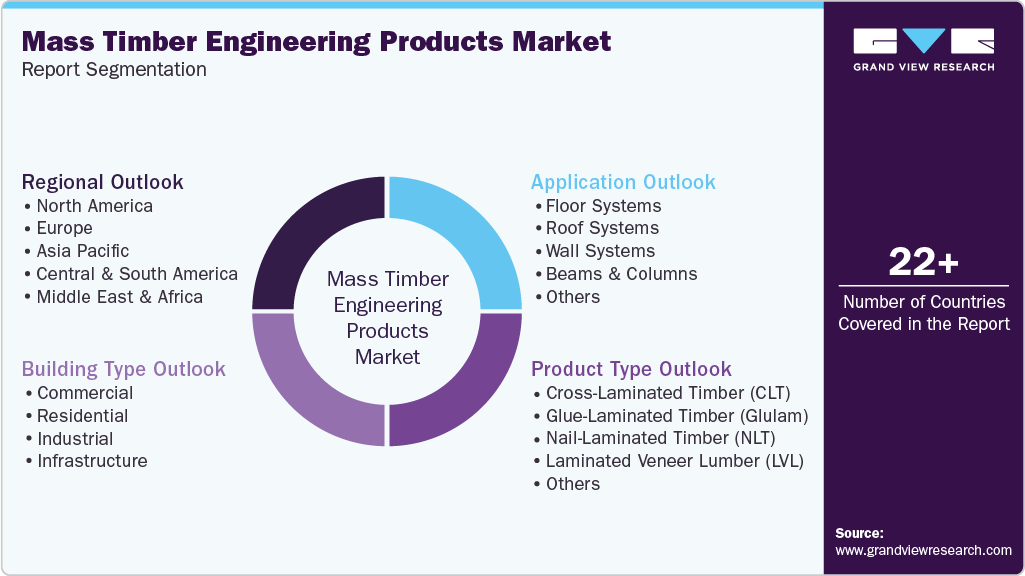
This report forecasts revenue growth at the global, regional & country levels and provides an analysis on the industry trends in each of the sub-segments from 2021 to 2033. For this study, Grand View Research has segmented the global mass timber engineering products market report on the basis of product type, application, building type, and region:
 To learn more about this report, Download Free Sample Report
-
Product Type Outlook (Revenue, USD Billion, 2021 - 2033)
-
Cross-Laminated Timber (CLT)
-
Glue-Laminated Timber (Glulam)
-
Nail-Laminated Timber (NLT)
-
Laminated Veneer Lumber (LVL)
-
Others
-
-
Application Outlook (Revenue, USD Billion, 2021 - 2033)
-
Floor Systems
-
Roof Systems
-
Wall Systems
-
Beams & Columns
-
Others
-
-
Building Type Outlook (Revenue, USD Billion, 2021 - 2033)
-
Commercial
-
Residential
-
Industrial
-
Infrastructure
-
-
Regional Outlook (Revenue, USD Billion, 2021 - 2033)
-
North America
-
U.S.
-
Canada
-
Mexico
-
-
Europe
-
UK
-
Germany
-
France
-
Italy
-
Spain
-
-
Asia Pacific
-
China
-
Japan
-
India
-
South Korea
-
-
Central and South America
-
Brazil
-
-
Middle East and Africa
-
Saudi Arabia
-
-
Research Methodology
The mass timber engineering products marketfigures in this report are based on a proven research process that combines executive interviews with secondary research from proprietary databases, company filings, and recognized regulatory and institutional sources. Market size is built through value-chain sizing-reconciling supply-side and demand-side estimates-and triangulated with bottom-up and top-down approaches. Every estimate passes multiple levels of expert validation before publication, with eachmass timber engineering products segment quantified using the revenue-capture definitions in the table below.
Segment Definition
Product
Revenue Capture Definition
Cross-Laminated Timber (CLT)
Revenue generated from the sale of factory-manufactured solid wood panels formed by laminating multiple timber layers perpendicular to each other, primarily used as structural walls, floors, roofs, and other load-bearing components.
Glue-Laminated Timber (Glulam)
Revenue generated from the sale of structural timber members manufactured by bonding multiple layers of dimension lumber with adhesive, including beams, columns, arches, and other load-bearing components.
Nail-Laminated Timber (NLT)
Revenue generated from the sale of structural mass timber panels manufactured by mechanically fastening layers of dimensional lumber together with nails or similar fasteners, primarily for floor and roof applications.
Laminated Veneer Lumber (LVL)
Revenue generated from the sale of engineered structural wood products manufactured by bonding thin wood veneers with their grain predominantly aligned in the same direction, used for beams, headers, columns, joists, and other structural applications.
Others
Revenue generated from other mass timber engineering products not separately classified under CLT, glulam, NLT, or LVL, including dowel-laminated timber (DLT), parallel strand lumber (PSL), laminated strand lumber (LSL), and other engineered mass timber systems.
Application
Revenue Capture Definition
Floor Systems
Revenue generated from mass timber products supplied for structural floor assemblies, including CLT panels, NLT panels, glulam members, LVL components, and associated structural elements used in building floors.
Roof Systems
Revenue generated from mass timber products used in structural roof assemblies, including CLT and NLT panels, glulam beams, LVL components, and other engineered timber elements supporting roof loads.
Wall Systems
Revenue generated from mass timber products used for structural and load-bearing wall assemblies, including CLT panels and other engineered timber components used for exterior, interior, shear, and partition wall applications.
Beams & Columns
Revenue generated from structural mass timber products used as beams, columns, posts, and other vertical or horizontal load-bearing members, primarily comprising glulam, LVL, and related engineered wood products.
Others
Revenue generated from mass timber products used in applications other than floor systems, roof systems, wall systems, and beams & columns, including stairs, bridges, façade components, and specialized structural applications.
Building Type
Revenue Capture Definition
Residential
Revenue generated from mass timber engineering products used in single-family, multifamily, apartment, condominium, student housing, and other residential construction projects.
Commercial
Revenue generated from mass timber products used in offices, retail buildings, hotels, hospitality facilities, educational buildings, healthcare facilities, and other commercial or institutional structures.
Industrial
Revenue generated from mass timber products used in warehouses, manufacturing facilities, distribution centers, agricultural buildings, and other industrial structures requiring engineered timber components.
Infrastructure
Revenue generated from mass timber products used in infrastructure and civil construction applications, including pedestrian bridges, transportation structures, public facilities, and other non-building infrastructure projects.
Estimation Model
Layer Name
Key Question
Description
Parent Market Analysis
What is the overall size and growth outlook of the global engineered wood and timber construction market?
The estimation begins by evaluating the broader engineered wood products and timber construction market. Global construction activity, residential and commercial building development, timber availability, sustainable construction initiatives, green building requirements, and investments in prefabricated and low-carbon construction are analyzed to establish the total addressable market for mass timber engineering products.
Mass Timber Product Penetration Analysis
What proportion of the engineered wood and structural timber market is represented by mass timber engineering products across different products?
This layer estimates the penetration of Cross-Laminated Timber (CLT), Glue-Laminated Timber (Glulam), Nail-Laminated Timber (NLT), Laminated Veneer Lumber (LVL), and other mass timber engineering products. Product adoption, structural applications, manufacturing capacity, prefabrication trends, building-code acceptance, and use across different construction systems are analyzed to determine the market contribution of each product category.
Regional & End-use Demand Assessment
Which regions, applications, and building types contribute the highest demand for mass timber engineering products?
Market demand is evaluated across Asia Pacific, North America, Europe, Central & South America, and the Middle East & Africa based on construction activity, timber resources, building regulations, sustainability targets, and adoption of engineered wood systems. Demand is further assessed across floor systems, roof systems, wall systems, beams & columns, and other applications, as well as residential, commercial, industrial, and infrastructure buildings, to determine revenue contribution.
Company Revenue Validation & Market Forecasting
How is the final market size validated and forecast?
The final market estimates are validated using company revenues, mass timber production capacities, product portfolios, manufacturing facilities, project pipelines, construction contracts, expansion initiatives, partnerships, and secondary research. Bottom-up and top-down approaches are triangulated to generate reliable market size estimates and long-term forecasts for the Mass Timber Engineering Products Market.
Delivered Customizations
We have successfully delivered the following deep-dive customizations
Client Request
Customization Delivered
Value Adds
Product & Technology Benchmarking
Comprehensive comparison of CLT, Glulam, NLT, LVL, and other mass timber engineering products based on structural performance, manufacturing technology, prefabrication suitability, durability, load-bearing capability, and application potential.
Enables stakeholders to benchmark product capabilities, identify technology gaps, optimize product portfolios, prioritize R&D investments, and select suitable mass timber systems across different construction applications.
Regional Regulatory & Building Code Assessment
Detailed evaluation of regional building codes, fire safety standards, structural timber requirements, timber certification, seismic provisions, sustainability regulations, embodied-carbon policies, and mass timber building-height provisions across major markets.
Supports regulatory compliance, reduces project approval risks, guides region-specific market entry and certification strategies, and identifies markets with favorable regulatory conditions for mass timber adoption.
Sustainable Timber Sourcing & Carbon Assessment
Assessment of certified timber availability, responsible forestry practices, raw material sourcing, embodied carbon, biogenic carbon, material efficiency, waste utilization, and end-of-life considerations across the mass timber value chain.
Helps companies strengthen sustainable sourcing strategies, assess carbon-related opportunities, improve environmental positioning, support green-building requirements, and differentiate products based on sustainability performance.
Frequently Asked Questions About This Report
The mass timber engineering products market size was estimated at USD 10.3 billion in 2025 and is expected to reach USD 10.9 billion in 2026.
The mass timber engineering products market is expected to grow at a compound annual growth rate of 6.3% from 2026 to 2033 to reach USD 16.7 billion by 2033.
Which building type segment accounted for the largest mass timber engineering products market share?The commercial segment accounted for the highest revenue share of 38.9% in 2025, driven by increasing adoption across offices, hospitality, education, and other commercial buildings.
North America held the highest revenue market share of 36.4% in 2025, supported by growing adoption of CLT and glulam across commercial, residential, and institutional construction.
Increasing demand for sustainable construction, prefabricated building systems, lower embodied carbon, and faster project execution is driving the mass timber engineering products market.
Some key players in the mass timber engineering products market include Stora Enso, binderholz, KLH Massivholz GmbH, Mayr-Melnhof Holz, HASSLACHER Group, Rubner Group, Mercer Mass Timber, SmartLam North America, Element5, and Metsä Wood.
The floor systems segment dominated the market with a revenue share of 28.4% in 2025.
The cross-laminated timber (CLT) segment is projected to register a CAGR of 7.1% during the forecast period from 2026 to 2033.
About the Author(s)
Advanced Interior Materials Research Team
Advanced Materials · Advanced Interior MaterialsThis report was authored by the advanced interior materials research team at Grand View Research - comprising two research analysts, one senior research analyst, and one industry expert - with specialized expertise in the advanced interior materials segment of the advanced materials industry. All findings are based on proprietary advanced materials databases, executive interviews, and regulatory analysis, subject to internal peer review prior to publication.
Last Updated:
Speak to Analyst

Customize this report to your needs - add regions, segments, or data points, with 20% free customization.
Or view our licence options:


ISO 9001:2015 & 27001:2022 Certified
We are GDPR and CCPA compliant! Your transaction & personal information is safe and secure. For more details, please read our privacy policy.


