
- Home
- »
- Advanced Interior Materials
- »
-
Mechanical Anchors Market Size, Industry Report, 2033GVR Report cover
![Mechanical Anchors Market Size, Share & Trends Report]()
Mechanical Anchors Market (2025 - 2033) Size, Share & Trends Analysis Report By Material (Carbon Steel, Stainless Steel, Others), By Application (Residential, Commercial), By Region, And Segment Forecasts
Market Size, 2024
$2.0BMarket Estimate, 2026
$2.0BMarket Forecast, 2033
$2.6BCAGR, 2025–2033
3.2%Mechanical Anchors Market Summary
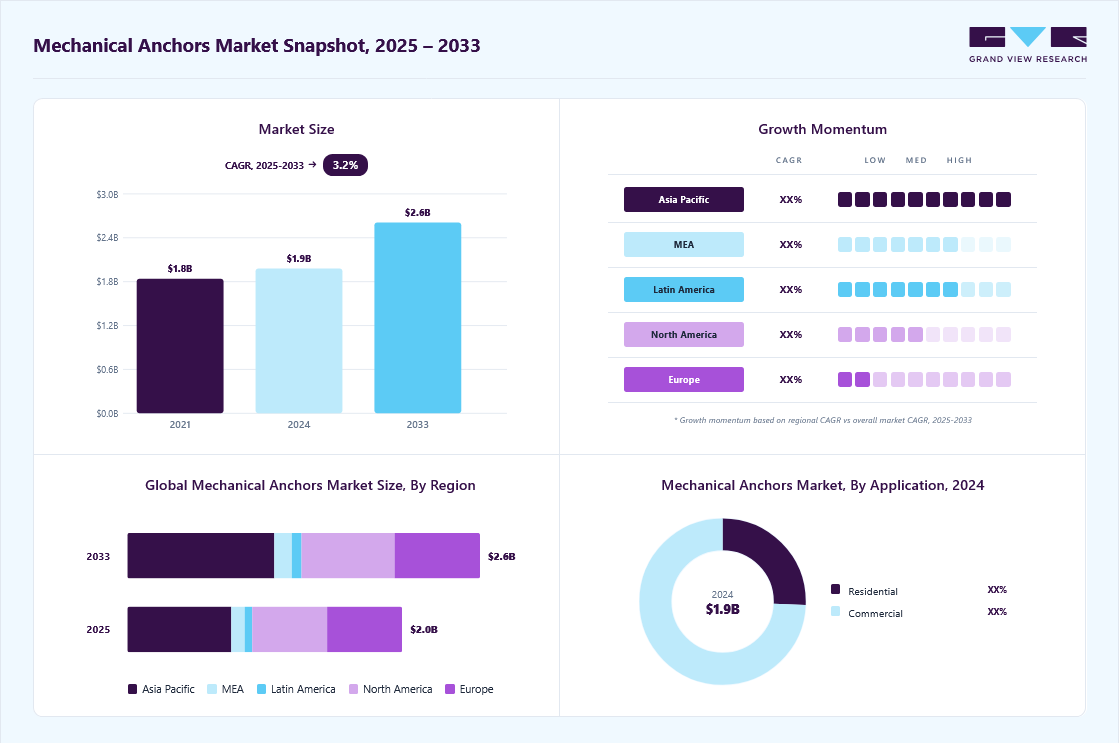
The global mechanical anchors market size was estimated at USD 1.95 billion in 2024 and is projected to reach USD 2.57 billion by 2033, growing at a CAGR of 3.2% from 2025 to 2033. The mechanical anchors have high potential demand and installation across the building and construction sector including historic masonry materials.
Key Market Trends & Insights
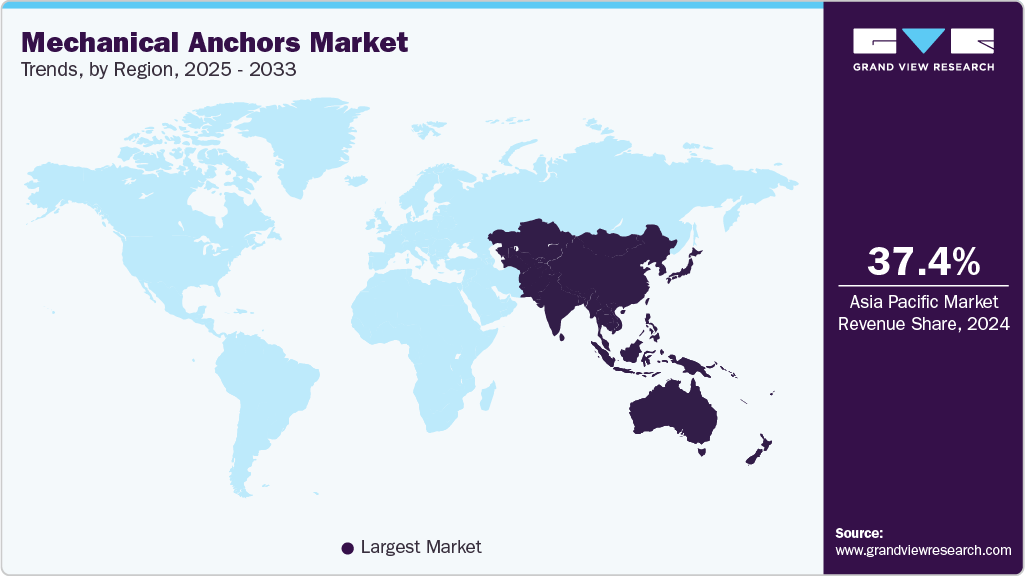
- Asia Pacific dominated the mechanical anchors market with the largest revenue share of 37.4% in 2024.
- By material, the stainless steel segment is expected to grow at the fastest CAGR of 3.4% over the forecast period.
- By application, the commercial segment is expected to grow at the fastest CAGR of 3.2% over the forecast period.
Market Size & Forecast
- 2024 Market Size: USD 1.95 Billion
- 2033 Projected Market Size: USD 2.57 Billion
- CAGR (2025-2033): 3.2%
- Asia Pacific: Largest market in 2024
These anchors secure themselves in the base material through friction and mechanical interlocking, using specific movements to achieve strong holding values. Mechanical concrete anchors are experiencing growth in the market due to their wide range of applications and benefits in concrete construction. There are various types of mechanical anchors are available in the market such as wedge anchors, sleeve anchors, machine screw anchors, hammer drive anchors, single expansion anchors, and double expansion anchors. They find applications across various sectors, utilizing their properties and benefits, which are expected to drive their demand in the market.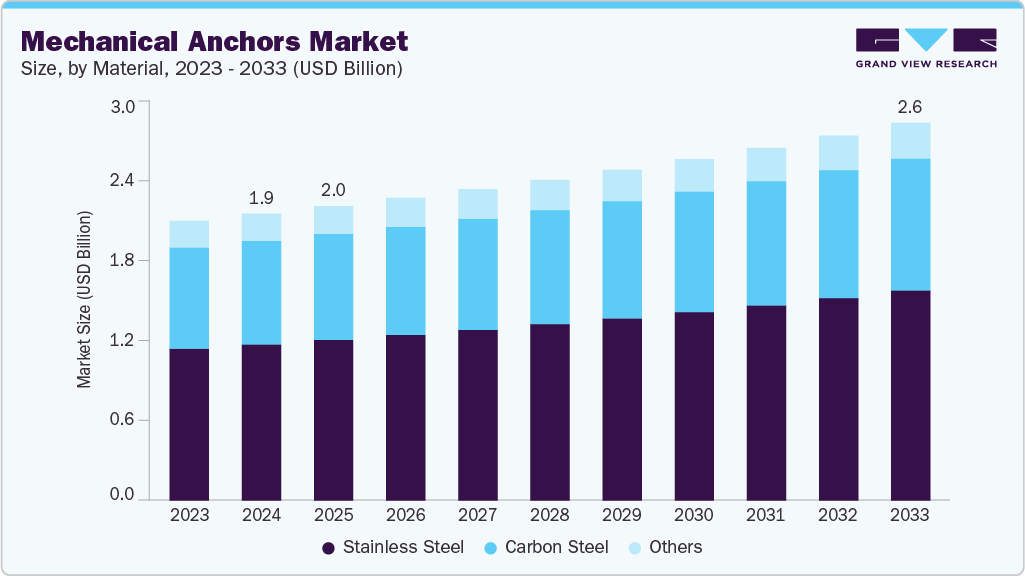
The major manufacturers in the mechanical anchors market include DeWalt Commercial Tool Company, Guangdong KinLong Hardware Products Co., Ltd., Hilti Corporation, Simpson Strong-Tie Company, Inc., ITW RED HEAD, and Koelner Rawlplug IP which supplies the final product to the wholesaler, distributor, or supplier for the final distribution to the retailer or the end users across the construction or residential sector.
Mechanical anchors are also having potential users across the stone masonry. These are commonly installed in historic masonry materials. Moreover, signage installations, scaffolding lateral supports, and telecommunication launching systems. Structural engineers are improvising the designs and specifications of the mechanical anchors according to the development and advancement in the structural design market. The aforementioned factors are expected to propel product demand.
Market Concentration & Characteristics
The mechanical anchors market is moderately consolidated, with major global players such as Hilti Group, Simpson Strong-Tie, and Stanley Black & Decker dominating. However, regional manufacturers in the Asia Pacific and Europe cater to localized demand with customized solutions. The market sees intense competition in pricing and innovation, especially for mid-load and heavy-load applications. Leading firms maintain a strong presence through extensive distribution networks and R&D investments. Continuous product certification and testing requirements act as barriers for new entrants, thereby stabilizing market shares. Strategic mergers and acquisitions further consolidate the market position of key players, ensuring technological advancement and brand dominance.
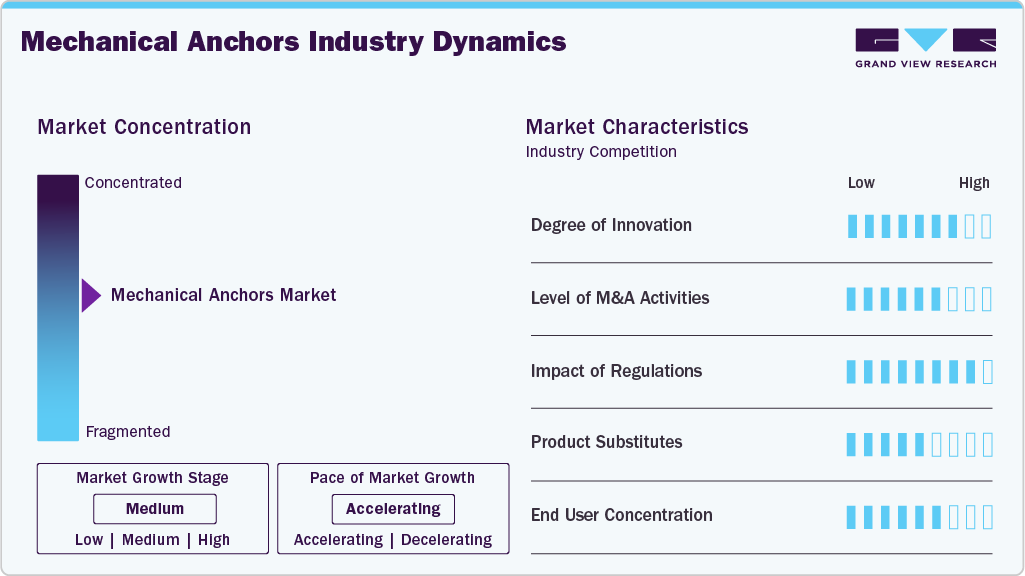
Chemical anchors and adhesive bonding systems are the primary substitutes for mechanical anchors. However, their adoption depends on application, substrate type, and curing time, making mechanical anchors more versatile for instant-load requirements. In dynamic or overhead applications, mechanical anchors still outperform alternatives due to reliability and lower installation complexity. Precast fastening systems and welded joints offer limited substitution, primarily in specialized projects. Despite these substitutes, the mechanical anchors’ cost-effectiveness and load efficiency sustain their market appeal. Hence, the overall threat of substitutes remains moderate, as mechanical anchors continue to be indispensable for structural and retrofit projects.
Material Insights
Stainless steel accounted for the largest revenue share of 54.5% in 2024 and is expected to grow at the fastest CAGR during the forecast period. Stainless steel hardly gets oxidized when compared to other materials including iron, and carbon steel. In addition, aesthetic shining appearance, corrosion resistance, low maintenance, and strength make stainless steel a widely used material for manufacturing mechanical anchors.
Carbon steel accounted for a revenue share of USD 703.4 million in 2024 owing to its high strength. The presence of high carbon content makes them good at resisting abrasion and retaining shape under excess load in construction buildings. In addition, the material is primarily heat-treated by austenitizing, and quenching, followed by tempering to enhance its mechanical properties including yield and tensile strength.
In terms of the price standpoint, stainless steel is primarily more expensive than carbon steel. The high price of stainless steel is attributed to the wide array of other metals that are added to the stainless steel including chromium, manganese, and nickel. These additional elements increase the cost of stainless steel metal over carbon steel which is widely used in the building & construction industry.
Other materials used on small scale to produce mechanical anchors include alloy steel which is expected to grow at a CAGR of 3.1% over the forecast period. These are primarily iron-based mixtures resulting in the formation of alloy steel having different element compositions including manganese, silicon, and copper. Other materials are also used in small quantities including nickel, chromium, and molybdenum in the alloy steel to achieve the required hardness, strength, and chemical resistance.
Application Insights
The commercial segment accounted for a revenue share 74.4% in 2024. In commercial sectors, mechanical anchor finds its wide application in various malls, hotels, sports complexes, and industries.
The building design of malls, hotels, and sports & recreational stadiums is becoming more complex and is fitted with a wide variety of pipes, tubes, and cables suspended from the ceiling. These are primarily held on metal trenches which are fitted with mechanical anchors to fasten them to the underside of the concrete deck for support and hold.
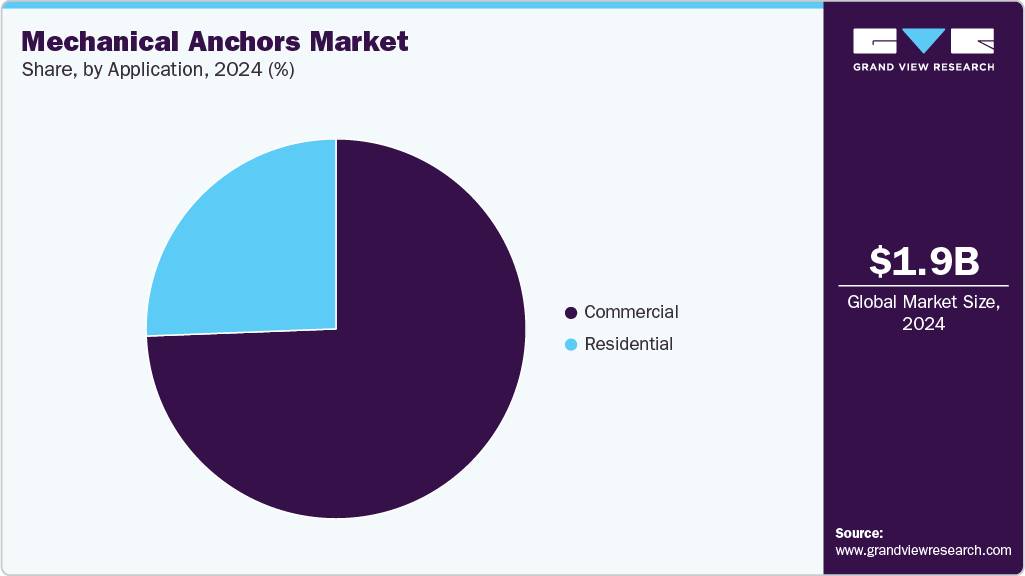
The residential applications segment accounted for a comparatively smaller revenue share than the commercial segment in 2024. The use of mechanical anchors in residential applications includes fixing wooden or plastic frames to the concrete or masonry units, railing and fences, and cable trenches. Metals such as aluminum and steel are widely used in the manufacturing of windows and doors in buildings owing to the lightweight and highly durable properties exhibited by these metals.
Furthermore, critical design and construction considerations for the adequate connection of the wooden frames and structural systems to a concrete or stone base are the major key areas where mechanical fasteners are used in residential applications. In addition, increasing security concerns among the residential areas are amplifying the need for railing and fencing that uses mechanical anchors which get fixed to the railing bars with the boundary wall of the house. The above-mentioned factors are expected to boost the market demand during over the forecast period.
Regional Insights
Asia Pacific mechanical anchors marketdominated the respective global market mechanical anchors market and accounted for the largest revenue share of 37.4% in 2024, owing to rapid industrialization, smart city projects, and infrastructure development in China, India, and Southeast Asia. The region’s demand is driven by commercial and public infrastructure expansion, including metro networks and high-rise projects. India’s increasing adoption of green building codes has encouraged the use of durable anchor systems. Rising foreign direct investment (FDI) in construction and affordable housing initiatives further support market growth. In addition, the presence of local manufacturers offering cost-effective products enhances availability. Countries such as Japan and South Korea are adopting seismic-resistant anchors, improving market depth. The region is expected to maintain dominance through 2033 due to sustained construction investments.
Mechanical anchors market in China remains a key market in the region, it’s growth is supported by its large-scale infrastructure projects under the Belt and Road Initiative and continued urban renewal drives. Government-backed megaprojects such as expressways, tunnels, and industrial zones have sustained demand for high-load mechanical anchors. The presence of domestic producers ensures competitive pricing, while quality improvements align with international standards. Adoption of seismic-rated and corrosion-resistant anchors is rising in coastal regions. Increasing investment in clean energy infrastructure, such as wind and solar, also fuels demand. Furthermore, local construction codes mandating reliable fastening systems enhance long-term market growth in the country.
North America Mechanical Anchors Market Trends
North America exhibits steady growth driven by robust construction recovery and infrastructure modernization. The U.S. Infrastructure Investment and Jobs Act is generating high demand for mechanical anchors across highways, bridges, and public transit systems. Residential renovation activities and the DIY sector also contribute to sustained sales. Increasing focus on safety and compliance with ICC and ASTM standards favors certified anchor products. Technological advancements such as torque-controlled anchors are gaining popularity. Moreover, key manufacturers headquartered in the U.S. maintain strong distribution networks across Canada and Mexico. The market outlook remains positive through the next decade.
U.S. Mechanical Anchors Market Trends
The U.S. market benefits from the ongoing expansion of commercial real estate and retrofitting of old structures. Increased federal funding for smart infrastructure and public facilities enhances anchor demand. Commercial warehousing, driven by e-commerce and logistics growth, requires reliable mechanical fastening systems. The trend toward green construction and LEED-certified buildings has spurred the adoption of sustainable anchor materials. Stringent building codes drive innovation in load-rated anchor designs. Partnerships between manufacturers and contractors are optimizing installation efficiency. The U.S. is expected to witness consistent growth due to its diversified end-use industries and advanced R&D capabilities.
Europe Mechanical Anchors Market Trends
Europe shows strong demand for mechanical anchors due to extensive renovation of aging infrastructure. The EU Green Deal and the “Renovation Wave” initiative are promoting energy-efficient construction, driving anchor installations. Germany, Italy, and the UK are leading markets, which are emphasizing structural reinforcement in heritage buildings. Strict product certification requirements, including ETA approvals, ensure quality and reliability. Increasing adoption of lightweight anchors compatible with insulation and façade systems is also notable. European manufacturers are focusing on sustainability and recyclability in product development. The market outlook is stable, supported by both public and private infrastructure funding.
Germany mechanical anchors market remains one of the largest markets in Europe for mechanical anchors due to its strong construction and manufacturing sectors. Government incentives for energy-efficient building upgrades are driving retrofit applications. Infrastructure projects such as bridges and tunnels under the “Federal Transport Infrastructure Plan” continue to spur product demand. German firms emphasize precision-engineered, high-tensile anchors certified under ETA and DIN standards. Additionally, adoption of digital installation monitoring systems is growing in commercial projects. The presence of global players such as Hilti and Fischer enhances market competitiveness. Germany’s commitment to carbon-neutral construction will sustain anchor innovation through the forecast period.
Central & South America Mechanical Anchors Market Trends
In Central & South America, infrastructure revitalization and housing projects in Brazil, Mexico, and Chile are fueling the demand for mechanical anchors. Government-led public works programs, along with urbanization trends, have boosted construction activities. Import of cost-effective anchors from Asia Pacific helps meet regional needs. Increasing foreign investment in logistics parks and industrial facilities enhances anchor applications. Seismic regions like Chile are adopting more durable and compliant anchoring systems. However, market growth is slightly hindered by fluctuating economic conditions. Nevertheless, continued public infrastructure investments are likely to maintain steady regional demand.
Middle East & Africa Mechanical Anchors Market Trends
The Middle East & Africa region is experiencing robust demand, driven by smart city developments and large-scale construction projects in Saudi Arabia, the UAE, and Qatar. Initiatives such as NEOM and Expo City Dubai are creating sustained opportunities for mechanical anchor suppliers. The push toward sustainable, energy-efficient structures is also supporting premium anchor adoption. Africa’s infrastructure expansion in roadways and energy sectors further boosts consumption. Local manufacturing collaborations are increasing to reduce import dependence. The region’s focus on modern architecture and high-rise buildings ensures long-term market prospects. MEA’s mechanical anchors market is projected to grow steadily through 2033.
Key Mechanical Anchors Company Insights
Some of the key players operating in the market include Stanley Black & Decker, Inc., and Hilti Group
-
Stanley Black & Decker, Inc. is a global leader in tools and fastening systems, offering high-performance mechanical anchors under brands such as DeWalt and Powers. Strong in North America and Europe, it focuses on durability, safety, and fast installation for construction and infrastructure projects.
-
Hilti Group is a top player in premium mechanical anchors with ETA-approved, seismic-rated solutions. Known for precision engineering, onsite support, and smart installation tools, Hilti leads the professional construction fastening segment globally.
Prosoco, Inc., MKT Fastening, LLC, are some of the emerging market participants in the mechanical anchors market.
-
Prosoco, Inc. specializes in anchors for masonry restoration and concrete repair. Focuses on structural retrofitting applications integrated with its protective coatings and sealant systems, mainly serving the North American restoration market.
-
MKT Fastening, LLC is a U.S. based manufacturer offering wedge, sleeve, and drop-in anchors certified under ICC and ACI standards. Known for reliable, code-compliant mechanical fastening products and strong distribution across commercial construction markets.
Key Mechanical Anchors Companies:
The following are the leading companies in the mechanical anchor market. These companies collectively hold the largest market share and dictate industry trends.
- Stanley Black & Decker, Inc.
- Guangdong Kin Long Hardware Products Co., Ltd
- Hilti Group
- Simpson Strong-Tie Company, Inc.
- Illinois Tool Works Inc.
- Koelner Rawlplug IP
- Mungo Befestigungstechnik AG
- Prosoco, Inc.
- MITEK IN
- Mudge Fasteners, Inc.
- MKT Fastening, LLC
- Mechanical Plastic Corporation
- UCAN FASTENING PRODUCTS
- Fisher Group of Companies
- NINGBO LONDEX INDUSTRIALS CO., L.T.D.
- Cobra Anchors
Recent Developments
-
In June 2025, Cobra Anchors launched WallDriller PLUS, a drywall (hollow-wall) anchor designed to combine strength, ease of installation, and improved holding capacity.
-
In January 2025, Fischer Group unveiled a new line of advanced mechanical anchors. The launch includes the HybridPower, SX Plus, and FSU (Fischer Strong Undercut Anchor) systems, designed to meet evolving structural, safety, and efficiency demands across global construction sectors.
Mechanical Anchors Market Report Scope
Report Attribute
Details
Market size value in 2025
USD 2.00 billion
Revenue forecast in 2033
USD 2.57 billion
Growth rate
CAGR of 3.2% from 2025 to 2033
Base year for estimation
2024
Actual estimates/Historical data
2021 - 2023
Forecast period
2025 - 2033
Quantitative units
Revenue in USD million/billion and CAGR from 2025 to 2033
Report coverage
Revenue forecast, company ranking, competitive landscape, growth factors, and trends
Segments covered
Material, application, region
Regional scope
North America; Europe; Asia Pacific; Central & South America; MEA
Country scope
U.S.; Canada; Mexico; Germany; UK; France; Spain; China; Japan; India; South Korea; Saudi Arabia; UAE; Egypt; Kuwait; Qatar
Key companies profiled
Stanley Black & Decker, Inc.; Guangdong Kin Long Hardware Products Co., Ltd; Hilti Group; Simpson Strong-Tie Company, Inc.; Illinois Tool Works Inc.; Koelner Rawlplug IP; Mungo Befestigungstechnik AG; Prosoco, Inc.; MITEK IN; Mudge Fasteners, Inc.: MKT Fastening, LLC; Mechanical Plastic Corporation; UCAN FASTENING PRODUCTS; Fisher Group of Companies; NINGBO LONDEX INDUSTRIALS CO., L.T.D.; Cobra Anchors
Customization scope
Free report customization (equivalent up to 8 analysts working days) with purchase. Addition or alteration to country, regional & segment scope.
Pricing and purchase options
Avail customized purchase options to meet your exact research needs. Explore purchase options
Global Mechanical Anchors Market Report Segmentation
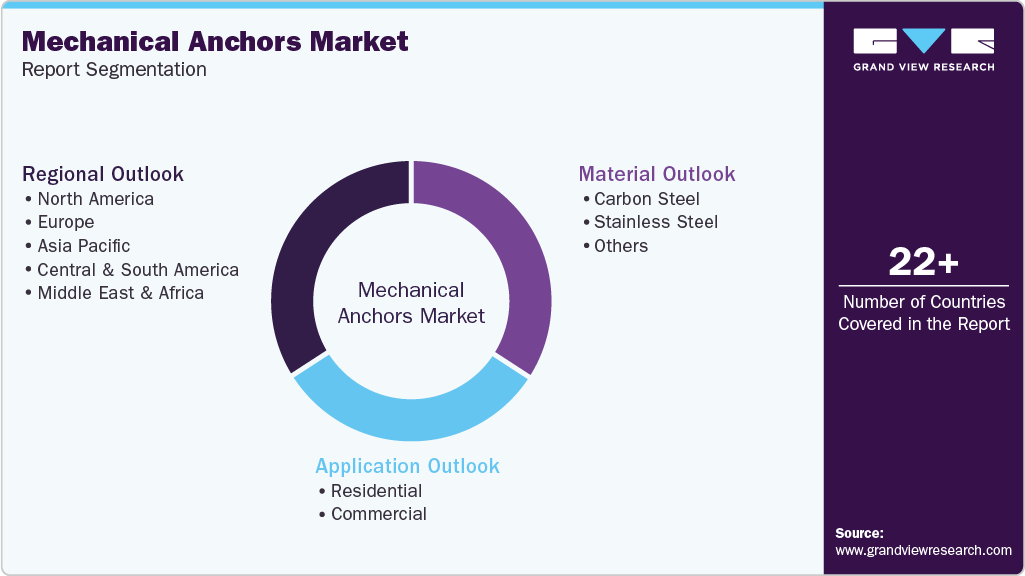
This report forecasts revenue growth at global, regional & country levels and provides an analysis on the industry trends in each of the sub-segments from 2021 to 2033. For this study, Grand View Research has segmented the mechanical anchors market based on material, application, and region.
-
Material Outlook (Revenue, USD Million, 2021 - 2033)
-
Carbon Steel
-
Stainless Steel
-
Others
-
-
Application Outlook (Revenue, USD Million, 2021 - 2033)
-
Residential
-
Commercial
-
-
Regional Outlook (Revenue, USD Million; 2021 - 2033)
-
North America
-
U.S.
-
Canada
-
Mexico
-
-
Europe
-
UK
-
Germany
-
France
-
Spain
-
-
Asia Pacific
-
China
-
Japan
-
India
-
South Korea
-
-
Central & South America
-
Middle East & Africa
-
Saudi Arabia
-
UAE
-
Egypt
-
Qatar
-
Kuwait
-
-
Frequently Asked Questions About This Report
The global mechanical anchors market size was estimated at USD 1.95 billion in 2024 and is expected to reach USD 2.00 billion in 2025.
The global mechanical anchors market is expected to grow at a compound annual growth rate of 3.2% from 2025 to 2033, reaching around USD 2.57 billion by 2033.
Stainless steel was the largest and fastest growing market segment and accounted for 54.5% of the revenue share in 2024 as stainless steel hardly gets oxidized when compared to other materials including iron, and carbon steel.
Some of the key players operating in the mechanical anchor market include Stanley Black & Decker, Inc., Guangdong Kin Long Hardware Products Co., Ltd, Hilti Group, Simpson Strong-Tie Company, Inc., and Illinois Tool Works Inc.
The key factor which is driving the mechanical anchor market is the rise in building and construction activities due to rapid urbanization and industrialization across the globe.
About the Author(s)
Advanced Interior Materials Research Team
Advanced Materials · Advanced Interior MaterialsThis report was authored by the advanced interior materials research team at Grand View Research - comprising two research analysts, one senior research analyst, and one industry expert - with specialized expertise in the advanced interior materials segment of the advanced materials industry. All findings are based on proprietary advanced materials databases, executive interviews, and regulatory analysis, subject to internal peer review prior to publication.
Last Updated:
Speak to Analyst


Customize this report to your needs — add regions, segments, or data points, with 20% free customization.
Or view our licence options:


ISO 9001:2015 & 27001:2022 Certified
We are GDPR and CCPA compliant! Your transaction & personal information is safe and secure. For more details, please read our privacy policy.


