
- Home
- »
- Clothing, Footwear & Accessories
- »
-
Mechanical Watch Market Size & Share Report, 2026-2033GVR Report cover

Mechanical Watch Market (2026 - 2033)
Size, Share & Trends Analysis Report By Price (Entry-Level, Luxury), By End-user (Men, Women), By Distribution Channel (Online, Offline), By Region (North America, Europe, Asia Pacific, Central & South America, Middle East & Africa), And Segment Forecasts
Market Size, 2025
$47.5BMarket Estimate, 2026
$49.5BMarket Forecast, 2033
$67.3BCAGR, 2026–2033
4.5%Mechanical Watch Market Summary
The global mechanical watch market size was valued at USD 47.5 billion in 2025 and is projected to grow from USD 49.5 billion in 2026 to USD 67.3 billion by 2033, at a CAGR of 4.5% from 2026 to 2033. North America dominated the market, accounting for a revenue share of 33.8% in 2025. Rising consumer demand for luxury, craftsmanship, and status-symbol timepieces supports this growth.
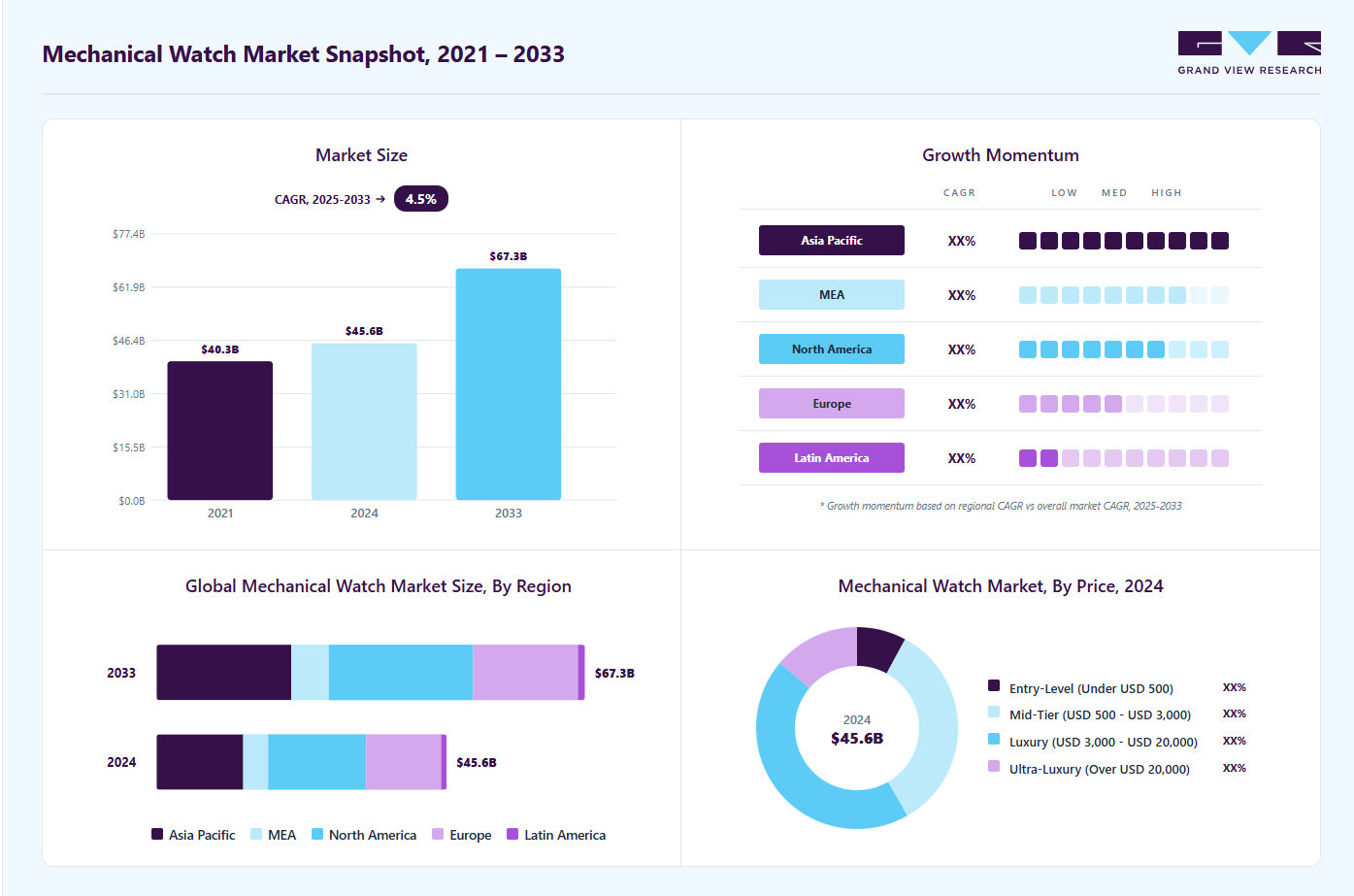 Source: Grand View Research, IR Documents, Primary Interviews, Paid DatabasesTo learn more about this report,
 Download Free Sample Report
 Key Market Trends & Insights
- By distribution channel: Offline channel segment held the largest market share of 87.0% in 2025.
- By price: Luxury (USD 3,000 - USD 20,000) mechanical watch segment dominated the market, with a revenue share of 44.5% in 2025.
- By end user: Men segment held the largest market share of 75.0% in 2025.
Regional Highlights
- Largest regional market: North America (33.8% revenue share, 2025)
- Fastest-growing regional market: Asia Pacific (highest CAGR, 2026-2033)
- By country: The U.S. held the largest market share in 2025.
Market Size & Forecast
- Market size in 2025: USD 47.5 Billion
- Estimated market size in 2026: USD 49.5 Billion
- Projected market size by 2033: USD 67.3 Billion
- CAGR (2026-2033): 4.5%
GVR research-powered AIAsk Prism AI about the mechanical watch marketGet cited answers from GVR research on market growth, segments, regulations and forecasts.Start with✓ Source-linked answers ✓ Market-specific context ✓ Traceable figuresExplore Prism AI ↗
This growth is fueled by its enduring allure of intricate engineering, timeless design, and artisanal excellence. Manufacturers leverage the perception of sophistication and durability, enabling premium pricing and brand prestige. This appeal resonates with seasoned collectors in established markets and aspirational buyers in emerging regions, ensuring steady demand and reinforcing the market’s position as a symbol of craftsmanship and luxury.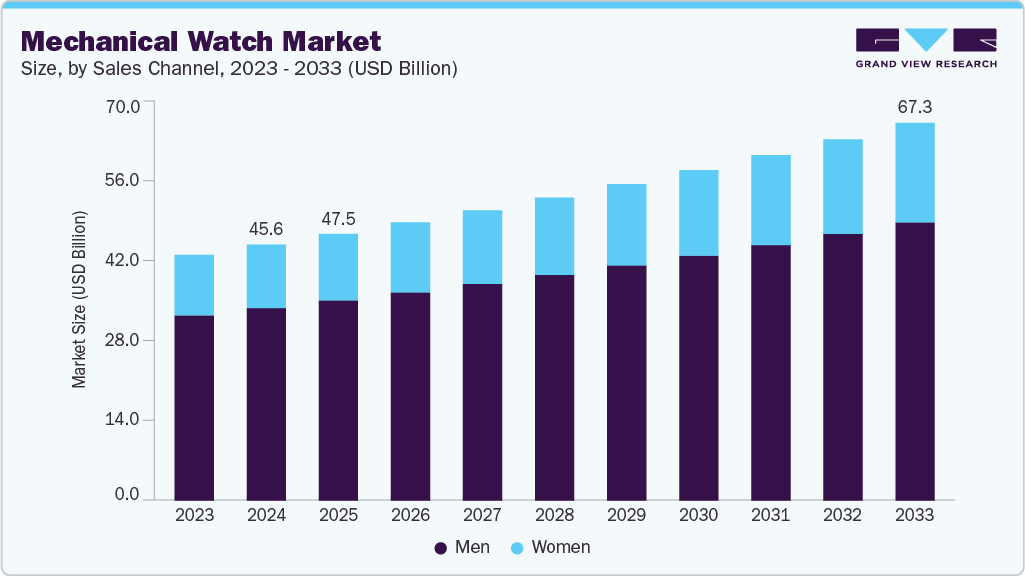 To learn more about this report, Download Free Sample Report
 Consumers, especially in North America, Europe, and APAC, increasingly value products that signify status and craftsmanship. With their intricate movements and heritage branding, mechanical watches are seen as collectibles rather than mere timekeeping tools. Limited-edition releases, collaborations with luxury fashion brands, and bespoke customization options create hype and drive sales, particularly among millennials and Gen Z buyers who view these watches as investment pieces and lifestyle statements. A May 2025 article by Chrono24 reports that over one-third of Gen Z either already own a high-quality watch or plan to purchase one.
Mechanical watches are increasingly treated as assets rather than just accessories. The secondary market for pre-owned and vintage watches is booming, with brands like Rolex, Patek Philippe, and Audemars Piguet commanding significant premiums. Watch auctions, and social media communities foster a culture of collecting and trading, encouraging both first-time buyers and seasoned collectors to participate in the market. This trend reinforces brand value and drives continuous demand for new models with limited availability. For instance, in June 2024, Audemars Piguet introduced a new watch batch that blends heritage and innovation. Key highlights include the [RE]Master02 Self-winding, a modern take on a 1960s asymmetric model with an 18-carat sand gold case and midnight blue dial, the Royal Oak Selfwinding Full Gemset featuring 861 baguette-cut gemstones in pixelated camouflage patterns.
While established markets like Europe and North America remain strong, rising disposable incomes in countries such as China, India, and the Middle East drive demand for premium watches. E-commerce, digital marketing, and brand-owned online stores have made these products more accessible, allowing consumers in previously underserved regions to explore and purchase mechanical watches directly from renowned brands.
Market Dynamics
The global mechanical watch market represents the premium segment of the watch industry, distinguished by traditional watchmaking, in-house movement craftsmanship, and strong brand heritage. The market is characterized by a high concentration of value within luxury and ultra-luxury brands, where purchasing decisions are influenced by craftsmanship, exclusivity, and brand reputation rather than functional timekeeping alone. Competition remains centered on product quality, heritage, innovation in mechanical movements, and global brand positioning.
A key driver of the market is the growing consumer preference for mechanical watches that reflect craftsmanship, brand heritage, and prestige. Increasing luxury spending, rising high-net-worth populations, and demand for premium gifting and milestone purchases continue to support sales across established mechanical watch brands.
Market growth is constrained by the premium pricing of mechanical watches, which limits adoption to affluent consumers and enthusiasts. In addition, lower-cost quartz watches and multifunctional smartwatches provide practical alternatives for consumers prioritizing affordability and functionality over traditional watchmaking.
A significant opportunity exists in the growing demand for entry-level and mid-premium mechanical watches that offer traditional craftsmanship at more accessible price points. As younger consumers increasingly seek luxury products with strong brand heritage and long-term ownership appeal, manufacturers are expanding their portfolios to attract first-time mechanical watch buyers while broadening the addressable customer base.
Analyst Perspective
The mechanical watch market continues to occupy the premium end of the global watch industry, with demand driven by craftsmanship, brand heritage, and long-term ownership appeal rather than functional timekeeping alone. Market value remains concentrated among established luxury manufacturers with strong pricing power and limited-production strategies. Competition is increasingly shaped by movement innovation, product exclusivity, and brand storytelling, while continued interest from affluent consumers and first-time luxury buyers is expected to support market expansion over the forecast period.
Consumer Insights
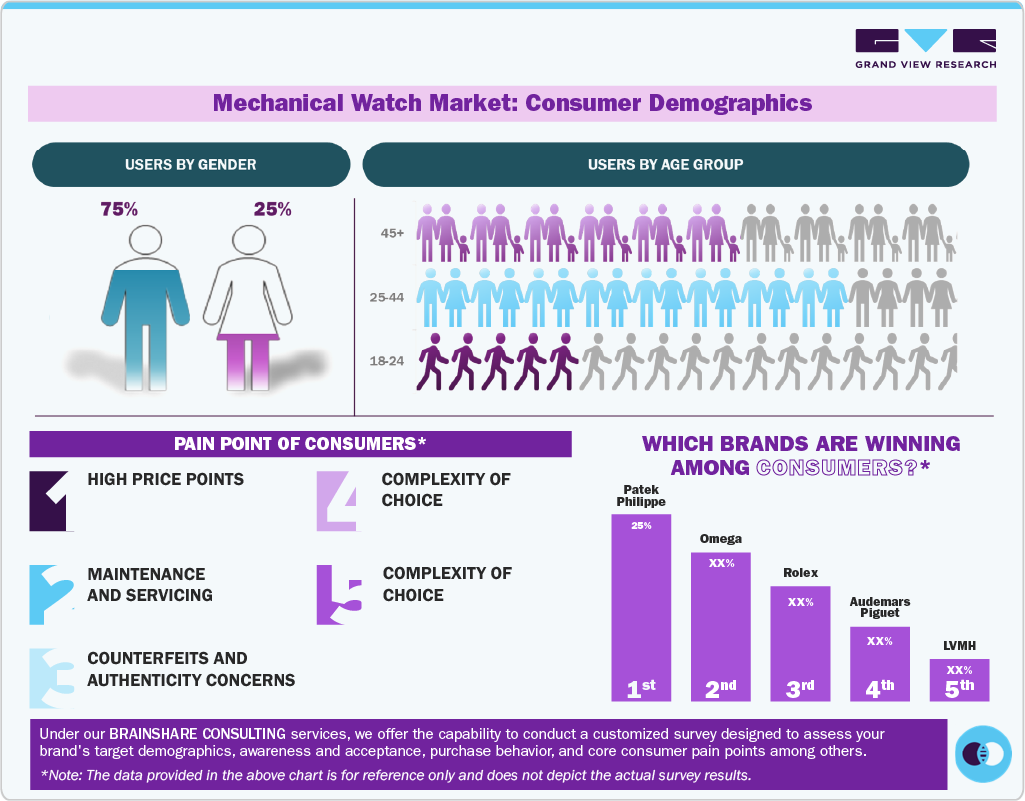
The mechanical watch industry remains largely male-dominated, with approximately 70% of buyers being men and 30% women. While men are drawn to these timepieces as status symbols and collectibles, women increasingly enter the market, often opting for smaller, elegant designs from brands like Cartier and Omega. This gender distribution highlights that, while traditional marketing has targeted men, a growing female segment is shaping design and product offerings.
 To learn more about this report, Download Free Sample Report
 Age-wise, buyers are divided into three main groups. The 25-34 age group is increasingly aspirational, influenced by social media and disposable income, and prefers entry-level to mid-tier luxury watches. The 35-55 age group, often established professionals and collectors, forms the core market, driving demand for mid- to high-end mechanical watches. The 55+ group consists of traditional collectors and repeat buyers, typically investing in ultra-luxury or heritage pieces, often valuing craftsmanship and long-term investment potential over trends.
Despite the market’s appeal, consumers face several challenges. High price points make entry difficult for first-time buyers, while maintenance and servicing requirements add ongoing costs and effort. Complexity in choosing the right model and concerns over counterfeits and authenticity, especially in markets without official brand stores, can discourage potential buyers. These pain points shape consumer behavior, pushing them toward trusted brands and verified purchase channels.
In terms of brand performance, a few key players dominate consumer preference. Rolex leads the market with strong recognition and high resale value, followed by Omega, known for precision and heritage models. Audemars Piguet and Patek Philippe continue to attract ultra-luxury buyers, while LVMH and Richemont’s portfolios cover both mid- and high-tier segments, catering to aspirational buyers and collectors alike. These brands’ focus on craftsmanship, exclusivity, and marketing ensures they remain top choices for mechanical watch enthusiasts worldwide.
End User Insights
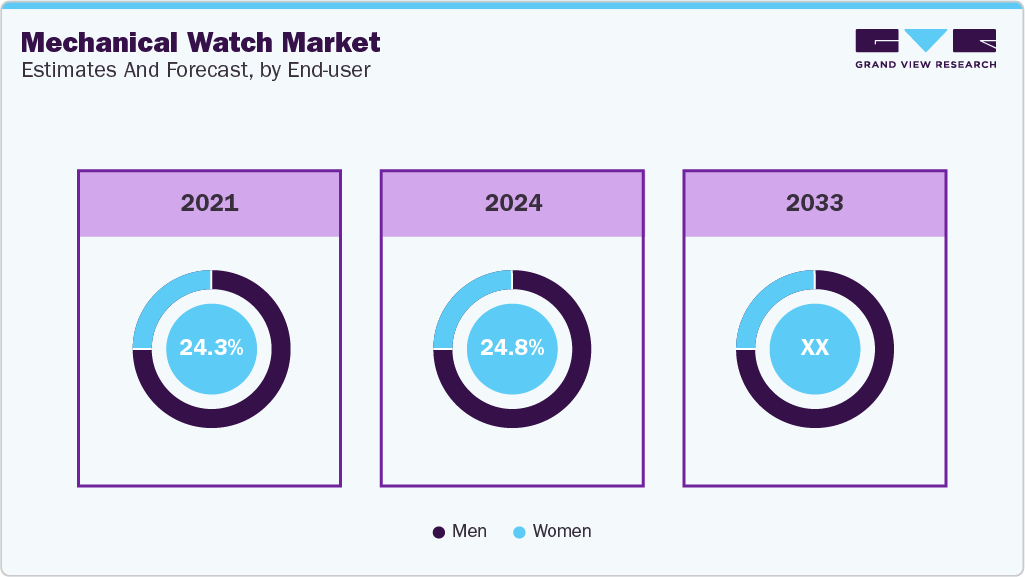
Based on end user, mechanical watch for men led the market with the largest revenue share of 75.0% in 2025, reflecting the longstanding dominance of male consumers in the luxury and enthusiast segments. Men traditionally demand larger, complication-rich timepieces-such as chronographs, tourbillons, and diver watches-from brands like Rolex, TAG Heuer, and Seiko. The segment’s leadership is reinforced by a strong collector culture, higher disposable incomes, and preferences for watches as status symbols or investment assets, while marketing and retail strategies remain heavily focused on male buyers, maintaining their substantial market share.
 To learn more about this report, Download Free Sample Report
 Mechanical watch for women grow at the fastest CAGR over the forecast period, driven by growing interest in luxury and fashion-forward timepieces that combine craftsmanship with style. Brands are increasingly designing smaller, aesthetically refined automatic models tailored to women, such as Omega’s De Ville Prestige or Longines’ Master Collection, which appeal to professional and lifestyle buyers. The segment also benefits from rising female purchasing power and a cultural shift toward collecting watches as statement accessories, supported by targeted marketing campaigns, influencer collaborations, and social media visibility that highlight mechanical sophistication and elegance.
Price Insights
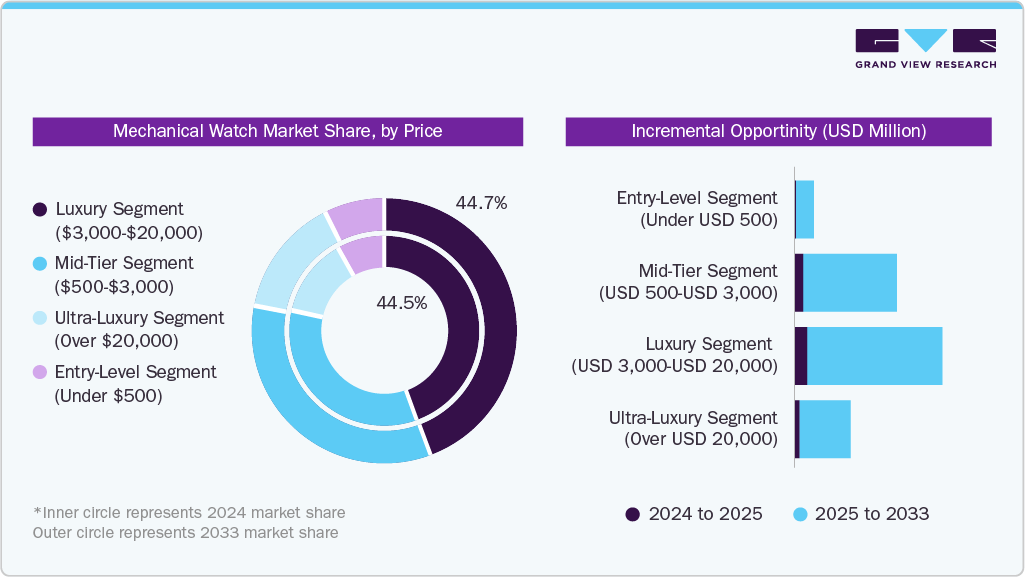
Based on price range, Luxury (USD 3,000 - USD 20,000) mechanical watch led the market with the largest revenue share of 44.5% in 2025, reflecting strong demand for high-quality, accessible prestige timepieces. This segment appeals to enthusiasts and aspirational buyers seeking craftsmanship, brand heritage, and recognizable designs from names like Omega, TAG Heuer, and Longines. Its dominance is supported by widespread availability through authorized boutiques, e-commerce platforms, premium retail partners, regular model updates, limited editions, and marketing campaigns that maintain consumer interest and reinforce the value proposition of luxury mechanical watches.
 To learn more about this report, Download Free Sample Report
 Ultra-Luxury (Over USD 20,000) mechanical watch grow at the fastest CAGR over the forecast period, owing to sustained demand from high-net-worth individuals and collectors seeking exclusivity, heritage, and investment value. Limited editions, bespoke designs, and rare complications from brands like Patek Philippe, Audemars Piguet, and Vacheron Constantin continue to command premiums, while secondary markets and auction platforms amplify visibility and liquidity. In addition, global expansion of flagship boutiques and personalized concierge services enhances accessibility for affluent buyers, supporting steady growth in this niche, prestige-driven segment.
Distribution Channel Insights
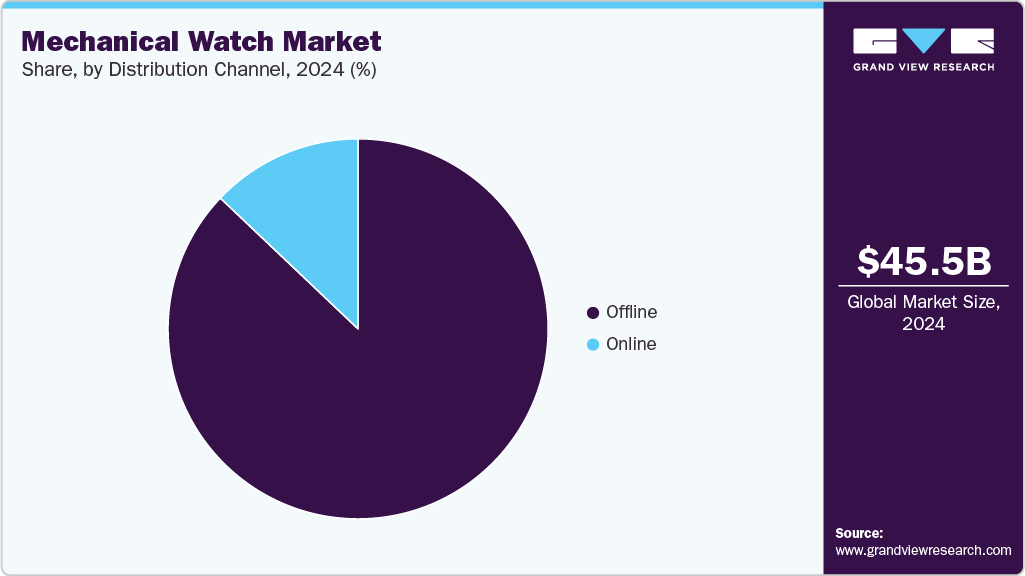
Based on the distribution channel, the sale of mechanical watch through offline channel led the market with a revenue share of 87.0% in 2025, as consumers purchasing high-value timepieces still prioritize tactile and experiential aspects of shopping. Visiting brand boutiques or authorized retailers enables buyers to feel the weight, examine the finishing, and try on watches-essential experiences for the premium and ultra-luxury segments. Personalized services, such as in-store consultations, after-sales support, and access to limited editions, further strengthen the offline stronghold. Moreover, the prestige and confidence linked to established physical stores continue to foster trust, especially for buyers investing in mechanical watches as status symbols and long-term assets.
 To learn more about this report, Download Free Sample Report
 The sale of mechanical watch through online channel is the fastest growing CAGR over the forecast period, as consumer buying habits shift toward digital-first platforms offering greater transparency, variety, and accessibility. Younger buyers, in particular, prefer researching and purchasing online, where side-by-side comparisons, financing options, and resale opportunities are easier to navigate. This blend of convenience, authenticity assurance, and access to new and secondary-market pieces accelerates e-commerce adoption for mechanical watches.
Regional Insights
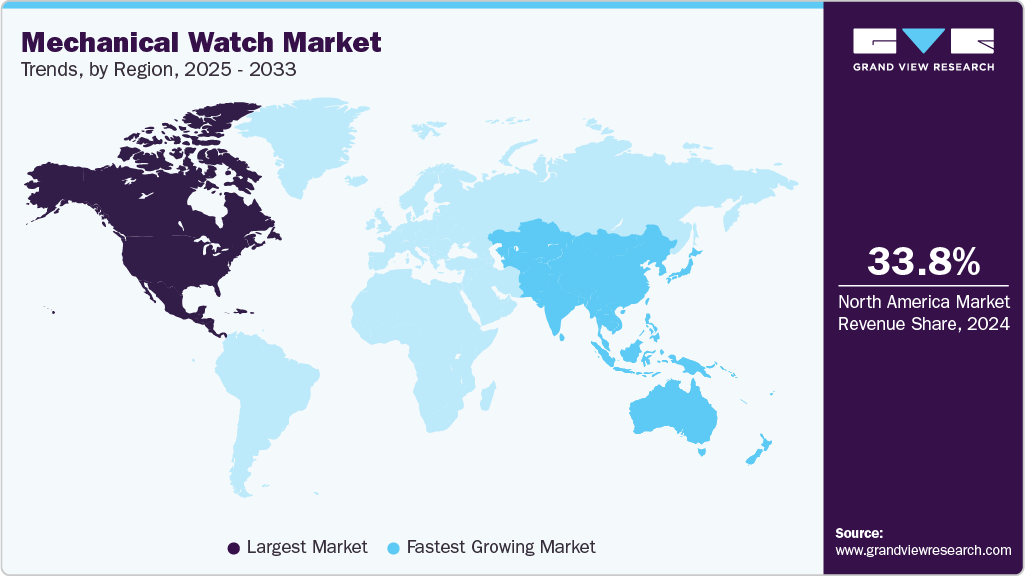
North America dominated the mechanical watch market with the largest revenue share of 33.8% in 2025, supported by the region’s strong culture of collecting and gifting high-value timepieces. Growth is further underpinned by robust retail networks, rising traction of boutique experiences in cities like New York and Los Angeles, and brand-led marketing tied to sports and entertainment. In addition, the expanding secondhand ecosystem and certified pre-owned programs are drawing in buyers who see mechanical watches as lifestyle statements and durable assets, helping sustain long-term demand across income segments.
 To learn more about this report, Download Free Sample Report
 U.S. Mechanical Watch Market Trends
The mechanical watch market in U.S. held the market share of 85.6% in the North America region in 2025. This can be attributed to a mix of heritage appeal and shifting consumer behavior. On the ground, younger affluent buyers are increasingly seeking out mechanical watches not just as luxury goods but as long-term assets. Independent brands and microbrands are also fueling growth by offering accessible automatic models-such as Seiko’s Presage or U.S.-based brands like Weiss-that appeal to first-time buyers priced out of traditional Swiss luxury. This blend of scarcity at the top end and democratization at the entry level underpins the market’s steady expansion.
Asia Pacific Mechanical Watch Market Trends
The mechanical watch industry in the Asia Pacific is anticipated to grow at the fastest CAGR from 2026 to 2033, driven by the rapid expansion of luxury consumption, particularly in China, Hong Kong, and Japan, which serve as retail and re-export hubs for Mechanical watches. Moreover, emerging markets such as India and Southeast Asia are experiencing increased brand penetration through flagship boutiques and premium retail partnerships.
Key Mechanical Watch Company Insights
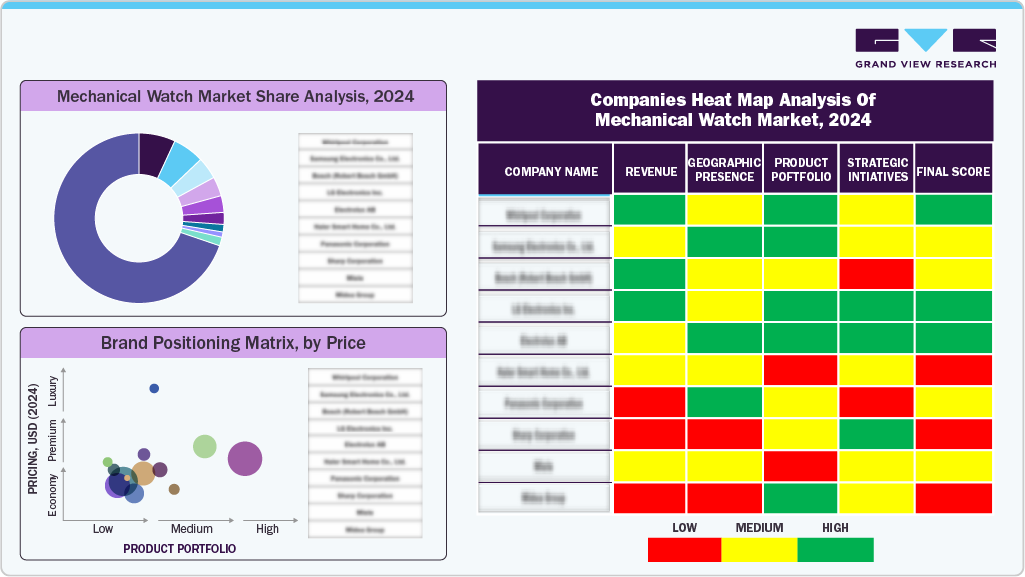
The market is characterized by a diverse mix of global powerhouses, established luxury maisons, and emerging independents, each shaping the industry’s competitive dynamics differently. While heritage-driven brands such as Seiko, Citizen, and Grand Seiko anchor the mid- to premium segments with strong value propositions, European houses like A. Lange & Söhne, IWC, and Jaeger-LeCoultre continue to push technical boundaries in haute horlogerie. Independent makers and microbrands are steadily gaining visibility, leveraging direct-to-consumer channels and niche designs to capture younger, digitally savvy buyers.
Market share leadership varies by price point and geography. Japanese brands hold significant strength in entry and mid-tier categories, Swiss maisons dominate the luxury and ultra-luxury ranges, while boutique independents increasingly compete in the enthusiast community. Companies focus on limited editions, brand collaborations, and heritage-inspired reissues to retain customer loyalty and differentiate in a crowded market. Strategic investment in service networks, personalization options, and sustainability initiatives is also reshaping brand equity, signaling a shift from pure product excellence to holistic brand experiences.
 To learn more about this report, Download Free Sample Report
 Key Mechanical Watch Companies:
The following key companies have been profiled for this study on the mechanical watch market.
-
Rolex
-
Patek Philippe
-
Audemars Piguet
-
Swatch Group
-
LVMH
-
Richemont
-
Seiko Group
-
Citizen Watch Co.
-
Casio
-
Fossil Group
Competitive Benchmarking
Category
Operating Strategies
Competitive Edge
Weakness
Established Players (Rolex, Patek Philippe, Audemars Piguet, Swatch Group, LVMH, Richemont, Seiko Group)
- Focus on heritage-driven brand positioning, in-house movement development, craftsmanship, limited production, and expansion through authorized retail and brand boutiques.
- Strong brand equity, extensive watchmaking expertise, high pricing power, loyal customer base, and global luxury distribution networks.
- High production costs, limited manufacturing scalability, and greater exposure to fluctuations in discretionary luxury spending.
Emerging Players (Citizen Watch Co., Casio, Fossil Group)
- Focus on expanding mechanical watch portfolios, accessible luxury positioning, product innovation, and strengthening retail and online distribution.
- Competitive pricing, broad consumer reach, diversified product portfolios, and strong manufacturing capabilities.
- Lower prestige in the luxury mechanical watch segment and comparatively weaker brand perception among high-end collectors and enthusiasts.
Recent Developments
-
In September 2025, Casio India officially entered the mechanical watch segment by launching its first-ever automatic timepiece collection in India-the Edifice EFK-100 series. Drawing inspiration from motorsports, this lineup includes five distinctive models, featuring premium finishes like forged carbon on select watches for a lightweight yet durable design aesthetic.
-
In August 2025, Seiko expanded its heritage-driven portfolio by introducing its latest releases, led by the Prospex Marinemaster “Shinkai.” Limited to 600 pieces, this professional diver features a titanium case with diamond-like coating, a deep-sea inspired dial, and Seiko’s new 8L45 automatic movement with a three-day power reserve. Alongside it, the King Seiko VANAC Collection debuted with five colorful models, reviving 1970s design flair while celebrating Tokyo’s vibrant skyline.
Mechanical Watch Market Report Scope
Report Attribute
Details
Market size in 2025
USD 47.5 billion
Estimated market size in 2026
USD 49.5 billion
Projected market size by 2033
USD 67.3 billion
Growth rate
CAGR of 4.5% from 2026 to 2033
Base year for estimation
2025
Historical data
2021 - 2024
Forecast period
2026 - 2033
Quantitative units
Revenue in USD million/billion and CAGR from 2026 to 2033
Report coverage
Revenue forecast, company ranking, competitive landscape, growth factors, and trends
Segments covered
Price , end user, distribution channel, region
Regional scope
North America; Europe; Asia Pacific; Central & South America; Middle East & Africa
Country scope
U.S.; Canada; Mexico; Germany; UK; France; Italy; Spain; China; Japan; India; South Korea; Australia & New Zealand; Brazil; South Africa
Key companies profiled
Rolex; Patek Philippe; Audemars Piguet; Swatch Group; LVMH; Richemont; Seiko Group; Citizen Watch Co.; Casio; Fossil Group
Customization scope
Free report customization (equivalent up to 8 analysts' working days) with purchase. Addition or alteration to country, regional & segment scope.
Pricing and purchase options
Avail customized purchase options to meet your exact research needs. Explore purchase options
Global Mechanical Watch Market Report Segmentation
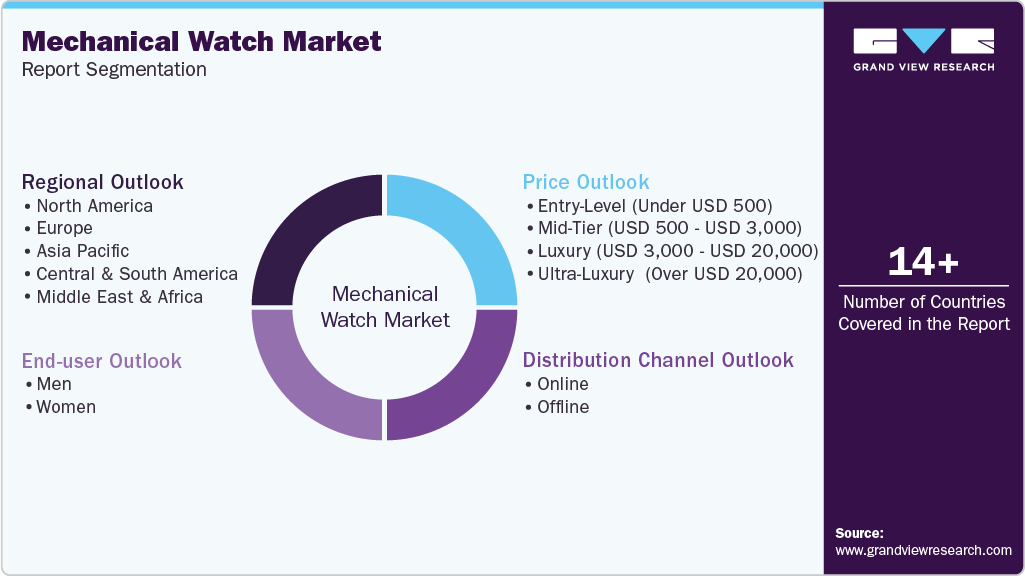
This report forecasts revenue growth at the global, regional, and country levels and provides an analysis of the latest industry trends and opportunities in each of the sub-segments from 2021 to 2033. For this study, Grand View Research has segmented the global mechanical watch market report based on price, end user, distribution channel, and region:
 To learn more about this report, Download Free Sample Report
 -
Price Outlook (Revenue, USD Million, 2021 - 2033)
-
Entry-Level (Under USD 500)
-
Mid-Tier (USD 500 - USD 3,000)
-
Luxury (USD 3,000 - USD 20,000)
-
Ultra-Luxury (Over USD 20,000)
-
-
End User Mode Outlook (Revenue, USD Million, 2021 - 2033)
-
Men
-
Women
-
-
Distribution Channel (Revenue, USD Million; 2021 - 2033)
-
Online
-
Offline
-
-
Regional Outlook (Revenue, USD Million; 2021 - 2033)
-
North America
-
U.S.
-
Canada
-
Mexico
-
-
Europe
-
UK
-
Germany
-
France
-
Italy
-
Spain
-
-
Asia Pacific
-
China
-
Japan
-
India
-
Australia
-
South Korea
-
-
Central & South America
-
Brazil
-
-
Middle East & Africa
-
South Africa
-
-
Research Methodology
The mechanical watch market figures in this report are based on a proven research process that combines executive interviews with secondary research from proprietary databases, company filings, and recognized regulatory and institutional sources. Market size is built through value-chain sizing - reconciling supply-side and demand-side estimates - and triangulated with bottom-up and top-down approaches. Every estimate passes multiple levels of expert validation before publication, with each mechanical watch segment quantified using the revenue-capture definitions in the table below.
Segment Definition
Segment - Price
Revenue capture definition
Entry-Level (Under USD 500)
Revenue is generated through the sale of entry-level mechanical watches priced below USD 500, offering automatic or manual mechanical movements and traditional watchmaking at accessible price points. Revenue includes purchases through authorized retailers, specialty stores, and online channels.
Mid-Tier (USD 500 - USD 3,000)
Revenue is generated through the sale of mid-tier mechanical watches priced between USD 500 and USD 3,000, featuring enhanced movement quality, refined craftsmanship, premium materials, and established brand positioning. Revenue includes purchases through authorized dealers, brand boutiques, and online retail channels.
Luxury (USD 3,000 - USD 20,000)
Revenue is generated through the sale of luxury mechanical watches priced between USD 3,000 and USD 20,000, distinguished by in-house or high-grade mechanical movements, superior craftsmanship, premium materials, and strong brand heritage. Revenue includes purchases through luxury boutiques and authorized dealers.
Ultra-Luxury (Over USD 20,000)
Revenue is generated through the sale of ultra-luxury mechanical watches priced above USD 20,000, characterized by exceptional hand craftsmanship, complex mechanical complications, precious materials, limited production, and prestigious brand positioning. Revenue includes purchases through exclusive boutiques, authorized dealers, and private client channels.
Estimation Model
Layer Name
Key Question
Description
Addressable Consumer Base Layer
Who forms the addressable customer base?
Consumers across different income groups seeking timepieces for personal use, gifting, luxury consumption, and collection.
Watch Ownership & Purchase Layer
Who purchases watches?
Consumers purchasing watches for first-time ownership, replacement, gifting, milestone occasions, or collection expansion through offline and online retail channels.
Mechanical Watch Adoption Layer
Which consumers choose mechanical watches?
Consumers selecting mechanical watches based on craftsmanship, heritage, movement complexity, brand prestige, and long-term ownership preferences across different price segments.
Monetisation Layer
How much revenue is generated?
Revenue generated through the sale of mechanical watches across price segments, brands, distribution channels, and consumer groups.
Delivered Customizations
This report has been delivered with the following In-depth customizations
Client Request
Customization Delivered
Value Adds
Price Segment Analysis (Price Range × Distribution Channel)
Mapped demand across economy, mid-range, premium, luxury, and ultra-luxury quartz watches by consumer demographics, purchase intent, and spending behavior.
Identifies the highest-value consumer segments and supports targeted product positioning across price tiers.
Movement Complexity Analysis
Evaluated market demand for watches based on movement sophistication (time-only, chronograph, GMT, moonphase, perpetual calendar, etc.).
Supports premium product portfolio planning and identifies high-value product opportunities.
Authorized Retail & Boutique Performance Assessment
Evaluated the role of brand boutiques, authorized dealers, independent retailers, and online luxury platforms in mechanical watch sales.
Identifies the most effective sales channels and supports luxury distribution strategies.
Frequently Asked Questions About This Report
Quartz watch for men led with a 75.0% revenue share in 2025, while mechanical watch for women is the fastest-growing segment.
Luxury (USD 3,000 - USD 20,000) mechanical watch led the market with the largest revenue share of 44.5% in 2025, Ultra-Luxury (Over USD 20,000) mechanical watch is the fastest-growing segment.
Key players include Rolex; Patek Philippe; Audemars Piguet; Swatch Group; LVMH; Richemont; Seiko Group; Citizen Watch Co.; Casio; Fossil Group
The global mechanical watch market size was valued at USD 47.5 billion in 2025 and is estimated at USD 49.5 billion for 2026.
The global mechanical watch market is expected to grow at a CAGR of 4.5% from 2026 to 2033, reaching USD 67.3 billion.
The global mechanical watch market’s growth is fueled by its enduring allure of intricate engineering, timeless design, and artisanal excellence. Manufacturers leverage the perception of sophistication and durability, enabling premium pricing and brand prestige.
North America dominated with a 33.8% revenue share in 2025.
Asia Pacific is the fastest-growing region over the forecast period.
Offline channel segment held the largest market share of 87.0% in 2025.
About the Author(s)
Clothing, Footwear & Accessories Research Team
Consumer Goods · Clothing, Footwear & AccessoriesThis report was authored by the clothing, footwear & accessories research team at Grand View Research - comprising two research analysts, one senior research analyst, and one industry expert - with specialized expertise in the clothing, footwear & accessories segment of the consumer goods industry. All findings are based on proprietary consumer goods databases, executive interviews, and regulatory analysis, subject to internal peer review prior to publication.
Last Updated:
Speak to Analyst

Customize this report to your needs - add regions, segments, or data points, with 20% free customization.
Or view our licence options:


ISO 9001:2015 & 27001:2022 Certified
We are GDPR and CCPA compliant! Your transaction & personal information is safe and secure. For more details, please read our privacy policy.


