
- Home
- »
- Medical Devices
- »
-
Medical Device And Equipment Tags Market Report 2026-2033GVR Report cover

Medical Device And Equipment Tags Market (2026 - 2033)
Size, Share & Trends Analysis Report By Tag Technology (Passive Optical Tags, RFID Tags, Real-Time Location System (RTLS) Tags), By Product Form Factor, By Asset/Application Type, By End-use, By Region, And Segment Forecasts
Market Size, 2025
$1.9BMarket Estimate, 2026
$2.1BMarket Forecast, 2033
$3.6BCAGR, 2026–2033
8.4%Medical Device And Equipment Tags Market Summary
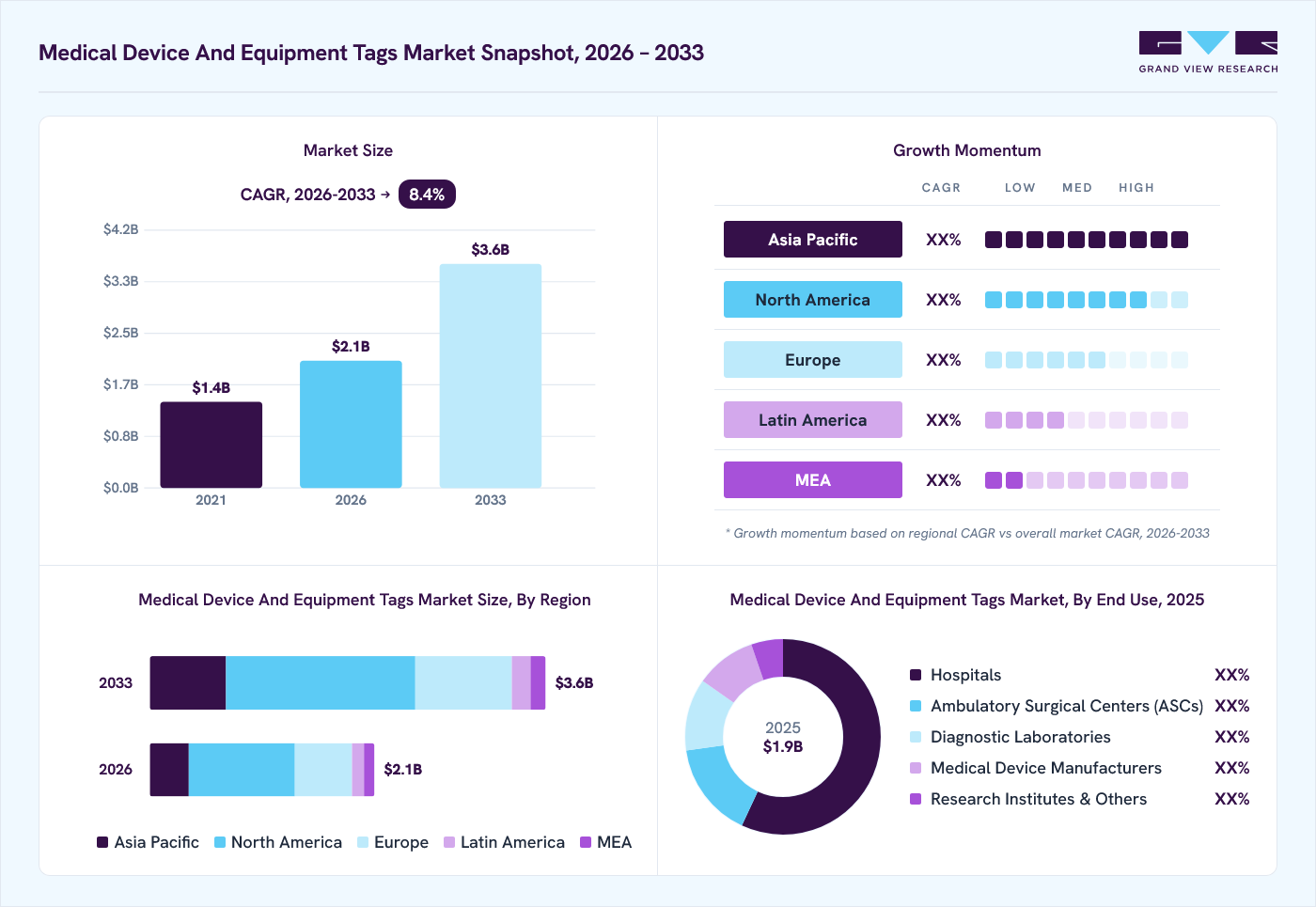
The global medical device & equipment tags market size was valued at USD 1.9 billion in 2025 and is projected to grow from USD 2.1 billion in 2026 to USD 3.6 billion by 2033, at a CAGR of 8.4% from 2026 to 2033. North America dominated the market, accounting for the largest revenue share of 47.1% in 2025. The growth of the medical device & equipment tags industry is primarily driven by increasingly stringent regulatory requirements for Unique Device Identification (UDI) and product traceability, compelling healthcare providers and manufacturers to adopt durable, compliant tagging solutions.
 Source: Grand View Research, IR Documents, Primary Interviews, Paid DatabasesTo learn more about this report,
 Download Free Sample Report
Key Market Trends & Insights
- By tag technology: Passive optical tags held the largest revenue share of 57.7% in 2025
- By product form factor: Direct part marking (DPM) held the largest revenue share of 36.7% in 2025
- By asset/application type: Surgical instruments & trays held the largest revenue share of 35.5% in 2025
- By end use: Hospitals held the largest revenue share of 56.9% in 2025
Regional Highlights
- Largest regional market: North America (47.1% revenue share, 2025)
- Highest-growing regional market: Asia Pacific (highest CAGR, 2026-2033)
- By country: The U.S. held the largest revenue share of North America in 2025
Market Size & Forecast
- Market Size in 2025: USD 1.9 Billion
- Estimated market size in 2026: USD 2.1 Billion
- Projected Market Size by 2033: USD 3.6 Billion
- CAGR (2026-2033): 8.4%
Prism AI by Grand View Research Free to tryAsk a question about the medical device and equipment tags marketTry asking✓Every figure cited from GVR research Prefer the report? Download free sample →
In addition, the growing adoption of RFID- and barcode-based asset management systems, rising investments in hospital digitalization, and the need to improve equipment utilization, preventive maintenance, and patient safety are accelerating market demand. Stringent unique device identification (UDI) and medical device traceability regulations drive the medical device & equipment tags market, as regulatory authorities require standardized labeling to improve device identification and lifecycle tracking. Compliance with regulations such as the U.S. FDA’s UDI requirements and the EU Medical Device Regulation (EU MDR) has accelerated the adoption of durable barcode, QR code, and RFID-enabled tags. These tagging solutions enhance product traceability, streamline recall management, strengthen regulatory compliance, and improve patient safety across healthcare systems and medical device supply chains.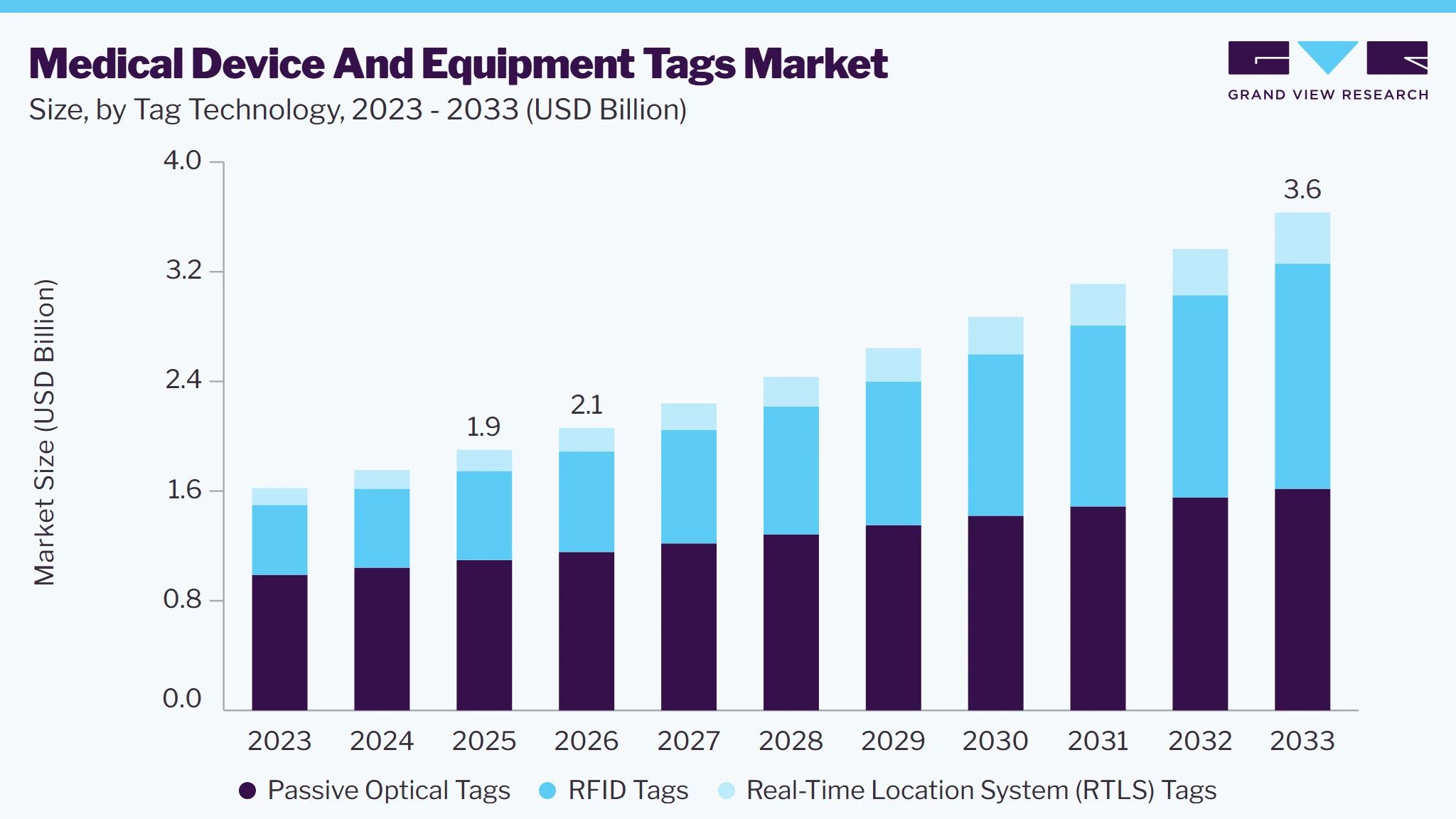 To learn more about this report, Download Free Sample Report
-
In May 2026, the European Commission made the EUDAMED UDI/Devices module mandatory for manufacturers placing new medical devices on the EU market, requiring registration of UDI/device information to strengthen traceability and lifecycle management.
-
In July 2025, the Medical Device Coordination Group (MDCG) published guidance clarifying Master UDI-DI implementation timelines for specific medical devices, encouraging manufacturers to prepare for expanded UDI registration requirements within EUDAMED.
The growing adoption of RFID- and barcode-based asset tracking systems is a key driver of the medical device and equipment tags market, enabling healthcare providers to monitor the real-time location, utilization, and maintenance status of critical medical equipment. These technologies help reduce equipment loss, improve inventory accuracy, optimize asset utilization, and streamline preventive maintenance schedules. As hospitals continue to invest in digital asset management and smart healthcare infrastructure, demand for durable RFID- and barcode-enabled medical device tags is increasing significantly.
Recent Industry Developments in RFID and Barcode-Based Medical Asset Tracking
Date
Company/Organization
Latest Instance
Jan-26
Zebra Technologies
Zebra expanded its healthcare asset tracking solutions, enabling hospitals to use RFID and barcode technologies for real-time visibility of critical assets such as infusion pumps, wheelchairs, and imaging equipment. (Zebra Technologies)
Jan-26
Cybra
Cybra highlighted the growing integration of RFID with AI and IoT in healthcare, enabling hospitals to automate asset tracking, medication management, and inventory visibility while reducing reliance on manual barcode workflows. (CYBRA)
Source: Company Websites
The expansion of healthcare infrastructure and the rise of smart hospitals are significant drivers of the medical device & equipment tags market, as healthcare facilities increasingly adopt digital technologies to improve operational efficiency and patient care. The growing installation of connected medical equipment and smart asset management systems is driving demand for RFID-, barcode-, and QR code-enabled tags for real-time tracking and inventory management. In addition, investments in new hospitals, ambulatory surgical centers, and healthcare modernization projects are accelerating the adoption of durable equipment tagging solutions that support preventive maintenance, regulatory compliance, and optimized asset utilization.
Market Dynamics
The medical device & equipment tags market is driven by stringent Unique Device Identification (UDI) regulations, the increasing adoption of RFID- and barcode-based asset tracking systems, and expanding investments in smart hospitals and digital healthcare infrastructure. The growing emphasis on patient safety, equipment traceability, and efficient inventory management is accelerating demand for durable, sterilization-resistant tagging solutions. While high implementation costs and integration challenges with legacy hospital systems restrain market growth, ongoing advancements in IoT-enabled asset management, cloud-based tracking platforms, and healthcare automation are expected to create significant opportunities for market expansion.
The growth of the medical device & equipment tags market is driven by stringent global regulations requiring Unique Device Identification (UDI) and comprehensive product traceability throughout the medical device lifecycle. Healthcare providers and manufacturers are increasingly adopting RFID-, barcode-, and QR code-enabled tagging solutions to improve asset visibility, regulatory compliance, recall management, and patient safety. Furthermore, the rapid digitalization of hospitals and growing investments in smart asset management systems are driving demand for durable, intelligent medical device and equipment tags.
The medical device & equipment tags market faces challenges due to the high initial costs associated with deploying RFID-enabled tagging systems, including investments in tags, readers, software, and supporting IT infrastructure. In addition, integrating advanced asset tracking solutions with legacy hospital information systems can be complex and time-consuming. These costs and interoperability challenges may slow adoption, particularly among small healthcare facilities and organizations with limited technology budgets.
The expansion of smart hospitals and the rapid digitalization of healthcare infrastructure present significant growth opportunities for the medical device & equipment tags market. Increasing adoption of IoT-enabled asset management platforms, real-time location systems (RTLS), and cloud-based inventory solutions is driving demand for intelligent RFID- and barcode-enabled tags. In addition, rising healthcare investments in emerging economies and the growing need for efficient equipment utilization and lifecycle management are creating new opportunities for advanced medical device tagging solutions.
Market Concentration & Characteristics
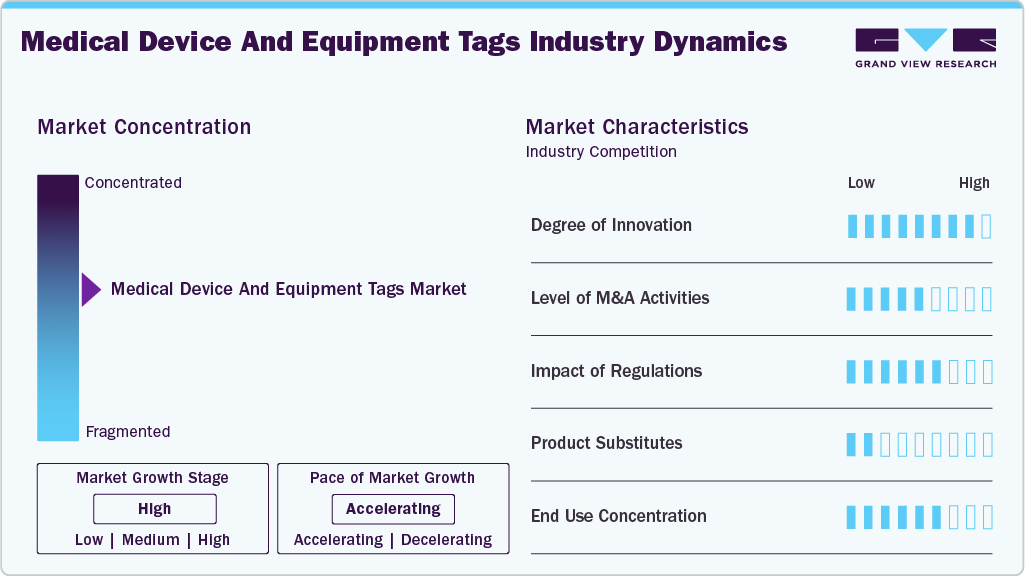
The medical device & equipment tags industry is witnessing moderate to high innovation, driven by the integration of RFID, NFC, QR codes, and IoT-enabled smart tagging technologies that enable real-time asset tracking and lifecycle management. Manufacturers are developing highly durable tags that withstand repeated sterilization, chemical exposure, and harsh hospital environments while supporting UDI compliance. In addition, innovations in printable electronics, cloud-based asset management platforms, and antimicrobial label materials are enhancing equipment traceability, operational efficiency, and patient safety across healthcare facilities. For instance, in April 2026, Avery Dennison launched a new portfolio of RFID inlays designed to withstand major medical sterilization methods, enabling reliable identification and traceability of reusable medical devices and surgical instruments throughout repeated sterilization cycles while supporting regulatory compliance and healthcare asset management.
The medical device & equipment tags market has experienced moderate merger and acquisition (M&A) activity, primarily driven by companies seeking to strengthen their capabilities in RFID technology, intelligent labeling, and healthcare identification solutions. Strategic acquisitions have focused on expanding product portfolios, enhancing digital traceability and UDI compliance offerings, and increasing global manufacturing and distribution capabilities. As hospitals continue adopting connected asset management systems and regulatory requirements become more stringent, M&A activity is expected to remain focused on smart labeling, IoT-enabled tracking technologies, and healthcare automation solutions.
 To learn more about this report, Download Free Sample Report
Regulatory requirements have a high impact on the market, as frameworks such as the U.S. FDA’s Unique Device Identification (UDI) system and the EU Medical Device Regulation (EU MDR) mandate standardized labeling and product traceability. These regulations have accelerated the adoption of durable barcode, QR code, and RFID-based tags that enable accurate device identification throughout the product lifecycle. Compliance requirements are also driving innovation in sterilization-resistant tagging materials and digital tracking solutions, improving patient safety, recall management, and healthcare asset visibility.
The market is highly concentrated in hospitals and healthcare systems, which account for the largest share due to extensive inventories of medical equipment requiring identification, maintenance tracking, and regulatory compliance. Medical device manufacturers also represent a significant end-use segment, driven by UDI labeling requirements and product traceability. Demand is increasing further across ambulatory surgical centers, diagnostic laboratories, and long-term care facilities as these organizations adopt digital asset management and inventory-tracking solutions.
Analyst Perspective
The medical device & equipment tags market is expected to witness significant growth, driven by increasing demand for asset traceability, regulatory compliance, and digital transformation across healthcare facilities. While passive optical tags continue to dominate due to their affordability and widespread adoption, RFID and RTLS tags are gaining momentum as hospitals invest in real-time asset tracking and smart inventory management. In the future, integration with IoT-enabled healthcare infrastructure, automation platforms, and hospital information systems is expected to accelerate the adoption of intelligent tagging solutions, creating opportunities for both established manufacturers and technology-focused entrants.
Tag Technology Insights
Passive optical tags dominated the medical device & equipment tags market in 2025 due to their low cost, ease of implementation, and widespread use in barcode- and QR-code-based identification systems. Healthcare providers extensively adopted these tags for equipment identification, inventory management, sterilization tracking, and regulatory labeling. Their compatibility with existing scanning infrastructure and minimal maintenance requirements further strengthened their market leadership.
The RFID tags segment is expected to grow at the fastest CAGR during the forecast period, driven by the increasing adoption of real-time asset tracking, automated inventory management, and enhanced equipment traceability. Hospitals and healthcare facilities are investing in RFID-enabled systems to reduce asset loss, improve operational efficiency, and support regulatory compliance. The growing shift toward smart hospitals and digital healthcare infrastructure is expected to accelerate RFID tag adoption further.
Product Form Factor Insights
Direct part marking (DPM) dominated the medical device & equipment tags industry in 2025, owing to its ability to provide permanent, durable identification directly on medical devices and surgical instruments. Its resistance to repeated sterilization, chemicals, and wear made it the preferred marking method for reusable medical equipment. Growing regulatory requirements for Unique Device Identification (UDI) and product traceability further supported its widespread adoption.
Adhesive labels are expected to grow at the fastest CAGR over the forecast period, due to their versatility, ease of application, and compatibility with a wide range of medical devices and packaging formats. The increasing demand for durable, sterilization-resistant labels that support Unique Device Identification (UDI) and regulatory compliance is driving adoption. Advancements in high-performance adhesive materials and printable label technologies are expected to further accelerate market growth.
Asset/Application Type Insights
Surgical instruments & trays dominated the medical device & equipment tags market in 2025 due to the high volume of reusable instruments requiring permanent identification and traceability. Hospitals increasingly adopted tagging solutions to improve sterilization tracking, inventory management, and compliance with Unique Device Identification (UDI) regulations. The growing number of surgical procedures further strengthened the segment's dominance.
Implantable medical devices are expected to register the fastest CAGR during the forecast period, driven by increasing demand for lifetime traceability, patient safety, and stringent Unique Device Identification (UDI) regulations. The growing adoption of orthopedic, cardiovascular, and dental implants is driving demand for durable, high-performance tagging solutions. Advancements in RFID and permanent marking technologies are further supporting segment growth.
End Use Insights
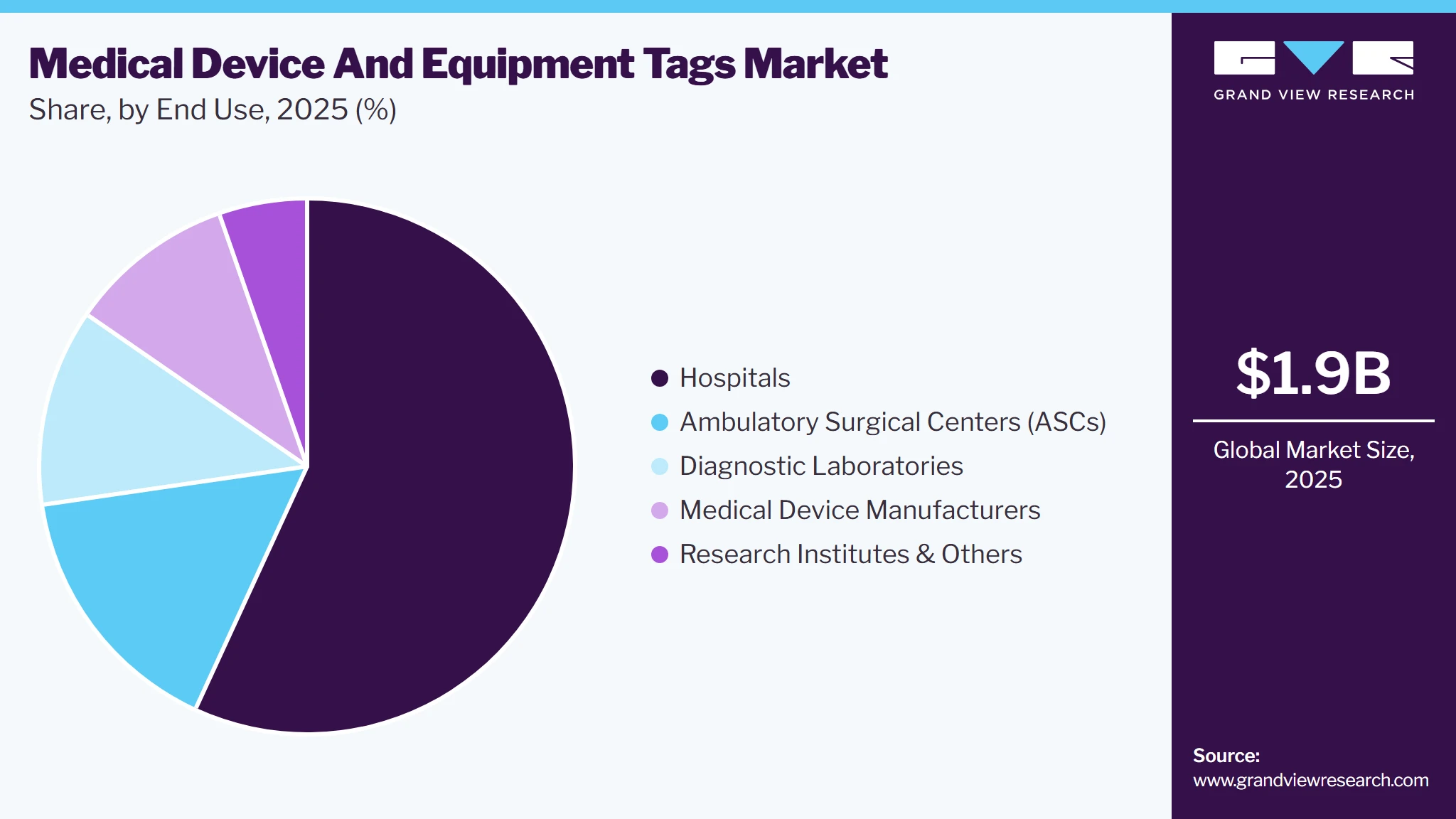
Hospitals dominated the medical device & equipment tags industry in 2025 due to their extensive use of tagged medical devices and equipment for asset management, patient safety, and regulatory compliance. The high volume of surgical procedures and large inventories of reusable medical equipment increased demand for reliable tagging solutions. Growing adoption of digital inventory management and traceability systems further strengthened the segment’s market leadership.
 To learn more about this report, Download Free Sample Report
Ambulatory surgical centers (ASCs) are expected to register the fastest CAGR over the forecast period, driven by the growing shift toward outpatient surgical procedures and the increasing demand for efficient asset tracking. ASCs are adopting advanced tagging solutions to improve equipment utilization, streamline inventory management, and ensure regulatory compliance. The expansion of minimally invasive surgeries and cost-effective healthcare delivery is expected to further drive segment growth.
Regional Insights
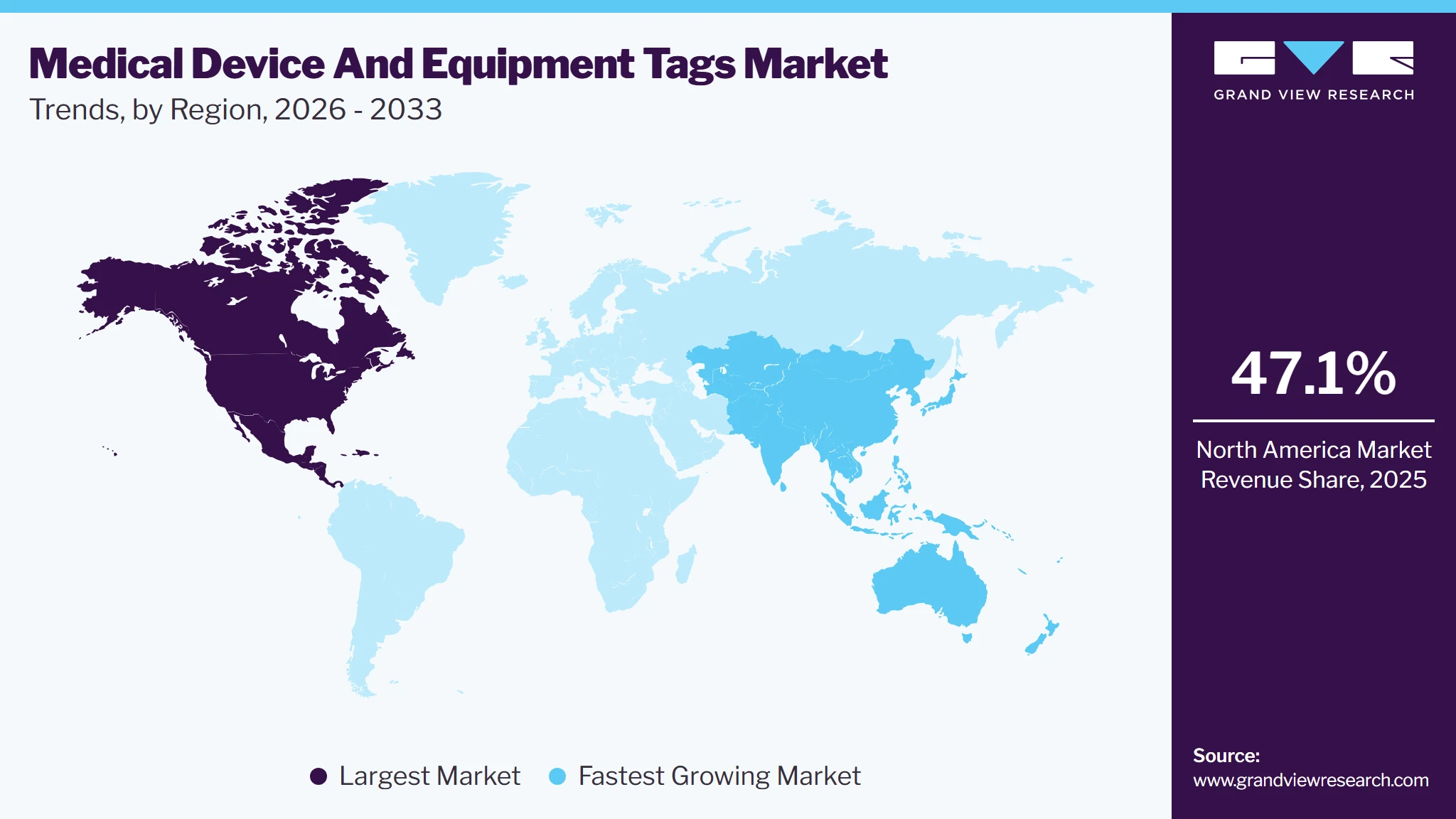
North America held the market accounting for the largest revenue share of 47.1% in 2025. The North America medical device & equipment tags market is witnessing strong growth, driven by the widespread adoption of RFID- and barcode-enabled asset tracking, increasing compliance with the U.S. FDA’s Unique Device Identification (UDI) regulations, and ongoing digital transformation across healthcare facilities. Hospitals and medical device manufacturers are increasingly investing in smart tagging solutions that enable real-time equipment tracking, predictive maintenance, and inventory optimization. Additionally, advancements in sterilization-resistant RFID tags and cloud-based asset management platforms are improving operational efficiency, regulatory compliance, and patient safety across the region.
 To learn more about this report, Download Free Sample Report
U.S. Medical Device And Equipment Tags Market Trends
The U.S. medical device & equipment tags industry is being shaped by stringent FDA Unique Device Identification (UDI) regulations, increasing adoption of RFID-enabled asset tracking, and the digital transformation of hospitals and healthcare systems. Healthcare providers are investing in durable, sterilization-resistant barcode and RFID tags to improve equipment traceability, preventive maintenance, and inventory management. In addition, the growing integration of cloud-based asset management platforms and real-time location systems (RTLS) is enhancing operational efficiency, regulatory compliance, and patient safety across U.S. healthcare facilities.
Europe Medical Device And Equipment Tags Market Trends
The Europe medical device & equipment tags industry is driven by the implementation of the EU Medical Device Regulation (EU MDR), which has strengthened requirements for device identification, traceability, and lifecycle management. Healthcare providers and medical device manufacturers are increasingly adopting RFID-, barcode-, and QR code-based tagging solutions to improve regulatory compliance, inventory control, and patient safety. In addition, the region is witnessing growing investments in smart hospitals and digital healthcare infrastructure, which is accelerating demand for durable, sterilization-resistant equipment tags and connected asset-tracking technologies.
The UK medical device & equipment tags market is witnessing significant growth, driven by the National Health Service (NHS) focus on digital transformation, asset optimization, and patient safety. Healthcare providers are increasingly implementing RFID- and barcode-based tagging solutions to improve equipment tracking, inventory management, and preventive maintenance across hospitals. In addition, evolving post-Brexit medical device regulations and greater emphasis on product traceability are encouraging the adoption of durable, UDI-compliant labeling and smart asset management technologies.
The medical device & equipment tags market in France is experiencing significant growth, supported by increasing investments in healthcare digitalization, stringent compliance with the EU Medical Device Regulation (EU MDR), and the modernization of hospital asset management systems. Healthcare providers are adopting RFID- and barcode-based tagging solutions to enhance equipment traceability, inventory control, and preventive maintenance. Furthermore, the growing emphasis on patient safety, reusable medical device tracking, and connected healthcare infrastructure is driving demand for durable, sterilization-resistant equipment tags nationwide.
Asia Pacific Medical Device And Equipment Tags Market Trends
The Asia Pacific medical device & equipment tags industry is expanding rapidly due to increasing healthcare infrastructure investments, rising medical device manufacturing, and the accelerating adoption of digital hospital management systems. Countries such as China, Japan, India, and South Korea are implementing RFID- and barcode-based tagging solutions to improve equipment traceability, inventory management, and regulatory compliance. In addition, growing awareness of patient safety, healthcare automation, and government initiatives promoting medical device quality standards are driving the demand for advanced equipment tagging solutions across the region.
The Japan medical device & equipment tags market is driven by the country's advanced healthcare infrastructure, increasing adoption of smart hospital technologies, and strong emphasis on medical device traceability and quality management. Hospitals and medical device manufacturers are implementing RFID-, barcode-, and QR code-based tagging solutions to improve asset tracking, inventory control, and equipment maintenance. Furthermore, Japan's focus on healthcare automation, aging population, and stringent regulatory standards is accelerating the demand for durable, high-performance medical device and equipment tags.
Latin America Medical Device And Equipment Tags Market Trends
The Latin America medical device & equipment tags industry is witnessing significant growth, driven by expanding healthcare infrastructure, rising medical device procurement, and the gradual adoption of digital hospital management systems. Healthcare providers across countries such as Brazil and Mexico are implementing barcode- and RFID-based tagging solutions to improve equipment traceability, inventory management, and maintenance efficiency. In addition, rising regulatory awareness, investments in healthcare modernization, and the growing focus on patient safety are driving demand for durable, compliant medical devices and equipment tags across the region.
MEA Medical Device And Equipment Tags Market Trends
The Middle East & Africa medical device & equipment tags industry is experiencing gradual growth, driven by increasing investments in healthcare infrastructure, hospital modernization, and digital asset management initiatives. Healthcare providers are adopting barcode- and RFID-based tagging solutions to enhance medical equipment traceability, inventory control, and preventive maintenance. Furthermore, the growing regulatory focus on patient safety, the expansion of healthcare facilities, and the rising demand for efficient equipment management are driving the adoption of durable medical equipment tags across the region.
Key Medical Device And Equipment Tags Company Insights
The medical device & equipment tags market is moderately consolidated, with leading players such as Avery Dennison Corporation, Brady Corporation, Zebra Technologies Corporation, and CCL Industries Inc. competing through RFID innovation, UDI-compliant labeling solutions, and global distribution networks. Market leaders continue to strengthen their positions by expanding durable tagging portfolios, investing in smart asset-tracking technologies, and forming strategic partnerships with healthcare providers and medical device manufacturers.
Key Medical Device And Equipment Tags Companies
The following key companies have been profiled for this study of the medical device & equipment tags market.
-
AVERY DENNISON CORPORATION
-
Brady
-
PDC
-
Zebra Technologies Corp.,
-
HID Global Corporation
-
Beontag
-
Camcode
-
CILS International
-
Metalcraft, Inc.
-
Dura-ID Solutions
-
GAO Group
-
Salvonic
-
CCL Healthcare
Competitive Benchmarking
Operating Strategies
Competitive Edge
Weaknesses
Established Players (AVERY DENNISON CORPORATION, Brady Corporation, PDC Healthcare)
- Expand product portfolios across RFID, barcode, and RTLS tags.
- Strengthen partnerships with hospitals, OEMs, and distributors.
- Strong brand recognition and established distribution networks.
- Broad product portfolios with proven reliability.
- Higher operating costs and slower product development cycles.
- Legacy product portfolios may limit agility.
Emerging Players (Beontag, Camcode, CILS International)
- Develop niche, application-specific tagging solutions.
- Focus on cost-effective and customizable products.
- Faster innovation cycles and technology adoption.
- Greater flexibility in product customization.
- Limited global presence and brand recognition.
- Smaller production capacity and distribution networks.
Recent Developments
-
In March 2026, Avery Dennison expanded its sterilization portfolio, enabling healthcare facilities to track medical devices and surgical instruments throughout the entire sterilization cycle without compromising RFID performance, thereby enhancing asset traceability and workflow efficiency.
-
In July 2025, Avery Dennison launched its RFID-enabled In-Mold Label (IML) portfolio, designed to be embedded in plastic products during injection molding. The new intelligent labels offer high durability, reliable RFID performance, and support reusable and circular product systems across multiple industries.
Medical Device And Equipment Tags Market Report Scope
Report Attribute
Details
Market size in 2025
USD 1.9 billion
Estimated market size in 2026
USD 2.1 billion
Projected market size by 2033
USD 3.6 billion
Growth rate
CAGR of 8.4% from 2026 to 2033
Base year for estimation
2025
Historical data
2021 - 2024
Forecast period
2026 - 2033
Quantitative units
Revenue in USD million/billion and CAGR from 2026 to 2033
Report coverage
Revenue forecast, company ranking, competitive landscape, growth factors, and trends
Segments covered
Tag technology, product form factor, asset/application type, end use, region
Regional scope
North America; Europe; Asia Pacific; Latin America; MEA
Country scope
U.S.; Canada; Mexico; Germany; UK; France; Italy; Spain; Norway; Denmark; Sweden; Russia; Iceland; Finland; China; Japan; India; South Korea; Australia; Thailand; Singapore; Brazil; Argentina; Saudi Arabia; South Africa; UAE; Kuwait; Israel
Key companies profiled
AVERY DENNISON CORPORATION; Brady; PDC; Zebra Technologies Corp.; HID Global Corporation; Beontag; Camcode; CILS International; Metalcraft, Inc.; Dura-ID Solutions; GAO Group; Salvonic; CCL Healthcare
Customization scope
Free report customization (equivalent up to 8 analysts' working days) with purchase. Addition or alteration to country, regional & segment scope.
Pricing and purchase options
Avail customized purchase options to meet your exact research needs. Explore purchase options
Global Medical Device And Equipment Tags Market Report Segmentation
This report forecasts revenue growth at the global, regional, and country levels and provides an analysis of the latest industry trends in each of the sub-segments from 2021 to 2033. For this study, Grand View Research has segmented the global medical device & equipment tags market report based on tag technology, product form factor, asset/application type, end use, and region:
-
Tag Technology Outlook (Revenue, USD Million/Billion, 2021 - 2033)
-
Passive Optical Tags
-
Linear Barcodes
-
2D Data Matrix
-
QR Codes
-
-
RFID Tags
-
HF/NFC RFID
-
UHF/RAIN RFID
-
-
Real-Time Location System (RTLS) Tags
-
Bluetooth Low Energy (BLE)
-
Ultra-Wideband (UWB)
-
Wi-Fi/Infrared
-
-
-
Product Form Factor Outlook (Revenue, USD Million/Billion, 2021 - 2033)
-
Direct Part Marking (DPM)
-
Adhesive Labels
-
Heat-Shrink/Sleeve Tags
-
Embedded/Molded Tags
-
Hard Asset Tags
-
-
Asset/Application Type Outlook (Revenue, USD Million/Billion, 2021 - 2033)
-
Surgical Instruments & Trays
-
Medical Equipment & Capital Assets
-
Implantable Medical Devices
-
Diagnostic & Laboratory Assets
-
Consumables & Disposable Devices
-
-
End Use Outlook (Revenue, USD Million/Billion; 2021 - 2033)
-
Hospitals
-
Ambulatory Surgical Centers (ASCs)
-
Diagnostic Laboratories
-
Medical Device Manufacturers
-
Research Institutes & Others
-
-
Regional Outlook (Revenue, USD Million/Billion, 2021 - 2033)
-
North America
-
U.S.
-
Canada
-
Mexico
-
-
Europe
-
Germany
-
UK
-
France
-
Italy
-
Spain
-
Sweden
-
Denmark
-
Norway
-
-
Asia Pacific
-
Japan
-
China
-
India
-
Australia
-
South Korea
-
Thailand
-
-
Latin America
-
Brazil
-
Argentina
-
-
Middle East & Africa
-
South Africa
-
Saudi Arabia
-
UAE
-
Kuwait
-
-
Research Methodology
The medical device & equipment tags market figures in this report are based on a proven research process that combines executive interviews with secondary research from proprietary databases, company filings, and recognized regulatory and institutional sources. Market size is built through value-chain sizing-reconciling supply-side and demand-side estimates-and triangulated with bottom-up and top-down approaches. Every estimate passes multiple levels of expert validation before publication, with each medical device & equipment tags segment quantified using the revenue-capture definitions in the table below.
Segment Definition
Segment - Tag Technology
Revenue capture definition
Passive Optical Tags
Passive optical tags accounted for a significant share of the medical device & equipment tags market due to their cost-effectiveness, ease of integration with barcode/QR code systems, and widespread use for device identification, inventory tracking, and regulatory labeling.
RFID Tags
RFID tags captured a growing share of the medical device & equipment tags market owing to their ability to enable real-time asset tracking, automated inventory management, and improved traceability, supporting operational efficiency and regulatory compliance across healthcare facilities.
Real-Time Location System (RTLS) Tags
Real-time location system (RTLS)tags accounted for a growing share of the medical device & equipment tags market due to increasing adoption for real-time tracking of high-value medical assets, workflow optimization, and enhanced patient safety in healthcare facilities.
Estimation Model
Layer Name
Description
Bottom-Up Modeling
Regional markets were defined using country-level healthcare infrastructure databases, including hospital bed count, medical device test sites, diagnostic imaging equipment volumes, and adoption rates of RFID, barcode, and NFC tags across hospitals, diagnostic labs, and medical device manufacturers. Average selling prices (ASPs) by tag type were applied to estimate regional revenues.
Top-Down Revenue Triangulation
The medical device equipment tags market was estimated by evaluating the share within the broader healthcare asset tracking and IoT-enabled medical device market. Revenue contributions of leading manufacturers such as Zebra Technologies, Honeywell, Avery Dennison, CenTrak, and Stanley Healthcare were analyzed using annual reports, product portfolios, investor presentations, and publicly available financial disclosures.
Demand-Side Asset Tracking Modeling
Market demand was estimated by analyzing the volume of medical devices and equipment requiring tracking, asset loss and theft rates, UDI compliance and regulatory tagging mandates, and hospital asset utilization levels. These volumes were combined with average tag costs per unit and regional healthcare IT expenditure to determine total market demand and revenue generation.
Delivered Customizations
This report has been delivered with the following In-depth customizations
Client Request
Customization Delivered
Value Adds
Analyze the market by tag type (RFID, barcode, NFC, RTLS), technology, frequency band, application, end user, and region with country-level forecasts.
Delivered detailed market sizing and forecasts by tag type and technology segment, along with country-level analysis for key markets such as the U.S., Germany, China, Japan, and India.
Enabled targeted investment decisions, regional expansion planning, and identification of high-growth market segments.
Assess the competitive landscape and benchmark leading manufacturers based on product portfolio, innovation, pricing, and strategic developments.
Provided company profiling, market share assessment, competitive benchmarking, SWOT analysis, and recent product launches, partnerships, acquisitions, and regulatory approvals.
Helped identify competitive gaps, benchmark industry leaders, and support strategic positioning and partnership opportunities.
Evaluate technology trends and future growth opportunities, including wearable medical devices, skin-friendly adhesives, and sustainable materials.
Delivered in-depth analysis of emerging technologies, innovation pipeline, regulatory trends, and opportunities in assessment across hospitals, asset tracking, surgical instrument tagging, and connected device applications.
Supported long-term product development, R&D prioritization, and market entry strategies by identifying high-potential growth areas.
Frequently Asked Questions About This Report
North America dominated with a 47.1% revenue share in 2025.
Asia Pacific is the fastest-growing region over the forecast period.
The passive optical tags segment held the largest share of 57.7% in 2025, while RFID tags is the fastest-growing segment over the forecast period.
Key players include AVERY DENNISON CORPORATION, Brady, PDC, Zebra Technologies Corp.,HID Global Corporation, Beontag, Camcode, CILS International, Metalcraft, Inc., Dura-ID Solutions, GAO Group, Salvonic, CCL Healthcare
The hospitals segment held the largest share of 56.9% in 2025.
The Direct Part Marking (DPM) held the largest share of 36.7% in 2025, while adhesive labels is the fastest-growing segment over the forecast period.
The surgical instruments & trays segment held the largest share of 35.5% in 2025, while implantable medical devices is the fastest-growing segment over the forecast period.
The global medical device & equipment tags market size was valued at USD 1.9 billion in 2025 and is estimated at USD 2.1 billion for 2026.
The global medical device & equipment tags market is expected to grow at a CAGR of 8.4% from 2026 to 2033, reaching USD 3.6 billion.
Key factors include the stringent Unique Device Identification (UDI) regulations, the increasing adoption of RFID- and barcode-based asset tracking systems and expanding investments in smart hospitals and digital healthcare infrastructure.
About the Author(s)
Medical Devices Research Team
Healthcare · Medical DevicesThis report was authored by the medical devices research team at Grand View Research - comprising two research analysts, one senior research analyst, and one industry expert - with specialized expertise in the medical devices segment of the healthcare industry. All findings are based on proprietary healthcare databases, executive interviews, and regulatory analysis, subject to internal peer review prior to publication.
Last Updated:
Speak to Analyst

Customize this report to your needs - add regions, segments, or data points, with 20% free customization.
Or view our licence options:


ISO 9001:2015 & 27001:2022 Certified
We are GDPR and CCPA compliant! Your transaction & personal information is safe and secure. For more details, please read our privacy policy.


