
- Home
- »
- Plastics, Polymers & Resins
- »
-
Medical Device Packaging Market Size Report 2026-2033GVR Report cover

Medical Device Packaging Market (2026 - 2033)
Size, Share & Trends Analysis Report By Material (Plastic, Metal, Paper & Paperboard), By Product (Pouches & Bags, Trays, Boxes, Clamshells), By Application (Devices, IVD, Implants), By Region, And Segment Forecasts
Market Size, 2025
$40.6BMarket Estimate, 2026
$43.1BMarket Forecast, 2033
$66.8BCAGR, 2026–2033
6.4%Medical Device Packaging Market Summary
The global medical device packaging market size was valued at USD 40.6 billion in 2025 and is projected to grow from USD 43.1 billion in 2026 to USD 66.8 billion by 2033, at a CAGR of 6.4% from 2026 to 2033. Europe dominated the global market with the largest revenue share of 31.5% in 2025. The growing demand for medical devices, including surgical implants and instruments, medical supplies, in-vitro diagnostic tools, electro-medical equipment, reagents, dental products, and irradiation devices, has been fueling the need for medical device packaging solutions.
 Source: Grand View Research, IR Documents, Primary Interviews, Paid DatabasesTo learn more about this report,
 Download Free Sample Report
 Key Market Trends & Insights
- By material: Plastic segment led the market with the largest revenue share of 64.6% in 2025.
- By product: Pouches & Bags segment led the market with the largest revenue share of 35.8% in 2025.
- By application: Equipment & Tools segment led the market with the largest revenue share of 34.0% in 2025.
Regional Highlights
- Largest regional market: Europe (31.5% revenue share, 2025)
- Fastest-growing regional market: Asia Pacific (highest CAGR, 2026-2033)
- By country: The medical device packaging market in Germany held the largest share in the Europe region in 2025.
Market Size & Forecast
- Market Size in 2025: USD 40.6 Billion
- Estimated Market Size in 2026: USD 43.1 Billion
- Projected Market Size by 2033: USD 66.8 Billion
- CAGR (2026-2033): 6.4%
Three ways to get this report
Buy it, customize it, or ask a question.Ask an Analyst
A direct answer, usually in 1 working day
- AccessReport author, directly
- Reply timeWithin 1 working day
- No sales callDirect answer only
- FormatEmail reply
- CostFree, no cost
Get the Full Report
What the study covers
- FormatsPDF · Excel · Dashboard
- Timeline2026–2033 annual, 2025 base
- Coverage20+ countries, 5 regions
- Companies10+ key players profiled
Customize the Report
20% free customization
- IncludeCountries, segments, points
- TailorTo your product definition
- ExtendDeeper competitor detail
- OrA fully bespoke study
- Turnaround5–10 working days
Unhealthy lifestyles have led to a rise in chronic diseases such as heart disease, cancer, diabetes, stroke, and arthritis, especially in developed countries. These conditions require advanced medical devices for diagnosis and treatment, driving growth in the medical device market. Manufacturers are introducing products with technologies such as peel/seal and counterfeit prevention features. Solutions such as 2-D barcodes, UV codes, holograms, and hidden text using security ink help protect against product counterfeiting and ensure product authenticity. To learn more about this report, Download Free Sample Report
 The medical device packaging market is growing due to the increasing complexity of packaging design and the need to meet evolving global regulatory standards. Manufacturers must ensure product safety, efficacy, and compliance through strict quality control, labeling, and traceability. As the healthcare sector expands, there’s greater demand for packaging solutions that protect product integrity, optimize transportation and meet sterilization requirements. Additionally, proactive collaboration with regulatory bodies ensures manufacturers stay ahead of changes, maintaining market relevance and consumer trust.
Market Dynamics
The medical device packaging market is witnessing steady growth driven by increasing global demand for medical devices, rising surgical procedures, and stringent regulatory requirements related to product safety and sterility. Packaging plays a critical role in protecting medical devices from contamination, physical damage, and environmental exposure throughout storage, transportation, and usage. Growing adoption of advanced medical technologies, expansion of healthcare infrastructure, and increasing use of single-use and minimally invasive devices are further boosting demand for high-performance packaging solutions. In addition, manufacturers are increasingly investing in sustainable and cost-efficient packaging materials while ensuring compliance with evolving international standards. However, challenges such as fluctuating raw material prices, complex validation processes, and strict regulatory approvals may impact market growth. Despite these constraints, continuous innovation in sterile barrier systems, smart packaging technologies, and recyclable materials is expected to create significant opportunities for market expansion over the forecast period.
The increasing demand for sterile and safe medical devices is a primary driver of the Medical Device Packaging Market. Medical device packaging serves as a critical barrier against contamination, moisture, microorganisms, and physical damage, ensuring that devices maintain their integrity and functionality until the point of use. As healthcare providers place greater emphasis on infection prevention and patient safety, the need for reliable sterile packaging solutions has grown significantly. This trend is particularly evident in hospitals, ambulatory surgical centers, diagnostic laboratories, and home healthcare environments, where maintaining product sterility is essential for clinical outcomes and regulatory compliance.
The growing volume of surgical procedures, expansion of healthcare infrastructure, and rising adoption of disposable and minimally invasive medical devices are further accelerating demand for advanced packaging systems. Manufacturers are increasingly utilizing high-performance materials and sterile barrier technologies that can withstand sterilization processes while preserving device quality throughout transportation and storage. The continuous introduction of sophisticated medical devices, combined with stricter quality standards and global healthcare expansion, is reinforcing the importance of effective packaging solutions, thereby driving sustained growth in the Medical Device Packaging Market.
A significant restraint for the market is the high cost and complexity associated with regulatory compliance, packaging validation, and quality assurance requirements. Medical device packaging must undergo extensive testing to verify sterility maintenance, seal integrity, material compatibility, shelf-life performance, and resistance to transportation and environmental stresses. Compliance with stringent international standards and regulatory frameworks requires substantial investments in documentation, testing procedures, and certification processes. These requirements can increase development costs and extend product launch timelines, particularly for small and medium-sized manufacturers. As a result, the financial and operational burden of meeting evolving regulatory expectations can limit innovation and create barriers to market growth.
A significant opportunity in the medical device packaging market lies in the increasing adoption of sustainable and smart packaging solutions. As healthcare organizations and medical device manufacturers pursue environmental sustainability goals, demand is rising for recyclable, bio-based, and material-efficient packaging that reduces waste without compromising product safety or sterility. Simultaneously, advancements in smart packaging technologies, including RFID tags, QR codes, temperature indicators, and traceability systems, are enhancing supply chain visibility, inventory management, and product authentication. These innovations help improve regulatory compliance, reduce product losses, and strengthen patient safety, creating new growth opportunities for packaging manufacturers that can deliver both sustainability and enhanced functionality.
Analyst Perspective
The medical device packaging market is positioned for steady growth, supported by the increasing production of medical devices, rising surgical and diagnostic procedures, and stringent regulatory requirements related to product sterility and safety. As healthcare providers and manufacturers place greater emphasis on infection prevention, product integrity, and supply chain reliability, demand is growing for advanced packaging solutions that offer superior barrier protection, durability, and traceability. The market is also experiencing a shift toward sustainable and recyclable packaging materials as healthcare organizations pursue environmental goals without compromising performance and compliance standards. Going forward, companies that can successfully integrate innovative sterile barrier technologies, smart packaging features, and sustainable material solutions while meeting evolving regulatory expectations will be well positioned to capitalize on emerging opportunities across global healthcare markets.
Material Insights
Based on material, the plastic segment led the market with the largest revenue share of 64.6% in 2025. Plastic materials are safe, hygienic, versatile, and durable, offering aesthetic flexibility from opaque to clear. Their lightweight, cost-effective nature makes them an ideal choice for medical device packaging. Plastic packaging maintains the sterility and integrity of medical devices and diagnostic equipment. Formats such as blister packs, vials, and pouches provide protective layers for delicate products, improving handling and administration. Common recyclable healthcare plastics include semi-rigid, flexible, or rigid sterile barrier packaging, such as pouches, header bags, vented bags, blister packs, and film bags.
The metal segment in the medical device packaging market is expected to grow at the fastest CAGR of 7.1% over the forecast period. The growth of the medical device packaging market is driven by metal packaging’s safety, sustainability, and versatility. With customizable sizes, shapes, and designs, it enhances brand appeal and offers superior shelf presence. Its stackability optimizes storage and transportation efficiency, while its unbreakable nature prevents damage. Additionally, its eco-friendly supply chain, reduced CO2 emissions, and cost-effectiveness contribute to its growing demand in the medical packaging sector.
Product Insights
Based on product, the pouches & Bags segment led the market with the largest revenue share of 35.8% in 2025. Pouches and bags efficiently pack medical devices of all sizes, offering easy storage and handling. Made from materials such as LLDPE and PET, they protect devices from light, moisture, and gases, ensuring product safety. Pouches and bags withstand various sterilization methods such as steam, ETO, and gamma irradiation, offering flexibility in medical workflows. Their puncture-resistant design ensures durability through sterilization, distribution, storage, and use, maintaining device integrity. Additionally, their stackable design optimizes storage and transportation, reducing spoilage and costs and further enhancing the efficiency of the packaging process.
The medical device packaging boxes market is expected to grow at the fastest CAGR of 7.4% over the forecast period. Boxes can be customized in size, shape, and design to fit specific medical devices, improving brand competitiveness securely. Their stackable nature enables efficient storage and transportation, minimizing spoilage and costs. Built to comply with stringent industry regulations, including tamper-evident seals and sterilization compatibility, these boxes ensure medical devices stay sterile and safe for use. Made from recyclable materials such as corrugated cardboard, boxes reduce environmental impact by promoting reuse and recycling. Their sturdy design minimizes waste, ensuring efficient use of space in storage and transportation, further decreasing carbon footprints.
Application Insights
Based on application, the equipment & Tools segment led the market with the largest revenue share of 34.0% in 2025. Medical tools require flexible packaging that ensures a high level of sterilization. Most of these tools are packaged in flexible materials such as plastic pouches, trays, bags, and clamshells. Additionally, the equipment segment needs packaging solutions for large diagnostic devices, such as CT scanners, X-ray machines, MRI machines, and ultrasound scanners. These sizable devices require structured packaging to protect them, as hospitals and healthcare facilities typically purchase them.
 To learn more about this report, Download Free Sample Report
 The medical device packaging market for IVD (in-vitro diagnostic) is expected to grow at the fastest CAGR of 7.6% over the forecast period. As IVD tests become more widespread for disease detection and monitoring in healthcare, there is a rising need for advanced, reliable packaging solutions. A greater public understanding of the benefits of preventative healthcare is driving demand for IVD testing. With a growing elderly population, the need for regular monitoring of chronic conditions such as diabetes, heart disease, and cancer through IVD tests is increasing. Therefore, medical device packaging ensures the safety, sterility, and integrity of sensitive diagnostic components, giving rise to the market demand.
Regional Insights
The North America medical device packaging market held a substantial market share in 2024. The growing number of surgeries in North America, driven by both elective and non-elective procedures, is increasing demand for medical device packaging, especially for ensuring sterility and safety. Major cities in the region, such as Mexico, focus on innovative, high-quality technologies that deliver strong healthcare outcomes, with high demand in areas such as preventative care, diagnostics, and orthopedics. With established brands, investments, and technological advancements, the region has seen a surge in the medical device packaging industry.
U.S. Medical Device Packaging Market Trends
The U.S. medical device packaging market dominated the North America market, with the highest revenue share of % in 2024. The U.S. holds a competitive advantage in terms of instrumentation, technology, software development, and high investments in the R&D field, resulting in high production volumes of medical devices. The US medical device industry is the largest in the world, with many companies developing advanced medical technologies to improve healthcare. Furthermore, compliance with rigorous regulations to ensure patient safety and product efficacy is driving demand for high-quality packaging materials and designs.
Europe Medical Device Packaging Market Trends
Europe dominated the medical device packaging market with the largest revenue share of 31.5% in 2025. The region is characterized by the presence of several well-established device manufacturing companies operating locally as well as in the international market. The U.K. is known as the key exporter of medical devices globally and is at the forefront of innovation and developments in medical technology. Furthermore, investment in advanced packaging technologies, such as recyclable materials and sustainable designs, is also driving growth, as companies aim to meet both regulatory standards and environmental sustainability goals.
 To learn more about this report, Download Free Sample Report
 The medical device packaging market in Germany held the largest share in the Europe region in 2025. The growth is driven by significant investment in capacity and technology. In May 2024, Coveris Group invested approximately USD 8.4 million to improve its medical device packaging production capabilities, adding new pouch lines and a header bag line at Rohrdorf and Halle sites in Germany. Furthermore, the rise in home-based medical diagnostics and devices, such as test kits for diabetes or infection, has increased demand for packaging that ensures product integrity, portability, and user-friendliness.
Asia Pacific Medical Device Packaging Market Trends
The Asia Pacific medical device packaging market is expected to grow at the fastest CAGR of 7.9% over the forecast period. The rising healthcare sector in the region is giving rise to the medical device packaging industry. The Asia-Pacific healthcare market is growing rapidly, driven by changing demographics, rising disposable incomes, and increasing healthcare demands. The senior population in China is expanding by 10 million annually, while the middle class is expected to reach 3.49 billion by 2030. Furthermore, the region has become a global hub for medical tourism, particularly in countries such as Thailand, India, and Singapore, where affordable and high-quality medical treatments attract international patients.
The medical device packaging market in China dominated the Asia Pacific market with the highest revenue share in 2024. Government initiatives such as China's Healthy China 2030, which aims to double the health service industry by 2030, have given rise to the medical device packaging industry. China's medical device market is the second-largest globally after the U.S. The increasing need for long-term healthcare and high-quality medical services, fueled by higher incomes and expanding middle-class expectations, pushes demand for advanced medical equipment packaging across major cities and smaller regions, further giving rise to the medical device packaging market.
Key Medical Device Packaging Company Insights
Key companies in the global medical device packaging market include Amcor plc, DuPont, SteriPack, and Wipak Walothen GmbH, among others. These companies invest in innovative technologies, ensure compliance with global regulatory standards, and prioritize sustainability. They also focus on research and development to offer customized packaging solutions, optimize sterilization processes, and enhance supply chain efficiency. Strategic partnerships and acquisitions further help them expand their market reach and maintain leadership.
-
Amcor plc offers a wide range of products, such as sterile barrier systems, thermoformed trays and blisters, pouches and bags, medical packaging films, custom packaging solutions, and eco-friendly packaging. It is headquartered in Zurich, Switzerland. It also operates in various regions, including North America, Europe, Asia, and Latin America.
-
DuPont offers packaging solutions for the medical device industry, including Tyvek, nylon films, medical-grade adhesives, and specialty films, ensure sterility, integrity, and safety. DuPont’s packaging meets regulatory standards, supports various sterilization methods and focuses on sustainability, helping manufacturers maintain product protection and patient safety while reducing environmental impact.
Key Medical Device Packaging Companies:
The following are the leading companies in the medical device packaging market. These companies collectively hold the largest market share and dictate industry trends.
- Amcor PLC
- DuPont
- SteriPack
- Wipak Walothen GmbH
- Sonoco Products Company
- Sealed Air
- Tekni-Plex, Inc.
- Nelipak
- Oliver
- Berry Global Inc.
Competitive Benchmarking
Category
Operating Strategies
Competitive Edge
Weakness
Established Players (Amcor plc, DuPont, Sonoco Products Company, Sealed Air, Berry Global Inc., and Tekni-Plex, Inc.)
- Focus on large-scale global manufacturing, vertically integrated supply chains, and long-term contracts with leading medical device manufacturers to ensure consistent demand and operational efficiency.
- Invest heavily in R&D, sustainable packaging innovations, sterilization-compatible materials, and regulatory compliance capabilities to strengthen market leadership.
- Strong global presence, extensive production capacity, and diversified healthcare packaging portfolios enable them to serve multinational medical device companies across multiple regions.
- Established regulatory expertise, proven quality systems, and significant financial resources support continuous innovation and customer retention.
- Large organizational structures can result in slower decision-making processes and reduced flexibility when addressing niche customer demands.
- High operational and compliance costs may limit responsiveness to pricing pressures in highly competitive market segments.
Emerging Players (SteriPack, Wipak Walothen GmbH, Nelipak, and Oliver Healthcare Packaging)
- Emphasize specialized medical device packaging solutions, custom sterile barrier systems, and flexible manufacturing to address specific customer requirements.
- Pursue growth through strategic partnerships, geographic expansion, and investments in advanced thermoforming and cleanroom packaging technologies.
- High level of specialization in medical device packaging allows for customized solutions, faster project execution, and closer customer collaboration.
- Greater operational agility enables rapid adaptation to evolving sterilization standards, packaging requirements, and emerging medical technologies.
- Limited financial resources and narrower geographic reach may restrict large-scale expansion and investment capabilities.
- Greater dependence on specific product categories or customer groups increases exposure to demand fluctuations and competitive pressures from larger industry participants.
Recent Developments
-
In February 2024, Spectrum Plastics Group, a DuPont Business, announced the expansion of its Heredia, Costa Rica manufacturing facility. Expanding from 36,000 to 52,000 square feet, the facility is expected to increase capacity for medical packaging tubing, pouches, and sterile packaging. The expansion included additional extrusion equipment and production lines. As a DuPont Tyvek Authorized Converter, Spectrum is expected to be adhering to ISO 13485:2016 and ISO 9001:2015 standards, providing high-quality medical packaging with a 24/7 production schedule to meet growing demand.
-
In January 2024, Sanner Group, a healthcare packaging company, and CDMO acquired Springboard, a medical device design and development specialist for regulated markets. This acquisition aligned with Sanner's goal to expand its drug delivery, diagnostics, and medtech services. Springboard's expertise enhanced Sanner's in-house capabilities, creating a new Design Center of Excellence in the UK. The partnership strengthened Sanner's ability to support clients across various medical device sectors and the entire product lifecycle, from concept to manufacturing.
Medical Device Packaging Market Report Scope
Report Attribute
Details
Market size in 2025
USD 40.6 billion
Estimated market size in 2026
USD 43.1 billion
Projected market size by 2033
USD 66.8 billion
Growth rate
CAGR of 6.4% from 2026 to 2033
Base year for estimation
2025
Historical data
2021 - 2024
Forecast period
2026 - 2033
Quantitative units
Revenue in USD million/billion and CAGR from 2026 to 2033
Report coverage
Revenue forecast, company ranking, competitive landscape, growth factors, and trends
Segments covered
Material, product, application, region
Regional scope
North America; Europe; Asia Pacific; Latin America; MEA
Country scope
U.S.; Canada; Mexico; Germany; UK; France; Italy; Spain; China; Japan; India; Australia; Brazil; Saudi Arabia
Key companies profiled
Amcor PLC; DuPont; SteriPack; Wipak Walothen GmbH; Sonoco Products Company; Sealed Air; Tekni-Plex, Inc.; Nelipak; Oliver; Berry Global Inc.
Customization scope
Free report customization (equivalent up to 8 analysts' working days) with purchase. Addition or alteration to country, regional & segment scope.
Pricing and purchase options
Avail customized purchase options to meet your exact research needs. Explore purchase options
Global Medical Device Packaging Market Report Segmentation
This report forecasts revenue growth at global, regional, and country levels and analyzes the latest industry trends in each sub-segment from 2021 to 2033. For this study, Grand View Research has segmented the global medical device packaging market report based on material, product, application, and region.
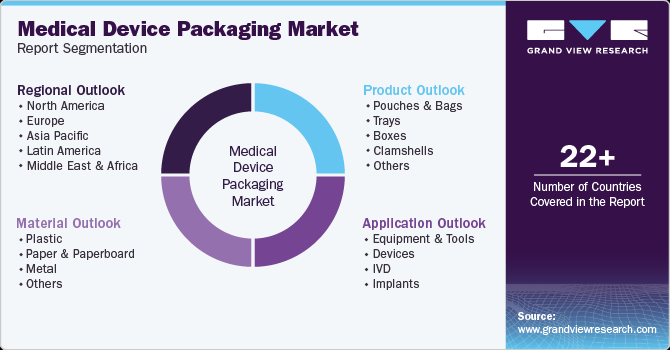 To learn more about this report, Download Free Sample Report
 -
Material Outlook (Revenue, USD Million; 2021 - 2033)
-
Plastic
-
Paper & Paperboard
-
Metal
-
Others
-
-
Product Outlook (Revenue, USD Million; 2021 - 2033)
-
Pouches & Bags
-
Trays
-
Boxes
-
Clamshells
-
Others
-
-
Application Outlook (Revenue, USD Million; 2021 - 2033)
-
Equipment & Tools
-
Devices
-
IVD
-
Implants
-
-
Regional Outlook (Revenue, USD Million; 2021 - 2033)
-
North America
-
U.S.
-
Canada
-
Mexico
-
-
Europe
-
UK
-
Germany
-
France
-
Italy
-
Spain
-
-
Asia Pacific
-
China
-
Japan
-
India
-
Australia
-
-
Latin America
-
Brazil
-
-
Middle East & Africa
-
Saudi Arabia
-
-
Research Methodology
Segment Definition
Segment - Material
Revenue capture definition
Plastic
Revenue generated from the sale of medical device packaging products manufactured using plastic materials such as polyethylene (PE), polypropylene (PP), polyethylene terephthalate (PET), polyvinyl chloride (PVC), and other polymers. This segment includes pouches, trays, thermoformed packaging, containers, and protective components used to ensure sterility, durability, and product protection.
Paper & Paperboard
Revenue generated from the sale of medical device packaging products manufactured using paper and paperboard materials designed for lightweight protection, labeling, transport, and secondary packaging applications. This segment includes cartons, boxes, inserts, wraps, and sterile barrier packaging used across healthcare and medical device supply chains.
Metal
Revenue generated from the sale of medical device packaging products manufactured using metal materials such as aluminum, stainless steel, and other specialty alloys. This segment includes foil-based packaging, rigid containers, protective cases, and sterilization-compatible packaging solutions used for high-value and sensitive medical products.
Others
Revenue generated from the sale of medical device packaging products manufactured using alternative materials such as glass, Tyvek, textiles, composites, biodegradable materials, and specialty barrier substrates. This segment includes customized packaging solutions designed to meet specific performance, sterility, and regulatory requirements.
Segment - Product
Revenue capture definition
Pouches & Bags
Revenue generated from the sale of flexible medical device packaging products designed to provide sterile barrier protection and ease of handling. This segment includes heat-sealable pouches, peelable pouches, sterilization bags, and flexible packaging used for single-use and reusable medical devices.
Trays
Revenue generated from the sale of rigid and thermoformed trays used to securely hold, organize, and protect medical devices during sterilization, storage, and transportation. This segment includes custom-molded trays for surgical instruments, implants, diagnostic kits, and procedural sets.
Boxes
Revenue generated from the sale of cartons, corrugated boxes, and rigid packaging containers used for primary, secondary, and tertiary medical device packaging. This segment includes packaging solutions designed for product protection, branding, regulatory labeling, and distribution.
Clamshells
Revenue generated from the sale of hinged, rigid packaging solutions designed to provide visibility, protection, and secure containment of medical devices. This segment includes thermoformed clamshell packaging used for diagnostic devices, surgical tools, and healthcare products requiring enhanced product presentation and protection.
Others
Revenue generated from the sale of other medical device packaging formats, including wraps, blister packs, tubes, containers, kits, and customized packaging solutions not classified under the above categories.
Segment - Application
Revenue capture definition
Equipment & Tools
Revenue generated from the sale of packaging solutions used for medical equipment, surgical instruments, and healthcare tools requiring protection against contamination, physical damage, and environmental exposure during storage and transportation.
Devices
Revenue generated from the sale of packaging solutions used for medical devices such as catheters, syringes, monitoring devices, respiratory products, and other therapeutic or diagnostic products. This segment includes sterile and non-sterile packaging designed to maintain product integrity and regulatory compliance.
IVD
Revenue generated from the sale of packaging solutions used for in vitro diagnostic (IVD) products, including test kits, reagents, sample collection devices, and laboratory consumables. This segment includes packaging designed to ensure product stability, traceability, and contamination control.
Implants
Revenue generated from the sale of packaging solutions used for implantable medical products such as orthopedic implants, dental implants, cardiovascular implants, and other surgically implanted devices. This segment includes sterile barrier systems and high-performance packaging designed to maintain sterility and product safety until use.
Estimation Model
Layer Name
Key Question
Description
Medical Device Production & Consumption Layer
What forms the demand base?
Identify global production and consumption volumes of medical devices across key categories including equipment & tools, devices, in vitro diagnostics (IVD), implants, and other healthcare products. This layer establishes the total addressable demand for packaging by evaluating medical device manufacturing output, healthcare utilization trends, surgical procedure volumes, and diagnostic testing activities across major regions.
Packaging Adoption & Penetration Layer
Where is medical device packaging utilized?
Estimate the penetration of packaging solutions across various medical device categories and healthcare applications. Assess the adoption of sterile barrier systems, thermoformed packaging, pouches & bags, trays, boxes, clamshells, and other packaging formats based on device complexity, sterility requirements, regulatory standards, and distribution needs across developed and emerging markets.
Packaging Volume Intensity Layer
How much packaging volume is consumed?
Analyze average packaging consumption per medical device unit, considering factors such as package configuration, material usage, sterility requirements, product dimensions, transportation conditions, and shelf-life specifications. Packaging intensity varies by application, with implants, IVD products, and high-value medical devices generally requiring more sophisticated and protective packaging solutions.
Revenue Layer
How is market revenue generated?
Market revenue is quantified through the sale of medical device packaging products manufactured from plastic, paper & paperboard, metal, and other specialty materials. Revenue is generated from packaging formats such as pouches & bags, trays, boxes, clamshells, and customized solutions used across equipment & tools, devices, IVD products, implants, and other healthcare applications. Additional value is created through design services, sterilization-compatible packaging development, regulatory compliance support, labeling, and supply chain optimization solutions.
Delivered Customizations
This report has been delivered with the following In-depth customizations
Client Request
Customization Delivered
Value Adds
Regional Segmentation Analysis
Detailed market sizing, growth forecasts, regulatory assessment, and demand analysis across North America, Europe, Asia Pacific, Central & South America, and Middle East & Africa, including country-level evaluation of major medical device manufacturing and healthcare markets.
Enabled identification of high-growth regions, demand concentration areas, investment opportunities, and region-specific market dynamics to support expansion and resource allocation strategies.
Cross-Segmentation Analysis
Comprehensive analysis across key segment intersections, including Material, Product, Application, and Region. The study evaluates demand trends for Plastic, Paper & Paperboard, Metal, and Other materials across Pouches & Bags, Trays, Boxes, Clamshells, and Other products used in Equipment & Tools, Devices, IVD, and Implants.
Helped identify the most attractive segment combinations, emerging application areas, and product-material alignments driving future revenue growth.
Opportunity Assessment
Identification of high-growth opportunities across packaging solutions for Devices, IVD, Implants, and Equipment & Tools, along with emerging demand for sustainable materials, advanced sterile barrier packaging, and high-performance packaging formats across key regions.
Supported investment prioritization, innovation roadmap development, market expansion planning, and long-term revenue growth strategies.
Frequently Asked Questions About This Report
The global medical device packaging market size was valued at USD 40.6 billion in 2025 and is estimated at USD 43.1 billion for 2026.
The global medical device packaging market is expected to grow at a CAGR of 6.4% from 2026 to 2033, reaching USD 66.8 billion by 2033.
Asia Pacific is the fastest-growing region over the forecast period.
The plastic films segment led the market with a 64.6% revenue share in 2025.
The pouches & bags segment led the market with a 35.8% revenue share in 2025
Equipment & tools segment held the largest revenue share of 34.0 % in 2025.
Key players in the medical device packaging market include Amcor PLC; DuPont; SteriPack; Wipak Walothen GmbH; Sonoco Products Company; Sealed Air; Tekni-Plex, Inc.; Nelipak; Oliver; Berry Global Inc.
Key factors driving the medical device packaging market include rising demand for sterile medical devices, increasing surgical and diagnostic procedures, expanding healthcare infrastructure, growing adoption of single-use devices, stringent regulatory requirements, and advancements in sterile barrier and sustainable packaging technologies.
Europe dominated the medical device packaging market with a 31.5% revenue share in 2025.
About the Author(s)
Plastics, Polymers & Resins Research Team
Bulk Chemicals · Plastics, Polymers & ResinsThis report was authored by the plastics, polymers & resins research team at Grand View Research - comprising two research analysts, one senior research analyst, and one industry expert - with specialized expertise in the plastics, polymers & resins segment of the bulk chemicals industry. All findings are based on proprietary bulk chemicals databases, executive interviews, and regulatory analysis, subject to internal peer review prior to publication.
Last Updated:
Speak to Analyst

Customize this report to your needs - add regions, segments, or data points, with 20% free customization.
Or view our licence options:


ISO 9001:2015 & 27001:2022 Certified
We are GDPR and CCPA compliant! Your transaction & personal information is safe and secure. For more details, please read our privacy policy.


