
- Home
- »
- Advanced Interior Materials
- »
-
Medical Textile Fibers Market Size Report, 2026-2033GVR Report cover

Medical Textile Fibers Market (2026 - 2033)
Size, Share & Trends Analysis Report By Textile Structures (Nonwoven, Woven, Knitted, Braided), By Fiber Type (Synthetic Fibers, Natural Fibers, Regenerated Fibers), By Application, By Region, And Segment Forecasts
Market Size, 2025
$4.3BMarket Estimate, 2026
$4.5BMarket Forecast, 2033
$6.4BCAGR, 2026–2033
5.4%Medical Textile Fibers Market Summary
The global medical textile fibers market size was valued at USD 4.3 billion in 2025 and is projected to grow from USD 4.5 billion in 2026 to USD 6.4 billion by 2033, at a CAGR of 5.4% from 2026 to 2033. dominated the market, accounting for the largest revenue share of The medical textile fibers market is witnessing increasing demand as healthcare systems expand their use of specialized textile-based products for wound care, surgical procedures, infection control, patient support, and implantable applications.
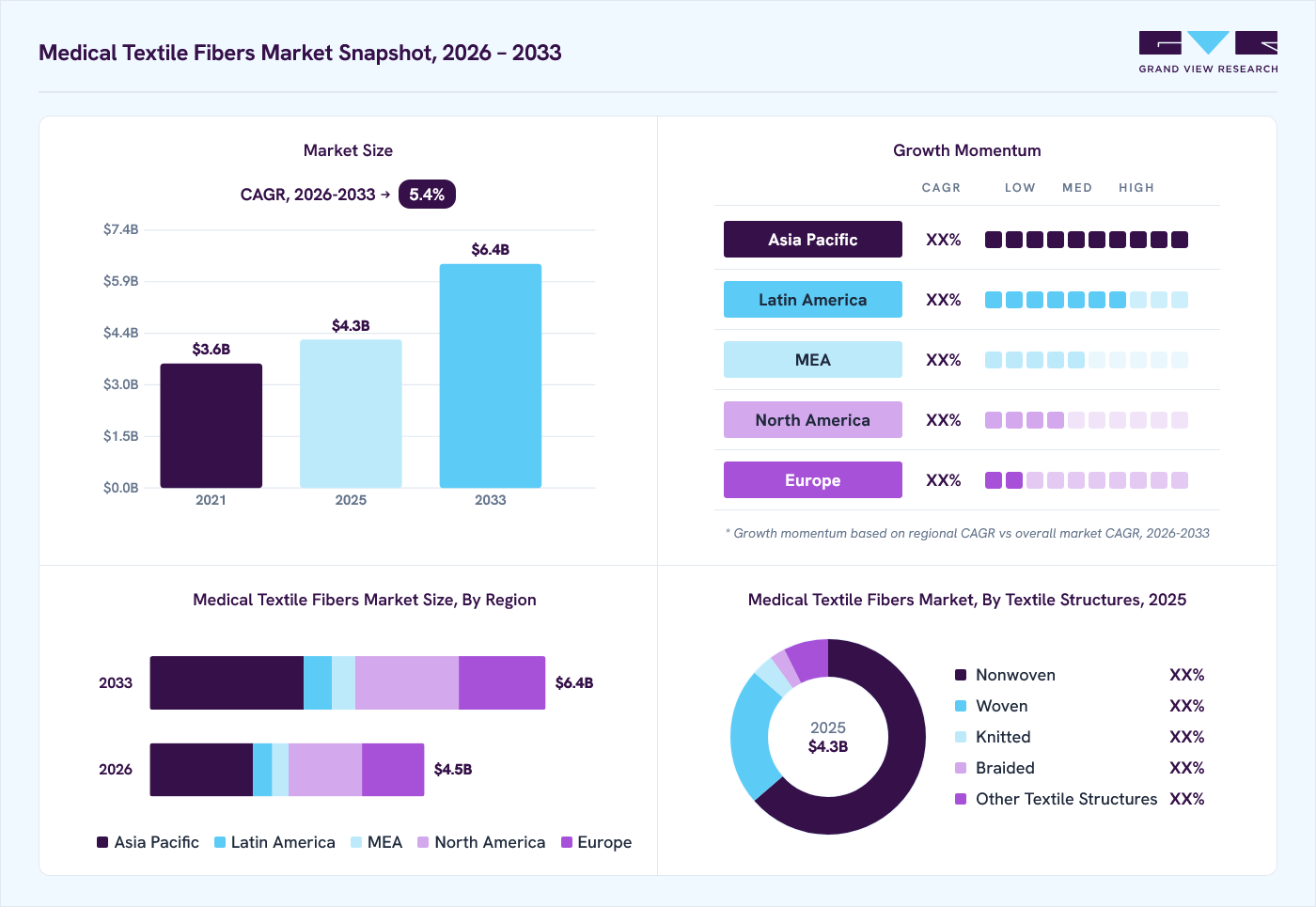 Source: Grand View Research, IR Documents, Primary Interviews, Paid DatabasesTo learn more about this report,
 Download Free Sample Report
 Key Market Trends & Insights
- By fiber type: Regenerated fibers segment is expected to grow at a CAGR of 6.1% over the forecast period.
- By application: Wound care segment dominated the market with a revenue share of 31.2% in 2025.
- By textile structures: Woven segment is projected to register a CAGR of 6.1% during the forecast period from 2026 to 2033.
Regional Highlights
- Largest regional market: Asia Pacific (37.4% revenue share, 2025)
- Fastest-growing regional market: Asia Pacific (highest CAGR, 2026-2033)
Market Size & Forecast
- Market size in 2025: USD 4.3 Billion
- Estimated market size in 2026: USD 4.5 Billion
- Projected market size by 2033: USD 6.4 Billion
- CAGR (2026-2033): 5.4%
Three ways to get this report
Buy it, customize it, or ask a question.Ask an Analyst
A direct answer, usually in 1 working day
- AccessReport author, directly
- Reply timeWithin 1 working day
- No sales callDirect answer only
- FormatEmail reply
- CostFree, no cost
Get the Full Report
What the study covers
- FormatsPDF · Excel · Dashboard
- Timeline2026–2033 annual, 2025 base
- Coverage20+ countries, 5 regions
- Companies10+ key players profiled
Customize the Report
20% free customization
- IncludeCountries, segments, points
- TailorTo your product definition
- ExtendDeeper competitor detail
- OrA fully bespoke study
- Turnaround5–10 working days
Medical textiles are increasingly preferred where lightweight construction, flexibility, moisture management, softness, durability, and controlled interaction with biological tissues are required. The growing volume of surgical procedures, chronic wounds, hospital-acquired infections, and long-term care requirements is supporting demand for fibers designed for specific medical applications.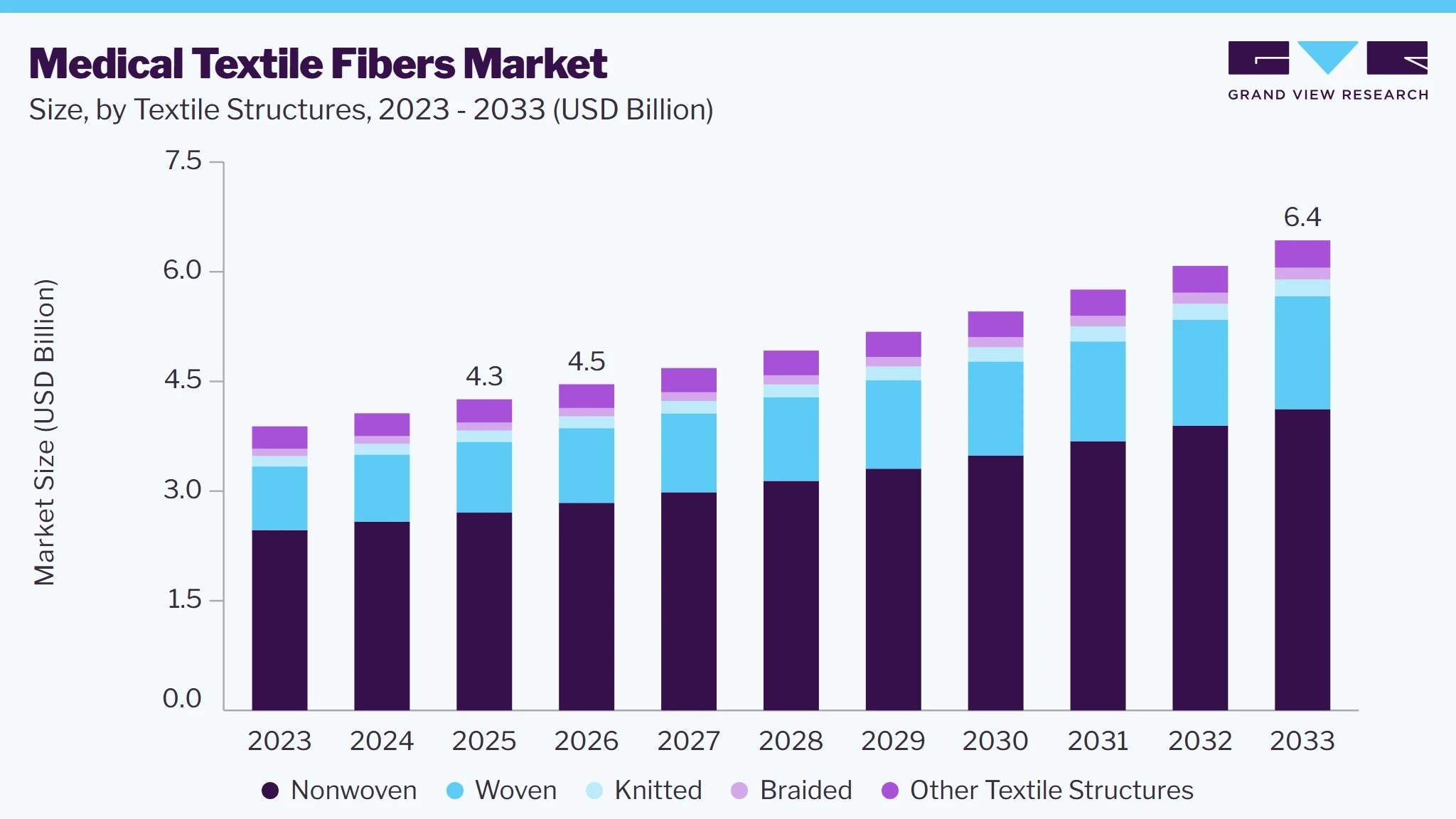 To learn more about this report, Download Free Sample Report
 Key market drivers include the rising prevalence of chronic wounds, increasing surgical procedures, expansion of healthcare infrastructure, growing geriatric populations, and greater adoption of disposable medical products. Demand is also supported by the wider use of nonwoven and textile-based materials in wound dressings, surgical gowns, drapes, masks, compression products, orthopedic supports, and other healthcare applications. The development of antimicrobial, absorbent, biocompatible, and high-strength fibers is further expanding the range of applications.
Innovation is shifting the market toward functional and application-specific medical fibers. Developments include antimicrobial fibers, bioactive fibers, absorbent fibers, biodegradable and bioresorbable materials, smart textile structures, and fibers engineered for controlled fluid management. Advances in polymer processing, surface modification, fiber spinning, coating technologies, and material blending are enabling manufacturers to improve strength, softness, absorbency, thermal performance, and biocompatibility.
Market Dynamics
The medical textile fibers market is shaped by the increasing need for high-performance textile materials across healthcare applications, supported by rising healthcare expenditure, expanding surgical and wound-care requirements, and continuous development of specialized medical products. Demand is influenced by the balance between performance requirements and material costs, while regulatory compliance and biocompatibility requirements create entry barriers for new suppliers. At the same time, advancements in functional fibers and sustainable materials are creating opportunities for manufacturers to differentiate their products and address specialized medical applications.
The increasing prevalence of chronic wounds and the growing number of surgical procedures are strengthening demand for medical textile fibers used in wound dressings, surgical gowns, drapes, sutures, compression products, and other healthcare textiles. Chronic wounds associated with aging populations and long-term health conditions often require advanced dressing materials that provide controlled absorption, moisture management, protection, and patient comfort. This is encouraging healthcare product manufacturers to use fibers with specific absorbency, strength, softness, and fluid management characteristics.
The expansion of surgical and hospital infrastructure is further supporting demand for specialized fibers used in disposable and reusable medical textiles. Hospitals increasingly require materials that can provide barrier protection, durability, breathability, and resistance to contamination while maintaining wearer comfort. The growing adoption of single-use medical textiles is also increasing consumption of synthetic and cellulosic fibers across healthcare facilities. These trends are encouraging suppliers to develop fibers that combine functional performance with consistent quality and compatibility with sterilization processes.
Stringent regulatory requirements represent a key restraint for the medical textile fibers market because materials intended for healthcare applications must meet strict requirements related to safety, biocompatibility, chemical composition, cleanliness, sterilization compatibility, and performance consistency. Qualification and testing requirements can increase development costs and lengthen product approval cycles, particularly for fibers intended for direct patient contact or implantable applications. These requirements can also limit the ability of manufacturers to rapidly introduce new materials and increase the compliance burden for smaller suppliers.
The development of bioactive, biodegradable, bioresorbable, and smart fibers presents an important opportunity for market participants. Researchers and manufacturers are increasingly exploring fibers capable of supporting controlled drug delivery, antimicrobial protection, tissue regeneration, wound healing, and responsive healthcare applications. Such materials can provide higher functional value than conventional fibers and support the development of advanced wound dressings, implantable textiles, tissue-engineering structures, and intelligent medical products. Growing interest in sustainable healthcare materials is also creating opportunities for biodegradable, renewable fiber alternatives in selected applications.
Market Concentration & Characteristics
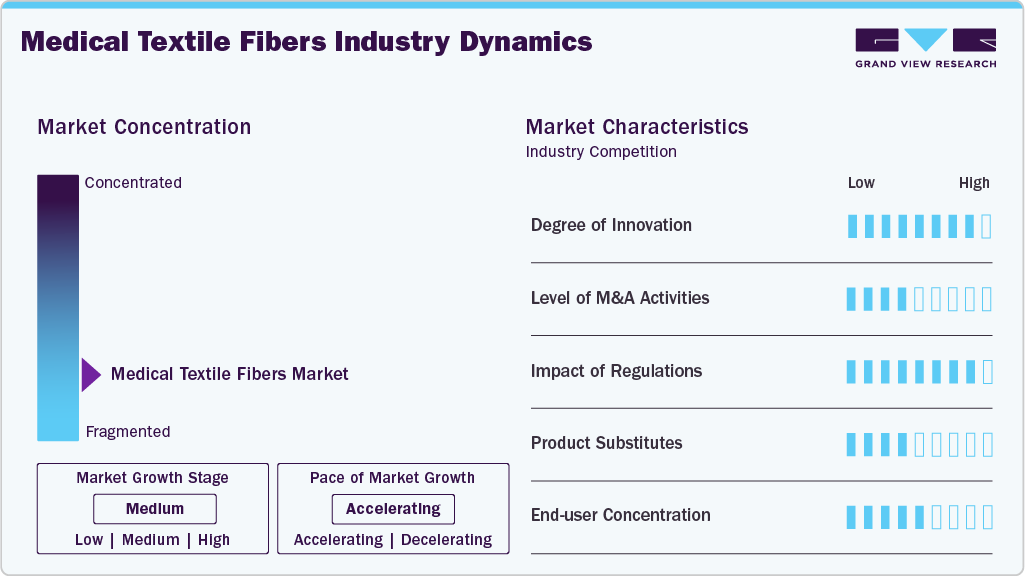
The medical textile fibers market is characterized by a mix of established fiber manufacturers, specialty material suppliers, medical textile producers, and vertically integrated healthcare-material companies. Competition is influenced by technical capabilities, product consistency, regulatory compliance, material performance, application expertise, and the ability to supply customized fibers for specific medical applications. Established participants benefit from manufacturing scale, extensive testing capabilities, established customer relationships, and experience with healthcare standards, while specialized suppliers compete through functional materials, application-specific formulations, and advanced fiber technologies.
 To learn more about this report, Download Free Sample Report
 The threat of substitutes in the medical textile fibers market is moderate, as textile fibers can be replaced by alternative material forms such as films, foams, membranes, molded polymers, elastomers, and other non-textile medical materials in selected applications. However, fibers provide specific advantages, including flexibility, breathability, surface area, absorbency, drapability, softness, and ease of conversion into woven and nonwoven structures. These characteristics make direct substitution difficult across wound care, surgical textiles, compression products, and implantable textile applications.
Analyst Perspective
The medical textile fibers market is supported by rising healthcare demand, increasing use of specialized textile-based medical products, and ongoing development of functional, biocompatible, and sustainable fibers. Growth opportunities are particularly strong in advanced wound care, surgical textiles, implantable materials, and healthcare & hygiene applications, while regulatory requirements and material performance standards remain important factors shaping market development.
Textile Structures Insights
The nonwoven segment held the highest revenue share of 63.6% in 2025, supported by its extensive use in wound dressings, surgical gowns, drapes, masks, hygiene products, and other disposable medical textiles. Nonwoven structures offer advantages such as high absorbency, lightweight construction, breathability, fluid management, and efficient large-scale manufacturing. Their ability to provide barrier protection and support single-use applications further strengthens adoption across hospitals and healthcare facilities.
The woven segment is expected to grow at a CAGR of 6.1% over the forecast period, as woven medical textiles continue to find applications requiring high tensile strength, dimensional stability, durability, and controlled fabric construction. Woven structures are used across surgical textiles, implantable medical products, compression materials, and specialized healthcare textiles where structural integrity is important. Increasing demand for durable, high-performance medical textile products is expected to drive the adoption of woven fiber structures.
Fiber Type Insights
The synthetic fibers segment held the highest revenue share of 56.7% in 2025, driven by the broad use of polyester, polypropylene, polyamide, polyethylene, and other synthetic fibers across medical and healthcare applications. These fibers provide desirable characteristics such as strength, durability, chemical resistance, controlled performance, and compatibility with various textile manufacturing and sterilization processes. Their versatility and suitability for both disposable and specialized medical products continue to support their leading position.
The regenerated fibers segment is expected to grow at a CAGR of 6.1% over the forecast period, as demand increases for absorbent, soft, biodegradable, and renewable-material alternatives in selected medical textile applications. Regenerated cellulose and other regenerated fibers offer characteristics such as moisture management, softness, and absorbency, making them suitable for wound care, hygiene products, and other healthcare textiles. Increasing interest in sustainable materials and reduced environmental impact is further encouraging the development and adoption of regenerated fiber solutions.
Application Insights
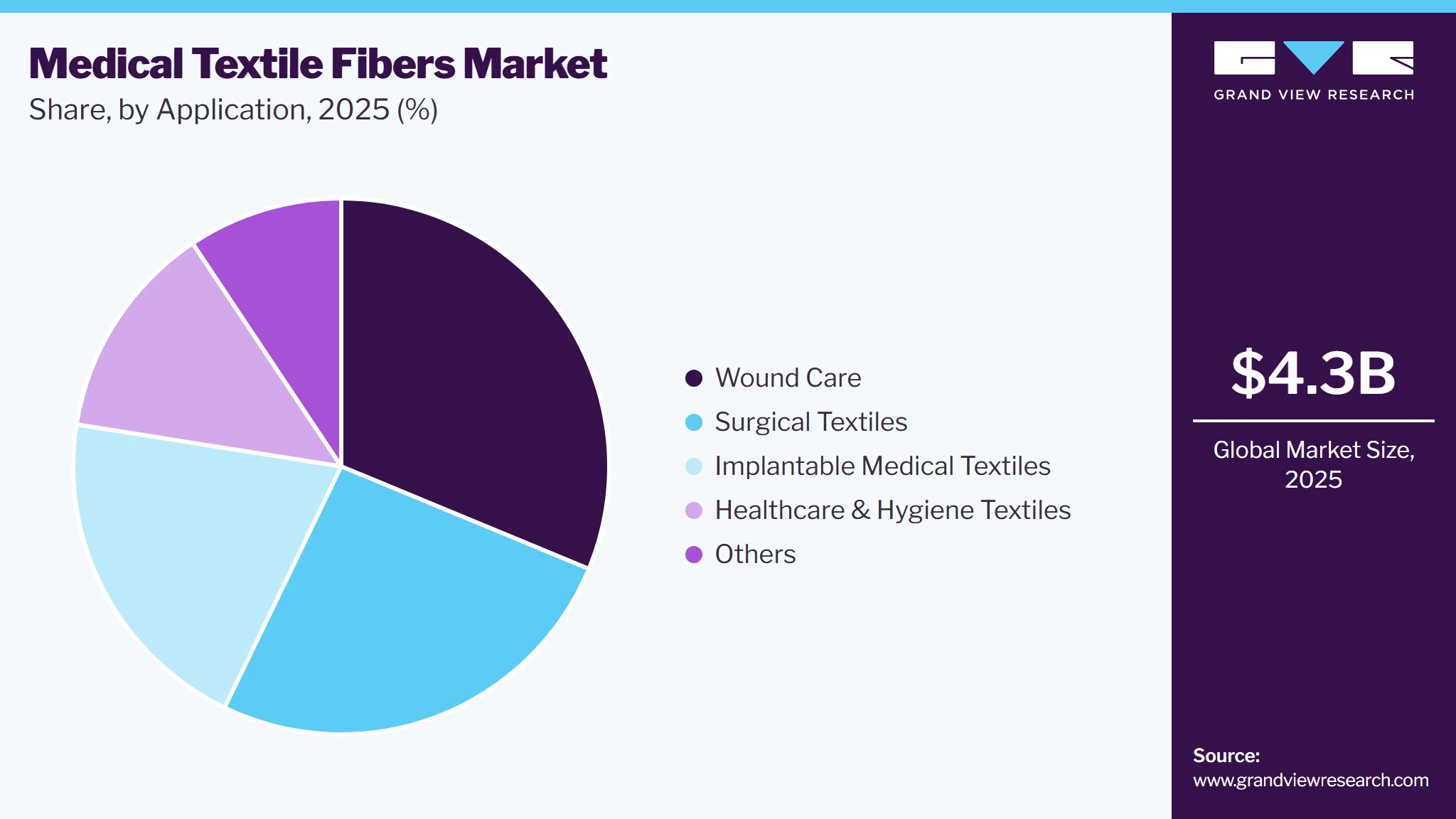
The wound care segment held the highest revenue market share of 31.2% in 2025, supported by the extensive use of medical textile fibers in dressings, bandages, absorbent materials, wound-contact layers, and advanced wound-management products. Growing demand for effective management of chronic and acute wounds is increasing the need for fibers offering high absorbency, fluid management, softness, protection, and moisture control. Continued development of advanced wound-care products is further strengthening fiber consumption in this application.
 To learn more about this report, Download Free Sample Report
 The healthcare & hygiene textiles segment is expected to grow at a CAGR of 6.4% over the forecast period, as hospitals and healthcare facilities increase their use of textile-based products for patient care, hygiene, protection, and infection control. Medical textile fibers are increasingly incorporated into hospital textiles, protective products, hygiene materials, and other healthcare consumables requiring cleanliness, absorbency, comfort, and barrier performance. Rising healthcare activity and continued emphasis on infection prevention are expected to support demand across this segment.
Regional Insights
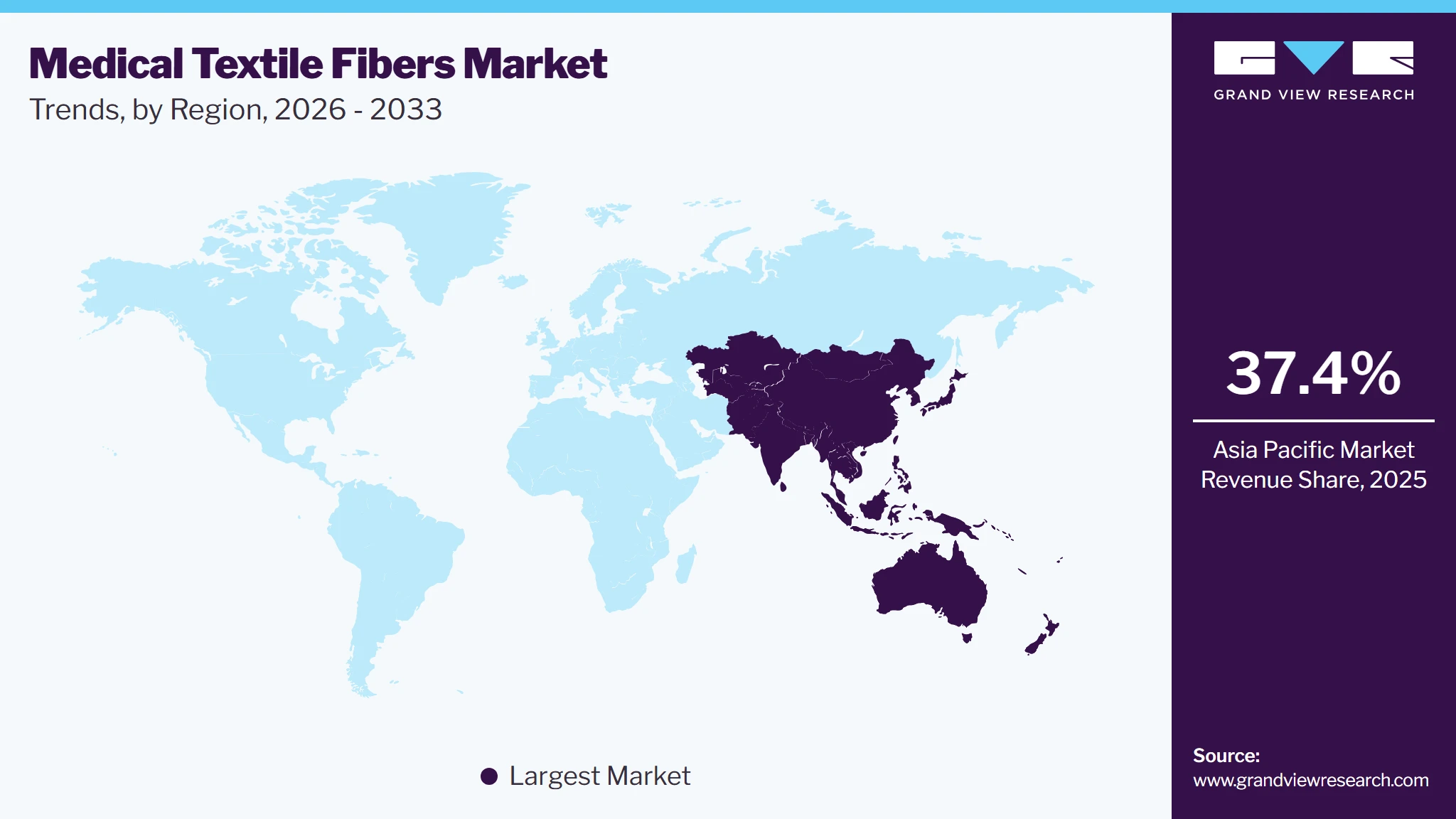
Asia Pacific dominated the global medical textile fibers market, accounting for the largest revenue share of 37.4% in 2025, driven by expanding healthcare infrastructure, rising healthcare expenditure, increasing surgical volumes, and growing medical-product manufacturing capacity. Countries across the region are strengthening domestic healthcare supply chains and expanding production of medical textiles, nonwovens, wound-care products, and protective healthcare products. The availability of manufacturing capabilities and the growing demand for cost-effective medical products are supporting regional fiber consumption.
 To learn more about this report, Download Free Sample Report
 China Medical Textile Fibers Market Trends
China represents a major and rapidly expanding market for medical textile fibers, supported by its large healthcare system, extensive textile manufacturing base, increasing healthcare expenditure, and growing demand for advanced medical products. Medical textile applications include wound dressings, surgical textiles, protective products, implants, hygiene products, and other healthcare applications. The country's large-scale manufacturing capabilities provide a strong supply base for synthetic and specialty fibers used in medical textiles, while increasing healthcare standards are encouraging the adoption of higher-performance materials.
North America Medical Textile Fibers Market Trends
North America is a major market for medical textile fibers due to its developed healthcare infrastructure, high adoption of advanced medical products, and strong demand for specialized wound care and surgical textiles. The region benefits from extensive use of disposable medical products, advanced healthcare facilities, and continuous development of high-performance materials for clinical applications. Demand is also supported by the increasing use of functional fibers in infection-control products, wound management, orthopedic textiles, and other specialized healthcare applications. Strong regulatory and quality requirements encourage the use of consistent, technically validated fiber materials.
U.S. Medical Textile Fibers Market Trends
The U.S. is a leading market for medical textile fibers, supported by advanced healthcare infrastructure, high healthcare expenditure, significant surgical volumes, and strong adoption of specialized medical products. Demand is particularly supported by wound care, implantable products, surgical textiles, protective medical products, and healthcare and hygiene applications. The market benefits from established medical-device development capabilities and stringent quality and regulatory requirements, which encourage the use of technically validated and application-specific fiber materials. Increasing emphasis on infection prevention, advanced wound management, patient comfort, and high-performance medical products is supporting continued demand for specialized textile fibers.
Europe Medical Textile Fibers Market Trends
Europe has a well-established medical textiles industry supported by advanced healthcare systems, strong medical device manufacturing capabilities, and an increasing emphasis on product safety and sustainability. Demand for medical textile fibers is supported by wound care, surgical textiles, compression products, hygiene applications, and other specialized healthcare products. The region's focus on circularity and environmental performance is also encouraging research into recyclable, biodegradable, and renewable medical fiber materials.
The Germany medical textile fibers market is a prominent European market for medical textile fibers, supported by its advanced healthcare system, strong technical-textile industry, medical-device manufacturing capabilities, and established research and engineering base. Demand is driven by applications including implantable textiles, wound-care products, compression materials, surgical textiles, and healthcare and hygiene products. The country's aging population and increasing surgical needs drive demand for specialized medical textile products, while stringent quality and regulatory standards encourage the use of high-performance, consistently manufactured fibers.
Central and South America Medical Textile Fibers Market Trends
Central and South America market is supported by improving healthcare infrastructure, increasing access to medical services, and growing demand for healthcare consumables and surgical products. Medical textile fiber consumption is particularly associated with wound-care materials, surgical textiles, hygiene products, and protective healthcare applications. Expansion of healthcare facilities and increasing awareness of infection prevention are supporting demand for specialized medical textiles.
Middle East & Africa Medical Textile Fibers Market Trends
The Middle East & Africa market is supported by healthcare infrastructure development, hospital expansion, increasing investment in advanced medical facilities, and growing demand for healthcare consumables. Major healthcare-development programs are encouraging the modernization of hospitals and medical services, creating demand for surgical textiles, wound-care products, protective textiles, and other medical applications. The region also presents opportunities for suppliers of high-performance and specialized fibers as healthcare providers increasingly adopt advanced medical products.
Key Medical Textile Fibers Company Insights
Some of the key players operating in the market include Freudenberg Performance Materials and DuPont
-
Freudenberg Performance Materials is a global manufacturer of technical textiles and advanced nonwoven materials, serving applications across healthcare, hygiene, apparel, automotive, construction, and industrial sectors. The company develops specialty textile materials for medical applications, including wound care, surgical products, and healthcare products, supported by broad manufacturing capabilities and technical expertise.
-
DuPont is a global science and materials company offering high-performance materials and technologies for healthcare, industrial, protection, and other specialized applications. Its portfolio includes advanced fibers and nonwoven materials used in medical and protective applications, with a focus on properties such as strength, barrier performance, chemical resistance, and durability.
Fitesa S.A. and Suominen Corporation are some of the emerging market participants in the medical textile fibers market.
-
Fitesa is a global manufacturer of nonwoven fabrics serving hygiene, medical, and healthcare applications. The company produces technologies including spunbond and meltblown nonwovens, with products designed for applications such as surgical gowns, drapes, face masks, wound care, and other healthcare products.
-
Suominen Corporation is a global manufacturer of nonwoven materials for healthcare, hygiene, and other specialized applications. The company develops fiber-based nonwovens using synthetic and cellulose-based materials, supplying products for applications including wipes, medical products, and healthcare-related solutions.
Key Medical Textile Fibers Companies
The following key companies have been profiled for this study on the medical textile fibers market.
-
Freudenberg Performance Materials
-
DuPont
-
Ahlstrom
-
Toray Industries, Inc.
-
Asahi Kasei Corporation
-
Lenzing AG
-
Suominen Corporation
-
Fitesa S.A.
-
WPT Nonwovens Corporation
-
Kae Hwa
Competitive Benchmarking
Category
Operating Strategies
Competitive Edge
Weakness
Established Players: Freudenberg Performance Materials, DuPont, Ahlstrom, Toray Industries, Inc., Asahi Kasei Corporation, Lenzing AG
- Invest in advanced fiber and nonwoven technologies to improve strength, softness, absorbency, filtration performance, biocompatibility, and barrier properties for medical and healthcare applications.
- Expand production capabilities and geographic presence to serve growing demand from wound care, surgical textiles, healthcare and hygiene products, and other specialized medical applications.
- Develop application-specific fiber grades and strengthen partnerships with medical textile converters, healthcare product manufacturers, and downstream textile producers to support customized solutions.
- Established manufacturing infrastructure and extensive technical expertise support consistent production of medical-grade fibers and fiber-based materials.
- Diversified portfolios covering synthetic, regenerated, specialty, and nonwoven fiber materials enable these companies to serve multiple medical textile applications.
- Strong quality-control systems, customer relationships, technical support capabilities, and global distribution networks support adoption in demanding and regulated healthcare applications.
- High capital requirements for specialized fiber and nonwoven manufacturing facilities, quality systems, R&D, and capacity expansion.
- Strict medical application requirements can result in lengthy product development, testing, validation, and customer qualification cycles.
- Exposure to raw material prices, energy costs, regulatory requirements, and technically demanding production processes can affect manufacturing economics.
Emerging Players: Suominen Corporation, Fitesa S.A., WPT Nonwovens Corporation, Kae Hwa
- Focus on specialized fiber and nonwoven materials targeting wound care, hygiene, surgical, filtration, and other healthcare applications requiring controlled performance and consistent quality.
- Expand market presence through partnerships with medical product manufacturers, healthcare textile converters, distributors, and regional customers.
- Prioritize product development, material optimization, sustainability, and customized solutions to address specific medical textile requirements and niche applications.
- Specialized product portfolios allow these companies to address targeted medical and healthcare textile requirements.
- Focused technical capabilities support differentiation through fiber composition, absorbency, softness, filtration, barrier properties, and other application-specific characteristics.
- Greater focus on selected product categories can provide flexibility in developing customized materials and serving underserved or specialized customer requirements.
- Relatively smaller scale and narrower product portfolios compared with the largest global fiber and nonwoven manufacturers.
- Dependence on specific healthcare, hygiene, and medical textile applications can limit diversification and market expansion opportunities.
- Higher production costs, limited manufacturing scale, and the need for continuous investment in quality, technology, and regulatory compliance can constrain price competitiveness.
Recent Developments
-
In November 2025, DuPont launched Tyvek APX, a new disposable garment material offering increased breathability while maintaining protection and durability. The development strengthens DuPont's portfolio of high-performance fiber-based materials for protective and healthcare-related applications.
-
In December 2025, Lenzing announced a EUR 15 million investment to expand nonwoven fiber production capacity at its Lenzing site, focusing on VEOCEL Viscostar fibers. The company also developed VEOCEL Lyocell EC, a fiber designed for disinfectant wipes to improve the release of active ingredients.
Medical Textile Fibers Market Report Scope
Report Attribute
Details
Market size in 2025
USD 4.3 Billion
Estimated market size in 2026
USD 4.5 Billion
Projected market size by 2033
USD 6.4 Billion
Growth rate
CAGR of 5.4% from 2026 to 2033
Base year for estimation
2025
Actual data
2021 - 2024
Forecast period
2026 - 2033
Quantitative units
Revenue in USD billion and CAGR from 2026 to 2033
Report coverage
Revenue forecast, company ranking, competitive landscape, growth factors, and trends
Segments covered
Fiber type, form, application, region
Regional scope
Global
Country scope
U.S.; Canada; Mexico; Germany; UK; France; Italy; Spain; China; Japan; India; South Korea; Brazil; Saudi Arabia
Key companies profiled
Freudenberg Performance Materials; DuPont; Ahlstrom; Toray Industries, Inc.; Asahi Kasei Corporation; Lenzing AG; Suominen Corporation; Fitesa S.A.; WPT Nonwovens Corporation; Kae Hwa
Customization scope
Free report customization (equivalent up to 8 analysts working days) with purchase. Addition or alteration to country, regional & segment scope.
Pricing and purchase options
Avail customized purchase options to meet your exact research needs. Explore purchase options
Global Medical Textile Fibers Market Report Segmentation
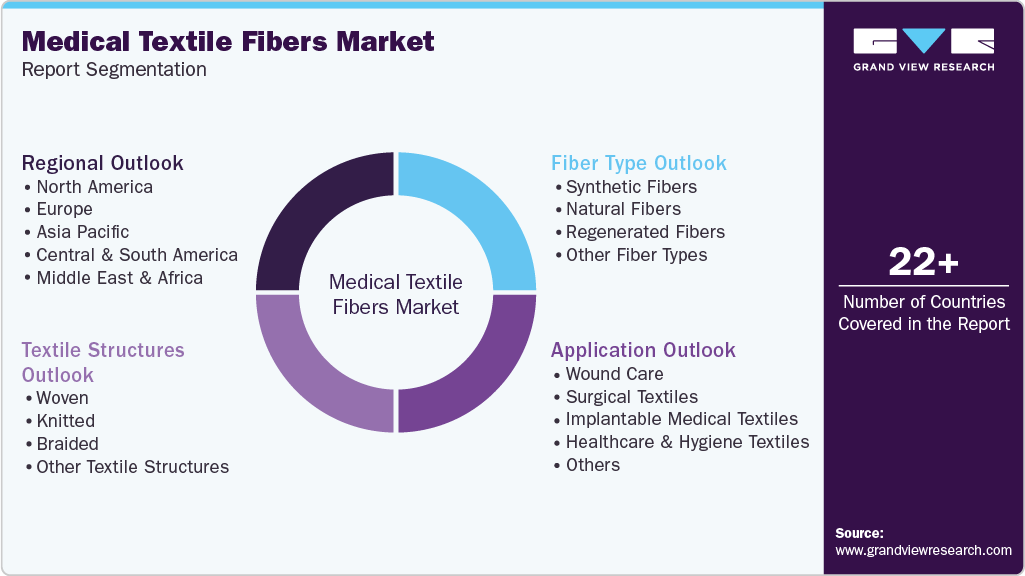
This report forecasts revenue growth at regional & country levels and provides an analysis on the industry trends in each of the sub-segments from 2021 to 2033. For the purpose of this study, Grand View Research has segmented the medical textile fibers market on the basis of fiber type, textile structures, application, and region:
 To learn more about this report, Download Free Sample Report
 -
Textile Structures Outlook (Revenue, USD Billion, 2021 - 2033)
-
Nonwoven
-
Woven
-
Knitted
-
Braided
-
Other Textile Structures
-
-
Fiber Type Outlook (Revenue, USD Billion, 2021 - 2033)
-
Synthetic Fibers
-
Natural Fibers
-
Regenerated Fibers
-
Other Fiber Types
-
-
Application Outlook (Revenue, USD Billion, 2021 - 2033)
-
Wound Care
-
Surgical Textiles
-
Implantable Medical Textiles
-
Healthcare & Hygiene Textiles
-
Others
-
-
Regional Outlook (Revenue, USD Billion, 2021 - 2033)
-
North America
-
U.S.
-
Canada
-
Mexico
-
-
Europe
-
UK
-
Germany
-
France
-
Italy
-
Spain
-
-
Asia Pacific
-
China
-
Japan
-
India
-
South Korea
-
-
Central and South America
-
Brazil
-
-
Middle East and Africa
-
Saudi Arabia
-
-
Research Methodology
The medical textile fibers market figures in this report are based on a proven research process that combines executive interviews with secondary research from proprietary databases, company filings, and recognized regulatory and institutional sources. Market size is built through value-chain sizing - reconciling supply-side and demand-side estimates - and triangulated with bottom-up and top-down approaches. Every estimate passes multiple levels of expert validation before publication, with each medical textile fibers segment quantified using the revenue-capture definitions in the table below.
Segment Definition
Segment - Textile Structures
Revenue Capture Definition
Nonwoven
Revenue generated from the sale of medical textile fibers converted into nonwoven structures used in wound dressings, surgical gowns, drapes, masks, hygiene products, and other healthcare applications requiring lightweight, absorbent, breathable, or barrier properties.
Woven
Revenue generated from the sale of medical textile fibers converted into woven structures used in surgical textiles, wound-care products, implantable textiles, compression products, and other applications requiring dimensional stability, strength, and controlled fabric construction.
Knitted
Revenue generated from the sale of medical textile fibers converted into knitted structures used in compression garments, orthopedic supports, wound-care products, tubular medical textiles, and other applications requiring elasticity, flexibility, conformability, and patient comfort.
Braided
Revenue generated from the sale of medical textile fibers converted into braided structures used primarily in medical cords, sutures, ligature materials, vascular and orthopedic applications, and other products requiring high strength, flexibility, and controlled structural integrity.
Other Textile Structures
Revenue generated from the sale of medical textile fibers used in textile structures other than nonwoven, woven, knitted, and braided forms, including specialized textile constructions developed for application-specific medical and healthcare requirements.
Segment - Fiber Type
Revenue Capture Definition
Synthetic Fibers
Revenue generated from the sale of synthetic medical textile fibers, including polyester, polyamide, polypropylene, polyethylene, and other polymer-based fibers, used in applications requiring strength, durability, chemical resistance, controlled performance, and compatibility with medical processing.
Natural Fibers
Revenue generated from the sale of natural medical textile fibers, including cotton, silk, and other naturally derived fibers, used in wound care, surgical textiles, hygiene products, and other applications requiring softness, absorbency, biocompatibility, or natural material characteristics.
Regenerated Fibers
Revenue generated from the sale of regenerated medical textile fibers produced from natural or cellulose-based feedstocks, including regenerated cellulose fibers and other processed bio-based fibers, used in absorbent, wound-care, hygiene, and other healthcare textile applications.
Other Fiber Types
Revenue generated from the sale of medical textile fibers not classified as synthetic, natural, or regenerated fibers, including specialty, bio-based, bioresorbable, and other advanced fiber materials developed for specialized medical applications.
Segment - Application
Revenue Capture Definition
Wound Care
Revenue generated from the sale of medical textile fibers used in wound-care products, including dressings, bandages, absorbent materials, wound-contact layers, and advanced wound-management textiles requiring absorbency, fluid management, softness, protection, or controlled healing environments.
Surgical Textiles
Revenue generated from the sale of medical textile fibers used in surgical gowns, drapes, caps, masks, surgical packs, curtains, and other surgical textiles requiring barrier protection, durability, breathability, cleanliness, and resistance to fluid penetration.
Implantable Medical Textiles
Revenue generated from the sale of medical textile fibers used in implantable textile products, including sutures, vascular grafts, hernia meshes, ligament and tendon repair materials, and other implantable structures requiring biocompatibility, mechanical strength, flexibility, and controlled interaction with body tissues.
Healthcare & Hygiene Textiles
Revenue generated from the sale of medical textile fibers used in healthcare and hygiene products, including hospital textiles, patient-care products, hygiene materials, protective textiles, and other healthcare applications requiring cleanliness, absorbency, comfort, barrier performance, or infection-control properties.
Others
Revenue generated from the sale of medical textile fibers used in applications outside wound care, surgical textiles, implantable medical textiles, and healthcare and hygiene textiles, including orthopedic textiles, rehabilitation products, medical supports, therapeutic textiles, and other specialized healthcare applications.
Estimation Model
Layer No.
Layer Name
Key Question
Description
01
Parent Market Analysis
What is the overall size and growth outlook of the global medical textiles, technical textiles, synthetic fibers, and specialty fiber markets?
The estimation begins with the broader medical textiles, technical textiles, synthetic fibers, and specialty materials markets. Production, consumption, healthcare demand, textile manufacturing activity, and application development are assessed to establish the addressable market for medical textile fibers.
02
Medical Fiber Penetration Analysis
What proportion of the broader fiber and technical textile market is represented by medical textile fibers across different fiber types and textile structures?
This layer estimates the penetration of medical textile fibers across synthetic, natural, regenerated, and other fiber types, considering their material properties, production, medical applications, and adoption. Penetration is further assessed across nonwoven, woven, knitted, braided, and other textile structures.
03
Regional & End-use Demand Assessment
Which regions, fiber types, textile structures, and medical applications contribute the highest demand for medical textile fibers?
Demand is assessed across major regions based on healthcare infrastructure, surgical procedures, wound-care requirements, medical-device manufacturing, hygiene product consumption, and technical-textile activity. Application-level demand is evaluated across wound care, surgical textiles, implantable medical textiles, healthcare & hygiene textiles, and other medical applications.
04
Company Revenue Validation & Market Forecasting
How is the final market size validated and forecast across fiber types, textile structures, regions, and applications?
Final estimates are validated using company revenues, production capacities, product portfolios, manufacturing facilities, investments, capacity expansions, and application-specific developments. Bottom-up and top-down approaches are triangulated across company, fiber type, textile structure, regional, and application data to generate market estimates and forecasts.
Delivered Customizations
This report has been delivered with the following In-depth customizations
Client Request
Customization Delivered
Value Adds
Textile Structures & Fiber Performance Assessment
Evaluate synthetic, natural, regenerated, and other medical textile fibers across nonwoven, woven, knitted, braided, and other textile structures based on strength, absorbency, flexibility, biocompatibility, durability, sterilization compatibility, moisture management, and application suitability.
Helps identify the performance advantages, positioning, and application potential of different fiber types and textile structures while highlighting opportunities for specialty and higher-value medical fiber development.
Application & End-use Demand Assessment
Assess demand across wound care, surgical textiles, implantable medical textiles, healthcare & hygiene textiles, and other applications based on clinical requirements, material performance, adoption levels, healthcare activity, and substitution potential.
Provides visibility into high-demand and high-growth application areas and helps identify end-use sectors offering strong opportunities for market expansion, product development, and application-specific fiber innovation.
Competitive Landscape & Capacity Benchmarking
Benchmark key medical textile fiber manufacturers based on production capacity, fiber portfolio, manufacturing footprint, technology capabilities, medical application coverage, geographic presence, partnerships, investments, and capacity expansion plans.
Provides a clear view of competitive positioning, market concentration, production capabilities, leading players, strategic strengths, and potential gaps for new investments, partnerships, or market entry.
About the Author(s)
Advanced Interior Materials Research Team
Advanced Materials · Advanced Interior MaterialsThis report was authored by the advanced interior materials research team at Grand View Research - comprising two research analysts, one senior research analyst, and one industry expert - with specialized expertise in the advanced interior materials segment of the advanced materials industry. All findings are based on proprietary advanced materials databases, executive interviews, and regulatory analysis, subject to internal peer review prior to publication.
Last Updated:
Speak to Analyst

Customize this report to your needs - add regions, segments, or data points, with 20% free customization.
Or view our licence options:


ISO 9001:2015 & 27001:2022 Certified
We are GDPR and CCPA compliant! Your transaction & personal information is safe and secure. For more details, please read our privacy policy.


