
- Home
- »
- Network Security
- »
-
Messaging Security Market Size & Share Report, 2026-2033GVR Report cover

Messaging Security Market (2026 - 2033)
Size, Share, & Trends Analysis Report By Product (Anti-virus, Email Protection, Messaging Gateway), By Deployment (Cloud, On-premises), By End Use (Corporate, Residence), By Region, And Segment Forecasts
Market Size, 2025
$10.4BMarket Estimate, 2026
$11.6BMarket Forecast, 2033
$27.7BCAGR, 2026–2033
13.2%Messaging Security Market Summary
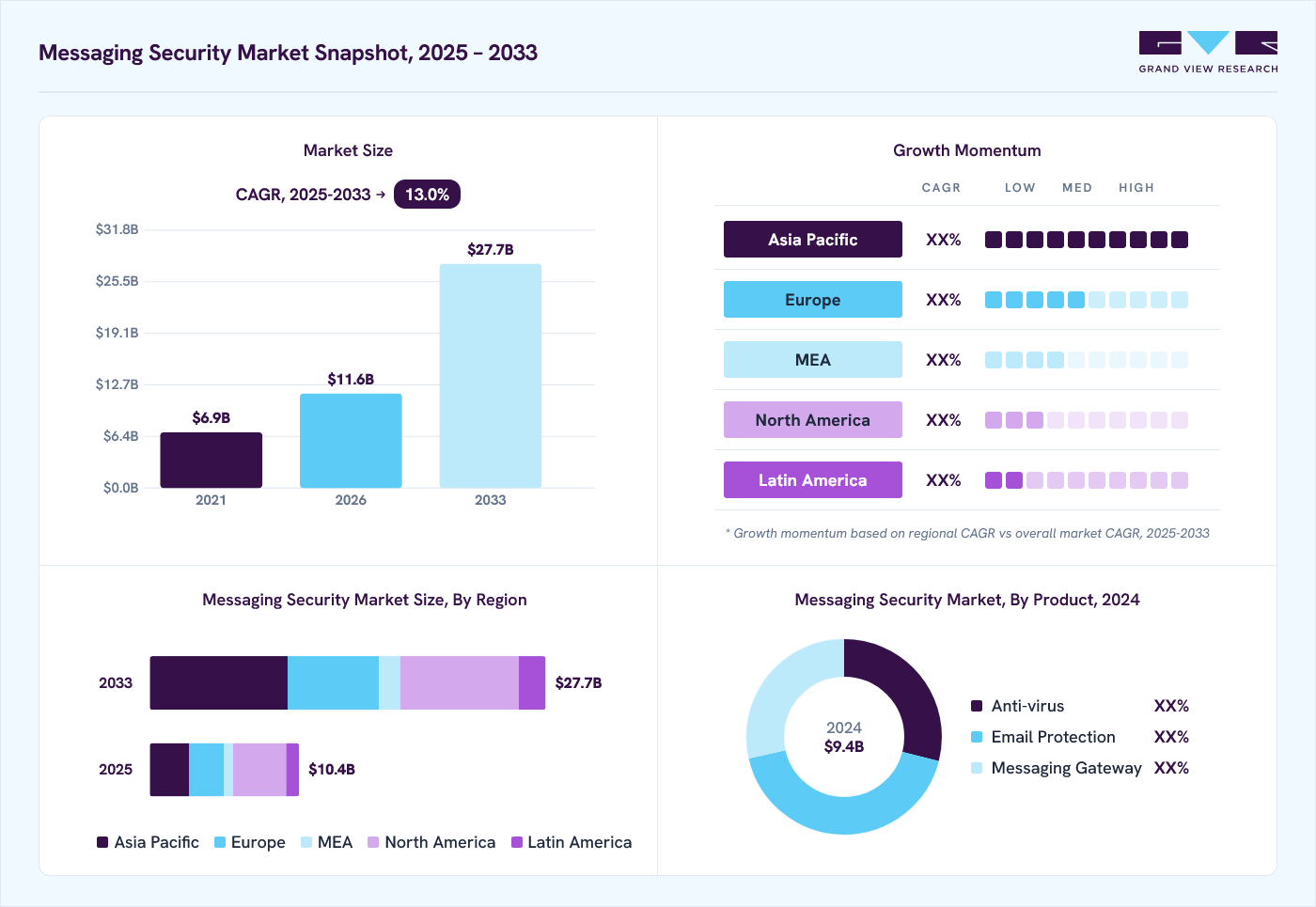
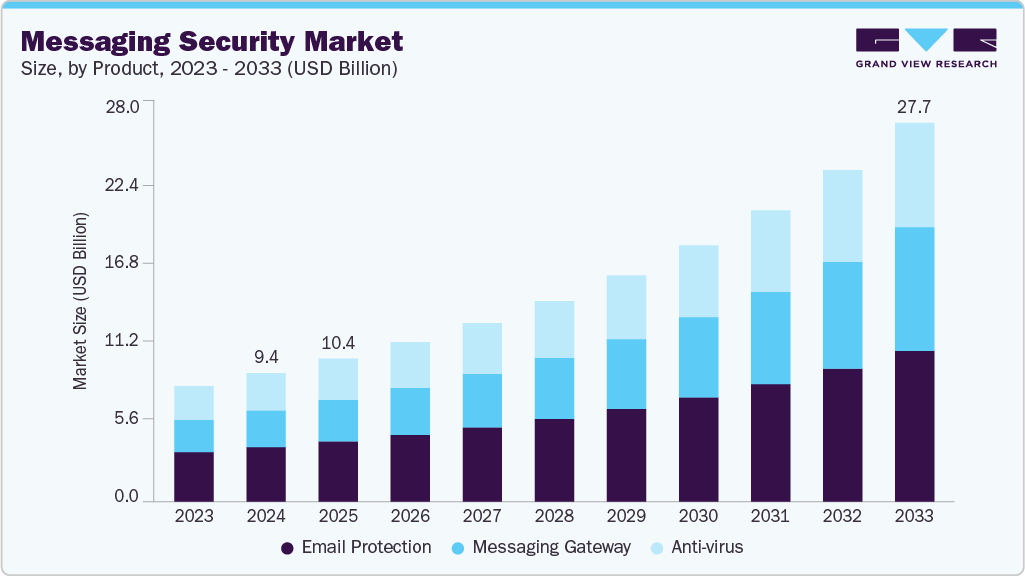
The global messaging security market size was valued at USD 10.4 billion in 2025 and is projected to grow from USD 11.6 billion in 2026 to USD 27.7 billion by 2033, at a CAGR of 13.2% from 2026 to 2033. North America dominated the market, accounting for a revenue share of 38.5% in 2025. The market is witnessing steady growth, driven by the exponential rise in cyber threats targeting enterprise communication channels, especially email and instant messaging platforms.
 Source: Grand View Research, IR Documents, Primary Interviews, Paid DatabasesTo learn more about this report,
 Download Free Sample Report
 Key Market Trends & Insights
- By product: Email protection segment dominated the market, with a revenue share of 45.9% in 2025
- By deployment: Cloud segment dominated the market, with a revenue share of 63.8% in 2025
- By end Use: Corporate segment held the largest market share in 2025
Regional Highlights
- Largest regional market: North America (38.5% revenue share, 2025)
- Fastest-growing regional market: Asia Pacific (highest CAGR, 2026-2033)
- By country: The U.S. held the largest market share in 2025
Market Size & Forecast
- Market size in 2025: USD 10.4 billion
- Estimated market size in 2026: USD 11.6 billion
- Projected market size by 2033: USD 27.7 billion
- CAGR (2026-2033): 13.2%
Three ways to get this report
Buy it, customize it, or ask a question.Ask an Analyst
Analyst response in 1 business day
- AccessReport author, directly
- Reply timeWithin 1 working day
- No sales callDirect answer only
- FormatEmail reply
- CostFree, no cost
Get the Full Report
What the study covers
- FormatsPDF · Excel · Dashboard
- Timeline2026–2033 annual, 2025 base
- Coverage20+ countries, 5 regions
- Companies10+ key players profiled
Customize the Report
20% free customization
- IncludeCountries, segments, points
- TailorTo your product definition
- ExtendDeeper competitor detail
- OrA fully bespoke study
- Turnaround5–10 working days
The rise in regulatory pressure and data protection laws globally is playing a significant role in fueling the messaging security market. Regulations such as GDPR in Europe, HIPAA in the U.S., and various data localization mandates across Asia-Pacific have compelled organizations to ensure that sensitive data shared over email or messaging platforms is adequately protected. This includes implementing encryption, data loss prevention (DLP), and audit trails to demonstrate compliance during regulatory audits or investigations. Messaging security products that offer built-in compliance support and automated policy enforcement are being prioritized by industries such as healthcare, finance, and legal services, where data confidentiality is not just a preference but a legal requirement.
Furthermore, the growing reliance on automation and artificial intelligence in messaging security products is helping enterprises respond faster and more effectively to emerging threats. Security vendors are integrating AI-driven analytics and machine learning algorithms into their solutions to detect anomalies, flag suspicious content, and adapt to new threat patterns without manual intervention. These intelligent systems can analyze massive volumes of message data in real-time and help security teams prioritize the most critical threats. The promise of faster threat detection and reduced response times through automation is particularly appealing in an era where cyberattacks can unfold in minutes, and the cost of delayed action is exceptionally high. As AI capabilities continue to mature, their role in enhancing the efficacy of messaging security platforms is likely to become more pronounced.
 To learn more about this report, Download Free Sample Report
 In addition to external threats, the increasing focus on insider risk management is contributing to market growth. Employees may inadvertently or maliciously share confidential information via messaging platforms, bypassing existing controls. Messaging security tools that incorporate content inspection, user behavior analytics, and contextual policy enforcement can help detect and prevent these incidents. Organizations are also using these tools to monitor sensitive data transmissions, block unauthorized file sharing, and ensure that communication policies are being followed across internal teams and external stakeholders. As insider threats become a more widely recognized risk factor, the ability of messaging security solutions to provide real-time oversight and control over internal communications is becoming a key differentiator.
Market Dynamics
The global messaging security market is experiencing strong growth due to the increasing sophistication of cyber threats targeting email, collaboration platforms, and enterprise messaging channels. The rapid rise of AI-powered phishing campaigns, business email compromise (BEC), account takeover attacks, and ransomware delivery through messaging platforms has compelled organizations to strengthen their communication security frameworks. Enterprises are increasingly adopting advanced messaging security solutions that leverage artificial intelligence, machine learning, behavioral analytics, and real-time threat intelligence to detect and mitigate evolving threats. Additionally, the growing use of cloud-based productivity suites, hybrid work environments, and mobile communication tools has expanded the attack surface, driving demand for integrated messaging security platforms capable of protecting email, instant messaging, and collaboration applications across distributed workforces.
A key trend shaping the market is the transition from traditional secure email gateways toward cloud-native, API-based messaging security architectures that provide continuous monitoring and post-delivery threat remediation. Security vendors are increasingly incorporating generative AI-powered threat detection, zero-trust access principles, and integrated data loss prevention (DLP) capabilities to address emerging risks associated with cloud communications. Furthermore, regulatory requirements related to data privacy, cybersecurity resilience, and critical infrastructure protection are encouraging organizations to invest in advanced messaging protection solutions. Growing adoption among small and medium-sized enterprises (SMEs), coupled with increasing demand for managed security services and Security-as-a-Service (SECaaS) offerings, is further accelerating market expansion across both developed and emerging economies.
The increasing frequency and sophistication of phishing, business email compromise (BEC), account takeover, and ransomware attacks are serving as a major growth driver for the messaging security market. Cybercriminals are increasingly leveraging artificial intelligence and automation to create highly convincing phishing emails, impersonate trusted business contacts, and bypass traditional security filters. As email remains one of the most widely used communication channels in organizations, it continues to be a primary attack vector for cyber threats, resulting in significant financial losses, operational disruptions, and reputational damage.
In response, organizations across industries are investing in advanced messaging security solutions capable of detecting anomalous behavior, malicious attachments, suspicious URLs, and social engineering attempts in real time. The integration of AI-powered threat detection, behavioral analytics, threat intelligence feeds, and automated incident response capabilities is enabling enterprises to strengthen communication security and reduce cyber risk exposure. The growing emphasis on protecting cloud-based email environments and collaboration platforms is further accelerating demand for next-generation messaging security technologies.
Despite growing cybersecurity concerns, budget limitations and the complexity associated with deploying and managing advanced messaging security solutions continue to restrain market growth, particularly among small and medium-sized enterprises (SMEs). Many organizations struggle to justify cybersecurity investments due to competing IT priorities and limited financial resources. The adoption of comprehensive messaging security platforms often requires expenditures related to licensing, integration, employee training, and ongoing management, which can be challenging for resource-constrained businesses.
Additionally, the evolving threat landscape requires continuous policy updates, threat monitoring, and security optimization to maintain effectiveness. Organizations with limited cybersecurity expertise often face difficulties managing multiple security tools and ensuring seamless integration with existing infrastructure. These operational challenges can delay implementation decisions and increase reliance on basic security controls, thereby slowing the adoption of advanced messaging security solutions in certain market segments.
The rapid migration of enterprise communication workloads to cloud-based platforms presents a significant growth opportunity for messaging security vendors. Organizations are increasingly adopting cloud productivity suites, collaboration applications, and remote work technologies, creating demand for security solutions specifically designed for cloud environments. API-based messaging security platforms are gaining traction because they provide deeper visibility into user communications, enable post-delivery threat remediation, and offer enhanced protection against sophisticated attacks that may evade traditional gateway-based defenses.
Furthermore, advancements in artificial intelligence, machine learning, and cloud security analytics are enabling vendors to deliver scalable, subscription-based messaging security services that appeal to organizations of all sizes. The growing adoption of managed security services and Security-as-a-Service (SECaaS) models is creating additional opportunities in emerging markets where cybersecurity expertise remains limited. As enterprises continue embracing hybrid work models and cloud-first strategies, demand for flexible, cloud-native messaging protection solutions is expected to increase substantially, creating long-term growth prospects for market participants.
Analyst Perspective
The global messaging security market is witnessing robust growth as organizations increasingly prioritize protecting email and digital communication channels from sophisticated cyber threats. The rise of AI-powered phishing, business email compromise (BEC), ransomware, and social engineering has made messaging security a critical component of enterprise cybersecurity strategies. The growing adoption of cloud-based productivity suites, remote work, and digital collaboration platforms is driving demand for advanced solutions incorporating artificial intelligence, behavioral analytics, threat intelligence, and automated response capabilities. From an analyst's perspective, the market is shifting from traditional email filtering and antivirus solutions toward integrated, cloud-native communication security platforms. Vendors are investing in AI-driven threat detection, API-based architectures, Zero Trust frameworks, and managed security services to address evolving security needs. While large enterprises remain key adopters, rising cybersecurity awareness among SMEs and increasing data protection regulations are creating new opportunities. Over the forecast period, cloud deployment and advanced email protection solutions are expected to remain major revenue contributors.
Product Insights
Based on product, the email protection segment led the market with the largest revenue share of 45.9% in 2025. The increasing adoption of Bring Your Device (BYOD) policies and remote work models has significantly widened the attack surface. Employees often access their email accounts from personal devices, shared networks, or unsecured public Wi-Fi, weakening the traditional security perimeter. In such environments, ensuring consistent email protection becomes challenging. To address this, organizations are implementing email security solutions that are device-agnostic and network-independent, allowing policies to follow users wherever they work. Endpoint-aware email security, coupled with identity-based authentication, enables secure access and ensures that emails are scanned for threats regardless of the device or location. This shift not only ensures continuity in security coverage but also enables better enforcement of compliance mandates for distributed workforces.
The messaging gateway segment is projected to be the fastest-growing segment from 2025 to 2033. The need for advanced content filtering and attachment scanning is fueling growth in the messaging security market. Attackers are increasingly using obfuscated file attachments, links to malware-hosting websites, and encrypted payloads to evade traditional defenses. Messaging gateways address this challenge by integrating with dynamic threat intelligence feeds and sandboxing environments, allowing real-time inspection of attachments and embedded URLs. Suspicious content is quarantined or rejected at the gateway level, preventing its entry into the organization’s core systems. This capability is particularly valuable in environments with high email traffic volumes, as it automates initial threat screening and reduces the burden on endpoint and user-level protections.
Deployment Insights
Based on the deployment, the cloud segment led the market with the largest revenue share of 63.8% in 2025. The shift toward Zero Trust architectures is amplifying the demand for cloud-native messaging security. Under the Zero Trust model, no user or system is trusted by default, and continuous verification is required to access resources, including email services. Cloud messaging security solutions align with these principles by incorporating user identity verification, context-aware access controls, and behavioral analytics into their protective mechanisms. They monitor for anomalous login attempts, suspicious message routing, or unusual communication patterns, enforcing policies dynamically based on risk assessment. As organizations continue their journey toward Zero Trust, cloud messaging security becomes a critical layer that enables secure and conditional access to communication tools.
The on-premises segment is projected to grow at a CAGR from 2025 to 2033. The rising complexity and volume of targeted cyberattacks, including ransomware and spear phishing, are driving the demand for the messaging security market. On-premises messaging security systems offer organizations the ability to deploy multilayered defenses tailored to their unique threat landscapes. These systems can incorporate advanced content filtering, anti-spam, anti-malware, and sandboxing functionalities directly into their internal infrastructure. Moreover, because they are hosted within the organization’s perimeter, these platforms offer faster access to logs, forensic data, and threat indicators, enabling quicker response and recovery in the event of an incident.
End Use Insights
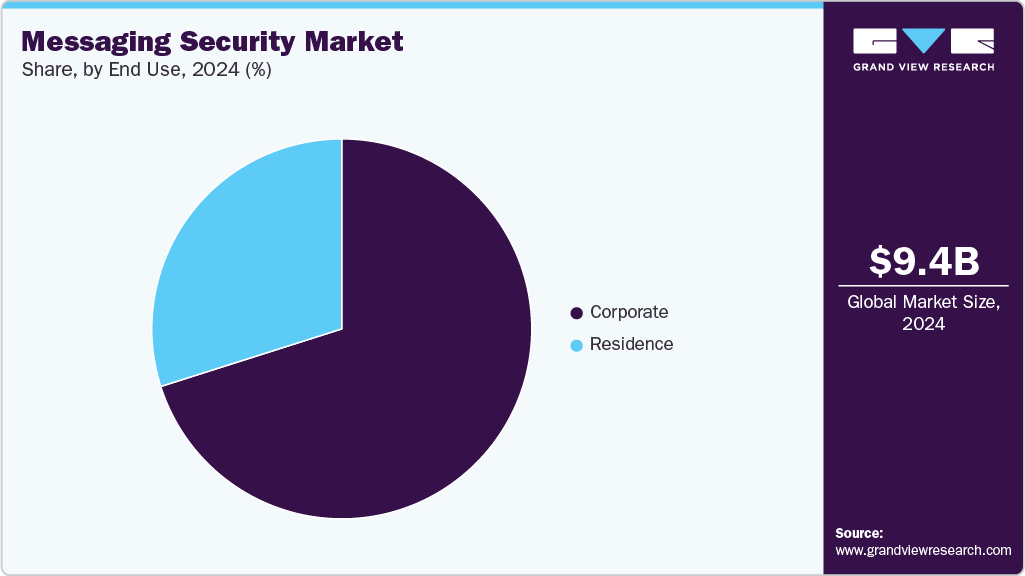
Based on the end use, the corporate segment led the market with the largest revenue share of 70.7% in 2025. The rise of insider threats, whether malicious or accidental, is driving messaging security market growth in corporate environments. Employees can unintentionally expose sensitive information through misdirected emails, unsecured attachments, or non-compliance with security protocols. Messaging security platforms help mitigate these risks by implementing user behavior analytics, real-time DLP, encryption enforcement, and automated alerts. These features allow security teams to monitor for abnormal activity, block risky content transmissions, and maintain full visibility into internal communication patterns. In corporations where thousands of employees interact daily across multiple departments and locations, such capabilities are vital for maintaining internal trust and security.
 To learn more about this report, Download Free Sample Report
 The residence segment is projected to grow at a CAGR of 10.5% from 2025 to 2033. The rise of smart home ecosystems and IoT connectivity is also contributing to the growth of the messaging security market in the residential segment. As more household devices become internet-enabled, from smart TVs to voice assistants and security systems, they generate a vast stream of data that can be intercepted or manipulated via compromised messaging platforms. Messaging security in this context extends beyond traditional email and includes secure notification systems, alerts, and remote access communications. Ensuring that messages from IoT devices are authenticated and protected against spoofing or tampering which is essential for maintaining home security and privacy.
Regional Insights
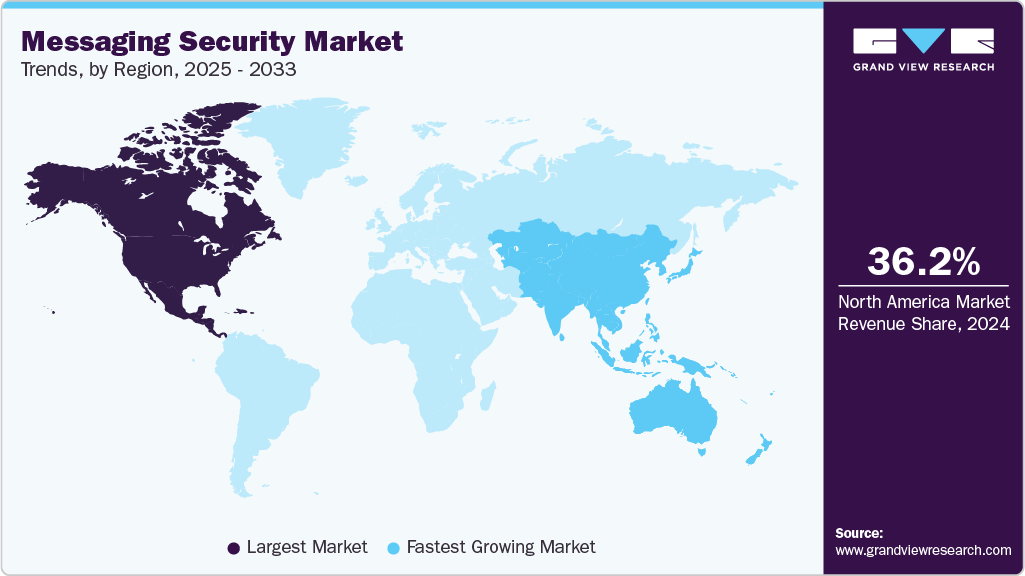
North America dominated the global messaging security market, with the largest revenue share of 38.5% in 2025. The increasing frequency of high-profile cyber incidents involving North American companies has also heightened awareness and urgency around messaging security. Attacks targeting major enterprises, educational institutions, and government agencies through phishing campaigns and malicious attachments have underscored the need for real-time protection and rapid incident response capabilities. As a result, there is a growing adoption of messaging security platforms that leverage artificial intelligence, machine learning, and threat intelligence to identify and neutralize threats before they cause damage. These solutions are often integrated into broader security ecosystems that support centralized monitoring, policy enforcement, and cross-platform visibility capabilities that are highly valued by North American organizations managing complex and distributed IT environments.
 To learn more about this report, Download Free Sample Report
 U.S. Messaging Security Market Trends
The messaging security market in the U.S. held the largest share of the North American market in 2025.
Europe Messaging Security Market Trends
The U.S. messaging security industry is projected to grow during the forecast period. The rapid advancement of AI-based attack methods is driving the U.S. messaging security market growth. Cybercriminals deploy generative AI tools to craft hyper-personalized phishing messages that are difficult for humans and traditional filters to detect. These AI-generated threats mimic writing styles, leverage contextual data, and adapt dynamically to user responses, making them far more effective than conventional spam or phishing attempts. To counter this, U.S. organizations are adopting AI-enhanced messaging security solutions that leverage behavioral analytics, anomaly detection, and adaptive learning to detect even subtle signs of malicious intent. The arms race between attackers and defenders is driving continuous innovation and deeper integration of artificial intelligence into commercial security products.
Europe Messaging Security Market Trends
The messaging security industry in Europe is expected to grow during the forecast period. Europe’s focus on digital sovereignty and the localization of data processing is influencing the market. Several countries within the region, including Germany and France, have emphasized the need for data to be stored and managed within national or EU borders. This has prompted the adoption of messaging security solutions that comply with data residency requirements and offer local data centers for hosting. European businesses are increasingly choosing security vendors that align with these sovereignty goals, fostering a market for regional and GDPR-compliant messaging security providers. This focus on sovereignty and compliance has also driven innovation in privacy-preserving technologies such as end-to-end encryption and metadata protection in enterprise messaging applications.
The messaging security industry in the UK is grow during the forecast period. The rise of cloud-native businesses and digital startups in the UK is driving the messaging security market growth. These organizations, many of which operate in industries like fintech, edtech, and healthtech, prioritize speed, scalability, and remote collaboration, making traditional on-premises security models less suitable. As a result, they are gravitating toward messaging security platforms that are cloud-delivered, API-driven, and capable of integrating seamlessly into DevOps workflows. These platforms provide traditional filtering and encryption functions and enable real-time visibility into message-level threats and user behaviors across cloud communication environments. This alignment between modern software development practices and messaging security is particularly relevant in the UK’s fast-growing technology sector.
Asia Pacific Messaging Security Market Trends
The Asia Pacific messaging security industry is expected to be the fastest-growing segment, with a CAGR of 16.9% over the forecast period. The rapid adoption of 5G technology and the expansion of smart city initiatives across countries such as China, South Korea, Japan, and Singapore also play a crucial role in the messaging security market's expansion. These developments are enabling real-time communication between devices, systems, and individuals at an unprecedented scale. However, as smart city infrastructure relies on a continuous flow of secure digital messages for monitoring traffic systems, utilities, public safety, and healthcare, the potential impact of compromised communication grows significantly. Messaging security in this context must extend beyond conventional corporate email to cover machine-to-machine messaging, alert systems, and public communication platforms.
The messaging security industry in China is projected to grow during the forecast period. The growing popularity of business messaging apps, many of which double as social platforms, drives the growth of the Chinese messaging security market. Applications such as WeCom (WeChat Work), Lark, and DingTalk have become standard for business communications in China, blurring the lines between personal and professional messaging. While convenient, this convergence increases the chances of data leakage, unauthorized access, and targeted attacks exploiting user habits. Organizations are now adopting security tools that can monitor and control the use of these platforms, enforcing policies on message retention, access rights, and file sharing while ensuring compliance with both corporate governance rules and national data laws.
Key Messaging Security Company Insights
Some of the key companies operating in the market BlackBerry Limited, and Proofpoint, Inc., among others are some of the leading participants in the messaging security market.
-
BlackBerry Limited is a Canadian software company. BlackBerry’s messaging security offerings are primarily anchored in its BlackBerry UEM and BlackBerry SecuSUITE platforms. These systems ensure secure messaging, voice, and data communications across mobile and desktop environments, particularly in highly regulated industries such as government, healthcare, and finance. Through end-to-end encryption, secure voice calling, and secure text messaging capabilities, BlackBerry enables organizations to communicate confidentially across various endpoints, whether on-premises or in the cloud.
-
Proofpoint, Inc. is a cybersecurity and compliance company specializing in advanced threat protection solutions that safeguard digital communications. Proofpoint’s messaging security offerings include the Email Security and Protection platform, which includes cloud-based email filtering, threat intelligence, and advanced detection technologies. This platform uses multilayered machine learning and behavioral analytics to identify and block known and unknown threats, including ransomware, credential phishing, and malicious attachments or URLs.
LeapXpert, and SlashNext, Inc. are some of the emerging market participants in the messaging security market.
-
LeapXpert is a software firm that specializes in secure, compliant messaging solutions for enterprises across highly regulated industries such as finance, healthcare, and legal services. LeapXpert offers messaging security through its AI-driven Messaging Security Suite, which focuses on advanced impersonation detection, malware prevention, and the identification of hidden threats in real-time. This suite uses machine learning to identify unusual patterns in communication such as an executive’s identity being spoofed or fraudsters exploiting familiar channels-to alert security teams before harm occurs.
-
SlashNext, Inc. is a cybersecurity company that specializes in AI-driven, multi-channel messaging security solutions that protect enterprises from advanced phishing and social engineering attacks. Its flagship platform, SlashNext Complete, integrates defenses across email, mobile, browser, and collaboration apps covering Microsoft 365, Gmail, Slack, Teams, Zoom, SMS, WhatsApp, and LinkedIn. The company’s generative and behavioral AI engines leverage natural language processing, computer vision, relationship graphing, and contextual analysis to detect zero-hour threats such as business email compromise (BEC), spear-phishing, smishing, and QR-code scams with detection accuracy and extremely low false positive rates.
Key Messaging Security Companies:
The following key companies have been profiled for this study on the messaging security market.
- Barracuda Networks, Inc.
- BlackBerry Limited
- Cisco Systems, Inc.
- Clearswift
- Enea
- Forcepoint LLC
- LeapXpert
- McAfee, LLC
- Mimecast Email Protection Limited
- Panda Security
- Proofpoint, Inc.
- SlashNext, Inc.
- Sophos Ltd.
- Symantec Corp.
- Trend Micro Inc.
Competitive Benchmarking
Category
Operating Strategies
Competitive Edge
Weakness
Mature Players (Cisco Systems, Inc., Symantec Corp., Trend Micro Inc., McAfee, LLC, Proofpoint, Inc., Barracuda Networks, Inc., Forcepoint LLC, Sophos Ltd., Mimecast Email Protection Limited)
- Focus on comprehensive email and messaging security, AI-based threat detection, secure gateways, encryption, and cloud security solutions.
- Strong brand presence, large customer base, broad product portfolio, and extensive threat intelligence capabilities.
- Higher costs, complex deployments, and slower adaptation to emerging communication channels.
Emerging Players (SlashNext, Inc., LeapXpert, Enea, Panda Security, Clearswift)
- Focus on AI-driven phishing protection, mobile messaging security, cloud-native security, and niche communication security solutions.
- Agile innovation, specialized technologies, and faster response to emerging threats.
- Limited market reach, smaller customer base, and lower brand recognition than established vendors.
Recent Developments
-
In June 2025, LeapXpert acquired StartADAM to enhance its platform with advanced AI features, additional messaging channels, and enterprise-grade CRM integrations. With this acquisition, all StartADAM assets, including its team, intellectual property, and product, will be integrated into LeapXpert.
-
In November 2024, LeapXpert launched its new Messaging Security Package, aimed at strengthening the security of messaging communications against various threats. A key feature of this package is the Messaging Impersonation Detection solution, which leverages AI to detect and flag impersonation attempts in real-time across platforms such as WhatsApp, WeChat, iMessage, SMS, and LINE. In contrast to traditional device endpoint, antivirus, anti-malware, and Content Disarm and Reconstruction (CDR) solutions, which act after threats reach the device, LeapXpert’s approach offers proactive protection, intercepting and neutralizing threats before they can impact recipients, specifically across consumer messaging platforms.
-
In May 2024, SlashNext launched SlashNext GenAI for Spam and Graymail, the industry’s first detection and filtering solution for spam and graymail powered by a generative AI large language model (LLM). This advanced solution delivers exceptional accuracy and near-zero false positives. It features a specialized set of AI classifiers trained to identify various categories of spam and graymail, including marketing promotions, sales outreach, newsletters, and announcements. By enhancing detection precision, the solution significantly reduces hidden threats within such emails and boosts productivity for both end-users and SOC teams.
Messaging Security Market Report Scope
Report Attribute
Details
Market size in 2025
USD 10.4 billion
Estimated market size in 2026
USD 11.6 billion
Projected market size by 2033
USD 27.7 billion
Growth rate
CAGR of 13.2% from 2026 to 2033
Base year for estimation
2025
Historical data
2021 - 2024
Forecasts period
2026 - 2033
Quantitative units
Revenue in USD billion/billion and CAGR from 2026 to 2033
Report coverage
Revenue forecasts, company market share analysis, competitive landscape, growth factors, and trends
Segments covered
Product, deployment, end use, region
Regional scope
North America; Europe; Asia Pacific; Latin America; MEA
Country scope
U.S.; Canada; Mexico; Germany; UK; France; China; Japan; India; South Korea; Australia; Brazil; Saudi Arabia; South Africa; UAE
Key companies profiled
BlackBerry Limited; Cisco Systems, Inc.; Symantec Corp.; Trend Micro Inc.; McAfee, LLC; Barracuda Networks, Inc.; Proofpoint, Inc.; Panda Security; Clearswift; Forcepoint LLC; Sophos Ltd.; Mimecast Email Protection Limited; LeapXpert; Enea; SlashNext, Inc.
Customization scope
Free report customization (equivalent to up to 8 analysts' working days) with purchase. Addition or alteration to country, regional & segment scope.
Pricing and purchase options
Avail customized purchase options to meet your exact research needs. Explore purchase options
Global Messaging Security Market Report Segmentation
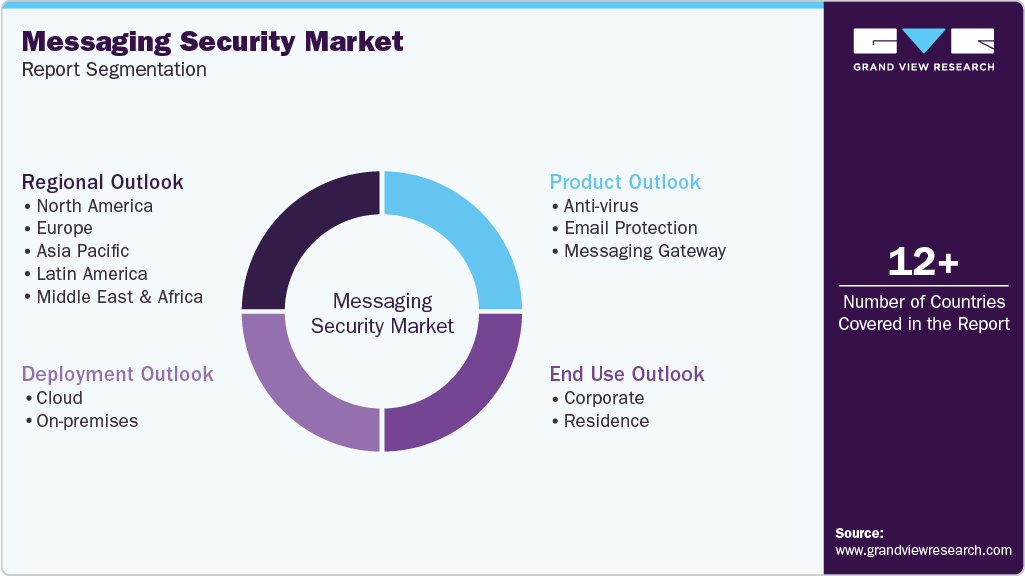
This report forecasts revenue growth at global, regional, and country levels and provides an analysis of the latest industry trends in each of the sub-segments from 2021 to 2033. For this study, Grand View Research has segmented the messaging security market report based on product, deployment, end use, and region.
 To learn more about this report, Download Free Sample Report
 -
Product Outlook (Revenue, USD Billion, 2021 - 2033)
-
Anti-virus
-
Email Protection
-
Messaging Gateway
-
-
Deployment Outlook (Revenue, USD Billion, 2021 - 2033)
-
Cloud
-
On-premises
-
-
End Use Outlook (Revenue, USD Billion, 2021 - 2033)
-
Corporate
-
Residence
-
-
Regional Outlook (Revenue, USD Billion, 2021 - 2033)
-
North America
-
U.S.
-
Canada
-
Mexico
-
-
Europe
-
Germany
-
UK
-
France
-
-
Asia Pacific
-
China
-
India
-
Japan
-
South Korea
-
Australia
-
-
Latin America
-
Brazil
-
-
Middle East & Africa
-
UAE
-
Saudi Arabia
-
South Africa
-
-
Research Methodology
The Messaging Security market figures in this report are based on a proven research process that combines executive interviews with secondary research from proprietary databases, company filings, and recognized regulatory and institutional sources. Market size is built through value-chain sizing - reconciling supply-side and demand-side estimates - and triangulated with bottom-up and top-down approaches. Every estimate passes multiple levels of expert validation before publication, with each Messaging Security segment quantified using the revenue-capture definitions in the table below.
Segment Definition
Segment - Product
Revenue Capture Definition
Anti-virus
Revenue generated from messaging security solutions that identify, block, quarantine, and remediate malware, ransomware, spyware, trojans, malicious attachments, and other harmful content transmitted through email and messaging platforms. Includes signature-based, heuristic, behavioral, and AI-powered malware detection technologies integrated into messaging security environments.
Email Protection
Revenue generated from email security solutions designed to protect organizations and users from phishing, business email compromise (BEC), spoofing, account takeover, malicious URLs, spam, data leakage, and advanced persistent threats. Includes secure email gateways, cloud email security platforms, email encryption, data loss prevention (DLP), threat intelligence, and AI-driven email threat detection solutions.
Messaging Gateway
Revenue generated from secure messaging gateway solutions that monitor, filter, inspect, route, and protect inbound and outbound email and messaging traffic. Includes secure email gateways (SEGs), messaging firewalls, content filtering, policy enforcement, spam filtering, attachment sandboxing, and communication security appliances deployed across enterprise messaging environments.
Segment - Deployment
Revenue Capture Definition
Cloud
Revenue generated from cloud-based messaging security platforms delivered through Software-as-a-Service (SaaS) or managed cloud models. Includes cloud email security, API-based email protection, cloud security gateways, threat intelligence services, email encryption, and security solutions protecting cloud collaboration and communication platforms.
On-premise
Revenue generated from messaging security solutions deployed within an organization's own IT infrastructure. Includes on-premise secure email gateways, messaging security appliances, email encryption servers, malware filtering systems, and internally managed messaging protection platforms designed to meet specific security, compliance, and data residency requirements.
Segment - End Use
Revenue Capture Definition
Corporate
Revenue generated from messaging security solutions and services adopted by enterprises, government agencies, educational institutions, healthcare organizations, financial institutions, telecommunications providers, and other commercial entities. Includes spending on email protection, messaging gateways, anti-phishing solutions, encryption, threat detection, compliance management, and managed messaging security services deployed to secure organizational communications.
Residence
Revenue generated from messaging security solutions used by individual consumers and households to protect personal email accounts and digital communications from phishing, spam, malware, identity theft, and fraudulent activities. Includes consumer email security software, anti-virus solutions with email protection capabilities, personal encryption tools, and subscription-based messaging security services.
Estimation Model
Layer
Question
Analysis
Communication User Base Layer (TAM)
Who can potentially require messaging security?
All organizations and individuals using email, messaging platforms, and digital communication channels. This includes enterprises, government agencies, educational institutions, healthcare providers, financial organizations, SMEs, and residential users that rely on secure electronic communications.
Security Adoption Layer (SAM)
Who can technically adopt messaging security solutions?
Organizations and consumers using internet-connected email systems, cloud collaboration platforms, messaging applications, and enterprise communication networks that require protection against phishing, malware, spam, and data breaches.
Active Deployment Layer (SOM)
Who actively deploys messaging security today?
Large enterprises, government agencies, BFSI institutions, healthcare organizations, telecom providers, educational institutions, SMEs, and security-conscious consumers actively deploying email protection, messaging gateways, anti-virus, encryption, and cloud messaging security solutions.
Revenue Realization Layer
How is revenue generated?
Revenue is generated through sales and subscriptions of anti-virus solutions, email protection platforms, messaging gateways, cloud-based messaging security services, on-premise security solutions, managed security services, maintenance contracts, and threat intelligence offerings.
Delivered Customizations
This report has been delivered with the following In-depth customizations
Client Request
Customization Delivered
Value Adds
Messaging security readiness & threat resilience assessment
Assessed organizational security maturity across email protection, anti-virus capabilities, secure messaging gateways, phishing protection, malware detection, encryption, threat intelligence, and incident response readiness.
Identifies messaging security gaps, improves cyber resilience, and supports the development of effective communication protection strategies.
Enterprise messaging security architecture review
Evaluated security frameworks protecting email systems, cloud communication platforms, messaging infrastructure, user identities, data exchange, and collaboration environments across cloud and on-premise deployments.
Enhances end-to-end communication security, reduces exposure to phishing, malware, spam, and data leakage risks, and enables optimized security architecture planning.
Cloud vs. on-premise messaging security adoption assessment
Analyzed adoption trends, deployment preferences, migration strategies, and security requirements across cloud-based and on-premise messaging security solutions.
Helps organizations identify the optimal deployment approach, improve scalability, and align messaging security investments with evolving IT infrastructure strategies.
Frequently Asked Questions About This Report
The global messaging security market size was valued at USD 10.4 billion in 2025 and is estimated at USD 11.6 billion in 2026.
The email protection segment led with a 45.9% revenue share in 2025 and messaging gateway segment is also the fastest-growing segment.
Some key players operating in the messaging security market include Cisco Systems, Inc., Sophos Ltd., proofpoint, Panda Security, Clearswift, McAfee, LLC, Broadcom, Forcepoint, Trend Micro Incorporated., Barracuda Networks, Inc. among others.
Key factors that are driving the messaging security market growth include the increasing popularity of the cloud-based delivery method is compelling security solution providers to expand their product portfolios to incorporate cloud offerings.
North America dominated with 38.5% revenue share in 2025.
Asia Pacific is the fastest-growing region over the forecast period.
The cloud segment led with a 63.8% revenue share in 2025 and on-premises segment is also the fastest-growing segment.
The corporate segment led with a 70.7% revenue share in 2025.The rise of insider threats, whether malicious or accidental, is driving messaging security market growth in corporate environments.
The global messaging security market is expected to grow at a compound annual growth rate of 13.2% from 2026 to 2033, reaching USD 27.7 billion by 2033.
About the Author(s)
Network Security Research Team
Technology · Network SecurityThis report was authored by the network security research team at Grand View Research - comprising two research analysts, one senior research analyst, and one industry expert - with specialized expertise in the network security segment of the technology industry. All findings are based on proprietary technology databases, executive interviews, and regulatory analysis, subject to internal peer review prior to publication.
Last Updated:
Speak to Analyst

Customize this report to your needs - add regions, segments, or data points, with 20% free customization.
Or view our licence options:


ISO 9001:2015 & 27001:2022 Certified
We are GDPR and CCPA compliant! Your transaction & personal information is safe and secure. For more details, please read our privacy policy.


