
- Home
- »
- Homecare & Decor
- »
-
MICE Market Size, Share And Growth Report, 2026-2033GVR Report cover

MICE Market (2026 - 2033)
Size, Share & Trends Analysis Report By Event Type (Meetings, Incentives), By Booking Mode (Direct Booking, OTAs), By Meeting Size (From 50- to 149, From 150 to 249), By Region, And Segment Forecasts
Market Size, 2025
$945.6BMarket Estimate, 2026
$1,028.9BMarket Forecast, 2033
$1,828.7BCAGR, 2026–2033
8.6%MICE Market Summary
The global MICE market size was valued at USD 945.6 billion in 2025 and is projected to grow from USD 1,028.9 billion in 2026 to USD 1,828.7 billion by 2033, at a CAGR of 8.6% from 2026 to 2033. Europe dominated the market, accounting for a revenue share of 50.6% in 2025. MICE travel represents a specialized segment of the travel and tourism industry encompassing business-oriented travel associated with meetings, incentives, conferences, and exhibitions.
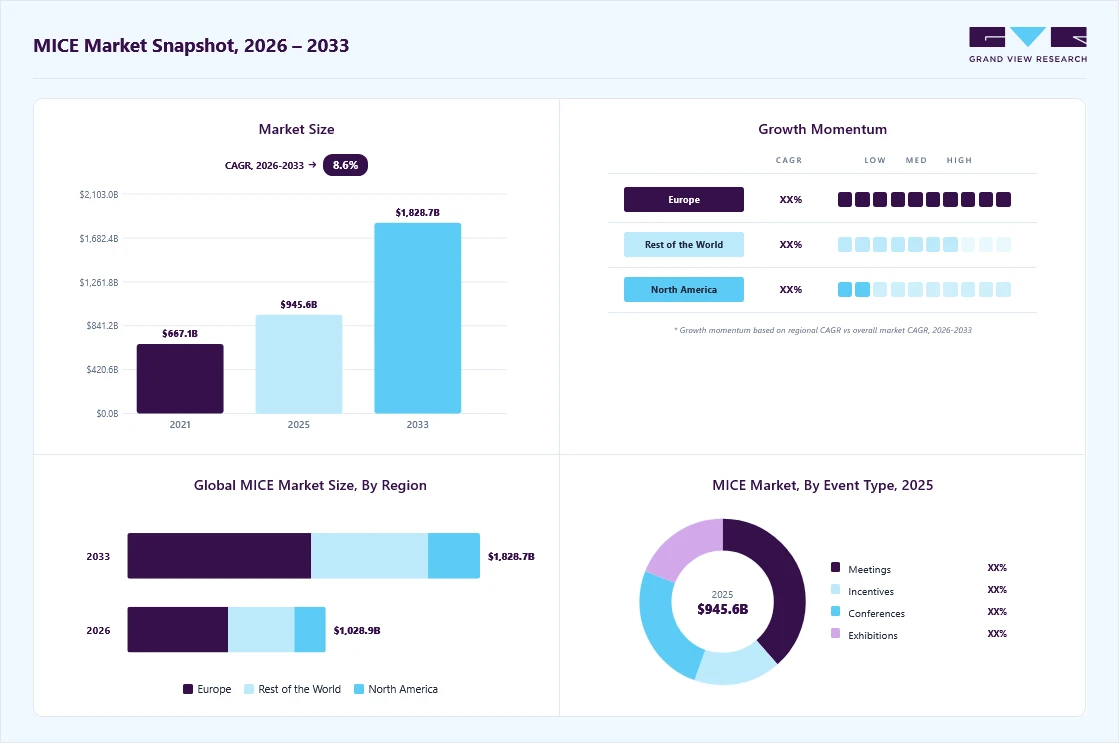 Source: Grand View Research, IR Documents, Primary Interviews, Paid DatabasesTo learn more about this report,
 Download Free Sample Report
 Key Market Trends & Insights
- By event type: Meetings segment held the largest market share of 38.5% in 2025
- By meeting size: 150 to 249 segment held the largest market share of 26.4% in 2025
- By booking mode: Direct booking segment held the largest market share of 39.4% in 2025
Regional Highlights
- Largest regional market: Europe (50.6% revenue share, 2025)
- Fastest-growing regional market: Asia Pacific (fastest CAGR, 2026-2033)
Market Size & Forecast
- Market size in 2025: USD 945.6 Billion
- Estimated market size in 2026: USD 1,028.9 Billion
- Projected market size by 2033: USD 1,828.7 Billion
- CAGR (2026-2033): 8.6%
Three ways to get this report
Buy it, customize it, or ask a question.Ask an Analyst
A direct answer, usually in 1 working day
- AccessReport author, directly
- Reply timeWithin 1 working day
- No sales callDirect answer only
- FormatEmail reply
- CostFree, no cost
Get the Full Report
What the study covers
- FormatsPDF · Excel · Dashboard
- Timeline2026–2033 annual, 2025 base
- Coverage20+ countries, 5 regions
- Companies10+ key players profiled
Customize the Report
20% free customization
- IncludeCountries, segments, points
- TailorTo your product definition
- ExtendDeeper competitor detail
- OrA fully bespoke study
- Turnaround5–10 working days
The increasing use of business events as platforms for corporate communication, networking, knowledge exchange, employee engagement, and business development is contributing to sustained demand for MICE-related travel and services. The expansion of multinational companies and increasing cross-border business activities are strengthening demand for corporate meetings, conferences, training programs, exhibitions, and client events. As businesses establish operations in new markets and engage with geographically dispersed employees, customers, partners, and investors, professionally organized events provide opportunities for in-person collaboration and relationship-building. This trend is also increasing demand for integrated MICE services, including venue sourcing, accommodation, transportation, event management, and destination management. The growing number of specialized MICE service providers is further supporting the availability and customization of these services across major business destinations.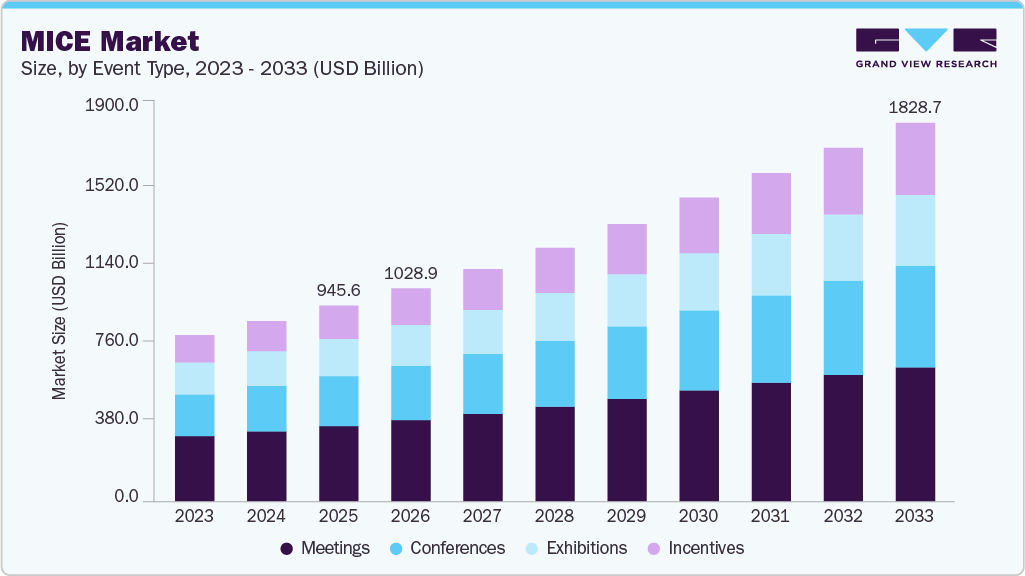 To learn more about this report, Download Free Sample Report
 The increasing focus on employee engagement and performance recognition is also contributing to demand for incentive travel programs. Organizations are increasingly incorporating experiential travel into employee reward and recognition initiatives to strengthen team engagement, improve motivation, and support employee retention. As a result, demand is expanding for customized incentive programs that combine accommodation, leisure activities, cultural experiences, and corporate events. Destinations offering premium hospitality infrastructure and distinctive experiences, including the Maldives and Paris, continue to benefit from this trend.
The development of business and tourism infrastructure in established and emerging destinations is further supporting MICE demand. Major commercial and financial hubs such as Singapore and Dubai are attracting conferences, exhibitions, and corporate events due to their international connectivity, modern convention facilities, hospitality infrastructure, and capacity to accommodate large-scale gatherings. At the same time, the growing adoption of hybrid and technology-enabled event formats is expanding the range of participation models available to event organizers. Hybrid formats complement physical gatherings by enabling broader participation, improving flexibility, and facilitating engagement among geographically dispersed attendees. These developments are contributing to the evolution of MICE event formats and supporting demand for technology-enabled and customized event solutions.
Market Dynamics
The MICE market is supported by expanding cross-border business activities and the increasing use of corporate events for collaboration, networking, and employee engagement. However, high event organization and travel costs can constrain participation and budgets. Meanwhile, growing demand for personalized and experiential incentive travel presents opportunities for providers to develop customized, higher-value MICE offerings.
The increasing internationalization of businesses is strengthening demand for meetings, conferences, exhibitions, and incentive programs. Companies expanding into new geographic markets increasingly organize face-to-face events to engage employees, customers, channel partners, investors, and other stakeholders. Cross-border collaboration also increases requirements for venue sourcing, accommodation, transportation, event management, and destination management services. Major business hubs with strong connectivity and convention infrastructure are consequently attracting a growing number of corporate events. Furthermore, multinational organizations are increasingly using MICE events to facilitate knowledge exchange, strengthen business relationships, and support market expansion initiatives. The continued growth of international business networks is therefore expected to sustain demand for professionally organized MICE travel and associated hospitality and event services.
The high costs of organizing and participating in MICE events pose a significant constraint on market expansion, particularly for organizations with limited travel and event budgets. Expenses related to venue rental, accommodation, transportation, catering, event production, technology, and destination services can significantly increase the overall cost of corporate events. International events also entail additional costs for air travel, visas, currency fluctuations, and logistical coordination. Rising hospitality and transportation costs can further affect event budgets and influence organizations to reduce event frequency, shorten event duration, or shift toward virtual and hybrid formats. Small and medium-sized businesses may be particularly sensitive to these costs, which can limit their participation in large-scale conferences, exhibitions, and incentive travel programs.
The increasing emphasis on employee engagement, recognition, and retention presents opportunities for MICE providers to expand experiential and personalized incentive travel offerings. Organizations are increasingly seeking distinctive experiences rather than conventional reward programs, creating demand for customized itineraries that combine business activities with leisure, cultural experiences, wellness, adventure, and premium hospitality. MICE destinations can capitalize on this trend by developing tailored packages based on employee preferences, organizational objectives, and group profiles. Digital technologies can further support personalization through data-driven itinerary planning, mobile event platforms, and real-time engagement tools. The expansion of experiential incentive programs across emerging destinations also creates opportunities for destination management companies, hotels, event organizers, and travel service providers to diversify their offerings and capture higher-value corporate travel demand.
Analyst Perspective
The MICE market is entering a phase of sustained expansion as organizations increasingly view business events as strategic platforms for relationship building, employee engagement, networking, and market development. The recovery of international business travel, combined with the growing adoption of experiential incentive programs, is supporting demand for customized MICE services. Major destinations are also strengthening convention infrastructure and connectivity to attract high-value corporate events. However, rising venue, accommodation, transportation, and event management costs remain a key consideration for organizers. Providers offering integrated, technology-enabled, and personalized solutions are therefore better positioned to capture evolving corporate and group travel requirements.
Event Type Insights
The meetings segment accounted for 38.5% revenue share of the global MICE industry in 2025, supported by the continued use of corporate meetings as a platform for decision-making, stakeholder engagement, knowledge exchange, and business development. The segment encompasses shareholder meetings, management meetings, general meetings, and other corporate gatherings. The demand is also extending beyond major business centers, as organizations increasingly select regional destinations and less-dense tier cities for smaller and mid-sized events. Government initiatives to attract international business events are also supporting MICE activity across established and emerging destinations. For instance, in May 2026, Tourism Australia announced the extension of its Business Events Bid Fund Program into future years. The program provides financial support at the bidding stage to help Australia secure international association congresses and conferences, corporate incentive programs and meetings, and exhibitions, with supported events expected to generate significant economic activity for the country's tourism and business events ecosystem.
The demand for incentive services is projected to grow at a CAGR of 10.2% from 2026 to 2033. The growing preference for distinctive and experiential travel among younger employees is driving corporate spending on incentive programs that recognize performance and enhance employee engagement. Organizations are increasingly moving beyond conventional reward programs toward tailor-made itineraries incorporating leisure, adventure, wellness, and cultural experiences. The availability of accessible destinations and personalized travel programs is further broadening the use of incentive travel as a tool for employee recognition and engagement.
Event Size Insights
Events comprising 150 to 249 participants accounted for a revenue share of approximately 26.4% in 2025. This meeting size provides a balance between event scale, participant engagement, and cost management, making it suitable for regional conferences, strategy meetings, product launches, training programs, and corporate gatherings. Organizations increasingly favor mid-sized formats that allow greater interaction among participants without the logistical complexity and cost associated with large-scale events. The availability of meeting facilities in upscale hotels and convention venues, together with the format's compatibility with hybrid participation, further supports its adoption.
The 50- to 149-participant segment is projected to grow at a CAGR of 9.0% from 2026 to 2033. Demand for this meeting size is supported by the increasing use of smaller corporate and association events for knowledge exchange, training, strategic planning, and team collaboration. The adoption of hybrid work structures has also increased the need for periodic in-person interactions among geographically distributed teams. Regional meetings and corporate off-sites offer organizations greater flexibility in venue selection and event budgets while retaining opportunities for face-to-face engagement, supporting the segment's expansion.
Booking Mode Insights
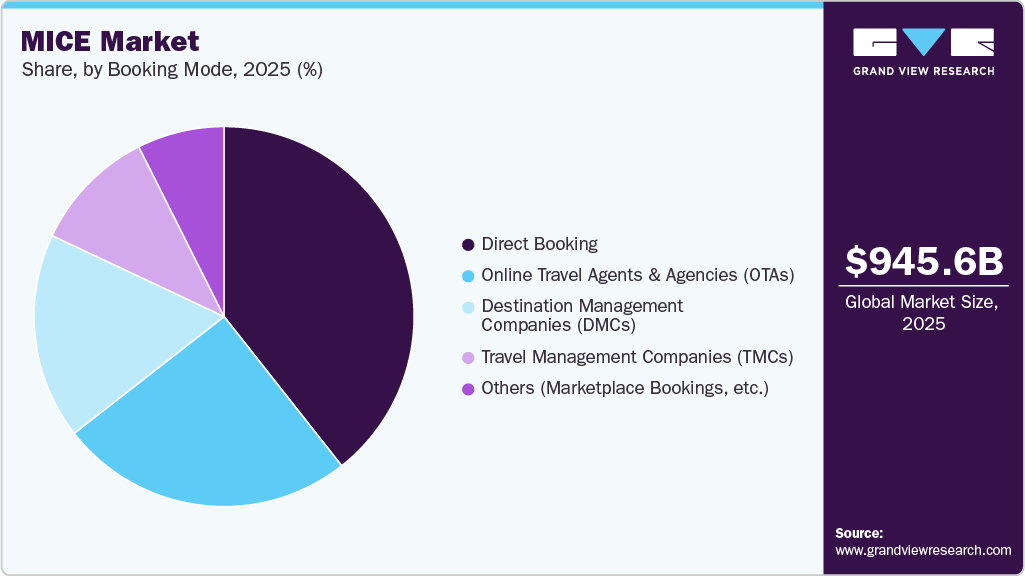
The direct booking segment accounted for a revenue share of 39.4% in 2025, supported by the preference of corporate clients and event planners for greater control over venue selection, pricing, services, and event specifications. Direct engagement with hotels, convention centers, venues, and other MICE service providers also facilitates customized arrangements for accommodation, meeting spaces, catering, transportation, and event-related services. Large hotel groups and convention operators increasingly maintain dedicated MICE sales teams and corporate booking channels, enabling organizations to negotiate packages and coordinate multiple requirements through a single provider. The availability of online booking engines and dedicated corporate portals is further simplifying direct engagement between buyers and service providers.
 To learn more about this report, Download Free Sample Report
 The booking of MICE services through online travel agents (OTAs) is projected to grow at the fastest CAGR of 11.0% from 2026 to 2033. Increasing digitization of business travel procurement is improving the accessibility of OTA platforms for organizations seeking to compare destinations, accommodation, transportation, and event-related services. Transparent pricing, broader inventory, centralized booking, and streamlined coordination are particularly relevant for smaller organizations and event planners managing multiple suppliers. Advances in platform functionality, including personalized recommendations, flexible booking options, and integrated payment and management tools, are further increasing the relevance of OTA-based booking within the MICE ecosystem.
Regional Insights
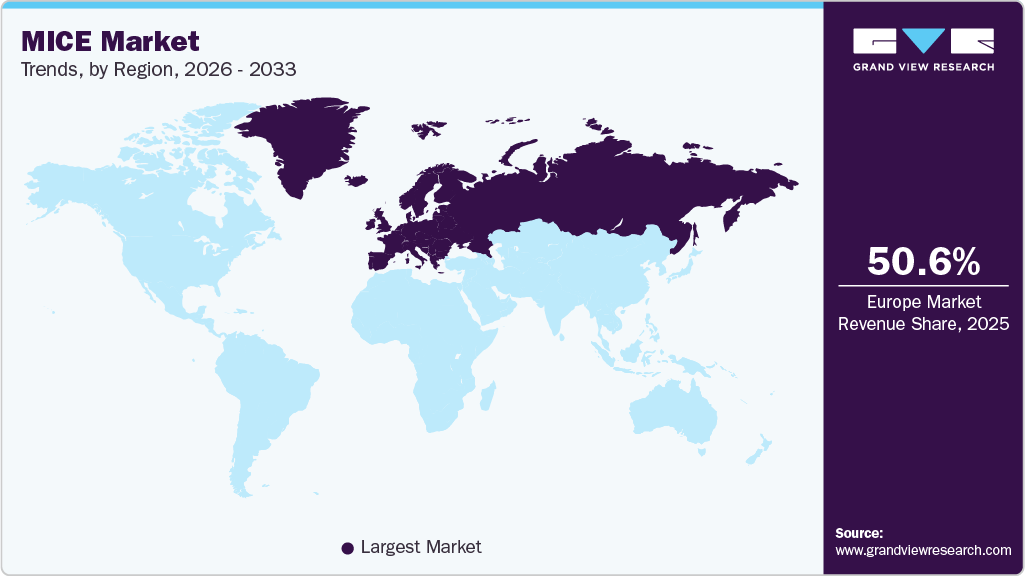
The Europe MICE market accounted for the largest global revenue share of 50.6% in 2025. The region benefits from a well-established business events ecosystem supported by its concentration of corporate headquarters, international organizations, financial centers, and established tourism destinations. Strong connectivity between major European cities, extensive convention and exhibition infrastructure, and a broad supply of business-oriented hotels continue to support year-round MICE activity. Hospitality providers are also adapting their offerings to accommodate the specific requirements of business events, including dedicated meeting spaces, event technology, group accommodation, and customized packages. In addition, organizations across Europe are reassessing corporate travel policies and adopting digital expense-management and booking technologies to improve control over business travel spending.
 To learn more about this report, Download Free Sample Report
 The MICE market in Germany accounted for 17.4% of regional revenue in 2025. Germany's position as a major industrial and commercial economy supports sustained demand for trade fairs, corporate meetings, professional conferences, training programs, and industry networking events. Major business centers such as Berlin, Frankfurt, Munich, and Cologne benefit from established convention facilities, extensive exhibition infrastructure, and efficient domestic and international transport networks.
North America MICE Market Trends
North America accounted for 16.0% revenue share of the global MICE industry in 2025. The region benefits from a large corporate base, established business travel networks, extensive convention infrastructure, and strong demand from financial services, technology, healthcare, manufacturing, and professional services industries. Government-supported trade and investment programs also contribute to business-event activity. For instance, the U.S. Department of Commerce's SelectUSA program organizes investment summits, roadshows, conferences, and trade events that connect international investors with U.S. state and local economic development organizations. The SelectUSA Investment Summit brings together investors, companies, economic development organizations, and industry experts, creating additional demand for business-event infrastructure and related services.
The U.S. MICE marketis significant in North America, supported by sustained corporate travel activity and demand for conferences, exhibitions, training programs, networking events, and incentive travel. The country's large and diversified corporate sector generates recurring business-event requirements across technology, healthcare, financial services, manufacturing, and professional services. The U.S. also continues to use trade exhibitions as platforms for international business development. For example, the U.S. Commercial Service's Trade Event Partnership Program recruits international buyer delegations and facilitates business-to-business meetings at selected U.S. trade shows. Such initiatives reinforce the role of exhibitions and conferences as channels for trade development, networking, and market expansion, supporting demand for MICE services.
Asia Pacific MICE Market Trends
The MICE industry in the Asia Pacific is projected to grow at a CAGR of 11.0% from 2026 to 2033. The region benefits from expanding corporate activity, increasing internationalization of businesses, and rising cross-border trade, which are generating demand for meetings, conferences, exhibitions, and incentive programs. Singapore continues to strengthen its position as a regional MICE hub through government-backed initiatives. In July 2026, the Singapore Ministry of Trade and Industry highlighted that MICE receipts had increased 35% year-on-year to SGD 2.3 billion in the preceding year. The Singapore Tourism Board is also implementing the Business Events in Singapore (BEiS) scheme, which provides tailored support for eligible MICE projects, including venue assistance, marketing, bidding, and business development.
Latin America MICE Market Trends
The Latin America MICE industry is projected to grow at a CAGR of 9.5% from 2026 to 2033. The region is entering a new phase of MICE development, supported by improvements in convention infrastructure, destination connectivity, regional collaboration, and the adoption of hybrid event formats. Established hubs, including Rio de Janeiro and São Paulo in Brazil, Bogotá and Cartagena in Colombia, and Buenos Aires in Argentina, continue to strengthen their positions as destinations for international conferences, exhibitions, and incentive travel. For instance, PROMPERÚ reported in May 2026 that Peru hosted 93 international congresses in 2025, representing a 52.5% increase over 2024, while Lima hosted 72 events, a 67.4% increase, making it the second-largest destination in Latin America for international congresses. In addition, the growing preference for combining business travel with leisure experiences is driving demand for incentive programs and customized corporate itineraries, particularly in destinations that offer cultural, culinary, and recreational experiences alongside established MICE infrastructure.
Middle East MICE Market Trends
The MEA MICE industry is projected to grow at a CAGR of 9.0% from 2026 to 2033. Significant investments in convention centers, hotels, entertainment infrastructure, and destination development are strengthening the region's capacity to host large-scale international events. Improving air connectivity is further facilitating international participation, while the integration of business events with leisure and entertainment offerings is increasing the attractiveness of the region for incentive travel. Growth is further supported by large-scale airport modernization projects and the introduction of visa-on-arrival schemes across several Gulf and African nations, which are lowering entry barriers for international business travelers and event organizers alike.
Government-led measures are also improving accessibility for international delegates in Africa. For instance, South Africa introduced the Meetings, Exhibitions, Events and Tourism Scheme (MEETS) in March 2026 to streamline high-volume, time-sensitive group visa applications associated with international events. These infrastructure and policy initiatives are strengthening the region’s ability to attract international conferences, exhibitions, corporate meetings, and incentive programs.
Key MICE Company Insights
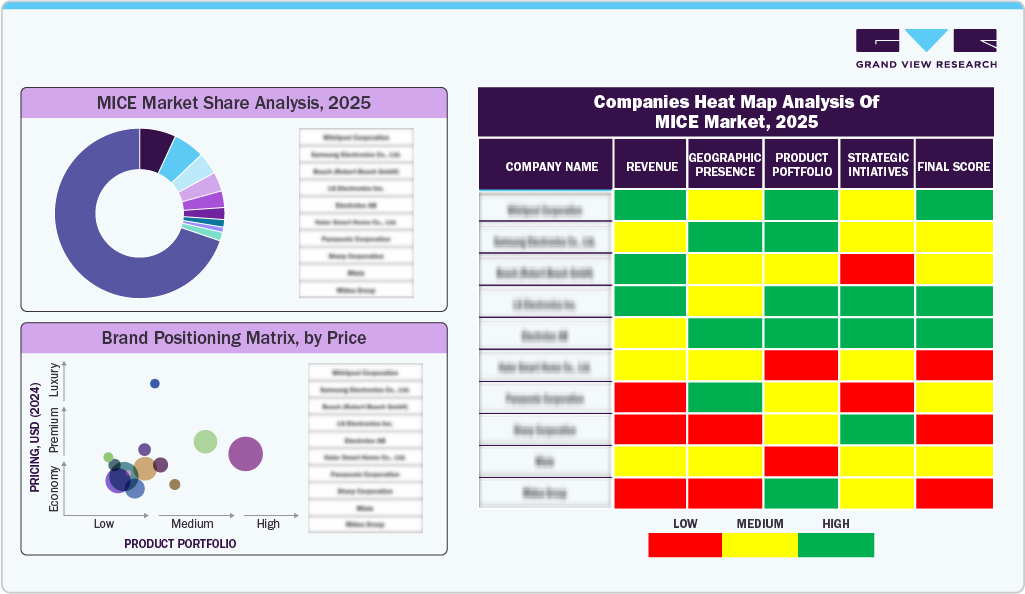
The global MICE market comprises international event organizers, destination management companies, convention and exhibition operators, hospitality groups, specialized event agencies, and regional players serving corporate and institutional clients. Competition is increasingly centered on the ability to deliver integrated, customized, and technology-enabled event experiences across meetings, incentives, conferences, and exhibitions. Market participants are investing in digital event platforms, hybrid event capabilities, attendee engagement solutions, and data analytics to improve event execution and demonstrate measurable outcomes to clients. Leading companies are also expanding their geographic presence through partnerships, acquisitions, new event launches, and entry into emerging business destinations and secondary cities. At the same time, providers are diversifying their portfolios toward experiential incentive travel, industry-specific conferences, and large-scale exhibitions to capture higher-value corporate and international event demand.
 To learn more about this report, Download Free Sample Report
 Key MICE Companies
The following key companies have been profiled for this study on the MICE market.
-
American Express Global Business Travel
-
CWT Meetings & Events
-
BCD Meetings & Events
-
Maritz
-
Conference Care
-
ATPI Ltd.
-
FCM Meetings & Events
-
Global Cynergies, LLC
-
Capita plc
-
AVIAREPS AG
-
ITL World Company (MICEMINDS)
-
Questex
-
Beyond Summits
-
Meetings and Incentives Worldwide, Inc.
-
One10, LLC
-
Creative Group, Inc.
-
Cambria DMC
-
Ci Events
-
redtag.ca M.I.C.E.
Recent Developments
-
In August 2026, BCD Meetings & Events expanded its India headquarters and operations, citing the strong growth potential of the MICE market. The expansion is intended to strengthen the company’s capabilities and support the increasing demand for meetings and events in India
-
In February 2026, redtag.ca M.I.C.E. launched by redtag.ca as a dedicated MICE (meetings, incentives, conferences, and exhibitions) offering to expand its services beyond leisure travel into business and corporate events. The new division aims to leverage redtag.ca’s existing travel expertise and its parent company’s global network to help Canadian companies plan and execute domestic and international meetings and incentive programs more effectively, positioning the brand alongside established corporate travel and event specialists.
-
In February 2025, Hyatt Hotels Corporation launched the Asia Pacific Meetings & Events Alliance, a new initiative designed to simplify multi-city event planning for corporate clients across the region. The program brings together nine Hyatt properties in key business hubs to offer centralized planning support, customized packages, and coordinated services that help event organizers manage complex itineraries more efficiently. By enabling collaborative event delivery and enhanced incentives across participating hotels, the alliance aims to make large-scale meetings and conferences easier to book and execute throughout the Asia Pacific.
MICE Market Report Scope
Report Attribute
Details
Market size in 2025
USD 945.6 billion
Estimated market size in 2026
USD 1,028.9 billion
Projected market size by 2033
USD 1,828.7 billion
Growth rate
CAGR of 8.6% from 2026 to 2033
Base year for estimation
2025
Historical data
2021 - 2024
Forecast period
2026 - 2033
Quantitative units
Revenue in USD billion, volume in number of travelers, and CAGR from 2026 to 2033
Report coverage
Revenue forecast, volume forecast, company ranking, competitive landscape, growth factors, and trends
Segments covered
Event type, booking mode, meeting size, region
Regional scope
North America; Europe; Asia Pacific; Latin America; Middle East & Africa
Country scope
U.S.; Canada; Mexico; Germany; UK; France; Italy; Spain; Austria; Netherlands; China; Japan; India; Australia; ASEAN; Brazil; South Africa; UAE
Key companies profiled
American Express Global Business Travel; CWT Meetings & Events; BCD Meetings & Events; Maritz; Conference Care; ATPI Ltd.; FCM Meetings & Events; Global Cynergies, LLC; Capita plc; AVIAREPS AG; ITL World Company (MICEMINDS); Questex; Beyond Summits; Meetings and Incentives Worldwide, Inc.; One10, LLC; Creative Group, Inc.; Cambria DMC; Ci Events; redtag.ca M.I.C.E.
Customization scope
Free report customization (equivalent to 8 analyst working days) with purchase. Addition or alteration to country, regional & segment scope.
Pricing and purchase options
Avail of customized purchase options to meet your exact research needs. Explore purchase options
Global MICE Market Report Segmentation
This report forecasts revenue & volume growth at the global, regional, and country levels and provides an analysis of the latest industry trends and opportunities in each of the sub-segments from 2021 to 2033. For this study, Grand View Research has segmented the global MICE market report based on event type, booking mode, meeting size, and region:
-
Event Type Outlook (Volume, Number of Travelers; Revenue, USD Billion, 2021 - 2033)
-
Meetings
-
Incentives
-
Conferences
-
Exhibitions
-
-
Booking Mode Outlook (Volume, Number of Travelers; Revenue, USD Billion, 2021 - 2033)
-
Direct Booking
-
Online Travel Agents and Agencies (OTAs)
-
Destination Management Companies (DMCs)
-
Travel Management Companies (TMCs)
-
Others
-
-
Meeting Size Outlook (Volume, Number of Travelers; Revenue, USD Billion, 2021 - 2033)
-
From 50 to 149
-
From 150 to 249
-
From 250 to 499
-
From 500 to 999
-
From 1000 to 1999
-
From 2000 to 2999
-
From 3000 & Above
-
-
Regional Outlook (Volume, Number of Travelers; Revenue, USD Billion, 2021 - 2033)
-
North America
-
U.S.
-
Canada
-
Mexico
-
-
Europe
-
UK
-
Germany
-
France
-
Spain
-
Italy
-
Austria
-
Netherlands
-
-
Asia Pacific
-
China
-
India
-
Japan
-
Australia
-
-
Latin America
-
Brazil
-
-
Middle East & Africa
-
South Africa
-
UAE
-
-
About the Author(s)
Homecare & Decor Research Team
Consumer Goods · Homecare & DecorThis report was authored by the homecare & decor research team at Grand View Research - comprising two research analysts, one senior research analyst, and one industry expert - with specialized expertise in the homecare & decor segment of the consumer goods industry. All findings are based on proprietary consumer goods databases, executive interviews, and regulatory analysis, subject to internal peer review prior to publication.
Last Updated:
Speak to Analyst

Customize this report to your needs - add regions, segments, or data points, with 20% free customization.
Or view our licence options:


ISO 9001:2015 & 27001:2022 Certified
We are GDPR and CCPA compliant! Your transaction & personal information is safe and secure. For more details, please read our privacy policy.


