
- Home
- »
- Medical Devices
- »
-
Microsurgical Instruments Market Size Report, 2026-2035GVR Report cover

Microsurgical Instruments Market (2026 - 2035)
Size, Share & Trends Analysis Report By Type (Operating Microscopes, Micro Sutures, Micro Forceps, Microsurgery Needle Holders, Micro Scissors), By Microsurgery Type, By End User, Regional Outlook, And Segment Forecasts
Market Size, 2025
$2.6BMarket Estimate, 2026
$2.8BMarket Forecast, 2035
$4.8BCAGR, 2026–2035
6.4%Microsurgical Instruments Market Summary
The global microsurgical instruments market size was valued at USD 2.6 billion in 2025 and is projected to grow from USD 2.8 billion in 2026 to USD 4.8 billion in 2035, at a CAGR of 6.4% from 2026 to 2035. North America dominated the market, accounting for a revenue share of 38.0% in 2025. The market is witnessing steady growth, driven by rising demand for minimally invasive procedures, advancements in surgical technologies, increasing prevalence of chronic diseases, and growing adoption of precision-based microsurgical techniques across various medical specialties.
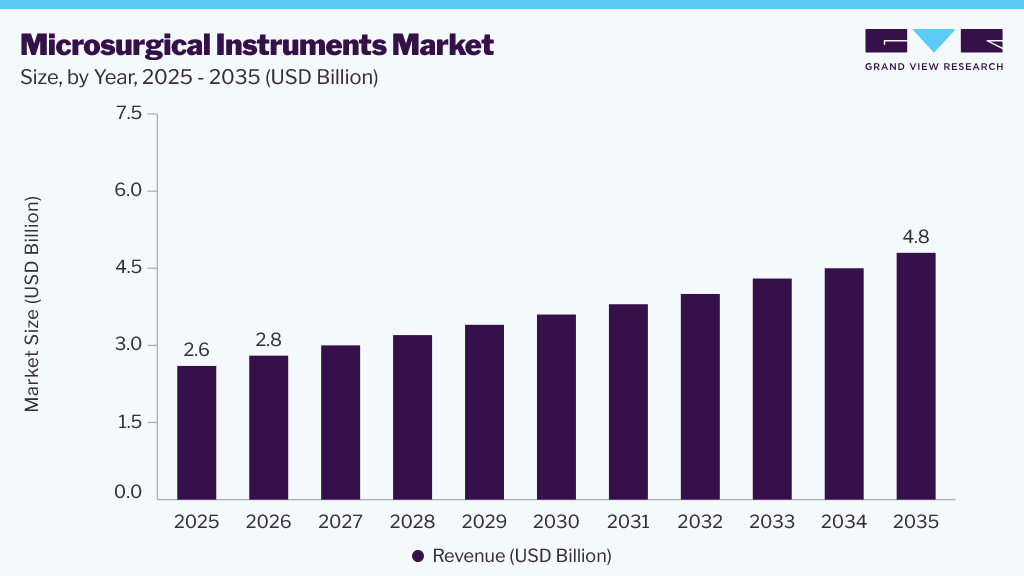 Source: Grand View Research, IR Documents, Primary Interviews, Paid DatabasesTo learn more about this report,
 Download Free Sample Report
 Key Market Trends & Insights
- By type: Operating microscopes segment held the largest market share of approximately 40.0% in 2025.
- By microsurgery type: Ophthalmic microsurgeries segment held the largest market share of approximately 32.0% in 2025.
- By end user: Hospitals segment held the largest market share of approximately 68.0% in 2025.
Regional Highlights
- Largest regional market: North America (38.0% revenue share, 2025)
- Fastest-growing regional market: Asia Pacific (highest CAGR, 2026-2035)
Market Size & Forecast
- Market size in 2025: USD 2.6 Billion
- Estimated market size in 2026: USD 2.8 Billion
- Projected market size by 2035: USD 4.8 Billion
- CAGR (2026-2035): 6.4%
Three ways to get this report
Buy it, customize it, or ask a question.Ask an Analyst
A direct answer, usually in 1 working day
- AccessReport author, directly
- Reply timeWithin 1 working day
- No sales callDirect answer only
- FormatEmail reply
- CostFree, no cost
Get the Full Report
What the study covers
- FormatsPDF · Excel · Dashboard
- Timeline2026–2035 annual, 2025 base
- Coverage20+ countries, 5 regions
- Companies10+ key players profiled
Customize the Report
20% free customization
- IncludeCountries, segments, points
- TailorTo your product definition
- ExtendDeeper competitor detail
- OrA fully bespoke study
- Turnaround5–10 working days
The microsurgical instruments market is driven by the increasing adoption of precision-based surgical techniques, the rising prevalence of ophthalmic, neurological, orthopedic, and reconstructive conditions, and the growing demand for advanced surgical procedures. Advancements in surgical visualization systems, high-precision instruments, and specialized microsurgical tools enabling surgeons to perform complex procedures with greater accuracy and improved patient outcomes. In addition, the growing aging population, increasing healthcare expenditure, expansion of specialized surgical centers, and rising investments in advanced medical technologies are supporting market growth. The growing preference for procedures that enable greater surgical precision, reduced tissue trauma, shorter recovery times, and improved surgical efficiency is further accelerating the adoption of microsurgical instruments across various medical specialties.However, the market is constrained by the high cost of advanced microsurgical equipment, the limited availability of surgeons trained in complex microsurgical procedures, and stringent regulatory requirements for medical device approvals. Budget constraints within developing healthcare systems and challenges associated with the maintenance and sterilization of specialized instruments also limit adoption. Despite these challenges, significant opportunities exist through the development of robotic-assisted microsurgery, integration of artificial intelligence and advanced imaging technologies, and increasing investments in healthcare infrastructure across emerging economies. The rising adoption of outpatient and ambulatory surgical procedures, along with ongoing innovation in microsurgical instrument design, is expected to create further growth opportunities during the forecast period.
Analyst Perspective
The microsurgical instruments market is set for steady growth, driven by rising demand for minimally invasive and precision procedures. Technological advancements in visualization systems, instrument miniaturization, and robotic assistance are significantly expanding surgical capabilities. A growing global prevalence of ophthalmic, neurological, orthopedic, and reconstructive conditions continues to boost procedure volumes. Hospitals remain the primary end users due to superior infrastructure, while ambulatory surgery centers are rapidly gaining traction for cost efficiency. To meet evolving clinical needs, key market players are actively developing ergonomic, precise, and durable instruments. Furthermore, emerging economies offer major growth opportunities through expanding healthcare infrastructure, rising expenditure, and broader access to advanced technologies.
Type Insights
The operating microscopes segment accounted for the largest share of approximately 40.0% in 2025. The large share of the segment is attributed to the essential role of operating microscopes in providing high-magnification visualization, enhanced surgical precision, and greater control during complex microsurgical procedures. Increasing adoption of advanced optical technologies, including digital imaging, fluorescence visualization, and 3D visualization capabilities, is further supporting demand for operating microscopes. Moreover, increasing investments by hospitals in advanced operating room infrastructure are strengthening the segment's market position. For instance, in December 2025, NYC Health + Hospitals in Elmhurst acquired three state-of-the-art Leica surgical microscopes following a USD 1 million investment from the Queens Borough President. The microscopes are used across ENT, neurosurgery, general surgery, and reconstructive surgery, highlighting the growing adoption of advanced operating microscopes across a range of complex surgical procedures.
The micro sutures segment is expected to experience the fastest growth during the forecast period. Rising demand for delicate tissue repair procedures, increasing adoption of minimally invasive microsurgical techniques, and expanding applications in vascular, reconstructive, and transplant surgeries are driving segment growth. Advancements in absorbable and non-absorbable suture materials are improving handling characteristics, supporting effective wound closure, and reducing tissue trauma during delicate surgical procedures. The increasing focus on precision-based surgery and the expansion of microsurgical applications across emerging healthcare markets are further supporting the adoption of advanced micro sutures.
Microsurgery Type Insights
The ophthalmic microsurgeries segment accounted for the largest share of approximately 32.0% in 2025. The segment's large share is driven by the high prevalence of vision-related conditions, including cataracts, glaucoma, retinal diseases, and corneal disorders, which contribute to demand for precise ophthalmic surgical procedures. The growing aging population, increasing demand for vision-restoring procedures, and continuous advancements in ophthalmic surgical techniques are supporting the adoption of specialized microsurgical instruments. In addition, the increasing use of advanced operating microscopes, micro forceps, and other precision instruments in cataract, retinal, and corneal surgeries is contributing to segment growth. Expanding access to eye care services and increasing investments in ophthalmic surgical infrastructure across developed and emerging economies are further strengthening the segment's leading position.
The neurological microsurgeries segment is expected to witness the fastest growth during the forecast period. The segment growth is supported by the rising prevalence of neurological disorders, increasing incidence of brain and spinal conditions, and growing adoption of advanced surgical techniques for complex neurological procedures. Improvements in surgical visualization systems, robotic-assisted microsurgery, and precision instruments are enabling surgeons to perform intricate procedures with enhanced accuracy and reduced risks. The integration of robotic technologies is further expanding the application scope of microsurgical instruments in neurosurgery. For instance, in October 2025, Medical Microinstruments (MMI) completed the world's first robotic microsurgical intracranial brain surgery using its Symani Surgical System, marking a significant advancement in robotic-assisted microsurgery for neurological applications. This innovation highlights the growing role of advanced microsurgical platforms in improving precision and expanding treatment possibilities for complex neurological conditions.
End User Insights
The hospitals segment accounted for the largest share of approximately 68.0% in 2025. The segment's leading position is primarily attributed to the availability of advanced surgical infrastructure, specialized medical professionals, and a high volume of complex microsurgical procedures performed in hospital settings. Hospitals are the primary centers for ophthalmic, neurological, reconstructive, transplant, and other specialized surgeries that require high-precision instruments and advanced visualization systems. Increasing investments in operating room modernization, expansion of specialty departments, and adoption of advanced surgical technologies are further supporting demand for microsurgical instruments in hospitals. In addition, the growing number of surgical procedures, rising healthcare investments, and increasing focus on improving patient outcomes are contributing to the continued adoption of microsurgical instruments across hospital settings.
The ambulatory surgery centers (ASCs) segment is expected to witness the fastest growth during the forecast period. Segment growth is driven by the increasing shift toward minimally invasive and outpatient procedures, growing emphasis on cost-efficient treatment models, and rising preference for shorter hospital stays. ASCs are increasingly adopting advanced surgical instruments to support efficient procedures, facilitate faster recovery, and improve patient convenience. The expansion of outpatient surgical infrastructure, increasing availability of specialized surgeons, and advancements in compact and user-friendly microsurgical systems are further supporting segment growth. As healthcare systems continue to prioritize value-based care and efficient surgical delivery models, ambulatory surgery centers are expected to play an increasingly important role in the adoption of microsurgical instruments.
Regional Insights
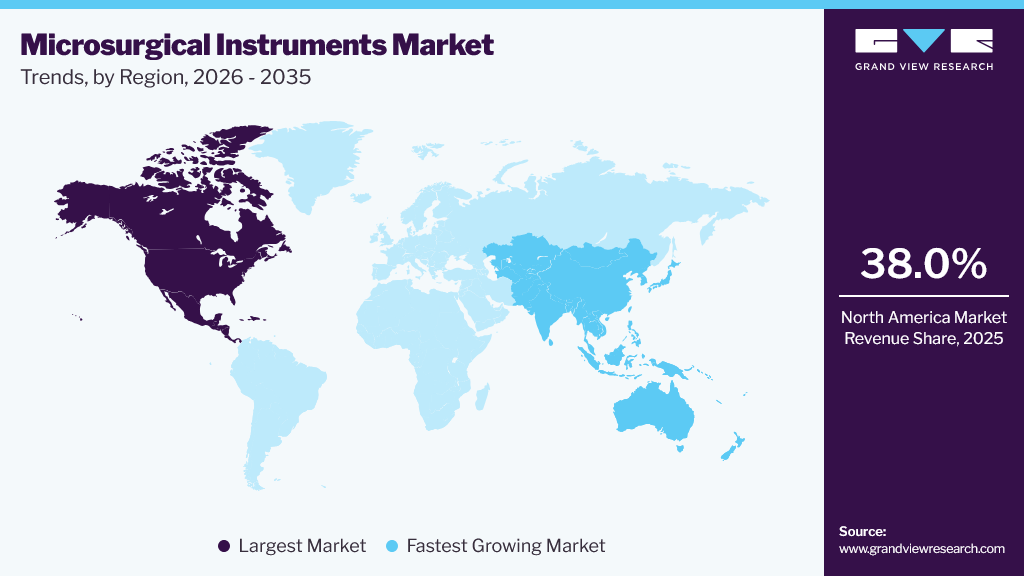
North America accounted for the largest share of approximately 38.0% in 2025. Regional dominance is attributed to the presence of advanced healthcare infrastructure, high adoption of advanced surgical systems, and a strong presence of leading medical device manufacturers. Increasing demand for minimally invasive procedures, rising prevalence of ophthalmic and neurological disorders, and continuous investments in surgical innovation are supporting the adoption of microsurgical instruments across hospitals and specialized surgical centers. In addition, favorable reimbursement policies, higher healthcare expenditure, and growing availability of skilled surgeons continue to strengthen North America's leading position in the global market.
 To learn more about this report, Download Free Sample Report
 Asia Pacific Microsurgical Instruments Market Trends
Asia Pacific is expected to witness the fastest growth during the forecast period. The region's growth is driven by improving healthcare infrastructure, rising healthcare expenditure, increasing surgical volumes, and growing access to advanced medical technologies across emerging economies such as India and China. Increasing investments by healthcare providers, expansion of specialty hospitals, and growing demand for precision-based surgical procedures are creating significant opportunities for microsurgical instrument manufacturers. The rising adoption of advanced surgical systems, coupled with improvements in after-sales service networks, is further supporting market penetration across the region. In addition, the expansion of technical support and servicing infrastructure is improving access to and maintenance of advanced surgical equipment. For instance, in September 2025, Olympus India opened an additional repair facility for its Surgical Business in Gurugram to strengthen servicing capabilities for surgical devices and instruments and support the growing demand for minimally invasive surgical procedures in India.
Key Microsurgical Instruments Company Insights
The microsurgical instruments market is characterized by the presence of global medical device manufacturers focusing on product innovation, precision engineering, and expansion of advanced surgical solutions. Companies are investing in high-performance instruments, robotic-assisted microsurgery platforms, advanced visualization systems, and ergonomic designs to improve surgical accuracy and patient outcomes. Market participants are strengthening their portfolios through new product launches, regulatory approvals, strategic collaborations, and expansion of healthcare technology capabilities. The increasing adoption of minimally invasive procedures and demand for specialized instruments across ophthalmology, neurosurgery, reconstructive surgery, and transplant procedures are encouraging companies to develop advanced solutions with improved precision and reliability. Leading players are also focusing on expanding their global presence, enhancing surgeon training programs, and improving access to advanced microsurgical technologies across developed and emerging healthcare markets.
Key Microsurgical Instruments Companies
The following key companies have been profiled for this study on the microsurgical instruments market:
-
Alcon Inc.
-
B. Braun SE
-
Baxter International Inc.
-
Beaver-Visitec International, Inc.
-
Danaher Corporation (Leica Microsystems)
-
Global Surgical Corporation
-
Haag-Streit Surgical
-
Integra LifeSciences
-
Johnson & Johnson Services, Inc. (Ethicon)
-
Karl Kaps GmbH
Recent Developments
-
In February 2026, ZEISS Medical Technology received NMPA approval for its ARTEVO 750 and ARTEVO 850 ophthalmic microscopes in China, enabling the expansion of advanced ophthalmic visualization solutions with RGB illumination and integrated digital workflow capabilities to support precision-driven eye surgeries.
-
In December 2025, Medical Microinstruments (MMI) received FDA 510(k) clearance for its NanoWrist scissors and forceps, expanding the capabilities of the Symani Surgical System and strengthening its robotic microsurgery platform for advanced precision procedures.
-
In October 2025, AROSurgical Instruments Corporation introduced next-generation titanium spring microvascular clamps with radiopaque visibility, FDA-cleared disposable microsurgical clamps designed for vascular anastomosis in reconstructive, hand, and transplant microsurgery.
Microsurgical Instruments Market Report Scope
Report Attribute
Details
Market size in 2025
USD 2.6 billion
Estimated market size in 2026
USD 2.8 billion
Projected market size by 2035
USD 4.8 billion
Growth rate
CAGR of 6.4% from 2026 to 2035
Base year for estimation
2025
Historical data
2021 - 2024
Forecast period
2026 - 2035
Quantitative units
Revenue in USD billion, and CAGR from 2026 to 2035
Report coverage
Revenue forecast, company ranking, competitive landscape, growth factors, and trends
Segments covered
Type, microsurgery type, end user, region
Regional scope
North America; Europe; Asia Pacific; Latin America; Middle East & Africa
Country scope
U.S.; Canada; Mexico; UK; Germany; France; Italy; Spain; China; Japan; India; Australia; South Korea; Brazil; Argentina; South Africa; Saudi Arabia; UAE
Key companies profiled
Alcon Inc.; B. Braun SE; Baxter International Inc.; Beaver-Visitec International, Inc.; Danaher Corporation (Leica Microsystems); Global Surgical Corporation; Haag-Streit Surgical; Integra LifeSciences; Johnson & Johnson Services, Inc. (Ethicon); Karl Kaps GmbH
Customization scope
Free report customization (equivalent to 8 analyst working days) with purchase. Addition or alteration to country, regional & segment scope.
Pricing and purchase options
Avail of customized purchase options to meet your exact research needs. Explore purchase options
Global Microsurgical Instruments Market Report Segmentation
This report forecasts revenue growth at the global, regional, and country levels and provides an analysis of the latest industry trends and opportunities across each sub-segment from 2021 to 2035. For this study, Grand View Research has segmented the global microsurgical instruments market report based on by type, microsurgery type, end user, and region:
-
Type Outlook (Revenue, USD Billion, 2021 - 2035)
-
Operating Microscopes
-
Micro Sutures
-
Micro Forceps
-
Microsurgery Needle Holders
-
Micro Scissors
-
Others
-
-
Microsurgery Type Outlook (Revenue, USD Billion, 2021 - 2035)
-
Ophthalmic Microsurgeries
-
Neurological Microsurgeries
-
Orthopedic Microsurgeries
-
Plastic & Reconstructive Microsurgeries
-
ENT Microsurgeries
-
Dental Microsurgeries
-
Gynecological & Urological Microsurgeries
-
Others
-
-
End User Outlook (Revenue, USD Billion, 2021 - 2035)
-
Hospitals
-
Ambulatory Surgery Centers
-
Academic & Research Centers
-
Others
-
-
Regional Outlook (Revenue, USD Billion, 2021 - 2035)
-
North America
-
U.S.
-
Canada
-
Mexico
-
-
Europe
-
UK
-
Germany
-
France
-
Italy
-
Spain
-
-
Asia Pacific
-
China
-
Japan
-
India
-
Australia
-
South Korea
-
-
Latin America
-
Brazil
-
Argentina
-
-
Middle East and Africa (MEA)
-
South Africa
-
Saudi Arabia
-
UAE
-
-
Frequently Asked Questions About This Report
The global microsurgical instruments market size was valued at USD 2.6 billion in 2025 and is estimated at USD 2.8 billion in 2026.
The global microsurgical instruments market is expected to grow at a CAGR of 6.4% from 2026 to 2035, reaching USD 4.8 billion by 2035
North America dominated with approximately 38.0% revenue share in 2025.
The operating microscopes segment accounted for the largest revenue share of approximately 40.0% in 2025.
Key players in the market include Alcon Inc., B. Braun SE, Baxter International Inc., Beaver-Visitec International, Inc., Danaher Corporation (Leica Microsystems), Global Surgical Corporation, Haag-Streit Surgical, Integra LifeSciences, Johnson & Johnson Services, Inc. (Ethicon), Karl Kaps GmbH., and others.
About the Author(s)
Medical Devices Research Team
Healthcare · Medical DevicesThis report was authored by the medical devices research team at Grand View Research - comprising two research analysts, one senior research analyst, and one industry expert - with specialized expertise in the medical devices segment of the healthcare industry. All findings are based on proprietary healthcare databases, executive interviews, and regulatory analysis, subject to internal peer review prior to publication.
Last Updated:
Speak to Analyst

Customize this report to your needs - add regions, segments, or data points, with 20% free customization.
Or view our licence options:


ISO 9001:2015 & 27001:2022 Certified
We are GDPR and CCPA compliant! Your transaction & personal information is safe and secure. For more details, please read our privacy policy.


