
- Home
- »
- Power Generation & Storage
- »
-
Middle East AI In Energy Market Size, Industry Report, 2033GVR Report cover

Middle East AI In Energy Market (2025 - 2033) Size, Share & Trends Analysis Report By Type (Solutions, Services), By Application (Robotics, Renewable Energy Management, Demand Forecasting), By Country, And Segment Forecasts
Middle East AI In Energy Market Summary
The Middle East AI in energy market size was estimated at approximately USD 54.48 million in 2024 and is projected to reach USD 374.42 million by 2033, growing at a CAGR of 22.24% from 2025 to 2033. AI adoption in the region spans predictive maintenance, energy demand forecasting, smart grid optimization, and automated asset management to improve operational efficiency, reduce downtime, and support the energy transition.
Key Market Trends & Insights
- The Saudi Arabia AI in energy market held the largest share of 44.35% of the Middle East market in 2024.
- The AI in energy industry in the Middle East is expected to grow significantly over the forecast period.
- By type, Solutions held the highest market share of 70.60% in 2024.
- Based on application, the renewables management segment held the highest market share in 2024.
Market Size & Forecast
- 2024 Market Size: USD 54.48 Million
- 2033 Projected Market Size: USD 374.42 Million
- CAGR (2025-2033): 22.24%
- Saudi Arabia: Largest market in 2024
- Oman: Fastest growing market
Prism AI by Grand View Research Free to tryAsk a question about the middle east AI in energy marketTry asking✓Every figure cited from GVR research Prefer the report? Download free sample →
Governments across Saudi Arabia, the UAE, Qatar, and Egypt are investing in AI-driven solutions to enhance grid reliability, integrate renewable energy, and monitor industrial energy consumption. Initiatives under national strategies such as Saudi Vision 2030 and the UAE Energy Strategy 2050 are driving large-scale AI deployments, promoting international collaborations, and facilitating the development of intelligent energy infrastructures that align with sustainability and decarbonization goals.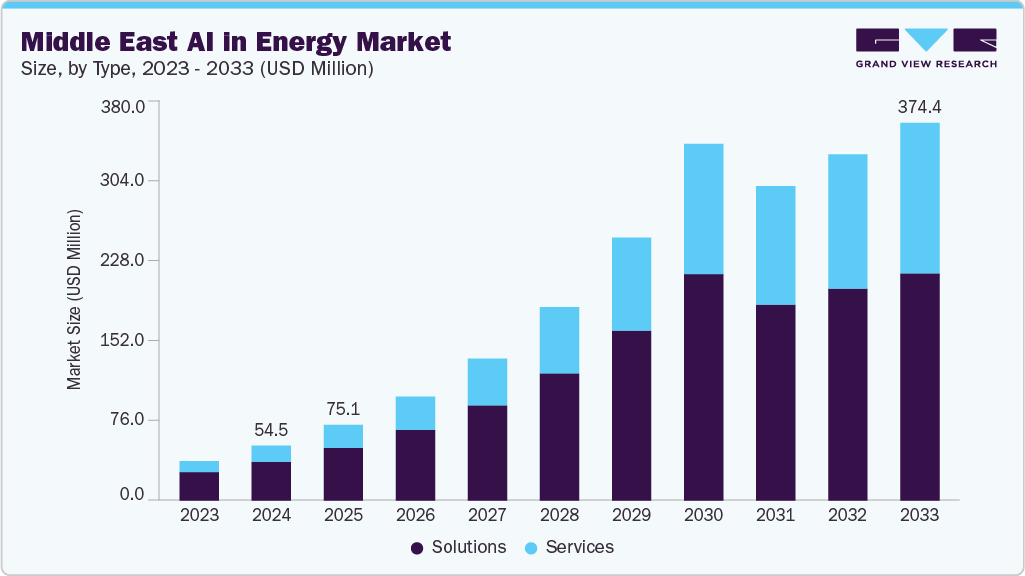 Source: Grand View Research, IR Documents, Primary Interviews, Paid DatabasesTo learn more about this report,
 Download Free Sample Report
The growth of Middle East AI in energy industry is fueled by the increasing deployment of renewable energy, rising complexity in grid operations, and the need for real-time energy management across commercial, industrial, and utility-scale applications. AI-enabled tools for predictive maintenance, load balancing, and demand response enhance operational efficiency and reduce costs. At the same time, integration with IoT and digital monitoring systems enables better decision-making and energy optimization. Key players such as Siemens, Schneider Electric, ABB, GE, and Masdar are actively delivering AI-powered solutions and smart energy projects in the region. With supportive policies, growing investments, and the push toward sustainable energy systems, the market is poised for transformative growth. It is expected to play a central role in the region’s digital and energy transition over the next decade.
Drivers, Opportunities & Restraints
The Middle East AI in energy market’s growth is driven by rising electricity demand, increasing grid complexity, and governments’ strategic focus on digital transformation and energy efficiency. Countries such as Saudi Arabia, the UAE, Qatar, and Egypt are pursuing national visions like Saudi Vision 2030 and the UAE Energy Strategy 2050, emphasizing smart grid modernization, energy security, and operational efficiency. Adopting AI technologies for predictive maintenance, demand forecasting, grid optimization, and integration with renewable energy sources positions the region to improve reliability and reduce operational costs across industrial, commercial, and utility sectors. Growing urbanization, industrial expansion, and large-scale renewable deployments further accelerate the need for AI-driven solutions to dynamically manage energy supply and demand.
In the Middle East, AI opportunities in the energy market include integrating AI with IoT-enabled smart meters, energy storage management, and hybrid renewable microgrids. Advanced analytics, real-time monitoring, and machine learning can optimize grid performance, enable predictive maintenance, and support decarbonization goals. Public-private partnerships, international technology collaborations, and AI-as-a-service models create additional investment and knowledge transfer avenues. However, the market faces high implementation costs, data security and privacy concerns, and limited AI talent in certain countries. Fragmented regulatory frameworks and slow standardization of AI-driven energy solutions can also hinder adoption. At the same time, integration challenges with legacy grid infrastructure may delay the rollout of fully optimized AI-enabled systems.
Type Insights
The solutions segment emerged as the dominant category in the Middle East AI in energy industry, accounting for a revenue share of over 70.60% in 2024. It is expected to maintain its lead throughout the forecast period, driven by the growing demand for predictive maintenance, grid optimization, energy management systems, and AI-enabled analytics across industrial, commercial, and utility sectors. AI solutions are being increasingly deployed in countries such as Saudi Arabia, the UAE, Qatar, and Egypt, where integration with smart grids, renewable energy sources, and microgrid systems enhances operational efficiency and reliability. Flagship initiatives such as AI-powered energy management platforms in large-scale industrial parks and smart city energy networks illustrate the scale and ambition of AI adoption in the region.
Government incentives, strategic national programs, and partnerships with global technology providers further support the growing prominence of AI solutions. Integrating AI with IoT devices, digital monitoring tools, and predictive analytics allows utilities and enterprises to optimize energy consumption, reduce downtime, and manage peak load demand effectively. Moreover, the rapid adoption of cloud-based AI platforms and hybrid AI analytics solutions across commercial and industrial installations reflects the versatility and scalability of AI applications in the Middle East energy sector. While data security, high implementation costs, and regulatory fragmentation persist, advancements in machine learning algorithms, real-time analytics, and intelligent automation reinforce the solutions segment’s cost-effectiveness and long-term potential in the region’s energy digitalization journey.
Application Insights
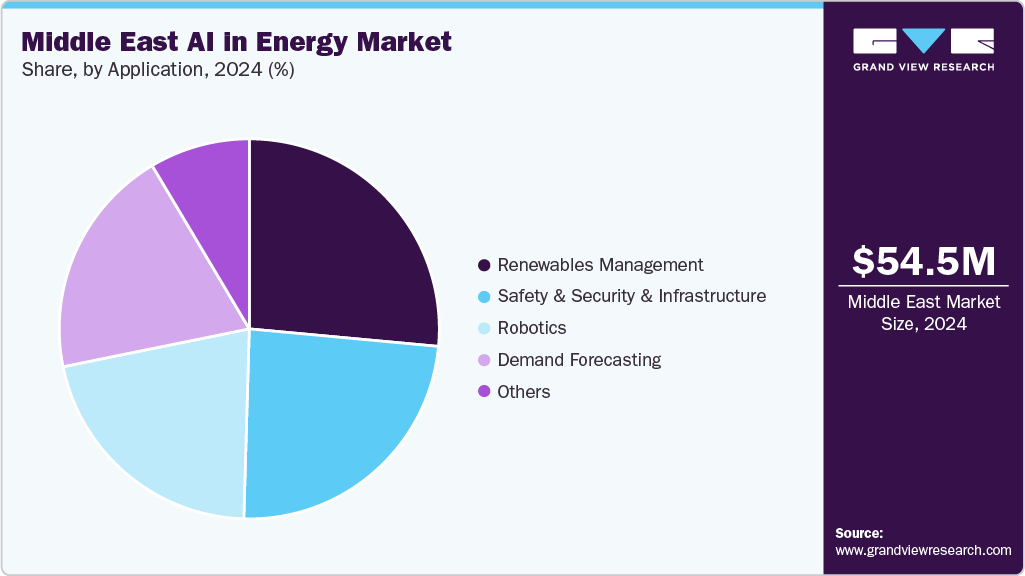
The renewable energy management segment led the Middle East AI in energy with the largest revenue share of over 26.47% in 2024. It is expected to retain its dominance over the forecast period. This robust growth can be attributed to the region’s strategic focus on integrating AI technologies to optimize renewable generation, enhance grid stability, and improve operational efficiency across solar, wind, and hybrid energy projects. Large-scale deployments of AI-driven monitoring and management systems are increasingly being implemented in countries such as Saudi Arabia, the UAE, and Egypt, where utility-scale solar parks, wind farms, and hybrid microgrids benefit from predictive analytics, automated performance monitoring, and intelligent dispatch strategies. Initiatives like AI-enabled forecasting, demand-response integration, and energy storage optimization drive demand for reliable, cost-efficient solutions tailored to variable renewable energy output.
 To learn more about this report, Download Free Sample Report
The surge in demand for AI-driven renewable energy management is further fueled by growing investments in green hydrogen, smart grids, and decarbonization initiatives, which require advanced analytics and real-time operational intelligence. AI solutions are also being adopted to monitor energy performance in industrial, commercial, and urban renewable installations, enabling predictive maintenance, grid balancing, and reduced curtailment of renewable generation. With regulatory incentives, supportive policies, and long-term energy agreements encouraging digital energy adoption, the renewable energy management segment is poised to remain the cornerstone of AI in Energy applications in the Middle East, reinforcing sustainability objectives and operational excellence.
Country Insights
Saudi Arabia AI in Energy Market Trends
Saudi Arabia leads the Middle East AI in energy market with a share of 44.35% in 2024, leveraging AI technologies to optimize generation, distribution, and consumption across its expanding renewable portfolio. Under Vision 2030, the Kingdom is deploying AI-driven predictive maintenance, grid optimization, and energy management systems across major solar, wind, and green hydrogen projects, including NEOM, the Red Sea Project, and the Sakaka PV plant. The AI In Energy Project Development Office (REPDO) integrates advanced analytics and machine learning to support structured auctions, competitive bidding, and project monitoring. These initiatives enhance operational efficiency, improve forecasting accuracy, and reduce project costs.
The Kingdom's rich solar irradiance and wind corridors provide ideal conditions for AI-enabled energy solutions, such as smart grid deployment and predictive generation modeling. In green hydrogen, AI tools are being applied to optimize production and logistics at NEOM's USD 8.4 billion facility. Favorable policies, investor-friendly regulations, and sovereign-backed funding support the adoption of AI technologies in energy, reinforcing Saudi Arabia's leadership in the regional AI energy market.
UAE AI in Energy Market Trends
The UAE holds a significant share of Middle East AI in the energy market in 2024, driven by its advanced renewable infrastructure and digital energy initiatives under the UAE Energy Strategy 2050. AI applications in utility-scale solar PV and CSP projects, such as the Mohammed bin Rashid Al Maktoum Solar Park, enable real-time performance monitoring, predictive maintenance, and load balancing across distributed energy systems. Smart grid enhancements in Abu Dhabi and Dubai leverage AI for demand forecasting, energy efficiency, and predictive analytics, improving grid resilience and operational efficiency.
The UAE also explores AI applications in green hydrogen projects, particularly in export-oriented initiatives developed with international partners. Strong regulatory frameworks, low financing costs, and an open investment environment support rapid AI integration, positioning the country as a regional hub for intelligent energy management.
Oman AI in Energy Market Trends
Oman is emerging as a promising AI in the Middle East's energy market, focusing on digitalizing solar, wind, and green hydrogen projects. AI-driven forecasting, grid management, and predictive maintenance are being piloted to support Oman Vision 2040, which targets 30% renewable electricity by 2030. The country's solar-rich deserts and wind-prone Dhofar region provide ideal conditions for AI-enabled energy solutions.
The Hydrogen Oman (Hydrom) initiative is leveraging AI to optimize hydrogen production, supply chain logistics, and plant efficiency, attracting international consortia. While grid infrastructure and regulatory frameworks are still developing, AI pilot projects and ongoing policy improvements are laying a strong foundation for long-term growth in Oman's intelligent energy sector.
Qatar AI in Energy Market Trends
Qatar's AI in the energy market is gaining momentum as the country integrates advanced analytics and AI into its renewable energy and carbon reduction strategies under Qatar National Vision 2030. The 800 MW Al Kharsaah Solar PV Plant uses AI-based performance optimization, predictive maintenance, and energy dispatch solutions to enhance output efficiency. The country is exploring AI-driven hydrogen production and carbon capture technologies to reduce emissions in its gas-heavy power sector.
Although fossil fuels remain dominant, Qatar is strengthening regulatory support for AI integration in energy infrastructure, fostering international collaboration, and preparing for future electricity demand from urbanization and industrial growth. AI adoption is expected to improve operational efficiency, optimize energy costs, and accelerate the transition to a more sustainable energy system.
Key Middle East AI in Energy Company Insights
Some of the key players operating in the Middle East AI in energy market include Siemens Energy, ABB Ltd., Schneider Electric, General Electric (GE), Honeywell International Inc., IBM Corporation, Microsoft Corporation, Huawei Technologies Co., Ltd., SAS Institute Inc., and Hitachi Energy Ltd., among others. These companies are leveraging AI-driven solutions to optimize energy generation, transmission, and consumption across the region’s power, oil & gas, and renewable energy sectors.
Key Middle East AI in Energy Companies:
- Siemens Energy
- ABB Ltd.
- Schneider Electric
- General Electric (GE)
- Honeywell International Inc.
- IBM Corporation
- Microsoft Corporation
- Huawei Technologies Co., Ltd.
- SAS Institute Inc.
- Hitachi Energy Ltd.
Recent Developments
-
In March 2025, Siemens Energy partnered with the Dubai Electricity and Water Authority (DEWA) to implement an AI-driven renewable energy management system across Dubai’s clean power portfolio. The initiative integrates advanced machine learning models to optimize grid stability, forecast renewable generation, and enhance asset performance through predictive maintenance. The project aims to reduce operational costs, extend equipment lifespan, and support Dubai’s Clean Energy Strategy 2050.
Middle East AI in Energy Market Report Scope
Report Attribute
Details
Market size value in 2025
USD 75.09 million
Revenue forecast in 2033
USD 374.42 million
Growth rate
CAGR of 22.24% from 2025 to 2033
Base year for estimation
2024
Historical data
2021 - 2023
Forecast period
2025 - 2033
Quantitative units
Revenue in USD million and CAGR from 2025 to 2033
Report coverage
Revenue forecast, competitive landscape, growth factors, and trends
Segments covered
Type, application, country
Country scope
UAE; Saudi Arabia; Oman; Qatar
Key companies profiled
Siemens Energy; ABB Ltd.; Schneider Electric; General Electric (GE); Honeywell International Inc.; IBM Corporation; Microsoft Corporation; Huawei Technologies Co., Ltd.; SAS Institute Inc.; Hitachi Energy Ltd.
Customization scope
Free report customization (equivalent up to 8 analysts working days) with purchase. Addition or alteration to country, regional & segment scope.
Pricing and purchase options
Avail customized purchase options to meet your exact research needs. Explore purchase options
Middle East AI in Energy Market Report Segmentation
This report forecasts revenue growth at country levels and provides an analysis of the latest industry trends in each of the sub-segments from 2021 to 2033. For this study, Grand View Research has segmented the Middle East AI in energy market report on the basis of type, application, and country:
-
Type Outlook (Revenue, USD Million; 2021 - 2033)
-
Solutions
-
Services
-
-
Application Outlook (Revenue, USD Million; 2021 - 2033)
-
Robotics
-
Renewable Energy Management
-
Demand Forecasting
-
Safety Security & Infrastructure
-
Others
-
-
Country Outlook (Revenue, USD Million; 2021 - 2033)
-
Middle East
-
UAE
-
Saudi Arabia
-
Oman
-
Qatar
-
-
Frequently Asked Questions About This Report
The Middle East AI In Energy market size was estimated at USD 54.48 million in 2024 and is expected to reach USD 75.09 million in 2025.
The Middle East AI In Energy market is expected to grow at a compound annual growth rate of 22.24% from 2025 to 2033 to reach USD 374.42 million by 2033.
Based on the application segment, Renewable Energy Management held the largest revenue share of 26.47% in the Middle East AI in Energy market in 2024, driven by the region’s strategic focus on optimizing renewable energy generation, storage, and distribution through advanced artificial intelligence solutions.
Some of the key vendors operating in the Middle East AI in Energy market include Siemens Energy, ABB Ltd., Schneider Electric, General Electric (GE), and Honeywell International Inc., among others.
The key factors driving the Middle East AI in Energy market include ambitious national digitalization strategies, rising energy demand, and the urgent need for operational efficiency across power generation and distribution networks.
About the Author(s)
Power Generation & Storage Research Team
Energy & Power · Power Generation & StorageThis report was authored by the power generation & storage research team at Grand View Research - comprising two research analysts, one senior research analyst, and one industry expert - with specialized expertise in the power generation & storage segment of the energy & power industry. All findings are based on proprietary energy & power databases, executive interviews, and regulatory analysis, subject to internal peer review prior to publication.
Last Updated:
Speak to Analyst

Customize this report to your needs - add regions, segments, or data points, with 20% free customization.
Or view our licence options:


ISO 9001:2015 & 27001:2022 Certified
We are GDPR and CCPA compliant! Your transaction & personal information is safe and secure. For more details, please read our privacy policy.


