
- Home
- »
- Next Generation Technologies
- »
-
IoT Devices Market Size, Share & Trends Report, 2025-2030GVR Report cover

IoT Devices Market (2025 - 2030)
Size, Share & Trends Analysis Report By Component (Sensors, Actuators, Processors, Edge Devices), By End Use, By Connectivity, By Region (North America, Europe, APAC, Latin America, MEA), And Segment Forecasts
Market Size, 2024
$70.3BMarket Estimate, 2026
$99.7BMarket Forecast, 2030
$181.2BCAGR, 2025–2030
16.8%Iot Devices Market Summary
The global IoT devices market size was valued at USD 70.3 billion in 2024 and is projected to grow from USD 99.7 billion in 2026 to USD 181.2 billion by 2030, at a CAGR of 16.8% from 2025 to 2030. North America dominated the market, accounting for a revenue share of 34.0% in 2024. This expansion is largely fueled by the convergence of technological advancements and growing innovations such as 5G connectivity, edge computing, and the increasing demand for real-time data analytics.
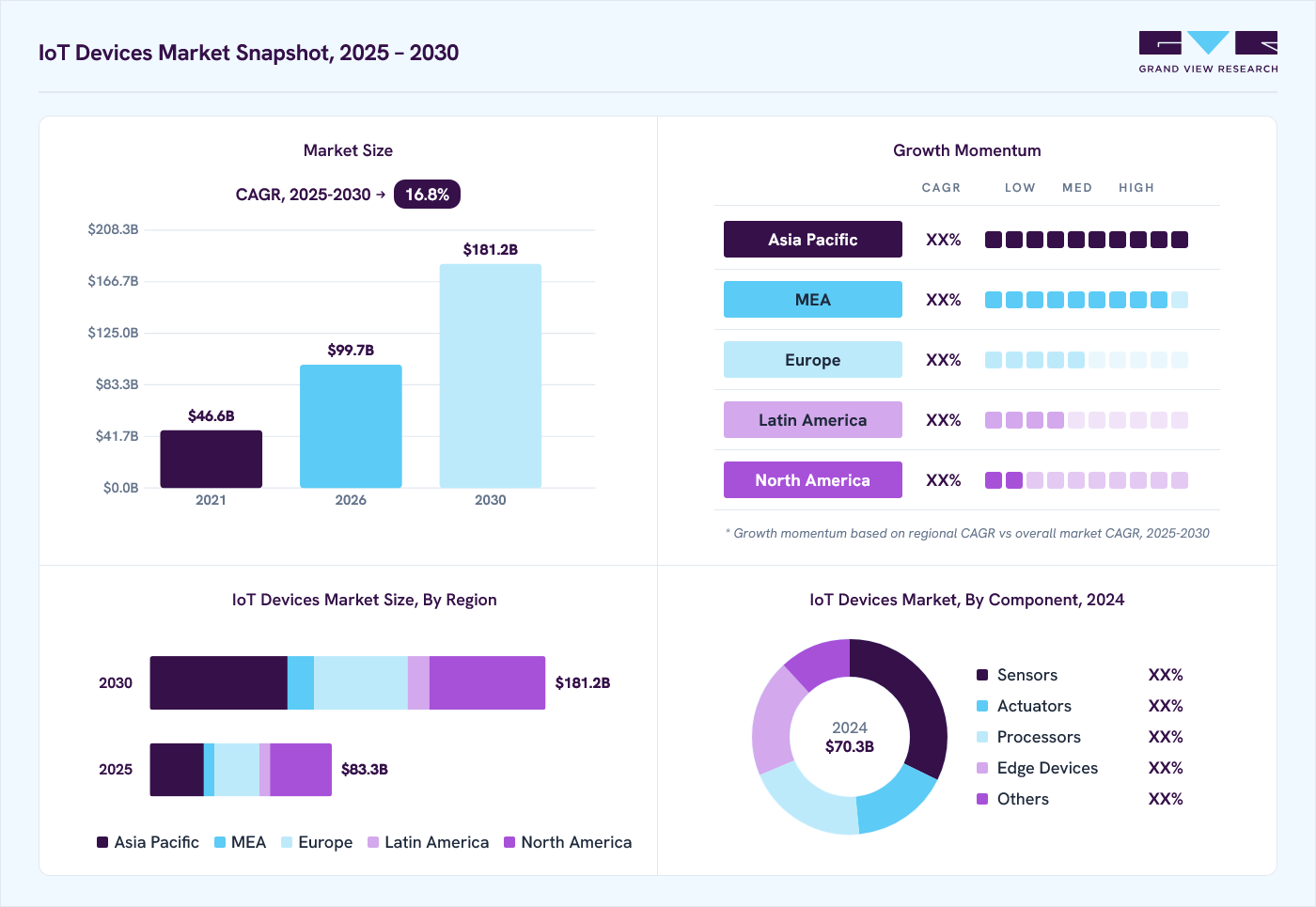 Source: Grand View Research, IR Documents, Primary Interviews, Paid DatabasesTo learn more about this report,
 Download Free Sample Report
 Key Market Trends & Insights
- The U.S. IoT devices industry held a dominant position in 2024.
- By component, the sensors segment recorded the largest revenue share of over 32% in 2024.
- By end use, the industrial IoT (IIoT) segment recorded the largest revenue share in 2024.
- By connectivity, wi-Fi segment recorded the largest revenue share in 2024.
Market Size & Forecast
- 2024 Market Size: USD 70.3 Billion
- 2030 Projected Market Size: USD 181.2 Billion
- CAGR (2025-2030): 16.8%
- North America: Largest market in 2024
Three ways to get this report
Buy it, customize it, or ask a question.Ask an Analyst
Analyst response in 1 business day
- AccessReport author, directly
- Reply timeWithin 1 working day
- No sales callDirect answer only
- FormatEmail reply
- CostFree, no cost
Get the Full Report
What the study covers
- FormatsPDF · Excel · Dashboard
- Timeline2025–2030 annual, 2024 base
- Coverage20+ countries, 5 regions
- Companies10+ key players profiled
Customize the Report
20% free customization
- IncludeCountries, segments, points
- TailorTo your product definition
- ExtendDeeper competitor detail
- OrA fully bespoke study
- Turnaround5–10 working days
These technologies are enhancing operational efficiencies across various sectors, including healthcare and manufacturing, and enabling the development of smarter products and services that cater to a more connected lifestyle, which is expected to present lucrative opportunities for the internet of things (IoT) devices industry in the coming years.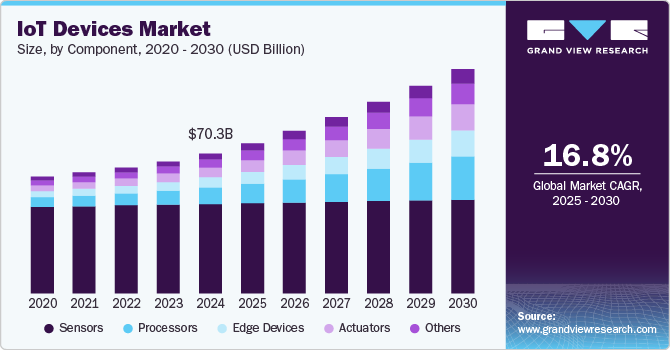 To learn more about this report, Download Free Sample Report
 The increased adoption of smart devices is reshaping everyday life, with wearables, smart appliances, and home automation systems creating interconnected ecosystems that enhance convenience and efficiency. In industries, IoT devices are enabling real-time data collection and analytics, optimizing operations, and reducing costs. The rise of smart cities is another major driver, as governments and businesses invest in technologies for traffic management, energy distribution, and environmental monitoring to improve urban living standards.
The expansion of Industrial IoT (IIoT) is a significant trend, particularly in manufacturing. IoT devices are being employed to optimize production processes, reduce resource consumption, and enable predictive maintenance. These advancements are transforming factories into smart facilities capable of data-driven decision-making. Additionally, the automotive sector is leveraging IoT for connected vehicles, enabling features such as real-time monitoring, electric vehicle charging integration, and advanced payment mechanisms.
The push for sustainability and energy efficiency is further propelling the IoT devices industry. Sensor-based solutions are being widely adopted to monitor and manage energy consumption across homes, businesses, and public infrastructure. These technologies not only help reduce costs but also align with global environmental goals by promoting resource optimization and reducing carbon footprints.
Moreover, technological advancements such as 5G connectivity, edge computing, and the integration of AI and machine learning are revolutionizing the IoT devices industry. 5G networks provide faster data transmission with low latency, enabling seamless communication between devices. Edge computing enhances real-time data processing at the device level, while AI and machine learning enable predictive analytics and automation across industries. This trend is expected to drive the IoT devices industry’s expansion in the coming years.
Market Dynamics
The rapid growth of e-commerce across both B2C and B2B segments has significantly increased the volume of goods being shipped globally, directly driving demand for pressure sensitive tapes. Every online transaction requires reliable packaging for safe transit, making carton sealing tapes an essential component in the supply chain. The convenience of online shopping, rising internet penetration, and expansion of digital payment systems have further accelerated order volumes, particularly in emerging economies.
The expansion of logistics and warehousing infrastructure is another key factor reinforcing this demand. Companies are investing heavily in distribution centers, fulfillment hubs, and last-mile delivery networks to support faster delivery timelines. This has led to increased usage of pressure sensitive tapes not only for sealing packages but also for labeling, bundling, and inventory management. The need for efficient handling and secure transportation of goods across long distances further emphasizes the importance of high-quality adhesive tapes in logistics operations.
The emerging applications of IoT devices in the healthcare sector are significantly driving the growth of the IoT devices market. These applications are transforming healthcare delivery, enhancing patient care, and improving operational efficiency, thus increasing demand for connected devices and systems.
The rise in remote patient monitoring is increasing the demand for IoT-enabled wearables, such as fitness trackers, smartwatches, and medical-grade sensors. These devices continuously monitor vital signs, chronic conditions, and recovery progress. As healthcare providers shift to a more preventive, data-driven approach, there is a growing need for connected devices that can provide real-time data.
The growth of telemedicine has been accelerated by the COVID-19 pandemic and is expected to continue driving the IoT devices market. Devices such as digital stethoscopes, smart thermometers, and remote diagnostic tools are in high demand as they enable remote consultations and health monitoring. This shift toward virtual care is fueling investments in telehealth platforms and the IoT devices that support them.
IoT-enabled smart pills and medication dispensers that remind patients to take their medications are gaining popularity. These devices are essential for ensuring proper medication adherence, especially for patients with chronic conditions. The demand for these devices is contributing to the overall growth of the IoT devices market in healthcare.
IoT devices are increasingly being used in clinical trials to collect real-time data from participants. Devices that track vital signs, activity levels, and other metrics allow researchers to monitor participants remotely, enhancing the efficiency of clinical trials and improving the accuracy of data collection. The demand for such devices is contributing to the growth of the IoT devices market. The integration of IoT devices into clinical research through remote monitoring, data collection, and patient interaction is driving growth of the IoT devices market.
The Internet of Things (IoT) Devices Market presents significant opportunities driven by the rapid convergence of artificial intelligence, edge computing, and next-generation connectivity technologies such as 5G and Wi-Fi 6. As enterprises increasingly seek real-time operational visibility and automation, demand is rising for intelligent IoT devices that can process data locally, reduce latency, and enable predictive decision-making. This creates substantial growth prospects for manufacturers of smart sensors, industrial gateways, and connected devices used across manufacturing, healthcare, transportation, and energy sectors. The expansion of Industry 4.0 initiatives and smart infrastructure projects is further accelerating the deployment of advanced IoT hardware and integrated device ecosystems.
Another major opportunity lies in the growing adoption of IoT devices across consumer and commercial environments, including smart homes, wearable health monitors, asset-tracking systems, and building automation solutions. Rising investments in digital transformation, particularly in emerging economies across Asia Pacific, Latin America, and the Middle East, are opening new markets for cost-effective and scalable IoT devices. In addition, increasing emphasis on sustainability and energy efficiency is boosting demand for connected devices that enable remote monitoring, resource optimization, and carbon footprint reduction. Companies that focus on secure, interoperable, and AI-enabled IoT devices tailored to specific industry applications are well-positioned to capitalize on these expanding market opportunities.
Market Concentration & Characteristics
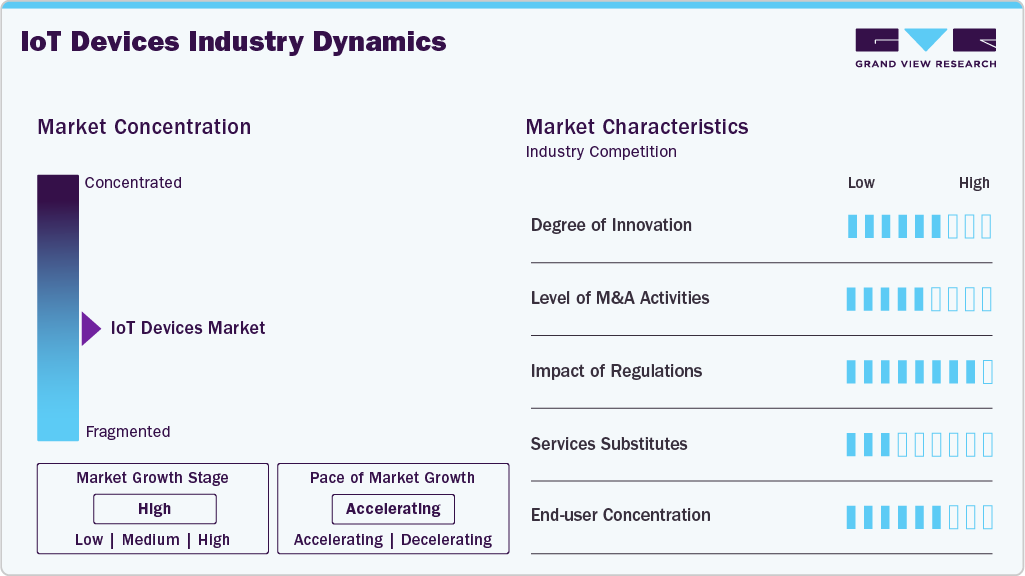
The IoT devices market is highly fragmented, with numerous global technology companies, semiconductor manufacturers, device OEMs, and emerging startups competing across industrial, commercial, and consumer applications. Leading players leverage broad product portfolios, advanced sensor and connectivity technologies, and strong global distribution networks to maintain their competitive positions. Meanwhile, regional manufacturers and niche providers focus on specialized applications such as smart agriculture, healthcare monitoring, industrial automation, and smart home systems. The large concentration of manufacturers in Asia Pacific intensifies price competition and accelerates innovation. Strategic partnerships, acquisitions, and continuous product development are common as companies seek to expand their technological capabilities and market reach.
 To learn more about this report, Download Free Sample Report
 The IoT devices market faces competition from alternative technologies, such as traditional automation systems, standalone sensors, and non-connected monitoring solutions, which can fulfill basic operational requirements without requiring full IoT integration. In some applications, enterprises may also rely on software-based analytics platforms or edge gateways to reduce the need to deploy large numbers of dedicated IoT devices. Concerns related to cybersecurity, interoperability, and deployment costs can encourage end users to adopt simpler or less connected alternatives. However, IoT devices maintain a strong competitive advantage through their ability to collect real-time data, enable remote monitoring, support predictive maintenance, and seamlessly integrate with cloud and artificial intelligence platforms.
Component Insights
The sensors segment recorded the largest revenue share of over 32% in 2024. This growth is driven by the rising demand for connected and wearable devices, particularly in industries such as healthcare and consumer electronics. This demand is further fueled by advancements in technology, such as improved wireless connectivity and the increasing adoption of smart home systems, which enhance operational efficiency and user experience.
The edge devices segment is projected to register the fastest CAGR of over 17% from 2025 to 2030. This growth is largely driven by advancements in edge computing and 5G technology, which facilitate faster data processing and real-time analytics. The growing need for reduced latency and improved data management in various applications, including industrial automation and smart cities, is also propelling this segment growth.
End Use Insights
The industrial IoT (IIoT) segment recorded the largest revenue share in 2024. This growth is primarily driven by the increasing focus on Industry 4.0 technologies that enhance productivity and efficiency in manufacturing processes. This transformation is facilitated by the integration of IoT solutions that enable real-time monitoring, predictive maintenance, and data analytics, ultimately reducing operational costs and downtime. Additionally, the rising investments in smart factories and automation technologies reflect a shift towards more connected and efficient production systems, further propelling segmental growth.
 To learn more about this report, Download Free Sample Report
 The agriculture segment is projected to register the fastest CAGR from 2025 to 2030, primarily driven by the growing need for precision farming techniques that utilize IoT devices for monitoring crop health, soil conditions, and weather patterns. The adoption of smart agriculture technologies is enhancing yield efficiency and resource management, addressing challenges such as labor shortages and climate variability. Moreover, government initiatives promoting sustainable farming practices and technological advancements in sensor and drone technologies are significantly contributing to the rapid growth of this segment.
Connectivity Insights
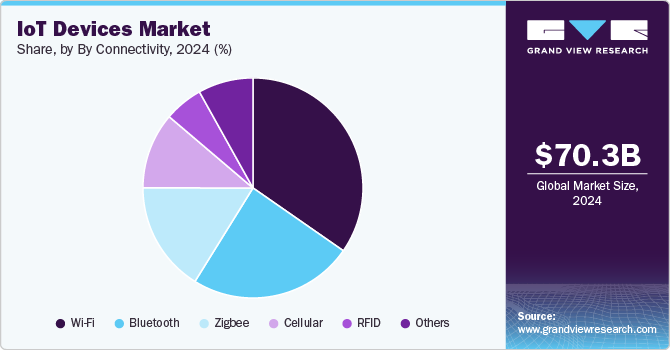
The Wi-Fi segment recorded the largest revenue share in 2024. This growth is primarily driven by the increasing demand for high-speed internet and the proliferation of connected devices. As IoT adoption accelerates, efficient and reliable Wi-Fi modules have become essential for ensuring seamless connectivity and data exchange among a growing number of IoT devices. The advancements in Wi-Fi technology, particularly with the rollout of Wi-Fi-6 and the introduction of Wi-Fi-7, enhance communication efficiency, making it a preferred choice for various applications, including smart homes and industrial settings, thereby propelling the segmental growth.
The cellular segment is projected to register the fastest CAGR from 2025 to 2030, primarily driven by the expanding coverage and capabilities of cellular networks, particularly with the advent of 5G technology. This advancement allows for improved data transmission speeds and lower latency, which are critical for applications requiring real-time data processing and communication. The growing need for mobile connectivity in sectors such as automotive, healthcare, and smart cities is also propelling this segment forward, as it supports a wide range of IoT applications that demand robust and reliable network infrastructure.
Regional Insights
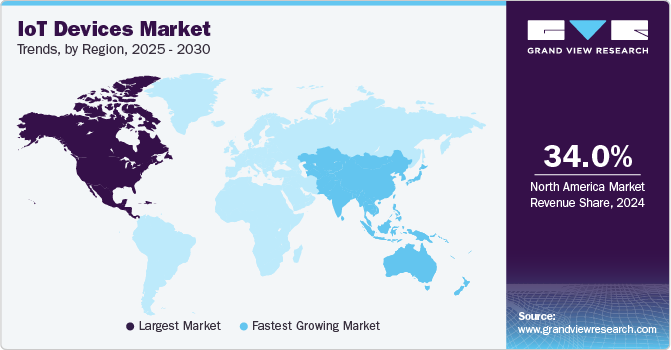
North America dominated IoT devices market with a share of over 34% in 2024. This expansion is largely driven by the increasing penetration of smart devices, heightened consumer electronics demand, and the rollout of 5G technologies, which facilitate faster and more reliable connectivity. The region's advanced telecom infrastructure is expected to further support this growth.
 To learn more about this report, Download Free Sample Report
 U.S. IoT Devices Market Trends
The U.S. IoT devices industry held a dominant position in 2024. This growth is primarily driven by an increasing adoption of automation technologies across various industries, enhancing operational efficiency and reducing costs. The integration of advanced analytics and smart sensors facilitates real-time data collection and decision-making, which is crucial for predictive maintenance and supply chain optimization.
Europe IoT Devices Market Trends
The European IoT devices industry is expected to grow at a CAGR of over 15% from 2025 to 2030. This growth is driven by significant investments in smart city initiatives and industrial automation. The region is witnessing a surge in the adoption of IoT technologies across sectors like healthcare, manufacturing, and transportation, fueled by government support and regulatory frameworks promoting digital transformation. The integration of AI with IoT is also enhancing operational efficiencies and creating new business models. As European countries focus on sustainability and energy efficiency, the demand for connected devices is expected to rise significantly in the coming years.
The IoT devices market in UK is expected to grow at a significant CAGR in the coming years, primarily fueled by the growing demand for smart home technologies and consumer IoT devices. The popularity of smart thermostats, lighting systems, and security cameras is driving the need for effective IoT device management solutions to ensure seamless operation and integration. Additionally, government initiatives aimed at promoting digital transformation and sustainability are further propelling market growth, making the UK a key player in the European IoT landscape.
The Germany IoT devices market landscape is characterized by its strong focus on industrial automation and smart manufacturing. The country's robust industrial base is increasingly adopting IoT solutions to enhance operational efficiency and productivity. Furthermore, Germany's commitment to sustainability and energy efficiency is driving the development of connected devices that optimize resource usage while meeting regulatory standards, positioning it as a critical hub for IoT innovation.
Asia Pacific IoT Devices Market Trends
The Asia-Pacific IoT devices industry is expected to grow at the fastest CAGR of over 20% from 2025 to 2030, driven by rapid urbanization and increasing smartphone penetration. Countries like China and India are leading this growth, driven by their large populations and expanding middle class. The rise in demand for smart home devices and industrial IoT applications is further accelerated by government initiatives aimed at fostering technological innovation and infrastructure development. Additionally, the proliferation of 5G networks in APAC is set to enhance connectivity for IoT applications, thereby propelling market growth.
Japan IoT devices market remains at the forefront, characterized by technological advancements and a strong emphasis on automation across various sectors, including manufacturing and healthcare. The integration of AI and machine learning with IoT applications is enhancing data analytics capabilities, enabling real-time monitoring and predictive maintenance. Additionally, Japan's aging population is driving demand for smart healthcare solutions that leverage IoT technologies to improve patient care and streamline operations within healthcare facilities.
The IoT devices market in China is experiencing rapid expansion owing to its rapid urbanization and large-scale adoption of smart technologies. The Chinese government’s support for digital transformation initiatives and investments in 5G infrastructure is accelerating the deployment of IoT solutions across various industries. With an increasing focus on smart city projects and industrial IoT applications, China is poised to lead in connected device proliferation, driving innovation and economic growth in the region.
Key IoT Devices Company Insights
Some of the key players operating in the market include Cisco Systems, Inc.; Honeywell International, Inc., and Qualcomm Technologies, Inc.
-
Cisco Systems, Inc. is a technology company specializing in networking hardware, software, and telecommunications equipment. The company is also known for its innovative enterprise networking, security, and IoT solutions. The company caters to diverse industries and industry verticals, including cities and communities, manufacturing, smart buildings, education, mining, financial services, mining, oil & gas, healthcare, transportation, and retail, among others.
-
Honeywell International Inc. is a multinational conglomerate engaged in the development of technologies and solutions for building automation, energy and sustainability, industrial automation, and aerospace applications. The company is known for its innovative and diversified technology-based products and services. The company caters to diverse industries and industry verticals, including aerospace, commercial buildings, energy, healthcare, IT/hi-tech, life sciences, and manufacturing, among others.
Some of the emerging market players in the IoT devices market include Sierra Wireless and Silicon Laboratories, Inc.
-
Sierra Wireless, a subsidiary of Semtech Corporation, is a provider of IoT connectivity solutions, specializing in cellular modules, rugged routers, and comprehensive global connectivity services. With nearly 30 years of experience, Semtech simplifies the IoT landscape by providing a robust portfolio that includes advanced 4G LTE and 5G technologies, enabling secure and reliable connections for various applications across industries such as utilities, healthcare, and logistics.
-
Silicon Laboratories, Inc.is a global player in wireless connectivity for the Internet of Things (IoT), offering an integrated hardware and software platform, intuitive development tools, and unmatched ecosystem support. With nearly two decades of expertise, the company focuses on high-performance, low-power solutions with advanced security and multi-protocol support, enabling the development of innovative industrial, commercial, and home applications.
Key IoT Devices Companies:
The following are the leading companies in the IoT devices market. These companies collectively hold the largest market share and dictate industry trends.
- ABB Group
- Cisco Systems, Inc.
- Honeywell International Inc.
- Huawei Technologies Co., Ltd.
- Intel Corporation
- NXP Semiconductors NV
- PTC Inc.
- Qualcomm Technologies, Inc.
- Robert Bosch GmbH
- Samsung Electronics Co., Ltd.
- Siemens AG
- Sierra Wireless
- Silicon Laboratories, Inc.
- STMicroelectronics NV
- Texas Instruments Incorporated
Competitive Benchmarking
Operating Strategies
Competitive Edge
Weakness
Mature Players: ABB Group; Cisco Systems, Inc.; Honeywell International, Inc.; Huawei Technologies Co., Ltd.; NXP Semiconductors N.V.
- Mature players in the IoT devices market are primarily focused on expanding their global footprint, enhancing the intelligence, connectivity, and energy efficiency of connected devices, and strengthening their end-to-end IoT portfolios
- Mature players in the IoT devices market gain a competitive advantage through extensive product portfolios, advanced sensor and connectivity technologies, and well-established end-to-end IoT ecosystems
- Mature players in the IoT devices market often face high operational costs, as developing and manufacturing advanced connected devices requires substantial investments in embedded processors, wireless communication modules, and cybersecurity capabilities.
Emerging Players: PTC Inc.; Sierra Wireless; Silicon Laboratories, Inc.; Texas Instruments Incorporated
- Emerging players in the Market compete through rapid innovation, specialized device designs, and cost-effective low-power solutions equipped with advanced sensors, and wireless connectivity technologies such as Bluetooth Low Energy, NB-IoT, and 5G to address targeted industry applications
- Emerging players in the IoT devices market gain an advantage through agility, rapid innovation, and specialized connected device solutions that enable the quick development of targeted products for industrial automation, remote monitoring, smart healthcare, and intelligent consumer applications
- Emerging players in the IoT devices market face challenges such as limited brand recognition, smaller manufacturing capacity, and constrained access to capital, which can restrict product development, scale-up, and broader market penetration segments
Recent Developments
-
In January 2025, At CES 2025, Samsung Electronics Co.Ltd unveiled its innovative "Home AI" technology aimed at hyper-personalization within smart homes. This suite of AI solutions enhances user experiences by integrating with SmartThings to provide tailored services for various household needs. The incorporation of the Samsung Knox Matrix security system addresses critical concerns about device security in the IoT ecosystem, promoting consumer confidence in adopting smart technologies.
-
In January 2025, Honeywell International, Inc. in partnership with Verizon launched a groundbreaking bundled solution designed to streamline the retail lifecycle, encompassing procurement through customer operations. This collaboration combines Honeywell's hardware, software, and services with Verizon's high-speed 5G connectivity, providing businesses with a simplified procurement process and a single point of contact for all technology needs.
-
In January 2025, Qualcomm Technologies, Inc. announced a collaboration with Toshiba to develop scalable AI-powered IoT solutions for the retail sector. This partnership aims to integrate edge computing with cloud services, allowing real-time processing of data from intelligent cameras and other retail devices.
IoT Devices Market Report Scope
Report Attribute
Details
Market size in 2024
USD 70.3 billion
Estimated market size in 2026
USD 99.7 billion
Projected market size by 2030
USD 181.2 billion
Growth rate
CAGR of 16.8% from 2025 to 2030
Base year for estimation
2024
Historical data
2018 - 2023
Forecast period
2025 - 2030
Quantitative units
Revenue in USD billion and CAGR from 2025 to 2030
Report coverage
Revenue forecast, company ranking, competitive landscape, growth factors, and trends
Segments covered
Component, end use, connectivity, region
Regional scope
North America; Europe; Asia Pacific; Latin America; Middle East & Africa
Country scope
U.S.; Canada; Mexico; UK; Germany; France; China; Australia; Japan; India; South Korea; Brazil; South Africa; Saudi Arabia; UAE
Key companies profiled
ABB Group; Cisco Systems, Inc.; Honeywell International Inc.; Huawei Technologies Co., Ltd.; Intel Corporation; NXP Semiconductors NV; PTC Inc.; Qualcomm Technologies, Inc.; Robert Bosch GmbH; Samsung Electronics Co., Ltd.; Siemens AG; Sierra Wireless; Silicon Laboratories, Inc.; STMicroelectronics NV; Texas Instruments Incorporated.
Customization scope
Free report customization (equivalent to up to 8 analyst’s working days) with purchase. Addition or alteration to country, regional & segment scope.
Pricing and purchase options
Avail customized purchase options to meet your exact research needs. Explore purchase options
Global IoT Devices Market Report Segmentation
This report forecasts revenue growth at global, regional, and country levels and provides an analysis of the latest technology trends in each of the sub-segments from 2018 to 2030. For this study, Grand View Research has segmented the global IoT devices market report based on component, end use, connectivity, and region:
-
Component Outlook (Revenue, USD Billion, 2018 - 2030)
-
Smart Home
-
Sensors
-
Actuators
-
Processors
-
Edge Devices
-
Others
-
-
Industrial IoT (IIoT)
-
Sensors
-
Actuators
-
Processors
-
Edge Devices
-
Others
-
-
Healthcare
-
Sensors
-
Actuators
-
Processors
-
Edge Devices
-
Others
-
-
Automotive and Transportation
-
Sensors
-
Actuators
-
Processors
-
Edge Devices
-
Others
-
-
Retail
-
Sensors
-
Actuators
-
Processors
-
Edge Devices
-
Others
-
-
Agriculture
-
Sensors
-
Actuators
-
Processors
-
Edge Devices
-
Others
-
-
Energy and Utilities
-
Sensors
-
Actuators
-
Processors
-
Edge Devices
-
Others
-
-
Smart Cities
-
Sensors
-
Actuators
-
Processors
-
Edge Devices
-
Others
-
-
Wearables
-
Sensors
-
Actuators
-
Processors
-
Edge Devices
-
Others
-
-
Consumer Electronics
-
Sensors
-
Actuators
-
Processors
-
Edge Devices
-
Others
-
-
Others
-
-
End Use Outlook (Revenue, USD Billion, 2018 - 2030)
-
Smart Home IoT Devices
-
Smart Thermostats
-
Energy Meters
-
Smart Locks
-
Surveillance Cameras
-
Smart Speakers
-
Connected Appliances
-
Others
-
-
Industrial IoT (IIoT)
-
Programmable Logic Controllers (PLCs)
-
Asset Trackers
-
RFID Systems
-
Connected Cameras
-
Others
-
-
Healthcare
-
Wearable Health Monitors
-
Remote Diagnostic Tools
-
Connected Imaging Devices
-
Smart Insulin Pens
-
Smart Ventilators
-
Others
-
-
Automotive and Transportation
-
Onboard Diagnostic (OBD) Devices
-
Telematics Systems
-
GPS Trackers
-
Asset Trackers
-
Connected Cameras
-
Others
-
-
Retail
-
Digital Kiosks
-
Electronic Price Tags
-
RFID Systems
-
Connected Barcode Scanners
-
Surveillance Cameras
-
Access Control Devices
-
Others
-
-
Agriculture
-
Weather Stations
-
Irrigation Controllers
-
Wearable Animal Trackers
-
Feeding Monitors
-
Connected Cameras
-
Others
-
-
Energy and Utilities
-
Connected Meters
-
Load Control Switches
-
Grid Sensors
-
Leak Detection Sensors
-
Flow Meters
-
Pressure Monitoring Devices
-
Others
-
-
Smart Cities
-
Smart Streetlights
-
Connected Parking Meters
-
Waste Management Sensors
-
Air Quality Monitors
-
EV Charging Stations
-
Traffic Monitoring Systems
-
Connected Cameras
-
Others
-
-
Wearables
-
Smartwatches
-
Fitness Bands
-
Wearable AR/VR Devices
-
Others
-
-
Consumer Electronics
-
Smart TVs
-
Gaming Consoles
-
Streaming Devices
-
Smart Routers
-
Smart Glasses
-
Others
-
-
Others
-
-
Connectivity Outlook (Revenue, USD Billion, 2018 - 2030)
-
Smart Home IoT Devices
-
Wi-Fi
-
Bluetooth
-
Zigbee
-
Cellular (5G,4G,3G)
-
RFID
-
Others
-
-
Industrial IoT (IIoT)
-
Wi-Fi
-
Bluetooth
-
Zigbee
-
Cellular (5G,4G,3G)
-
RFID
-
Others
-
-
Healthcare
-
Wi-Fi
-
Bluetooth
-
Zigbee
-
Cellular (5G,4G,3G)
-
RFID
-
Others
-
-
Automotive and Transportation
-
Wi-Fi
-
Bluetooth
-
Zigbee
-
Cellular (5G,4G,3G)
-
RFID
-
Others
-
-
Retail
-
Wi-Fi
-
Bluetooth
-
Zigbee
-
Cellular (5G,4G,3G)
-
RFID
-
Others
-
-
Agriculture
-
Wi-Fi
-
Bluetooth
-
Zigbee
-
Cellular (5G,4G,3G)
-
RFID
-
Others
-
-
Energy and Utilities
-
Wi-Fi
-
Bluetooth
-
Zigbee
-
Cellular (5G,4G,3G)
-
RFID
-
Others
-
-
Smart Cities
-
Wi-Fi
-
Bluetooth
-
Zigbee
-
Cellular (5G,4G,3G)
-
RFID
-
Others
-
-
Wearables
-
Wi-Fi
-
Bluetooth
-
Zigbee
-
Cellular (5G,4G,3G)
-
RFID
-
Others
-
-
Consumer Electronics
-
Wi-Fi
-
Bluetooth
-
Zigbee
-
Cellular (5G,4G,3G)
-
RFID
-
Others
-
-
Others
-
-
Regional Outlook (Revenue, USD Billion, 2018 - 2030)
-
North America
-
U.S.
-
Canada
-
Mexico
-
-
Europe
-
UK
-
Germany
-
France
-
-
Asia Pacific
-
China
-
India
-
Japan
-
South Korea
-
Australia
-
-
Latin America
-
Brazil
-
-
Middle East & Africa
-
South Africa
-
Saudi Arabia
-
UAE
-
-
Delivered Customizations
This report has been delivered with the following In-depth customizations
Client Request
Customization Delivered
Value Adds
IoT Devices Market Entry & Expansion Assessment for Semiconductor Manufacturers, Connectivity Providers, and Technology Companies
Evaluation of regional market attractiveness, regulatory requirements, certification standards, and ecosystem maturity across North America, Europe, Asia Pacific, and the Middle East
Competitive benchmarking of leading IoT device manufacturers, chipset suppliers, and connectivity platform providers
Identified the most attractive IoT device segments and geographies for market entry and expansion
Strengthened competitive positioning through differentiated offerings aligned with evolving customer requirements
IoT Devices Technology & Innovation Assessment for Device Manufacturers, Semiconductor Companies, and Connectivity Providers
Assessment of emerging IoT device technologies across industrial, healthcare, automotive, consumer electronics, and smart city applications
Benchmarking of leading IoT device manufacturers and chipset vendors based on performance, power efficiency, interoperability, and scalability
Supported R&D prioritization and product roadmap development for next-generation connected devices
Identified breakthrough technologies and innovation trends shaping the future of IoT devices
Frequently Asked Questions About This Report
The global IoT devices market size was valued at USD 70.3 billion in 2024 and is estimated at USD 99.7 billion for 2026.
The global IoT devices market is expected to grow at a CAGR of 16.8% from 2025 to 2030, reaching USD 181.2 billion by 2030.
North America dominated the IoT devices market with a share of over 34% in 2024, driven by the increasing penetration of smart devices, heightened consumer electronics demand, and the rollout of 5G technologies, which facilitate faster and more reliable connectivity.
Some key players operating in the IoT devices market include ABB Group, Cisco Systems, Inc., Honeywell International Inc., Huawei Technologies Co., Ltd., Intel Corporation, NXP Semiconductors NV, PTC Inc., Qualcomm Technologies, Inc., Robert Bosch GmbH, Samsung Electronics Co., Ltd., Siemens AG, Sierra Wireless, Silicon Laboratories, Inc., STMicroelectronics NV, and Texas Instruments Incorporated
The key factors IoT devices market include the convergence of technological advancements and growing innovations such as 5G connectivity, edge computing, and the increasing demand for real-time data analytics.
About the Author(s)
Next Generation Technologies Research Team
Technology · Next Generation TechnologiesThis report was authored by the next generation technologies research team at Grand View Research - comprising two research analysts, one senior research analyst, and one industry expert - with specialized expertise in the next generation technologies segment of the technology industry. All findings are based on proprietary technology databases, executive interviews, and regulatory analysis, subject to internal peer review prior to publication.
Last Updated:
Speak to Analyst

Customize this report to your needs - add regions, segments, or data points, with 20% free customization.
Or view our licence options:


ISO 9001:2015 & 27001:2022 Certified
We are GDPR and CCPA compliant! Your transaction & personal information is safe and secure. For more details, please read our privacy policy.


