
- Home
- »
- Advanced Interior Materials
- »
-
Middle East Personal Protective Equipment Market Report, 2033GVR Report cover

Middle East Personal Protective Equipment Market (2025 - 2033) Size, Share & Trends Analysis Report By Product (Head Protection, Eye Protection, Face Protection, Hearing Protection), By End Use (Construction, Manufacturing, Oil & Gas, Chemicals), By Country, And Segment Forecasts
 Source: Grand View Research, IR Documents, Primary Interviews, Paid DatabasesTo learn more about this report,
 Download Free Sample Report
Middle East Personal Protective Equipment Market Summary
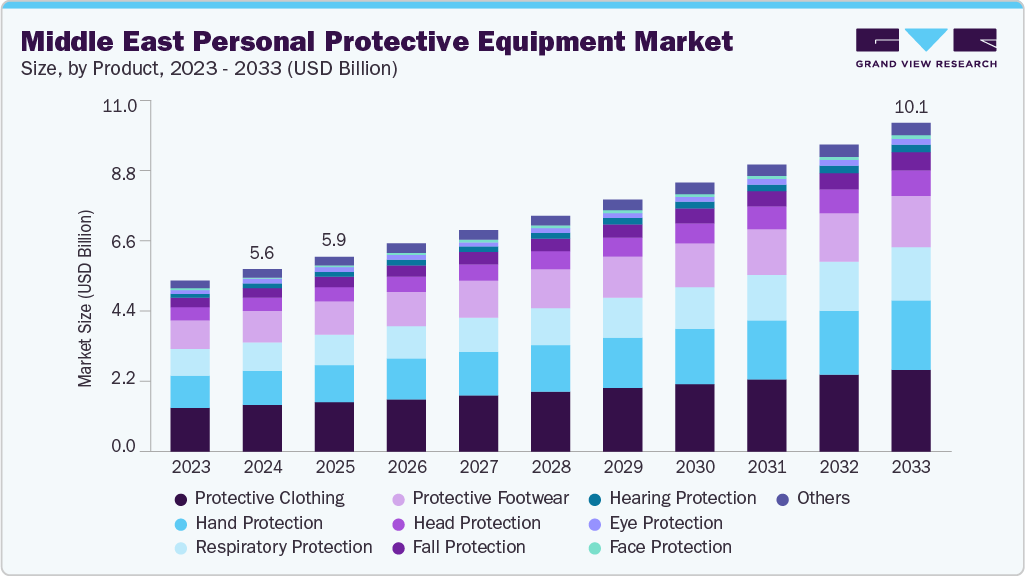
The Middle East personal protective equipment market size was estimated at USD 5,597.6 million in 2024 and is projected to reach USD 10,075.9 million by 2033, growing at a CAGR of 6.8% from 2025 to 2033. The personal protective equipment (PPE) market in Middle East is primarily driven by the region’s growing industrialization, particularly across oil & gas, construction, and manufacturing sectors.
Key Market Trends & Insights
- The personal protective equipment market in the UAE is expected to grow at a rapid CAGR of 7.5% from 2025 to 2033.
- By product, the hand protection segment is expected to grow at the fastest CAGR of 8.0% from 2025 to 2033.
- By end use, the healthcare segment is projected to expand at the fastest CAGR of 10.1% from 2025 to 2033.
Market Size & Forecast
- 2024 Market Size: USD 5,597.6 Million
- 2033 Projected Market Size: USD 10,075.9 Million
- CAGR (2025-2033): 6.8%
Three ways to get this report
Buy it, customize it, or ask a question.Ask an Analyst
Analyst response in 1 business day
- AccessReport author, directly
- Reply timeWithin 1 working day
- No sales callDirect answer only
- FormatEmail reply
- CostFree, no cost
Get the Full Report
What the study covers
- FormatsPDF · Excel · Dashboard
- Timeline2025–2033 annual, 2024 base
- Coverage20+ countries, 5 regions
- Companies10+ key players profiled
Customize the Report
20% free customization
- IncludeCountries, segments, points
- TailorTo your product definition
- ExtendDeeper competitor detail
- OrA fully bespoke study
- Turnaround5–10 working days
 To learn more about this report, Download Free Sample Report
Strict workplace safety regulations and government initiatives to reduce occupational hazards are pushing industries to adopt certified PPE products. Rising infrastructure development projects and high-risk activities further fuel demand for helmets, protective clothing, gloves, and respiratory equipment. Another key driver is the heightened focus on worker health and hygiene following the COVID-19 pandemic, which created lasting awareness of respiratory and medical protective gear. Rapid growth in healthcare infrastructure, coupled with investments in pharmaceuticals and laboratories, is driving demand for medical-grade PPE. Increasing expatriate workforce participation in hazardous industries also raises the need for high-quality protective solutions. Moreover, rising collaborations between international PPE manufacturers and local distributors are enhancing availability and adoption across Middle Eastern markets.
Market Concentration & Characteristics
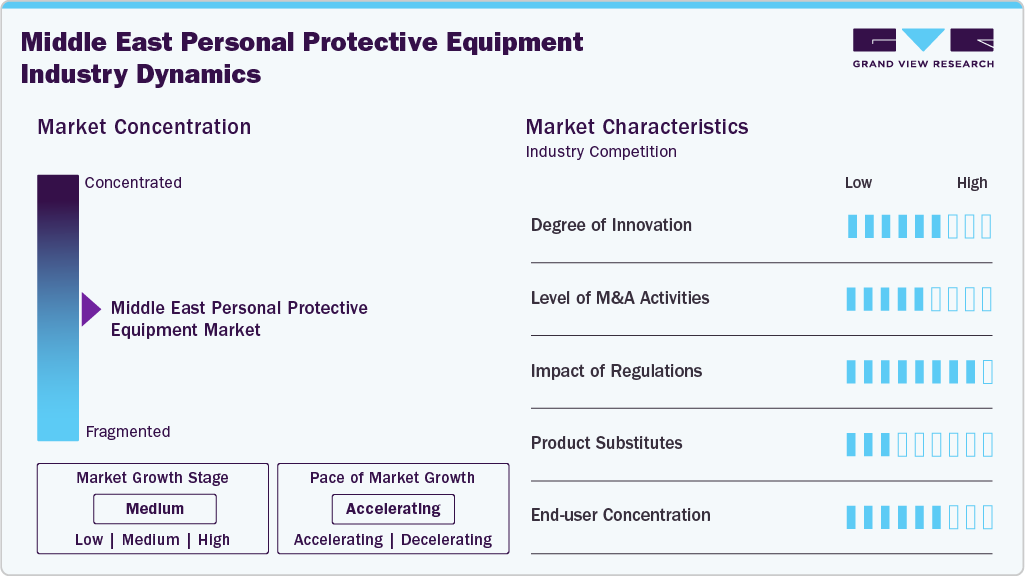
The Middle East personal protective equipment market is moderately concentrated, with a mix of established international manufacturers and regional suppliers competing across product categories. Global firms hold strong positions through advanced technologies and adherence to international safety standards, shaping the premium segment. At the same time, local players focus on cost-effective offerings and niche applications, especially in small-scale industries. This balance of large global presence and regional competitiveness creates a semi-concentrated market structure.
The degree of innovation in the Middle East PPE market is steadily advancing, with developments in lightweight, durable, and ergonomically designed products. Integration of smart technologies such as sensors and connected wearables is gaining traction, especially in high-risk industries. Innovation is also evident in the use of sustainable and recyclable materials to align with global environmental goals. These advancements are shaping product differentiation and increasing end-user adoption.
 To learn more about this report, Download Free Sample Report
The level of mergers and acquisitions in the market remains moderate, as global players look to strengthen their presence through partnerships with regional distributors and manufacturers. Strategic alliances help expand product portfolios and improve supply chain efficiency in high-demand sectors. M&A activity also enables companies to localize production facilities, reducing costs and improving market reach. This consolidation trend ensures stronger market positioning and long-term competitiveness.
Regulation has a significant impact on the PPE industry in the Middle East, as governments enforce strict workplace safety laws across construction, oil & gas, and healthcare. Compliance with international certifications and national standards drives demand for high-quality products. Non-compliance often results in penalties and reputational risks, compelling industries to prioritize certified equipment. Thus, regulation acts as both a driver of adoption and a barrier to entry for unqualified suppliers.
Drivers, Opportunities & Restraints
The key drivers for the Middle East PPE market include rapid industrial expansion, infrastructure development, and strict workplace safety regulations. High-risk sectors such as construction, oil & gas, and manufacturing create consistent demand for protective clothing, helmets, gloves, and respiratory gear. Growing awareness of occupational safety among employers and workers further strengthens adoption. Moreover, the region’s increasing healthcare investments support demand for medical PPE.
Opportunities lie in the rising adoption of smart and sustainable PPE solutions tailored to regional needs. The expansion of mega projects, smart cities, and industrial zones presents significant growth potential for advanced protective equipment. Localization of manufacturing and partnerships with regional distributors create additional market opportunities. Moreover, customization for extreme weather conditions in the Middle East can attract strong demand.
Restraints include high product costs for advanced PPE, which limit adoption in cost-sensitive sectors. Limited awareness and compliance gaps among smaller enterprises also restrict market penetration. Dependence on imports for high-quality products can lead to supply chain disruptions and pricing fluctuations. Furthermore, counterfeit or low-quality alternatives pose a challenge to safety compliance and overall market credibility.
Product Insights
Protective clothing segment is dominating the Middle East PPE market and accounted for a revenue share of 25.50% in 2024, due to its widespread use across construction, oil & gas, and manufacturing industries, where workers are exposed to fire, chemicals, and extreme conditions. Mandatory safety guidelines have further boosted the adoption of coveralls, flame-resistant suits, and high-visibility apparel. Large-scale infrastructure projects and industrial expansion ensure steady demand. This dominance is reinforced by regulatory enforcement and employer emphasis on full-body protection.
Hand protection is emerging as the fastest-growing segment, driven by the need to safeguard workers from cuts, abrasions, chemical exposure, and mechanical injuries. Industries such as healthcare, pharmaceuticals, and food processing are increasingly relying on disposable and specialized gloves. Rising emphasis on hygiene standards after the pandemic has further accelerated growth. The availability of innovative, durable, and ergonomically designed gloves is also enhancing adoption in multiple sectors.
End Use Insights
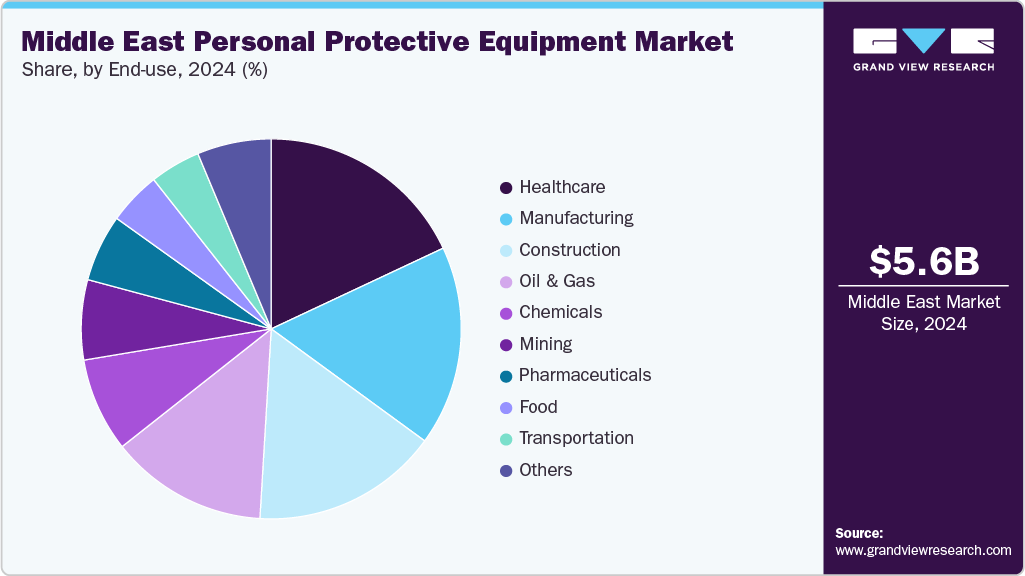
Healthcare is dominating the Middle East PPE market and accounted for a revenue share of 18.04% in 2024, due to continuous investments in hospitals, clinics, and laboratories, along with strict infection control protocols. The COVID-19 pandemic created lasting awareness about medical protective gear such as masks, gowns, and gloves. Government initiatives to strengthen healthcare infrastructure have further supported consistent demand. In addition, the focus on hygiene and patient safety ensures sustained use of medical-grade PPE across the region.
 To learn more about this report, Download Free Sample Report
Construction is growing significantly as large-scale infrastructure and urban development projects expand across Saudi Arabia, UAE, and other Gulf nations. Workers are exposed to high-risk conditions, driving demand for helmets, protective clothing, and fall protection gear. Regulations mandating compliance with safety standards are further fueling adoption. The rising number of mega projects under regional development plans is accelerating PPE demand in this sector.
Country Insights
Saudi Arabia PPE Market Trends
Saudi Arabia dominates the Middle East PPE market and accounted for 37.8% share, supported by its large-scale oil & gas sector, extensive construction projects, and stringent workplace safety regulations. The government’s Vision 2030 initiative is driving massive industrial and infrastructure development, creating sustained demand for protective equipment. Strong enforcement of occupational safety standards across high-risk industries further boosts adoption. In addition, the presence of large industrial workforces strengthens the market’s dominance in the country.
UAE PPE Market Trends
The UAE is witnessing significant growth in the PPE market due to its rapid urbanization, expansion of commercial projects, and rising healthcare investments. Mega initiatives such as smart cities and green buildings are increasing the demand for advanced protective equipment. The country’s focus on worker safety compliance, particularly in construction and logistics, is enhancing adoption levels. Furthermore, the influx of an international workforce across industrial sectors is fueling demand for diverse PPE categories.
Key Middle East Personal Protective Equipment Company Insights
Some of the key players operating in the market include MSA Safety Inc., 3M, and Lakeland Inc.
-
MSA Safety Inc. delivers advanced safety solutions, including gas detectors, fall protection systems, and helmets. The company has established a strong footprint in the Middle East via regional offices and certified distributors. Its products serve industries such as oil & gas, construction, and heavy manufacturing. MSA also conducts local training and safety awareness programs for workers. Moreover, it provides maintenance and support services for PPE equipment across the region.
-
3M offers a wide range of protective gear, such as respirators, ear protection, and safety eyewear, designed for Middle East industries. The company operates through GCC offices and authorized partners. Its PPE products cater to oil & gas, construction, healthcare, and chemical industries. 3M engages in regional safety training and compliance initiatives with local organizations. Technical support and user training are provided to ensure proper PPE use throughout the Middle East.
Key Middle East Personal Protective Equipment Companies:
- MSA Safety Inc.
- 3M
- Lakeland Industries, Inc.
- DuPont
- ALPHAPROTECH
- ANSELL LTD.
- Top Glove Corporation Bhd
- MCR Safety
- KARAM Safety Pvt. Ltd.
- SHOWA GROUP
Recent Developments
-
In January 2024, DuPont has launched its Tyvek ES coverall range, developed with recycled content to support sustainability goals. The new range is designed to maintain high protective performance for workers. It addresses industry demand for safer and more eco-friendly protective solutions.
-
In January 2024, MSA Safety has opened a new manufacturing facility in Chelalate, Morocco, to support growing PPE demand in the Europe, Middle East, and Africa (EMEA) region. The facility likely to produce various PPE products, boosting the company’s manufacturing capacity. MSA has operated in Morocco since 2002 following the CGF Gallet acquisition. This investment strengthens regional growth and ensures high levels of customer service.
Middle East Personal Protective Equipment Market Report Scope
Report Attribute
Details
Market size value in 2025
USD 5,965.7 million
Revenue forecast in 2033
USD 10,075.9 million
Growth rate
CAGR of 6.8% from 2025 to 2033
Base year for estimation
2024
Historical data
2021 - 2023
Forecast period
2025 - 2033
Quantitative units
Revenue in USD million/billion, and CAGR from 2025 to 2033
Report coverage
Revenue forecast, company market position analysis, competitive landscape, growth factors, and trends
Segments covered
Product, end use, country.
Regional scope
Middle East
Country Scope
Saudi Arabia; Oman; UAE; Qatar; Israel; Kuwait
Key companies profiled
3M; Lakeland Industries, Inc.; DuPont; ALPHAPROTECH; ANSELL LTD.; Top Glove Corporation Bhd; MCR Safety; KARAM Safety Pvt. Ltd.; SHOWA GROUP; MSA Safety Inc.
Customization scope
Free report customization (equivalent up to 8 analysts working days) with purchase. Addition or alteration to country, regional & segment scope.
Pricing and purchase options
Avail customized purchase options to meet your exact research needs. Explore purchase options
Middle East Personal Protective Equipment Market Report Segmentation
This report forecasts revenue growth at Middle East, regional, and country levels and provides an analysis of the latest industry trends in each of the sub-segments from 2021 to 2033. For this study, Grand View Research has segmented the Middle East personal protective equipment market report based on product, end use, and country.
-
Product Outlook (Revenue, USD Million, 2021 - 2033)
-
Head Protection
-
Hard Hats
-
Bump Caps
-
-
Eye Protection
-
Safety Glasses
-
Goggles
-
-
Face Protection
-
Full Face Shields
-
Half Face Shields
-
-
Hearing Protection
-
Earmuffs
-
Earplugs
-
-
Protective Clothing
-
Heat & flame protection
-
Chemical defending
-
Clean room clothing
-
Mechanical protective clothing
-
Limited general use
-
Others
-
-
Respiratory Protection
-
Air-purifying respirator
-
Supplied air respirators
-
-
Protective Footwear
-
Leather
-
Rubber
-
PVC
-
Polyurethane
-
Others
-
-
Fall Protection
-
Soft Goods
-
Hard Goods
-
Others
-
-
Hand Protection
-
Disposable by Type
-
General purpose
-
Chemical handling
-
Sterile gloves
-
Surgical
-
Others
-
-
Disposable by Material
-
Natural Rubber
-
Nitrile
-
Vinyl
-
Neoprene
-
Polyethylene
-
Others
-
-
Durable
-
Mechanical gloves
-
Chemical handling
-
Thermal/flame retardant
-
Others
-
-
-
Others
-
-
End Use Outlook (Revenue, USD Million, 2021 - 2033)
-
Construction
-
Manufacturing
-
Oil & Gas
-
Chemicals
-
Food
-
Pharmaceuticals
-
Healthcare
-
Transportation
-
Mining
-
Others
-
-
Country Outlook (Revenue, USD Million, 2021 - 2033)
-
Saudi Arabia
-
UAE
-
Qatar
-
Israel
-
Oman
-
Kuwait
-
Frequently Asked Questions About This Report
The Middle East personal protective equipment market size was estimated at USD 5,597.6 million in 2024 and is expected to be USD 5,965.7 million in 2025.
The Middle East personal protective equipment market, in terms of revenue, is expected to grow at a compound annual growth rate of 6.8% from 2025 to 2033 to reach USD 10,075.9 million by 2033.
Protective clothing is dominating the Middle East PPE market and accounted for 25.5% share in 2024, due to its widespread use across construction, oil & gas, and manufacturing industries where workers are exposed to fire, chemicals, and extreme conditions. Mandatory safety guidelines have further boosted the adoption of coveralls, flame-resistant suits, and high-visibility apparel.
Some of the key players operating in the Middle East personal protective equipment market include 3M, Lakeland Industries, Inc., DuPont, ALPHAPROTECH, ANSELL LTD., Top Glove Corporation Bhd, MCR Safety, KARAM Safety Pvt. Ltd., SHOWA GROUP, and MSA Safety Inc.
Rising workplace safety regulations, growing awareness of occupational hazards, and expanding industrial activities are the primary drivers of the Middle East personal protective equipment (PPE) market. Additionally, increased investments in infrastructure, healthcare, and manufacturing sectors, especially in emerging economies—continue to fuel PPE demand worldwide.
About the Author(s)
Advanced Interior Materials Research Team
Advanced Materials · Advanced Interior MaterialsThis report was authored by the advanced interior materials research team at Grand View Research - comprising two research analysts, one senior research analyst, and one industry expert - with specialized expertise in the advanced interior materials segment of the advanced materials industry. All findings are based on proprietary advanced materials databases, executive interviews, and regulatory analysis, subject to internal peer review prior to publication.
Last Updated:
Speak to Analyst

Customize this report to your needs - add regions, segments, or data points, with 20% free customization.
Or view our licence options:


ISO 9001:2015 & 27001:2022 Certified
We are GDPR and CCPA compliant! Your transaction & personal information is safe and secure. For more details, please read our privacy policy.


