
- Home
- »
- Advanced Interior Materials
- »
-
Middle East Water Desalination Equipment Market Report, 2033GVR Report cover

Middle East Water Desalination Equipment Market (2025 - 2033) Size, Share & Trends Analysis Report By Technology (Reverse Osmosis, Multi-stage Flash (MSF) Distillation, Multi-effect Distillation (MED)), By Source, By Application, By Country, And Segment Forecasts
Middle East Water Desalination Equipment Market Summary
The Middle East water desalination equipment market size was estimated at USD 7,245.1 million in 2024 and is projected to reach USD 16,918.9 million by 2033, growing at a CAGR of 10% from 2025 to 2033. The industry is growing due to rising water scarcity, rapid urbanization, and increasing demand for sustainable water sources.
Key Market Trends & Insights
- The water desalination equipment in the Saudi Arabia is expected to grow at a substantial CAGR of 10.6% from 2025 to 2033.
- By technology, the reverse osmosis segment is expected to grow at a considerable CAGR of 10.3% from 2025 to 2033 in terms of revenue.
- In terms of source, the seawater segment is expected to grow at a considerable CAGR of 10.2% from 2025 to 2033 in terms of revenue.
- Based on application, the municipal segment is expected to grow at a considerable CAGR of 10.2% from 2025 to 2033 in terms of revenue.
Market Size & Forecast
- 2024 Market Size: USD 7,245.1 Million
- 2033 Projected Market Size: USD 16,918.9 Million
- CAGR (2025-2033): 10.0%
Three ways to get this report
Buy it, customize it, or ask a question.Ask an Analyst
A direct answer, usually in 1 working day
- AccessReport author, directly
- Reply timeWithin 1 working day
- No sales callDirect answer only
- FormatEmail reply
- CostFree, no cost
Get the Full Report
What the study covers
- FormatsPDF · Excel · Dashboard
- Timeline2025–2033 annual, 2024 base
- Coverage20+ countries, 5 regions
- Companies10+ key players profiled
Customize the Report
20% free customization
- IncludeCountries, segments, points
- TailorTo your product definition
- ExtendDeeper competitor detail
- OrA fully bespoke study
- Turnaround5–10 working days
Governments are investing heavily in desalination projects to ensure water security. Technological advancements and public-private partnerships are also supporting market expansion, driving demand for efficient and energy-saving solutions across the region. The market is also shaped by broader energy and economic transitions in the region. The integration of renewable energy, particularly solar and wind power, into desalination plants is gaining momentum, aimed at lowering carbon footprints and reducing dependence on fossil fuels. Moreover, technological innovations, such as smart monitoring systems and modular equipment, are enhancing operational efficiency and lowering lifecycle costs.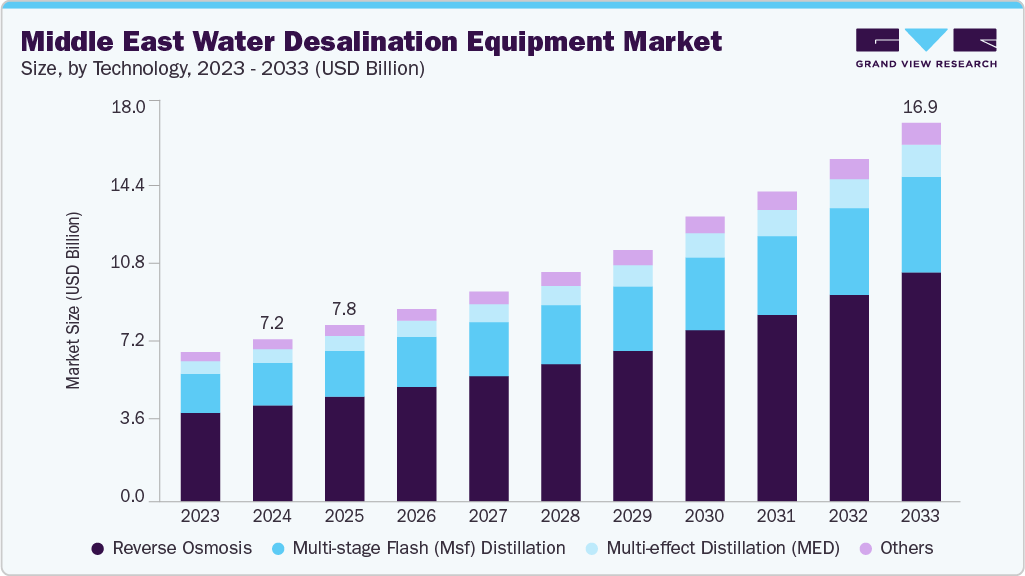 Source: Grand View Research, IR Documents, Primary Interviews, Paid DatabasesTo learn more about this report,
 Download Free Sample Report
 Market Concentration & Characteristics
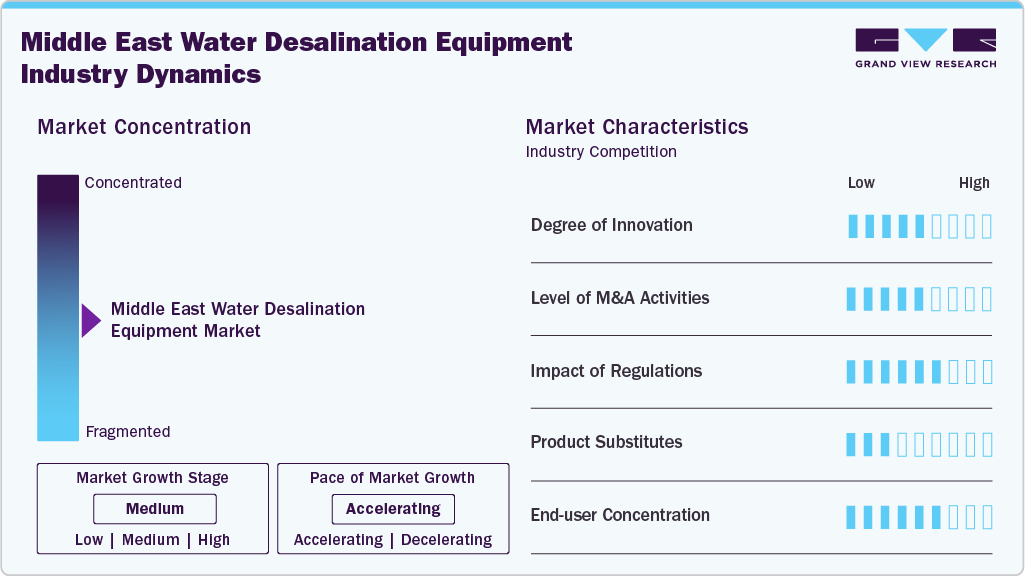
The water desalination equipment industry in the Middle East is relatively fragmented. It features a mix of international manufacturers, regional suppliers, and local installers competing across various segments. While global brands dominate high-end and technologically advanced products, many small and medium-sized companies serve niche markets and provide tailored solutions, resulting in a diverse and competitive landscape.
The Middle East is rapidly advancing in desalination technology by adopting energy-efficient reverse osmosis systems and integrating renewable energy sources. Innovations such as AI-driven monitoring, smart plant systems, and advanced membranes like graphene are improving efficiency, reducing operational costs, and increasing water recovery rates. These developments are transforming the region into a global hub for sustainable desalination innovation.
 To learn more about this report, Download Free Sample Report
 Mergers and acquisitions are accelerating in the Middle East desalination sector, with major players consolidating assets to expand regional operations and strengthen infrastructure capabilities. Strategic deals are enabling companies to scale up desalination capacity, optimize costs, and enter new markets. This consolidation trend is enhancing competitiveness, streamlining operations, and driving investment in more efficient, large-scale desalination projects.
Regulatory frameworks in the Middle East are increasingly focused on sustainability, energy conservation, and environmental impact. Governments are encouraging the use of renewable-powered desalination and eco-friendly technologies through policy support and incentives. Regulations targeting reduced carbon emissions and responsible brine disposal are shaping project design and technology selection, pushing the market toward more efficient and environmentally conscious desalination solutions.
Drivers, Opportunities & Restraints
A major driver in the market is the region’s acute water scarcity. Rapid urbanization, population growth, and industrial expansion are increasing water demand, making desalination a critical solution. Government investments in large-scale desalination infrastructure are boosting the industry, especially with a shift toward more energy-efficient and sustainable technologies.
An emerging opportunity lies in the integration of renewable energy, especially solar and wind, with desalination processes. As countries aim to reduce carbon footprints and improve sustainability, there is a rising demand for hybrid and green desalination systems. This opens avenues in the Middle East water desalination equipment market for innovation in equipment design, system automation, and energy recovery technologies tailored for harsh environments.
One key challenge is the high energy consumption and associated operational costs. Traditional thermal desalination methods are expensive and environmentally taxing. Transitioning to cost-effective, energy-efficient solutions while maintaining scalability remains difficult, especially for countries with limited renewable infrastructure or tight budgets for sustainable development.
Technology Insights
Reverse osmosis dominated the market in 2024, accounting for the largest revenue share at 59.2%against the backdrop of increasing water scarcity, urbanization, and industrial demand. RO technology is favored for its energy efficiency, cost-effectiveness, and ability to produce high-quality freshwater. Governments and industries are investing heavily in large-scale RO plants, often integrating renewable energy to reduce environmental impact, making it a leading technology for sustainable desalination in the region.
Multi-effect distillation (MED) segment is expected to witness significant growth during the forecast period due to its high energy efficiency and suitability for desalinating highly saline seawater. MED technology uses multiple evaporation and condensation stages, making it reliable and long-lasting for both large and small-scale projects. Rising population and growing agricultural and industrial water needs are driving increased adoption of MED as a key solution to address regional water scarcity challenges.
Source Insights
Seawater spearheaded the market in 2024, capturing the largest revenue share at 63.0% in light of the region's severe water scarcity. Seawater desalination provides a reliable source of potable water, essential for urban and industrial needs. Countries like Saudi Arabia and the UAE are investing heavily in large-scale seawater desalination projects, often integrating renewable energy sources to enhance sustainability and reduce operational costs.
The brackish water segment is expected to witness steady growth during the forecast period. Brackish water desalination offers higher freshwater recovery rates compared to seawater, making it an attractive option for municipal, industrial, and agricultural applications. The Middle East's increasing demand for water, coupled with advancements in desalination technologies, is propelling the adoption of brackish water desalination solutions across the region.
Application Insights
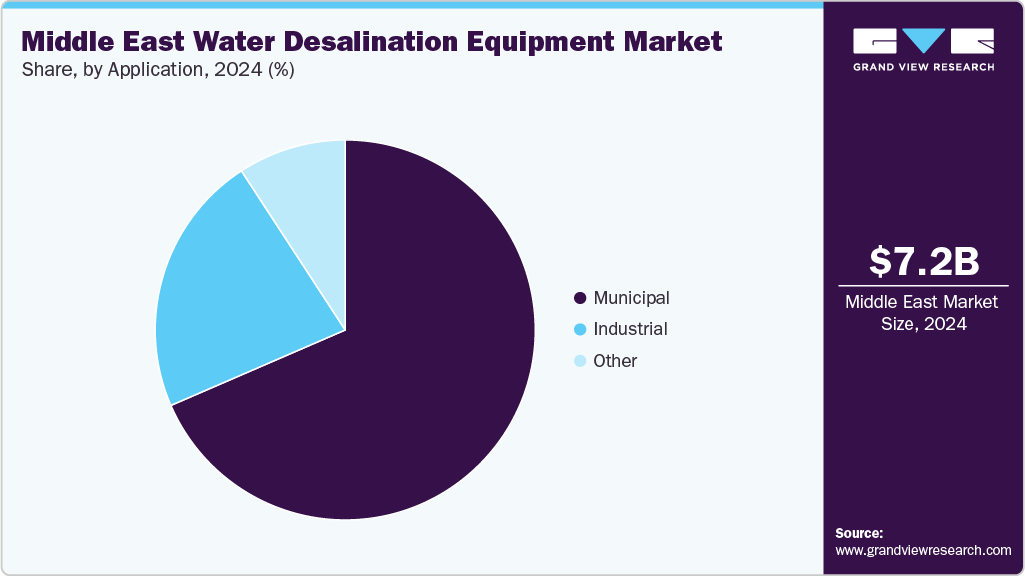
The municipal segment logged the largest revenue share of 68.5% in 2024, led by relentless urbanization, rising populations, and depletion of traditional freshwater sources. Cities increasingly rely on desalination to meet essential drinking water needs, prompting governments to invest in large-scale, modern systems. Public-private partnerships and sustainable technologies like renewable-powered RO plants are accelerating deployments.
 To learn more about this report, Download Free Sample Report
 The industrial segment is expected to grow robustly in the market for water desalination equipment in the Middle East, as sectors such as oil & gas, power generation, and manufacturing demand large volumes of treated water for processes like cooling, steam generation, and enhanced oil recovery. Desalination technologies, particularly advanced RO systems, are essential to meet these needs amid strained freshwater supplies. Strict environmental regulations and the expansion of industrial activities further spur adoption. As economies diversify, industrial desalination remains vital for sustainable operations and compliance.
Country Insights
Saudi Arabia Water Desalination Equipment Market Trends
Saudi Arabia water desalination equipment industry dominated the market with a 38.8% share in 2024, largely attributed to its extensive investments, advanced infrastructure, and strong government support. The country is home to numerous large-scale desalination plants and continues to prioritize water security through its Vision 2030 initiatives. Strategic partnerships and the adoption of advanced technologies further reinforce its leading position in the region.
Kuwait Water Desalination Equipment Market Trends
The water desalination equipment industry in Kuwait is expected to grow at a CAGR of 10.3% from 2025 to 2033 in the wake of its heavy dependence on desalination for freshwater, driven by scarce natural water resources. Government-led infrastructure expansion, adoption of energy-efficient technologies like reverse osmosis and renewable-powered systems, and ongoing innovation in sustainable desalination methods are all accelerating market development across municipal and industrial sectors.
Key Middle East Water Desalination Equipment Company Insights
Some of the key players operating in the market include Veolia, Xylem Inc., and Acciona S.A.
-
Veolia is a global environmental services company that designs and operates water treatment and desalination systems. In the Middle East, it develops and manages large-scale desalination plants using technologies like reverse osmosis and thermal processes. Veolia works with municipalities and industries to provide sustainable water solutions, often integrating energy recovery and efficiency into its plant operations.
-
Xylem, Inc. is a global water technology company engaged in the manufacturing, designing, and servicing of products that primarily cater to the water sector as well as the electric and gas sectors. The company owns numerous brands such as Aanderaa, AC Fire, Bell & Gossett, Bellingham + Stanley, CentriPro, ebro, Godwin,0 Flygt, Flojet, and Goulds Water Technology.
Key Middle East Water Desalination Equipment Companies:
- Acciona S.A.
- Doosan Heavy Industries & Construction
- Veolia
- SAWACO
- IDE Technologies
- Xylem, Inc.
- Aquatech International LLC
- Biwater Holdings Limited
- Genesis Water Technologies
- WETICO
Recent Developments
-
In March 2025, WETICO expanded into the UAE with a comprehensive water infrastructure package. The project includes seawater desalination, a demineralization plant, a condensate polishing unit, and an effluent treatment system.
-
In December 2024, Veolia intensified its desalination activities in the Middle East, aiming for a 50% increase in regional operations by 2033. The Middle East plays a central role in Veolia’s GreenUp 24-27 plan, which focuses on sustainable growth. Veolia’s expansion strategy includes advanced desalination technologies and partnerships to address water scarcity while supporting regional environmental and economic development goals.
Middle East Water Desalination Equipment Market Report Scope
Report Attribute
Details
Market size value in 2025
USD 7,879.3 million
Revenue forecast in 2033
USD 16,918.9 million
Growth rate
CAGR of 10.0% from 2025 to 2033
Historical data
2021 - 2023
Forecast period
2025 - 2033
Quantitative units
Revenue in USD million and CAGR from 2025 to 2033
Report coverage
Revenue forecast, company ranking, competitive landscape, growth factors, and trends
Segments covered
Source, technology, application, country
Country scope
Saudi Arabia; UAE; Kuwait; Israel
Key companies profiled
Acciona S.A.; Doosan Heavy Industries & Construction; Veolia; SAWACO; IDE Technologies; Xylem, Inc.; Aquatech International LLC; Biwater Holdings Limited; Genesis Water Technologies; WETICO
Customization scope
Free report customization (equivalent up to 8 analysts working days) with purchase. Addition or alteration to country, regional & segment scope.
Pricing and purchase options
Avail customized purchase options to meet your exact research needs. Explore purchase options
Middle East Water Desalination Equipment Market Report Segmentation
This report forecasts revenue growth at regional, and country levels and provides an analysis of the latest industry trends in each of the sub-segments from 2021 to 2033. For this study, Grand View Research has segmented the Middle East water desalination equipment market report based on technology, source, application, and country:
-
Technology Outlook (Revenue, USD Million, 2021 - 2033)
-
Reverse Osmosis
-
Multi-stage Flash (MSF) Distillation
-
Multi-effect Distillation (MED)
-
Others
-
-
Source Outlook (Revenue, USD Million, 2021 - 2033)
-
Sea Water
-
Brackish water
-
River water
-
Others
-
-
Application Outlook (Revenue, USD Million, 2021 - 2033)
-
Municipal
-
Industrial
-
Others
-
-
Country Outlook (Revenue, USD Million, 2021 - 2033)
-
Saudi Arabia
-
UAE
-
Kuwait
-
Israel
-
Frequently Asked Questions About This Report
The Middle East water desalination equipment market size was estimated at USD 7,245.1 million in 2024 and is expected to be USD 7,879.3 million in 2025.
The Middle East water desalination equipment market, in terms of revenue, is expected to grow at a compound annual growth rate of 10.0% from 2025 to 2033 to reach USD 16,918.9 million by 2033.
Reverse osmosis dominated the market in 2024, accounting for the highest revenue share of 59.2% due to increasing water scarcity, urbanization, and industrial demand. RO technology is favored for its energy efficiency, cost-effectiveness, and ability to produce high-quality freshwater.
Some of the key players operating in the Middle East water desalination equipment market include Acciona S.A., Doosan Heavy Industries & Construction, Veolia, SAWACO, IDE Technologies, Xylem, Inc., Aquatech International LLC, Biwater Holdings Limited, Genesis Water Technologies, WETICO.
Key factors driving the Middle East water desalination equipment market include water scarcity, rapid population growth, urbanization, industrial expansion, and government investment in infrastructure. Technological advancements and a shift toward energy-efficient and sustainable desalination solutions also contribute significantly.
About the Author(s)
Advanced Interior Materials Research Team
Advanced Materials · Advanced Interior MaterialsThis report was authored by the advanced interior materials research team at Grand View Research - comprising two research analysts, one senior research analyst, and one industry expert - with specialized expertise in the advanced interior materials segment of the advanced materials industry. All findings are based on proprietary advanced materials databases, executive interviews, and regulatory analysis, subject to internal peer review prior to publication.
Last Updated:
Speak to Analyst

Customize this report to your needs - add regions, segments, or data points, with 20% free customization.
Or view our licence options:


ISO 9001:2015 & 27001:2022 Certified
We are GDPR and CCPA compliant! Your transaction & personal information is safe and secure. For more details, please read our privacy policy.


