
- Home
- »
- IT Services & Applications
- »
-
Military Mass Notification System Market Size Report, 2033GVR Report cover

Military Mass Notification System Market (2026 - 2033)
Size, Share & Trends Analysis By Component, By Integration, By Deployment, By Communication Type, By System Type, By Application, By Region (North America, Europe, Asia Pacific), And Segment Forecasts
Market Size, 2025
$535.2MMarket Estimate, 2026
$663.8MMarket Forecast, 2033
$3,075.2MCAGR, 2026–2033
24.5%Military Mass Notification System Market Summary
The global military mass notification system market size was valued at USD 535.2 million in 2025 and is projected to grow from USD 663.8 million in 2026 to USD 3,075.2 million by 2033, at a CAGR of 24.5% from 2026 to 2033. The North America held the largest share of 41.2% of the global market in 2025. The market focuses on platforms that deliver real-time alerts to support safety and rapid response in defense operations.
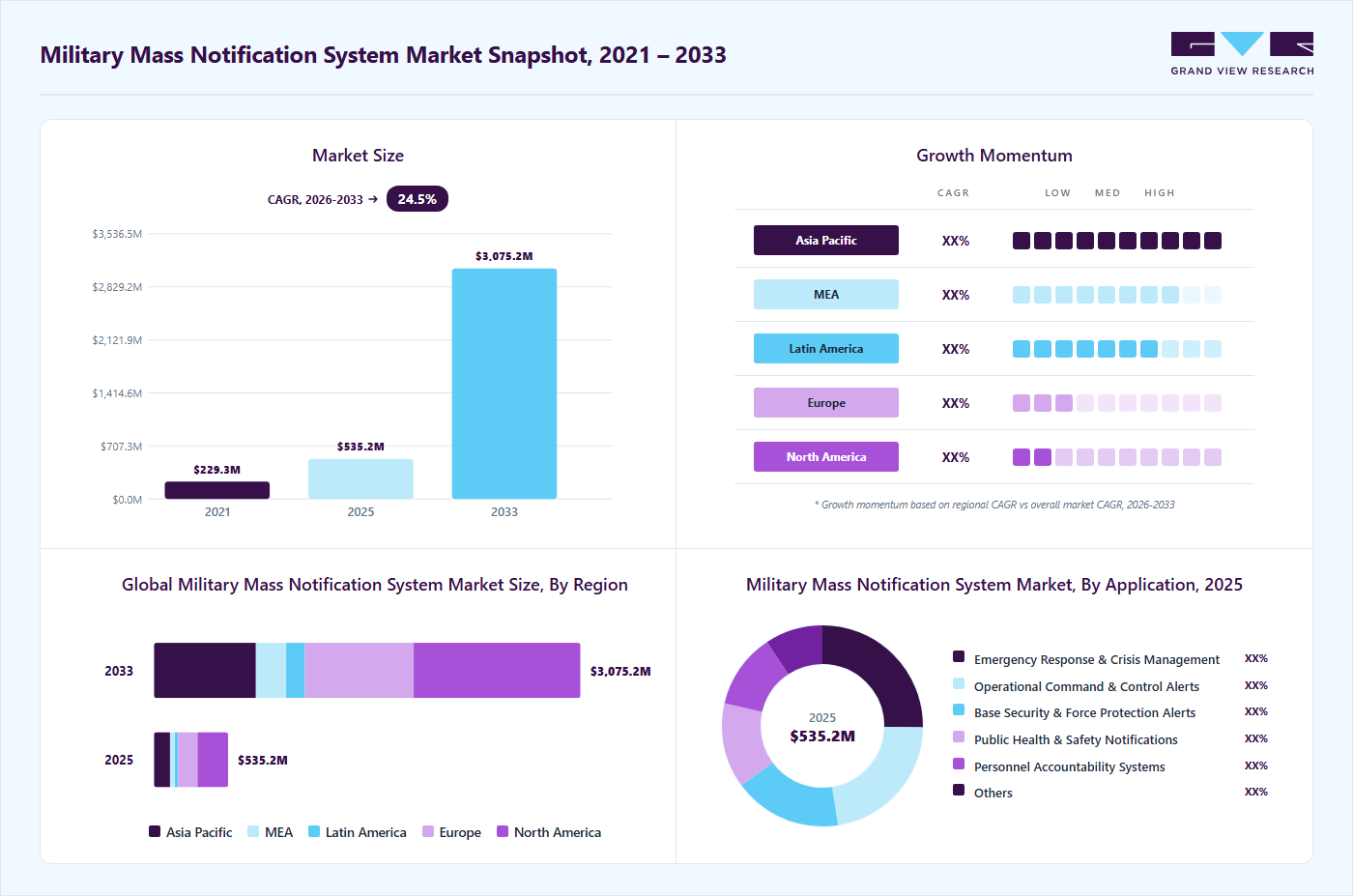 Source: Grand View Research, IR Documents, Primary Interviews, Paid DatabasesTo learn more about this report,
 Download Free Sample Report
Key Market Trends & Insights
- By component: The hardware segment accounted for the largest revenue share of 59.2% in 2025.
- By integration: The integrated segment held the largest share in 2025.
- By deployment: The on-premise segment dominated the market, accounting for the largest revenue share in 2025.
- By system type: The indoor system segment dominated the market in 2025.
- By communication type: The text-based segment dominated the market, accounting for the largest revenue share in 2025.
- By application: The emergency response & crisis management segment is expected to grow significantly from 2026 to 2033.
Regional Highlights
- Largest regional market: North America (41.2% revenue share, 2025)
- Fastest-growing regional market: Asia Pacific (highest CAGR, 2026-2033)
- By country: The U.S. held a dominant position in 2025.
Market Size & Forecast
- Market size in 2025: USD 535.2 Million
- Estimated market size in 2026: USD 663.8 Million
- Projected market size by 2033: USD 3,075.2 Million
- CAGR (2026-2033): 24.5%
Prism AI by Grand View Research Free to tryAsk a question about the military mass notification system marketTry asking✓Every figure cited from GVR research Prefer the report? Download free sample →
The market focuses on specialized platforms designed to deliver rapid, secure alerts to armed forces personnel during emergencies, security threats, cyber incidents, and natural disasters. These systems integrate with command-and-control networks, physical security infrastructure, and multi-channel communication tools, including desktop pop-ups, SMS, email, and voice alerts.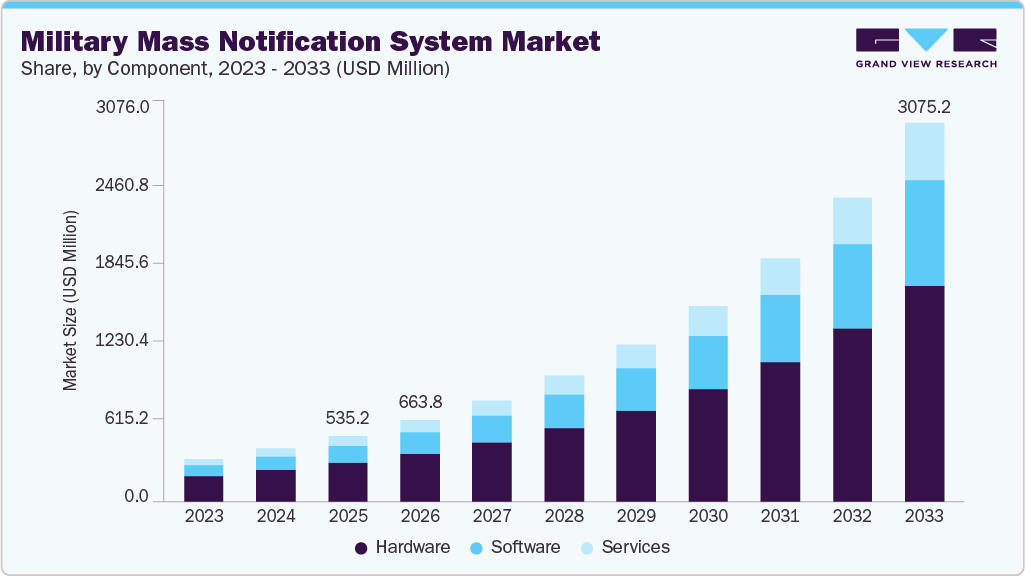 To learn more about this report, Download Free Sample Report
Several key factors are driving market expansion. Ongoing defense modernization programs worldwide emphasize the digitization of military bases and the need for interoperable communication solutions that support joint and allied operations. Rising geopolitical tensions, along with the increasing frequency of cyber threats and extreme weather events, have heightened the demand for robust emergency response tools that ensure continuity of operations. Military buyers are prioritizing systems that offer secure, multi-channel delivery and seamless integration with existing networks, helping to meet strict safety regulations and enhance overall mission effectiveness in both peacetime and conflict scenarios.
Moreover, defense organizations are adopting advanced communication technologies that combine mobility, resilience, and real-time data capabilities. Industry collaborations are also playing a key role in developing integrated solutions tailored to evolving military requirements. For instance, in September 2025, Motorola Solutions and Nokia partnered to develop a next-generation tactical communication network for UK defense agencies. In the market, such solutions enhance real-time alerting, secure communication, and situational awareness, supporting faster response and improved coordination in critical defense operations. This move strengthens the ecosystem of integrated solutions available to military buyers and reflects the broader trend of companies working together to address the complex requirements of modern battlefield and base-level alerting.
In summary, the market is well-positioned for continued growth as defense priorities center on rapid, dependable communication in uncertain environments. By addressing both immediate operational needs and long-term strategic goals, these systems play a key role in enhancing readiness and protecting personnel worldwide. As technology advances and global security challenges persist, sustained investment in this sector will remain essential for maintaining effective military preparedness.
Component Insights
The hardware segment dominated the market, accounting for a 59.2% revenue share in 2025. This segment includes components such as speakers, sirens, control panels, displays, and communication devices that enable real-time dissemination of emergency messages in both indoor and outdoor settings. Demand for this segment is primarily driven by the need for robust and durable equipment that can operate effectively in harsh and mission-critical conditions, along with the increasing focus on base modernization and force protection. Military organizations are investing in advanced hardware that supports multi-channel communication, integration with digital networks, and enhanced coverage across large or remote installations. In conclusion, the hardware segment continues to play a vital role in ensuring operational readiness and effective emergency response, supporting the broader adoption of integrated and resilient mass notification systems in defense operations.
The software segment is anticipated to grow at the fastest CAGR during the forecast period. This segment consists of platforms for alert management, system integration, data processing, and multi-channel communication, which are essential for ensuring the timely and accurate dissemination of information during emergencies. The growing need for interoperable and automated communication systems is a major factor driving this segment, as defense organizations prioritize rapid response and operational efficiency. For instance, in December 2025, Bogen Communications partnered with Alertus Technologies to integrate paging and alerting platforms through secure APIs, enhancing automated alert delivery and system coordination across facilities. Such developments highlight how software-driven integration improves reliability and supports synchronized responses in critical situations. Overall, the software segment is expected to witness steady growth, supported by ongoing advancements in integration capabilities, automation, and the rising emphasis on secure and efficient communication infrastructure in military operations.
Integration Insights
The integrated segment dominated the market, accounting for the largest revenue share in 2025, driven by the increasing need for centralized and synchronized communication across diverse defense infrastructure. Integrated systems enable seamless connectivity between alerting platforms, command-and-control systems, surveillance networks, and communication channels, allowing real-time dissemination of critical information during complex operational scenarios such as coordinated attacks, border conflicts, or multi-domain warfare situations. A key driving factor is the growing emphasis on interoperability within modern defense ecosystems, where armed forces require unified situational awareness across land, air, sea, cyber, and space domains. During high-alert conditions, integrated notification systems can automatically trigger alerts based on inputs from radar systems, threat detection software, and intelligence feeds, significantly reducing response time and human dependency. In addition, the adoption of network-centric warfare strategies and digitized military bases is further accelerating demand for integrated solutions that ensure consistent and reliable communication across all units. As a result, the integrated segment is anticipated to emerge as a critical component in enhancing operational readiness and decision-making efficiency in military environments.
The standalone segment is expected to grow at a significant CAGR over the forecast period. Growing focus on enhancing in-store experiences drives segment growth. Defense installations, forward operating bases, and high-security zones often prefer standalone systems to ensure uninterrupted communication during cyber incidents, network failures, or electronic warfare conditions that may disrupt integrated infrastructures. A key driving factor for this segment is the need for isolated and fail-safe alerting mechanisms that can function without reliance on centralized IT ecosystems, especially in contested or remote environments where connectivity is limited or compromised. In addition, standalone systems offer faster deployment, simplified maintenance, and reduced vulnerability to cyber threats, making them suitable for mission-critical applications. Although the broader market is gradually shifting toward integrated and interoperable platforms, the standalone segment is expected to maintain steady demand due to its strategic importance in ensuring resilient and secure emergency communication capabilities.
Deployment Insights
The on-premise segment dominated the market, accounting for the largest revenue share in 2025. Military organizations often operate in sensitive and classified settings where data sovereignty, cybersecurity, and uninterrupted system availability are critical, making on-premise deployments a preferred choice over cloud alternatives. A key driving factor for this segment is the requirement for real-time alert dissemination in restricted or remote operational zones-such as forward operating bases or naval vessels-where external network connectivity may be limited or deliberately isolated to prevent cyber threats. In such scenarios, on-premise systems ensure consistent performance, low latency, and independence from third-party networks. In addition, these systems can be tightly integrated with existing defense communication networks and legacy infrastructure, enhancing interoperability and operational continuity. As a result, despite the gradual adoption of cloud technologies, the on-premise segment remains dominant in high-security military applications and is expected to sustain steady demand due to its unmatched control, resilience, and compliance capabilities.
The cloud segment is expected to grow at the fastest CAGR over the forecast period. Cloud-based platforms enable rapid dissemination of mission-critical information across multiple bases, mobile units, and command centers, while supporting integration with advanced technologies such as AI-driven threat detection and geolocation-based alerting. A key driving factor is the growing reliance on joint and coalition operations, where interoperable and remotely accessible communication infrastructure is essential for coordinated response during emergencies and combat scenarios. In addition, cloud deployment reduces infrastructure burden, enhances system resilience, and allows for faster updates and scalability in dynamic threat environments. As a result, the cloud segment is emerging as a preferred deployment model, supporting improved operational readiness and communication efficiency in modern military frameworks.
System Type Insights
The indoor system segment dominated the military mass notification system industry, with the largest revenue share in 2025, driven by the critical need for real-time communication within enclosed and high-density operational environments such as command centers, barracks, training facilities, and underground bunkers. These systems ensure rapid dissemination of alerts during emergencies such as security breaches, fire incidents, or chemical hazards, where immediate personnel response is essential to minimize risk and maintain operational continuity. A key driving factor is the increasing modernization of military infrastructure, with a growing focus on integrated communication networks that support multi-channel alerts, including audio-visual signals, desktop notifications, and mobile integration within indoor settings. In addition, the rising emphasis on personnel safety, regulatory compliance, and readiness in confined environments further strengthens adoption. As defense organizations continue to invest in smart base technologies and resilient communication frameworks, the indoor system segment is anticipated to witness steady growth, supported by its essential role in enhancing situational awareness and response efficiency.
The outdoor system is expected to grow at the fastest CAGR during the forecast period. These systems, which include high-powered sirens, loudspeakers, and integrated broadcast units, are critical in scenarios where personnel may not have immediate access to personal communication devices, enabling commanders to rapidly disseminate alerts related to incoming threats, perimeter breaches, or natural hazards. A key driving factor is the rising emphasis on force protection in geographically dispersed operations, where outdoor notification infrastructure ensures uninterrupted communication even in GPS-denied or network-disrupted conditions. In addition, advancements in ruggedized hardware and integration with centralized command systems are enhancing reliability and response coordination. As modern military operations increasingly prioritize rapid situational awareness and resilience, the outdoor system segment is expected to remain a vital component in strengthening emergency preparedness and operational effectiveness.
Communication Type Insights
The text-based segment dominated the market, accounting for the largest revenue share in 2025. In operational scenarios such as remote deployments, conflict zones, or during electronic warfare conditions where voice networks may be disrupted or monitored, text-based alerts delivered via SMS, secure messaging apps, or encrypted military communication platforms provide a discreet and low-data means of disseminating critical information to personnel. In addition, text messages enable clear, standardized instructions that can be quickly referenced, reducing the risk of miscommunication during high-pressure situations such as base lockdowns or coordinated tactical movements. The growing integration of automated alert generation systems with geotargeting capabilities further enhances the precision and timeliness of these notifications. As military forces increasingly prioritize resilient and interoperable communication frameworks, the text-based segment is expected to maintain steady growth, supported by its operational efficiency and adaptability across diverse mission environments.
The digital signage segment is projected to register the fastest CAGR during the forecast period, driven by the increasing need for instant and synchronized communication during critical scenarios such as perimeter breaches, missile threats, or natural disasters, where personnel may not have immediate access to personal communication devices. In addition, advancements in ruggedized display technologies and integration with command-and-control systems are enhancing reliability and operational continuity. As military organizations continue to prioritize multi-channel, fail-safe communication strategies, the digital signage segment is expected to witness steady growth, supported by its effectiveness in reinforcing alert visibility and improving response coordination.
Application Insights
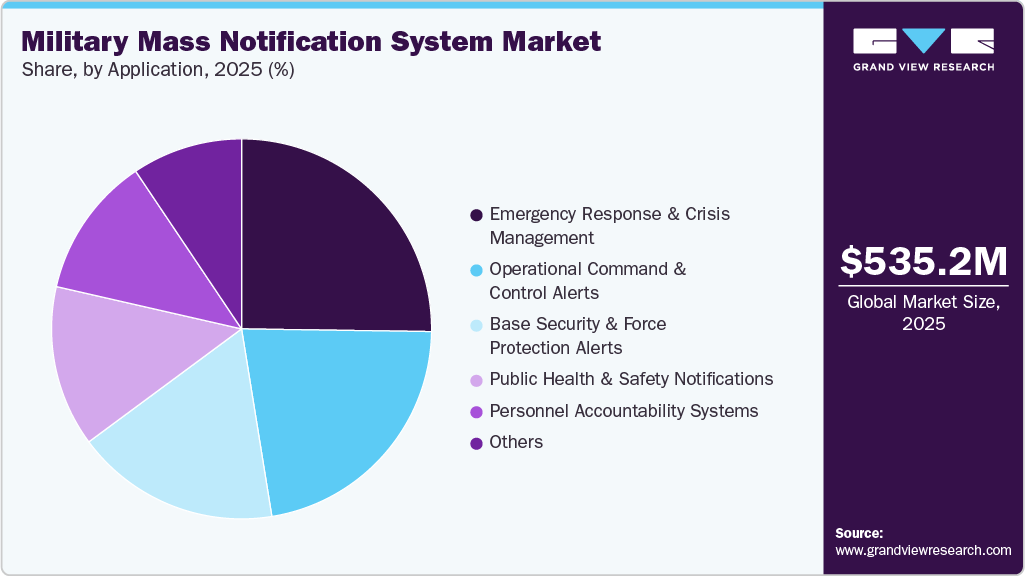
The emergency response & crisis management segment dominated the market, accounting for the highest revenue share in 2025, driven by the increasing need for rapid, coordinated communication during high-risk and time-sensitive situations. Military bases and operational units are frequently exposed to diverse threats such as missile attacks, cyber intrusions, natural disasters, and insider security breaches, where immediate dissemination of accurate information is essential to minimize casualties and operational disruption. In such scenarios, advanced notification systems enable real-time, multi-channel alerts integrating text, voice, and visual signals-to ensure that personnel across dispersed locations receive clear instructions simultaneously. The growing emphasis on mission readiness and force protection, along with the integration of automated alert triggers linked to surveillance and threat detection systems, is further accelerating adoption in this segment. As modern warfare increasingly involves unpredictable and hybrid threats, the demand for reliable, fast, and interoperable crisis communication solutions is expected to sustain strong growth in this application area.
 To learn more about this report, Download Free Sample Report
The base security & force protection alerts segment is projected to be the fastest-growing segment from 2026 to 2033, driven by the increasing need for real-time threat detection and rapid response across military installations. This segment is gaining prominence as defense agencies face evolving risks such as unauthorized intrusions, drone-based surveillance, cyber-physical attacks, and insider threats within high-security zones. In such scenarios, mass notification systems enable immediate dissemination of geo-targeted alerts, lockdown instructions, and situational updates to personnel, thereby enhancing coordination between security teams and minimizing response time. The growing integration of advanced technologies, including sensor-based perimeter monitoring and AI-enabled threat analytics, further strengthens the effectiveness of these alerts by enabling automated and precise communication during critical events. As military bases continue to prioritize operational readiness and personnel safety, the demand for robust and interoperable alert systems in force protection is expected to witness sustained growth, reinforcing its importance within the overall market landscape.
Regional Insights
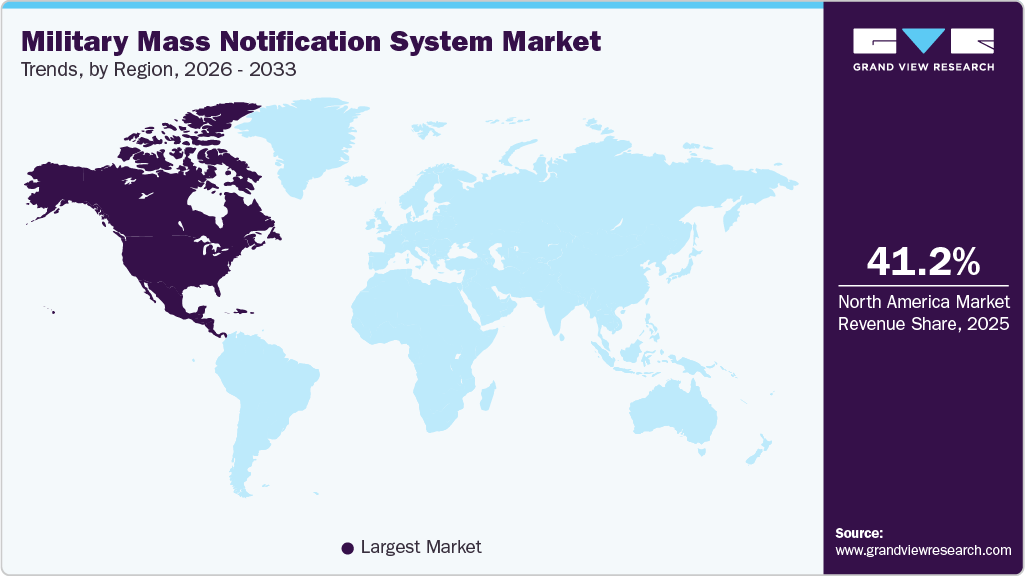
The North America military mass notification system accounted for the largest global revenue share of 41.2% in 2025. The military mass notification system market in North America dominated the global market with the largest revenue share in 2025, driven by the region’s strong defense infrastructure and continuous focus on advanced communication readiness across military bases. In particular, the increasing frequency of multi-domain operations and joint training exercises has created a critical need for real-time, synchronized alerting systems that can operate seamlessly across air, land, sea, cyber, and space domains. Military installations are increasingly adopting integrated notification platforms capable of delivering geo-targeted alerts, ensuring rapid dissemination of threat information such as unauthorized intrusions, cyber incidents, or missile warnings to both on-base personnel and remote units. In addition, the modernization of legacy communication systems, supported by rising defense budgets in countries such as the U.S. and Canada, is accelerating the deployment of cloud-enabled and interoperable notification solutions. These systems enhance situational awareness, reduce response times, and improve coordination during emergencies and operational disruptions. As a result, the market in North America is expected to maintain its dominance, supported by ongoing technological advancements and the region’s strategic emphasis on force protection and mission continuity.
 To learn more about this report, Download Free Sample Report
U.S. Military Mass Notification System Market Trends
The military mass notification system market in the U.S. is expected to grow significantly at a CAGR from 2025 to 2033. A key driving factor is the increasing need for real-time, multi-channel communication to ensure rapid response during diverse threat scenarios, including active shooter incidents, cyberattacks, natural disasters, and operational disruptions, which are highly relevant in the U.S. defense environment. The U.S. Department of Defense is actively investing in upgrading legacy public address and alert systems to integrated, digital platforms that combine mobile alerts, loudspeakers, desktops, and surveillance-linked systems, enabling improved situational awareness and coordinated response across large and complex bases.
Europe Military Mass Notification System Market Trends
The military mass notification system market in Europe is anticipated to register considerable growth from 2026 to 2033, supported by the region’s strong emphasis on defense modernization, cross-border security coordination, and regulatory-driven emergency communication frameworks. European NATO members and EU-aligned defense programs are increasingly investing in advanced notification platforms to enhance real-time situational awareness, particularly in joint and multinational operations where secure, interoperable communication is critical. The rising geopolitical tensions in Eastern Europe and the expansion of network-centric warfare doctrines are accelerating the adoption of integrated alerting systems that can deliver rapid, multi-channel communication across dispersed military units and command structures. In addition, EU-level mandates such as public warning system regulations and the broader Common Security and Defense Policy are creating a structured demand for reliable, geo-targeted alerting capabilities across defense and civilian infrastructure, further strengthening the market foundation.
The UK military mass notification system market is expected to grow significantly in the forecast period, driven by increasing government focus on national security, crisis preparedness, and modernization of defense communication infrastructure. The UK Ministry of Defense is actively investing in advanced communication ecosystems, including integrated and beyond-line-of-sight systems, to ensure real-time coordination across the armed forces and allied networks, reflecting the country’s emphasis on operational readiness and rapid response capabilities.
The military mass notification system market in Germany held a substantial market share in 2025. Germany’s evolving security landscape-shaped by rising geopolitical tensions in Europe, commitments to NATO operations, and heightened focus on national resilience has accelerated investments in advanced communication infrastructure, including integrated alerting and emergency response systems. The need to replace legacy public address and alert systems with interoperable, software-driven platforms that can seamlessly connect with command-and-control networks is a key driver, particularly as the German armed forces prioritize situational awareness and rapid decision-making capabilities.
Asia Pacific Military Mass Notification System Market Trends
The military mass notification system market in the Asia Pacific held a significant share of the global market in 2025, driven by rising defense modernization programs and the increasing need for real-time, resilient communication across geographically dispersed military operations. Countries such as China and India are significantly increasing defense budgets and investing in advanced communication infrastructure to strengthen command and control capabilities, particularly along border regions and in maritime zones, which is driving the adoption of integrated notification platforms. In parallel, nations such as Japan, Indonesia, and the Philippines, which are frequently exposed to earthquakes, typhoons, and other natural disasters, are prioritizing dual-use systems that can support both military operations and large-scale emergency response, enhancing demand for interoperable and location-based alerting technologies.
Japan military mass notification system market is expected to grow significantly during the forecast period. Japan’s unique geopolitical and environmental context, characterized by frequent natural disasters such as earthquakes and tsunamis, along with rising regional security concerns, including missile threats, has driven the government to invest heavily in rapid, automated alerting systems across military bases and critical infrastructure. Systems such as the nationwide J-ALERT platform enable real-time, satellite-based dissemination of alerts across multiple channels, including public address systems, mobile networks, and broadcast media, ensuring immediate situational awareness during both natural and defense-related emergencies
The military mass notification system market in China held a substantial revenue share in 2025. As the People’s Liberation Army continues to transition toward network-centric and multi-domain warfare, there is a rising requirement for real-time, secure, and interoperable communication systems that can rapidly disseminate alerts across bases, command centers, and deployed units. Moreover, stringent national emergency response regulations and increasing focus on public safety and disaster readiness are encouraging the deployment of advanced notification platforms across government and defense establishments. The market is also benefiting from the shift toward software-driven, multi-channel alerting systems that integrate with command-and-control architectures to support faster decision-making and coordinated response during security incidents.
Key Military Mass Notification System Company Insights
Key players operating in the industry are Checkmarx Ltd., Everbridge, Motorola Solutions, BlackBerry, Federal Signal, andHCL Technologies. The companies are focusing on various strategic initiatives, including new product development, partnerships & collaborations, and agreements to gain a competitive advantage over their rivals. The following are some instances of such initiatives.
-
In February 2026, Regroup partnered with SOS Technologies to integrate real-time threat detection with automated mass notification. The solution enables instant, multi-channel alerts triggered by alarms, enhancing response speed, coordination, and operational efficiency in high-risk and mission-critical military environments. This partnership is expected to accelerate the adoption of AI-driven, automated communication solutions in the market.
-
In May 2025, Motorola Solutions announced the acquisition of Silvus Technologies for USD 4.4 billion to strengthen secure, high-bandwidth mobile ad-hoc network capabilities. Silvus’ technology enables resilient, infrastructure-free communication supporting military operations, autonomous systems, and real-time data exchange in complex and contested environments. This acquisition is expected to accelerate technological advancement and drive demand for robust communication solutions in the market.
-
In July 2024, Acoustic Technology, Inc. introduced the ATI IPAWS Alert Origination Tool, enabling government and defense agencies to deliver multi-channel emergency alerts through integrated systems. The solution enhances coordination, geo-targeted messaging, and real-time communication, supporting reliable and efficient alert dissemination across military and public safety environments. This launch is expected to drive innovation and strengthen the adoption of integrated alerting solutions in the market.
Key Military Mass Notification System Companies:
The following key companies have been profiled for this study on the military mass notification system market.
- Alert Media, Inc.
- Alertus Technologies LLC
- BlackBerry
- Crisis24
- Eaton
- Everbridge
- Federal Signal
- Honeywell International
- Johnson Controls
- Motorola Solutions
- Omnilert
- Rave Mobile Safety
- Singlewire Software, LLC.
Military Mass Notification System Market Report Scope
Report Attribute
Details
Market size in 2025
USD 535.2 million
Estimated Market size in 2026
USD 663.8 million
Projected Market size by 2033
USD 3,075.2 million
Growth rate
CAGR of 24.5% from 2026 to 2033
Actual data
2021 - 2025
Forecast period
2026 - 2033
Quantitative units
Revenue in USD million/billion and CAGR from 2026 to 2033
Report enterprise size
Revenue forecast, company share, competitive landscape, growth factors, and trends
Segments covered
Component, integration, deployment, communication type, system type, application, region
Regional scope
North America; Europe; Asia Pacific; Latin America; MEA
Country scope
U.S.; Canada; Mexico; UK; Germany; France; China; India; Japan; Australia; South Korea; Brazil; UAE; Saudi Arabia; South Africa
Key companies profiled
BlackBerry; Alert Media, Inc.; Alertus Technologies LLC; Crisis24; Eaton; Everbridge; Federal Signal; Rave Mobile Safety; Honeywell International; Johnson Controls; Motorola Solutions; Omnilert; Singlewire Software, LLC.
Customization scope
Free report customization (equivalent to 8 analysts working days) with purchase. Addition or alteration to country, regional & segment scope.
Pricing and purchase options
Avail customized purchase options to meet your exact research needs. Explore purchase options
Global Military Mass Notification System Market Report Segmentation
This report forecasts revenue growth at global, regional, and country levels and provides an analysis of the latest industry trends in each of the sub-segments from 2021 to 2033. For this study, Grand View Research has segmented the global military mass notification system market report based on component, integration, deployment, communication type, system type, application, and region:
-
Component Outlook (Revenue, USD Million, 2021 - 2033)
-
Hardware
-
Fire Alarm System
-
Public Address System
-
Duress Buttons
-
Electronic Messaging Displays
-
Visual Alert Devices
-
Sirens
-
-
Software
-
Services
-
Professional Services
-
Consulting and Planning Services
-
Training and Support Services
-
-
Managed Services
-
Managed Alert Creation and Delivery
-
24/7 Monitoring and Response
-
Emergency Event Coordination
-
Dedicated Emergency Response Teams
-
Content Creation and Management
-
-
-
-
Integration Outlook (Revenue, USD Million, 2021 - 2033)
-
Standalone
-
Integrated
-
-
Deployment Outlook (Revenue, USD Million, 2021 - 2033)
-
Cloud
-
On-premise
-
-
Communication Type Outlook (Revenue, USD Million, 2021 - 2033)
-
Text-based
-
Voice-based
-
Digital Signage
-
Email-based
-
Others
-
-
System Type Outlook (Revenue, USD Million, 2021 - 2033)
-
Indoor System
-
Outdoor System
-
-
Application Outlook (Revenue, USD Million, 2021 - 2033)
-
Emergency Response & Crisis Management
-
Operational Command & Control Alerts
-
Base Security & Force Protection Alerts
-
Public Health & Safety Notifications
-
Personnel Accountability Systems
-
Others
-
-
Regional Outlook (Revenue, USD Million, 2021 - 2033)
-
North America
-
U.S.
-
Canada
-
Mexico
-
-
Europe
-
UK
-
Germany
-
France
-
-
Asia Pacific
-
China
-
India
-
Japan
-
South Korea
-
Australia
-
-
Latin America
-
Brazil
-
-
Middle East & Africa
-
UAE
-
Saudi Arabia
-
South Africa
-
-
Frequently Asked Questions About This Report
The global military mass notification system market was valued at USD 535.2 million in 2025 and is expected to reach USD 663.8 million in 2026.
Factors such as growing focus on delivering real-time alerts to support safety and rapid response in defence operations are driving the growth of the military mass notification system market.
North America dominated the military mass notification system market with the largest revenue share of 41.2% in 2025.
Asia Pacific is the fastest growing regional market.
The integrated segment held the largest revenue share in 2025.
The on-premise segment led the market, accounting for the largest revenue share in 2025.
The text-based segment dominated the market, accounting for the largest revenue share in 2025.
The emergency response & crisis management segment dominated the market in 2025.
Some key players operating in the market include BlackBerry, Alert Media, Inc., Alertus Technologies LLC, Crisis24, Eaton, Everbridge, Federal Signal, Rave Mobile Safety, Honeywell International, Johnson Controls, Motorola Solutions, Omnilert, Singlewire Software, LLC., and others.
The hardware segment accounted for the largest revenue share of 59.2% In 2025.
About the Author(s)
IT Services & Applications Research Team
Technology · IT Services & ApplicationsThis report was authored by the it services & applications research team at Grand View Research - comprising two research analysts, one senior research analyst, and one industry expert - with specialized expertise in the it services & applications segment of the technology industry. All findings are based on proprietary technology databases, executive interviews, and regulatory analysis, subject to internal peer review prior to publication.
Last Updated:
Speak to Analyst

Customize this report to your needs - add regions, segments, or data points, with 20% free customization.
Or view our licence options:


ISO 9001:2015 & 27001:2022 Certified
We are GDPR and CCPA compliant! Your transaction & personal information is safe and secure. For more details, please read our privacy policy.


