
- Home
- »
- Performance Chemicals
- »
-
Military Nitrocellulose Market Size & Share Report 2026-2033GVR Report cover

Military Nitrocellulose Market (2026 - 2033)
Size, Share & Trends Analysis Report By Grade (High-Nitrogen (?13.0% N), Medium-Nitrogen (12.0-12.9% N)), By Propellant Type (Single-Base, Double-Base), By Application, By Region, And Segment Forecasts
Market Size, 2025
$198.6MMarket Estimate, 2026
$212.8MMarket Forecast, 2033
$344.6MCAGR, 2026–2033
7.1%Military Nitrocellulose Market Summary
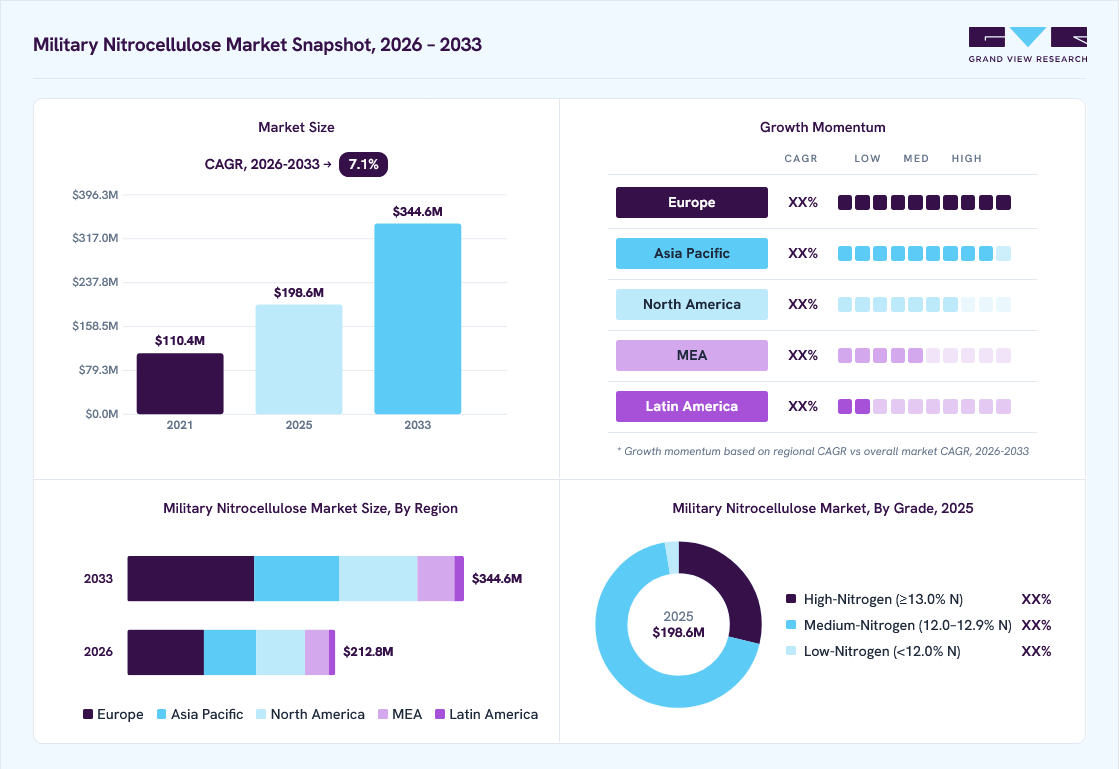
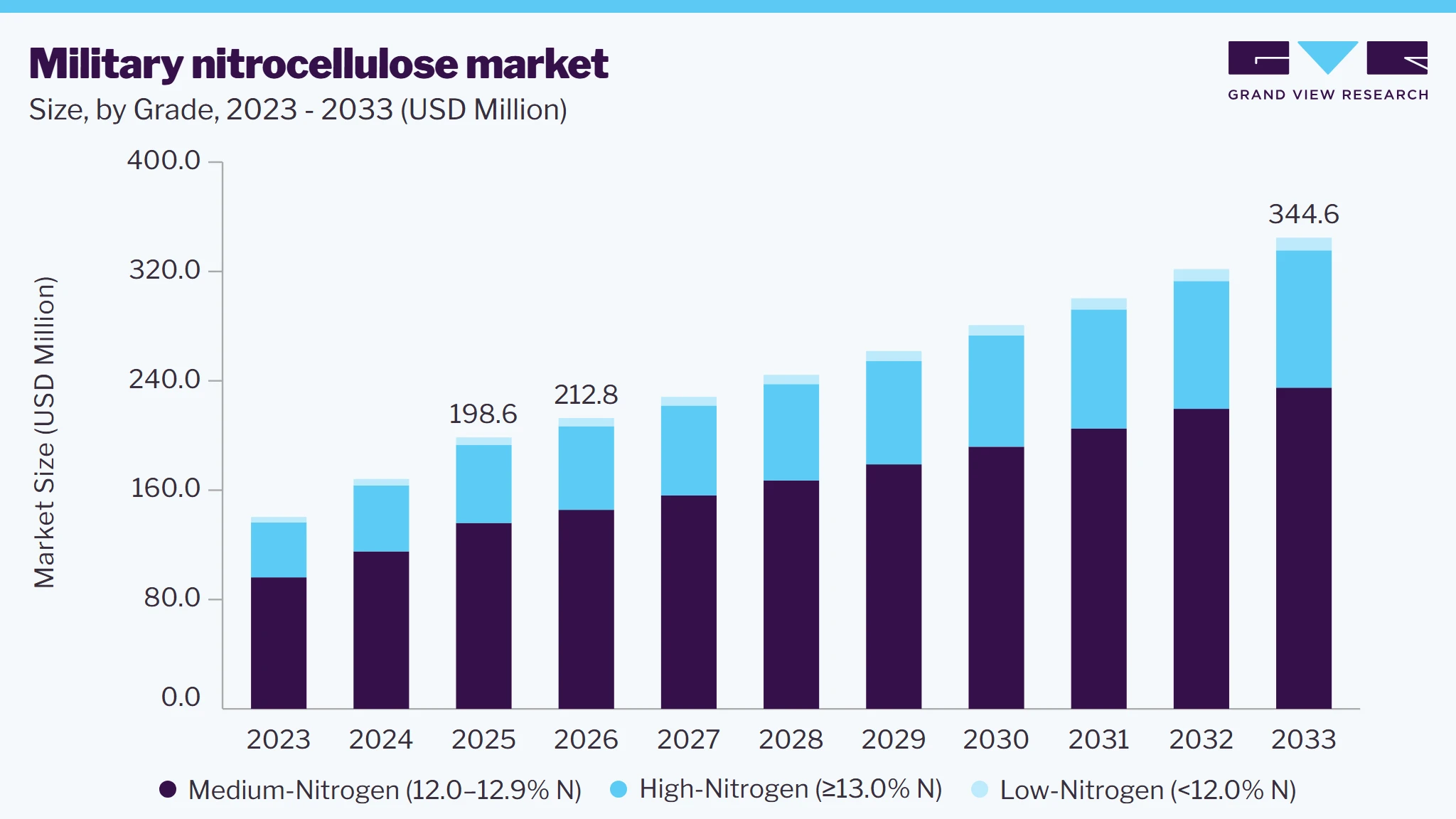
The global military nitrocellulose market size was valued at USD 198.6 million in 2025 and is expected to grow from USD 212.8 million in 2026 to USD 344.6 million in 2033, at a CAGR of 7.1% from 2026 to 2033. Europe dominated the global market, accounting for a revenue share of 36.7% in 2025. The market growth is supported by increasing demand for nitrocellulose as a key energetic material in small-arms propellants, artillery ammunition, military explosives, and other defense applications, particularly due to its high energy content, controlled burning characteristics, compatibility with propellant formulations, and ability to support consistent ballistic performance.
 Source: Grand View Research, IR Documents, Primary Interviews, Paid DatabasesTo learn more about this report,
 Download Free Sample Report
Key Market Trends & Insights
- By grade: Medium-nitrogen (12.0-12.9% N) held the largest revenue share of 68.5% in 2025.
- By propellant type: Single-base segment held the largest revenue share of 46.2% in 2025.
- By application: Rocket & missile propulsion is expected to grow at the fastest CAGR of 7.5% from 2026 to 2033.
Regional Highlights
- Largest regional market: Europe (36.7% revenue share, 2025)
- By country: Germany held the largest share in 2025
Market Size & Forecast
- Market size in 2025: USD 198.6 Million
- Estimated market size in 2026: USD 212.8 Million
- Projected market size by 2033: USD 344.6 Million
- CAGR (2026-2033): 7.1%
GVR research-powered AIAsk Prism AI about the military nitrocellulose marketGet cited answers from GVR research on market growth, segments, regulations and forecasts.Start with✓ Source-linked answers ✓ Market-specific context ✓ Traceable figuresExplore Prism AI ↗Rising defense spending, modernization of military ammunition, expansion of small-arms and artillery capabilities, and increasing requirements for reliable energetic materials are driving demand for military-grade nitrocellulose. Nitrocellulose is primarily used as a key energetic component in smokeless powders, propellants, ammunition, and other military applications, where controlled combustion, energy output, stability, and consistent ballistic performance are critical. Growing procurement of small-caliber ammunition, artillery systems, and other defense platforms is supporting demand for high-quality nitrocellulose with controlled nitrogen content and consistent physical and chemical properties. Increasing focus on ammunition reliability, propellant performance, domestic defense production, and secure supply chains is also encouraging manufacturers to invest in advanced nitrocellulose production and processing capabilities. The expansion of defense manufacturing capacity across Asia Pacific, Europe, North America, and other emerging defense markets, together with efforts to strengthen indigenous ammunition supply, is further shaping market development.
 To learn more about this report, Download Free Sample Report
Market Dynamics
The military nitrocellulose market is gaining momentum as defense manufacturers and ammunition producers seek reliable energetic materials that provide consistent combustion, energy output, storage stability, and ballistic performance. Demand is supported by rising military expenditure, ammunition replenishment programs, modernization of armed forces, and expansion of domestic ammunition manufacturing capabilities. Increasing requirements for small-arms ammunition, artillery propellants, and other military energetic systems are creating demand for nitrocellulose grades with application-specific performance characteristics. At the same time, stringent requirements related to safety, storage, handling, hazardous-material transportation, and energetic-material manufacturing are influencing product specifications, production processes, and supplier selection.
Growing demand for reliable, high-performance ammunition and propellant systems is a key driver of the military nitrocellulose market. Defense manufacturers require nitrocellulose with consistent chemical composition, controlled burning characteristics, stability, and compatibility with different propellant formulations to support predictable ballistic performance. Increasing procurement of small-arms ammunition, artillery ammunition, and other military systems is expanding the requirement for high-quality nitrocellulose across defense manufacturing operations.
The modernization of military forces and replacement of aging ammunition inventories are also supporting demand for advanced propellant formulations. At the same time, manufacturers are investing in improved production, purification, stabilization, and formulation processes to achieve greater consistency, safety, storage stability, and performance. These developments are strengthening the use of military-grade nitrocellulose across ammunition and defense applications.
Manufacturing military-grade nitrocellulose requires stringent process controls and quality-control procedures, as variations in chemical properties can affect energetic performance, material stability, and suitability for defense applications. Manufacturing facilities require specialized equipment, controlled operating conditions, extensive safety systems, and stringent process monitoring to manage the risks associated with energetic materials. These requirements increase capital intensity and make capacity expansion more complex compared with conventional chemical manufacturing. Producers must maintain consistent product characteristics across production batches while managing risks associated with heat generation, chemical reactions, moisture content, and material handling throughout the manufacturing process.
The complexity of production also increases the technical and operational requirements for manufacturers seeking to enter or expand in the military nitrocellulose market. Facilities require experienced personnel, specialized quality-control capabilities, secure storage infrastructure, and robust process-safety systems to meet the stringent requirements of defense customers. Equipment upgrades, safety improvements, environmental control systems, and production line modifications can require significant investment and extended implementation periods. These factors can limit the pace at which new capacity is established, and favor established manufacturers with existing energetic-material expertise, qualified facilities, and long-standing relationships with ammunition and defense manufacturers.
The increasing emphasis on defense self-reliance, ammunition localization, and secure domestic supply chains presents significant opportunities for military nitrocellulose manufacturers. Governments are expanding domestic production capabilities for ammunition and energetic materials to reduce dependence on imported defense inputs and strengthen strategic supply security. This is creating opportunities for manufacturers to establish new production facilities, expand capacity, and develop higher-performance nitrocellulose grades for military propellant applications.
Advancements in propellant technology represent another growth opportunity. Modern ammunition programs increasingly require energetic materials with controlled combustion characteristics, improved storage stability, consistent performance, and compatibility with advanced propellant formulations. Manufacturers capable of supplying application-specific nitrocellulose while meeting stringent defense specifications, quality standards, and safety requirements can strengthen their position across established and emerging defense markets.
Market Concentration & Characteristics
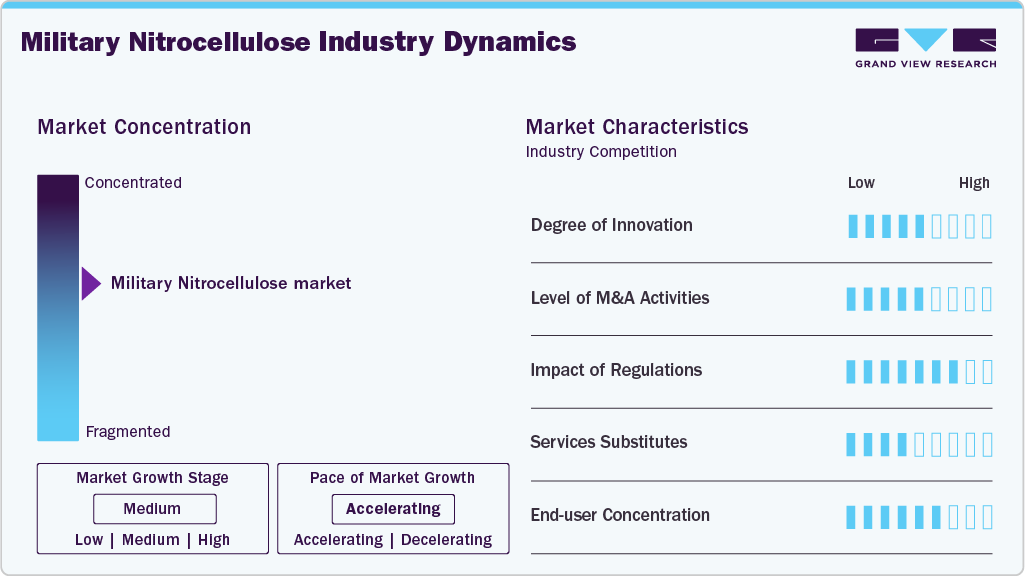
The military nitrocellulose market comprises specialty chemical manufacturers, defense-industry suppliers, integrated propellant producers, and government-linked defense manufacturers serving military ammunition and energetic-material applications. Competitive positioning depends on product purity, nitrogen content, consistency, stability, production capacity, quality assurance, defense certifications, regulatory compliance, supply reliability, and technical capabilities. Companies are focusing on expanding production capacity, strengthening domestic supply chains, improving manufacturing efficiency, and developing nitrocellulose grades suited to different military propellant requirements. The market remains closely linked to the geographic distribution of defense manufacturing and ammunition production, particularly across North America, Europe, Asia Pacific, and selected emerging defense markets. Large international suppliers compete through established defense relationships, manufacturing capabilities, technical expertise, product consistency, and secure supply infrastructure, while regional producers increasingly compete through localized production, government procurement programs, shorter supply chains, and strategic partnerships. Rising demand for ammunition, defense modernization, domestic manufacturing initiatives, and requirements for a reliable supply of energetic materials are expected to intensify competition and encourage continued investment in military nitrocellulose production.
 To learn more about this report, Download Free Sample Report
Leading companies are strengthening their military nitrocellulose capabilities through new product development, production capacity expansion, process optimization, strategic collaborations, and investments in advanced energetic-material technologies. Increasing investments in nitrocellulose quality and consistency, nitrogen-content control, stability, safety, formulation compatibility, and manufacturing efficiency are supporting product differentiation. Companies are also focusing on expanding domestic production capabilities, strengthening secure supply chains, improving process-safety systems, and developing nitrocellulose grades and propellant solutions designed to meet evolving military ammunition and defense requirements.
Analyst Perspective
The military nitrocellulose market is driven by the growing emphasis on efficient textile coloration, consistent shade quality, and improved fabric performance. Rising demand for durable and visually differentiated textiles, increasing use of synthetic and blended fibers, and the expansion of apparel, home textile, technical textile, and industrial fabric production are accelerating the adoption of application-specific dyes and pigments. Advances in dye formulations, pigment dispersion, colorfastness, processing technologies, and digital textile printing are improving coloration efficiency and shade consistency while reducing reprocessing, water consumption, energy use, and chemical requirements. The increasing focus on sustainable textile manufacturing is also spurring the development of lower-impact dyes, concentrated formulations, and coloration technologies designed to meet evolving environmental and regulatory requirements.
Grade Insights
The medium-nitrogen (12.0-12.9% N) segment dominated the military nitrocellulose industry, accounting for 68.5% of total revenue in 2025. Its leading position is supported by its broad suitability for military propellant formulations, where consistent combustion characteristics, stability, and predictable performance are important. Demand remains closely linked to the production and replenishment of ammunition requiring reliable nitrocellulose-based propellant systems. The established manufacturing base and widespread use of medium-nitrogen grades across defense applications further support their dominant market position.
The high-nitrogen (≥13.0% N) segment is expected to grow at the fastest CAGR of 7.3% during the forecast period. Growth is supported by increasing demand for high-performance energetic materials that can provide greater energy content and meet the performance requirements of advanced propellant formulations. Rising investments in ammunition modernization, next-generation defense systems, and higher-performance propulsion technologies are creating additional demand for high-nitrogen grades. Continued development of specialized military propellant formulations is expected to strengthen adoption of these grades over the forecast period.
Propellant Type Insights
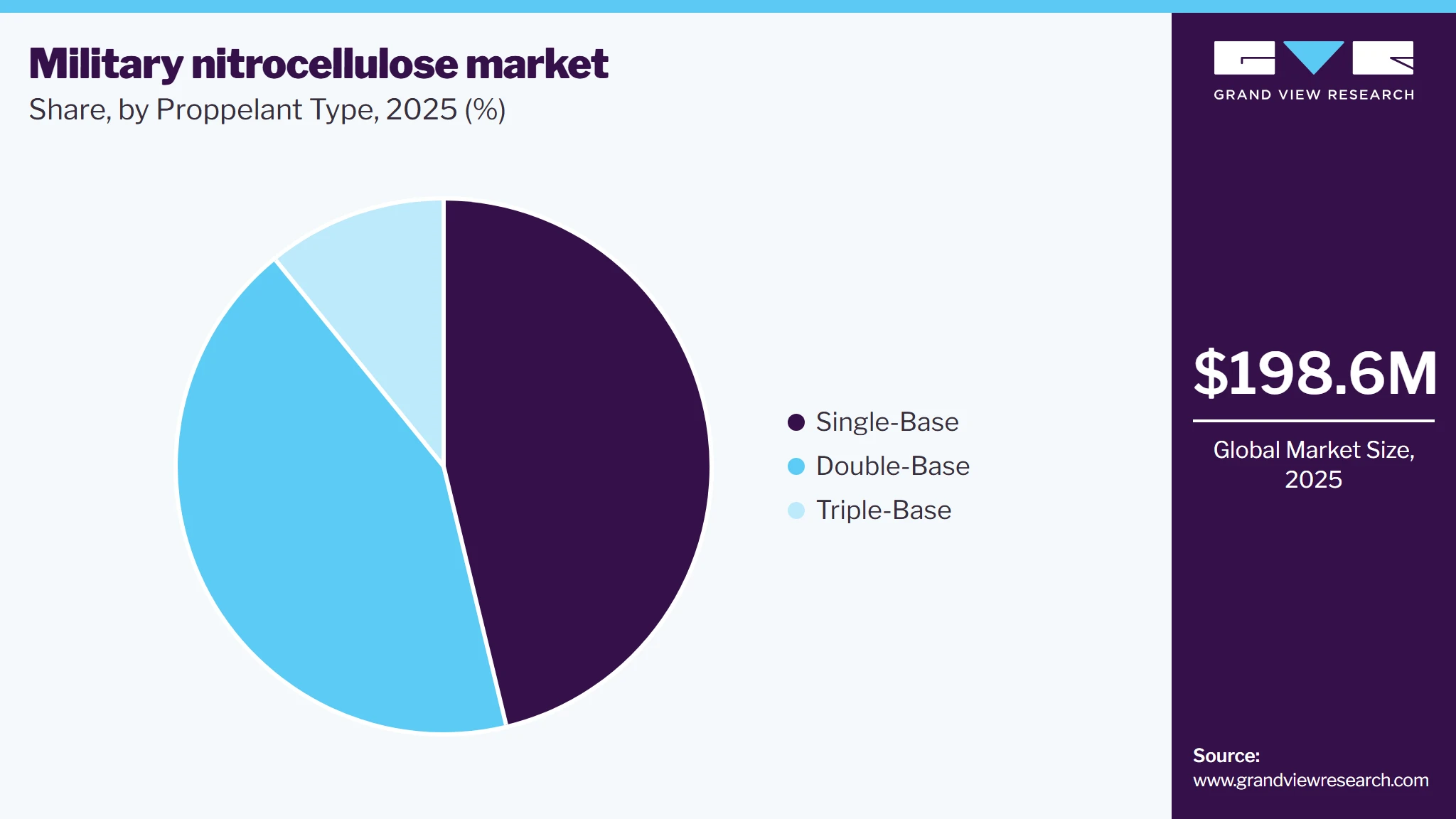
The single-base segment dominated the military nitrocellulose market, accounting for 46.2% of total revenue in 2025. Its strong market position is supported by extensive use in conventional military ammunition and propellant systems where established performance, manufacturing familiarity, and reliable combustion characteristics are important. Single-base propellants primarily rely on nitrocellulose as the energetic component and are widely used across ammunition applications. Continued procurement and replenishment of conventional ammunition, particularly for small-arms and artillery systems, is expected to sustain demand for single-base propellant formulations.
 To learn more about this report, Download Free Sample Report
The double-base segment is expected to grow at a CAGR of 7.5% during the forecast period, supported by increasing demand for propellant systems offering higher energy performance and application-specific ballistic characteristics. Double-base formulations incorporate nitrocellulose alongside an additional energetic component, enabling manufacturers to tailor performance for more demanding military applications. Growing investments in advanced ammunition, propulsion systems, and defense modernization programs are creating opportunities for double-base propellants. Increasing requirements for improved energy output and performance consistency are expected to support the segment's faster growth.
Application Insights
Artillery ammunition dominated the military nitrocellulose industry, accounting for a revenue share of 47.1% in 2025. Growth in defense expenditure, ammunition stock replenishment, modernization of artillery capabilities, and ongoing military procurement programs is supporting consumption in this segment. The increasing focus on maintaining adequate ammunition inventories and strengthening artillery capabilities across major defense markets is also sustaining demand. As artillery systems remain an important component of conventional military operations, their large ammunition requirements continue to make the application a significant contributor to the market growth.
The rocket & missile propulsion is expected to grow at the fastest CAGR of 7.5% during the forecast period. Growth is supported by increasing investments in missile capabilities, rocket systems, precision-strike technologies, and advanced military propulsion programs. Rising defense budgets and the development of next-generation propulsion systems are creating demand for energetic materials with consistent performance and specialized characteristics. Increasing modernization of missile and rocket inventories across major defense markets is expected to further accelerate demand for nitrocellulose-based energetic formulations within this application.
Regional Insights
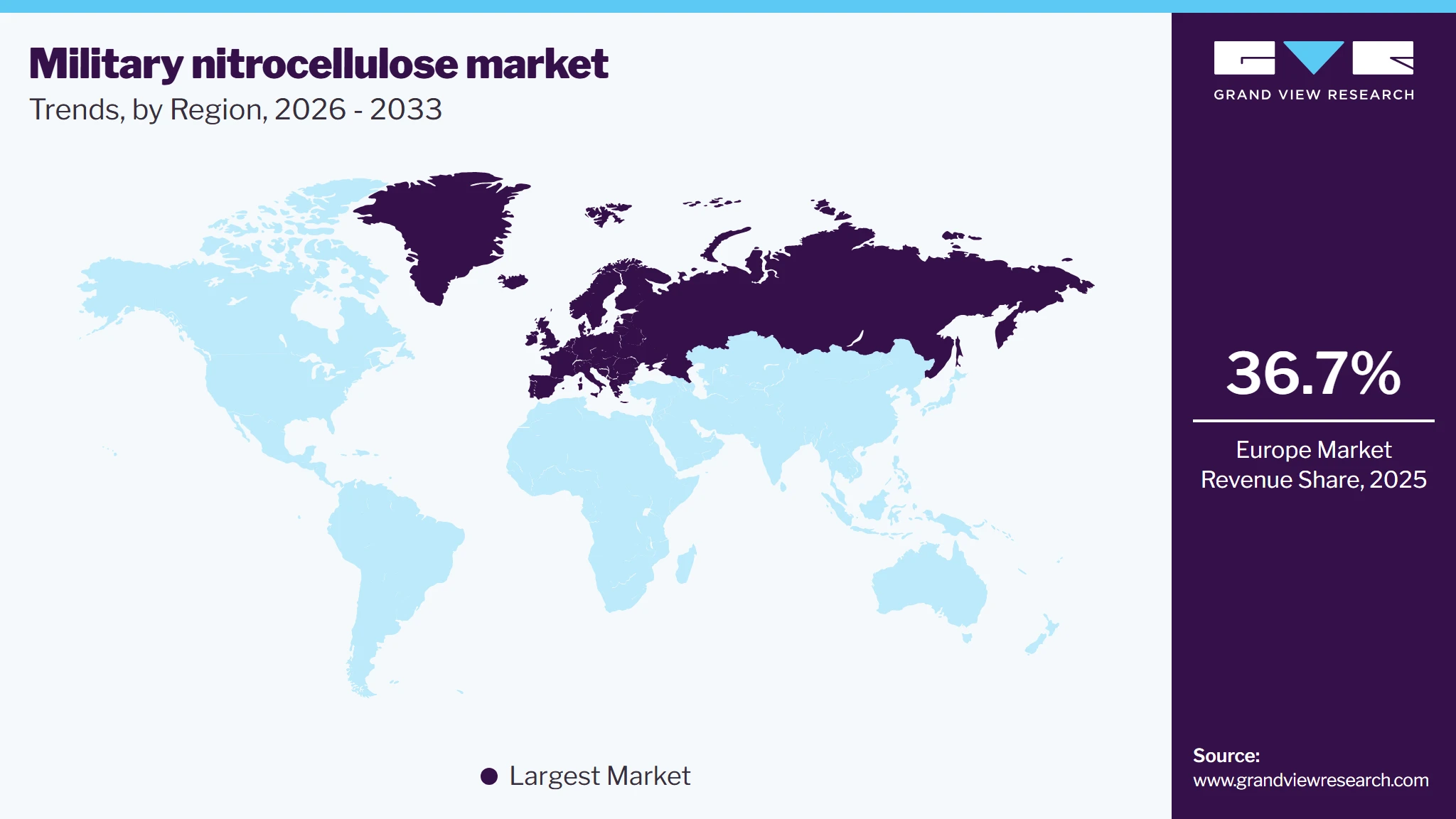
Europe dominated the military nitrocellulose market with a 36.7% revenue share in 2025, and is expected to grow at the fastest CAGR over the forecast period. The market growth is supported by its established defense-industrial base, ammunition manufacturing capabilities, and presence of major energetic-material producers. Increasing defense expenditure, ammunition replenishment requirements, and efforts to strengthen regional production capacity are supporting demand for military-grade nitrocellulose. Rising investments in artillery systems, ammunition stockpiling, and defense modernization are creating sustained requirements for nitrocellulose-based propellant materials. European initiatives to expand domestic ammunition and energetic-material production are also expected to strengthen regional supply chains and market development.
 To learn more about this report, Download Free Sample Report
Germany Military Nitrocellulose Market Trends
The Germany military nitrocellulose market is significant in Europe, supported by its advanced defense manufacturing infrastructure and established ammunition and propellant industry. Increasing defense spending and efforts to expand military capabilities are driving investments across artillery ammunition, small-caliber ammunition, and other defense systems. Growing requirements for ammunition replenishment and domestic production capacity are supporting demand for reliable energetic materials. The presence of established defense and specialty chemical manufacturers further strengthens Germany's position in the regional nitrocellulose supply chain.
Asia Pacific Military Nitrocellulose Market Trends
Asia Pacific is witnessing increasing demand for military nitrocellulose as countries expand defense budgets, modernize armed forces, and strengthen domestic ammunition production capabilities. Rising procurement of artillery systems, small-arms ammunition, rockets, and other military platforms is supporting demand for nitrocellulose-based propellant materials. Governments across the region are also emphasizing defense self-reliance and localization of critical energetic-material supply chains. Expansion of ammunition manufacturing capacity, particularly in major defense-producing economies, is expected to support regional market growth over the forecast period.
The China military nitrocellulose market is major in Asia Pacific, supported by its large defense-industrial base, extensive ammunition manufacturing capabilities, and continued military modernization. Demand is supported by production of small-arms ammunition, artillery systems, rockets, and other defense applications requiring energetic materials and propellant formulations. The country's focus on strengthening domestic production of strategic defense inputs is supporting investments across the energetic-material supply chain. Continued modernization of military equipment and expansion of domestic defense manufacturing are expected to sustain demand for military-grade nitrocellulose.
North America Military Nitrocellulose Market Trends
North America is experiencing steady demand for military nitrocellulose, supported by substantial defense expenditure, ammunition procurement, military stock replenishment, and modernization programs. The region's established defense-industrial ecosystem creates consistent requirements for propellants and energetic materials used in small-arms ammunition, artillery, rockets, and other military systems. Increasing emphasis on strengthening domestic supply chains for critical defense inputs is encouraging investment in local manufacturing capacity. Continued procurement programs and efforts to improve ammunition availability are expected to support regional demand.
The U.S. represents the principal military nitrocellulose industry in North America, supported by its large defense budget, extensive ammunition requirements, and advanced defense manufacturing infrastructure. Increasing procurement of artillery ammunition, small-caliber ammunition, rockets, and other military systems is supporting demand for nitrocellulose-based propellant materials. Efforts to expand and modernize domestic ammunition production are also increasing requirements for secure supplies of critical energetic materials. Continued defense modernization, inventory replenishment, and investments in domestic manufacturing capacity are expected to sustain market growth.
Latin America Military Nitrocellulose Market Trends
Latin America is developing as an emerging market for military nitrocellulose, supported by efforts to modernize defense equipment, maintain ammunition inventories, and strengthen domestic defense manufacturing capabilities. Demand is concentrated around countries with established ammunition and military manufacturing operations, while regional procurement programs provide additional opportunities for energetic-material suppliers. Increasing focus on defense self-sufficiency and modernization of military equipment is supporting demand for locally available propellant inputs. However, comparatively lower defense expenditure and limited manufacturing capacity across several countries continue to constrain the pace of regional market development.
Middle East Military Nitrocellulose Market Trends
The Middle East is witnessing increasing demand for military nitrocellulose as governments raise defense spending, expand ammunition inventories, and invest in advanced military capabilities. Ongoing procurement of artillery systems, rockets, missiles, and small-arms ammunition is creating demand for reliable propellant and energetic-material inputs. Several countries are also pursuing defense localization strategies to reduce dependence on imported military supplies and develop domestic ammunition manufacturing capabilities. Rising investments in defense production infrastructure and regional security requirements are expected to create additional opportunities for military nitrocellulose suppliers.
Key Military Nitrocellulose Company Insights
Companies operating in the military nitrocellulose market are strengthening their competitive positions through product development, production capacity expansion, process optimization, strategic partnerships, and investments in advanced energetic-material technologies. Leading manufacturers are focusing on improving nitrocellulose consistency, nitrogen content control, stability, safety, and compatibility with various propellant formulations, while expanding capabilities to serve small-arms ammunition, artillery ammunition, rocket propulsion, and other defense applications.
-
Rheinmetall AG is a prominent participant in the military energetic materials and ammunition market through its Nitrochemie activities, which focus on propellants, nitrocellulose, and other energetic materials for defense applications. The company supports the development and production of advanced propellant systems designed to deliver consistent ballistic performance, stability, and reliability across military ammunition applications. Rheinmetall is strengthening its competitive position through investments in ammunition and energetic-material production capacity, technology development, and integrated defense manufacturing capabilities, supported by growing demand for artillery ammunition and other military systems.
-
Eurenco is a major European producer of energetic materials, including nitrocellulose and propellant-related products, serving military ammunition and defense applications. The company focuses on developing and manufacturing high-performance energetic materials with controlled properties, consistent quality, and compatibility with different propellant systems. Eurenco is strengthening its market position through investments in production capacity, modernization of manufacturing facilities, and development of advanced energetic-material technologies to support growing demand for ammunition, propellants, and other defense applications across Europe and international markets.
Key Military Nitrocellulose Companies
The following key companies have been profiled for this study of the military nitrocellulose market.
-
Rheinmetall AG
-
Eurenco
-
Nitrochemie
-
Rudraksha Allied Chemicals Pvt. Ltd
-
CSG
-
BAE Systems
-
Synthesia Nitrocellulose
-
TNC Chemicals Philippines Inc.
-
North Chemical Industries Co., Ltd.
-
BORU Defense Industry
Company Categorization
Operating Strategies
Competitive Edge
Weaknesses
Mature Players: Rheinmetall AG, Eurenco, Nitrochemie, BAE Systems, Synthesia Nitrocellulose.
- Invest in advanced energetic-material, propellant, and nitrocellulose production technologies to improve product consistency, stability, safety, and performance.
- Expand production capacity for nitrocellulose, propellants, ammunition, and related energetic materials to address increasing defense procurement and ammunition replenishment requirements.
- Strengthen vertically integrated capabilities across energetic materials, propellant systems, ammunition, and defense platforms to improve supply security and production efficiency.
- Modernize manufacturing facilities and implement advanced process-control, quality-assurance, and safety systems for military-grade materials.
- Pursue long-term contracts, strategic partnerships, and collaborations with defense ministries, ammunition manufacturers, and military customers to strengthen market access and secure demand.
- Established expertise in energetic materials, propellants, ammunition, and military-grade nitrocellulose applications.
- Strong manufacturing infrastructure with specialized production, quality-control, safety, and testing capabilities.
- Established relationships with defense ministries, armed forces, ammunition manufacturers, and other military customers.
- Strong financial and R&D capabilities supporting production expansion, process development, technology upgrades, and new defense programs.
- Established international presence and experience in supplying products that meet stringent military specifications and quality requirements.
- Large-scale production facilities and stringent safety requirements can result in high capital and operating costs.
- Exposure to fluctuations in chemical feedstock, energy, transportation, and specialized production costs can affect manufacturing economics.
- Strict qualification and testing requirements can increase development timelines for new products and production facilities.
- Large organizational structures may limit flexibility in responding rapidly to smaller-volume or highly customized requirements.
- Dependence on government procurement cycles and defense budgets can create fluctuations in order volumes across individual markets.
Emerging Players: Rudraksha Allied Chemicals Pvt. Ltd., CSG, TNC Chemicals Philippines Inc., North Chemical Industries Co., Ltd., BORU Defense Industry
- Expand nitrocellulose and energetic-material production capabilities to address increasing domestic and international defense requirements.
- Focus on establishing reliable local supply of military-grade nitrocellulose and reducing dependence on imported energetic materials.
- Invest in production capacity, process efficiency, quality-control systems, and specialized infrastructure to meet defense-sector specifications.
- Develop application-specific capabilities for ammunition, propellant, rocket, and other military energetic-material applications.
- Strengthen relationships with defense manufacturers, ammunition producers, government procurement agencies, and regional distributors to increase market penetration.
- Greater flexibility in serving regional defense customers and responding to localized procurement requirements.
- Competitive manufacturing economics and proximity to regional defense and ammunition production clusters.
- Ability to benefit from increasing government emphasis on defense localization and domestic production of strategic materials.
- Potential for faster capacity expansion and product customization compared with some large multinational organizations.
- Established regional expertise in chemicals, energetic materials, ammunition, or defense manufacturing provides a foundation for market expansion.
- Smaller international footprint compared with established multinational defense and energetic-material companies.
- More limited financial and R&D resources may constrain large-scale capacity expansion, advanced technology development, and international commercialization.
- Qualification, certification, and customer-approval requirements can create longer commercialization timelines for new suppliers.
- Dependence on regional defense procurement programs and government contracts may create concentration risk.
- Lower international brand recognition and shorter track records in some markets may make it more challenging to secure large, long-term contracts with major global defense manufacturers.
Recent Developments
- In June 2025, Production Capacity Expansion: Czechoslovak Group (CSG) announced plans to establish in-house production of military-grade nitrocellulose at its Walsrode facility in Lower Saxony, Germany, following its acquisition of the former IFF nitrocellulose business. The company planned to retool or expand the facility to produce energetic-grade nitrocellulose within approximately two years, strengthening vertical integration across its artillery ammunition value chain and reducing reliance on external suppliers.
Military Nitrocellulose Market Report Scope
Report Attribute
Details
Market Definition
The military nitrocellulose market comprises dyes and pigments used to impart color, shade consistency, and functional properties to textile fibers, yarns, and fabrics. It covers coloration products used across apparel, home textiles, technical textiles, automotive fabrics, and industrial textile applications.
Market size in 2025
USD 198.6 million
Estimated market size in 2026
USD 212.8 million
Projected market size by 2033
USD 344.6 million
Growth rate
CAGR of 7.1% from 2026 to 2033
Base year for estimation
2025
Historical data
2021 - 2024
Forecast period
2026 - 2033
Quantitative units
Volume in kilotons, revenue in USD million, and CAGR from 2026 to 2033
Report coverage
Revenue forecast, volume forecast, company ranking, competitive landscape, growth factors, and trends
Segments covered
Grade, propellant type, application, region
Country scope
U.S.; Canada; Mexico; Germany; UK; France; Italy; Spain; China; India; Japan; South Korea; Brazil; Argentina; Saudi Arabia; South Africa
Key companies profiled
Rheinmetall AG; Eurenco; Nitrochemie; Rudraksha Allied Chemicals Pvt. Ltd; CSG; BAE Systems; Synthesia Nitrocellulose; TNC Chemicals Philippines Inc.; North Chemical Industries Co., Ltd.; BORU Defense Industry
Customization scope
Free report customization (equivalent up to 8 analysts’ working days) with purchase. Addition or alteration to country, regional & segment scope.
Pricing and purchase options
Avail customized purchase options to meet your exact research needs. Explore purchase options
Global Military Nitrocellulose Market Report Segmentation
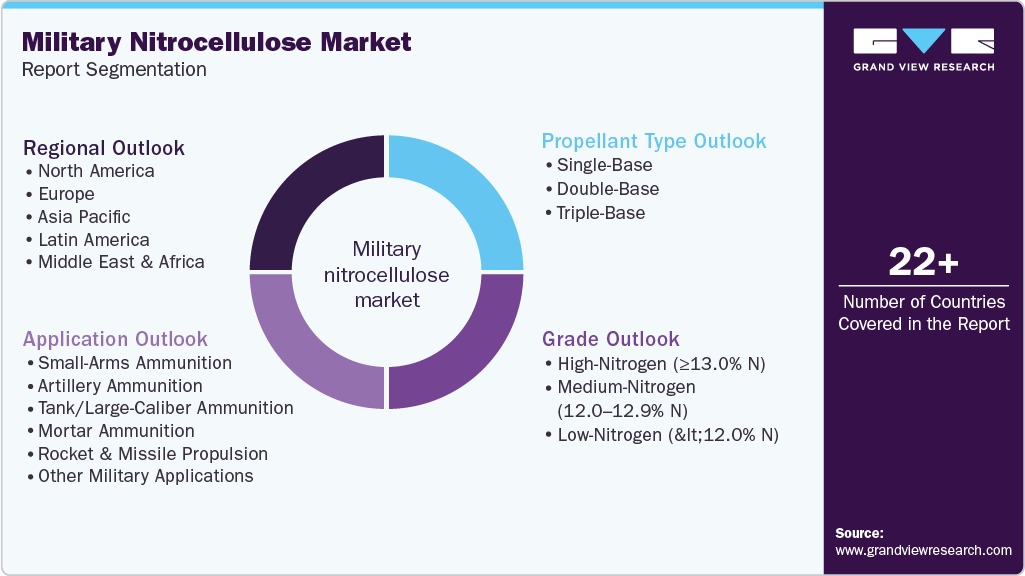
This report forecasts revenue & volume growth at the global, regional & country levels and provides an analysis of the latest industry trends in each of the sub-segments from 2021 to 2033. For this study, Grand View Research has segmented the global military nitrocellulose market report based on grade, propellant type, application, and region:
 To learn more about this report, Download Free Sample Report
-
Grade Outlook (Volume, Kilotons; Revenue, USD Million, 2021 - 2033)
-
High-Nitrogen (≥13.0% N)
-
Medium-Nitrogen (12.0-12.9% N)
-
Low-Nitrogen (<12.0% N)
-
-
Propellant Type Outlook (Volume, Kilotons; Revenue, USD Million, 2021 - 2033)
-
Single-Base
-
Double-Base
-
Triple-Base
-
-
Application Outlook (Volume, Kilotons; Revenue, USD Million, 2021 - 2033)
-
Small-Arms Ammunition
-
Artillery Ammunition
-
Tank/Large-Caliber Ammunition
-
Mortar Ammunition
-
Rocket & Missile Propulsion
-
Other Military Applications
-
-
Regional Outlook (Volume, Kilotons; Revenue, USD Million, 2021 - 2033)
-
North America
-
U.S.
-
Canada
-
Mexico
-
-
Europe
-
Germany
-
UK
-
France
-
Italy
-
Spain
-
-
Asia Pacific
-
China
-
India
-
Japan
-
South Korea
-
-
Latin America
-
Brazil
-
Argentina
-
-
Middle East & Africa
-
Saudi Arabia
-
South Africa
-
-
Research Methodology
The military nitrocellulose market figures in this report are based on a proven research process that combines executive interviews with secondary research from proprietary databases, company filings, and recognized regulatory and institutional sources. Market size is built through value-chain sizing-reconciling supply-side and demand-side estimates-and triangulated with bottom-up and top-down approaches. Every estimate passes multiple levels of expert validation before publication, with each military nitrocellulose segment quantified using the revenue-capture definitions in the table below.
Segment Definition
Segment - Grade
Revenue capture definition
High-Nitrogen (≥13.0% N)
Sales are generated from military-grade nitrocellulose containing nitrogen levels of 13.0% or higher, primarily used where higher energetic performance is required in advanced propellant and military applications. Revenue is supported by demand for high-performance energetic materials used in specialized ammunition and propulsion formulations, where energy output, combustion characteristics, stability, and consistency are important performance requirements.
Medium-Nitrogen (12.0-12.9% N)
Sales are generated from military-grade nitrocellulose with nitrogen content ranging from 12.0% to 12.9%, widely used as an energetic component in conventional propellant formulations. Revenue is supported by demand from small-arms ammunition, artillery ammunition, and other military applications requiring consistent combustion, predictable ballistic performance, storage stability, and compatibility with established propellant systems.
Low-Nitrogen (<12.0% N)
Sales are generated from nitrocellulose with nitrogen content below 12.0%, used in selected military and defense-related formulations where specific material characteristics and controlled energetic performance are required. Revenue is supported by specialized applications requiring particular burning, processing, or formulation properties, although its role in military propellant applications is more limited compared with medium- and high-nitrogen grades.
Segment - Propellant Type
Revenue capture definition
Single-Base
Sales are generated from nitrocellulose used as the primary energetic component in single-base propellant formulations for military ammunition. Revenue is supported by demand for conventional ammunition systems, particularly small-arms and artillery applications, where established propellant technology, consistent combustion, storage stability, and predictable ballistic performance are required.
Double-Base
Revenue is captured from nitrocellulose used in double-base propellant formulations, where nitrocellulose is combined with an additional energetic component to achieve higher energy output and tailored combustion characteristics. Demand is supported by military ammunition and propulsion applications requiring enhanced energetic performance, consistent ballistic characteristics, and application-specific propellant properties.
Triple-Base
Market revenues arise from nitrocellulose incorporated into triple-base propellant formulations, which combine nitrocellulose with additional energetic components to provide specific performance characteristics. Demand is associated primarily with specialized military ammunition applications requiring controlled combustion, reduced flash or signature characteristics, improved ballistic performance, and other formulation-specific requirements.
Segment - Application
Revenue capture definition
Small-Arms Ammunition
Revenue is derived from military-grade nitrocellulose supplied for small-arms propellant formulations used in military and defense ammunition. Demand is supported by large-scale ammunition production, inventory replenishment, military training requirements, and replacement of existing ammunition stocks, with emphasis on consistent combustion, reliable ignition, storage stability, and predictable ballistic performance.
Artillery Ammunition
Market revenues are generated from nitrocellulose used in artillery propellant systems supporting field artillery and large-caliber ammunition. Revenue is supported by increasing artillery ammunition production, defense stock replenishment, modernization programs, and requirements for reliable propellant performance across different artillery systems.
Tank/Large-Caliber Ammunition
Sales are generated from military-grade nitrocellulose incorporated into propellant systems for tank ammunition and other large-caliber weapon systems. Revenue is supported by armored-force modernization, ammunition replenishment, and continued demand for reliable energetic materials capable of providing consistent ballistic performance and stability under demanding military operating and storage conditions.
Mortar Ammunition
Revenue is generated from nitrocellulose supplied for mortar propellant and ammunition systems used by ground forces. Demand is supported by military procurement, ammunition replenishment, training requirements, and modernization of indirect-fire capabilities. Product requirements emphasize consistent combustion, reliable propulsion, and predictable ballistic performance across different mortar ammunition configurations.
Rocket & Missile Propulsion
Market revenues arise from nitrocellulose used in selected rocket and missile propulsion formulations, where it can serve as an energetic component in propellant systems. Demand is supported by investments in rocket and missile capabilities, propulsion-system development, defense modernization, and production of advanced military systems requiring reliable and consistent energetic materials.
Other Military Applications
Sales are generated from military-grade nitrocellulose used in other defense-related energetic-material and propellant applications not specifically classified under small-arms, artillery, tank/large-caliber, mortar, or rocket and missile propulsion. Revenue is supported by specialized military requirements where nitrocellulose provides controlled energetic characteristics, formulation compatibility, and consistent performance.
Estimation Model
Layer Name
Key Question
Description
Raw Material & Production Layer
What forms is the supply base?
Examine the sourcing and production of military-grade nitrocellulose using high-purity cellulose, nitric acid, sulfuric acid, stabilizers, processing chemicals, and other production inputs. The assessment covers cellulose preparation, nitration, washing, stabilization, purification, dewatering, drying, blending, quality control, storage, and production-capacity requirements. It also evaluates developments in nitration technology, process control, product consistency, nitrogen-content management, safety systems, production efficiency, and environmental management that influence product quality, stability, cost, and scalability.
Form Adoption Layer
Where is military nitrocellulose utilized?
Evaluate the adoption of military-grade nitrocellulose across single-base, double-base, and triple-base propellant formulations and its use in small-arms ammunition, artillery ammunition, tank and large-caliber ammunition, mortar ammunition, rocket and missile propulsion, and other military applications. Demand is influenced by requirements for consistent combustion, energy output, storage stability, ballistic performance, formulation compatibility, and reliability. Increasing ammunition production, defense modernization, military stock replenishment, and expansion of domestic propellant manufacturing are contributing to broader adoption of military-grade nitrocellulose.
Consumption Intensity Layer
How much military nitrocellulose is consumed?
Assess consumption based on ammunition production volumes, propellant loading requirements, caliber, weapon-system type, propulsion requirements, and nitrocellulose content within different propellant formulations. The analysis considers production of small-arms, artillery, tank, large-caliber, and mortar ammunition, along with selected rocket and missile propulsion systems. It also evaluates propellant formulation characteristics, consumption per ammunition unit, production intensity, military stock replenishment, procurement programs, and changes in ammunition manufacturing volumes to estimate annual nitrocellulose consumption across major defense markets.
Revenue Layer
How is market revenue generated?
Market revenue is generated through the manufacture and sale of military-grade nitrocellulose supplied for propellant and energetic-material applications across small-arms ammunition, artillery ammunition, tank and large-caliber ammunition, mortar ammunition, rocket and missile propulsion, and other military applications. Revenue growth is supported by increasing defense expenditure, ammunition replenishment programs, military modernization, expansion of domestic ammunition and propellant production, and investments in secure energetic-material supply chains. Demand for higher-performance nitrocellulose grades, specialized propellant formulations, and reliable domestic supply is also contributing to market revenue growth.
Delivered Customizations
This report has been delivered with the following In-depth customizations
Client Request
Customization Delivered
Value Adds
Cross-segmentation
The assessment provides detailed cross-segmentation of the military nitrocellulose market across grade, propellant type, application, and geography. Grade-level analysis covers High-Nitrogen (≥13.0% N), Medium-Nitrogen (12.0-12.9% N), and Low-Nitrogen (<12.0% N) grades. Propellant Type analysis covers Single-Base, Double-Base, and Triple-Base formulations, while application-level assessment includes Small-Arms Ammunition, Artillery Ammunition, Tank/Large-Caliber Ammunition, Mortar Ammunition, Rocket & Missile Propulsion, and Other Military Applications.
Enables identification of high-growth opportunities across specific grade-propellant type-application combinations. Supports product development, capacity planning, production optimization, market-entry, and supply-chain strategies by highlighting applications requiring specific nitrogen content, combustion characteristics, stability, ballistic performance, and formulation compatibility.
Opportunity Assessment
Detailed evaluation of growth opportunities arising from increasing defense expenditure, ammunition replenishment, military modernization, expansion of domestic ammunition production, defense localization, and demand for secure energetic-material supply chains. The assessment covers opportunities associated with higher-performance nitrocellulose grades, advanced propellant formulations, domestic production capacity, process optimization, and application-specific energetic-material requirements for ammunition and propulsion systems.
Enables identification of attractive investment opportunities across the military nitrocellulose value chain. Supports decisions related to capacity expansion, technology investments, domestic manufacturing, strategic partnerships, regional market entry, and product development by highlighting defense procurement programs, ammunition production requirements, localization initiatives, and evolving propellant-performance requirements.
Competitive Benchmarking
Comparative assessment of leading military nitrocellulose manufacturers and defense-industry participants based on product portfolio, nitrogen-content capabilities, manufacturing capacity, energetic-material expertise, production technology, quality-control systems, defense certifications, geographic presence, R&D capabilities, supply reliability, strategic partnerships, and customer relationships. The benchmarking evaluates product consistency, stability, formulation compatibility, production scalability, safety systems, process efficiency, application coverage, and ability to meet military and defense procurement requirements.
Supports benchmarking against key competitors while identifying opportunities to strengthen product differentiation, improve coloration performance, optimize manufacturing efficiency, expand distribution Supports benchmarking against key competitors while identifying opportunities to strengthen product differentiation, production efficiency, capacity, quality assurance, supply reliability, and technical capabilities. The analysis assists strategic decisions concerning R&D investment, manufacturing expansion, process modernization, vertical integration, defense partnerships, localization initiatives, and long-term positioning in the military nitrocellulose market, and develop application-specific dye and pigment solutions. The analysis assists strategic decisions concerning R&D investment, portfolio expansion, manufacturing capabilities, technology adoption, sustainability initiatives, partnerships, and long-term positioning in the military nitrocellulose market.
Frequently Asked Questions About This Report
The military nitrocellulose market size was estimated at USD 198.6 million in 2025 and is expected to reach USD 212.8 million in 2026.
The military nitrocellulose market is expected to grow at a compound annual growth rate of 7.1% from 2026 to 2033 to reach USD 344.6 million by 2033.
The medium-nitrogen grade (12.0–12.9% N) segment dominated the military nitrocellulose market, accounting for 68.5% of revenue in 2025. Its leading position is supported by extensive use in conventional military propellant formulations, where consistent combustion, predictable ballistic performance, storage stability, and formulation compatibility are required across small-arms, artillery, mortar, and other ammunition applications.
Key players include Rheinmetall AG, Eurenco, Nitrochemie, Rudraksha Allied Chemicals Pvt. Ltd., CSG, BAE Systems, Synthesia Nitrocellulose, TNC Chemicals Philippines Inc., North Chemical Industries Co., Ltd., and BORU Defense Industry. These companies compete through energetic-material expertise, production capacity, product consistency, nitrogen-content control, manufacturing technology, quality and safety systems, defense-industry relationships, geographic presence, and investments in domestic supply capabilities.
Growth is supported by increasing demand for high-performance military propellants, ammunition replenishment, defense modernization, and expansion of domestic ammunition manufacturing. Demand for consistent chemical composition, controlled combustion, storage stability, formulation compatibility, and reliable energetic-material supply is also encouraging investments in nitrocellulose production capacity, process control, and advanced propellant technologies.
Europe dominated the global military nitrocellulose market, accounting for 36.7% of revenue in 2025. The region benefits from an established defense-industrial base, significant ammunition and propellant manufacturing capabilities, established energetic-material producers, increasing defense spending, and ongoing investments in ammunition replenishment and domestic production capacity.
Rocket & missile propulsion is expected to grow at the fastest CAGR of 7.5% from 2026 to 2033.
The single-base propellant segment dominated the military nitrocellulose market, capturing 46.2% of revenue in 2025. Its leading position is supported by established use in conventional military ammunition, particularly small-arms and artillery applications, where predictable combustion, ballistic consistency, storage stability, and proven formulation characteristics are required.
About the Author(s)
Performance Chemicals Research Team
Specialty & Fine Chemicals · Performance ChemicalsThis report was authored by the performance chemicals research team at Grand View Research - comprising two research analysts, one senior research analyst, and one industry expert - with specialized expertise in the performance chemicals segment of the specialty & fine chemicals industry. All findings are based on proprietary specialty & fine chemicals databases, executive interviews, and regulatory analysis, subject to internal peer review prior to publication.
Last Updated:
Speak to Analyst

Customize this report to your needs - add regions, segments, or data points, with 20% free customization.
Or view our licence options:


ISO 9001:2015 & 27001:2022 Certified
We are GDPR and CCPA compliant! Your transaction & personal information is safe and secure. For more details, please read our privacy policy.


