
- Home
- »
- Advanced Interior Materials
- »
-
Milling Machine Market Size, Share, Global Industry Report, 2019-2025GVR Report cover

Milling Machine Market (2019 - 2025) Size, Share & Trends Analysis Report By Type (Horizontal Milling Machine, Vertical Milling Machines), By End Use, By Region, And Segment Forecasts
Report Overview
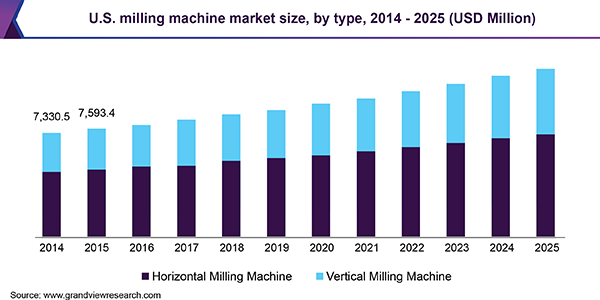
The global milling machine market size was valued at USD 63,156.5 million in 2018 and is expected to register a CAGR of 7.0% from 2019 to 2025. Milling machines are some of the most important machines used in metal cutting applications across several industries. The promising expansion of the global metalworking industry and a notable rise in metalworking facilities globally have triggered the demand for these machines in recent years.
 Source: Grand View Research, IR Documents, Primary Interviews, Paid DatabasesTo learn more about this report,
 Download Free Sample Report
 Milling machines are highly versatile and can perform a plethora of functions including fillet making, turning, chamfering, drilling, facing, gear cutting, and slot cutting. These machines can also be used for performing multiple cuts simultaneously by installing multiple cutters. Various other tools, such as rounding mills, fluted mills, and ball end mills, can also be integrated into these machines. These advantages make milling machines ideal for machining metal parts required in industries such as automotive and defense & aerospace.
Milling machines are widely used to drill, bore, cut gears, and produce slots. Various milling machine manufacturers are adopting the CNC technology to enhance the productivity and quality of the work performed by milling machines by using the same tools and program to produce multiple parts. Automation and multi-axis machining are some of the most prominent trends in the market. Moreover, companies are using software programs to control the axis, spindle speeds, and tool changes in milling machines, thereby reducing the need for manual intervention.
Integration of CAM and CAD software into CNC machines provides additional benefits such as reducing the machining time and enabling a smooth workflow. The inception of compact machine tools that occupy minimum floor space is particularly gaining traction within the industrial manufacturing sector.
Adoption of five-sided machining with the aim of reducing set-up time is another major trend in the market.However, the significant costs associated with the installation and maintenance of advanced machine tools and a looming lack of adequately skilled workforce holding expertise in operating complex machine tools are expected to restrain the growth of the market over the forecast period. To overcome these challenges, numerous companies are spending on R&D to minimize the maintenance cost by implementing automated diagnostic solutions.
Market Dynamics
The increasing need for high-precision machining and automated manufacturing processes across industries such as automotive, aerospace, defense, electronics, heavy machinery, and medical devices is a major factor driving the milling machine market. Milling machines play a critical role in producing complex metal and composite components with high dimensional accuracy, surface finish quality, and production efficiency. As industries continue to adopt advanced manufacturing techniques and tighter product tolerances, demand for CNC milling machines and multi-axis machining systems is rising significantly.
In the automotive and aerospace sectors, growing production of lightweight components, electric vehicle parts, turbine systems, and precision-engineered structures is accelerating the adoption of advanced milling technologies. The rising implementation of Industry 4.0 and smart factory concepts is also encouraging manufacturers to integrate CNC milling machines with automation systems, robotics, IoT-enabled monitoring, and digital process controls to improve productivity and reduce operational downtime.
Despite strong industrial demand, the milling machine market faces challenges related to high equipment costs and the requirement for skilled technical operators. Advanced CNC milling machines, multi-axis machining centers, and automated manufacturing systems involve substantial upfront investment in machinery, software integration, tooling systems, and maintenance infrastructure. Small and medium-sized manufacturers, particularly in developing regions, often face financial barriers in adopting high-end milling technologies due to limited capital availability. Additionally, operating modern milling machines requires skilled machinists and programmers with expertise in CNC programming, tooling selection, machine calibration, and process optimization. The shortage of trained technical personnel in several industrial regions can limit production efficiency and delay technology adoption.
Type Insights
On the basis of type, the milling machine market has been segmented into horizontal milling machines and vertical milling machines. The horizontal milling machines segment dominated the market in 2018 owing to the growing popularity and users’ preference for horizontal milling machines. Horizontal mills offer better chip evacuation, thereby delivering a more refined surface finish and an extended tool life. They can also execute more complicated parts with fewer operations. In a horizontal mill, the spindle points horizontally, thereby helping in ensuring a greater spindle uptime. Moreover, horizontal milling machines are particularly preferred owing to their ability to perform the work of three or more vertical mills.
Nevertheless, the vertical milling machines segment accounted for a considerable share of the market in the said year, owing to features such as high visibility, affordable costs, ease of use, and high accuracy. These mills are mainly used for drilling and plunging cuts and are available in a wide range of specifications depending on different end uses.
End-Use Insights
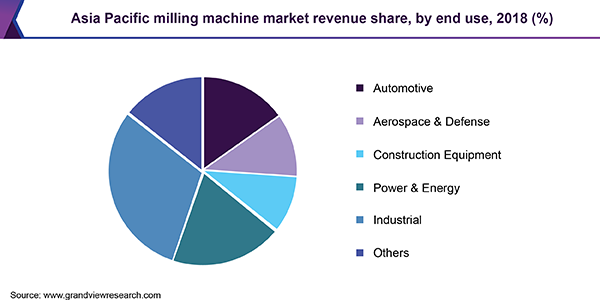
On the basis of end-use, the market has been segmented into automotive, aerospace & defense, construction equipment, power & energy, industrial, and others. The industrial segment dominated the market in 2018 owing to the extensive use of horizontal milling machines for result-driven operations. The growing demand for the mass production of a variety of goods such as consumer electronics, automobiles, and household appliances is also expected to drive the growth of the industrial segment.
 To learn more about this report, Download Free Sample Report
 The automotive segment is expected to register the highest CAGR over the forecast period in line with the rising preference of OEMs to metal parts with precise cuts. The power & energy segment also accounted for a significant share in 2018. The demand for drilling rigs continues to increase as oil & gas exploration companies across the globe embark upon new drilling projects. At the same time, power companies continue to invest in new technologies such as wind power in line with the growing emphasis on renewable energy. The specific components required for these steadily expanding application areas are machined using high-precision machine tools, which is expected to drive the demand for milling machines in the power sector in the near future.
Regional Insights
Asia Pacific dominated the market in 2018 owing to the rising adoption of metal cutting processes in the region. Given that Asia Pacific is home to some of the key market companies in the milling machine industry, it is anticipated to continue dominating the global market over the forecast period. Government initiatives such as the Government of India’s ‘Make in India’ and ‘Skill India’ are also expected to drive the demand for machine tools in the region.
Europe accounted for a substantial share in 2018 owing to an aggressive adoption of milling machines by the automotive manufacturers in the region. While Europe is home to several automotive manufacturers, multi-tasking machines are also being adopted by companies in the rail industry in some European countries, such as Germany, France, and the U.K. The growth of the regional market can also be attributed to the growing energy sector and the subsequent growth in demand for parts such as turbines and motors, which need to be machined with using high-precision tools.
Key Companies & Market Share Insights
Some of the key vendors active in the market are AMADA CO., LTD.; Amera Seiki; DATRON Dynamics, Inc.; DMG MORI CO., LTD.; Haas Automation, Inc.; FANUC CORPORATION; Okuma Corporation; Shenyang Machine Tool Co., Ltd.; Hurco Companies, Inc.; Dalian Machine Tool Group Corporation (DMTG); and Yamazaki Mazak Corporation; among others. These industry participants are trying to gain a competitive edge over their rivals by launching innovative products. For instance, Okuma Corporation of Japan introduced MU-8000V LASER EX, a new multitasking machining center that employs the laser metal deposition technology to deliver unique cutting abilities in many different shapes and sizes.
Market players are also adopting different strategies such as mergers & acquisitions, partnerships, and collaborations to expand their product portfolios. Prominent players are particularly emphasizing on collaborating with companies offering advanced systems and components in order to integrate cutting-edge technologies into their products. For instance, in April 2017, Dalian Machine Tool Group Corporation of China and Gazdevice of Russia established a joint venture in Russia in Moskovskaya Oblast for manufacturing high-precision machine tools.
Competitive Benchmarking
Operating Strategies
Competitive Edge
Weaknesses
Mature Players: DMG MORI, Yamazaki Mazak Corporation, Haas Automation, Inc., Okuma Corporation, Makino Milling Machine Co., Ltd., FANUC Corporation, Hurco Companies, Inc.
- Expansion of high-speed and precision milling solutions for automotive, aerospace, medical, and industrial applications
- Integration of Industry 4.0, IoT-enabled monitoring, robotics, and AI-assisted machining systems
- Extensive global sales, technical support, and aftermarket service networks
- Strong global brand recognition and advanced machining expertise
- High precision, operational reliability, and automation capabilities
- Established customer base across aerospace, automotive, defense, and precision engineering sectors
- Strong R&D capabilities and diversified machining portfolios
- High equipment and software integration costs
- Dependence on industrial capital expenditure and manufacturing investment cycles
- Complex operation, maintenance, and programming requirements
- Increasing competition from low-cost Asian machine tool manufacturers
Emerging Players: Kent USA, SYIL Machine Tools Co. Ltd., Datron Dynamics, Inc., EMCO GmbH
- Expansion into small and medium-sized manufacturing sectors and regional industrial markets
- Increasing emphasis on compact, energy-efficient, and user-friendly milling systems
- Strengthening distributor partnerships and localized technical support capabilities
- Competitive pricing and flexibility in customized milling machine configurations
- Strong responsiveness to localized manufacturing requirements
- Growing adoption in job shops, tool rooms, educational institutions, and mid-sized manufacturing facilities
- Comparatively lower global market penetration and brand visibility
- Limited financial scale for large R&D and international expansion investments
- Lower technological diversification compared to multinational machine tool providers
Milling Machine Market Report Scope
Report Attribute
Details
Market size value in 2020
USD 71.6 billion
Revenue forecast in 2025
USD 100.9 billion
Growth Rate
CAGR of 7.0% from 2019 to 2025
Base year for estimation
2018
Historical data
2014 - 2017
Forecast period
2019 - 2025
Quantitative units
Revenue in USD billion and CAGR from 2019 to 2025
Report coverage
Revenue forecast, company ranking, competitive landscape, growth factors, and trends
Segments covered
Type, end use, and region.
Regional scope
North America; Europe; Asia Pacific; South America; Middle East & Africa
Country scope
U.S.; Canada; Germany; Italy; France; India; Japan; China; Brazil; Mexico.
Key companies profiled
AMADA CO., LTD.; Amera Seiki; DATRON Dynamics, Inc.; DMG MORI CO., LTD.; Haas Automation, Inc.; FANUC CORPORATION; Okuma Corporation; Shenyang Machine Tool Co., Ltd.; Hurco Companies, Inc.; Dalian Machine Tool Group Corporation (DMTG); and Yamazaki Mazak Corporation..
Customization scope
Free report customization (equivalent up to 8 analysts’ working days) with purchase. Addition or alteration to country, regional & segment scope.
Pricing and purchase options
Avail customized purchase options to meet your exact research needs. Explore purchase options
Segments covered in the report
This report forecasts revenue growth at global, regional, and country levels and provides an analysis of the latest industry trends in each of the sub-segments from 2014 to 2025. For the purpose of this study, Grand View Research has segmented the global milling machine market report based on type, end-use, and region.
-
Type Outlook (Revenue, USD Million, 2014 - 2025)
-
Horizontal Milling Machines
-
Vertical Milling Machines
-
-
End-Use Outlook (Revenue, USD Million, 2014 - 2025)
-
Automotive
-
Aerospace & Defense
-
Construction Equipment
-
Power & Energy
-
Industrial
-
Others
-
-
Region Outlook (Revenue, USD Million, 2014 - 2025)
-
North America
-
U.S.
-
Canada
-
-
Europe
-
Germany
-
Italy
-
France
-
-
Asia Pacific
-
China
-
India
-
Japan
-
-
Latin America
-
Mexico
-
-
MEA
-
Delivered Customizations
This report has been delivered with the following In-depth customizations
Client Request
Customization Delivered
Value Adds
Regional Segmentation
Detailed market estimates and forecasts for the milling machine market across North America, Europe, Asia Pacific, Latin America, and Middle East & Africa. Country-level demand analysis covering automotive, aerospace, defense, electronics, medical devices, heavy engineering, and industrial manufacturing sectors.
Identify high-growth regional markets and advanced manufacturing investment hotspots. Support regional expansion planning, distributor network optimization, and demand forecasting. Enable benchmarking of industrial automation and precision machining trends across regions.
Market Share & Competitive Positioning
Comprehensive analysis of market share by leading milling machine manufacturers, including revenue share, technological leadership, regional dominance, automation capabilities, and competitive intensity within the Milling Machine Market.
Enable evaluation of market concentration and competitive landscape. Support acquisition targeting, market entry planning, and strategic positioning.
Trade Assessment
Analysis of import-export trends, trade flows, tariff structures, and supply chain dynamics associated with milling machines.
Support supply chain optimization and sourcing strategy development. Identify trade dependencies, localization opportunities, and potential supply chain risks.
About the Author(s)
Advanced Interior Materials Research Team
Advanced Materials · Advanced Interior MaterialsThis report was authored by the advanced interior materials research team at Grand View Research - comprising two research analysts, one senior research analyst, and one industry expert - with specialized expertise in the advanced interior materials segment of the advanced materials industry. All findings are based on proprietary advanced materials databases, executive interviews, and regulatory analysis, subject to internal peer review prior to publication.
Last Updated:
Speak to Analyst

Customize this report to your needs - add regions, segments, or data points, with 20% free customization.
Or view our licence options:


ISO 9001:2015 & 27001:2022 Certified
We are GDPR and CCPA compliant! Your transaction & personal information is safe and secure. For more details, please read our privacy policy.


