
- Home
- »
- Advanced Interior Materials
- »
-
Mine Ventilation Systems Market Size Report, 2026-2033GVR Report cover
![Mine Ventilation Systems Market (2026 - 2033)Report]()
Mine Ventilation Systems Market (2026 - 2033)
Size, Share & Trends Analysis Report By Mining Technique (Underground Mining, Surface Mining), By System Type (Primary Ventilation, Auxiliary Ventilation), By Component, By Region, And Segment Forecasts
Market Size, 2025
$1.3BMarket Estimate, 2026
$1.4BMarket Forecast, 2033
$2.0BCAGR, 2026–2033
5.6%Mine Ventilation Systems Market Summary
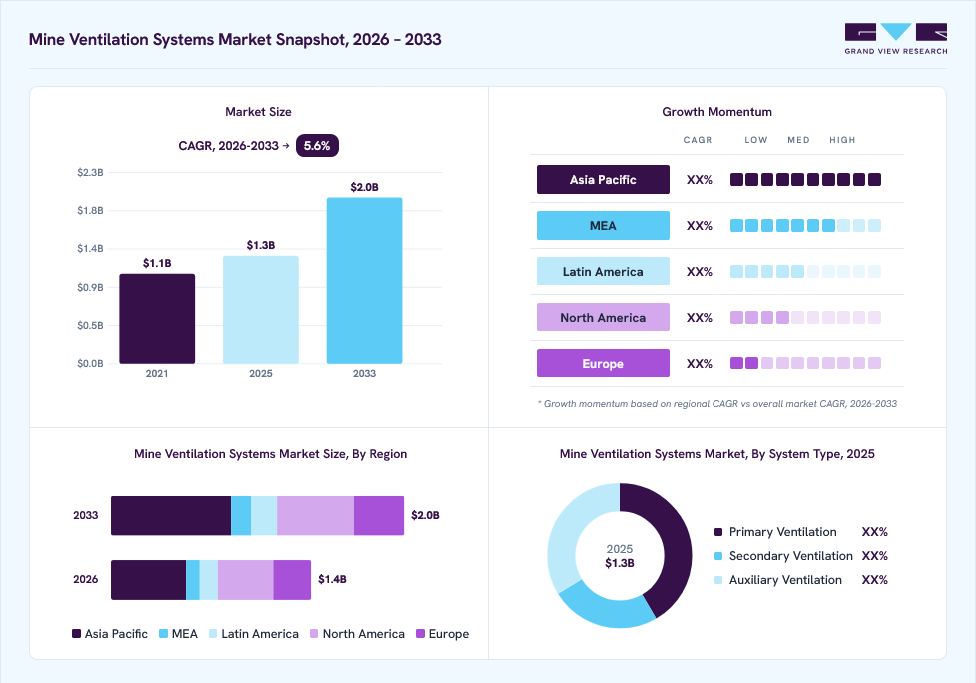
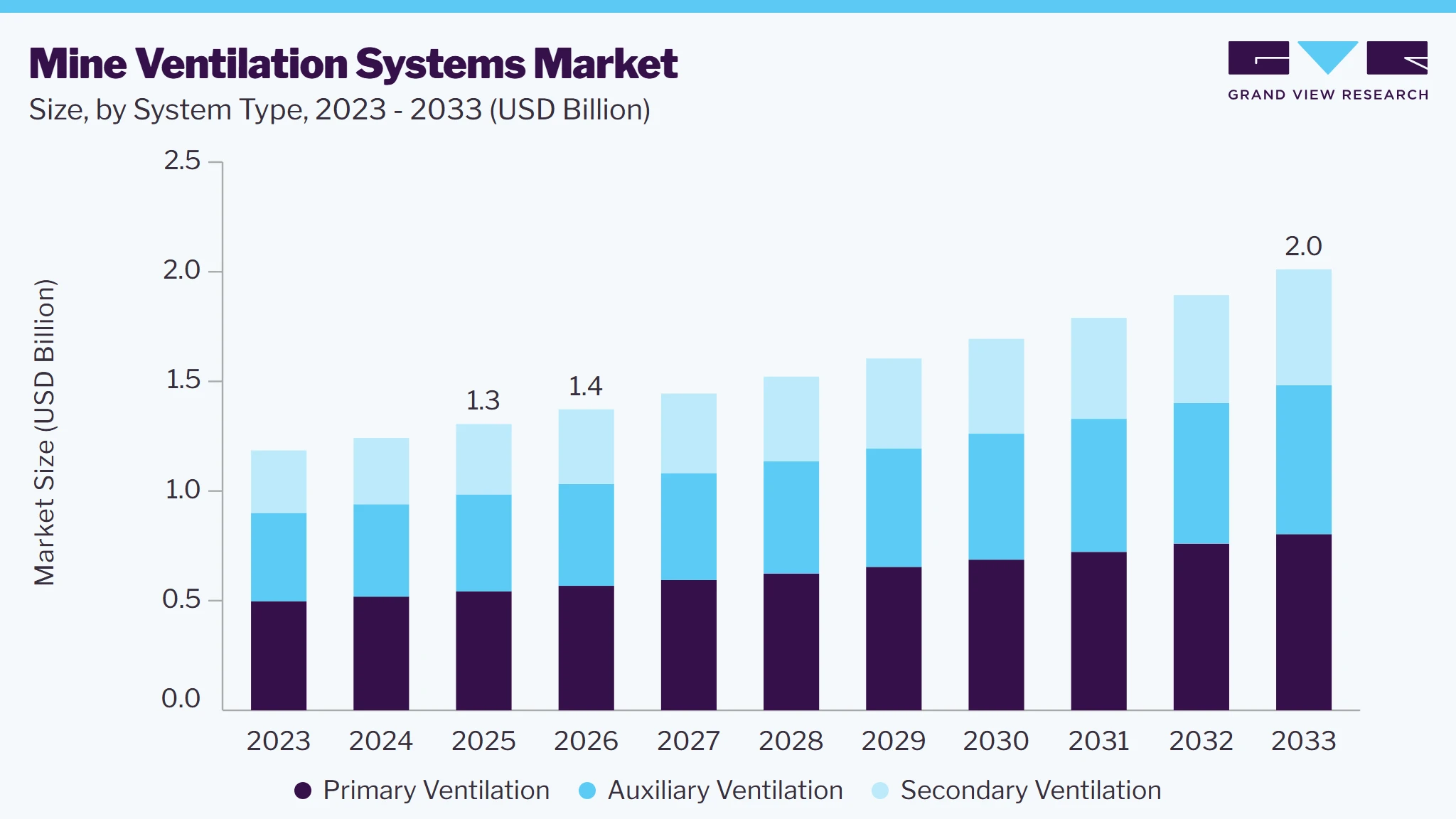
The global mine ventilation systems market size was valued at USD 1.3 billion in 2025 and is projected to grow from USD 1.4 billion in 2026 to USD 2.0 billion by 2033, at a CAGR of 5.6% from 2026 to 2033. Asia Pacific dominated the market, accounting for a revenue share of 37.1% in 2025. The industry is driven by the expansion and deepening of underground mining operations, where increasing mine depth intensifies heat, dust, diesel emissions, methane, and other air-quality challenges.
Key Market Trends & Insights
- By mining technique: Underground Mining segment held the largest market share of 82.6% in 2025.
- By system type: Primary ventilation segment dominated the market in 2025, accounting for 41.6% market share.
- By component: Fans & blowers dominated the market, with a revenue share of 49.3% in 2025.
Regional Highlights
- Largest regional market: Asia Pacific (37.1% revenue share, 2025)
- By country: China held the largest market share in 2025.
Market Size & Forecast
- Market Size in 2025: USD 1.3 Billion
- Estimated Market Size in 2026: USD 1.4 Billion
- Projected Market Size by 2033: USD 2.0 Billion
- CAGR (2026-2033): 5.6%
These conditions require continuous airflow management and are creating demand for primary and auxiliary fans, ventilation ducts, cooling equipment, and monitoring systems capable of maintaining safe working environments. Technology adoption is strengthening demand for automated and energy-efficient ventilation systems. Mining companies are integrating real-time gas and airflow sensors, variable-speed fan controls, digital monitoring, and ventilation-on-demand systems that adjust airflow to active work areas and changing mine conditions. This approach can reduce unnecessary fan operation and ventilation energy consumption while preserving required air quality and worker protection.Market Dynamics
The industry is shaped by the increasing technical requirements of underground mining, where ventilation infrastructure is essential for managing air quality, heat, dust, hazardous gases, and diesel emissions while maintaining safe operating conditions. As mining operations extend to greater depths and become more mechanized, ventilation networks are becoming more sophisticated, incorporating high-capacity fans, auxiliary ventilation, monitoring equipment, and automated airflow controls. Regulatory requirements concerning occupational exposure and mine safety continue to influence system specifications, while energy consumption is encouraging operators to optimize airflow rather than rely solely on fixed-capacity ventilation.
Expansion of underground extraction for coal, metals, and critical minerals is strengthening demand for mine ventilation systems as deeper and more complex workings require controlled airflow over larger distances. Greater mine depth increases thermal loads and the need to manage contaminants generated by blasting, diesel-powered equipment, and mineral handling, creating requirements for more capable primary and auxiliary ventilation infrastructure.
High capital expenditure and lifecycle operating costs remain significant constraints, particularly for mines requiring extensive networks of fans, ducting, shafts, cooling equipment, sensors, and control infrastructure. Ventilation can also represent a substantial share of mine electricity consumption, making energy-intensive systems increasingly difficult to justify where power costs are high or operating margins are constrained. Retrofitting older mines presents further challenges because new automated equipment and digital controls may require modifications to existing infrastructure, system integration, and specialized technical expertise.
The transition toward smart ventilation and Ventilation-on-Demand (VOD) systems presents significant opportunities for equipment manufacturers and technology providers. Real-time airflow, gas, temperature, pressure, equipment location, and personnel data can be used to adjust fan operation and airflow distribution according to actual underground activity, creating scope for lower energy consumption and more responsive environmental control.
Market Concentration & Characteristics
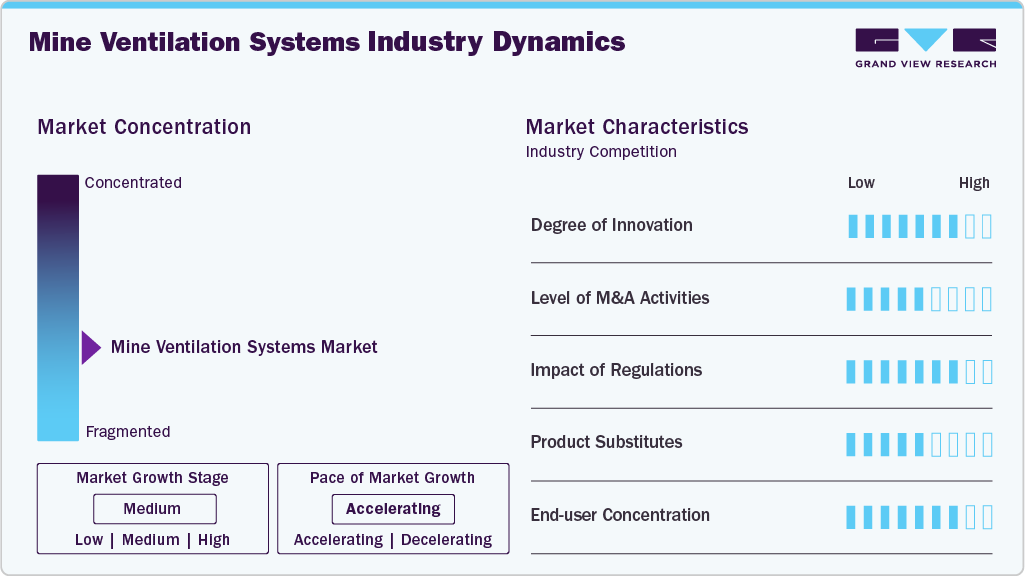
The industry exhibits a moderately concentrated competitive structure, with established international suppliers holding strong positions in large-scale underground mining projects while regional manufacturers serve localized and mid-sized requirements. Competition spans specialized ventilation equipment manufacturers, automation providers, and engineering firms, with technical expertise, installed base, service coverage, and project execution capabilities influencing supplier selection. This structure creates a diversified competitive environment while maintaining strong positions for suppliers with broad technical and service capabilities.
Competition is centered on system reliability, airflow performance, energy efficiency, regulatory compliance, and the ability to integrate ventilation equipment with broader mine automation infrastructure. Fans and blowers remain the core equipment category, while monitoring and control systems are becoming increasingly important as operators seek real-time visibility over airflow, gas levels, temperature, and ventilation demand. Suppliers with capabilities spanning equipment, controls, engineering, commissioning, and aftermarket support hold an advantage in complex underground projects where ventilation systems require site-specific design and long-term maintenance.
The industry is characterized by high technical and operational requirements, substantial project-specific customization, and long equipment service lives. Purchasing decisions are influenced less by upfront equipment cost alone and more by lifecycle performance, energy consumption, safety compliance, reliability, and maintenance requirements. Demand also varies by mine depth, geology, production intensity, and mine type, resulting in differentiated requirements for primary ventilation, auxiliary systems, cooling, heating, and digital airflow management. The shift toward ventilation-on-demand and sensor-enabled systems is further changing the market from conventional standalone equipment supply toward integrated, data-driven ventilation solutions.
Analyst Perspective
The industry is moving toward a more performance-oriented procurement environment in which system reliability, airflow adaptability, energy intensity, and lifecycle support are becoming increasingly important alongside initial equipment specifications. Demand is likely to favor suppliers capable of delivering integrated solutions that combine ventilation hardware, control architecture, engineering services, commissioning, and aftermarket support rather than isolated components. Modernization of existing underground mines offers a substantial commercial pathway, as operators can upgrade fans, controls, monitoring infrastructure, and network components without developing entirely new ventilation systems.
Mining Technique Insights
The underground mining segment held the largest revenue share of 82.6% in 2025, reflecting the substantially greater ventilation requirements associated with enclosed and interconnected mine workings. Underground operations require dedicated airflow pathways to supply fresh air and manage heat, dust, fumes, and hazardous gases across active production areas, shafts, and development zones. The scale and complexity of these networks also create sustained requirements for primary and auxiliary ventilation equipment, making underground operations the principal revenue-generating application for mine ventilation systems.
The surface mining segment is projected to register the fastest CAGR during the forecast period, supported by increasing requirements for controlled air quality, dust suppression, and environmental management across large open-pit and surface extraction sites. Although ventilation needs differ from enclosed underground workings, expanding mine footprints and stricter controls on airborne particulates and emissions are encouraging greater use of localized airflow and air-management solutions.
System Type Insights
The primary ventilation segment held the largest revenue share in 2025, reflecting its central role in establishing the main airflow network across mining operations. These systems are responsible for circulating fresh air through principal mine passages while directing contaminated air toward exhaust routes, supporting environmental control across extensive operating areas. Their deployment across shafts, main airways, and production zones sustains demand for high-capacity fans and associated ventilation infrastructure.
The secondary ventilation segment is projected to register the fastest CAGR of 6.4% during the forecast period, driven by the need for localized airflow management in development headings, production faces, and other areas where primary airflow does not provide sufficient coverage. The flexibility of secondary systems enables mine operators to adapt ventilation arrangements as working areas expand, contract, or shift, supporting their application in dynamic underground environments. Demand is further influenced by the need to maintain suitable air conditions across temporary and newly developed work zones.
Component Insights
The fans & blowers segment held the largest revenue share of 49.3% in 2025, reflecting their essential function in generating and maintaining the airflow required across mine ventilation networks. Their deployment spans primary and auxiliary ventilation applications, with equipment selection influenced by airflow capacity, pressure requirements, operating conditions, and efficiency characteristics.
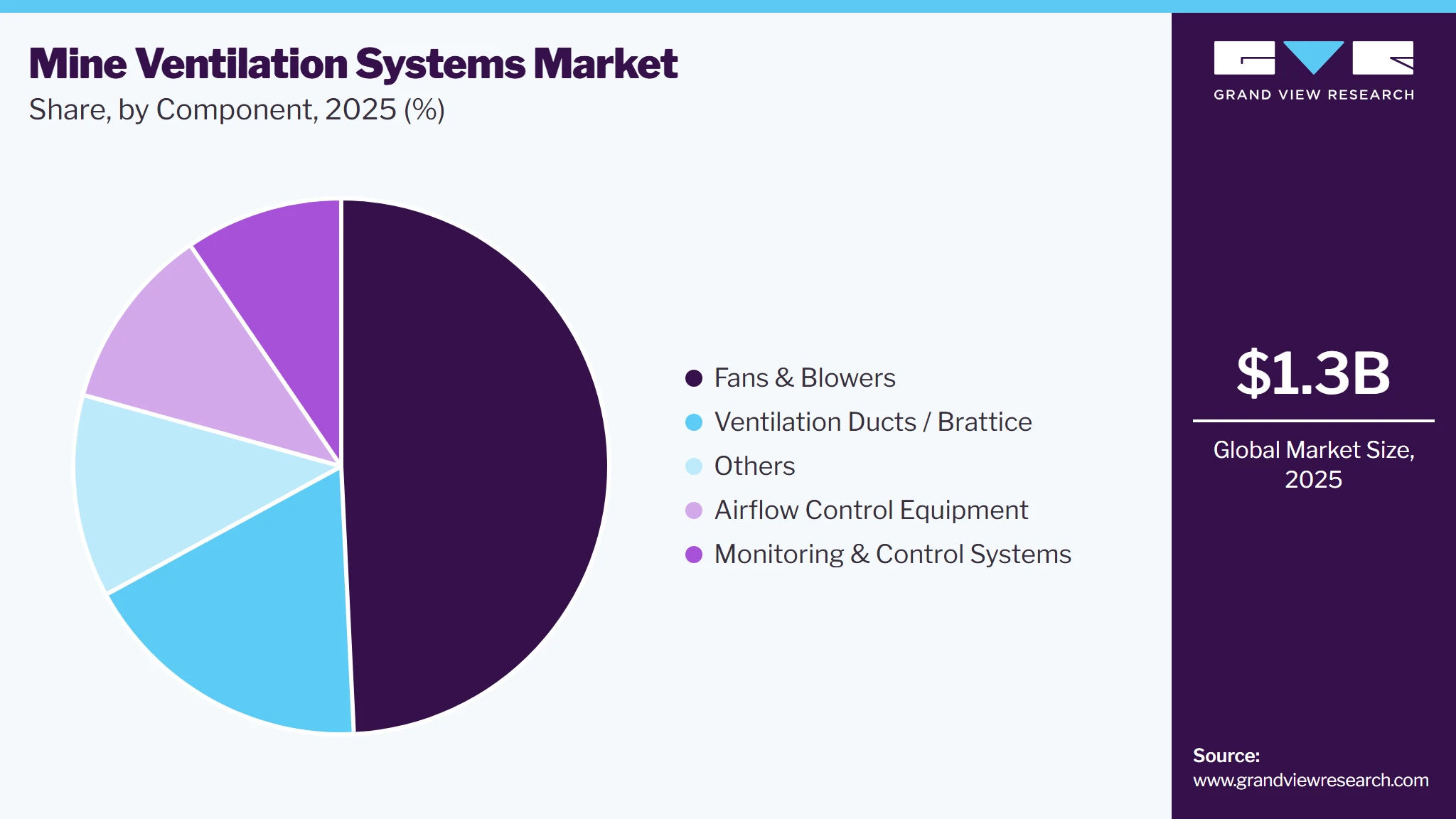
The ventilation ducts/brattice segment is projected to register the fastest CAGR during the forecast period, driven by increasing requirements for flexible air delivery in developing and changing mine sections. These components enable airflow to be directed toward localized work areas where fixed ventilation infrastructure may have limited reach, making them particularly relevant for advancing headings and temporary operating zones. Their relatively adaptable deployment supports ventilation network extensions and modifications as mine layouts evolve.
Regional Insights
The Asia Pacific mine ventilation systems market held the largest revenue share of 37.1% in 2025 and is also expected to grow at the fastest CAGR over the forecast period. The region represents the broadest demand base for mine ventilation systems, reflecting the region’s concentration of coal, iron ore, base metals, and emerging critical-mineral projects. Market requirements vary considerably by mine maturity, with established producers prioritizing network refurbishment while newer developments incorporate digitally managed airflow from the design stage. Procurement is also influenced by the region’s large installed equipment base, localized manufacturing capabilities, and expanding mine-safety programs. China and India form the principal country-level demand centers, while Australia contributes sophisticated requirements associated with deep hard-rock mining.

The China mine ventilation systems market has a substantial share because of its extensive underground coal and metal mining activity. Recent regulatory initiatives are placing greater emphasis on ventilation capacity, continuous measurement, independent airflow networks, and intelligent ventilation practices, creating a favorable environment for equipment replacement and system modernization. The development of dedicated national technical requirements for metal and non-metal mines also indicates continued institutional focus on standardized ventilation design, inspection, and evaluation.
The mine ventilation systems market in India offers a growth-oriented demand environment as coal remains central to the country’s power and industrial supply chain while underground mining modernization progresses. Opportunities are concentrated in projects requiring improved auxiliary air delivery, mine monitoring, and refurbishment of older ventilation arrangements. Procurement is likely to favor equipment that can operate reliably under variable underground conditions while remaining practical for large public-sector and commercial mining fleets, giving suppliers opportunities in both replacement projects and new mine development.
North America Mine Ventilation Systems Market Trends
The mine ventilation systems market in North America is characterized by a mature installed base and a comparatively high level of technical sophistication in mine airflow management. The market is increasingly influenced by critical mineral development, underground metal production, and efforts to improve the economics of existing ventilation networks. Rather than relying solely on capacity additions, operators are evaluating instrumentation, variable-speed operation, network simulation, and targeted upgrades that improve the utilization of installed infrastructure. Regulatory oversight and industrial hygiene requirements reinforce the need for dependable, measurable ventilation performance.
U.S. Mine Ventilation Systems Market Trends
The mine ventilation systems market in the U.S. is anchored by coal and metal mining operations and a well-established framework for controlling underground air quality and worker exposure. Demand opportunities extend beyond new equipment to replacement of aging fan installations, airflow measurement, diesel particulate management, and engineering services for mine ventilation assessments. Adoption of automated controls can help operators align ventilation output with production schedules and equipment activity, making controls and monitoring a growing area alongside conventional mechanical equipment.
The Canada mine ventilation systems market presents a distinct opportunity profile centered on underground gold, nickel, copper, potash, and other mineral developments. New critical-mineral projects are broadening the investment pipeline, particularly where deeper workings and extensive development drives require carefully engineered air distribution. The country’s mining environment also favors lifecycle-oriented solutions, with operators placing value on reliability, maintainability, energy performance, and ventilation planning that can accommodate mine expansion over long operating periods.
Europe Mine Ventilation Systems Market Trends
The mine ventilation systems market in Europe is a mature but technically demanding sector where ventilation expenditure is increasingly linked to resource efficiency, environmental performance, and modernization of established mining assets. The region’s strategic interest in domestic mineral supply is creating selective opportunities for underground mine development, while decarbonization objectives encourage operators to scrutinize the electricity burden of air movement. Demand therefore leans toward efficient equipment, sophisticated engineering, and monitoring capabilities capable of demonstrating performance improvements within constrained mine footprints.
The Germany mine ventilation systems market is shaped by its advanced engineering base and the transformation of its conventional mining sector. Demand is more selective than in large coal-producing economies, with emphasis placed on technically specialized applications, refurbishment, and engineered solutions for underground works and mineral extraction. High expectations for equipment reliability and energy performance favor suppliers able to combine mechanical design with precise control, diagnostics, and engineering support rather than competing primarily on equipment volume.
The mine ventilation systems market in France offers a specialized market in which mine ventilation requirements intersect with worker protection, environmental engineering, underground construction, and research-led airflow management. Demand is likely to be concentrated in technically complex applications where modeling, measurement, and contaminant control are important to system design. This creates scope for engineering-intensive solutions, advanced instrumentation, and consulting services that optimize air distribution rather than relying solely on higher fan capacity.
Middle East & Africa Mine Ventilation Systems Market Trends
The mine ventilation systems market in the Middle East & Africa presents a project-driven market with substantial variation between established mining economies and developing mineral-producing countries. Africa provides the stronger mining-related demand base, particularly across precious metals and other mineral operations where deep or geographically dispersed workings create specialized ventilation requirements. In the Middle East, new mineral-development programs are expanding the addressable market for engineered mine infrastructure.
The Saudi Arabia mine ventilation systems market is developing a broader mining ecosystem as resource diversification increases investment in gold, phosphate, bauxite, copper, and other mineral assets. The country’s emerging projects create opportunities for ventilation suppliers at the mine-design and infrastructure-development stages, where system capacity can be incorporated into new operating layouts rather than retrofitted later
Latin America Mine Ventilation Systems Market Trends
The mine ventilation systems market in Latin America remains an important market because of its concentration of copper, gold, silver, lithium, and polymetallic resources. The region’s distinctive operating conditions, including high-altitude mines, long access routes, and increasingly complex underground geometries, create demand for engineered airflow distribution and auxiliary systems.
The Brazil mine ventilation systems market is supported by its large mining industry and broad resource endowment, with iron ore forming the foundation of the sector while interest in copper, nickel, lithium, and rare earth resources expands the longer-term opportunity set. Ventilation requirements vary by mining method, meaning demand is not limited to conventional underground systems but also extends to enclosed workings and specialized applications.
Key Mine Ventilation Systems Companies Insights
Some of the key players operating in the mine ventilation system market include TLT-Turbo and Howden, among others.
-
TLT-Turbo is a Germany-based ventilation technology manufacturer with more than 160 years of experience in fan and ventilation engineering. The company has a strong focus on mine ventilation, offering axial and centrifugal fan systems, modular mining fans, auxiliary and booster fans, and customized ventilation solutions for underground and surface mining operations. Its mine ventilation portfolio emphasizes aerodynamic optimization, variable-pitch and intelligent drive technologies, energy efficiency, noise reduction, and reliable operation under demanding conditions.
-
Howden is a global engineering company with more than a century of experience in mine ventilation and is part of Chart Industries. Its mine ventilation portfolio includes axial, centrifugal, and mixed-flow fans for underground and surface applications, along with auxiliary ventilation equipment and integrated Total Mine Ventilation Solutions. The company combines ventilation equipment with engineering, airflow modeling through Ventsim software, control and monitoring solutions, mine cooling and heating systems, installation, commissioning, and aftermarket services.
Key Mine Ventilation Systems Companies
The following key companies have been profiled for this study on the mine ventilation systems market :
-
TLT-Turbo
-
Howden
-
Zitrón
-
Epiroc
-
Clemcorp Australia
-
ABC Industries
-
Twin City Fan & Blower
-
New York Blower (NYB)
-
ZVVZ GROUP
-
AMZ Ventprom
-
FanTR
-
Maya Fan
-
Shanxi Jinyun’an Fan
-
Korfmann Lufttechnik
-
CFT GmbH Compact Filter Technic
Competitive Benchmarking
Category
Operating Strategies
Competitive Edge
Weakness
Established Players (e.g., TLT-Turbo; Howden; Zitrón; Epiroc; Clemcorp Australia; Twin City Fan & Blower)
- Develop broad mine ventilation portfolios covering primary, auxiliary, booster, axial, and centrifugal fans for underground and surface mining applications.
- Invest in aerodynamic optimization, energy-efficient designs, variable-speed technologies, mine-specific engineering, commissioning, upgrades, and lifecycle maintenance.
- Strong expertise in mine airflow management, high-capacity fan engineering, and demanding underground operating conditions.
Established mining relationships, broad technical capabilities, and extensive engineering and aftermarket support strengthen their position in complex ventilation projects.
- High engineering, manufacturing, testing, installation, and maintenance costs for large-capacity mine ventilation equipment.
- Customized fan specifications and complex underground installations can increase project costs and execution requirements.
Emerging & Regional Players (e.g., ABC Industries; New York Blower (NYB); ZVVZ GROUP; AMZ Ventprom; FanTR; Maya Fan; Shanxi Jinyun'an Fan; Korfmann Lufttechnik; CFT GmbH Compact Filter Technic)
- Focus on mine-specific primary, auxiliary, booster, axial, and centrifugal ventilation fans tailored to airflow, pressure, installation, and operating requirements.
- Compete through application-specific engineering, regional manufacturing, customized configurations, responsive technical support, and replacement or maintenance services.
- Greater flexibility in configuring ventilation equipment for individual mine conditions and project specifications.
- Regional proximity and specialized fan-manufacturing capabilities enable responsive solutions for localized mining requirements.
- More limited international sales, service, and installation networks than established multinational suppliers.
- Smaller production and engineering capacities can constrain participation in large, multi-location projects requiring extensive commissioning and long-term service support.
Recent Developments
-
In December 2025, TLT-Turbo Africa launched its SMART Fan for underground mining, introducing an intelligent ventilation solution designed to automatically adjust airflow in response to changing mine conditions. The system integrates a variable-speed drive, programmable logic controller, and sensor inputs to regulate airflow while compensating for changes in resistance, leakage, and air density. The technology is designed to improve ventilation reliability and worker safety while reducing unnecessary energy consumption compared with conventional fixed-speed auxiliary fans. The company introduced a demonstration version at launch and planned full-scale production and deliveries from the first quarter of 2026.
-
In January 2025, Minetek launched its Raptor Series of underground ventilation fans specifically for hard-rock and metalliferous mining operations. The series includes primary, secondary, and booster fan configurations designed to deliver high airflow with improved energy efficiency, quieter operation, and a compact footprint suitable for space-constrained underground environments. The Raptor Series also incorporates Minetek’s Performance on Demand technology, enabling real-time adjustment of airflow, pressure, and power consumption according to changing mine ventilation requirements.
Global Mine Ventilation Systems Market Report Scope
Report Attribute
Details
Market size in 2025
USD 1.3 billion
Estimated market size in 2026
USD 1.4 billion
Projected market size by 2033
USD 2.0 billion
Growth rate
CAGR of 5.6% from 2026 to 2033
Base year for estimation
2025
Historical data
2021 - 2024
Forecast period
2026 - 2033
Quantitative units
Revenue in USD billion and CAGR from 2026 to 2033
Report coverage
Revenue forecast, company market position analysis, competitive landscape, growth factors, and trends
Segments covered
Mining technique, system type, component, region
Regional scope
North America; Europe; Asia Pacific; Latin America; Middle East & Africa
Country scope
U.S.; Canada; Mexico; Germany; UK; Italy; Spain; France; China; Japan; India; Australia; South Korea; Brazil; Argentina; Saudi Arabia; UAE; South Africa
Key companies profiled
TLT-Turbo; Howden; Zitrón; Epiroc; Clemcorp Australia; ABC Industries; Twin City Fan & Blower; New York Blower (NYB); ZVVZ GROUP; AMZ Ventprom; FanTR; Maya Fan; Shanxi Jinyun’an Fan; Korfmann Lufttechnik; CFT GmbH Compact Filter Technic
Customization scope
Free report customization (equivalent up to 8 analysts working days) with purchase. Addition or alteration to country, regional & segment scope.
Pricing and purchase options
Avail customized purchase options to meet your exact research needs. Explore purchase options
Global Mine Ventilation Systems Market Report Segmentation
This report forecasts revenue growth at global, regional & country levels and provides an analysis of the industry trends in each of the sub-segments from 2021 to 2033. For this study, Grand View Research has segmented the global mine ventilation systems market report on the basis of mining technique, system type, component, and region:
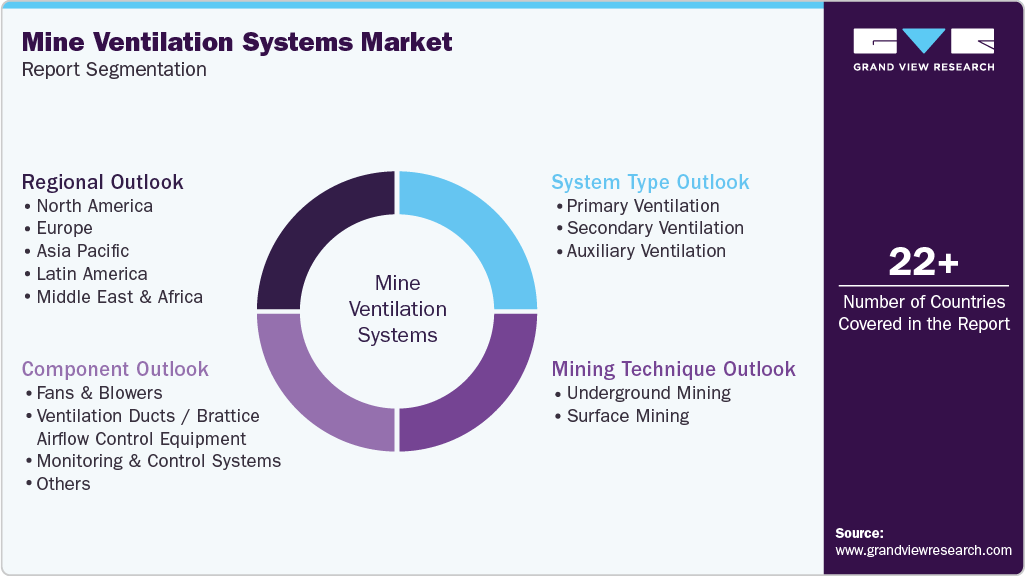
-
Mining Technique Outlook (Revenue, USD Billion, 2021 - 2033)
-
Underground Mining
-
Surface Mining
-
-
System Type Outlook (Revenue, USD Billion, 2021 - 2033)
-
Primary Ventilation
-
Secondary Ventilation
-
Auxiliary Ventilation
-
-
Component Outlook (Revenue, USD Billion, 2021 - 2033)
-
Fans & Blowers
-
Ventilation Ducts / Brattice
-
Airflow Control Equipment
-
Monitoring & Control Systems
-
Others
-
-
Regional Outlook (Revenue, USD Billion, 2021 - 2033)
-
North America
-
U.S.
-
Canada
-
Mexico
-
-
Europe
-
Germany
-
France
-
UK
-
Spain
-
Italy
-
-
Asia Pacific
-
China
-
India
-
Japan
-
South Korea
-
Australia
-
-
Latin America
-
Brazil
-
Argentina
-
-
Middle East & Africa
-
Saudi Arabia
-
UAE
-
South Africa
-
-
Research Methodology
The mining ventilation system market figures in this report are based on a proven research process that combines executive interviews with secondary research from proprietary databases, company filings, and recognized regulatory and institutional sources. Market size is built through value-chain sizing-reconciling supply-side and demand-side estimates-and triangulated with bottom-up and top-down approaches. Every estimate passes multiple levels of expert validation before publication, with each mining ventilation system segment quantified using the revenue-capture definitions in the table below.
Segment Definition
Mining Technique
Revenue Capture Definition
Underground Mining
Revenue generated from the sale of mine ventilation systems and equipment engineered for underground mining operations, including fans, ducting, airflow-control equipment, and monitoring systems.
Surface Mining
Revenue generated from the sale of mine ventilation systems and equipment configured for surface mining operations, including fans, blowers, ducting, airflow-control equipment, and monitoring systems.
System Type
Revenue Capture Definition
Primary Ventilation
Revenue generated from the sale of primary ventilation systems, including main fans, booster fans, fan stations, and associated ventilation controls that establish the principal airflow circuit.
Secondary Ventilation
Revenue generated from the sale of secondary ventilation equipment and systems that supplement primary airflow through dedicated fans, ducting, and airflow-management components.
Auxiliary Ventilation
Revenue generated from the sale of auxiliary ventilation equipment, including auxiliary fans, air movers, ventilation ducts, and associated components for localized airflow management.
Component
Revenue Capture Definition
Fans & Blowers
Revenue generated from the sale of mine-specific axial, centrifugal, primary, booster, and auxiliary fans and blowers, including integrated fan assemblies.
Ventilation Ducts / Brattice
Revenue generated from the sale of flexible and rigid ventilation ducts, brattice, duct sections, connectors, hangers, and related air-distribution products.
Airflow Control Equipment
Revenue generated from the sale of regulators, dampers, ventilation doors, louvers, airlocks, and other equipment used to control and regulate mine airflow.
Monitoring & Control Systems
Revenue generated from the sale of ventilation monitoring and control systems, including airflow and pressure sensors, environmental monitoring devices, fan controls, automation systems, and ventilation-on-demand solutions.
Others
Revenue generated from the sale of ancillary mine ventilation products, including silencers, diffusers, transitions, fan accessories, installation components, and other specialized equipment.
Estimation Model
Layer Name
Key Question
Description
Mining Demand Layer
Where is mine ventilation equipment required?
Assess demand across underground and surface mining operations by evaluating active mine numbers, new mine development, mine depth, production capacity, underground development, and ventilation requirements. This establishes the addressable requirement for mine ventilation systems and equipment.
Ventilation Infrastructure Investment Layer
Where is new and replacement ventilation demand being created?
Evaluate investments in new mines, mine expansions, shaft and underground development, ventilation-system upgrades, fan replacements, retrofits, and modernization projects. Assess replacement cycles, energy-efficiency initiatives, ventilation automation, and regulatory requirements to determine equipment procurement demand.
Segment Adoption Layer
How is ventilation equipment demand distributed across market segments?
Analyze demand across mining technique, system type, and component. Assess underground and surface mining requirements; primary, secondary, and auxiliary ventilation systems; and fans & blowers, ventilation ducts/brattice, airflow-control equipment, monitoring & control systems, and other components according to airflow capacity, pressure requirements, mine configuration, operating conditions, and replacement needs.
Revenue Generation Layer
How much revenue is generated from ventilation equipment sales?
Estimate annual sales of mine ventilation systems and equipment by mining technique, system type, component, and region. Convert equipment volumes and project demand into revenue using equipment-specific pricing, fan capacity, system configuration, project value, replacement requirements, and contract size.
Delivered Customizations
This report has been delivered with the following In-depth customizations
Client Request
Customization Delivered
Value Adds
Competitive Benchmarking
Benchmarked core mine ventilation manufacturers across primary, secondary, and auxiliary ventilation systems, fan and blower configurations, airflow and pressure capacity, energy-efficiency technologies, airflow control, monitoring and automation, engineering capabilities, aftermarket services, and market positioning.
Enabled stakeholders to compare supplier capabilities, technology differentiation, product breadth, customization, innovation, service capabilities, and competitive positioning.
Regional Segmentation
Assessed mine ventilation demand across major regions based on underground and surface mining activity, new mine development, mine expansion, mine depth, ventilation infrastructure investment, equipment replacement, modernization, and regulatory requirements.
Helped stakeholders identify high-potential regions, evaluate new and replacement equipment demand, prioritize geographic expansion, and align product portfolios with regional mining and ventilation requirements.
Opportunity Assessment
Evaluated opportunities across new mine development, underground expansion, ventilation-system upgrades, fan replacement, energy-efficient ventilation, ventilation-on-demand, automated airflow management, monitoring systems, and retrofit projects.
Supported identification of attractive equipment and technology opportunities, emerging procurement requirements, investment priorities, and product development strategies aligned with mine safety, energy efficiency, and ventilation performance.
Frequently Asked Questions About This Report
The global mine ventilation systems market size was valued at USD 1.3 billion in 2025 and is estimated at USD 1.4 billion for 2026.
The global mine ventilation systems market is expected to grow at a CAGR of 5.6% from 2026 to 2033, reaching USD 2.0 billion by 2033.
Asia Pacific dominated the global market with a revenue share of 37.1% in 2025.
The underground mining segment held the largest revenue share of 82.6% in 2025 while surface mining segment is fastest growing market.
The primary ventilation segment held the largest revenue share of 41.6% in 2025, reflecting its central role in establishing the main airflow network across mining operations.
Fans & blowers dominated the market, with a revenue share of 49.3% in 2025 while ventilation ducts/brattice segment is expected to be the fastest-growing market.
Key factors increasing underground mining activity, deeper and more complex mine operations, stricter safety requirements, and the need for energy-efficient ventilation are driving the mine ventilation systems market. Adoption of automated controls, sensors, and digital monitoring is also supporting market growth.
Key players include TLT-Turbo; Howden; Zitrón; Epiroc; Clemcorp Australia; ABC Industries; Twin City Fan & Blower; New York Blower (NYB); ZVVZ GROUP; AMZ Ventprom; FanTR; Maya Fan; Shanxi Jinyun’an Fan; Korfmann Lufttechnik; CFT GmbH Compact Filter Technic
About the Author(s)
Advanced Interior Materials Research Team
Advanced Materials · Advanced Interior MaterialsThis report was authored by the advanced interior materials research team at Grand View Research - comprising two research analysts, one senior research analyst, and one industry expert - with specialized expertise in the advanced interior materials segment of the advanced materials industry. All findings are based on proprietary advanced materials databases, executive interviews, and regulatory analysis, subject to internal peer review prior to publication.
Last Updated:
Speak to Analyst


Customize this report to your needs — add regions, segments, or data points, with 20% free customization.
Or view our licence options:


ISO 9001:2015 & 27001:2022 Certified
We are GDPR and CCPA compliant! Your transaction & personal information is safe and secure. For more details, please read our privacy policy.


