
- Home
- »
- Advanced Interior Materials
- »
-
Iron Ore Market Size, Share And Trends Report, 2026-2033GVR Report cover

Iron Ore Market (2026 - 2033)
Size, Share & Trends Analysis Report By Type (Fines, Pellets, Lumps), By End Use (Steel Industry, Others), By Region (North America, Europe, Asia Pacific, Latin America, Middle East & Africa), And Segment Forecasts
Market Size, 2025
$257.1BMarket Estimate, 2026
$264.1BMarket Forecast, 2033
$362.2BCAGR, 2026–2033
4.6%Iron Ore Market Summary
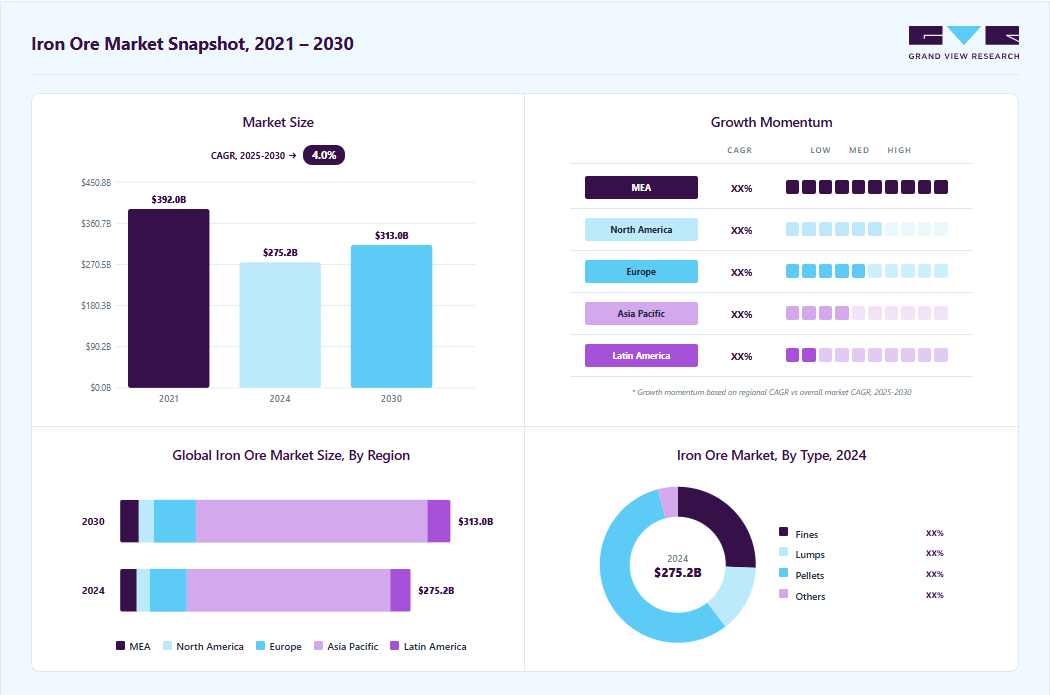
The iron ore market size was valued at USD 257.1 billion in 2025 and is projected to grow from USD 264.1 billion in 2026 to USD 362.2 billion by 2033, at a CAGR of 4.6% from 2026 to 2033. Asia Pacific dominated the market with the largest revenue share of 70.4% in 2025. The global demand for construction steel is anticipated to drive iron ore consumption worldwide.
 Source: Grand View Research, IR Documents, Primary Interviews, Paid DatabasesTo learn more about this report,
 Download Free Sample Report
 Key Market Trends & Insights
- By type: Pellets segment led the market with the largest revenue share of 56.4% in 2025.
- By end use: Steel industry segment accounted for the largest revenue share of 97.0% in 2025.
Regional Highlights
- Largest regional market: Asia Pacific (70.4% revenue share, 2025)
- By country: The China held the largest market share in 2025.
Market Size & Forecast
- Market size in 2025: USD 257.1 Billion
- Estimated market size in 2026: USD 264.1 Billion
- Projected market size by 2033: USD 362.2 Billion
- CAGR (2026-2033): 4.6%
Three ways to get this report
Buy it, customize it, or ask a question.Ask an Analyst
Analyst response in 1 business day
- AccessReport author, directly
- Reply timeWithin 1 working day
- No sales callDirect answer only
- FormatEmail reply
- CostFree, no cost
Get the Full Report
What the study covers
- FormatsPDF · Excel · Dashboard
- Timeline2026–2033 annual, 2025 base
- Coverage20+ countries, 5 regions
- Companies10+ key players profiled
Customize the Report
20% free customization
- IncludeCountries, segments, points
- TailorTo your product definition
- ExtendDeeper competitor detail
- OrA fully bespoke study
- Turnaround5–10 working days
The requirement for non-residential and commercial construction and affordable housing units in emerging countries is expected to drive the consumption of construction steel in the coming years, thereby surging the demand for iron ore. According to World Population Prospects, published by the United Nations, the global population is projected to reach 8.6 billion by 2030, 9.8 billion in 2050, and 11.2 billion in 2100. This, in turn, is expected to fuel the demand for new houses, indirectly contributing to the global demand for iron ore for manufacturing steel.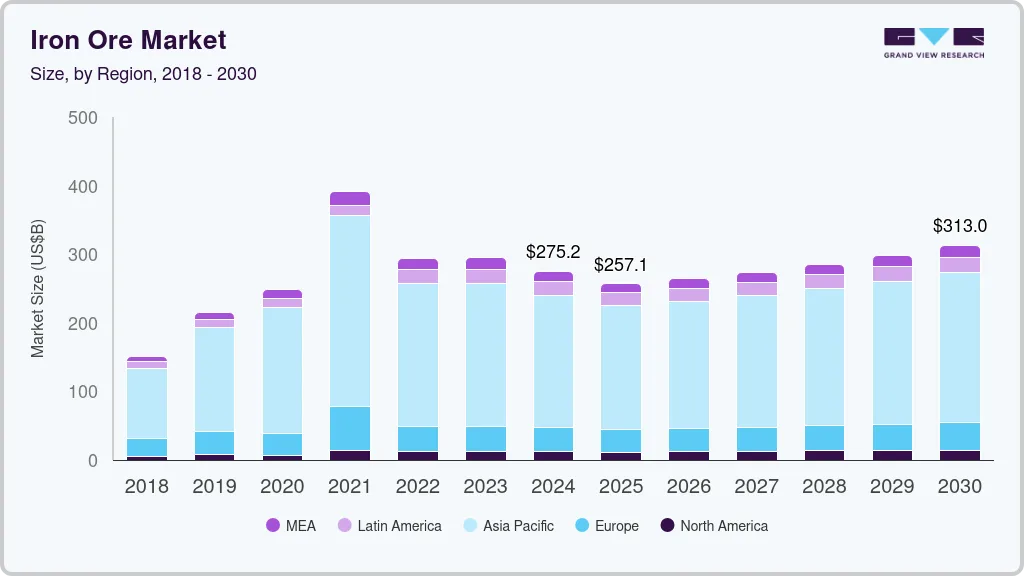 To learn more about this report, Download Free Sample Report
 Iron ore is a naturally occurring mineral found in the Earth's crust, primarily consisting of iron oxides like hematite and magnetite. It is an essential raw material for producing iron and steel. The extraction process involves refining the ore to separate the iron from impurities, yielding various iron ore grades. These different grades are used in steel production, which is critical for multiple industries. The demand for iron ore is primarily driven by the growing need for steel, fueled by rapid industrialization and urban growth, particularly in emerging economies like China and India.
Market Dynamics
The iron ore market is primarily driven by the sustained growth of the global steel industry, which accounts for the vast majority of iron ore consumption. Rising investments in infrastructure development, urbanization projects, commercial construction, transportation networks, and industrial manufacturing across emerging economies such as India, Southeast Asia, and Africa are significantly increasing steel demand. Governments worldwide continue to prioritize large-scale infrastructure spending, including railways, bridges, ports, renewable energy installations, and smart city developments, all of which require substantial quantities of steel and, consequently, iron ore. In addition, the expansion of automotive production, machinery manufacturing, and renewable energy sectors, such as wind power, is further supporting steel consumption. India is expected to emerge as a major growth engine for iron ore demand, supported by ambitious steel capacity expansion plans and increasing infrastructure investments.
The rapid expansion of global steel production remains one of the most significant growth drivers for the iron ore market, as iron ore is the primary raw material for blast furnace-based steelmaking. Growing investments in infrastructure, urban development, transportation networks, residential construction, and industrial manufacturing across emerging economies continue to support global steel demand. According to the World Steel Association, crude steel production reached 153.4 million tons in April 2026, following 159.9 million tons in March 2026 and 141.8 million metric tons in February 2026, demonstrating the substantial scale of steel output that directly drives iron ore consumption. India, the world's second-largest steel producer, recorded 15.3 million metric tons of crude steel production in March 2026, a 9.4% year-over-year increase, highlighting the growing demand for iron ore in developing economies.
In addition, long-term steel demand fundamentals remain strong despite regional fluctuations in production. The World Steel Association forecasts global steel demand to reach approximately 1.72 billion metric tons in 2026, supported by industrialization, renewable energy projects, automotive manufacturing, and large-scale infrastructure development. Countries such as India continue to witness robust growth in steel consumption and expansion of production capacity, while several Southeast Asian and Middle Eastern nations are investing heavily in new steelmaking facilities. As steelmakers seek to increase output to meet rising demand from the construction and manufacturing sectors, the need for high-quality iron ore feedstock is expected to remain strong, supporting sustained growth in the global iron ore market.
Iron ore prices are highly sensitive to fluctuations in global steel production, economic growth, supply disruptions, trade policies, geopolitical tensions, and changes in demand from major consuming countries, such as China. Sharp price swings can impact profit margins, delay investment decisions, and complicate long-term procurement and production planning for market participants. Furthermore, periods of declining iron ore prices can reduce mining companies' revenues. In contrast, sudden price increases raise raw material costs for steel producers, potentially affecting the competitiveness of end-use industries. This uncertainty in pricing dynamics often limits market stability and poses challenges for sustainable growth across the iron ore value chain.
High grade iron ore contains a greater iron content and fewer impurities, enabling steel manufacturers to achieve higher productivity while consuming less energy and generating lower greenhouse gas emissions during the production process. The transition toward greener steel production, driven by stringent environmental regulations, corporate sustainability commitments, and investments in low carbon technologies such as direct reduced iron (DRI) and hydrogen based steelmaking, is accelerating the preference for premium iron ore products. As major steel producing regions including Europe, China, and India pursue decarbonization goals, demand for high quality iron ore feedstock is expected to rise, creating growth opportunities for mining companies capable of supplying premium grade ore and supporting the industry's shift toward more sustainable steel production.
Market Concentration & Characteristics
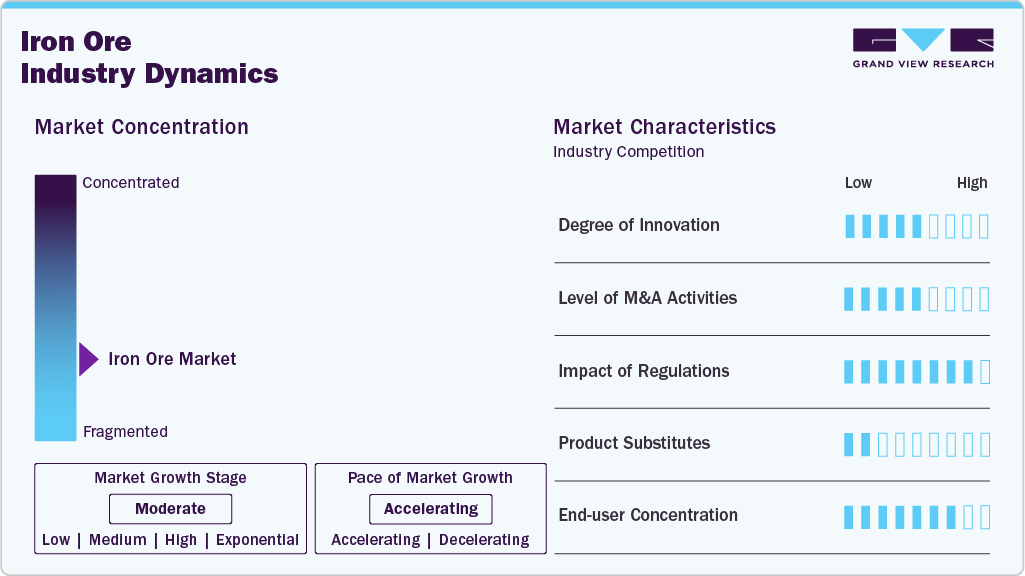
The global iron ore industry is at a lower industry growth stage, indicating an accelerated pace of development. Iron ore deposits are located worldwide, with Australia, Brazil, the U.S., and Canada being the most prominent producers. The global iron ore industry is consolidated due to the high capital costs and required regulatory approvals. As such, the market is characterized by large-scale producers of iron ore that cater to its global demand.
The market's degree of innovation is moderate and is characterized by upgrading technologies for mining and processing (beneficiation) iron ore. Presently, companies worldwide are focused on sustainable mining activities and are trying to ensure that their production processes achieve a low carbon footprint and incur minimal costs. The level of M&A activities in the market remained low in 2023.
 To learn more about this report, Download Free Sample Report
 Iron ore mining activities endure a high regulatory impact as players carrying out these activities are governed by stringent laws to obtain mining licenses and environmental clearance, and they have minimal socio-economic implications. Compliance with these regulations often requires significant investments in advanced technologies and sustainable mining practices, leading to a surge in operational costs. The substitutes for iron ore are limited, as it is a key raw material for producing steel. It is mainly found processed into pellets, lumps, and fines. The concentration of end users is also high in the market, as iron ore is used in the construction and cement manufacturing industries, as well as foundries and refractories. It is also used for manufacturing chemicals, ferroalloys, and glass.
Analyst Perspective
The iron ore market remains fundamentally tied to the health of the global steel industry and long-term infrastructure development trends. Continued investments in residential and commercial construction, transportation networks, manufacturing facilities, and energy infrastructure across emerging and developed economies are expected to sustain steady demand for iron ore over the coming years. While fluctuations in steel production, economic activity in China, and iron ore price volatility may create short-term uncertainties, the market continues to benefit from urbanization and industrialization in key regions such as the Asia Pacific, the Middle East, and Latin America. In addition, the rowing demand for high-grade iron ore and pellets to support more efficient, lower-emission steelmaking processes is gradually reshaping trade flows and investment priorities. Producers that can offer a consistent supply of high-quality ore and align with the steel industry's decarbonization goals are expected to strengthen their competitive position as the market advances.
Iron Ore Price Trends
In the first quarter of 2024, iron ore prices experienced a significant decline, dropping nearly 30% due to concerns over weakened demand from China, the world's largest commodity consumer. This downturn was attributed to ongoing challenges in China's real estate sector and broader economic uncertainties. However, by April 2024, prices began to stabilize, supported by efforts to revive the Chinese real estate market and initiatives by the Steel Association of China to enhance capacity utilization in anticipation of future demand.
Despite expectations for a mid-2024 recovery, economic reforms in China faced delays, leading to postponed implementation of new construction projects and deferred steel procurement. Consequently, iron ore prices remained below the anticipated USD 100 per ton threshold. Nevertheless, prices showed mild recovery by the end of 2024, reaching an average of approximately USD 117 per ton. This rebound was driven by the execution of global construction projects and a strengthening U.S. dollar against the Chinese yuan, which improved purchasing power.
Looking ahead, global iron ore prices are projected to remain within the USD 80 to USD 100 per ton range over the next 18 months, influenced by subdued worldwide demand and persistent supply-side growth challenges. This outlook suggests limited upward momentum in the near term, despite favourable economic conditions in key markets.
Type Insights
Based on type, pellets segment led the market with the largest revenue share of 56.4% in 2025. Pellets are ground iron ore fines converted to spherical-shaped balls. They have good physical properties for bulk and mechanical transportation over long distances. These balls also have excellent metallurgical properties that are better than raw iron ore. Pellets are used as raw materials for iron manufacturing, as a substitute for sinter and lumps.
 To learn more about this report, Download Free Sample Report
 Pellets are preferred for their desirable shape, size, strength, and excellent metallurgical properties. Their usage in blast furnaces can increase the productivity of iron plants without the requirement for additional capital investments. They enhance the productivity of the iron-making units without any further capital investments.
End Use Insights
Based on end use, steel industry segment led the market with the largest revenue share of 97.0% in 2025. Iron ore in the form of fines, lumps, pellets, and sinters is used to manufacture steel. Primary steelmaking involves pig iron, which is smelted from iron ore in the basic oxygen furnace (BOF) or electric arc furnace (EAF). These methods produce high-quality steel, which is further developed into different shapes.
Steel is further used in various end use industries. The construction and automotive industries account for the most significant revenue shares of the overall global steel consumed. Infrastructure development and construction activities extensively require high volumes of steel to enhance structures' aesthetic appeal and corrosion resistance.
In March 2024, the U.S. Department of Energy (DOE) announced a historic investment of USD 6 billion to fund 33 industrial decarbonization projects across more than 20 states. This initiative, the largest in U.S. history, aims to reduce greenhouse gas emissions from energy-intensive industries such as steel, cement, aluminium, and food production. The funding is sourced from the Inflation Reduction Act and the Bipartisan Infrastructure Law, with USD 5.47 billion allocated and USD 489 million from the latter.
The selected projects are expected to eliminate approximately 14 million metric tons of carbon emissions annually, equivalent to removing about 3 million gasoline-powered cars from the road. Notably, nearly 80% of these projects are in disadvantaged communities, aligning with the administration's commitment to equitable environmental benefits. Private sector investments are expected to match the federal funding, bringing the total investment to over USD 20 billion. These projects are anticipated to set new standards for clean manufacturing in the United States and globally, supporting the nation's net-zero carbon goals. Other end uses of iron ore include foundries, cement manufacturing, coal washeries, ferroalloys, chemical plants, glass manufacturing, and refractories.
Regional Insights
The iron ore market in North America is anticipated to grow at a significant CAGR during the forecast period. The growth has been due to various activities and government investments in infrastructure development projects. Countries in the region, especially the U.S. and Mexico, focus on accelerating their economic growth by investing in infrastructure development projects and supporting their manufacturing industry. This, in turn, is expected to surge the demand for steel, leading to a rise in iron ore consumption in the coming years.
U.S. Iron Ore Market Trends
The iron ore market in the U.S. is the third-largest steel producer in the world. The country's construction industry drives demand for steel, which drives demand for iron ore. According to the U.S. Census Bureau, total construction spending in the country during the first three months of 2024 amounted to USD 461.00 billion, an increase of 10.6% year over year.
Asia Pacific Iron Ore Market Trends
Asia Pacific dominated the iron ore market with the largest revenue share of 70.4% in 2025, due to the large crude steel production volume in China, India, and Japan. This steel is used in residential and commercial construction activities as well as the automotive & transportation, energy, and electronics industries. The construction industry in the region has witnessed significant growth over the past few years, owing to ongoing industrial development and its robust economy. This, in turn, has led to a rise in steel consumption, thereby contributing to the demand for iron ore used as a raw material to manufacture steel.
 To learn more about this report, Download Free Sample Report
 The iron ore market in the China held the largest share in the Asia Pacific region in 2025 due to a slowdown in its domestic market. This downturn was primarily influenced by the weakening of the country's real estate sector, which began in the fourth quarter of 2021 due to the debt crisis faced by real estate developers in China. However, the market indicated a moderate revival in 2023, encouraging iron ore producers to bank on stable prices.
Europe Iron Ore Market Trends
The iron ore market in Europe is anticipated to grow at a significant CAGR during the forecast period. The iron ore and steel industry continues to face significant challenges stemming from the ongoing Russia-Ukraine conflict, high energy costs, labor shortages, and increased competition from low-cost imports. These factors have reduced production capacities and economic strain across the sector.
The Germany iron ore market accounted for the largest revenue share of over 14% in Europe in 2024. The country's market growth is moderate due to geopolitical issues in Europe and increased input costs. However, the demand for sustainable energy production, consumer packaging, electric vehicles, and green construction is anticipated to improve in the coming years. In addition, the country is the largest exporter of semi-finished and finished steel in Europe.
Latin America Iron Ore Market Trends
The iron ore market in Latin America is projected to grow at a substantial CAGR during the forecast period, due to the region's flourishing construction industry. For instance, in March 2024, Hilton announced its accelerated expansion in the Caribbean and Latin America. With record room growth in 2023 and a robust pipeline of nearly 110 hotels, Hilton plans to open more than 15 hotels across the Caribbean and Latin America in 2024. Hilton is also introducing new brands to the region. Home2 Suites by Hilton has signed new hotels in Mexico, and Spark by Hilton is set to launch in CALA in 2025, aiming to redefine the premium economy segment.
Middle East Iron Ore Market Trends
The iron ore market in the Middle East and Africa (MEA) is anticipated to grow at the fastest CAGR during the forecast period, driven by substantial infrastructure investments and strategic partnerships. For instance, the Government of Egypt focuses on infrastructure development while attracting foreign investors to reduce its fiscal deficit. The Ras El Hekma project, undertaken by Abu Dhabi Developmental Holding Company (ADQ) for a total investment of USD 35 billion, is anticipated to mobilize infrastructure development projects in the country further. Such projects are expected to sustain iron ore manufacturing in the Middle East & Africa during the forecast period.
A joint venture between Egyptian and Qatari investors is set to establish a USD 100 million iron and steel plant in Qena, southern Egypt. The facility aims to commence operations in 2026 and focus on rebar production, with most output directed towards regional and international markets.
Key Iron Ore Company Insights
Some key players operating in the market are Vale, Rio Tinto, BHP, and ArcelorMittal.
-
Brazil-based Vale was incorporated in 1942. It is the largest producer of iron ore in the world. The company has mining assets in Brazil, China, and Oman. The ore extracted by it in Carajas, Brazil, has an iron content of 67%, one of the world's highest. Vale produces iron ore pellets and briquettes.
-
Rio Tinto was founded in 1873 and is one of the world’s largest mining and metals companies. Headquartered in Melbourne, the company’s iron ore operations are primarily based in the Pilbara region of Western Australia, where it manages an integrated system of 17 iron ore mines. Rio Tinto produces a wide range of iron ore products, including lump, fines, sinter feed, and pellets, which are shipped globally, with a strong focus on the Asia-Pacific region, particularly China, Japan, and South Korea.
-
Australia-based BHP was founded in 1966. Its operations include integrated iron ore mines and rail & port operations in Pilbara, Western Australia. The company produces lumps, sinters, fines, and pellets.
-
Luxembourg-based ArcelorMittal was incorporated in 2006 because of the merger of Arcelor with India-based Mittal Steel. Its seaborne iron ore mines are located in Quebec (Canada), as well as in Liberia. The company produces iron ore lumps, fines, concentrated pellets, and sinter feed.
Key Iron Ore Companies:
The following key companies have been profiled for this study on the iron ore market.
-
Anglo American
-
Ansteel Group Corporation Limited
-
ArcelorMittal
-
BHP
-
Cleveland-Cliffs Inc.
-
EVRAZ plc
-
Fortescue Metals Group Ltd
-
HBIS Group
-
LKAB
-
Metalloinvest MC LLC
-
Rio Tinto
-
Vale
Competitive Benchmarking
Category
Operating Strategies
Competitive Edge
Weakness
Established Players (e.g. Tinto, Vale, Anglo American, Fortescue Metals Group Ltd, LKAB, Metalloinvest MC LLC, Cleveland-Cliffs Inc.)
- Focus on large scale mining operations, long term resource development, and integrated logistics networks that connect mines, railways, ports, and export terminals.
- These companies emphasize operational efficiency through automation, digital mine management systems, and productivity enhancement programs to maintain cost competitiveness.
- Established players possess significant competitive advantages through ownership of vast high quality iron ore reserves and extensive mining infrastructure.
- Their large scale operations enable lower production costs per ton, stronger bargaining power with customers, and greater resilience during periods of market volatility.
- Despite their strong market positions, mature players face challenges related to high capital intensity and dependence on global steel production trends. Large mining projects require substantial investments in equipment, infrastructure, environmental management, and workforce development.
Emerging & Regional Players (e.g., Ansteel Group Corporation Limited, HBIS Group, ArcelorMittal, EVRAZ plc.)
- Focus on developing new mining assets, exploring untapped reserves, and targeting regional supply opportunities.
- Their strategies often emphasize efficient project development, selective production expansion, and partnerships with infrastructure providers to reduce capital burdens.
- Benefit from operational flexibility and the ability to incorporate advanced technologies without the limitations of legacy infrastructure.
- Their projects are often designed around modern efficiency standards, enabling streamlined operations and potentially lower environmental impacts.
- Emerging participants face significant challenges related to limited production scale, infrastructure constraints, and financing requirements.
- Developing iron ore mines requires substantial capital investment in extraction equipment, transportation networks, processing facilities, and export infrastructure.
Recent Developments
-
In April 2024, Australia-based Strike Resources Limited, an iron ore company, completed its negotiations to sell its Pilbara Paulsens East Iron Ore Project to Australia-based Miracle Iron Holdings for ~USD 13.4 million (A$ 20.5 million).
-
On February 14, 2025, Brazil-based Vale confirmed a significant investment of USD 12.26 billion in its Carajás complex in Pará. The investment will be deployed through 2030 and aims to boost annual iron ore production to 200 million tons, while also expanding copper output by 32%, reaching 350,000 tons annually. This move is part of Vale’s broader strategy to strengthen its position in the global iron ore supply and enhance the value of its mineral assets.
-
On March 26, 2024, Vale and China’s Jinnan Steel Group announced a joint investment of over USD 600 million to construct an iron ore beneficiation plant in the Sohar Port and Freezone, Oman. The facility will process 18 million tonnes of low-grade ore annually to produce 12.6 million tonnes of high-grade iron ore concentrate. Scheduled for completion by mid-2027, this project aims to support the production of direct reduction pellets and briquettes for low-carbon steel.
Iron Ore Market Report Scope
Report Attribute
Details
Market size in 2025
USD 257.1 billion
Estimated market size in 2026
USD 264.1 billion
Projected market size by 2033
USD 362.2 billion
Growth rate
CAGR of 4.6% from 2026 to 2033
Base year for estimation
2025
Historical data
2021 - 2024
Forecast period
2026 - 2033
Quantitative units
Revenue in USD million, volume in kilotons and CAGR from 2026 to 2033
Report coverage
Revenue forecast, volume forecast, company ranking, competitive landscape, growth factors, and trends
Segments covered
Type, end use, region.
Regional scope
North America; Europe; Asia Pacific; Latin America; Middle East & Africa
Country scope
U.S., Canada, Mexico, Germany, Turkey; Russia; France, India, China, Japan, Brazil,
Key companies profiled
Anglo American, Ansteel Group Corporation Limited, ArcelorMittal, BHP, Cleveland-Cliffs Inc., EVRAZ plc, Fortescue Metals Group Ltd, HBIS Group, LKAB, Metalloinvest MC LLC, Rio Tinto, Vale.
Customization scope
Free report customization (equivalent up to 8 analysts' working days) with purchase. Addition or alteration to country, regional & segment scope.
Pricing and purchase options
Avail customized purchase options to meet your exact research needs. Explore purchase options
Global Iron Ore Market Report Segmentation
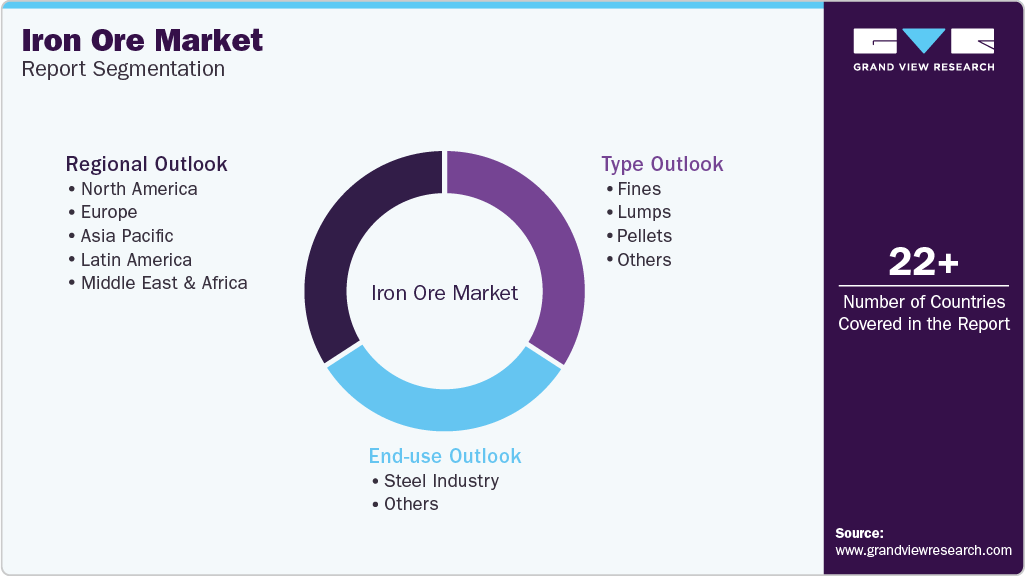
This report forecasts revenue and volume growth at global, regional, and country levels and provides an analysis of the latest industry trends in each of the sub-segments from 2021 to 2033. For this study, Grand View Research has segmented the global iron ore market report based on type, end use, and region:
 To learn more about this report, Download Free Sample Report
 -
Type Outlook (Volume, Million Tons; Revenue, USD Million, 2021 - 2033)
-
Fines
-
Lumps
-
Pellets
-
Others
-
-
End Use Outlook (Volume, Million Tons; Revenue, USD Million, 2021 - 2033)
-
Steel Industry
-
Others
-
-
Regional Outlook (Volume, Million Tons; Revenue, USD Million, 2021 - 2033)
-
North America
-
U.S.
-
Canada
-
Mexico
-
-
Europe
-
Germany
-
France
-
Turkey
-
Russia
-
-
Asia Pacific
-
China
-
India
-
Japan
-
-
Latin America
-
Brazil
-
-
Middle East & Africa
-
Research Methodology
Segment Definition
Type
Revenue Capture Definition
Fines
Iron ore fines are small particles of iron ore, typically less than 6.3 mm in size, generated during mining, crushing, and screening operations. They are primarily used in sintering and pelletizing processes before being charged into blast furnaces.
Lumps
Iron ore lumps are naturally occurring coarse ore pieces, generally ranging from 6.3 mm to 30 mm in size, that can be directly fed into blast furnaces. Their higher permeability and minimal processing requirements make them valuable for ironmaking operations.
Pellets
Iron ore pellets are spherical agglomerates produced by processing iron ore fines with binders and firing them at high temperatures. They offer high iron content, uniform size, and superior metallurgical performance, making them suitable for blast furnaces and direct reduction processes.
Others
The others segment includes specialty iron ore products such as concentrate, sinter feed, and briquettes that serve specific steelmaking and beneficiation requirements. These products are utilized based on plant configuration, processing technology, and desired iron grade specifications.
End Use
Revenue Capture Definition
Steel Industry
The steel industry is the primary end use segment for iron ore, where it serves as the essential raw material for producing pig iron and crude steel through blast furnace and direct reduction routes. Demand from this segment is driven by construction, automotive, infrastructure, machinery, and manufacturing activities worldwide.
Others
The others segment includes applications such as cement manufacturing, heavy media separation, pigments, chemical production, and water treatment processes. Iron ore is utilized in these industries for its mineral properties, though consumption volumes remain significantly lower than in steel production.
Estimation Model
Layer Name
Key Question
Description
Steel Production Demand Base Layer
What forms the demand base?
Identify global crude steel production volumes and iron ore consumption across integrated steel mills, direct reduced iron (DRI) facilities, and pig iron production units. Assess demand from major steel-producing industries including construction, automotive, machinery, shipbuilding, infrastructure, and energy. This layer establishes the total addressable demand for iron ore globally.
Iron Ore Supply & Trade Layer
Where is iron ore sourced and supplied?
Estimate iron ore production and availability from major mining regions and exporting countries. Analyze domestic production, seaborne trade flows, import dependency, and supply distribution across developed and emerging economies. Assess the contribution of fines, lumps, pellets, and concentrates within regional supply networks.
Consumption Intensity Layer
How much iron ore is consumed?
Analyze iron ore consumption intensity based on steel production routes, blast furnace utilization rates, DRI production, and metallurgical efficiency. Evaluate ore grade requirements, pelletization rates, beneficiation activities, and raw material mix across steelmaking facilities. Consumption intensity varies according to technology adoption, environmental regulations, and regional steel manufacturing practices.
Revenue Layer
How is market revenue generated?
Market revenue is quantified through the sale and trade of iron ore products including fines, lumps, pellets, concentrates, and other processed ores. Revenue generation is influenced by production volumes, international benchmark prices, ore grade premiums, freight costs, and long term supply contracts. Demand from steel producers, industrial manufacturers, and infrastructure projects drives overall market value.
Delivered Customizations
This report has been delivered with the following In-depth customizations
Client Request
Customization Delivered
Value Adds
Iron Ore & Industrial Minerals Competitive Landscape Assessment
Detailed competitive landscape analysis covering companies involved in the trading of iron ore pellets, iron ore fines, direct reduced iron, barite, and dolomite. The study profiled key competitors based on operational location, organizational structure, product portfolio, customer base, vendor network, financing structure, and strategic investments and expansion initiatives.
Enabled evaluation of competitive positioning, trading ecosystem dynamics, supplier relationships, and strategic growth approaches across the iron ore and industrial minerals value chain.
Trade Assessment
Evaluation of global iron ore trade flows, export import trends, country level trade balances, shipping routes, and supply concentration risks. Included assessment of major exporting nations, import dependent steel producing countries, port infrastructure, freight economics, and geopolitical developments affecting iron ore trade.
Highlighted supply security risks, export opportunities, and sourcing diversification possibilities. Supported strategic procurement decisions, logistics planning, and international market expansion initiatives.
Opportunity Assessment
Identification of high growth opportunities associated with increasing steel production, direct reduced iron projects, green steel initiatives, infrastructure development, and demand for premium grade iron ore products. Assessed emerging opportunities arising from decarbonization efforts, low emission steelmaking technologies, and investments in pelletizing and beneficiation facilities.
Enabled prioritization of high return investment opportunities and future growth segments. Supported long term business planning, capacity expansion decisions, and strategic investments aligned with evolving steel industry requirements.
Frequently Asked Questions About This Report
The iron ore market size was estimated at USD 257.1 billion in 2025 and is expected to reach USD 264.1 billion in 2026.
Asia Pacific dominated the market with a revenue share of 70.4% in 2025.
The iron ore market is expected to grow at a CAGR of 4.6% from 2026 to 2033 to reach USD 362.2 billion by 2033.
steel industry accounted for largest revenue share of 97.0% in 2025.
Pellets segment led the market with the largest revenue share of 56.4% in 2025. Pellets are ground iron ore fines converted to spherical-shaped balls. They have good physical properties for bulk and mechanical transportation over long distances.
The key factor driving the growth of the global iron ore market is the growing demand from industries like automotive and construction. Infrastructure projects, particularly in developing regions, are poised to boost the demand for steel and iron ore significantly.
Some of the key vendors in the global iron ore market are Anglo American, Ansteel Group Corporation Limited, ArcelorMittal, BHP, Cleveland-Cliffs Inc., EVRAZ plc, Fortescue Metals Group Ltd, HBIS Group, LKAB, Metalloinvest MC LLC, Rio Tinto, Vale.
About the Author(s)
Advanced Interior Materials Research Team
Advanced Materials · Advanced Interior MaterialsThis report was authored by the advanced interior materials research team at Grand View Research - comprising two research analysts, one senior research analyst, and one industry expert - with specialized expertise in the advanced interior materials segment of the advanced materials industry. All findings are based on proprietary advanced materials databases, executive interviews, and regulatory analysis, subject to internal peer review prior to publication.
Last Updated:
Speak to Analyst

Customize this report to your needs - add regions, segments, or data points, with 20% free customization.
Or view our licence options:


ISO 9001:2015 & 27001:2022 Certified
We are GDPR and CCPA compliant! Your transaction & personal information is safe and secure. For more details, please read our privacy policy.


