
- Home
- »
- Paints, Coatings & Printing Inks
- »
-
Mirror Coatings Market Size & Share, Industry Report, 2033GVR Report cover

Mirror Coatings Market (2025 - 2033) Size, Share & Trends Analysis Report By Resin (Polyurethane, Epoxy), By Application (Water-based Coatings, Solvent-based Coating), By End Use, By Region, And Segment Forecasts
Market Size, 2024
$819.6MMarket Estimate, 2026
$855.1MMarket Forecast, 2033
$1,309.1MCAGR, 2025–2033
5.4%Mirror Coatings Market Summary
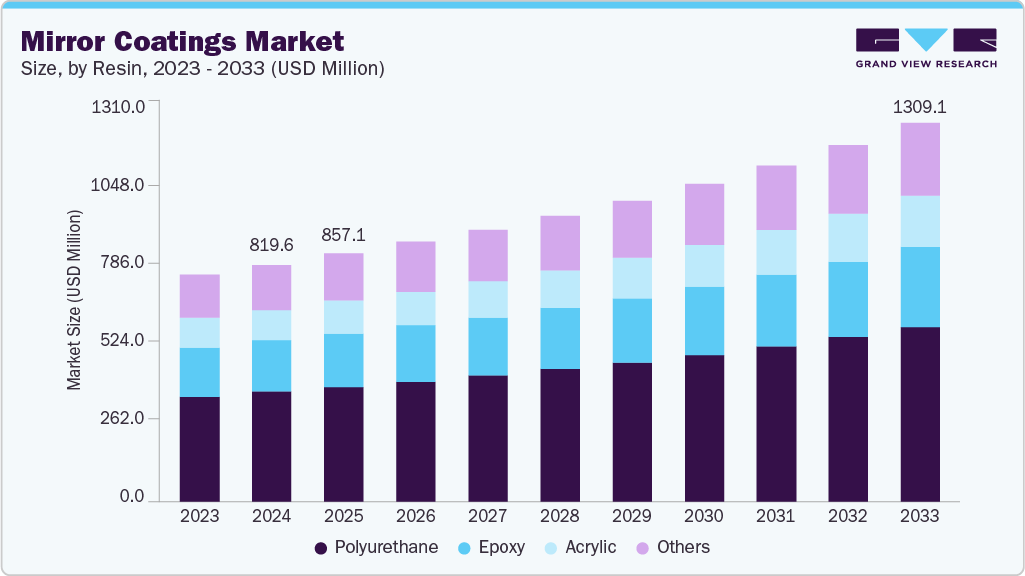
The global mirror coatings market size was estimated at USD 819.57 million in 2024, and is projected to reach USD 1,309.05 million by 2033, growing at a CAGR of 5.4% from 2025 to 2033. The market growth is primarily driven by growing demand from the construction, automotive, and solar energy sectors.
 Source: Grand View Research, IR Documents, Primary Interviews, Paid DatabasesTo learn more about this report,
 Download Free Sample Report
 Key Market Trends & Insights
- Asia Pacific dominated the global mirror coatings market with the largest revenue share of 38.6% in 2024.
- The mirror coatings market in the U.S. is expected to grow at a substantial CAGR of 5.0% from 2025 to 2033.
- By resin, the acrylic segment is expected to grow at a considerable CAGR of 6.0% from 2025 to 2033 in terms of revenue.
- By application, the water-based coatings segment led the market and accounted for the largest revenue share of 40.5% in 2024 in terms of revenue.
- By end use, the architectural segment led the market and accounted for the largest revenue share of 58.8% in 2024 in terms of revenue.
Market Size & Forecast
- 2024 Market Size: USD 819.57 Million
- 2033 Projected Market Size: USD 1,309.05 Million
- CAGR (2025-2033): 5.4%
- Asia Pacific: Largest market in 2024
- Europe: Fastest growing market
Three ways to get this report
Buy it, customize it, or ask a question.Ask an Analyst
Analyst response in 1 business day
- AccessReport author, directly
- Reply timeWithin 1 working day
- No sales callDirect answer only
- FormatEmail reply
- CostFree, no cost
Get the Full Report
What the study covers
- FormatsPDF · Excel · Dashboard
- Timeline2025–2033 annual, 2024 base
- Coverage20+ countries, 5 regions
- Companies10+ key players profiled
Customize the Report
20% free customization
- IncludeCountries, segments, points
- TailorTo your product definition
- ExtendDeeper competitor detail
- OrA fully bespoke study
- Turnaround5–10 working days
Increasing applications in decorative interiors, architectural glass, and smart mirrors are boosting consumption. Technological advancements in Nano coatings and environmentally friendly products have enhanced durability, reflectivity, and UV protection, attracting eco-conscious consumers.The global mirror coatings industry is driven by a combination of rapid urbanization, growing infrastructure investments, and evolving construction technologies. Expanding urban infrastructure and a surge in premium residential and commercial projects are increasing the adoption of high-performance decorative and architectural mirrors. In the automotive industry, mirror coating enhances visibility, aesthetics, and safety, especially in electric and luxury vehicles. Rapid growth in solar energy installations-especially in emerging economies, boosting demand for reflective coatings that improve energy capture in concentrated solar power (CSP) systems. In addition, innovations in nanocoatings offering anti-fog, scratch resistance, and UV protection appeal to sustainability-focused consumers.
 To learn more about this report, Download Free Sample Report
 High raw material costs and complex manufacturing processes associated with advanced mirror coatings pose challenges to market growth. The volatility in prices of key components like silver, aluminum, and titanium dioxide can significantly impact production expenses. Regulatory restrictions on certain chemicals and solvents used in coatings, particularly in Europe and North America, can limit formulation flexibility and increase compliance costs. Furthermore, the need for specialized application equipment and skilled labor makes implementation more expensive for end users. In developing economies, limited awareness and availability of high-performance mirror coatings may hinder widespread adoption across small-scale construction and manufacturing sectors.
Emerging markets in Asia-Pacific, Latin America, and the Middle East present strong growth opportunities due to rapid urbanization, infrastructure development, and increasing adoption of energy-efficient technologies. Innovations in smart coatings, such as self-cleaning, anti-fog, and antimicrobial mirrors, are opening new avenues in the healthcare, automotive, and hospitality sectors. The shift towards green buildings and sustainable construction materials creates demand for low-emission, eco-friendly mirror coatings. In addition, partnerships between manufacturers and solar energy firms to develop high-efficiency reflective coatings can unlock new revenue streams. Digitalization and e-commerce expansion also allow easier market penetration and product reach in untapped regions.
Market Dynamics
Increasing adoption of high-performance reflective coatings in automotive mirrors, smart mirrors, and architectural glass applications is driving growth in the mirror coatings market. Rising demand for enhanced durability, corrosion resistance, UV protection, and improved optical clarity is encouraging manufacturers to develop advanced coating technologies for residential, commercial, and transportation applications.
Expansion of smart buildings, premium interior infrastructure, and automotive safety technologies is further supporting market demand. Growing investments in energy-efficient buildings and modern vehicle designs are driving the adoption of advanced mirror coatings that enhance aesthetics, thermal efficiency, and long-term surface performance.
The mirror coatings market faces challenges due to fluctuations in the prices of silver, aluminum, specialty chemicals, and other coating materials used in manufacturing. Rising energy costs and supply chain disruptions are increasing production expenses for coating manufacturers, impacting overall profitability and pricing stability.
Stringent environmental regulations on chemical emissions and waste management are also increasing compliance and operational costs for manufacturers. These factors can create challenges for small- and medium-sized coating companies that operate with limited production scale and cost-optimization capabilities.
Market Concentration & Characteristics
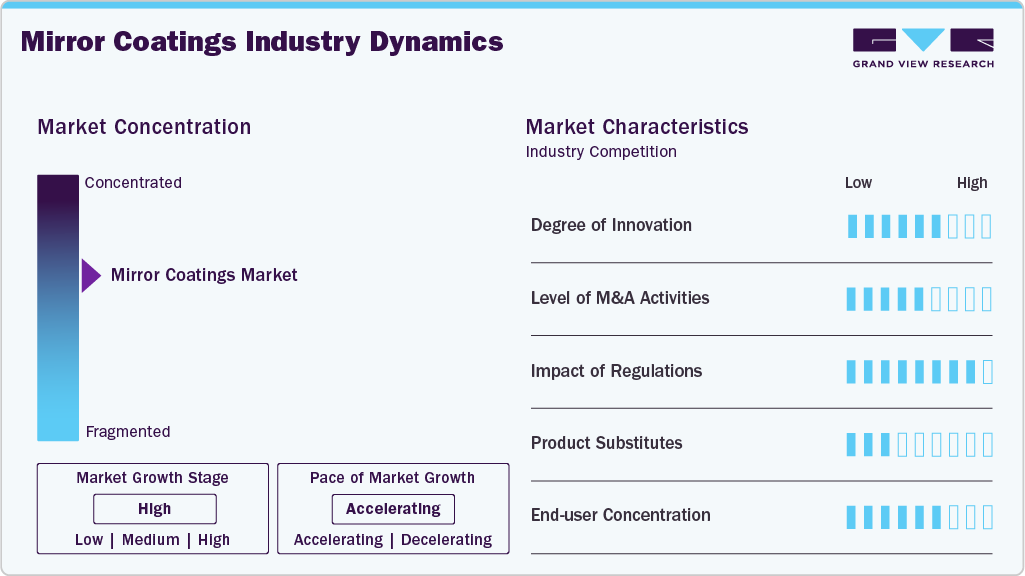
The global mirror coatings industry is moderately concentrated, with a few key players such as FENZI S.p.A., SHERWIN-WILLIAMS, and Arkema dominating significant market shares. These firms benefit from strong distribution networks, technological expertise, and established brand presence. However, regional and niche manufacturers also play a vital role, particularly in Asia-Pacific. Mergers, acquisitions, and partnerships are common strategies used to enhance capabilities, expand geographic reach, and compete effectively in a market characterized by innovation and performance-based differentiation.
 To learn more about this report, Download Free Sample Report
 The mirror coatings industry is defined by its focus on performance, aesthetics, and environmental compliance. It spans diverse end-use sectors including construction, automotive, solar, and electronics. Products must offer durability, high reflectivity, abrasion resistance, and often UV or anti-fog functionality. Innovation in eco-friendly and nanotechnology-based formulations is reshaping product development. The market is influenced by architectural trends, regulatory shifts, and sustainability goals, while customization and technological advancement remain key to meeting specific client and sectoral needs across global and regional markets.
Resin Insights
The polyurethane segment led the market with the largest revenue share of 46.4% in 2024. This growth is driven primarily due to their superior abrasion resistance, flexibility, and high gloss, making them ideal for architectural and automotive applications. Epoxy-based coatings are valued for their excellent adhesion and chemical resistance, especially in industrial mirrors and high-humidity environments.
The acrylic segment is expected to grow at the fastest CAGR of 6.0% from 2025 to 2033. It’s gaining traction due to their cost-effectiveness, UV resistance, and environmental friendliness, particularly in decorative mirrors. These characteristics make them suitable for mass and general-purpose applications in price-sensitive regions and for projects emphasizing sustainability. The growing demand for durability, sustainability, and versatility is shaping resin selection across diverse end-use industries globally.
Application Insights
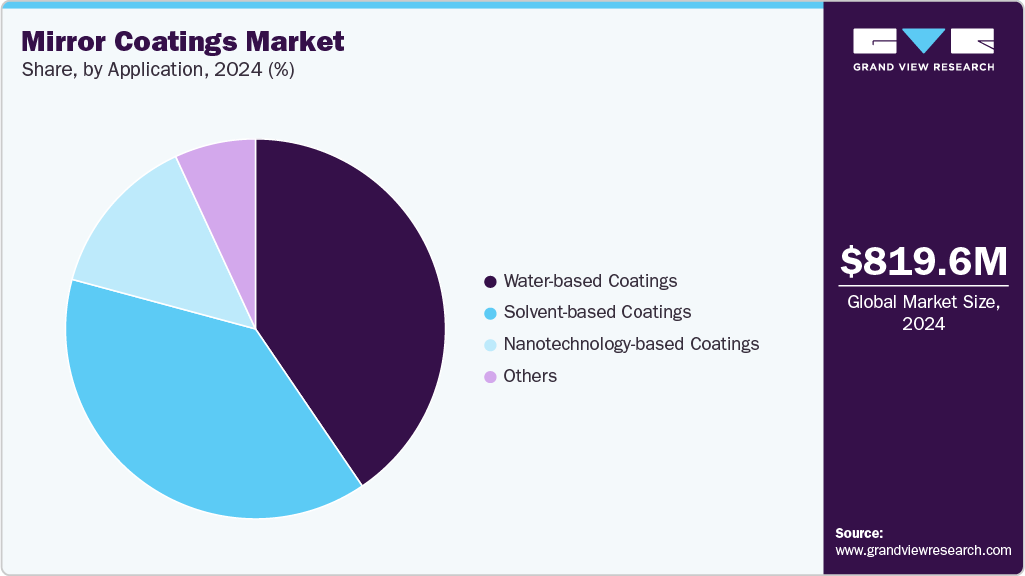
The water-based coatings segment led the market with the largest revenue share of 40.5% in 2024. This dominance is attributed to increasingly stringent environmental regulations across North America and Europe that limit the use of volatile organic compounds (VOCs) in industrial applications. Water-based coatings emit significantly fewer VOCs compared to their solvent-based counterparts, making them a preferred choice for sustainable manufacturing. In addition, advancements in formulation technology have enhanced their durability, adhesion, and reflectivity, enabling performance levels comparable to solvent-based systems while supporting eco-friendly practices in architectural and industrial applications.
 To learn more about this report, Download Free Sample Report
 The solvent-based coatings segment is anticipated to grow at the fastest CAGR during the forecast period. Solvent-based coatings still hold significant share due to their proven durability and widespread usage in demanding outdoor and industrial environments. Nanotechnology-based coatings are rapidly emerging, offering enhanced functionalities like self-cleaning, anti-fog, and anti-scratch properties. These advanced coatings are being increasingly adopted in premium construction, solar mirrors, and automotive mirrors where performance and innovation are critical.
End Use Insights
The architectural segment led the market with the largest revenue share of 58.8% in 2024. This leadership is primarily driven by the growing demand for both decorative and functional mirrors in modern residential and commercial infrastructure. Increasing urbanization, interior design trends, and the emphasis on natural lighting and spatial aesthetics have fueled the use of high-performance coated mirrors in windows, walls, elevators, and bathrooms. In addition, innovations in mirror coatings-such as ultraviolet (UV) protection, anti-fog, and scratch resistance-have enhanced their suitability for long-lasting use in high-traffic architectural environments.
Automotive and transportation applications are expanding with the integration of advanced coated mirrors in electric vehicles, smart interiors, and driver-assist systems. Solar power is a fast-growing segment as mirror coatings enhance reflectivity and efficiency in solar thermal plants. Sustainability goals and energy-efficient infrastructure are fueling demand across all these end-use segments globally.
Regional Insights
The mirror coatings market in North America is anticipated to grow at a significant CAGR during the forecast period. The market is witnessing steady growth driven by advancements in smart mirrors, rising renovation activities, and strong demand from the automotive and healthcare sectors. High disposable income, coupled with consumer preference for modern interior aesthetics, supports the use of decorative mirrors with functional coatings. Regulatory enforcement by the Environmental Protection Agency (EPA) for low volatile organic compound (VOC) coatings is shifting manufacturers toward eco-friendly water-based solutions. The integration of anti-fog, UV-resistant, and self-cleaning coatings is increasingly common in residential and commercial projects.
U.S. Mirror Coatings Market Trends
The mirror coatings market in the U.S. remains the dominant contributor within North America due to its well-developed construction and automotive sectors, along with rising investments in solar energy. High adoption of energy-efficient buildings and LEED (Leadership in Energy and Environmental Design) certifications is driving demand for sustainable mirror coatings. The growth of smart homes and connected technologies has fueled interest in mirrors with anti-fingerprint, scratch-resistant, and smart display coatings. The market is also supported by ongoing infrastructure modernization efforts and a focus on replacing conventional materials with advanced, durable coating systems.
Asia Pacific Mirror Coatings Market Trends
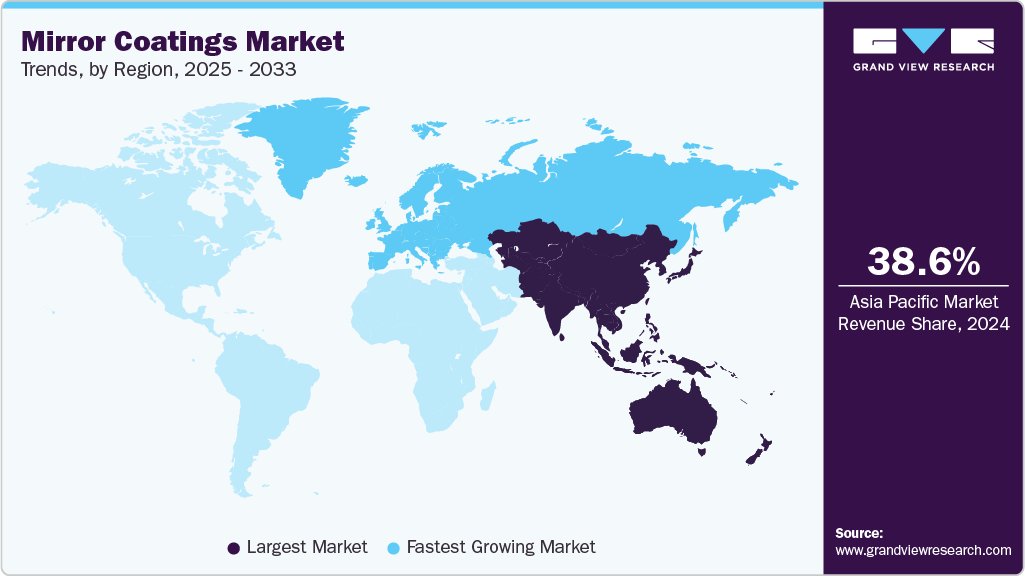
Asia Pacific market dominated the mirror coatings market with the largest revenue share of 38.6% in 2024. This dominance is driven by rapid urbanization, rising construction activity, and expanding automotive production across countries like China, India, and Southeast Asia. Growing adoption of energy-efficient materials and increasing investments in solar energy infrastructure further support market growth. The demand for decorative, architectural, and automotive mirrors continues to surge, while government initiatives promoting green building certifications accelerate the uptake of low-VOC and eco-friendly mirror coatings.
 To learn more about this report, Download Free Sample Report
 The mirror coatings market in China is a key growth engine for the Asia Pacific region, driven by large-scale infrastructure projects, high automotive output, and robust solar energy deployment. As the world’s leading solar panel producer, China’s demand for advanced reflective coatings is accelerating in support of concentrated solar power (CSP) and photovoltaic (PV) applications. In addition, increasing focus on sustainable construction, supported by national regulations promoting low-emission materials, is boosting the adoption of water-based and nanotechnology-enhanced mirror coatings in residential, commercial, and industrial developments.
Europe Mirror Coatings Market Trends
The mirror coatings market in Europe is expected to grow at the fastest CAGR of 5.4% during the forecast period. It is experiencing rapid growth, fueled by rapid urbanization, extensive infrastructure initiatives, and booming residential and commercial construction. Demand for low-VOC, water-based coatings is rising, especially in the construction and automotive sectors. Innovations in smart mirrors and functional coatings-such as anti-fog and self-cleaning technologies-are gaining traction in residential, healthcare, and hospitality settings. Europe’s emphasis on energy efficiency and green architecture further fuels the use of coated glass and mirrors in new infrastructure.
The Germany mirror coatings market is expanding rapidly, propelled by its strong automotive industry, progressive energy policies, and commitment to sustainable building practices. As a hub for green building innovations, Germany sees high demand for eco-friendly, high-performance mirror coatings in architectural glass and interior décor. The automotive sector also drives adoption of advanced coatings for exterior and interior mirrors with enhanced safety and optical clarity. Government support for solar energy, particularly in concentrated solar power (CSP) systems, further boosts demand for highly reflective, durable coatings.
Latin America Mirror Coatings Market Trends
The mirror coatings market in Latin America is expanding moderately, supported by increasing construction activity, urbanization, and growing awareness of sustainable materials. Countries like Brazil, Mexico, and Chile are witnessing infrastructure upgrades and a gradual shift toward green building practices. Rising middle-class income and demand for decorative, high-quality interior furnishings contribute to the adoption of mirror coatings. However, market growth is occasionally constrained by limited local production capacities and import reliance. Government incentives for renewable energy and solar investments are also fostering demand for high-reflectivity coatings in solar power applications.
Middle East & Africa Mirror Coatings Market Trends
The mirror coatings market in the Middle East & Africa is poised for growth, driven by rapid urban development, tourism infrastructure expansion, and rising investments in renewable energy. The United Arab Emirates and Saudi Arabia are spearheading smart city projects and energy-efficient building designs that increasingly utilize coated mirrors for both aesthetics and performance. Harsh climate conditions necessitate mirror coatings with enhanced UV resistance, durability, and anti-corrosion properties. In Africa, market growth is supported by gradual urbanization and energy access initiatives involving solar mirrors in off-grid or rural electrification programs.
Key Mirror Coating Company Insights
Some of the key players operating in the market include Edmund Optics Inc., SHERWIN-WILLIAMS, Arkema, Pearl Nano, Diamon-Fusion International, Inc.
-
Edmund Optics Inc. is a U.S.-based company headquartered in Barrington, New Jersey, specializing in the design and manufacture of precision optical components, assemblies, and imaging systems. Serving markets such as life sciences, industrial inspection, semiconductor, and defense, the company plays a pivotal role in supplying coated optical mirrors and lenses. With manufacturing facilities in the United States, Germany, Singapore, and China, Edmund Optics maintains a global footprint and emphasizes innovation, optical performance, and advanced coating technologies across its product lines.
-
Diamon-Fusion International, Inc. is a California-based surface coating technology company known for its proprietary chemical vapor deposition (CVD) process. The company specializes in hydrophobic and protective coatings for glass, mirrors, and other silica-based surfaces. DFI’s flagship product, Diamon-Fusion®, enhances durability, scratch resistance, and water repellency in architectural and automotive mirrors. With a presence in over 30 countries, DFI partners with glass manufacturers, fabricators, and OEMs worldwide. The company focuses on sustainability and performance in high-end, functional glass and mirror coatings.
General Optics (Asia) Limited, North America Coating Laboratories, Dynasil Corporation, and Guardian Industries are some of the emerging market participants in the mirror coatings industry.
-
General Optics (Asia) Limited, headquartered in Puducherry, India, is a subsidiary of the renowned Optics Balzers AG group. The company specializes in precision optical components, including high-performance mirrors, beam splitters, and coatings for industrial, defense, medical, and laser applications. It serves global clients with advanced thin-film deposition and metrology capabilities. With ISO-certified facilities, the company emphasizes R&D in optical coating technology. It is an important supplier within the Asia Pacific region for coated optics used in energy-efficient, automotive, and architectural sectors.
Key Mirror Coating Companies:
The following are the leading companies in the mirror coatings market. These companies collectively hold the largest market share and dictate industry trends.
- Abrisa Technologies
- AccuCoat inc.
- Arkema
- CASIX, Inc
- Diamon-Fusion International, Inc.
- Dynasil Corporation
- Edmund Optics Inc.
- FENZI S.p.A.
- General Optics (Asia) Limited
- Guardian Industries
- JENOPTIK AG
- North America Coating Laboratories
- Pearl Nano
- SHERWIN-WILLIAMS
Competitive Benchmarking
Operating Strategies
Competitive Edge
Weakness
Mature Players: Arkema; Guardian Industries; SHERWIN-WILLIAMS; JENOPTIK AG; FENZI S.p.A.; Edmund Optics Inc.; Abrisa Technologie
- Focus on expanding advanced reflective coating portfolios for automotive, architectural, solar, and optical applications
- Investment in high-performance, durable, and environmentally compliant coating technologies
- Strategic collaborations with OEMs and industrial glass manufacturers to strengthen long-term supply agreements
- Strong global distribution networks and established customer relationships
- Broad product portfolios with high-volume manufacturing capabilities
- Advanced R&D capabilities supporting innovation in anti-reflective, low-emissivity, and smart mirror coatings
- High dependence on raw material pricing and energy-intensive production processes
- Longer commercialization cycles for advanced coating technologies
- Exposure to fluctuations in construction, automotive, and industrial manufacturing demand
Emerging Players: AccuCoat Inc.; CASIX, Inc.; Diamon-Fusion International, Inc.; Dynasil Corporation; General Optics (Asia) Limited; North America Coating Laboratories; Pearl Nano
- Focus on niche optical coatings and customized mirror coating solutions for specialized applications
- Expansion through technology partnerships and application-specific product development
- Increasing emphasis on nano-coatings, anti-fog, anti-smudge, and high-durability surface technologies
- Higher operational flexibility and faster customization capabilities
- Strong focus on emerging coating technologies and precision optical applications
- Ability to address specialized customer requirements with lower production volumes
- Limited global market presence compared to established coating manufacturers
- Lower economies of scale and comparatively smaller production capacities
- Higher dependency on regional demand and specialized end-use industries
Recent Development
-
In March 2024, Guardian Glass and the VELUX Group entered a joint development agreement to advance tempered vacuum-insulated glass (VIG) technology. The partnership leverages both companies’ technical teams and intellectual property to accelerate the integration of VIG into VELUX roof window products, improving energy performance and sustainability.
-
In April 2024, Guardian Glass launched Guardian CrystalClear, a reduced-iron glass offering 67% greater color neutrality and 90% visible light transmission. It is compatible with Guardian SunGuard low-emissivity coatings and available in multiple thicknesses and jumbo sizes.
Mirror Coatings Market Report Scope
Report Attribute
Details
Market size value in 2025
USD 857.13 million
Revenue forecast in 2033
USD 1,309.05 million
Growth rate
CAGR of 5.4% from 2025 to 2033
Base year for estimation
2024
Historical data
2018 - 2023
Forecast period
2025 - 2033
Quantitative units
Volume in kilotons, Revenue in USD million/billion, and CAGR from 2025 to 2033
Report coverage
Revenue forecast, volume forecast, competitive landscape, growth factors, and trends
Segments covered
Resin, application, end use, region
Regional scope
North America; Europe; Asia Pacific; Latin America; Middle East & Africa
Country scope
U.S.; Canada; Mexico; Germany; UK; France; Italy; Spain; China; India; Japan; South Korea; Brazil; Argentina; Saudi Arabia; South Africa
Abrisa Technologies; AccuCoat Inc.; Arkema, CASIX, Inc.; Diamon-Fusion International, Inc.; Dynasil Corporation; Edmund Optics Inc.; FENZI S.p.A.; General Optics (Asia) Limited; Guardian Industries; JENOPTIK AG; North America Coating Laboratories; Pearl Nano; SHERWIN-WILLIAMS
Customization scope
Free report customization (equivalent up to 8 analyst’s working days) with purchase. Addition or alteration to country, regional, and segment scope.
Pricing and purchase options
Avail customized purchase options to meet your exact research needs. Explore purchase options
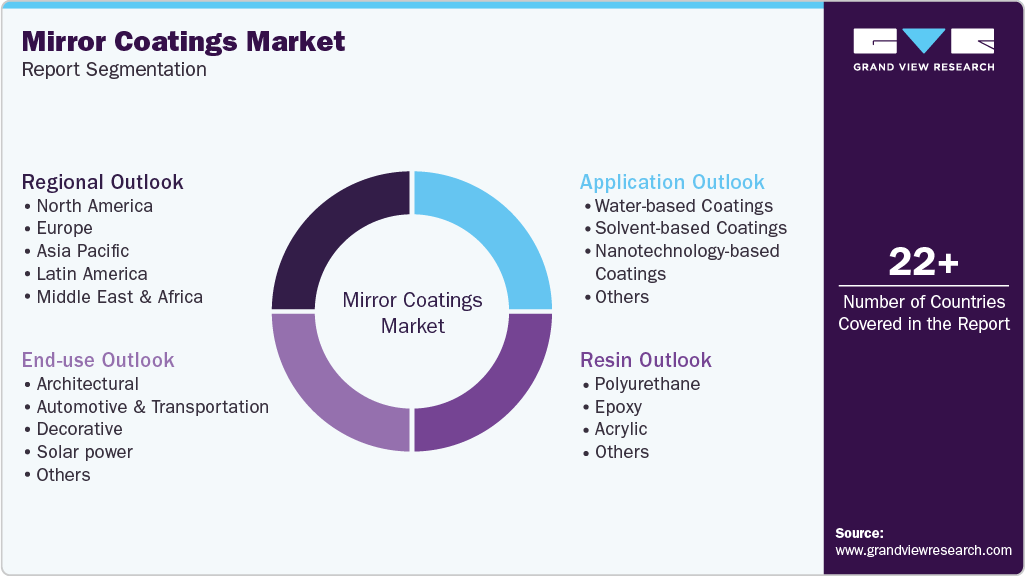
Global Mirror Coatings Market Report Segmentation
This report forecasts volume & revenue growth at a global level and provides an analysis of the latest industry trends in each of the sub-segments from 2018 to 2033. For this study, Grand View Research has segmented the global mirror coatings market report based on resin, application, end use, and region:
 To learn more about this report, Download Free Sample Report
 - Resin Outlook (Volume, Kilotons; Revenue, USD Million, 2018 - 2033)
-
Polyurethane
-
Epoxy
-
Acrylic
-
Others
-
- Application Outlook (Volume, Kilotons; Revenue, USD Million, 2018 - 2033)
-
Water-based coatings
-
Solvent-based coatings
-
Nanotechnology-based coatings
-
Others
-
-
End Use Outlook (Volume, Kilotons; Revenue, USD Million, 2018 - 2033)
-
Architectural
-
Automotive & Transportation
-
Decorative
-
Solar power
-
Others
-
-
Region Outlook (Volume, Kilotons; Revenue, USD Million, 2018 - 2033)
-
North America
-
U.S.
-
Canada
-
Mexico
-
-
Europe
-
Germany
-
UK
-
France
-
Italy
-
Spain
-
-
Asia Pacific
-
China
-
India
-
Japan
-
South Korea
-
-
Latin America
-
Brazil
-
Argentina
-
-
Middle East & Africa
-
Saudi Arabia
-
South Africa
-
-
Delivered Customizations
This report has been delivered with the following In-depth customizations
Client Request
Customization Delivered
Value Adds
Regional Segmentation
Expanded regional evaluation of the mirror coatings market across North America, Europe, Asia Pacific, Latin America, and Middle East & Africa was conducted, with additional country-level assessment of architectural construction activity, automotive production trends, solar infrastructure expansion, and decorative coating demand. The study also reviewed regional adoption patterns for polyurethane, epoxy, acrylic, water-based, solvent-based, and nanotechnology-based mirror coatings.
Facilitates identification of high-growth consumption regions and country-specific demand pockets. Supports regional expansion planning, manufacturing localization, and strategic distribution alignment across end-use industries.
Competitive Benchmarking
Key mirror coating manufacturers were benchmarked based on resin portfolio strength, coating technology expertise, sustainability initiatives, production capabilities, geographic presence, distribution networks, and innovation activity in advanced reflective coatings. The analysis also assessed positioning across automotive, architectural, and solar mirror applications.
Supports evaluation of competitive positioning and identification of differentiation opportunities within the reflective coatings value chain. Assists strategic planning, partnership evaluation, and market positioning decisions.
Opportunity Assessment
Emerging growth opportunities in smart mirrors, solar reflective coatings, eco-friendly water-based systems, and nanotechnology-enabled coatings were analyzed along with increasing adoption in green buildings, electric vehicles, and energy-efficient infrastructure projects. The assessment also reviewed evolving demand for durable and corrosion-resistant reflective coating technologies.
Helps identify future revenue pockets and innovation-focused investment areas. Supports long-term strategic planning, product pipeline expansion, and entry into high-growth application segments.
Frequently Asked Questions About This Report
The global mirror coatings market size was estimated at USD 819.57 million in 2024 and is expected to reach USD 857.13 million in 2025.
The global mirror coatings market is expected to grow at a compound annual growth rate of 5.4% from 2025 to 2033 to reach USD 1,309.05 million in 2033.
Asia Pacific region led the global landscape with a revenue share of 38.6% in 2024. It dominates the mirror coatings market due to rapid urbanization, rising construction and automotive output, and strong solar investments. Demand for decorative and energy-efficient mirrors is growing, supported by green building initiatives and adoption of low-VOC, eco-friendly coatings.
Some key players operating in the mirror coatings market include Abrisa Technologies, AccuCoat inc., Arkema, CASIX, Inc, Diamon-Fusion International, Inc., Dynasil Corporation, Edmund Optics Inc., FENZI S.p.A., General Optics (Asia) Limited, Guardian Industries, JENOPTIK AG, North America Coating Laboratories, Pearl Nano, SHERWIN-WILLIAMS.
The global mirror coatings market is driven by rising demand from construction, automotive, and solar sectors. Growth is fueled by smart mirrors, decorative interiors, eco-friendly nanocoatings, and expanding solar energy use, especially in emerging markets. Smart home trends and luxury interiors further boost coated mirror adoption.
About the Author(s)
Paints, Coatings & Printing Inks Research Team
Bulk Chemicals · Paints, Coatings & Printing InksThis report was authored by the paints, coatings & printing inks research team at Grand View Research - comprising two research analysts, one senior research analyst, and one industry expert - with specialized expertise in the paints, coatings & printing inks segment of the bulk chemicals industry. All findings are based on proprietary bulk chemicals databases, executive interviews, and regulatory analysis, subject to internal peer review prior to publication.
Last Updated:
Speak to Analyst

Customize this report to your needs - add regions, segments, or data points, with 20% free customization.
Or view our licence options:


ISO 9001:2015 & 27001:2022 Certified
We are GDPR and CCPA compliant! Your transaction & personal information is safe and secure. For more details, please read our privacy policy.


