
- Home
- »
- Plastics, Polymers & Resins
- »
-
Molded Fiber Packaging Market Size & Share Report, 2033GVR Report cover

Molded Fiber Packaging Market (2026 - 2033)
Size, Share & Trends Analysis Report By Source (Wood Pulp, Non-Wood Pulp), By Type (Thermoformed, Transfer), By Product, By End Use, By Region, And Segment Forecasts
Market Size, 2025
$9.0BMarket Estimate, 2026
$9.4BMarket Forecast, 2033
$13.5BCAGR, 2026–2033
5.2%Molded Fiber Packaging Market Summary
The global molded fiber packaging market size was valued at USD 9.0 billion in 2025 and is projected to grow from USD 9.4 billion in 2026 to USD 13.5 billion by 2033, at a CAGR of 5.2% from 2026 to 2033. The market in Asia Pacific dominated with a revenue share of 34.6% in 2025. Growing consumer-driven demand for sustainable and environmentally-friendly packaging solutions is expected to drive market growth over the forecast period.
 Source: Grand View Research, IR Documents, Primary Interviews, Paid DatabasesTo learn more about this report,
 Download Free Sample Report
Key Market Trends & Insights
- By source: Wood pulp segment held the largest market share of 68.4% in 2025.
- By type: Transfer segment held the largest market share of 48.4% in 2025.
- By product: Trays segment held the largest market share of 34.6% in 2025.
- By end use: Food packaging segment held the largest market share of 39.4% in 2025.
Regional Highlights
- Largest regional market: Asia Pacific (34.6% revenue share, 2025)
- By country: China held the largest market share in 2025
Market Size & Forecast
- Market size in 2025: USD 9.0 Billion
- Estimated market size in 2026: USD 9.4 Billion
- Projected market size by 2033: USD 13.5 Billion
- CAGR (2026-2033): 5.2%
Three ways to get this report
Buy it, customize it, or ask a question.Ask an Analyst
Analyst response in 1 business day
- AccessReport author, directly
- Reply timeWithin 1 working day
- No sales callDirect answer only
- FormatEmail reply
- CostFree, no cost
Get the Full Report
What the study covers
- FormatsPDF · Excel · Dashboard
- Timeline2026–2033 annual, 2025 base
- Coverage20+ countries, 5 regions
- Companies10+ key players profiled
Customize the Report
20% free customization
- IncludeCountries, segments, points
- TailorTo your product definition
- ExtendDeeper competitor detail
- OrA fully bespoke study
- Turnaround5–10 working days
Eggs are packaged in molded fiber trays and clamshells, which are then sold to restaurants, foodservice operators, and individual buyers. In addition, per capita egg consumption is increasing on a yearly basis in the world. Thus, the rising consumption of eggs, owing to the expanding population, associated health benefits, and increasing demand for higher protein intake, is anticipated to drive the demand for molded fiber packaging products, thereby propelling market growth.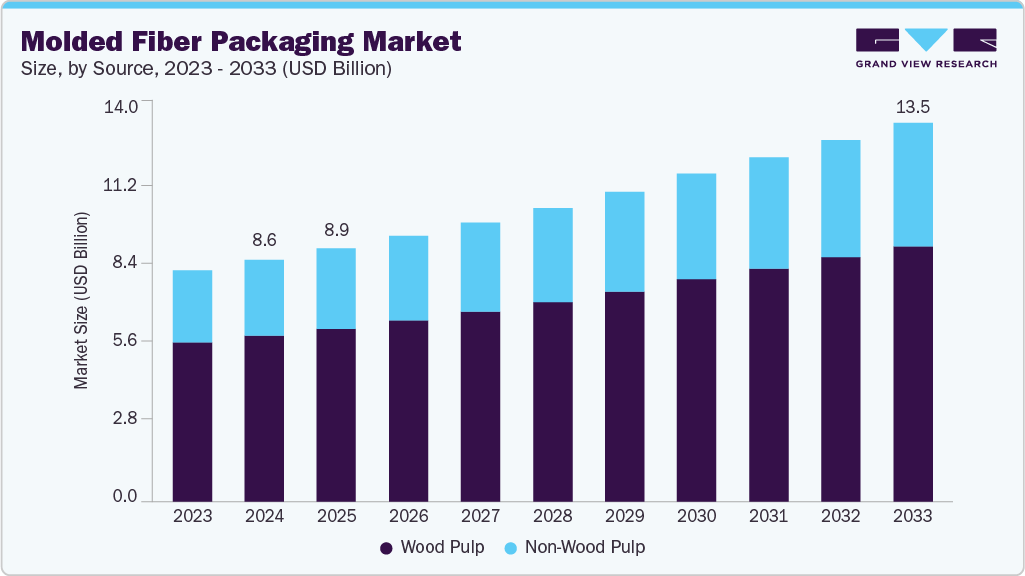 To learn more about this report, Download Free Sample Report
The rising consumption of eggs has increased the production of eggs. Eggs are packed in plastic as well as molded fiber trays and clamshells, which are further sold to retail chains and foodservice operators. The U.S., Netherlands, and Turkey are among the top exporters of eggs in the world. Molded fiber packaging can also be used for the storage and transportation of eggs, which is expected to drive the market over the forecast period.
Apart from eggs, fruits such as apples, avocados, guavas, and oranges are packaged in molded fiber packaging products such as trays. Factors such as a growing population, rising disposable income, and the growing trend of a healthy lifestyle are expected to drive the demand for fresh fruits in the coming years. This is expected to augment the demand for molded fiber packaging over the forecast period.
Manufacturers are striving to maintain a healthy competitive environment across the market space by implementing various strategies. For instance, in January 2024, Genpak launched a new sustainable molded fiber packaging line called the revamped Harvest Fiber, which includes hinged food service containers, trays, and tableware made from renewable fibers with no intentionally added PFAS. These containers are microwaveable and suitable for both hot and cold food applications, designed to meet the needs of foodservice operators by combining environmental sustainability with reliable performance and durability. The packaging is also BPI Certified Commercially Compostable and USDA BioPreferred, offering a practical and economical solution for restaurants facing increasing regulations against PFAS, while maintaining meal integrity for in-house and off-premises dining.
Market Dynamics
The molded fiber packaging market is experiencing steady growth, driven by increasing demand for sustainable packaging solutions, rising restrictions on single-use plastics, and growing consumer preference for recyclable and biodegradable materials. Expanding applications across food service, consumer goods, electronics, and healthcare sectors, along with advancements in molded fiber technology, are supporting market adoption. However, higher production costs and limited barrier properties compared to plastic packaging may hinder growth. Despite these challenges, ongoing innovation and increasing sustainability initiatives are expected to create favorable opportunities for market expansion.
The increasing demand for sustainable and eco-friendly packaging solutions is the primary driver of the molded fiber packaging market. Growing environmental concerns, heightened awareness of plastic pollution, and stricter government regulations on single-use plastics are encouraging businesses to adopt packaging materials with lower environmental impact. Molded fiber packaging, produced from renewable and recycled paper-based materials, offers biodegradability, recyclability, and compostability, making it an attractive alternative to conventional plastic packaging. As consumers increasingly favor environmentally responsible products, manufacturers across multiple industries are incorporating molded fiber packaging into their sustainability strategies.
The major companies in the food service, consumer electronics, healthcare, and consumer goods sectors are further strengthening their commitments to circular economy principles and reducing packaging waste. Molded fiber packaging helps organizations meet sustainability targets while maintaining product protection and packaging functionality. Continuous advancements in manufacturing processes have also improved the durability, design flexibility, and performance of molded fiber products, further supporting their adoption. As environmental regulations tighten and corporate sustainability initiatives expand globally, demand for molded fiber packaging is expected to continue rising significantly.
Higher production costs compared to conventional plastic packaging remain a significant restraint for the molded fiber packaging market. The manufacturing process often requires specialized equipment, substantial energy consumption, and additional treatments to enhance moisture and grease resistance, increasing overall production expenses. Furthermore, fluctuations in the availability and pricing of recycled paper and other fiber-based raw materials can impact cost structures. These factors make molded fiber packaging relatively more expensive than traditional plastic alternatives, limiting adoption among price-sensitive end users and creating challenges for widespread market penetration, particularly in developing economies.
The expanding use of sustainable packaging across diverse industries presents a significant opportunity for the molded fiber packaging market. Beyond traditional food service applications, industries such as consumer electronics, healthcare, cosmetics, and e-commerce are increasingly adopting molded fiber packaging to reduce environmental impact and meet sustainability goals. Growing demand for plastic-free packaging solutions, coupled with corporate commitments to carbon reduction and circular economy initiatives, is encouraging the development of innovative molded fiber products with enhanced strength, cushioning, and barrier properties. As businesses continue to prioritize sustainable packaging alternatives, the scope for molded fiber packaging is expected to expand substantially across global markets.
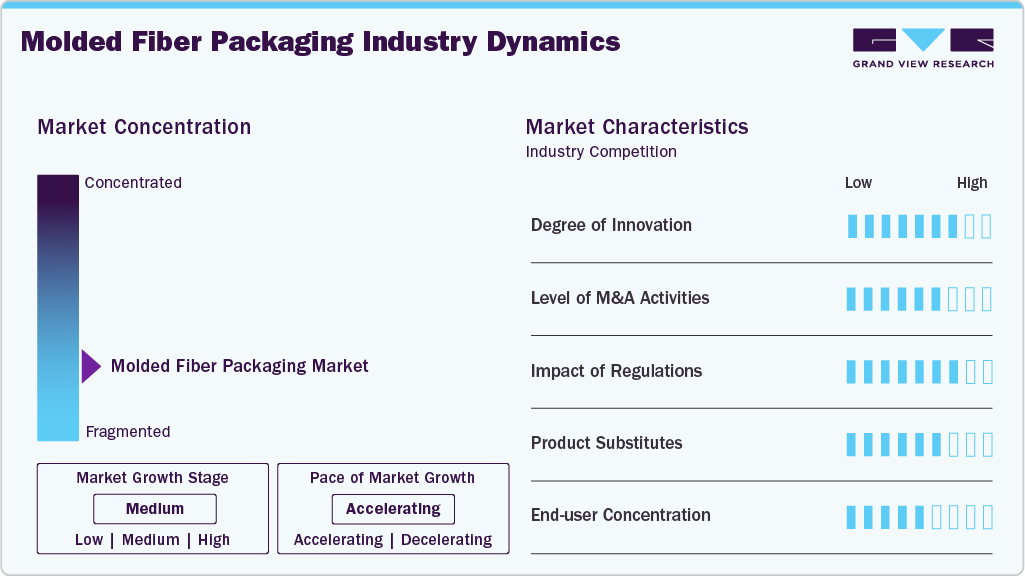
Market Concentration & Characteristics
The industry is characterized by its strong emphasis on sustainability, as products are primarily made from renewable, recycled, or biodegradable materials such as paper pulp, bagasse, and bamboo fibers. This eco-friendly approach aligns with growing consumer awareness about environmental issues and regulatory initiatives promoting recyclable and compostable packaging solutions. Companies in this industry aim to reduce plastic waste while providing functional alternatives for packaging across various sectors.
 To learn more about this report, Download Free Sample Report
The industry is heavily influenced by environmental regulations and sustainability standards. Compliance with guidelines on recyclability, compostability, and biodegradability is essential for market acceptance. Regulations such as the EU’s Single-Use Plastics Directive and various national Extended Producer Responsibility (EPR) programs incentivize the adoption of molded fiber solutions and drive market growth, especially in regions with strict environmental policies.
Analyst Perspective
The molded fiber packaging market is expected to grow steadily, driven by rising demand for sustainable and biodegradable packaging solutions across food & beverages, healthcare, and consumer goods industries. Increasing restrictions on single-use plastics, growing consumer preference for eco-friendly packaging, and corporate sustainability initiatives are accelerating market growth. Furthermore, advancements in molded fiber manufacturing technologies are improving product performance and expanding application areas, strengthening market adoption.
Source Insights
Based on source, the wood pulp segment led the market with the largest revenue share of 68.4% in 2025. Molded fiber packaging manufacturers mainly use waste newspapers for manufacturing fiber. The wide availability of wastepaper and virgin wood can be attributed to the highest share of the segment in 2024.
Non-wood pulp is expected to be the fastest growing source segment, with a growth rate of 5.7% over the forecast period. Non-wood pulp sources eliminate the need for virgin wood and, hence, provide complete sustainability, contributing to its growing market penetration rate.
Type Insights
Based on type, the transfer segment led the market with the largest revenue share of 48.4% in 2025. The wide-scale adoption of transfer molded fiber products, such as trays and clamshells for eggs and fruit packaging, can be attributed to the highest revenue share of the segment in the global market.
The thermoformed molded products segment is expected to grow with the highest growth rate of 5.7% over the forecast period. Thermoformed molded products offer higher aesthetic appeal, which has been driving considerable traction for the segment since the past several years.
Product Insights
Based on product, the trays segment led the market with the largest revenue share of 34.6% in 2025. Low cost, wide availability, and good shock absorption characteristics for the packaging of fragile products such as eggs and glass beverage bottles contributed to the highest share of the segment.
Clamshells are anticipated to progress in the product segment at a CAGR of 6.0% over the forecast period. The demand for molded fiber clamshells is rapidly increasing due to the high demand for retail egg packaging.
End Use Insights
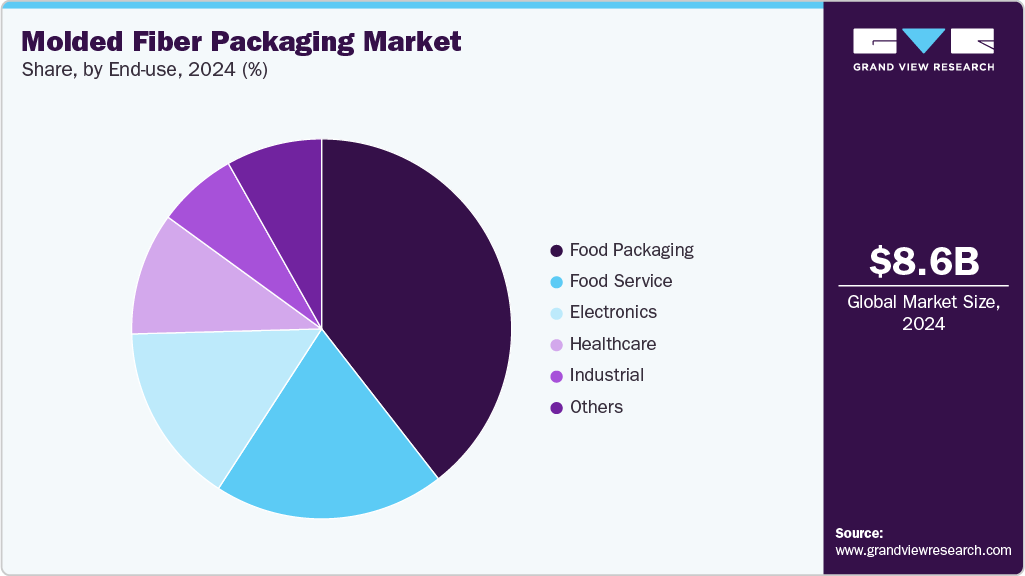
Food packaging emerged as the most significant end-use segment in 2024 and accounted for over 39.0% of the overall market share. Molded fiber packaging products, such as trays and clamshells used in the food industry, offer cushioning for fragile food items such as fruits and eggs. The molded fiber trays are used for stacking fruits in cardboard boxes. The growing import and export of fruits globally is expected to drive the demand for molded fiber packaging in the food packaging end-use industry.
 To learn more about this report, Download Free Sample Report
The food service sector is expected to be the fastest growing end-use segment in the market, driven by the growing demand for eco-friendly, disposable packaging solutions in restaurants, cafés, fast food chains, and catering services. Molded fiber products such as plates, bowls, trays, clamshells, and cups are widely used to replace single-use plastics due to their biodegradability, compostability, and cost-effectiveness. The rising trend of takeout, delivery services, and outdoor dining has further accelerated the adoption of molded fiber packaging.
Regional Insights
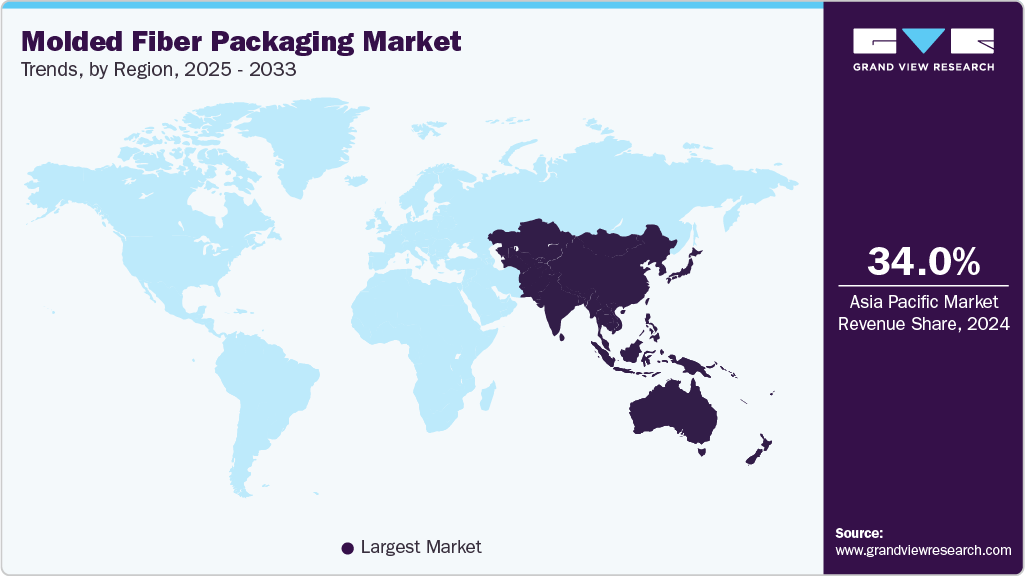
Asia Pacific dominated the molded fiber packaging market with the largest revenue share of 34.6% in 2025. The region is segmented into China, Japan, and India. China accounted for the largest market share of the market in 2024 in Asia Pacific, attributed to the large food & beverage industry, followed by the electronics market, owing to the high population and increasing disposable income of consumers in the country. Moreover, the country is home to several electronic companies such as Huawei Technologies Co., Ltd, Lenovo, Xiaomi, and others, which gives rise to demand for molded fiber packaging to store and transport delicate electronic goods.
 To learn more about this report, Download Free Sample Report
This growth in market share can be ascribed to the rising importance of using disposable packaging solutions on account of rising instances of environment-related problems faced by economies such as China and India in recent years. According to various sources, crates of unwanted packaging waste from the West have accumulated in many ports of Indonesia, the Philippines, and Vietnam. In another instance, huge piles of toxic waste from plastics from Europe and the U.S. have piled up across Malaysia. To improve these situations, local authorities and governments have vowed to reduce the landfill waste accumulated in the Southeast Asia region by introducing strict regulations related to waste disposal. These steps are likely to lead to the adoption of more sustainable packaging solutions across the verticals.
China Molded Fiber Packaging Market Trends
The molded fiber packaging market in China held the largest share in the Asia Pacific region in 2025. Out of this foodservice, full-service restaurants accounted for the highest share (around 70%) of sales. Emergence of problems related to the environment and pollution in the country has forced the governmental agencies and organizations to strictly adhere to sustainability strategies. This essentially meant to adopt biodegradable packaging solutions and ban the use of single-use plastic.
North America Molded Fiber Packaging Market Trends
Increasing digitization and focus on reducing the use of plastics, especially in packaged food and foodservice industry, are expected to augment the demand for molded fiber packaging in North America. Regulations pertaining to environmental safety and the rising need for easy disposal are expected to drive the demand for bio-based materials in packaging applications. This is expected to boost the overall market growth in the coming years.
In November 2021, ProAmpac Intermediate, Inc. acquired Irish Flexible Packaging and Fispak from their parent company, IFP Investments Limited. With these acquisitions, ProAmpac advances its strategy to expand in Europe and the United Kingdom by further enhancing its existing product offering with a strong portfolio of sustainability-focused flexible packaging capabilities. Such collaborations and partnerships are expected to drive the demand for molded fiber packaging over the forecast period.
Europe Molded Fiber Packaging Market Trends
The growth of the molded fiber packaging market in Europe can be attributed to the wide application scope for molded fiber packaging in the food service & packaging industry in Europe. The EU had close to one million restaurants and mobile food services in 2023, and the number is expected to increase during the forecast period. With an increasing number of restaurants and other food outlets, the demand for sustainable packaging solutions is also expected to grow. The member countries of the EU maintain a stringent regulatory regime to keep a check on environmental impacts caused by the disposal of wastes, mainly plastics.
Key Molded Fiber Packaging Company Insights
Key players operating in the molded fiber packaging market are undertaking various initiatives to strengthen their presence and increase the reach of their products and services. Strategies such as expansion activities and partnerships are key in propelling the market growth.
Key Molded Fiber Packaging Companies:
The following key companies have been profiled for this study on the molded fiber packaging market.
-
Amcor plc
-
Huhtamaki
-
Hartmann Packaging A/S
-
CKF Inc.
-
Stora Enso
-
PulPac
-
Genpak
-
ProAmpac
-
Otarapack
-
Mayr-Melnhof Karton AG
-
Pro-Care Packaging
-
Pactiv Evergreen Inc.
-
Sabert Corporation
-
Henry Molded Products Inc.
-
Wynalda Packaging
-
Dart Container Corporation
-
Jiangyin Pton Molded Fiber Products Co., Ltd
-
Fuzhou QiQi Paper Products Co., Ltd.
Competitive Benchmarking
Category
Operating Strategies
Competitive Edge
Weakness
Established Players (Amcor plc, Huhtamaki, Hartmann Packaging A/S, CKF Inc., Stora Enso, Genpak, ProAmpac, Mayr-Melnhof Karton AG, Pactiv Evergreen Inc., Sabert Corporation, Dart Container Corporation)
- Focus on expanding sustainable liquid packaging portfolios through continuous investment in recyclable, renewable, and high-performance packaging technologies.
- Strengthen global market presence by leveraging integrated manufacturing networks, long-term customer partnerships, and strategic acquisitions.
- Extensive production capabilities and diversified product portfolios enable efficient servicing of large-scale multinational customers across multiple end-use industries.
- Strong financial resources support continuous innovation, regulatory compliance, and investments in advanced manufacturing technologies.
- Large organizational structures can reduce operational agility and slow response to rapidly changing customer requirements and market trends.
- High capital expenditure and complex global operations increase fixed costs and expose companies to fluctuations in raw material and energy prices.
Emerging Players (PulPac, Otarapack, Pro-Care Packaging, Henry Molded Products Inc., Wynalda Packaging, Jiangyin Pton Molded Fiber Products Co., Ltd, Fuzhou QiQi Paper Products Co., Ltd)
- Differentiate through specialized liquid packaging solutions, customization capabilities, and customer-centric product development for niche applications.
- Expand market presence by adopting innovative sustainable materials, flexible manufacturing processes, and partnerships with regional distributors.
- Lean organizational structures enable faster decision-making, quicker product development, and greater responsiveness to evolving customer demands.
- Strong focus on innovation and niche market segments allows companies to establish differentiation despite limited market scale.
- Limited financial resources and manufacturing capacity restrict large-scale expansion, research investments, and global market penetration.
- Lower brand recognition and comparatively smaller distribution networks make it challenging to compete with established multinational packaging companies.
Recent Developments
-
In June 2025, Stora Enso and Matrix Pack entered a strategic partnership to accelerate the development of sustainable formed fiber packaging. This collaboration combines Stora Enso's leadership in renewable materials with Matrix Pack's global manufacturing expertise. The partnership aims to scale up fiber-based solutions to replace conventional plastics, enhancing circularity in packaging.
-
In June 2025, International Paper announced its exit from the molded fiber market as part of a strategic transformation to streamline operations and focus on sustainable packaging growth. The company will close its packaging facility in Marion, Ohio, and its recycling facility in Wichita, Kansas.
-
In June 2025, PulPac secured a EUR 20.0 million loan from the European Investment Bank to advance its Dry Molded Fiber technology. The funding will drive R&D efforts to enhance product performance and expand sustainable packaging solutions. This move aims to accelerate the shift from plastic to fiber-based packaging across industries.
Molded Fiber Packaging Market Report Scope
Report Attribute
Details
Market size in 2025
USD 9.0 billion
Estimated market size in 2026
USD 9.4 billion
Projected market size by 2033
USD 13.5 billion
Growth rate
CAGR of 5.2% from 2026 to 2033
Base year for estimation
2025
Historical data
2021 - 2024
Forecast period
2026 - 2033
Quantitative units
Revenue in USD million/billion and CAGR from 2026 to 2033
Report coverage
Revenue forecast, company ranking, competitive landscape, growth factors, and trends
Segments covered
Source, type, product, end use, region
Regional scope
North America; Europe; Asia Pacific; Latin America; MEA
Country scope
U.S.; Canada; Mexico; Germany; UK; France; Italy; Spain; China; Japan; India; South Korea; Australia; Brazil; Argentina; Saudi Arabia; South Africa; UAE
Key companies profiled
Amcor plc; Huhtamaki; Hartmann Packaging A/S; CKF Inc.; Stora Enso; PulPac; Genpak; ProAmpac; Otarapack; Mayr-Melnhof Karton AG; Pro-Care Packaging; Pactiv Evergreen Inc.; Sabert Corporation; Henry Molded Products Inc.; Wynalda Packaging; Dart Container Corporation; Jiangyin Pton Molded Fiber Products Co., Ltd; Fuzhou QiQi Paper Products Co., Ltd.
Customization scope
Free report customization (equivalent up to 8 analysts' working days) with purchase. Addition or alteration to country, regional & segment scope.
Pricing and purchase options
Avail customized purchase options to meet your exact research needs. Explore purchase options
Global Molded Fiber Packaging Market Report Segmentation
This report forecasts volume & revenue growth at global, regional, and country levels and provides an analysis of the latest industry trends and opportunities in each of the sub-segments from 2021 to 2033. For this study, Grand View Research has segmented the global molded fiber packaging market report on the basis of source, type, product, end-use, and region:
-
Source Outlook (Volume, Kilotons; Revenue, USD Million, 2021 - 2033)
-
Wood Pulp
-
Non-wood Pulp
-
-
Type Outlook (Volume, Kilotons; Revenue, USD Million, 2021 - 2033)
-
Thick Wall
-
Transfer
-
Thermoformed
-
Processed
-
-
Product Outlook (Volume, Kilotons; Revenue, USD Million, 2021 - 2033)
-
Trays
-
End Caps
-
Bowls & Cups
-
Clamshells
-
Plates
-
Others
-
-
End Use Outlook (Volume, Kilotons; Revenue, USD Million, 2021 - 2033)
-
Food Packaging
-
Food Service
-
Electronics
-
Healthcare
-
Industrial
-
Others
-
-
Regional Outlook (Volume, Kilotons; Revenue, USD Million, 2021 - 2033)
-
North America
-
U.S.
-
Canada
-
Mexico
-
-
Europe
-
Germany
-
France
-
UK
-
Italy
-
Spain
-
-
Asia Pacific
-
China
-
India
-
Japan
-
South Korea
-
Southeast Asia
-
-
Central & South America
-
Brazil
-
Argentina
-
-
Middle East & Africa
-
Saudi Arabia
-
UAE
-
South Africa
-
-
Research Methodology
The molded fiber packaging market figures in this report are based on a proven research process that combines executive interviews with secondary research from proprietary databases, company filings, and recognized regulatory and institutional sources. Market size is built through value-chain sizing - reconciling supply-side and demand-side estimates - and triangulated with bottom-up and top-down approaches. Every estimate passes multiple levels of expert validation before publication, with each molded fiber packaging segment quantified using the revenue-capture definitions in the table below.
Segment Definition
Segment - Source
Revenue capture definition
Wood Pulp
Revenue generated from the sale of molded fiber packaging manufactured using virgin or recycled wood pulp. This segment includes packaging products used across food & beverages, electronics, healthcare, industrial, and consumer goods applications where high strength, consistency, and sustainability are required.
Non-Wood Pulp
Revenue generated from the sale of molded fiber packaging produced from alternative natural fibers such as bagasse, bamboo, wheat straw, and other agricultural residues. This segment includes eco-friendly packaging solutions designed for food service, retail, consumer goods, and other applications seeking renewable and biodegradable packaging materials.
Segment - Type
Revenue capture definition
Thick Wall
Revenue generated from the sale of thick-wall molded fiber packaging designed for heavy-duty protection and industrial applications. This segment includes protective packaging used for automotive components, machinery parts, furniture, and other bulky products requiring superior cushioning.
Transfer
Revenue generated from the sale of transfer molded fiber packaging manufactured with improved surface finish and dimensional accuracy. This segment includes trays, cartons, and protective packaging used in food service, consumer goods, and electronics applications.
Thermoformed
Revenue generated from the sale of thermoformed molded fiber packaging produced using advanced molding technology for smooth surfaces and precise product designs. This segment includes premium packaging for food, electronics, healthcare, and consumer products requiring enhanced aesthetics and product protection.
Processed
Revenue generated from the sale of processed molded fiber packaging that undergoes secondary finishing operations such as coating, printing, trimming, or lamination to improve functionality, moisture resistance, and visual appeal. This segment includes customized packaging solutions for premium retail and specialty applications.
Segment - Product
Revenue capture definition
Trays
Revenue generated from the sale of molded fiber trays used for packaging, transporting, and protecting food products, eggs, fruits, electronics, and industrial components.
End Caps
Revenue generated from the sale of molded fiber end caps designed to cushion and protect products during storage and transportation. This segment includes protective packaging for electronics, appliances, furniture, and consumer goods.
Bowls & Cups
Revenue generated from the sale of molded fiber bowls and cups used for food service, takeaway, and beverage applications. This segment includes compostable and biodegradable disposable tableware for restaurants, catering, and retail outlets.
Clamshells
Revenue generated from the sale of molded fiber clamshell containers used for packaging fresh produce, ready-to-eat meals, bakery products, and takeaway food. This segment includes hinged containers offering product protection and convenience.
Plates
Revenue generated from the sale of molded fiber plates designed for disposable food service applications. This segment includes biodegradable plates used in households, restaurants, catering services, and institutional foodservice.
Others
Revenue generated from the sale of other molded fiber packaging products, including inserts, cups carriers, bottle holders, custom protective packaging, and specialty molded fiber solutions across multiple end-use industries.
Segment - End Use
Revenue capture definition
Food & Beverages
Revenue generated from the sale of molded fiber packaging used for food and beverage applications, including trays, clamshells, bowls, cups, plates, egg cartons, and fresh produce packaging designed to provide sustainable product protection and convenience.
Pharmaceuticals
Revenue generated from the sale of molded fiber packaging used for pharmaceutical products, medical devices, laboratory equipment, and healthcare supplies requiring protective, recyclable, and environmentally friendly packaging solutions.
Personal Care
Revenue generated from the sale of molded fiber packaging used for cosmetics, skincare, personal hygiene products, and premium beauty products, providing protective and sustainable packaging alternatives for retail distribution.
Others
Revenue generated from the sale of molded fiber packaging used across electronics, consumer goods, automotive, industrial, e-commerce, and other applications requiring protective, biodegradable, and recyclable packaging solutions.
Estimation Model
Layer Name
Key Question
Description
Packaging Demand Base Layer
What forms the demand base?
Identify global demand for molded fiber packaging across major end-use industries, including food & beverages, pharmaceuticals, personal care, consumer electronics, industrial goods, and e-commerce. This layer establishes the total addressable demand for sustainable fiber-based packaging solutions across developed and emerging markets.
Material & Application Penetration Layer
Where is molded fiber packaging utilized?
Estimate the adoption of molded fiber packaging by source (wood pulp and non-wood pulp), product type, and end-use industry. Assess penetration levels based on sustainability regulations, replacement of plastic packaging, consumer preferences, and industry-specific packaging requirements across key regions.
Production & Supply Chain Layer
How much molded fiber packaging is supplied?
Analyze production capacity, raw material availability, manufacturing output, supply chain efficiency, distribution networks, and regional trade flows for molded fiber packaging. Evaluate the impact of pulp availability, manufacturing technologies, logistics infrastructure, and end-user demand on market supply.
Revenue Layer
How is market revenue generated?
Market revenue is quantified through the sale of molded fiber packaging products, including trays, end caps, bowls & cups, clamshells, plates, and other molded fiber solutions. Revenue is generated from demand across food & beverages, pharmaceuticals, personal care, industrial, consumer goods, and other end-use industries, supported by the increasing adoption of sustainable and biodegradable packaging solutions.
Delivered Customizations
This report has been delivered with the following In-depth customizations
Client Request
Customization Delivered
Value Adds
Regional Segmentation Analysis
Delivered a detailed regional assessment of the molded fiber packaging market across North America, Europe, Asia Pacific, Central & South America, and the Middle East & Africa, highlighting market size, growth trends, regulatory landscape, sustainability initiatives, production capacity, and end-use demand across each region.
Enabled identification of high-growth regions, supported region-specific market entry strategies, and facilitated investment prioritization based on demand, sustainability regulations, and manufacturing capabilities.
Cross-Segmentation Analysis
Provided comprehensive cross-segmentation analysis by correlating Source (Wood Pulp, Non-Wood Pulp) with Type (Thick Wall, Transfer, Thermoformed, Processed), Product (Trays, End Caps, Bowls & Cups, Clamshells, Plates, Others), and End Use (Food Packaging, Food Service, Electronics, Healthcare, Industrial, Others) across major regions to identify high-growth market combinations.
Helped uncover niche growth opportunities, optimize product portfolio planning, and prioritize high-demand source-type-product-end use combinations across regional markets.
Competitive Benchmarking
Conducted benchmarking of leading molded fiber packaging manufacturers based on product portfolio across multiple product and type categories, production capabilities, sustainability initiatives, geographic presence, innovation focus, and end-use industry coverage.
Assisted in evaluating competitive positioning, identifying market gaps, and developing differentiation strategies to strengthen market competitiveness.
Frequently Asked Questions About This Report
The global molded fiber packaging market size was valued at USD 9.0 billion in 2025 and is estimated at USD 9.4 billion for 2026.
The global molded fiber packaging market is expected to grow at a CAGR of 5.2% from 2026 to 2033, reaching USD 13.5 billion by 2033.
Asia Pacific dominated the molded fiber packaging market with a 34.6% revenue share in 2025.
Asia Pacific is the fastest-growing region in the molded fiber packaging market with a CAGR of 5.7% over the forecast period.
The wood pulp segment led the molded fiber packaging market with a 68.4% revenue share in 2025.
The transfer segment led the molded fiber packaging market with a 48.4% revenue share in 2025.
The food packaging segment led the molded fiber packaging market with a 39.4% revenue share in 2025.
Key factors driving the molded fiber packaging market include rising demand for sustainable packaging, increasing restrictions on single-use plastics, growing consumer preference for eco-friendly products, expanding end-use applications, and continuous advancements in molded fiber manufacturing technologies.
Key players in the molded fiber packaging market include Amcor plc; Huhtamaki; Hartmann Packaging A/S; CKF Inc.; Stora Enso; PulPac; Genpak; ProAmpac; Otarapack; Mayr-Melnhof Karton AG; Pro-Care Packaging; Pactiv Evergreen Inc.; Sabert Corporation; Henry Molded Products Inc.; Wynalda Packaging; Dart Container Corporation; Jiangyin Pton Molded Fiber Products Co., Ltd; and Fuzhou QiQi Paper Products Co., Ltd.
About the Author(s)
Plastics, Polymers & Resins Research Team
Bulk Chemicals · Plastics, Polymers & ResinsThis report was authored by the plastics, polymers & resins research team at Grand View Research - comprising two research analysts, one senior research analyst, and one industry expert - with specialized expertise in the plastics, polymers & resins segment of the bulk chemicals industry. All findings are based on proprietary bulk chemicals databases, executive interviews, and regulatory analysis, subject to internal peer review prior to publication.
Last Updated:
Speak to Analyst

Customize this report to your needs - add regions, segments, or data points, with 20% free customization.
Or view our licence options:


ISO 9001:2015 & 27001:2022 Certified
We are GDPR and CCPA compliant! Your transaction & personal information is safe and secure. For more details, please read our privacy policy.


