
- Home
- »
- Plastics, Polymers & Resins
- »
-
Multi-layer Film Recycling Market Size Report, 2025-2033GVR Report cover

Multi-layer Film Recycling Market (2025 - 2033)
Size, Share & Trends Analysis Report By Laminate Type (PE/PA Films, PE/PET Films, PE/PP Films, Foil-based Laminates, Barrier-coated Films), By End Use, By Region, And Segment Forecasts
Market Size, 2024
$42.4MMarket Estimate, 2026
$48.8MMarket Forecast, 2033
$83.0MCAGR, 2025–2033
7.8%Multi-layer Film Recycling Market Summary
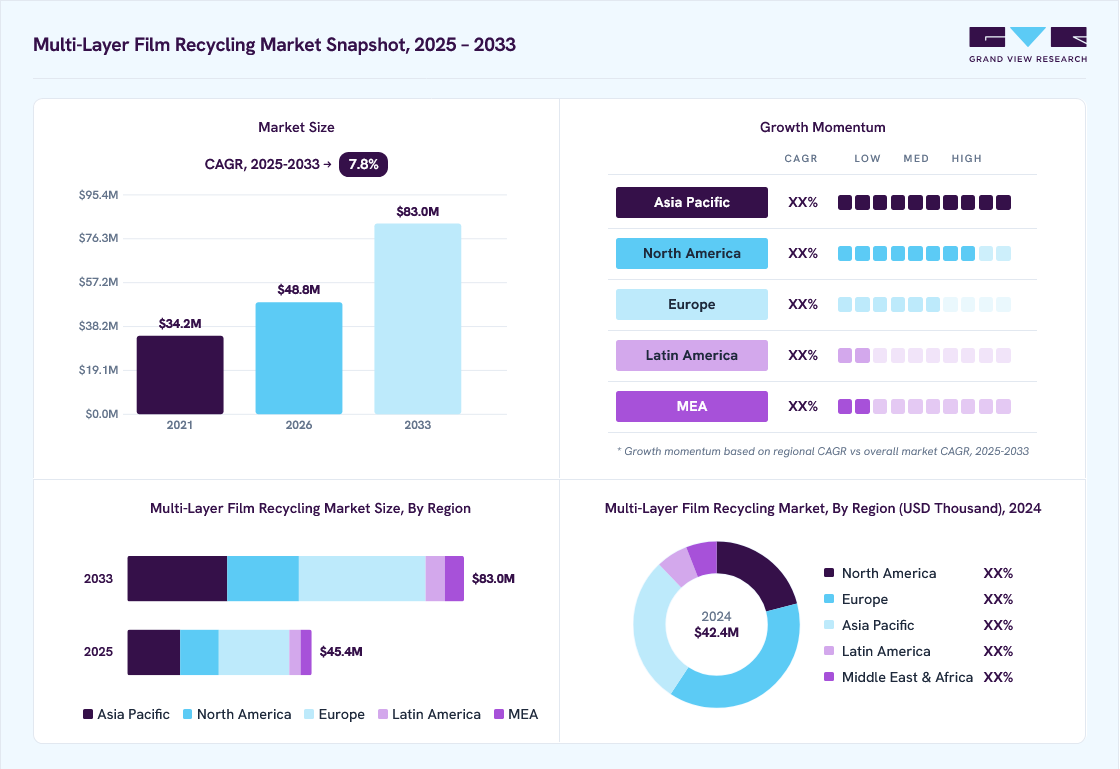
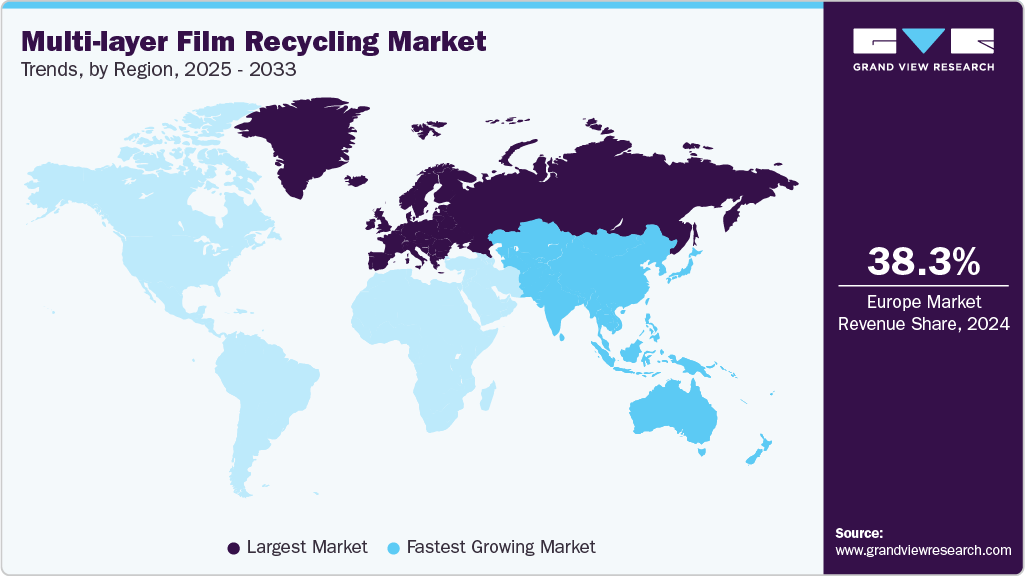
The global multi-layer film recycling market size was valued at USD 42.4 million in 2024 and is projected to grow from USD 48.8 million in 2026 to USD 83.0 million by 2033, at a CAGR of 7.8% from 2025 to 2033. Europe dominated the market, accounting for a revenue share of 38.3% in 2024. The market represents a critical evolution within the broader plastic waste management sector, focusing on films made from combined materials such as polyethylene (PE), polypropylene (PP), polyethylene terephthalate (PET), polyamide (PA), and aluminum foils.
 Source: Grand View Research, IR Documents, Primary Interviews, Paid DatabasesTo learn more about this report,
 Download Free Sample Report
Key Market Trends & Insights
- The multi-layer film recycling market in Germany is expected to grow at a substantial CAGR of 8.1% from 2025 to 2033.
- By laminate type, the PE/PA films segment is expected to grow at a considerable CAGR of 8.5% from 2025 to 2033 in terms of revenue.
- By end use, the food & beverage flexible packaging segment is expected to grow at a considerable CAGR of 8.2% from 2025 to 2033 in terms of revenue.
Market Size & Forecast
- 2024 Market Size: USD 42.4 Million
- 2033 Projected Market Size: USD 83.0 Million
- CAGR (2025-2033): 7.8%
- Europe: Largest market in 2024
- Asia Pacific: Fastest growing market
Three ways to get this report
Buy it, customize it, or ask a question.Ask an Analyst
Analyst response in 1 business day
- AccessReport author, directly
- Reply timeWithin 1 working day
- No sales callDirect answer only
- FormatEmail reply
- CostFree, no cost
Get the Full Report
What the study covers
- FormatsPDF · Excel · Dashboard
- Timeline2025–2033 annual, 2024 base
- Coverage20+ countries, 5 regions
- Companies10+ key players profiled
Customize the Report
20% free customization
- IncludeCountries, segments, points
- TailorTo your product definition
- ExtendDeeper competitor detail
- OrA fully bespoke study
- Turnaround5–10 working days
These films are widely used in food, beverage, personal care, agriculture, and industrial packaging due to their superior barrier properties, lightweight design, and cost efficiency
Growing environmental concerns, coupled with stricter regulatory frameworks targeting single-use plastics and non-recyclable packaging, have accelerated the demand for innovative recycling technologies for multi-layer films. Chemical recycling, solvent-based separation, compatibilizers, and pyrolysis are increasingly being explored as viable methods to close the loop on difficult-to-recycle laminates. This positions the market at the intersection of packaging innovation and circular economy goals.
 To learn more about this report, Download Free Sample Report
Drivers, Opportunities & Restraints
One of the primary drivers of this market is the rising global pressure to reduce plastic waste and improve recycling rates, particularly in the packaging industry. Governments and regulatory agencies across North America, Europe, and parts of Asia-Pacific have introduced extended producer responsibility (EPR) frameworks, recycled-content mandates, and landfill restrictions that directly target multi-layer plastics. These measures incentivize producers to invest in recycling infrastructure and alternative material recovery pathways.
In parallel, consumer brands are pledging ambitious sustainability targets, with companies such as Nestlé, Unilever, and PepsiCo committing to higher recycled content in flexible packaging. Their large-scale packaging footprints create strong downstream demand for recycled multi-layer film solutions, driving innovation and investment in advanced recovery technologies.
The development of cost-efficient and scalable recycling technologies offers one of the most significant opportunities for the multi-layer film recycling market. Innovations such as compatibilizer-based recycling, enzymatic depolymerization, and solvent-based delamination can enable higher-quality recyclates that re-enter food-grade or high-value packaging streams. Creating closed-loop systems for multi-layer films could significantly boost the circularity of flexible packaging.
However, the high cost of advanced recycling technologies remains a major restraint. Mechanical recycling methods are often inadequate for multi-layer films, while chemical and solvent-based processes require significant capital investments, higher operating costs, and complex regulatory approvals for food-contact applications. This limits adoption, particularly in cost-sensitive markets.
Market Concentration & Characteristics
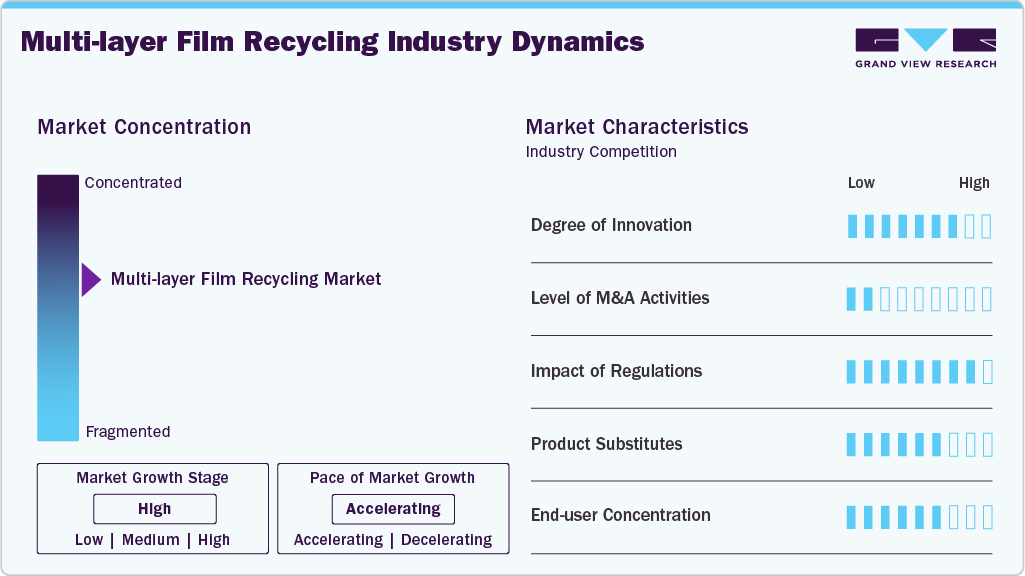
The market growth stage of the multi-layer film recycling market is high, and the pace is accelerating. The market is witnessing a moderate-to-high degree of innovation, driven by collaborations between chemical companies, recyclers, and packaging manufacturers. Novel processes such as multilayer delamination, compatibilizer-enhanced recycling, and pyrolysis of mixed laminates are being tested at pilot and industrial scale, with strong R&D funding and brand-owner partnerships.
Mergers and acquisitions in this sector are emerging but relatively low in frequency, primarily involving chemical companies acquiring recycling technology startups or recyclers to strengthen their sustainable packaging portfolios. Strategic alliances and joint ventures are more common than outright acquisitions at this stage.
 To learn more about this report, Download Free Sample Report
Regulations have a high impact on the multi-layer film recycling market. Policies such as the EU’s Single-Use Plastics Directive, EPR schemes, and recycled-content mandates directly influence demand and technology adoption. Regulatory support often determines whether advanced recycling solutions achieve commercial viability.
Substitutes include monomaterial flexible packaging films, paper-based laminates, and biodegradable alternatives. While these reduce reliance on multi-layer plastics, they often lack the same barrier performance and cost efficiency, meaning substitution is growing but not yet a complete replacement.
The end-user base is concentrated around the food & beverage and personal care sectors, which account for the majority of multi-layer film applications. Large multinational FMCG companies dominate demand, creating a high level of buyer influence on recyclability standards and recycled-content integration.
Laminate Type Insights
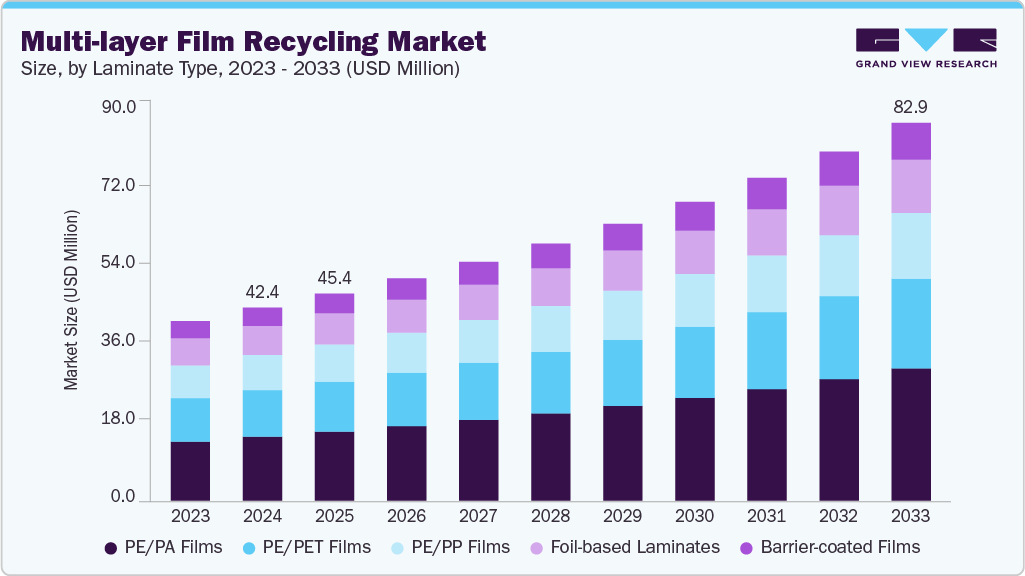
PE/PA films segment dominated the multi-layer film recycling market with a revenue share of 33.16% in 2024, and is anticipated to grow at a CAGR of 8.5% over the forecast period. PE/PA films, widely used for vacuum packaging of perishable foods and medical products due to their high puncture resistance and oxygen barrier, represent one of the more challenging streams for recycling.
However, advances in compatibilizers and mechanical recycling technologies are opening up opportunities to recover these films for secondary applications such as garbage bags, agricultural films, and construction sheets, driving gradual growth in the recycling potential of this segment.
PE/PET laminates are used as flexible packaging for snacks, frozen foods, and household goods, but the intrinsic incompatibility of polyethylene and polyester layers has traditionally limited recyclability. Recent progress in solvent-based separation and delamination technologies is helping unlock higher-value recycling streams.
The barrier-coated films segment is anticipated to grow at a significant CAGR of 8.3% through the forecast period. Barrier-coated films, such as those incorporating EVOH, SiOx, or AlOx coatings, are gaining traction as lightweight alternatives to foil laminates in food and beverage packaging. While they simplify recycling compared to full aluminum layers, they still pose challenges in separation and quality recovery. Innovations in compatibilizer chemistry, along with chemical recycling routes, are enabling improved recyclability of barrier-coated films.
PE/PP laminates are commonly found in dry food, confectionery, and pouch packaging. Unlike other multi-layer structures, PE and PP share some processing compatibility, making them comparatively easier to recycle. This has positioned PE/PP laminates as one of the more promising segments in the multi-layer film recycling market.
End Use Insights
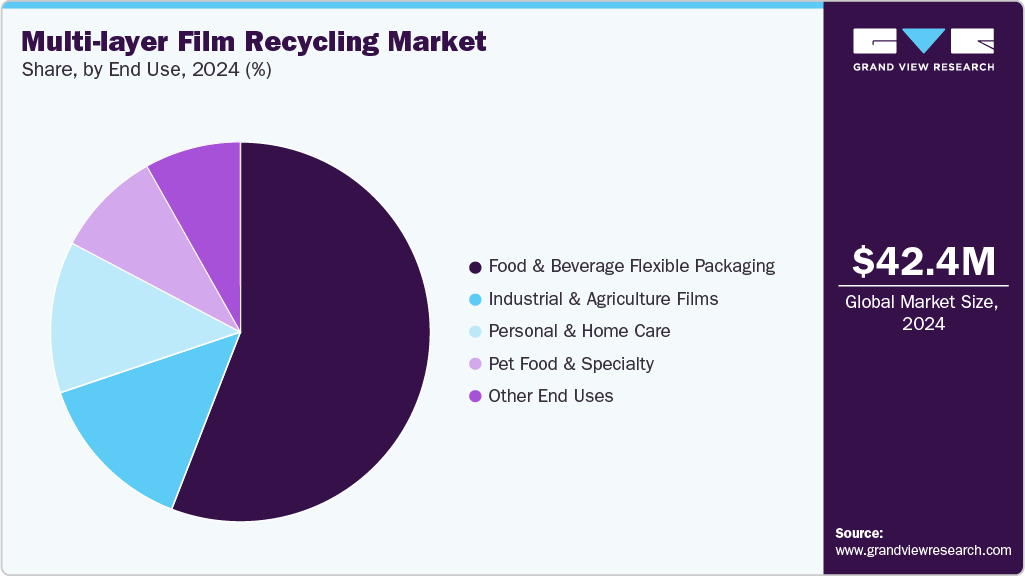
Food & beverage flexible packaging segment dominated the multi-layer film recycling market with a revenue share of 55.90% in 2024, and is anticipated to grow at a CAGR of 10.5% over the forecast period. With applications in snack pouches, frozen food bags, and beverage sachets, these laminates often combine PE, PET, PA, or foil to ensure barrier properties. However, with major FMCG players committing to recyclable packaging and regulations pushing for circularity, recycling initiatives targeting this stream are expected to expand rapidly over the forecast period.
Personal and home care products such as shampoos, detergents, and household cleaners frequently use multi-layer pouches and sachets for durability, branding, and shelf appeal. Recycling this stream has been slower due to contamination and smaller pack sizes, but brand owner sustainability targets are projected to further boost the collection and recycling investments.
 To learn more about this report, Download Free Sample Report
The pet food & specialty segment is anticipated to grow at a significant CAGR of 8.0% through the forecast period owing to rapid growth of the pet food sector globally. Pet food packaging is a critical contributor to multi-layer film waste, typically using foil-based laminates or barrier-coated films to maintain freshness and extend shelf life. These structures are among the hardest to recycle due to their high barrier requirements and material complexity. Still, pilot projects in Europe and North America are testing mechanical and chemical recycling methods for this waste stream, with recovered polymers being repurposed into construction products or lower-grade packaging.
Industrial and agriculture applications, such as silage wraps, greenhouse films, and protective industrial coverings, rely on multi-layer films for strength, UV resistance, and barrier properties. While contamination and collection logistics remain key challenges, the recycling of these films has gained momentum through take-back schemes and mechanical recycling lines adapted for high-volume, post-industrial waste.
Regional Insights
Europe multi-layer film recycling market held the largest share of 38.31% in terms of global market revenue in 2024. The industry is backed by robust regulatory frameworks such as the Packaging and Packaging Waste Regulation (PPWR). The region is transitioning toward mono-material films and investing heavily in mechanical and chemical recycling infrastructure. Despite challenges in sorting and contamination, initiatives such as the CIMPA project and widespread adoption of eco-design principles are improving recyclability.
 To learn more about this report, Download Free Sample Report
Multi-layer film recycling market in Germany stands out as a frontrunner in multilayer film recycling, owing to its advanced waste management systems and strong policy enforcement. Research institutions such as Fraunhofer IVV are developing solvent-based recycling processes that retain polymer integrity, enabling high-quality reuse. Moreover, industrial trials have demonstrated successful separation of PET/PE multilayer films, paving the way for scalable solutions.
North America Multi-layer Film Recycling Market Trends
North America is witnessing a paradigm shift in multi-layer film recycling, with increased collaboration between industry players, municipalities, and environmental coalitions. The region is investing in chemical recycling and AI-powered sorting systems to overcome the complexity of multilayer packaging. Regulatory momentum, including the EPA’s National Recycling Strategy, is pushing brand owners toward recyclable mono-material alternatives and circular packaging models.
U.S. Multi-layer Film Recycling Market Trends
Multi-layer film recycling market in the U.S.is grappling with infrastructure gaps and low consumer participation in recycling programs. Most multilayer films are not accepted in curbside systems, relying instead on store drop-off initiatives. However, companies are exploring compatibilization techniques and solvent-based separation to reclaim high-quality resins. The push for recycled content in packaging, driven by corporate sustainability goals and state-level legislation, is expected to boost investment in advanced recycling technologies.
Asia Pacific Multi-layer Film Recycling Market Trends
Multi-layer film recycling market in Asia Pacific is expected to grow at a CAGR of 8.3% over 2025 to 2033, driven by expanding manufacturing sectors and increasing environmental awareness. Countries such as China, India, and Southeast Asian nations are investing in advanced recycling technologies and infrastructure to manage the surge in flexible packaging waste. However, the market faces challenges due to fragmented waste collection systems and limited consumer participation. Government initiatives promoting circular economy models and compostable alternatives are expected to accelerate the adoption of sustainable multilayer film solutions.
Multi-layer film recycling market in China is dominating owing to its position as the world’s largest producer and consumer of plastic films, which plays a pivotal role in shaping the multi-layer film recycling landscape. The country has implemented strict regulations on plastic waste imports and is now focusing on domestic recycling capabilities. Mechanized recovery systems are being developed for agricultural film waste, which constitutes a significant portion of the plastic footprint.
India Multi-layer Film Recycling Marketis evolving rapidly, fueled by policy reforms such as the Extended Producer Responsibility (EPR) guidelines and growing pressure to manage flexible packaging waste. With over 40% of plastic consumption attributed to multilayer formats, the country faces significant challenges in collection and segregation. However, the market is poised for expansion as infrastructure and awareness improve. Hence, the product demand is expected to reach USD 24.62 million by 2030.
Latin America Multi-layer Film Recycling Market Trends
The region faces infrastructural and regulatory challenges but rising awareness and private sector innovation are driving progress. Informal recycling networks play a significant role, and new technologies are being introduced to improve sorting and processing.
Multi-layer film recycling market in Brazil is projected to lead in Latin America through disruptive technologies such as Deink 4D, which enables delamination and de-inking of complex packaging waste. With the launch of large-scale recycling plants and partnerships with global players signal Brazil’s commitment to transforming its plastic waste landscape.
Middle East & Africa Multi-layer Film Recycling Market Trends
The Middle East & Africa region is expected to gradually embrace multi-layer film recycling, driven by rising demand for sustainable packaging and government-led circular economy initiatives. Countries such as South Africa, UAE, and Egypt are investing in compostable multilayer films and expanding mechanical recycling capacity. The market is expected to grow steadily as public-private partnerships and regional policies gain momentum.
Key Multi-layer Film Recycling Company Insights
The competitive landscape of the multi-layer film recycling market is shaped by a mix of established recycling technology providers, packaging converters, and emerging startups focused on circular economy innovations. The market is moderately concentrated, with key players leveraging proprietary technologies such as compatibilizers, solvent-based separation, and chemical recycling to tackle the inherent complexity of multi-layer structures.
Strategic partnerships between recyclers and brand owners are rising, as companies seek to meet sustainability targets and regulatory mandates. The push toward mono-material alternatives is also influencing competition, with some players pivoting toward recyclable film design.
Key Multi-layer Film Recycling Companies:
The following are the leading companies in the multi-layer film recycling market. These companies collectively hold the largest market share and dictate industry trends.
- BASF SE
- Coperion GmbH
- Pluss Advanced Technologies
- Ingenia Polymers
- APK AG
- SUEZ Recycling & Recovery
- Waste Management Inc.
- KW Plastics
- Plastipak Packaging
- Enval Ltd.
Recent Developments
-
In August 2024, LyondellBasell has announced its acquisition of APK AG, a German company specializing in solvent-based recycling technology for low-density polyethylene (LDPE), aiming to enhance its Circular and Low Carbon Solutions business. This move complements LYB’s existing mechanical and advanced recycling capabilities. Moreover, the acquisition supported LYB’s goal to produce at least 2 million metric tons of recycled and renewable-based polymers annually by 2030.
-
In May 2023, BASF, Krones, SÜDPACK, and TOMRA had joined forces to tackle the recycling challenge of PET/PE multilayer packaging, widely used in food applications. In an industrial trial at Krones’ pilot plant, the team successfully separated 69% of the multilayer components using BASF’s debonding adhesive, SÜDPACK’s laminated trays, TOMRA’s NIR sorting technology, and Krones’ hot washing process. This collaboration demonstrates that existing infrastructure can be adapted for multilayer recycling, aligning with the EU’s Packaging and Packaging Waste Regulation goals for 2030.
Multi-layer Film Recycling Market Report Scope
Report Attribute
Details
Market size in 2024
USD 42.4 million
Estimated market size in 2026
USD 48.8 million
Projected market size by 2033
USD 83.0 million
Growth rate
CAGR of 7.8% from 2025 to 2033
Historical data
2021 - 2023
Forecast period
2025 - 2033
Quantitative units
Revenue in USD million/billion, Volume in Kilotons, and CAGR from 2025 to 2033
Report coverage
Revenue forecast, competitive landscape, growth factors, and trends
Segments covered
Laminate Type, end use, and region
Regional scope
North America; Europe; Asia Pacific; Latin America; Middle East & Africa
Country Scope
U.S.; Canada; Mexico; Germany; UK; France; Italy; Spain; China; India; Japan; South Korea; Australia; Brazil; Argentina; Saudi Arabia; South Africa; UAE
Key companies profiled
BASF SE; Coperion GmbH; Pluss Advanced Technologies; Ingenia Polymers; APK AG; SUEZ Recycling & Recovery; Waste Management Inc.; KW Plastics; Plastipak Packaging; Enval Ltd.
Customization scope
Free report customization (equivalent up to 8 analyst’s working days) with purchase. Addition or alteration to country, regional & segment scope
Pricing and purchase options
Avail customized purchase options to meet your exact research needs. Explore purchase options
Global Multi-layer Film Recycling Market Report Segmentation
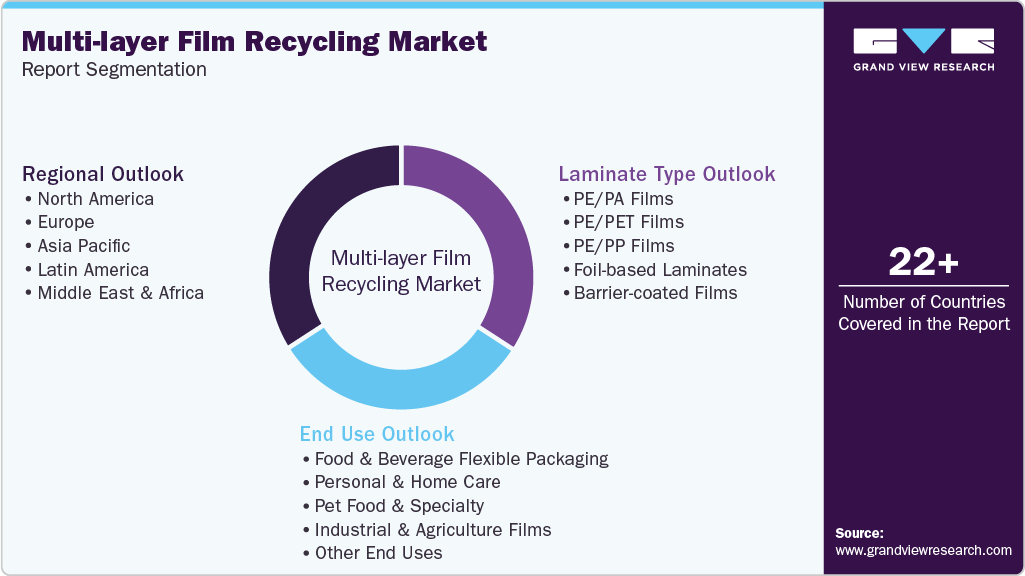
This report forecasts revenue growth at the global, regional, and country levels and provides an analysis of the latest industry trends in each of the sub-segments from 2021 to 2033. For this study, Grand View Research has segmented the multi-layer film recycling market report based on laminate type, end use, and region:
 To learn more about this report, Download Free Sample Report
-
Laminate Type Outlook (Revenue, USD Million; Volume, Kilotons, 2021 - 2033)
-
PE/PA Films
-
PE/PET Films
-
PE/PP Films
-
Foil-based Laminates
-
Barrier-coated Films
-
-
End Use Outlook (Revenue, USD Million; Volume, Kilotons, 2021 - 2033)
-
Food & Beverage Flexible Packaging
-
Personal & Home Care
-
Pet Food & Specialty
-
Industrial & Agriculture Films
-
Other End Uses
-
-
Regional Outlook (Revenue, USD Million; Volume, Kilotons, 2021 - 2033)
-
North America
-
U.S.
-
Canada
-
Mexico
-
-
Europe
-
Germany
-
UK
-
France
-
Italy
-
Spain
-
-
Asia Pacific
-
China
-
India
-
Japan
-
South Korea
-
Australia
-
-
Latin America
-
Brazil
-
Argentina
-
-
Middle East & Africa
-
Saudi Arabia
-
South Africa
-
UAE
-
-
Frequently Asked Questions About This Report
PE/PA films dominated the multi-layer film recycling market with a share of 33.16% in 2024. This is attributable to their wide use for vacuum packaging of perishable foods and medical products due to their high puncture resistance and oxygen barrier.
Some key players operating in the multi-layer film recycling market include BASF SE, Coperion GmbH, Pluss Advanced Technologies, Ingenia Polymers, APK AG, SUEZ Recycling & Recovery, Waste Management Inc., KW Plastics, Plastipak Packaging, and Enval Ltd.
Key factors driving the growth of the multi-layer film recycling market include its widespread use in food, beverage, personal care, agricultural, and industrial packaging due to its superior barrier properties, lightweight design, and cost efficiency.
The global multi-layer film recycling market size was valued at USD 42.4 million in 2024 and is estimated at USD 48.8 million for 2026.
The global multi-layer film recycling market is expected to grow at a CAGR of 7.8% from 2025 to 2033, reaching USD 83.0 million by 2033.
About the Author(s)
Plastics, Polymers & Resins Research Team
Bulk Chemicals · Plastics, Polymers & ResinsThis report was authored by the plastics, polymers & resins research team at Grand View Research - comprising two research analysts, one senior research analyst, and one industry expert - with specialized expertise in the plastics, polymers & resins segment of the bulk chemicals industry. All findings are based on proprietary bulk chemicals databases, executive interviews, and regulatory analysis, subject to internal peer review prior to publication.
Last Updated:
Speak to Analyst

Customize this report to your needs - add regions, segments, or data points, with 20% free customization.
Or view our licence options:


ISO 9001:2015 & 27001:2022 Certified
We are GDPR and CCPA compliant! Your transaction & personal information is safe and secure. For more details, please read our privacy policy.


