
- Home
- »
- Plastics, Polymers & Resins
- »
-
Polyethylene Market Size And Share, Industry Report, 2033GVR Report cover

Polyethylene Market (2026 - 2033) Size, Share & Trends Analysis Report By Product (LDPE, HDPE, LLDPE), By Application (Bottles & Containers, Films & Sheets, Bags & Sacks, Pipes & Fittings), By End Use, By Region, And Segment Forecasts
Market Size, 2025
$166.5BMarket Estimate, 2026
$173.7BMarket Forecast, 2033
$229.7BCAGR, 2026–2033
4.1%Polyethylene Market Summary
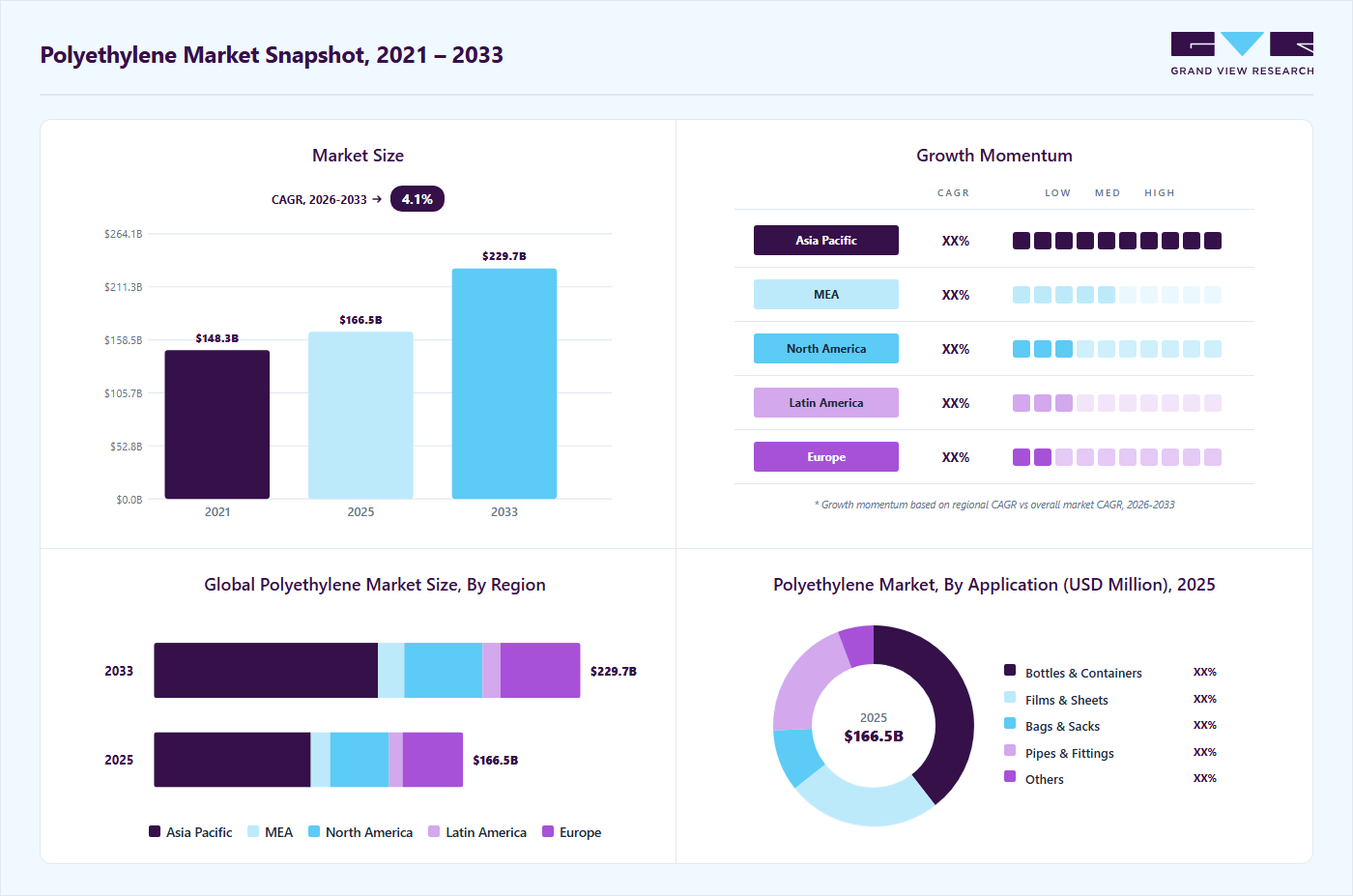
The global polyethylene market size was estimated at USD 166.5 billion in 2025 and is projected to grow from USD 173.7 billion in 2026 to USD 229.7 billion by 2033, at a CAGR of 4.1% from 2026 to 2033. Asia Pacific held the largest share of 50.7% of the global market in 2025. Growing investments in water distribution, gas pipelines, and irrigation systems are increasing demand for high-density polyethylene pipes.
 Source: Grand View Research, IR Documents, Primary Interviews, Paid DatabasesTo learn more about this report,
 Download Free Sample Report
 Key Market Trends & Insights
- By product: High-density polyethylene (HDPE) segment dominated the market, with a revenue share of 49.5% in 2025.
- By application: Bottles & containers segment held the largest market share of 39.4% in 2025.
- By end use: Packaging segment accounted for the largest revenue share of 52.7% in 2025.
Regional Highlights
- Largest regional market: Asia Pacific (50.7% revenue share, 2025)
- Fastest-growing regional market: Asia Pacific (highest CAGR, 2026-2033)
- By country: The China held the largest revenue share in 2025.
Market Size & Forecast
- Market size in 2025: USD 166.5 Billion
- Estimated market size in 2026: USD 173.7 Billion
- Projected market size by 2033: USD 229.7 Billion
- CAGR (2026-2033): 4.1%
Three ways to get this report
Buy it, customize it, or ask a question.Ask an Analyst
Analyst response in 1 business day
- AccessReport author, directly
- Reply timeWithin 1 working day
- No sales callDirect answer only
- FormatEmail reply
- CostFree, no cost
Get the Full Report
What the study covers
- FormatsPDF · Excel · Dashboard
- Timeline2026–2033 annual, 2025 base
- Coverage20+ countries, 5 regions
- Companies10+ key players profiled
Customize the Report
20% free customization
- IncludeCountries, segments, points
- TailorTo your product definition
- ExtendDeeper competitor detail
- OrA fully bespoke study
- Turnaround5–10 working days
Polyethylene offers corrosion resistance, durability, and long service life, making it a preferred material for modern infrastructure networks. A major trend in the polyethylene market is the rapid integration of circular economy practices, particularly through recycled and bio-based polyethylene grades. Producers are investing in mechanical and chemical recycling technologies to improve waste recovery and produce high-quality recycled polyethylene suitable for packaging and industrial applications.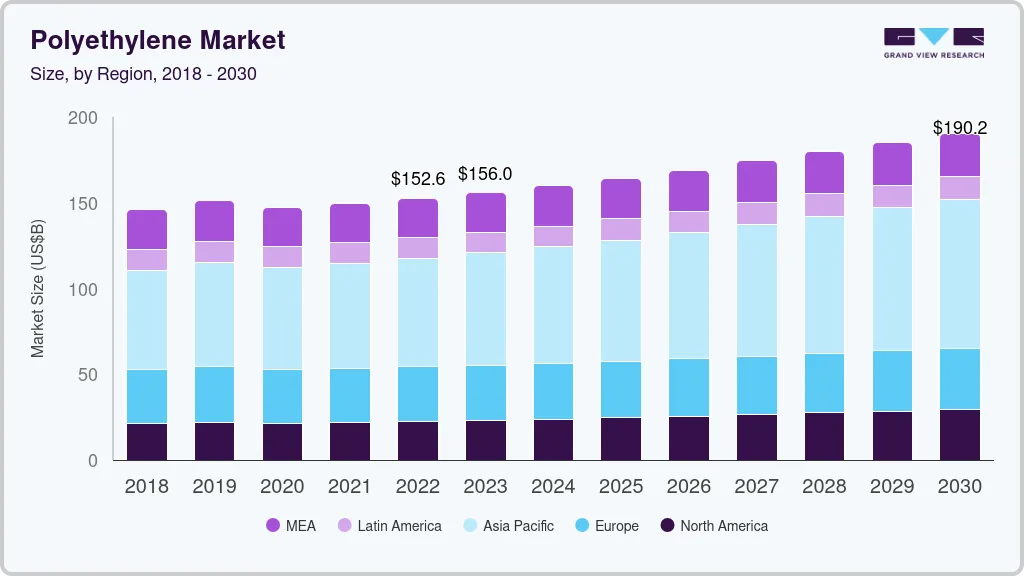 To learn more about this report, Download Free Sample Report
 Industry estimates indicate that more than 40% of polyethylene producers are investing in recycled-polymer technologies to meet sustainability targets and regulatory requirements. Brand owners in consumer goods and food packaging are also redesigning products to incorporate recyclable polyethylene materials.
 To learn more about this report, Download Free Sample Report
 Market Dynamics
The polyethylene market is being driven by rising demand for lightweight, durable, and cost-efficient polymer materials across packaging, construction, automotive, healthcare, agriculture, and consumer goods industries. Polyethylene remains one of the most widely consumed thermoplastics worldwide due to its versatility, chemical resistance, flexibility, and ease of processing. Rapid urbanization, expanding industrial manufacturing activity, and increasing packaged goods consumption continue to strengthen long-term demand for polyethylene products across developed and emerging economies.
Packaging applications remain the dominant driver of market growth. Polyethylene is extensively utilized in flexible packaging films, rigid containers, bottles, caps, industrial liners, and protective packaging due to its moisture resistance, durability, and cost competitiveness. Growth in e-commerce, food delivery services, retail packaging, and consumer goods industries is significantly increasing demand for both low-density polyethylene (LDPE) and high-density polyethylene (HDPE) materials. Sustainability initiatives are also accelerating the development of recyclable and circular polyethylene packaging solutions.
Environmental concerns related to plastic waste generation and disposal are creating substantial challenges for the industry. Governments and regulatory agencies across multiple regions are implementing stricter policies regarding single-use plastics, recycling targets, and sustainable packaging requirements. These regulations are increasing compliance costs and forcing manufacturers to invest heavily in recycling technologies, circular economy initiatives, and sustainable product development strategies.
Market Concentration & Characteristics
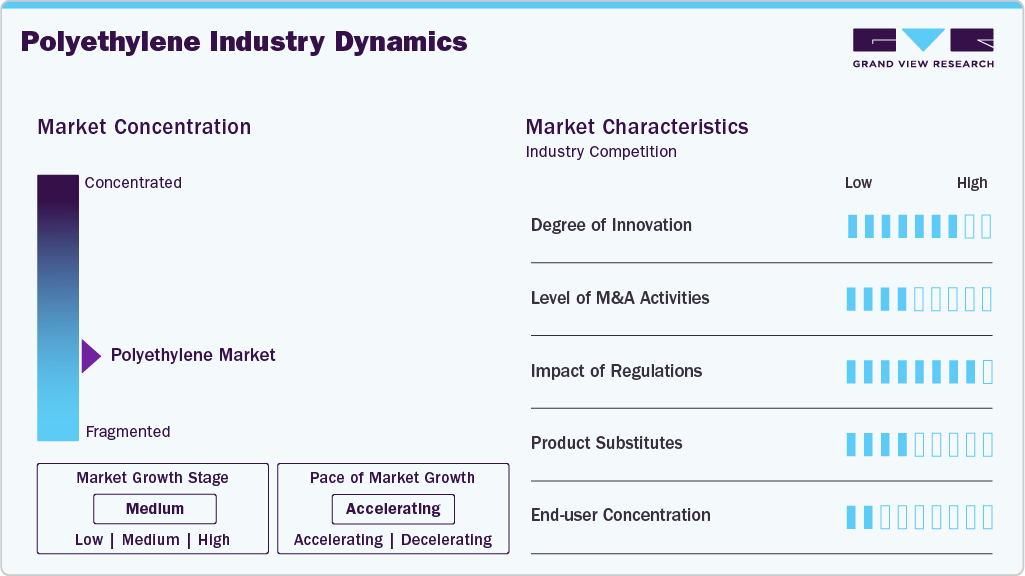
The market growth stage is medium, and growth is accelerating. The market exhibits fragmentation, with key players dominating the industry landscape. Major companies such as BASF SE, Borealis AG, Braskem, Dow, Exxon Mobil Corp., Formosa Plastics, INEOS Group, LG Chem, LyondellBasell Industries Holdings B.V., Mitsubishi Chemical Corp., MOL Group, SABIC, China Petrochemical Corp. (Sinopec), and others play a significant role in shaping the market dynamics. These leading players often drive innovation in the market by introducing new products, technologies, and materials to meet the industry's evolving demands.
The polyethylene market shows a moderate to high level of innovation, primarily driven by sustainability needs and performance enhancements in packaging and industrial uses. Producers are investing in advanced catalysts, bio-based feedstocks, and circular polymer technologies to lower carbon emissions and improve recyclability. Several companies have launched bio-based polyethylene grades with better mechanical strength and broader uses in packaging and automotive parts. R&D activity is increasing steadily, with new patents and product launches aimed at lightweight packaging, mono-material films, and improved recyclability.
 To learn more about this report, Download Free Sample Report
 Polyethylene faces pressure to be replaced by alternative materials that offer better sustainability or performance benefits in certain applications. Polypropylene, paper-based packaging, and emerging bioplastics are increasingly used in consumer packaging and food service sectors. Governments and brand owners are encouraging recyclable paper structures and compostable materials to cut down on plastic waste. Bioplastics made from renewable feedstocks are also gaining attention for their lower environmental impact in packaging. However, cost competitiveness and reliability of performance still help polyethylene maintain its dominant market position.
Product Insights
The high-density polyethylene (HDPE) segment led the market with a share of 49.5% in 2025, and is projected to grow at a 4.0% CAGR from 2026 to 2033. Rapid infrastructure expansion and utility pipeline development are fueling this segment. Governments and municipal authorities are increasingly replacing aging metal and concrete pipelines with HDPE due to its corrosion resistance, flexibility, and long service life exceeding 50-100 years. HDPE pipes are extensively used in water distribution, sewage systems, gas networks, and irrigation infrastructure. Over 60 percent of municipal water pipeline installations worldwide currently utilize HDPE, reflecting a strong preference for durable polymer-based infrastructure solutions.
The linear low-density polyethylene (LLDPE) segment is expected to grow at a 4.2% CAGR over the forecast period. The demand for LLDPE is strongly driven by its role in high-performance flexible films used across packaging and agriculture. LLDPE offers superior puncture resistance, stretchability, and seal strength compared with conventional polyethylene grades, enabling converters to reduce film thickness while maintaining performance. This process, known as downgauging, lowers material consumption and packaging costs. Films account for more than half of LLDPE consumption, particularly in stretch wraps, food packaging films, and industrial liners that require strong yet lightweight materials.
Application Insights
The bottles & containers segment dominated the market, accounting for 39.4% market share in 2025, and is forecast to grow at a 3.9% CAGR from 2026 to 2033. Growth in the bottles and containers segment is supported by rising global consumption of packaged household chemicals, personal care products, and food ingredients. HDPE containers offer chemical resistance, impact strength, and cost efficiency, making them suitable for detergents, dairy packaging, edible oil bottles, and industrial containers. Expanding FMCG distribution networks continue to strengthen demand for polyethylene-based rigid packaging.
The films & sheets segment is expected to expand at a 4.8% CAGR over the forecast period. The segment benefits from sustained demand for flexible packaging solutions across food, retail, and industrial supply chains. Polyethylene films are widely used in protective packaging, pallet wraps, agricultural films, and industrial liners due to their moisture-barrier performance and processing efficiency. The expansion of automated packaging and global trade continues to support polyethylene film consumption.
End Use Insights
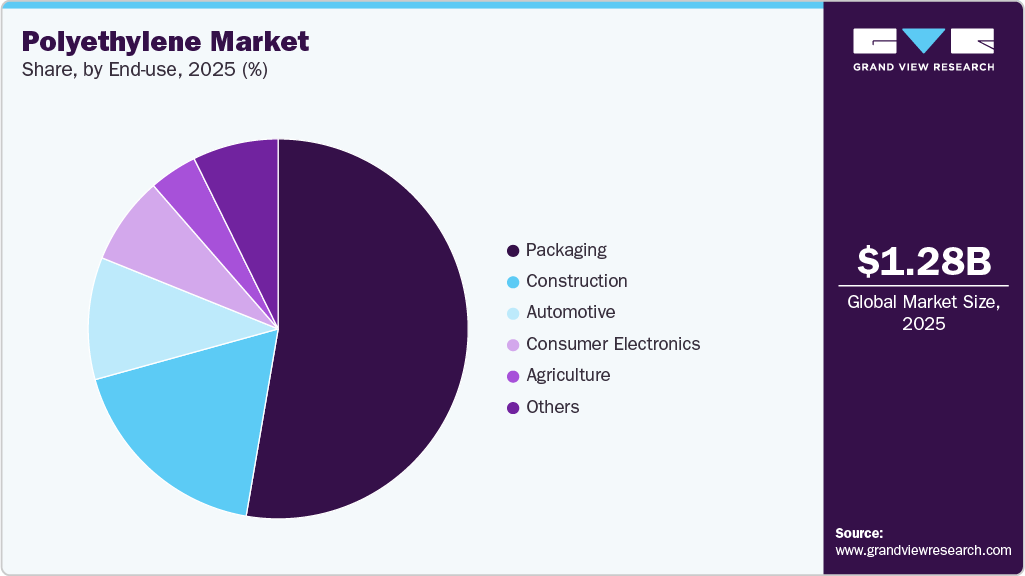
The packaging segment led the market, accounting for 52.7% of revenue share in 2025, and is expected to grow at a 4.3% CAGR from 2026 to 2033, due to its versatility across rigid and flexible formats. Polyethylene is widely used in bags, pouches, containers, shrink films, and protective packaging. The material offers excellent processability, chemical resistance, and low production costs. Packaging applications account for more than half of global polyethylene consumption, driven by growth in packaged food, e-commerce distribution, and consumer goods manufacturing. The increasing demand for lightweight, recyclable packaging solutions continues to strengthen polyethylene adoption across global supply chains.
 To learn more about this report, Download Free Sample Report
 The construction segment is projected to expand at a 4.6% CAGR over the forecast period. Polyethylene demand in the construction sector is supported by its expanding use in piping systems, geomembranes, insulation materials, and vapor barriers. HDPE pipes have gained widespread adoption due to their resistance to corrosion, chemical exposure, and environmental stress cracking. Construction applications account for nearly 9% of global polyethylene consumption, with demand rising due to urban infrastructure development and water management projects. Rapid infrastructure expansion in emerging economies and replacement of aging pipelines in developed regions continue to drive polymer usage in construction materials.
Regional Insights
The Asia Pacific polyethylene industry held the largest revenue share of 50.7% in 2025 and region is expected to grow at a CAGR of 4.5% over the forecast period. Rapid industrialization and expanding consumer markets continue to drive polyethylene consumption across the Asia Pacific. The region accounts for more than half of global polyethylene demand, driven by strong growth in packaging, electronics manufacturing, and construction. Rising urban populations and expanding middle-class consumption have increased demand for packaged foods, consumer goods, and household products that rely heavily on polyethylene materials. Several countries are also expanding polymer processing capacity and petrochemical production, strengthening the region’s role as both a major producer and consumer of polyethylene.
 To learn more about this report, Download Free Sample Report
 Polyethylene market in China represents the largest single market in the region due to the scale of its manufacturing and packaging industries. The China PE market is driven by strong demand for e-commerce packaging, industrial films, and construction materials. The rapid expansion of domestic petrochemical complexes and polymer processing facilities has strengthened local supply chains. Government-supported infrastructure projects and large-scale consumer goods manufacturing further stimulate demand for polyethylene in pipes, packaging films, and molded plastic products.
North America Polyethylene Market Trends
Abundant shale gas resources in North America provide a structural cost advantage for polyethylene production. Ethane derived from shale gas is widely used as feedstock for ethylene crackers, lowering raw material costs and strengthening regional competitiveness. This has encouraged large-scale capacity expansions along the U.S. Gulf Coast and supported strong export activity to Latin America, Europe, and Asia.
U.S. Polyethylene Market Trends
In the U.S., the polyethylene market is strongly driven by the expansion of domestic petrochemical manufacturing integrated with shale-based feedstocks. The country accounts for nearly 80% of North American polyethylene demand and hosts one of the world’s largest resin production hubs along the Gulf Coast. Competitive feedstock pricing has encouraged investments in new polyethylene plants and export terminals. As a result, the U.S. has become a major global supplier of HDPE and LLDPE resins used in packaging, infrastructure pipes, and industrial films.
Europe Polyethylene Market Trends
Demand for polyethylene in Europe is increasingly influenced by circular economy policies and sustainable packaging initiatives. Governments and industry associations are promoting recyclable plastic solutions and higher recycled-content packaging materials. This regulatory framework has accelerated investments in recycled polyethylene processing and advanced recycling technologies. Strong demand also comes from industrial packaging, construction materials, and automotive lightweight components across major economies such as Germany, France, and Italy.
Key Polyethylene Company Insights
The polyethylene industry is highly competitive, with several key players dominating the landscape. Major companies include BASF SE, Borealis AG, Braskem, Dow, Exxon Mobil Corp., Formosa Plastics, INEOS Group, LG Chem, LyondellBasell Industries Holdings B.V., Mitsubishi Chemical Corp., MOL Group, SABIC, and China Petrochemical Corp. (Sinopec). The polyethylene industry is characterized by a competitive landscape with several key players driving innovation and market growth. Major companies in this sector are investing heavily in research and development to enhance the performance, cost-effectiveness, and sustainability of their products.
Key Polyethylene Companies:
The following key companies have been profiled for this study on the polyethylene market.
- BASF SE
- Borealis AG
- Braskem
- Dow
- Exxon Mobil Corporation
- Formosa Plastics
- INEOS Group
- LG Chem
- LyondellBasell Industries Holdings B.V.
- Mitsubishi Chemical Corporation
- MOL Group
- SABIC
- China Petrochemical Corporation (Sinopec)
Competitive Benchmarking
Operating Strategies
Competitive Edge
Weakness
Mature Players: BASF SE; Borealis AG; Braskem
- Broad polyethylene portfolios across HDPE, LDPE, LLDPE, specialty polyethylene grades, and sustainable polymer solutions for packaging, construction, automotive, and industrial applications.
- Significant investment in advanced polymerization technologies, circular plastics initiatives, and recyclable packaging systems.
- Integrated petrochemical operations and large-scale global manufacturing infrastructure supporting high-volume production.
- Strong feedstock integration and large-scale production capabilities improve operational efficiency and supply reliability.
- Established global distribution networks and diversified end-use industry penetration.
- Advanced R&D infrastructure supporting specialty polyethylene innovation and sustainable polymer development.
- High exposure to crude oil, natural gas, and ethylene feedstock price volatility.
- Significant environmental compliance and sustainability-related investment requirements.
- Dependence on packaging and industrial manufacturing cycles affects market stability.
Emerging Players: MOL Group
- Expanding polyethylene production capabilities and regional petrochemical integration strategies.
- Increasing focus on sustainable polymer development, circular plastics initiatives, and specialty packaging applications.
- Strengthening regional supply networks and downstream industrial partnerships.
- Strong regional market positioning and integrated energy-petrochemical operations.
- Growing strategic focus on sustainable polymer technologies and packaging materials.
- Competitive manufacturing economics in selected regional markets.
- Smaller global manufacturing footprint compared with multinational polyethylene leaders.
- Limited economies of scale relative to large integrated petrochemical producers.
- Higher dependence on regional demand conditions and export competitiveness.
Recent Developments
-
In June 2025, Dow Inc. announced the launch of a new LLDPE/HDPE production unit online at Freeport, lifting Gulf Coast resin output and export volumes. The startup supports packaging and film supply chains and improves regional competitiveness for US resin exports.
-
In February 2025, ExxonMobil began test runs at its Huizhou petrochemical complex, commissioning a 1.6 million tons per annum cracker and downstream LLDPE trains with a combined capacity of about 1.2 million tons per annum. The facility materially increased Asian LLDPE and flexible-film resin capacity.
Polyethylene Market Report Scope
Report Attribute
Details
Market size in 2025
USD 166.5 billion
Estimated Market size in 2026
USD 173.7 billion
Projected Market size by 2033
USD 229.7 billion
Growth rate
CAGR of 4.1% from 2026 to 2033
Actual data
2021 - 2025
Forecast period
2026 - 2033
Quantitative units
Revenue in USD million/billion, Volume in Kilotons, and CAGR from 2026 to 2033
Report coverage
Revenue forecast, competitive landscape, growth factors, and trends
Segments covered
Product, application, end use, region
Regional scope
North America; Europe; Asia Pacific; Central & South America; Middle East & Africa
Country Scope
U.S.; Canada; Mexico; Germany; UK; France; Italy; Spain; China; India; Japan; Australia; South Korea; Brazil; Argentina; Saudi Arabia; UAE; South Africa
Key companies profiled
BASF SE; Borealis AG; Braskem; Dow; Exxon Mobil Corp.; Formosa Plastics; INEOS Group; LG Chem; LyondellBasell Industries Holdings B.V.; Mitsubishi Chemical Corp.; MOL Group; SABIC; China Petrochemical Corp. (Sinopec)
Customization scope
Free report customization (equivalent to up to 8 analyst working days) with purchase. Addition or alteration to country, regional & segment scope
Pricing and purchase options
Avail customized purchase options to meet your exact research needs. Explore purchase options
Global Polyethylene Market Report Segmentation
This report forecasts revenue growth at the global, regional, and country levels and provides an analysis of the latest industry trends across sub-segments from 2021 to 2033. For this study, Grand View Research has segmented the polyethylene market report based on product, application, end use, and region:
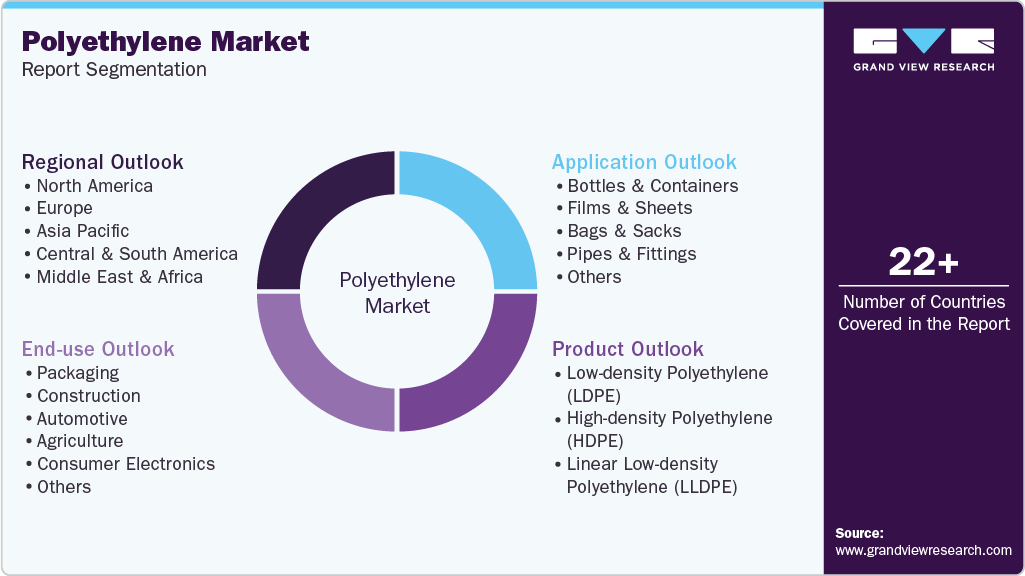 To learn more about this report, Download Free Sample Report
 -
Product Outlook (Volume, Kilotons; Revenue, USD Million, 2021 - 2033)
-
Low-density Polyethylene (LDPE)
-
High-density Polyethylene (HDPE)
-
Linear Low-density Polyethylene (LLDPE)
-
-
Application Outlook (Volume, Kilotons; Revenue, USD Million, 2021 - 2033)
-
Bottles & Containers
-
Films & Sheets
-
Bags & Sacks
-
Pipes & Fittings
-
Others
-
-
End Use Outlook (Volume, Kilotons; Revenue, USD Million, 2021 - 2033)
-
Packaging
-
Construction
-
Automotive
-
Agriculture
-
Consumer Electronics
-
Others
-
-
Regional Outlook (Volume, Kilotons; Revenue, USD Million, 2021 - 2033)
-
North America
-
U.S.
-
Canada
-
Mexico
-
-
Europe
-
Germany
-
UK
-
France
-
Italy
-
Spain
-
-
Asia Pacific
-
China
-
India
-
Japan
-
South Korea
-
Australia
-
-
Central & South America
-
Brazil
-
Argentina
-
-
Middle East & Africa
-
Saudi Arabia
-
UAE
-
South Africa
-
-
Delivered Customizations
This report has been delivered with the following In-depth customizations
Client Request
Customization Delivered
Value Adds
Pricing Analysis
Delivered comprehensive pricing analysis for HDPE, LDPE, LLDPE, recycled polyethylene, and specialty polyethylene grades across major global regions. The study evaluated ethylene feedstock pricing trends, crude oil impacts, regional supply-demand balances, production economics, logistics costs, trade dynamics, and packaging industry demand fluctuations influencing polyethylene pricing structures.
Supported procurement optimization and resin sourcing strategy development. Improved understanding of regional price volatility, feedstock cost exposure, and margin dynamics across polyethylene categories. Assisted in supplier comparison, contract planning, and risk assessment. Enabled proactive response to petrochemical price fluctuations and changing packaging demand trends.
Competitive Benchmarking
Conducted detailed benchmarking analysis of leading polyethylene producers based on production capacity, polymer portfolio strength, regional presence, sustainability initiatives, feedstock integration, technology capabilities, and end-use industry penetration. The assessment compared company positioning across commodity polyethylene, specialty packaging materials, circular plastics development, and infrastructure applications.
Supported competitive intelligence and strategic positioning analysis. Identified operational strengths, sustainability capabilities, and market differentiation strategies among key industry participants. Improved understanding of regional production advantages and specialty polyethylene positioning. Enabled informed sourcing, partnership, and expansion planning decisions.
Cross-Segmentation
Delivered cross-segment analysis across polyethylene type, application, end-use industry, processing technology, and regional demand trends. The study evaluated interactions between flexible packaging, rigid containers, infrastructure piping systems, agricultural films, automotive components, recycled polyethylene applications, and sustainable packaging technologies.
Improved understanding of high-growth application intersections and premium-value polyethylene opportunities. Supported product portfolio optimization and targeted commercialization planning. Enabled identification of emerging demand combinations and sustainability-driven innovation opportunities across the polyethylene value chain.
Frequently Asked Questions About This Report
The packaging segment accounted for the largest revenue share of 52.7% in 2025.
The global polyethylene market size was estimated at USD 166.5 billion in 2025 and is projected to reach USD 173.7 billion for 2026.
The global polyethylene market is expected to grow at a CAGR of 4.1% from 2026 to 2033, reaching USD 229.7 billion.
Growing investments in water distribution, gas pipelines, and irrigation systems are increasing demand for high-density polyethylene pipes. Polyethylene offers corrosion resistance, durability, and long service life, making it a preferred material for modern infrastructure networks.
Asia Pacific dominated with a 50.7% revenue share in 2025.
Asia Pacific is the fastest-growing region over the forecast period, expanding at an CAGR of 4.5%.
The high-density polyethylene (HDPE) segment led with a 49.5% revenue share in 2025.
The bottles & containers segment dominated the market, accounting for a 39.4% market share in 2025.
Key players include BASF SE, Borealis AG, Braskem, Dow, Exxon Mobil Corp., Formosa Plastics, INEOS Group, LG Chem, LyondellBasell Industries Holdings B.V., Mitsubishi Chemical Corp., MOL Group, SABIC, and China Petrochemical Corp. (Sinopec).
About the Author(s)
Plastics, Polymers & Resins Research Team
Bulk Chemicals · Plastics, Polymers & ResinsThis report was authored by the plastics, polymers & resins research team at Grand View Research - comprising two research analysts, one senior research analyst, and one industry expert - with specialized expertise in the plastics, polymers & resins segment of the bulk chemicals industry. All findings are based on proprietary bulk chemicals databases, executive interviews, and regulatory analysis, subject to internal peer review prior to publication.
Last Updated:
Speak to Analyst

Customize this report to your needs - add regions, segments, or data points, with 20% free customization.
Or view our licence options:


ISO 9001:2015 & 27001:2022 Certified
We are GDPR and CCPA compliant! Your transaction & personal information is safe and secure. For more details, please read our privacy policy.


