
- Home
- »
- Plastics, Polymers & Resins
- »
-
Multi-material 3D Printing Polymers Market Report 2026-2033GVR Report cover

Multi-material 3D Printing Polymers Market (2026 - 2033)
Size, Share & Trends Analysis Report Market By Material Type (Thermoplastics, Photopolymers, Elastomers, High-Performance Polymers), By Application, By Region, And Segment Forecasts
Market Size, 2025
$2.3BMarket Estimate, 2026
$2.7BMarket Forecast, 2033
$10.0BCAGR, 2026–2033
20.3%Multi-material 3D Printing Polymers Market Summary
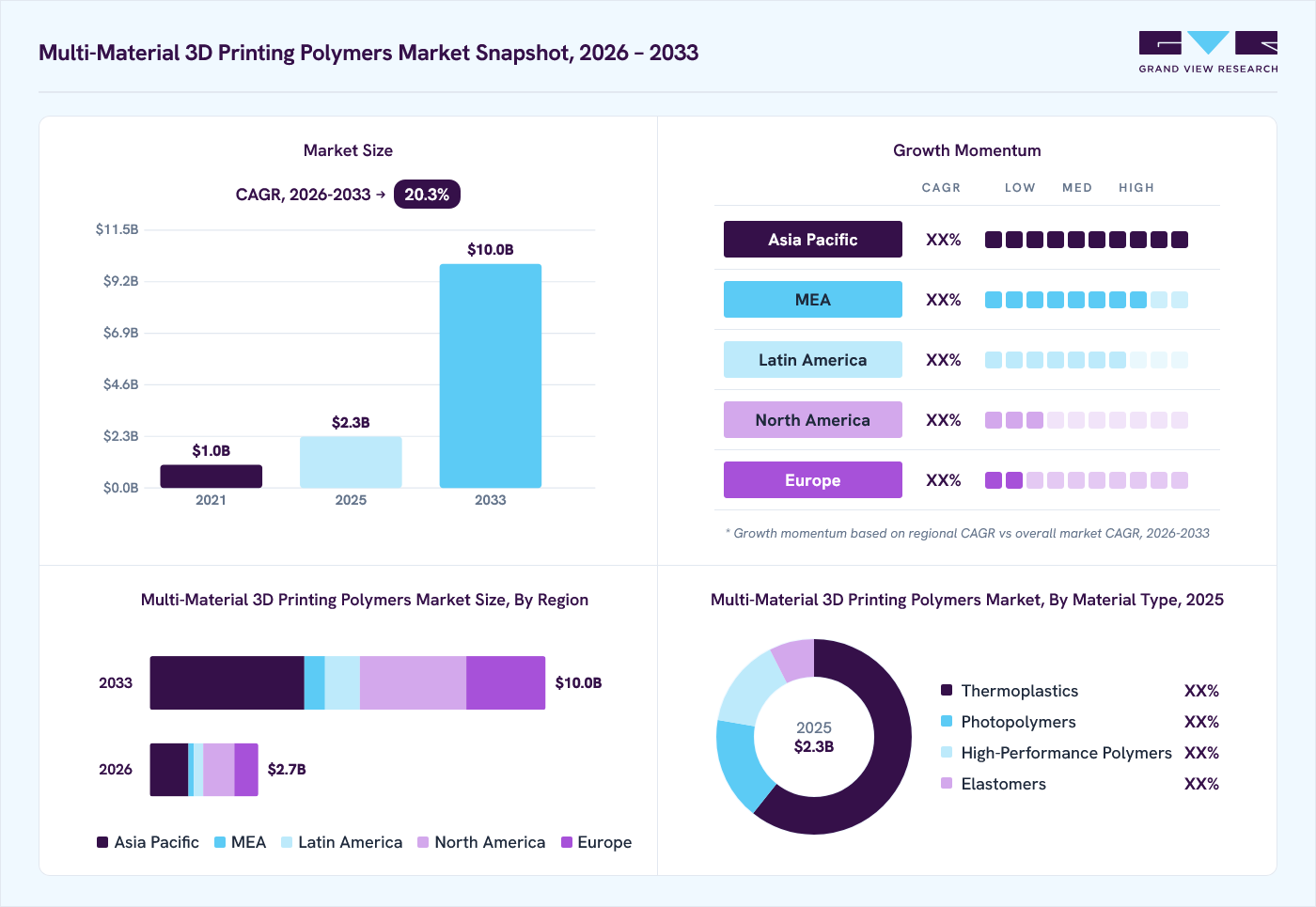
The global multi-material 3D printing polymers market size was valued at USD 2.3 billion in 2025 and is projected to grow from USD 2.7 billion in 2026 to USD 10.0 billion by 2033, at a CAGR of 20.3% from 2026 to 2033. Asia Pacific dominated the market, accounting for the largest revenue share of 35.2% in 2025. Growing demand for multi-material 3D-printing polymers across the automotive, healthcare and medical, robotics, soft robotics, and consumer electronics sectors is supporting market growth.
 Source: Grand View Research, IR Documents, Primary Interviews, Paid DatabasesTo learn more about this report,
 Download Free Sample Report
 Key Market Trends & Insights
- By material type: Thermoplastic polymers segment held the largest market share of 60.7% in 2025.
- By application: Prototyping segment held the largest market share of 36.8% in 2025.
Regional Highlights
- Largest regional market: Asia Pacific (35.2% revenue share, 2025)
- By country: India dominated the Asia Pacific with the largest revenue share in 2025
Market Size & Forecast
- Market size in 2025: USD 2.3 Billion
- Estimated market size in 2026: USD 2.7 Billion
- Projected Market Size by 2035: USD 10.0 Billion
- CAGR (2026-2033): 20.3%
Three ways to get this report
Buy it, customize it, or ask a question.Ask an Analyst
A direct answer, usually in 1 working day
- AccessReport author, directly
- Reply timeWithin 1 working day
- No sales callDirect answer only
- FormatEmail reply
- CostFree, no cost
Get the Full Report
What the study covers
- FormatsPDF · Excel · Dashboard
- Timeline2026–2033 annual, 2025 base
- Coverage20+ countries, 5 regions
- Companies10+ key players profiled
Customize the Report
20% free customization
- IncludeCountries, segments, points
- TailorTo your product definition
- ExtendDeeper competitor detail
- OrA fully bespoke study
- Turnaround5–10 working days
These polymers enable manufacturers to integrate rigid, flexible, and elastomeric materials within a single component, improving functionality, weight efficiency, durability, and design flexibility. Their ability to produce customized prosthetics, soft-hard robotic components, sealed electronic housings, ergonomic handles, and lightweight automotive assemblies is expanding commercial adoption.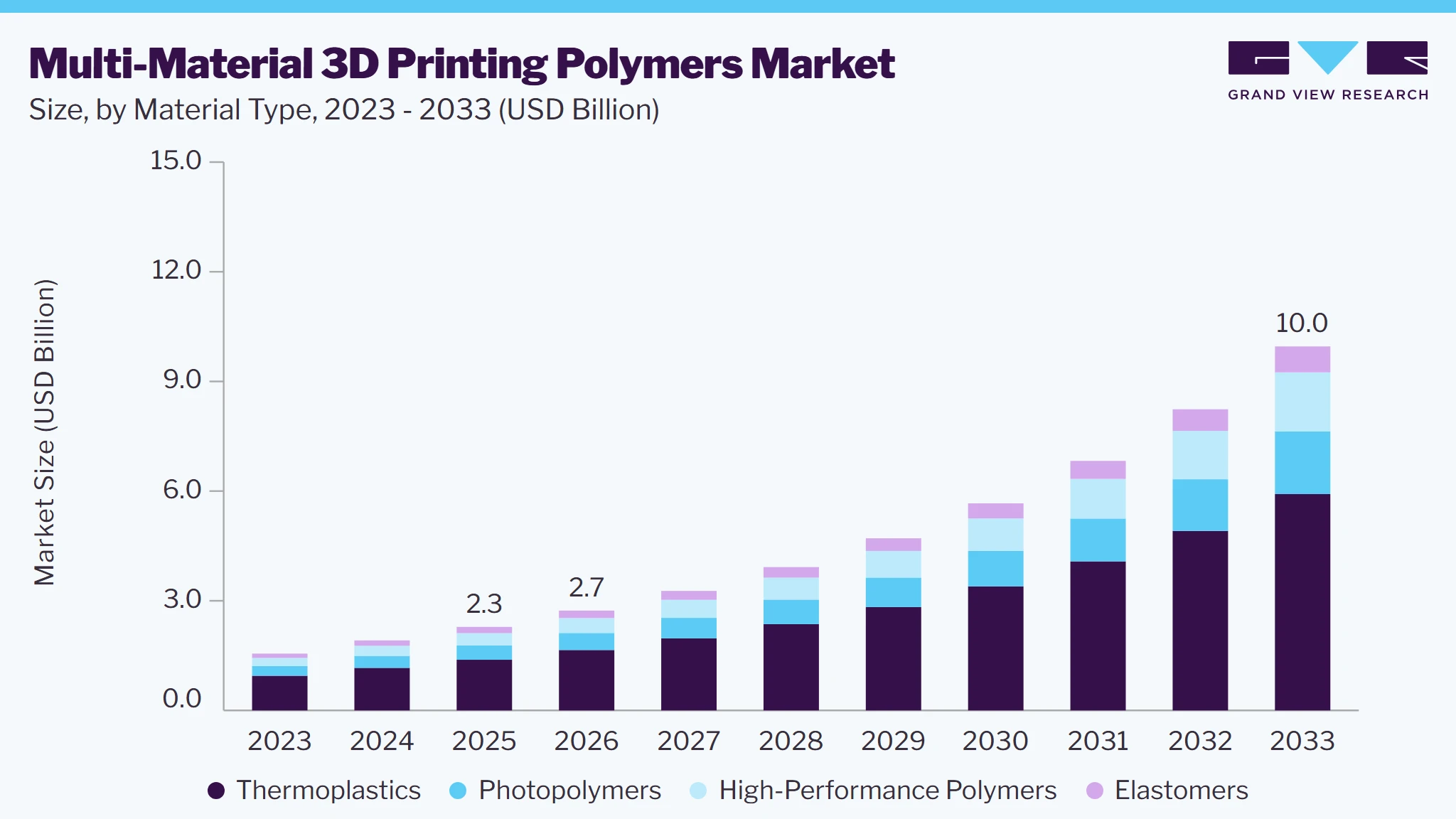 To learn more about this report, Download Free Sample Report
 Rapid progress in targeted therapeutic technologies is emerging as a key trend in the multi-material 3D printing polymers industry. Manufacturers are increasingly developing stimuli-responsive polymer systems capable of controlled release in specific biological environments, particularly for tumor-targeted drug delivery. Demand is rising across tissue engineering, nanomedicine, and precision therapeutics, where improved treatment accuracy, reduced systemic toxicity, and multifunctional carrier performance are critical to enhancing clinical outcomes.
The growing demand for biocompatible, biodegradable, and high-performance materials across the pharmaceutical, biotechnology, cosmetics, skincare, water treatment, agriculture, construction, and industrial processing sectors is a major driver of the multi-material 3D printing polymers industry. These polymers enable enhanced drug solubility, strong biological compatibility, and environmentally sustainable performance, making them suitable for diverse end-use applications. Increasing emphasis on eco-friendly materials and regulatory support for sustainable products is further accelerating adoption across industries.
Expansion of advanced biomedical technologies presents a significant opportunity for the multi-material 3D printing polymers industry. These materials are being increasingly used in regenerative medicine, tissue engineering scaffolds, and next-generation drug delivery systems, where biodegradability and controlled-release capabilities are essential. In addition, rising investments in sustainable agriculture, water treatment, and green industrial processes are creating new demand for environmentally friendly polymer solutions with high functional versatility and reduced environmental impact.
Market Dynamics
Healthcare and medical device applications are emerging as a key end-user segment for multi-material 3D-printing polymers, driven by the need for customized, function-specific solutions. The technology enables patient-specific anatomical models, multi-density surgical guides, and prosthetic components by combining rigid materials for structural precision with flexible materials for comfort and handling. This capability improves anatomical accuracy, procedural safety, and device performance across complex clinical applications.
The growing emphasis on personalized healthcare is further accelerating the adoption of multi-material 3D-printing polymers in medical applications. Manufacturers can integrate rigid structural cores with soft contact layers to produce customized prosthetic sockets, orthotic components, and surgical guides within a single manufacturing process. This approach enhances fit, durability, patient comfort, and design flexibility while reducing assembly requirements. Increasing demand for patient-specific solutions is therefore supporting broader use in advanced medical device fabrication.
Technical challenges associated with large-scale manufacturing and product standardization are restraining the multi-material 3D printing polymers industry. Differences in thermal expansion, processing temperatures, curing requirements, and rheological behavior among polymers can cause warping, residual stresses, inconsistent bonding, and dimensional inaccuracies. Single-nozzle systems face temperature conflicts and material purging issues, while multi-head systems require precise calibration to prevent nozzle offset and material cross-contamination, limiting scalability and increasing validation costs.
The growing adoption of advanced soft robotics is creating a significant growth opportunity for multi-material 3D printing polymers, as the technology enables the integrated fabrication of rigid structures, flexible joints, elastic grippers, and embedded conductive pathways. These capabilities support the development of lightweight, compliant robotic components with complex geometries and programmable functionality. Increasing deployment of soft robots across healthcare, manufacturing, logistics, and human-machine interaction is expected to accelerate commercialization and expand market opportunities.
Market Concentration & Characteristics
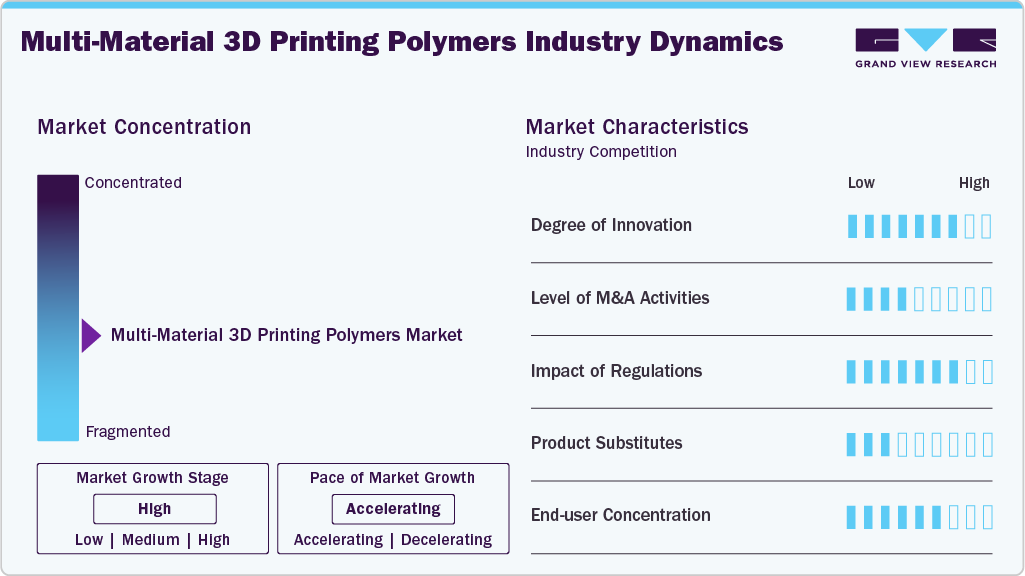
The market growth stage is exponential, and growth is accelerating. The market exhibits slight fragmentation, with key players dominating the industry landscape. Major companies such as Stratasys, 3D Systems, HP, Carbon, Formlabs, Desktop Metal/EnvisionTEC, Mimaki, Keyence, and others play a significant role in shaping the market dynamics. These leading players often drive innovation in the market by introducing new products, technologies, and materials to meet the industry's evolving demands.
Innovation in the multi-material 3D printing polymers industry is driven by advancements in material compatibility, interlayer bonding, processing efficiency, and functional integration. Developments in recyclable polymers, bio-based formulations, flexible-rigid combinations, and high-performance feedstocks are expanding applications across healthcare, automotive, robotics, and electronics. These advancements enhance design flexibility, component performance, and manufacturing efficiency while supporting sustainability objectives and enabling application-specific production.
 To learn more about this report, Download Free Sample Report
 Regulatory requirements and material qualification standards also influence the multi-material 3D printing polymers industry. Manufacturers must address chemical safety, traceability, emissions, biocompatibility, and performance requirements before commercialization. Compliance increases testing and certification costs, particularly for smaller producers. However, companies with established material portfolios, testing capabilities, and regulatory expertise can accelerate product qualification and strengthen customer confidence.
Analyst Perspective
The multi-material 3D printing polymers market is expected to move from prototyping toward application-specific production over the next 5-10 years. Demand will grow across healthcare, automotive, aerospace, electronics, robotics, and industrial manufacturing. Advances in material compatibility, high-performance polymers, and automated printing will expand applications. Sustainability will drive recyclable and bio-based material development. Standardization, regulatory compliance, and supply-chain reliability will become increasingly important. Companies will compete through proprietary materials, integrated platforms, application expertise, and strong IP. However, high costs, material volatility, process complexity, and equipment limitations may restrict growth. Competition from conventional manufacturing will also pressure margins. Overall, market leadership will increasingly depend on technology integration and material performance. Application-specific solutions will remain key to long-term competitive advantage.
Material Type Insights
The thermoplastics segment led the market with the largest revenue share of 60.7% in 2025. The segment is being driven by continuous advances in thermoplastic material formulation, processing technology, and multi-material printing systems, which enable precise control over melt flow, interlayer adhesion, and mechanical properties. This allows manufacturers to combine thermoplastics with varying stiffness, flexibility, and thermal resistance to meet specific end-use requirements. Customized material combinations improve print quality, durability, and functional performance, thereby supporting product differentiation and strengthening the role of thermoplastic multi-material 3D-printing polymers in high-value applications.
The high-performance polymers multi-material 3D printing polymers segment is expected to grow at the fastest CAGR of 21.7% over the forecast period. High-performance polymers represent a significant product segment within the multi-material 3D printing polymers industry, driven by their superior thermal resistance, mechanical strength, chemical stability, and dimensional durability. Demand is increasing as industries seek advanced materials capable of meeting demanding performance requirements in aerospace, automotive, healthcare, and industrial applications. These polymers enable manufacturers to combine high-strength structural components with complementary materials, supporting complex designs, improved functionality, and lightweight manufacturing while strengthening adoption in high-value engineering applications.
Application Insights
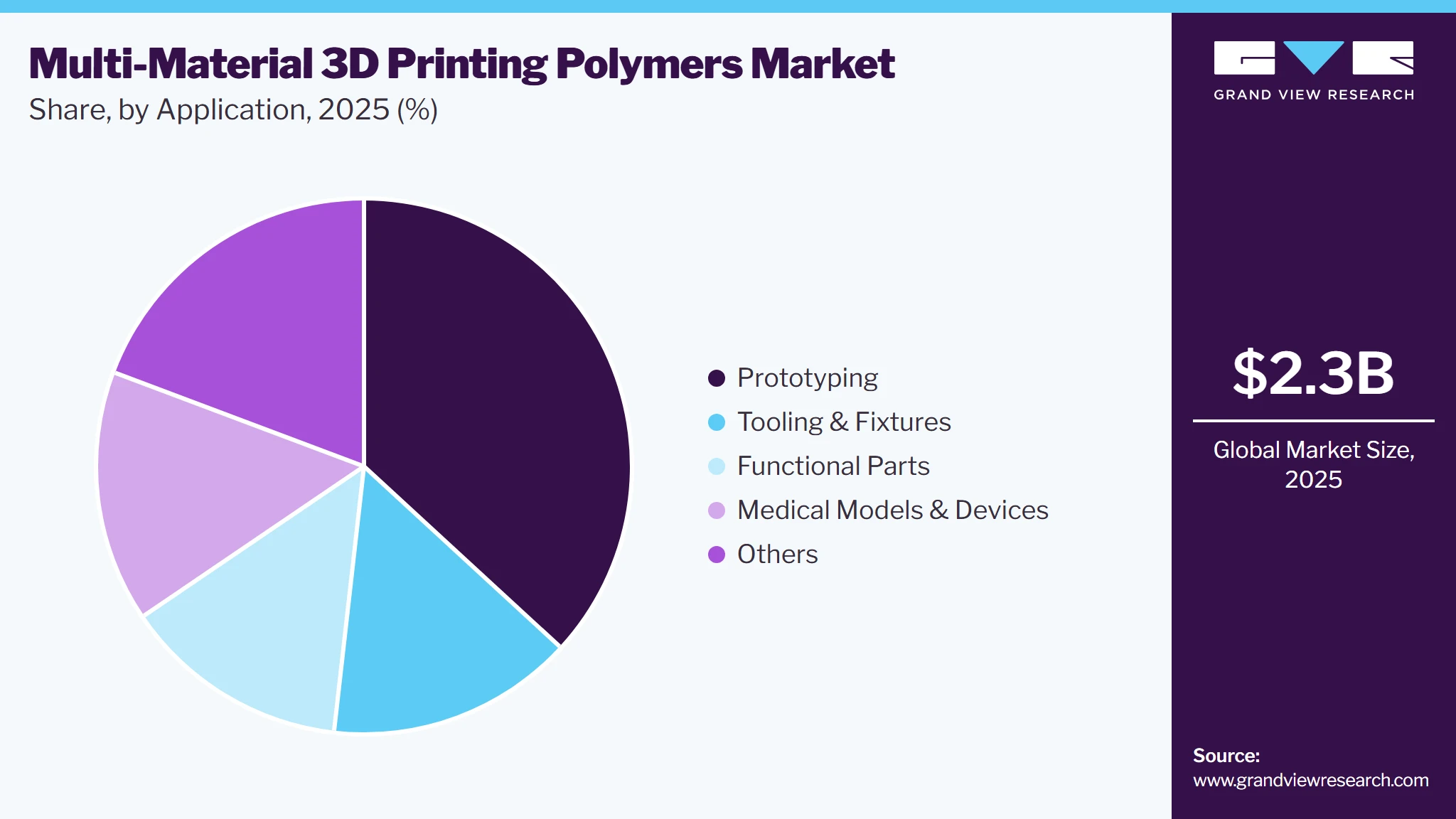
The prototyping segment led the market with the largest revenue share of 36.8% in 2025. The prototyping segment is gaining traction in the global market due to increasing demand for rapid, functional, and cost-effective product development. Multi-material polymers enable designers to combine rigid, flexible, and elastomeric materials within prototypes, allowing realistic testing of mechanical performance, fit, and functionality. Their ability to produce complex geometries and application-specific components supports faster design iterations, reduces development costs, and accelerates product validation across automotive, healthcare, consumer, and industrial applications.
 To learn more about this report, Download Free Sample Report
 The functional parts segment is expected to grow at the fastest CAGR of 21.8% over the forecast period. The functional parts segment represents a high-value application area for multi-material 3D printing polymers, supported by increasing demand for customized components with integrated mechanical and functional properties. Multi-material polymers enable the fabrication of parts combining rigid structures with flexible, conductive, or wear-resistant sections, making them suitable for automotive, robotics, electronics, healthcare, and industrial applications. Growing adoption of lightweight manufacturing, product customization, and integrated component design is further accelerating demand for advanced multi-material polymer solutions.
Regional Insights
The multi-material 3D printing polymers market is expanding rapidly, supported by strong demand from advanced healthcare, aerospace, automotive, and industrial applications. The region’s established additive manufacturing ecosystem and high adoption of advanced materials are driving the use of multi-material polymers for patient-specific medical devices, functional prototypes, lightweight components, and complex geometries. Growing investments in high-performance manufacturing technologies are further strengthening regional market development.
U.S. Multi-material 3D Printing Polymers Market Trends
The multi-material 3D printing polymers market in the U.S. represents a major contributor to regional growth, supported by extensive research capabilities, advanced healthcare infrastructure, and increasing adoption of additive manufacturing. Rising utilization of multi-material polymers in surgical models, prosthetics, robotics, and customized functional parts is accelerating demand. A strong emphasis on product innovation, lightweight design, and manufacturing efficiency is further encouraging manufacturers to adopt multi-material printing solutions for high-value applications.
Asia Pacific Multi-material 3D Printing Polymers Market Trends
Asia Pacific dominated the global multi-material 3D printing polymers market with the largest revenue share of 35.2% in 2025 and is expected to grow at the fastest CAGR during the forecast period. Rapid industrialization and expanding manufacturing capabilities are supporting the strong growth across the Asia Pacific. According to UNIDO, the region remains a major global manufacturing hub, with increasing investments in automotive, electronics, healthcare, and industrial production. This industrial ecosystem is driving demand for multi-material polymers for prototyping, functional parts, and customized components. Rising adoption of advanced manufacturing technologies, expanding healthcare infrastructure, and growing demand for lightweight, high-performance materials are further accelerating regional market development.
 To learn more about this report, Download Free Sample Report
 The multi-material 3D printing polymers market in India accounted for the largest revenue share in the Asia-Pacific region in 2025, driven by the growing adoption of additive manufacturing across automotive, healthcare, electronics, and industrial applications. Growing investments in advanced manufacturing, prototyping, and customized components are strengthening demand for polymer materials that combine multiple functional properties in a single printed structure. Government initiatives promoting domestic manufacturing and industry, along with rising demand for lightweight and complex components, are further encouraging the adoption of multi-material 3D printing polymers.
Europe Multi-material 3D Printing Polymers Market Trends
The multi-material 3D printing polymers market in Europe is expanding due to increasing adoption of advanced materials across healthcare, automotive, aerospace, electronics, and industrial manufacturing applications. Demand is rising for multi-material solutions that enable lightweight components, patient-specific medical devices, functional prototypes, and complex parts with integrated rigid and flexible properties. In addition, stringent sustainability regulations, circular economy initiatives, and the growing preference for recyclable and bio-based materials are encouraging broader adoption of multi-material 3D-printing polymers across the region.
Central & South America Multi-material 3D Printing Polymers Market Trends
The multi-material 3D printing polymers market in Central & South America is anticipated to grow at a significant CAGR during the forecast period. Growing manufacturing activity, expanding healthcare infrastructure, and rising adoption of advanced additive manufacturing technologies are driving demand for multi-material 3D-printing polymers across Central and South America. These materials are increasingly utilized in healthcare, automotive, consumer products, industrial equipment, and prototyping applications due to their design flexibility and functional performance. Increasing use in patient-specific medical models, customized components, soft robotics, and lightweight parts is further supporting market growth, while growing interest in cost-efficient manufacturing continues to encourage regional adoption.
Middle East & Africa Multi-material 3D Printing Polymers Market Trends
The multi-material 3D printing polymers market in the Middle East & Africa is growing steadily. The increasing industrialization, expanding healthcare infrastructure, and rising adoption of advanced manufacturing technologies are driving demand for multi-material 3D printing polymers in the Middle East & Africa. Growing utilization of additive manufacturing across healthcare, automotive, aerospace, construction, and industrial applications is supporting demand for polymers that enable lightweight, customized, and high-performance components. In addition, investments in digital manufacturing, medical technology, and industrial automation are encouraging the transition toward advanced polymer solutions, while diversification initiatives are strengthening regional adoption.
Key Multi-material 3D Printing Polymers Company Insights
Some of the key players operating in the market include Stratasys and 3D Systems
-
Stratasys participates in the multi-material 3D printing polymers industry through its advanced additive manufacturing portfolio, including PolyJet and FDM technologies that support the production of components with multiple materials, colors, and properties. Supported by extensive R&D capabilities and a global customer base, the company serves automotive, healthcare, aerospace, consumer products, and industrial applications with advanced polymer-based 3D printing solutions, enabling functional prototyping, customized components, and complex production parts.
-
3D Systems participates in the multi-material 3D printing polymers industry through its broad portfolio of additive manufacturing technologies, materials, and solutions, including advanced polymer-based printing systems and multi-material production capabilities. Supported by strong application expertise and an established global presence, the company serves healthcare, aerospace, automotive, consumer goods, and industrial sectors with customized additive manufacturing solutions. Its focus on material innovation and production scalability strengthens its position in advanced multi-material polymer applications.
Carbon and Formlabs are among the emerging participants in the multi-material 3D printing polymer industry.
-
Carbon is a technology company focused on digital manufacturing and advanced polymer-based 3D printing solutions for applications across automotive, healthcare, consumer products, and industrial markets. Leveraging its Digital Light Synthesis technology, the company develops high-performance polymer materials and production systems that enable the fabrication of complex geometries, functional components, and customized parts. Its material innovation and scalable manufacturing capabilities support the growing adoption of advanced and multi-material polymer solutions in additive manufacturing.
-
Formlabs is a 3D printing technology company focused on developing resin-based additive manufacturing systems and materials for applications across healthcare, engineering, manufacturing, consumer products, and education. Leveraging advanced stereolithography and digital light processing technologies, the company offers high-performance polymer materials and printing solutions that support prototyping, customization, and low-volume production. Its expanding materials portfolio and accessible professional-grade platforms strengthen its position in the multi-material 3D printing polymers industry.
Key Multi-Material 3D Printing Polymers Companies
The following key companies have been profiled for this study on the global multi-material 3D printing polymers market.
-
Stratasys
-
3D Systems
-
HP
-
Carbon
-
Formlabs
-
Desktop Metal/EnvisionTEC
-
Mimaki
-
Keyence
Competitive Benchmarking
Operating Strategies
Competitive Edge
Weakness
Mature Players: Stratasys, 3D Systems, HP, Mimaki, and Keyence
- Extensive portfolios of polymer-based additive manufacturing systems, materials, and multi-material printing technologies serving healthcare, aerospace, automotive, consumer products, and industrial applications.
- Continuous investment in material development, multi-material printing capabilities, software integration, and process automation to improve print quality, productivity, and application versatility.
- Established global sales, service, and distribution networks support adoption across prototyping, customized manufacturing, and production applications.
- Strong technological expertise in polymer additive manufacturing, multi-material printing, digital manufacturing, and industrial applications.
- Established customer bases, installed equipment platforms, and global commercial networks provide strong market access and recurring material demand.
- Broad application expertise and integrated hardware, materials, and software ecosystems enable customized solutions for diverse end-use industries.
- High equipment and material costs can limit adoption among small manufacturers and price-sensitive customers.
- Complex multi-material printing processes and material compatibility requirements can increase operational and maintenance costs.
- Dependence on continued adoption of additive manufacturing for production applications may expose companies to slower commercialization in certain industries.
Emerging Players: Carbon, Formlabs, and Desktop Metal/EnvisionTEC
- Focus on advanced polymer additive manufacturing platforms, including resin-based, digital light processing, and other digitally driven technologies for prototyping, customization, and end-use production.
- Emphasis on developing high-performance polymer materials, application-specific resins, and integrated software solutions to expand multi-material printing capabilities.
- Expansion into healthcare, dental, automotive, consumer products, and industrial applications through partnerships, new materials, and application-focused solutions.
- Strong specialization in next-generation polymer printing technologies and digitally enabled manufacturing workflows.
- Flexible technology platforms support rapid prototyping, customized components, complex geometries, and low-to-medium-volume production.
- Growing materials ecosystems and application-specific solutions enable penetration into emerging multi-material polymer applications.
- Comparatively smaller installed bases and global distribution networks than leading established players.
- High R&D and commercialization costs associated with developing advanced multi-material polymer systems and compatible materials.
- Greater dependence on expanding industrial adoption and achieving production-scale applications can increase exposure to market fluctuations and competitive pressure.
Recent Developments
-
In March 2026, Stratasys secured a multimillion-dollar U.S. Department of War program focused on accelerating the qualification and deployment of additively manufactured parts across military platforms. The initiative strengthens the adoption of advanced polymer additive manufacturing for aerospace and defense applications, while supporting production-scale manufacturing, faster part qualification, and supply chain resilience for mission-critical components.
-
In November 2025, 3D Systems launched Accura Xtreme Black, a high-performance SLA prototyping resin designed for durable assemblies, snap-fit components, rugged enclosures, and consumer electronics. The material strengthens the company’s engineering polymer portfolio and supports applications requiring a combination of dimensional accuracy, durability, aesthetics, and functional performance, thereby expanding material capabilities for demanding polymer additive manufacturing applications.
Multi-material 3D Printing Polymers Market Report Scope
Report Attribute
Details
Market size in 2025
USD 2.3 billion
Estimated market size in 2026
USD 2.7 billion
Projected market size by 2033
USD 10.0 billion
Growth rate
CAGR of 20.3% from 2026 to 2033
Base year for estimation
2024
Historical data
2021 - 2025
Forecast period
2026 - 2033
Quantitative units
Revenue in USD million/billion, volume in tons, and CAGR from 2026 to 2033
Report coverage
Revenue & volume forecast, competitive landscape, growth factors, and trends
Segments covered
Material type, application, region
Regional scope
North America; Europe; Asia Pacific; Central & South America; Middle East & Africa
Country scope
U.S.; Canada; Mexico; Europe; Germany; UK; France; Italy; Spain; China; India; Japan; South Korea; Australia; Brazil; Argentina; Saudi Arabia; UAE; South Africa
Key companies profiled
Stratasys; 3D Systems; HP; Carbon; Formlabs; Desktop Metal/EnvisionTEC; Mimaki; Keyence.
Customization scope
Free report customization (equivalent to up to 8 analyst working days) with purchase. Addition or alteration to country, regional & segment scope
Pricing and purchase options
Avail customized purchase options to meet your exact research needs. Explore purchase options
Global Multi-material 3D Printing Polymers Market Report Segmentation
This report forecasts revenue growth at the global, regional, and country levels and provides an analysis of the latest industry trends across sub-segments from 2021 to 2033. For this study, Grand View Research has segmented the global multi-material 3D printing polymers market report based on material type, application, and region:
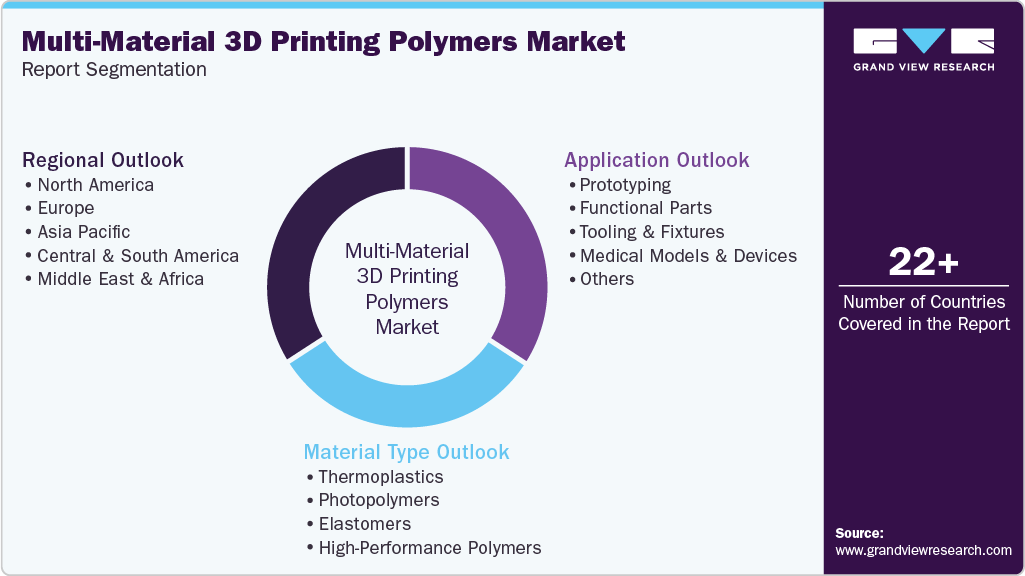 To learn more about this report, Download Free Sample Report
 -
Material Type Outlook (Volume, Tons; Revenue, USD Billion, 2021 - 2033)
-
Thermoplastics
-
Photopolymers
-
Elastomers
-
High-Performance Polymers
-
-
Application Outlook (Volume, Tons; Revenue, USD Billion, 2021 - 2033)
-
Prototyping
-
Functional Parts
-
Tooling & Fixtures
-
Medical Models & Devices
-
Others
-
-
Regional Outlook (Volume, Tons; Revenue, USD Billion, 2021 - 2033)
-
North America
-
U.S.
-
Canada
-
Mexico
-
-
Europe
-
Germany
-
UK
-
France
-
Italy
-
Spain
-
-
Asia Pacific
-
China
-
India
-
Japan
-
South Korea
-
Australia
-
-
Central & South America
-
Brazil
-
Argentina
-
-
Middle East & Africa
-
Saudi Arabia
-
UAE
-
South Africa
-
-
Research Methodology
The multi-material 3D printing polymers market figures in this report are based on a proven research process that combines executive interviews with secondary research from proprietary databases, company filings, and recognized regulatory and institutional sources. Market size is built through value-chain sizing—reconciling supply-side and demand-side estimates—and triangulated with bottom-up and top-down approaches. Every estimate passes multiple levels of expert validation before publication, with eachmulti-material 3D printing polymers segment quantified using the revenue-capture definitions in the table below.
Segment Definition
Segment - Material Type
Revenue capture definition
Thermoplastics
Revenue is captured through the sale of thermoplastic polymers used in multi-material 3D printing for prototyping, functional parts, tooling, automotive components, consumer products, and industrial applications. Demand is supported by their recyclability, processability, mechanical strength, and compatibility with extrusion-based printing systems. Growth is further driven by the increasing adoption of lightweight components, rapid product development, material combinations with varying stiffness levels, and scalable additive manufacturing processes that require cost-effective and versatile polymer solutions.
Photopolymers
Revenue is captured through the supply of photopolymer resins used in multi-material 3D printing for prototypes, medical models, dental devices, functional components, and precision applications. Value is driven by high dimensional accuracy, surface quality, rapid curing, and the ability to produce complex geometries with differentiated mechanical properties. Demand is supported by growing adoption of resin-based additive manufacturing, personalized medical products, rapid design validation, and applications requiring high-resolution multi-material fabrication and specialized functional characteristics.
Elastomers
Revenue is generated through elastomeric polymers used in multi-material 3D printing for flexible components, seals, gaskets, soft-touch interfaces, wearable products, robotics, and customized medical devices. Pricing is influenced by flexibility, elasticity, tear resistance, durability, and compatibility with rigid materials. Growth is supported by increasing adoption of soft robotics, flexible electronics, customized prosthetics, ergonomic components, and hybrid parts that combine rigid structural sections with compliant interfaces within a single printed component.
High-Performance Polymers
Revenue is captured through high-performance polymers used in multi-material 3D printing for aerospace components, automotive parts, medical devices, industrial equipment, and demanding engineering applications. Value is driven by high thermal resistance, chemical stability, mechanical strength, dimensional accuracy, and long-term durability. Demand is supported by increasing requirements for lightweight, high-performance components, advanced manufacturing in the aerospace and automotive sectors, and the development of complex parts that require multiple material properties within a single printed structure.
Segment - Application
Revenue capture definition
Prototyping
Revenue is captured through multi-material 3D printing polymers used to produce concept models, design prototypes, engineering prototypes, and functional prototypes across automotive, aerospace, healthcare, consumer products, and industrial applications. Value is driven by rapid production, design flexibility, realistic material simulation, and reduced development costs. Demand is supported by increasing product customization, shorter development cycles, and growing adoption of additive manufacturing for rapid design iteration, performance testing, and validation before commercial-scale production.
Functional Parts
Revenue is generated through multi-material 3D printing of polymers used to manufacture end-use components that require integrated structural, flexible, thermal, or functional properties. Applications include automotive components, robotics, electronics housings, consumer products, industrial parts, and customized equipment. Pricing is influenced by material performance, durability, dimensional accuracy, and functional integration. Growth is supported by increasing demand for lightweight components, component consolidation, customized manufacturing, and complex geometries that are difficult to produce using conventional manufacturing methods.
Tooling & Fixtures
Revenue is generated from multi-material 3D-printed polymers used in jigs, fixtures, assembly aids, molds, forming tools, inspection equipment, and production-line components. Value is driven by rapid manufacturing, low tooling costs, lightweight construction, customization, and shorter replacement cycles. Demand is supported by increasing adoption of additive manufacturing in automotive, aerospace, electronics, and industrial production, where manufacturers require application-specific tooling with combinations of rigidity, flexibility, wear resistance, and dimensional stability.
Medical Models & Devices
Revenue is generated through multi-material 3D printing polymers used in patient-specific anatomical models, surgical guides, prosthetics, orthotic devices, dental products, and customized medical components. Value is driven by biocompatibility, customization, dimensional accuracy, and the ability to combine rigid and flexible materials. Demand is supported by growing adoption of personalized healthcare, surgical planning, medical simulation, prosthetic customization, and advanced manufacturing technologies that improve patient fit, procedural accuracy, and device functionality.
Others
Revenue comes from specialized applications, including soft robotics, wearable devices, consumer products, electronics, educational models, architectural models, aerospace components, and research applications. Value is supported by multi-material design flexibility, functional integration, lightweight construction, and the ability to combine different mechanical and physical properties in a single component. These emerging applications create opportunities for premium material formulations, application-specific polymer development, technology differentiation, and diversified revenue streams across advanced manufacturing and specialty end-use sectors.
Estimation Model
Layer Name
Key Question
Description
Top-Down Demand Assessment Layer
What defines market boundaries?
This layer establishes global demand for multi-material 3D printing polymers across prototyping, functional parts, tooling & fixtures, medical models & devices, soft robotics, automotive, aerospace, electronics, and industrial applications. Demand is driven by macro drivers such as additive manufacturing adoption, product customization, lightweight-component requirements, digital manufacturing investments, and the increasing demand for complex geometries and integrated material functionality. This defines the total addressable market based on polymer material consumption in multi-material additive manufacturing.
End-Use Demand Validation Layer
Where is demand generated?
This layer maps demand across prototype development, functional component manufacturing, production tooling, patient-specific medical devices, surgical models, robotics, automotive components, aerospace parts, and specialty industrial applications. Market sizing is aligned with performance requirements, including mechanical strength, flexibility, thermal resistance, dimensional accuracy, interlayer adhesion, chemical resistance, biocompatibility, and compatibility between dissimilar polymer materials across different printing conditions.
Consumption-to-Revenue Conversion Layer
Who captures market revenue?
This layer translates polymer consumption and printing material volumes into revenue potential using material utilization rates, print volumes, formulation requirements, material combinations, printing technology, polymer grade, and application-specific performance specifications. Pricing differentials across commodity thermoplastics, photopolymers, elastomers, and high-performance polymers are incorporated to estimate value realization across material manufacturers, filament and resin suppliers, printing technology providers, distributors, and downstream users.
Regional Demand Verification Layer
How are assumptions validated?
This layer validates demand distribution across North America, Europe, Asia Pacific, Central & South America, and the Middle East & Africa by assessing adoption of additive manufacturing, industrial automation, healthcare manufacturing, aerospace and automotive production, electronics manufacturing, and investments in advanced production technologies. Regional technology maturity, manufacturing infrastructure, material availability, regulatory requirements, supply chain dynamics, and end-use industry expansion are used to verify market penetration assumptions and strengthen forecast reliability.
Delivered Customizations
This report has been delivered with the following In-depth customizations
Client Request
Customization Delivered
Value Adds
Regional Segmentation
Delivered a detailed regional assessment of the multi-material 3D printing polymers industry across North America, Europe, Asia Pacific, Central & South America, and the Middle East & Africa. The analysis evaluated market size, adoption trends, manufacturing capabilities, technology maturity, end-use demand, regulatory environment, and regional growth opportunities across healthcare, automotive, aerospace, electronics, robotics, and industrial applications.
Supported regional market prioritization and expansion planning. Identified high-growth geographies, technology adoption patterns, application hotspots, and regional demand drivers. Improved understanding of market maturity and competitive intensity. Enabled informed decisions regarding geographic expansion, resource allocation, partnerships, and market entry strategies.
Cross-Segmentation
Conducted comprehensive cross-segmentation analysis by material type, including thermoplastics, thermosets, elastomers, high-performance polymers, and other material classes, against applications such as prototyping, functional parts, healthcare & medical devices, soft robotics, automotive, aerospace, and electronics. The assessment evaluated demand patterns, material-property requirements, application suitability, and growth potential across key market combinations.
Supported identification of high-value material-application combinations and emerging demand pockets. Improved understanding of segment interdependencies, application-specific material requirements, and commercialization potential. Enabled targeted product development, portfolio optimization, and resource allocation toward attractive market segments.
Competitive Benchmarking
Delivered detailed benchmarking of major multi-material 3D printing polymer manufacturers and technology providers based on product portfolios, material compatibility, printing technologies, application coverage, innovation capabilities, production capacity, geographic presence, strategic partnerships, product launches, and expansion initiatives. The analysis compared competitive positioning across material and application categories.
Supported competitive intelligence and strategic positioning. Identified leading technology providers, product differentiation factors, innovation trends, and competitive strengths and gaps. Improved understanding of market concentration and technology leadership. Enabled informed decisions regarding partnerships, product development, acquisitions, and market entry strategies.
Frequently Asked Questions About This Report
The multi-material 3D printing market was estimated at around USD 2.3 billion in 2025 and is expected to reach around USD 2.7 billion in 2026.
The multi-material 3D printing market is expected to grow at a compound annual growth rate of 20.3% from 2026 to 2033 to reach around USD 10.0 billion by 2033.
The key players in the multi-material 3D printing market are Stratasys, 3D Systems, HP, Carbon, Formlabs, Desktop Metal / EnvisionTEC, Mimaki, and Keyence.
The Asia Pacific Multi-Material 3D Printing market accounted for the largest share of 35.2% market size in 2025.
South Korea was the leading multi-material 3D printing market and is expected to grow at a compound annual growth rate of 24.6%.
The functional parts segment, based on application, is expected to grow at a CAGR of 21.8% for the forecast period.
The thermoplastics multi-material 3D printing industry led the multi-material 3D printing material type market in 2025 with a 60.7% share. Rising demand for lightweight, durable components, coupled with advances in polymer processing and additive manufacturing technologies, is accelerating thermoplastics adoption for multi-material 3D printing applications, prototypes, and customized end-use components.
Increasing demand for multi-material 3D printing polymers across automotive, healthcare, robotics, and consumer electronics is driving market growth. These materials enable integration of rigid, flexible, and elastomeric components, enhancing functionality, weight efficiency, durability, and design flexibility while supporting customized medical devices, robotic systems, electronic housings, and automotive components.
Based on application, the prototyping segment accounted for the largest share of 36.8% market size in 2025. Growing demand for rapid product development, increasing customization, and advances in additive manufacturing technologies are accelerating multi-material 3D printing adoption for functional prototypes, design validation, complex geometries, and performance testing applications.
About the Author(s)
Plastics, Polymers & Resins Research Team
Bulk Chemicals · Plastics, Polymers & ResinsThis report was authored by the plastics, polymers & resins research team at Grand View Research - comprising two research analysts, one senior research analyst, and one industry expert - with specialized expertise in the plastics, polymers & resins segment of the bulk chemicals industry. All findings are based on proprietary bulk chemicals databases, executive interviews, and regulatory analysis, subject to internal peer review prior to publication.
Last Updated:
Speak to Analyst

Customize this report to your needs - add regions, segments, or data points, with 20% free customization.
Or view our licence options:


ISO 9001:2015 & 27001:2022 Certified
We are GDPR and CCPA compliant! Your transaction & personal information is safe and secure. For more details, please read our privacy policy.


