
- Home
- »
- Next Generation Technologies
- »
-
Music Streaming Market Size And Share Report, 2026-2033GVR Report cover

Music Streaming Market (2026 - 2033)
Size, Share & Trends Analysis Report By Service (On-demand Streaming, Live Streaming), By Platform (Apps, Browsers), By Content (Audio, Video), By End-use, By Region, And Segment Forecasts
Market Size, 2025
$54.1BMarket Estimate, 2026
$62.5BMarket Forecast, 2033
$158.1BCAGR, 2026–2033
14.2%Music Streaming Market Summary
The global music streaming market size was valued at USD 54.1 billion in 2025 and is projected to grow from USD 62.5 billion in 2026 to USD 158.1 billion by 2033, growing at a CAGR of 14.2% from 2026 to 2033. North America dominated globally with a share of over 34.1% in 2025. This growth is largely driven by the increasing consumption of digital music across various devices.
 Source: Grand View Research, IR Documents, Primary Interviews, Paid DatabasesTo learn more about this report,
 Download Free Sample Report
 Key Market Trends & Insights
- By service: On-demand streaming segment led the market with the largest revenue share of 71.1% in 2025.
- By platform: Apps segment led the market with the largest revenue share of 86.3% in 2025.
- By content: The audio segment accounted for the largest market share of 61.85% in 2025.
- By end use: The individual segment accounted for the largest market share of 63.36%in 2025.
Regional Highlights
- Largest regional market: North America (34.1% revenue share, 2025)
- Fastest-growing regional market: Asia Pacific (highest CAGR, 2026-2033)
- By country: The U.S. held the largest market share in 2025
Market Size & Forecast
- Market size in 2025: USD 54.1 Billion
- Estimated market size in 2026: USD 62.5 Billion
- Projected market size by 2033: USD 158.1 Billion
- CAGR (2026-2033): 14.2%
Three ways to get this report
Buy it, customize it, or ask a question.Ask an Analyst
Analyst response in 1 business day
- AccessReport author, directly
- Reply timeWithin 1 working day
- No sales callDirect answer only
- FormatEmail reply
- CostFree, no cost
Get the Full Report
What the study covers
- FormatsPDF · Excel · Dashboard
- Timeline2026–2033 annual, 2025 base
- Coverage20+ countries, 5 regions
- Companies10+ key players profiled
Customize the Report
20% free customization
- IncludeCountries, segments, points
- TailorTo your product definition
- ExtendDeeper competitor detail
- OrA fully bespoke study
- Turnaround5–10 working days
With the proliferation of smartphones, internet access, and high-speed data networks, more consumers are choosing music streaming platforms such as Spotify AB, Apple, Inc., and Amazon.com, Inc. (Amazon Music) over traditional media sources. The convenience of having instant access to millions of songs and the flexibility to create personalized playlists is further driving the music streaming industry expansion. To learn more about this report, Download Free Sample Report
 The growing adoption of subscription-based models is further enhancing the music streaming industry expansion. Services that offer premium, ad-free experiences along with exclusive content are enticing more users to upgrade from free, ad-supported versions. The freemium model, where users can access basic features for free but are prompted to subscribe for additional benefits, is particularly effective. This shift is increasing user retention and enhancing the revenue streams for streaming platforms. As more users opt for subscriptions, streaming services continue to refine their pricing structures and content offerings to attract and maintain loyal customers.
Artificial intelligence (AI) and machine learning have revolutionized how music streaming platforms recommend songs and playlists. By analyzing user behavior, preferences, and listening patterns, AI enables services to curate highly personalized music experiences, ensuring that users discover new artists and tracks based on their individual tastes. This level of customization is increasingly gaining traction as consumers expect more relevant content. In addition, AI-driven playlists and smart assistants enhance user engagement, contributing to the sustained growth of the market by making the listening experience more enjoyable and tailored to each listener’s preferences. These trends collectively enhance user experience and drive the music streaming industry's growth.
Furthermore, the rise of podcasts and other non-music audio content has significantly impacted the music streaming landscape. Platforms are increasingly diversifying their offerings to incorporate spoken word content, including podcasts, audiobooks, and even live-streamed events. This trend aligns with the growing demand for audio content that extends beyond music, catering to diverse interests such as storytelling, news, entertainment, and education. As consumers spend more time on streaming platforms, they seek out various types of content, further propelling the market's expansion into new audio formats.
Moreover, companies in the music streaming industry are forming strategic partnerships with artists, record labels, and even other tech companies to enhance their content offerings and expand their reach. Collaborations with artists allow platforms to offer exclusive content, early releases, and special events that attract new subscribers. Moreover, the global expansion of music streaming services into emerging markets, particularly in Asia-Pacific and Latin America, is accelerating the ongoing international music streaming industry expansion. Such strategies by key companies are expected to drive the music streaming industry growth in the coming years.
Market Dynamics
Music streaming platforms are gaining strong traction as they offer personalized features such as AI-powered song recommendations, curated playlists, offline listening, podcast integration, live audio content, and cross-device accessibility. These platforms enable users to access extensive music libraries while enhancing engagement through real-time recommendations, personalized listening experiences, and seamless digital connectivity. The growing preference for on-demand entertainment, coupled with rising smartphone adoption and affordable internet availability, is expected to continue driving growth in the music streaming market.
The increasing consumer preference for personalized digital audio experiences is a major driver shaping market expansion. Music platforms are leveraging advanced recommendation engines, curated playlists, mood-based listening options, and user-specific content suggestions to create highly tailored experiences. These features improve user engagement by enabling listeners to easily discover relevant music, podcasts, and exclusive audio content while supporting seamless access across multiple connected devices.
The growing penetration of smartphones, wireless audio devices, and high-speed mobile internet is accelerating user adoption across developed and emerging economies. Consumers increasingly favor instant access to large music libraries, flexible subscription models, and offline listening capabilities. This shift toward convenient, personalized, on-demand entertainment is strengthening user retention and increasing platform engagement, reinforcing broader expansion across digital audio ecosystems.
Increasing royalty payment burdens for platform providers remain a major restraint affecting profitability across streaming platforms. Companies are required to pay substantial licensing fees to record labels, publishers, and artists for content distribution, creating ongoing financial pressure. These costs often increase with subscriber volume and streaming frequency, limiting operating margins while making it more difficult for smaller platforms to compete with established global providers.
The complexity of licensing agreements across regions also creates operational challenges for platform expansion. Music rights differ by country, artist contracts, and distribution channels, increasing legal and administrative burdens for service providers. These financial obligations can limit investment in innovation, premium content acquisition, and market expansion, particularly in price-sensitive regions where balancing affordability with profitability remains difficult.
The expansion of regional-language audio content libraries presents a significant opportunity for platform providers seeking to reach a wider audience. Consumers are increasingly demanding access to local-language music catalogs, independent artists, and culturally relevant playlists that reflect regional preferences. Platforms investing in vernacular content partnerships and artist collaborations are improving engagement while strengthening subscriber acquisition across diverse demographic groups in emerging digital consumption markets.
This opportunity is especially prominent across countries with multilingual populations, where localized content significantly influences listening behavior. Streaming platforms are broadening catalog offerings to include regional genres, podcasts, and exclusive releases tailored to local audiences. Enhanced focus on culturally relevant audio content supports stronger user loyalty, deeper platform engagement, and increased differentiation in highly competitive digital entertainment ecosystems.
Market Concentration & Characteristics
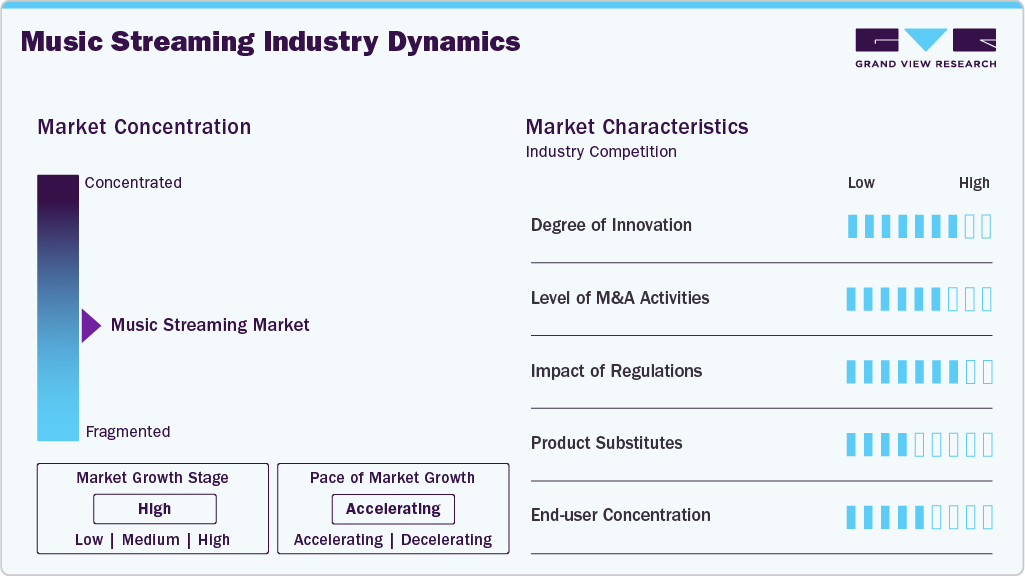
The music streaming market is moderately concentrated, with a mix of leading global streaming platforms, digital ecosystem providers, regional music services, and emerging audio-focused technology companies. The market is expanding due to rising consumer demand for on-demand digital entertainment, increasing adoption of subscription-based listening services, and growing access to smartphones and high-speed internet across developed and emerging economies. Strategic partnerships with music labels, podcast creators, telecom providers, and device manufacturers are becoming increasingly common as companies focus on strengthening content distribution reach and improving personalized user engagement. Continuous investments in AI-powered recommendation engines, audio quality enhancement, exclusive artist content, and platform-based listener analytics are emerging as core competitive strategies across the market.
 To learn more about this report, Download Free Sample Report
 The market is characterized by a very high level of innovation, driven by personalized music discovery algorithms, live audio streaming capabilities, immersive multimedia experiences, and expanding podcast integration. The industry is witnessing moderate merger and acquisition activities as streaming providers seek to strengthen audio content portfolios, broaden technology capabilities, and improve user acquisition strategies. Competition from video streaming platforms, radio broadcasting services, and free digital entertainment channels remains moderately high, although consumer preference for personalized music access continues to strengthen. Growing investments in regional-language music catalogs, creator monetization tools, connected device compatibility, and subscription-based audio ecosystems are expected to further support expansion across the music streaming market.
Analyst Perspective
The music streaming market is positioned at the convergence of expanding digital connectivity, rising paid subscription adoption, and the growing monetization of audio ecosystems through advertising, exclusive content, and bundled partnerships with telecom and device providers. The strongest long-term competitive moat, however, will belong to the platform that can combine music discovery, personalized recommendations, podcasts, live audio, and creator monetization into one unified listening ecosystem, transforming casual listening into a high-frequency daily habit and creating a durable user relationship that supports recurring revenue and premium pricing across global markets.
Service Insights
Based on service, the on-demand streaming segment led the market with the largest revenue share of 71.1% in 2025 and is expected to grow at a significant CAGR over the forecast period. This dominance is driven by the increasing consumer preference for personalized music experiences. With platforms offering vast libraries of songs and playlists, users can listen to what they want when they want. This shift towards on-demand consumption is accelerated by the growth of smartphones, improved internet access, and the convenience of streaming platforms offering tailored recommendations using AI algorithms. In addition, the growing number of subscription-based models and freemium services are boosting revenue in this segment.
The live streaming segment is expected to witness the fastest CAGR of over 15.5% from 2026 to 2033. Live streaming in music is gaining traction owing to the growing demand for real-time, interactive experiences. Factors driving this segment include the popularity of live concerts, virtual events, and the ease of access through streaming platforms during the pandemic era. Artists are also leveraging live streaming for global reach, allowing them to connect with fans without geographical limitations. The incorporation of real-time fan engagement tools, such as chat and virtual tips, further propels the growth of this segment, while platforms are investing in high-quality streaming infrastructure to deliver seamless experiences.
Platform Insights
Based on platform, the apps segment led the market with the largest revenue share of 86.3% in 2025. The increase in app-based music consumption is driven by convenience, portability, and the fact that many platforms offer exclusive content or features that are only available through their apps. These apps also integrate with various other services, such as social media and smart devices, driving user engagement. In addition, continuous updates and the introduction of new features, like AI-driven recommendations and offline listening, are boosting the popularity of music streaming apps.
 To learn more about this report, Download Free Sample Report
 The browsers segment is expected to witness the fastest CAGR from 2025 to 2030. The browser-based segment of music streaming platforms benefits from its accessibility and ease of use, especially for desktop users who prefer music streaming while working or multitasking. The main driver of this segment is the seamless integration of browser-based platforms with other productivity tools, enabling users to enjoy music without switching between apps. As many streaming services continue to offer web-based versions of their platforms alongside mobile apps, the convenience of accessing music directly from a browser without needing additional downloads or software contributes to the steady growth of this segment.
Content Insights
Based on content, the audio segment accounted for the largest market share of 61.85% in 2025, owing to the long-standing popularity of music as an audio-based medium. Music streaming services continue to drive growth with a vast catalog of songs, podcasts, and exclusive content, offering a wide variety of genres and artists. The shift toward higher-quality audio formats and integration with smart speakers and other IoT devices is fueling this segment's growth. In addition, the rise of podcasts and audiobooks is expanding the diversity of content within music streaming, attracting more users, and increasing monetization opportunities for service providers.
The video segment is expected to witness the fastest CAGR from 2026 to 2033. driven by the rise of music videos, live performances, and visual albums that offer an immersive experience. Platforms focus on delivering high-quality video content, including exclusive behind-the-scenes footage, interviews, and live streaming events, further enhancing the user experience. The increasing adoption of video streaming services, as well as the popularity of platforms, has made video an integral part of music consumption, pushing service providers to diversify their offerings and attract new subscribers.
End-use Insights
Based on end use, the individual segment accounted for the largest market share of 63.36% in 2025. The growing popularity of music streaming among younger generations, who are integrating music into their daily lives, is a major driver. This trend is further fueled by the increasing availability of wireless internet and the widespread use of mobile devices, leading to significant growth in the individual user segment.
The commercial segment is expected to register the fastest CAGR from 2026 to 2033. The expansion of the commercial segment, encompassing businesses such as restaurants, salons, and gyms, is driven by the use of data and analytics in music streaming. These tools provide valuable insights into popular music, customer preferences, and engagement, allowing businesses to make informed decisions about their music selection and enhance the customer experience. This data-driven approach is a key factor in the segment's growth.
Regional Insights
North America dominated the music streaming market with the largest revenue share of 34.1% in 2025, primarilydriven by the high smartphone penetration, fast internet speeds, and the shift from physical media to digital platforms. The preference for on-demand, personalized music experiences and the rise of subscription models are major contributors to growth. In addition, the popularity of podcasts and audio content within streaming platforms is becoming more pronounced. Integration with smart speakers, voice assistants, and other connected devices is further fueling the market growth. The increasing trend of exclusive artist content, live event streaming, and video integration are key trends shaping the market.
 To learn more about this report, Download Free Sample Report
 U.S. Music Streaming Market Trends
The music streaming market in the U.S. held the largest share in the North America region in 2025, driven by the widespread use of smartphones and high-speed internet, alongside the shift from traditional music formats to digital streaming. Consumers are increasingly attracted to the convenience, affordability, and vast content libraries offered by streaming services. Additionally, there is a rising trend of integrating music streaming with smart home devices, and podcasts and video content are gaining popularity within music platforms in the U.S.
Europe Music Streaming Market Trends
Europe music streaming industry is expected to grow at a CAGR from 2026 to 2033, fueled by widespread internet access, a strong mobile user base, and a cultural shift towards digital music consumption. Affordability, ease of access, and the ability to explore diverse music genres have made streaming services extremely popular. Trends include growing demand for personalized playlists, podcasts, and exclusive content such as live performances or early releases. Furthermore, the integration of music streaming with smart devices and the increasing use of music streaming for social interaction are influencing the market's development across European countries.
The music streaming industry in the UK is expected to grow at a significant rate in the coming years, fueled by the demand for instant access to a wide range of music, driven by high internet penetration and a culture of music appreciation. Consumers are transitioning from physical music purchases to subscription-based streaming models, seeking affordability and convenience. Exclusive content, live event streaming, and artist collaborations are becoming significant trends. Additionally, the increasing integration of music services into connected devices and the influence of social media platforms in promoting music are important factors in the market's growth.
The music streaming industry in Germany is characterized by strong digital infrastructure, high internet usage, and a shift away from illegal downloading toward legal streaming services. A growing number of consumers prefer subscription-based models to access high-quality music without interruptions. There is also a notable trend of users favoring personalized content such as curated playlists and podcasts. The increasing interest in niche music genres and tailored listening experiences further contribute to the evolution of the German music streaming market.
Asia-Pacific Music Streaming Market Trends
Asia Pacific music streaming industry is expected to grow at the fastest CAGR during the forecast period, driven by a combination of high mobile device usage, tech-savvy consumers, and a strong gaming and entertainment culture. Countries in the region are at the forefront, adopting AR/VR to enhance e-commerce, retail, and gaming experiences. Additionally, APAC’s rapidly growing middle class, coupled with the region’s focus on technological innovation, has accelerated the adoption of music streaming across various industries.
The Japan music streaming industry is gaining traction driven by a combination of advanced technology adoption and a rich culture of music consumption. The shift from physical music sales to streaming is accelerating, supported by the desire for convenience and affordability. Consumers are increasingly drawn to localized content, such as region-specific playlists and popular international music genres. There is also a growing preference for high-quality audio and exclusive content. Trends in Japan include the integration of music streaming with gaming and other digital entertainment and a strong focus on discovering both local and international artists.
The China music streaming industry is rapidly expanding, propelled by the large, digitally connected youth population, high mobile internet usage, and the popularity of streaming as a primary way to consume music. The market is characterized by strong investments in exclusive content, social interaction features, and user-generated content, which contribute to increasing consumer engagement. Live streaming and the blending of music with social media, gaming, and e-commerce are key trends in China. Additionally, the tightening of government regulations regarding licensing and content distribution is influencing the direction of the market's growth.
Key Music Streaming Company Insights
Some of the key players operating in the market are Spotify AB and Apple, Inc., among others.
-
Spotify AB is a global music streaming service provider that provides users with access to millions of tracks and episodes of music and podcasts. Available on various devices, the company allows users to choose what they want to listen to or be surprised by curated content. Users can also explore collections from friends, artists, and celebrities or create personalized radio stations. The company operates on a freemium model, offering both free (ad-supported) and subscription-based (ad-free) access. Spotify USA, Inc. caters to users in the United States, while Spotify AB serves users in all other markets.
-
Apple, Inc. (Apple Music) is Apple's subscription-based music streaming service, offering users access to over 100 million songs. Subscribers can listen ad-free, both online and offline, and enjoy features like Spatial Audio for an immersive listening experience and lossless audio for high-fidelity sound. The platform includes original content such as exclusive interviews, live concerts, and radio shows. A unique feature, Apple Music Sing, allows users to sing along with real-time lyrics. Apple Music is accessible across all Apple devices, as well as on other platforms, making it a versatile option for music lovers.
Tidal and YouTube Music are some of the emerging market participants in the music streaming industry.
-
TIDAL is a global music streaming service committed to connecting artists and fans through unparalleled sound quality and immersive experiences. With a library of over 110 million tracks, TIDAL offers best-in-class sound formats, including lossless, HiRes FLAC, and Dolby Atmos. Subscribers enjoy ad-free listening, offline playback, personalized mixes, curated playlists, and live sessions. TIDAL provides various subscription options, including Individual, Family, and Student plans, with add-ons like the DJ Extension. New users can explore the platform through a 30-day free trial.
-
YouTube Music is a music streaming service developed by Google that provides users with access to a vast library of songs, albums, live performances, and music videos. It allows users to listen to their favorite music, discover new artists, and create personalized playlists. YouTube Music also offers features such as offline playback, background listening, and integration with other Google services.
Key Music Streaming Companies:
The following key companies have been profiled for this study on the music streaming market.
-
Spotify AB
-
Apple, Inc. (Apple Music)
-
Amazon.com, Inc. (Amazon Music)
-
Deezer SA
-
Pandora Media, Inc.
-
Tencent Music Entertainment Group
-
Tidal
-
SoundCloud Global Limited & Co. KG
-
iHeartMedia, Inc.
-
YouTube Music
Competitive Benchmarking
Category
Operating Strategies
Competitive Edge
Weakness
Established Players (Spotify AB, Apple Inc., Amazon.com, Inc.)
- Focus on expanding exclusive audio ecosystems through artist partnerships, podcasts, audiobooks, and platform bundling.
- Invest heavily in AI-driven personalization technologies to improve engagement, retention, and subscriber monetization.
- A strong global presence, an extensive subscriber base, and recognized brand value support market leadership.
- Ability to offer broad music catalogs with advanced personalization across multiple connected devices.
- High royalty payment obligations create margin pressure across subscription and ad-supported offerings.
- Large platform structures can reduce agility against niche streaming providers targeting specialized audiences.
Emerging Players (Deezer SA, SoundCloud Global Limited & Co. KG, Tidal)
- Focus on expanding niche audio communities through independent artist partnerships and exclusive content.
- Invest in platform innovation to strengthen personalized discovery features and listener engagement.
- Strong focus on niche audiences supports differentiated positioning across competitive streaming platforms.
- Ability to introduce innovative audio experiences faster than larger established streaming providers.
- Limited financial resources and challenges in scaling user acquisition profitably
- Lower consumer trust and weaker clinical validation compared to established platforms
Recent Developments
-
In February 2025, Spotify launched "Mi Primer Escenario" (My First Stage) in Argentina, a music contest designed to support emerging artists. The contest offers up-and-coming Argentine musicians the chance to showcase their talent and connect with listeners, with the grand prize being a performance slot at Quilmes Rock, a major music festival, alongside established acts.
-
In December 2024, Apple, Inc. (Apple Music) expanded its live global radio offering with the launch of three new stations: Apple Música Uno, Apple Music Club, and Apple Music Chill. These stations join Apple Music 1, Hits, and Country to provide listeners with more exclusive shows hosted by a diverse range of artists. Apple Música Uno focuses on Latin music, with Becky G as the launch host, while Apple Music Club caters to dance and electronic music enthusiasts with mixes from top DJs. Apple Music Chill offers a calming escape with a continuous flow of relaxing music.
-
In August 2024, Amazon.com, Inc. (Amazon Music) launched Maestro, an AI playlist generator currently in beta for select U.S. customers on iOS and Android. Additionally, Amazon Music is introducing AI-generated "Topics" tags for podcasts, allowing listeners to discover related content by tapping on these tags beneath episode descriptions. Users can find these tags on popular podcasts like The Daily, SmartLess, and This American Life by updating to the latest version of the Amazon Music app and navigating to the podcast section.
Music Streaming Market Report Scope
Report Attribute
Details
Market size in 2025
USD 54.1 billion
Estimated market size in 2026
USD 62.5 billion
Projected market size by 2033
USD 158.1 billion
Growth rate
CAGR of 14.2% from 2026 to 2033
Base year for estimation
2025
Historical data
2021 - 2024
Forecast period
2026 - 2033
Quantitative units
Revenue in USD billion and CAGR from 2026 to 2033
Report coverage
Revenue forecast, company ranking, competitive landscape, growth factors, and trends
Segments covered
Service, platform, content type, end use, region
Regional scope
North America; Europe; Asia Pacific; Latin America; MEA
Country scope
U.S.; Canada; Mexico; Germany; U.K.; France; Italy; Spain; China; Japan; India; South Korea; Australia; Brazil; Saudi Arabia; South Africa; UAE
Key companies profiled
Spotify AB; Apple Inc. (Apple Music); Amazon.com, Inc. (Amazon Music); Deezer SA; Pandora Media, Inc.; Tencent Music Entertainment Group; Tidal; SoundCloud Global Limited & Co. KG; iHeartMedia, Inc; YouTube Music
Customization scope
Free report customization (equivalent up to 8 analysts' working days) with purchase. Addition or alteration to country, regional & segment scope.
Pricing and purchase options
Avail customized purchase options to meet your exact research needs. Explore purchase options
Global Music Streaming Market Report Segmentation
This report forecasts revenue growth at global, regional, and country levels and provides an analysis of the latest technology trends in each of the sub-segments from 2021 to 2033. For this study, Grand View Research has segmented the global music streaming market report based on service, platform, content, end-use, and region:
-
Service Outlook (Revenue, USD Million, 2021 - 2033)
-
On-demand streaming
-
Live streaming
-
-
Platform Outlook (Revenue, USD Million, 2021 - 2033)
-
Apps
-
Browsers
-
-
Content Outlook (Revenue, USD Million, 2021 - 2033)
-
Audio
-
Video
-
-
End-use Outlook (Revenue, USD Million, 2021 - 2033)
-
Individual
-
Commercial
-
-
Regional Outlook (Revenue, USD Million, 2021 - 2033)
-
North America
-
U.S.
-
Canada
-
Mexico
-
-
Europe
-
UK
-
Germany
-
France
-
Italy
-
Spain
-
-
Asia Pacific
-
China
-
Japan
-
India
-
South Korea
-
Australia
-
-
Latin America
-
Brazil
-
-
Middle East & Africa
-
Saudi Arabia
-
South Africa
-
UAE
-
-
Research Methodology
Segment Definition
Segment - Service
Revenue capture definition
On-demand streaming
Revenue is generated through paid subscriptions, ad-supported listening, and premium feature upgrades. This segment represents the largest revenue contributor as consumers increasingly prefer flexible, on-demand access to extensive music libraries across smartphones, connected devices, and digital entertainment ecosystems.
Live streaming
Revenue is captured through virtual concerts, artist live sessions, exclusive audio broadcasts, fan memberships, and brand-sponsored live events hosted on music streaming platforms. Additional monetization comes from digital tipping, premium event access, interactive audience engagement features, and exclusive artist collaborations that attract dedicated listener communities and encourage direct user spending.
Segment - Platform
Revenue capture definition
Apps
Revenue is generated through mobile app subscriptions, in-app premium upgrades, targeted advertising placements, and integrated payment features that support uninterrupted music access across smartphones and tablets. Mobile apps also strengthen monetization by increasing user engagement through push notifications, personalized playlists, and easy access to downloads, podcasts, and exclusive content.
Browsers
Revenue is captured through web-based streaming subscriptions and digital advertising across desktop and laptop users accessing music through internet browsers. This segment supports platform accessibility and user convenience while helping providers expand audience reach through synchronized cross-device listening and premium subscription conversions.
Segment – Content Type
Revenue capture definition
Audio
Revenue is generated through music subscriptions, podcast monetization, ad-supported listening, and premium audio features such as offline playback and enhanced sound quality. As the largest content segment, audio continues to dominate revenue generation due to strong listener demand for personalized access to music across genres, artists, podcasts, and regional-language content.
Video
Revenue is generated through music videos, artist interviews, live performances, and ad-supported visual content integrated into streaming platforms. This segment is expanding as consumers increasingly engage with multimedia entertainment experiences, creating additional monetization opportunities through premium video access and brand-sponsored promotional content.
Segment – End Use
Revenue capture definition
Individual
Revenue is captured through personal subscriptions, family plans, student memberships, and advertising linked to direct consumer listening activity. This segment accounts for the largest share as consumers increasingly adopt streaming platforms for personalized, on-demand access to music, podcasts, and exclusive audio content across devices.
Commercial
Revenue is generated through licensed music subscriptions purchased by retail stores, restaurants, hotels, offices, and fitness centers for business use. Commercial users generate recurring revenue through enterprise streaming packages that offer licensed playback rights, curated playlists, and music management solutions tailored to customer-facing environments.
Estimation Model
Audience Layer
Digital Access Layer
Engagement Layer
Monetisation Layer
Who are the potential music streaming users?
Who can access music streaming services?
Who actively uses music streaming platforms?
How much revenue is generated?
Identify the total addressable listener base by estimating the population with access to digital audio consumption, including smartphone users, internet users, and digitally active consumers across target regions. This establishes the potential music streaming audience.
Filter the potential audience based on access to streaming-enabling infrastructure, including mobile broadband, fixed internet, app store availability, digital payment access, and connected devices. This determines the digitally reachable market.
Apply music streaming adoption rates to the reachable audience and segment users into free/ad-supported and premium subscribers. This converts reachable consumers into active streaming users.
Estimate revenue from premium subscriptions, advertising income from free-tier users, family plans, student plans, and bundled telecom/music offerings. Multiply active users by ARPU to derive total market revenue.
Delivered Customizations
This report has been delivered with the following In-depth customizations
Client Request
Customization Delivered
Value Adds
Streaming Subscriber Growth, Listening Behavior & Platform Adoption Trends
Conducted a focused analysis of music streaming usage across premium subscriptions and ad-supported tiers, covering listener demographics, mobile and connected-device streaming, playlist consumption trends, personalized recommendation features, podcast integration, and regional platform adoption patterns.
Helps stakeholders identify high-growth listener segments, evaluate evolving consumption behavior, and assess monetization opportunities across subscriptions, advertising, and cross-platform engagement strategies.
Artist Monetisation, Content Strategy & Digital Audio Engagement Trends
Evaluated market trends related to music discovery, artist monetization models, exclusive releases, podcast expansion, creator tools, social media integration, and user engagement features including curated playlists, live sessions, and AI-driven music recommendations.
Provides insights into emerging content consumption trends, user retention strategies, and commercially attractive engagement models to support platform differentiation and long-term audience growth.
Streaming Infrastructure, Licensing Ecosystem & Market Expansion Opportunity Assessment
Assessed demand for scalable streaming infrastructure, audio delivery networks, licensing frameworks, royalty management systems, regional content partnerships, and expansion opportunities across developed and emerging digital music markets.
Supports investment and expansion strategies by identifying underserved geographies, evaluating platform scalability and licensing readiness, and strengthening long-term growth opportunities in the global music streaming ecosystem.
Frequently Asked Questions About This Report
The global music streaming market size was estimated at USD 54.1 billion in 2025 and is expected to reach USD 62.5 billion in 2026.
The global music streaming market is expected to grow at a compound annual growth rate of 14.2% from 2026 to 2033 to reach USD 158.1 billion by 2033.
Some key players operating in the music streaming market include Spotify AB, Apple, Inc., Amazon.com, Inc., Google LLC, Deezer, Pandora Media, Inc., and Tencent Music Entertainment Group.
The North America music streaming market dominated with a share of 34.1% in 2025.
Key factors that are driving the music streaming market growth include the growing adoption of digital music services, the rise in online content consumption, and technological advancements in the music streaming industry.
The on-demand streaming segment led with a 71.1% revenue share in 2025, while live streaming is the fastest growing segment.
The Apps segment led with an 86.3% revenue share in 2025 and is the fastest-growing platform.
The audio segment led with a 61.8% revenue share in 2025, while video is the fastest-growing segment.
The Asia Pacific is the fastest growing region over the forecast period.
About the Author(s)
Next Generation Technologies Research Team
Technology · Next Generation TechnologiesThis report was authored by the next generation technologies research team at Grand View Research - comprising two research analysts, one senior research analyst, and one industry expert - with specialized expertise in the next generation technologies segment of the technology industry. All findings are based on proprietary technology databases, executive interviews, and regulatory analysis, subject to internal peer review prior to publication.
Last Updated:
Speak to Analyst

Customize this report to your needs - add regions, segments, or data points, with 20% free customization.
Or view our licence options:


ISO 9001:2015 & 27001:2022 Certified
We are GDPR and CCPA compliant! Your transaction & personal information is safe and secure. For more details, please read our privacy policy.


