
- Home
- »
- Advanced Interior Materials
- »
-
Mycelium-based Building Materials Market Report 2025-2033GVR Report cover

Mycelium-based Building Materials Market (2025 - 2033)
Size, Share & Trends Analysis Report By Product (Mycelium Insulation Panels, Mycelium Bricks & Blocks, Mycelium Acoustic Panels, Mycelium Composites), By Application, By Region, And Segment Forecasts
Market Size, 2024
$910.3MMarket Estimate, 2026
$1,144.2MMarket Forecast, 2033
$2,546.8MCAGR, 2025–2033
12.1%Mycelium-based Building Materials Market Summary
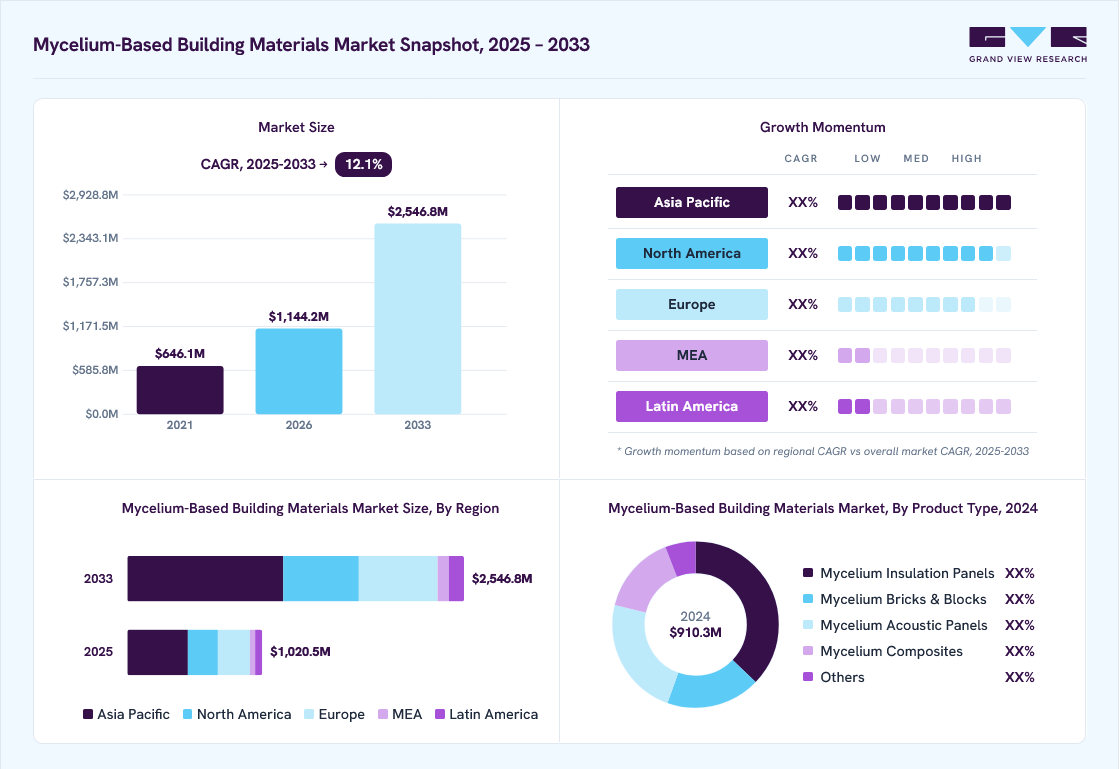
The global mycelium-based building materials market size was valued at USD 910.3 million in 2024 and is projected to grow from USD 1,144.2 million in 2026 to USD 2,546.8 million by 2033, at a CAGR of 12.1% from 2025 to 2033. Asia Pacific dominated the market, accounting for a revenue share of 44.6% in 2024, driven by the increasing demand for sustainable and eco-friendly construction materials. As environmental concerns related to carbon emissions and resource depletion intensify, there is a growing shift toward bio-based alternatives that minimize environmental impact.
 Source: Grand View Research, IR Documents, Primary Interviews, Paid DatabasesTo learn more about this report,
 Download Free Sample Report
 Key Market Trends & Insights
- China’s market is driven by a strong government focus on sustainable urban development and carbon neutrality goals under its “Green Building Action Plan.”
- By product, the mycelium acoustic panels segment is expected to grow at fastest CAGR of 12.8% over the forecast period.
- By application, the acoustic & aesthetic applications segment is expected to grow at fastest CAGR of 12.8% over the forecast period.
Market Size & Forecast
- 2024 Market Size: USD 910.3 Million
- 2033 Projected Market Size: USD 2,546.8 Million
- CAGR (2025-2033): 12.1%
- Asia Pacific: Largest market in 2024
Three ways to get this report
Buy it, customize it, or ask a question.Ask an Analyst
A direct answer, usually in 1 working day
- AccessReport author, directly
- Reply timeWithin 1 working day
- No sales callDirect answer only
- FormatEmail reply
- CostFree, no cost
Get the Full Report
What the study covers
- FormatsPDF · Excel · Dashboard
- Timeline2025–2033 annual, 2024 base
- Coverage20+ countries, 5 regions
- Companies10+ key players profiled
Customize the Report
20% free customization
- IncludeCountries, segments, points
- TailorTo your product definition
- ExtendDeeper competitor detail
- OrA fully bespoke study
- Turnaround5–10 working days
Mycelium, the root-like structure of fungi, offers a renewable, biodegradable, and carbon-negative solution, making it an attractive substitute for traditional materials like concrete, plastic, and insulation foam. Its ability to grow using agricultural waste further enhances its sustainability credentials, aligning with the global push for circular economy practices and green building certifications.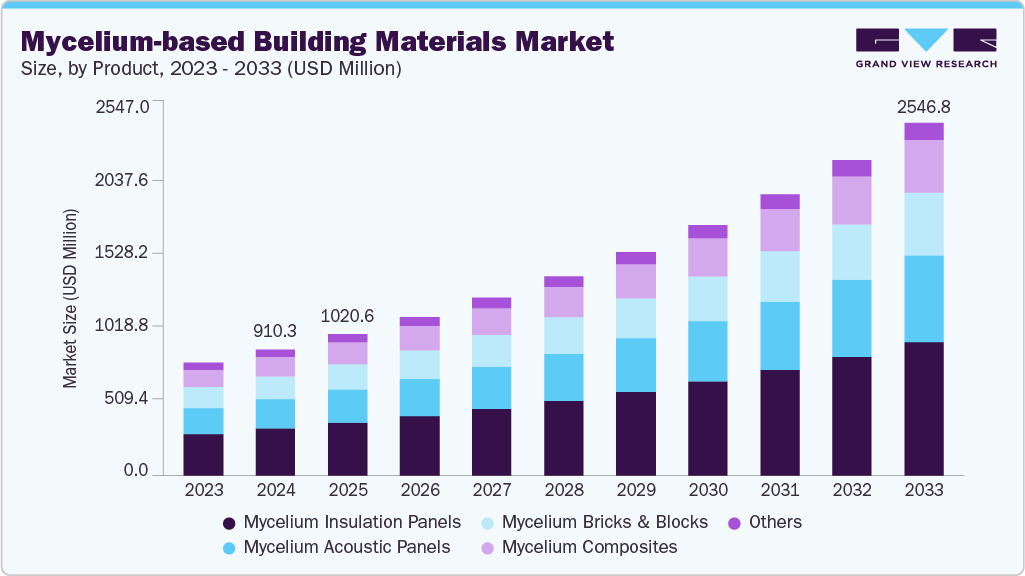 To learn more about this report, Download Free Sample Report
 Technological advancements in biotechnology and material science are further accelerating the adoption of mycelium-based building materials. Continuous innovations in cultivation processes, composite formulation, and fabrication techniques have improved the strength, durability, and scalability of mycelium-based products. Companies and research institutions are developing engineered mycelium composites suitable for structural and non-structural applications such as panels, insulation, and acoustic materials. These technological improvements are enabling the material to meet international building standards, encouraging broader use across the construction industry and driving market growth.
The market is also fueled by rising investments and collaborations among biotechnology firms, construction material manufacturers, and research organizations. Governments and private investors are increasingly funding sustainable material development projects to support low-carbon infrastructure goals. Initiatives promoting the use of bio-based materials in public buildings and infrastructure projects have created new growth avenues. Furthermore, the entry of innovative startups and partnerships with established construction firms are enhancing the commercialization of mycelium-based materials, making them more accessible and cost-competitive in global markets.
Market Concentration & Characteristics
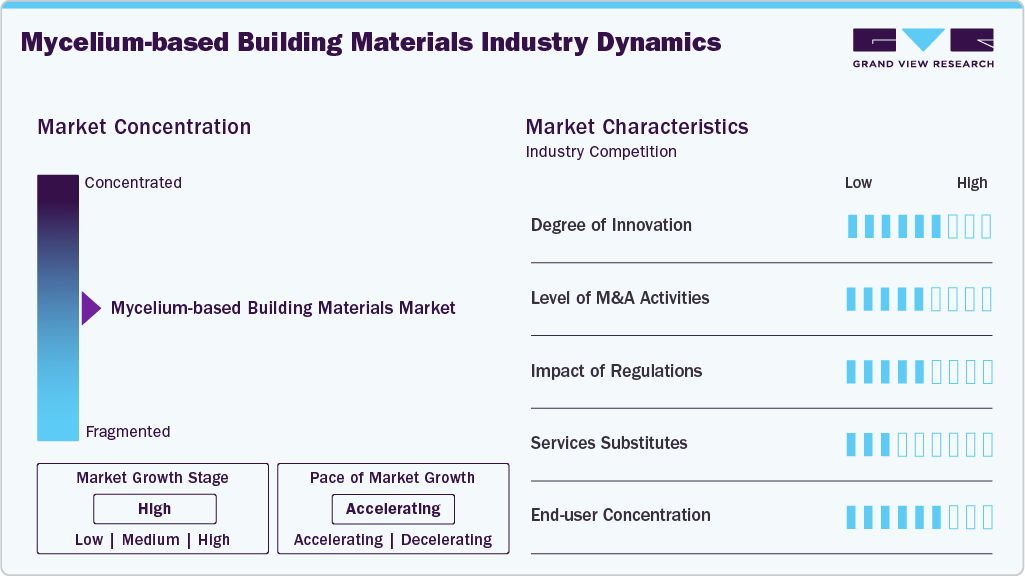
The industry is characterized by a high degree of innovation and strong research-driven development. The sector remains in an early but rapidly evolving stage, with companies focusing on optimizing growth conditions, improving material performance, and achieving scalability for commercial use. Innovation is particularly evident in product engineering, where advancements in composite strengthening and fabrication techniques are enabling mycelium-based materials to compete with conventional insulation, paneling, and structural products. Although the market is still fragmented, collaborations between biotechnology firms, construction companies, and academic institutions are becoming increasingly common, fostering joint product development and accelerating commercialization. Mergers and strategic partnerships are moderate but growing, as both established material manufacturers and startups seek to strengthen their sustainable product portfolios.
 To learn more about this report, Download Free Sample Report
 Regulatory frameworks and environmental standards play a pivotal role in shaping the market dynamics. Supportive policies encouraging the use of bio-based and low-carbon materials, along with green building certification programs such as LEED and BREEAM, are driving adoption across developed and emerging regions. However, the market faces limited direct substitutes, as few materials offer the same combination of biodegradability, insulation capability, and negative carbon footprint. While competition from other sustainable materials like hempcrete or bamboo composites exists, mycelium’s unique regenerative characteristics set it apart. End-user concentration is relatively diverse, encompassing sustainable construction firms, eco-design studios, and green architecture projects, though demand is concentrated among environmentally conscious developers and institutions prioritizing carbon-neutral construction practices.
Product Insights
Mycelium insulation panels led the market and accounted for the largest revenue share of 37.1% in 2024, driven by the increasing emphasis on sustainable and energy-efficient building materials. As construction industries worldwide adopt green building standards, mycelium-based insulation offers a renewable, biodegradable, and low-carbon alternative to conventional synthetic insulators. Its natural thermal resistance and fire-retardant properties make it suitable for residential and commercial structures seeking eco-friendly solutions.
The mycelium acoustic panels segment is expected to grow at the fastest CAGR of 12.8% over the forecast period, driven by the rising need for sustainable noise reduction and sound management systems. These panels combine effective acoustic performance with environmental benefits, appealing to architects, interior designers, and green construction projects. Their ability to absorb sound efficiently while maintaining a low environmental footprint positions them as a viable replacement for synthetic foams and composites. In addition, the expanding demand for sound-optimized spaces-such as offices, recording studios, and auditoriums-is propelling the segment forward.
Application Insights
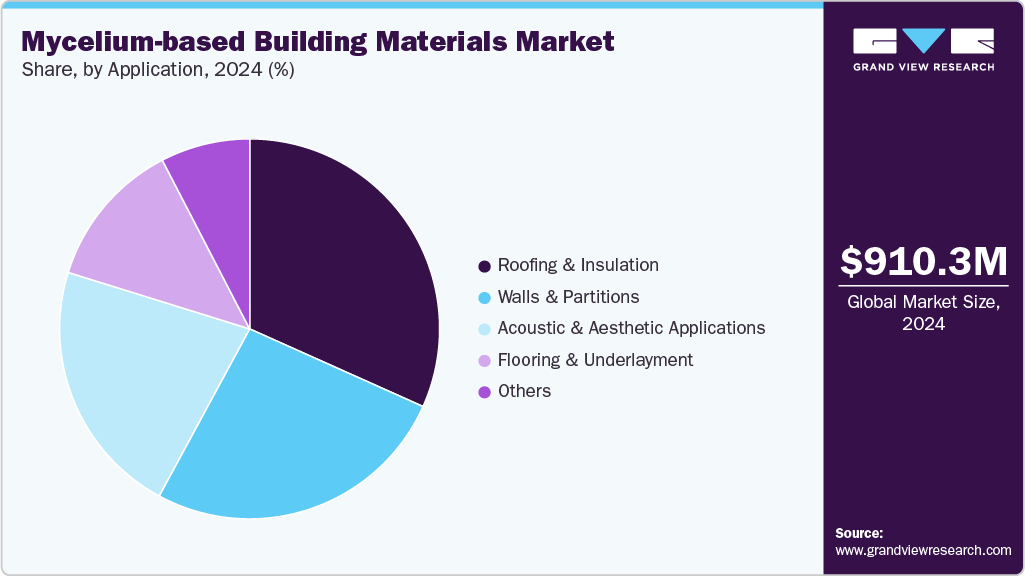
The roofing & insulation segment dominated the market and accounted for the largest revenue share of 31.7% in 2024, driven by the increasing preference for lightweight, durable, and biodegradable roofing materials. Mycelium composites provide natural resistance to moisture and temperature fluctuations, enhancing building performance while reducing environmental impact. The shift toward circular economy practices in construction is encouraging builders to integrate renewable materials such as mycelium for roofing and insulation purposes.
 To learn more about this report, Download Free Sample Report
 The acoustic & aesthetic applications segment is expected to grow at the fastest CAGR of 12.8% over the forecast period. Mycelium-based panels and decorative elements offer unique textures, natural finishes, and customizable designs suitable for modern architectural aesthetics. Their sustainable composition supports green certification goals while contributing to healthier indoor environments. This convergence of acoustic performance, aesthetic versatility, and environmental responsibility is driving the growing adoption of mycelium-based materials in interior design and decorative architecture.
Regional Insights
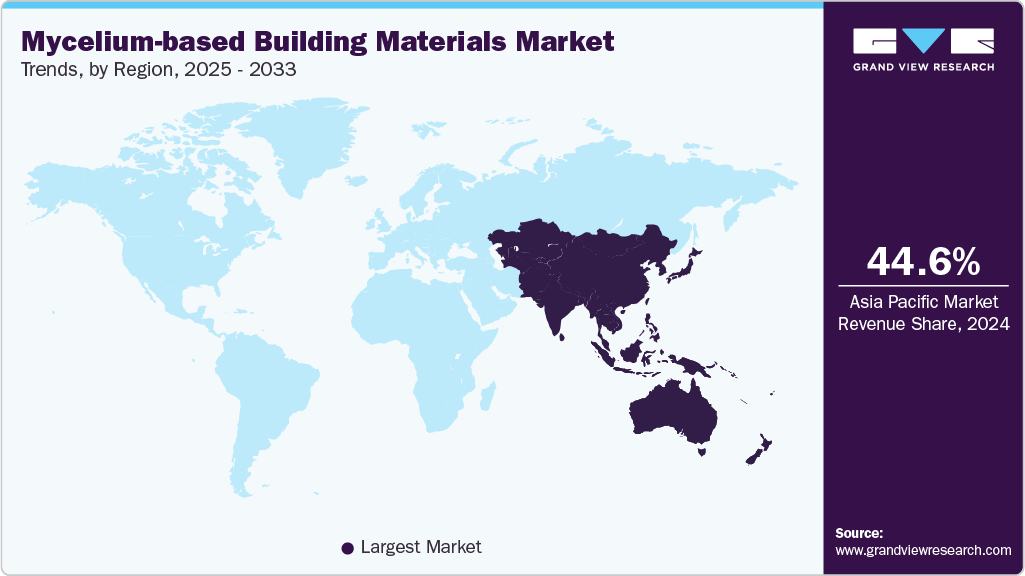
The Asia Pacific held the largest revenue market share of 44.6% in 2024, primarily driven by rapid urbanization and rising environmental concerns associated with conventional construction materials. Countries such as Japan, South Korea, and Australia are witnessing increasing investments in sustainable housing and infrastructure, supported by government-led green building programs. Mycelium-based materials are gaining traction as affordable, renewable alternatives to plastics and concrete, especially in regions focusing on low-energy and climate-resilient construction. Continuous advancements in biotechnology and material science across Asia are enhancing local production capabilities. The region’s growing awareness of eco-conscious design and support for circular economy initiatives further drives the adoption of mycelium-based products.
 To learn more about this report, Download Free Sample Report
 China’s market is driven by a strong government focus on sustainable urban development and carbon neutrality goals under its “Green Building Action Plan.” Rapid construction activity and industrial innovation have led to increased exploration of biodegradable and low-emission materials. Research collaborations between universities, biotech firms, and construction companies are improving the structural properties and scalability of mycelium composites. Mycelium’s ability to utilize agricultural waste aligns well with China’s sustainability objectives, offering a cost-effective waste valorization pathway. Additionally, growing domestic demand for environmentally friendly insulation and decorative materials in urban projects is supporting long-term market growth.
North America Mycelium-based Building Materials Market Trends
The mycelium-based building materials market in North America is driven by the strong emphasis on sustainable construction practices and stringent environmental regulations aimed at reducing carbon emissions. The U.S. and Canada are witnessing a rise in green building certifications such as LEED and WELL, which promote the use of renewable and biodegradable materials. Increasing corporate commitments toward carbon neutrality and the circular economy are further supporting the adoption of mycelium-based composites in insulation, wall panels, and furniture. Significant R&D activities by startups and academic institutions have enhanced the scalability and performance of mycelium materials. Government incentives for low-carbon infrastructure and growing consumer awareness of eco-friendly living spaces are further strengthening market expansion across the region.
The mycelium-based building materials market in the United States is fueled by rapid innovation in biofabrication technologies and strong policy support for sustainable construction. The U.S. Department of Energy and environmental agencies are funding research initiatives focused on developing energy-efficient, biodegradable materials. Construction firms are increasingly integrating mycelium-based panels and insulation materials into eco-friendly building projects, driven by rising demand for healthier, non-toxic interiors. The growing influence of sustainable design movements, along with collaboration between biotechnology startups and architecture firms, is also stimulating adoption. Additionally, the presence of leading green construction companies and advanced production capabilities is positioning the U.S. as a major hub for mycelium-based material innovation.
Europe Mycelium-based Building Materials Market Trends
The mycelium-based building materials market in Europe is driven by progressive environmental policies and the European Union’s focus on achieving net-zero emissions by 2050. Countries such as the Netherlands, Denmark, and the UK are leading in bio-based construction innovation, with significant R&D investments in mycelium-based materials. Supportive funding programs under the European Green Deal and Horizon Europe are accelerating commercialization and large-scale applications. The strong presence of sustainable architecture movements and eco-conscious consumers further bolsters adoption. Moreover, collaboration between construction companies and biotech firms is fostering the development of standardized, high-performance mycelium-based building solutions.
Germany mycelium-based building materials market is propelled by the country’s strong engineering base and commitment to sustainable construction. German universities and startups are at the forefront of developing high-strength mycelium composites for panels, insulation, and modular components. Government-backed sustainability initiatives and energy-efficient building standards are promoting the integration of bio-based materials into construction projects. The country’s preference for recyclable and low-carbon materials is driving the replacement of synthetic insulation and plastics. Additionally, Germany’s robust R&D ecosystem and growing green construction industry make it a key player in advancing the European mycelium materials market.
Central & South America Mycelium-based Building Materials Market Trends
The mycelium-based building materials market in Central & South America is growing steadily due to increasing awareness of sustainable architecture and eco-friendly housing solutions. Countries like Brazil, Mexico, and Chile are witnessing efforts to reduce deforestation and environmental pollution, encouraging the use of renewable materials. Mycelium-based composites are being explored as affordable and locally sourced alternatives to traditional building materials. Support from international environmental organizations and academic collaborations is fostering knowledge transfer and innovation. Rising urbanization and interest in cost-effective green construction are expected to further accelerate market growth across the region.
Middle East & Africa Mycelium-based Building Materials Market Trends
The mycelium-based building materials market in the Middle East & Africa is driven by the growing emphasis on sustainability in construction and the transition toward green building standards. Nations such as the UAE, Saudi Arabia, and South Africa are incorporating bio-based and energy-efficient materials into large-scale infrastructure and residential projects. Mycelium-based materials offer advantages such as thermal insulation and reduced embodied carbon, aligning with regional goals for energy conservation and environmental protection. Government-led smart city initiatives and sustainability visions, including Saudi Vision 2030, are fostering the adoption of alternative construction materials. Furthermore, increasing collaboration with international biotech firms is enhancing local availability and awareness of mycelium-based building materials.
Key Mycelium-based Building Materials Companies Insights
Key players operating in the mycelium-based building materials market are undertaking various initiatives to strengthen their presence and increase the reach of their products and services. Strategies such as expansion activities and partnerships are key in propelling the market growth. Some of the key players operating in the industry include Myconom Bio Materials, MIMBIOSIS.
-
Myconom, based in Istanbul, designs and produces mycelium-based acoustic panels and other composites for construction and interior applications. Their offerings include acoustic wall panels made from fungal mycelium and agricultural/textile waste, positioned as a petrochemical-free alternative to typical sponge or fiberglass materials.
-
MIMBIOSIS, a German startup, transforms textile waste and mycelium into carbon-negative biomaterials, offering panels for interior surfaces such as retail spaces and offices. Their panels focus on low-carbon biocomposites by combining mycelium with textile residuals and targeting aesthetic as well as functional applications in commercial build-outs.
Mykor, Mogu Srl are some of the emerging market participants in the mycelium-based building materials market.
-
Mykor, a UK/Portugal-based company, develops mycelium-based insulation and structural panels for building applications. Their core product, MykoFoam (or MykoSlab), is an acoustic and thermal insulation sheet made from mycelium and industrial waste, with fire resistance and low embodied carbon.
-
Mogu, based in Italy, manufactures mycelium-derived interior finishing materials, including acoustic panels, wall coverings, and flooring tiles. Their product lines such as Acoustic and PLUMA use fungal mycelium grown on up-cycled textile residues and are marketed as 100 % biobased and circular.
Key Mycelium-based Building Materials Companies:
The following are the leading companies in the mycelium-based building materials market. These companies collectively hold the largest market share and dictate industry trends.
- Myconom Bio Materials
- MIMBIOSIS
- Mykor
- Mogu Srl
- Ecovative LLC
- MycoFoundry (Canada)
- COMU Labs Inc.
- MycoWorks Inc.
Global Mycelium-based Building Materials Market Report Scope
Report Attribute
Details
Market size in 2024
USD 910.3 million
Estimated market size in 2026
USD 1,144.2 million
Projected market size by 2033
USD 2,546.8 million
Growth rate
CAGR of 12.1% from 2025 to 2033
Base year for estimation
2024
Historical data
2021 - 2023
Forecast period
2025 - 2033
Quantitative units
Revenue in USD million/billion and CAGR from 2025 to 2033
Report coverage
Revenue forecast, company ranking, competitive landscape, growth factors, and trends
Segments covered
Application, product, region
Regional scope
North America; Europe; Asia Pacific; Central & South America; Middle East & Africa
Country scope
U.S.; Canada; Mexico; UK; Germany; France; Italy; Spain; China; India; Japan
Key companies profiled
Myconom Bio Materials; MIMBIOSIS; Mykor; Mogu Srl; Ecovative LLC; MycoFoundry; COMU Labs Inc.; MycoWorks Inc.
Customization scope
Free report customization (equivalent up to 8 analysts’ working days) with purchase. Addition or alteration to country, regional & segment scope.
Pricing and purchase options
Avail customized purchase options to meet your exact research needs. Explore purchase options
Global Mycelium-based Building Materials Market Report Segmentation
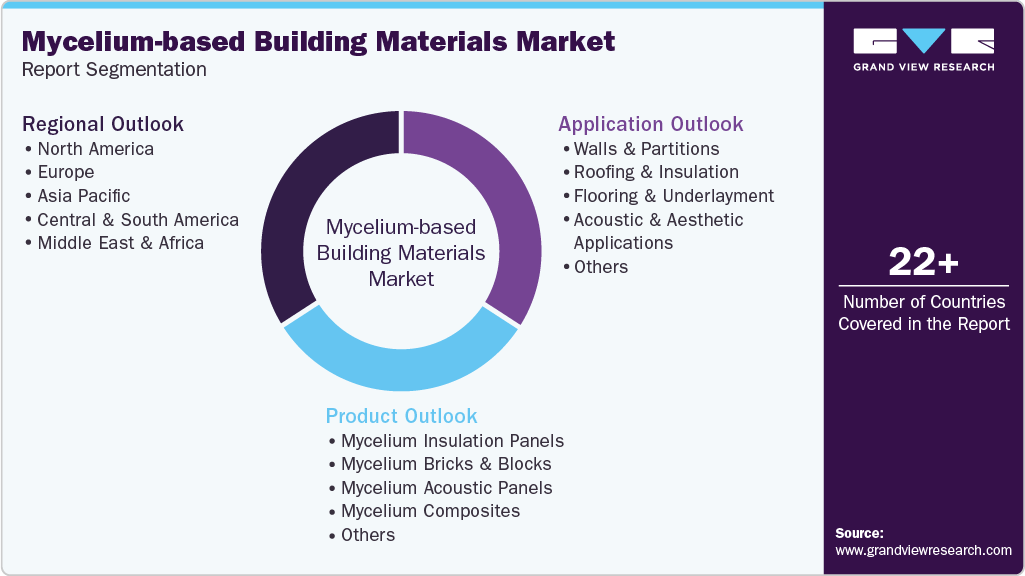
This report forecasts revenue growth at global, regional, and country levels and provides an analysis of the latest industry trends in each of the sub-segments from 2021 to 2033. For this study, Grand View Research has segmented the global mycelium-based building materials market report based on product, application, and region:
 To learn more about this report, Download Free Sample Report
 -
Product Outlook (Revenue, USD Million, 2021 - 2033)
-
Mycelium Insulation Panels
-
Mycelium Bricks & Blocks
-
Mycelium Acoustic Panels
-
Mycelium Composites
-
Others
-
-
Application Outlook (Revenue, USD Million, 2021 - 2033)
-
Walls & Partitions
-
Roofing & Insulation
-
Flooring & Underlayment
-
Acoustic & Aesthetic Applications
-
Others
-
-
Regional Outlook (Revenue, USD Million, 2021 - 2033)
-
North America
-
U.S.
-
Canada
-
Mexico
-
-
Europe
-
Germany
-
UK
-
France
-
Italy
-
Spain
-
-
Asia Pacific
-
China
-
Japan
-
India
-
-
Central & South America
-
Middle East & Africa
-
Frequently Asked Questions About This Report
The global mycelium-based building materials market size was estimated at USD 910.3 million in 2024 and is expected to reach USD 1,020.6 million in 2025.
The global mycelium-based building materials market is expected to grow at a CAGR of 12.1% from 2025 to 2033, reaching USD 2,546.8 million by 2033.
Roofing & insulation segment dominated the market and accounted for the largest revenue share of 31.7% in 2024, driven by the increasing preference for lightweight, durable, and biodegradable roofing materials.
Some of key players in the mycelium-based building materials market are Myconom Bio Materials, MIMBIOSIS, Mykor, Mogu Srl, Ecovative LLC, MycoFoundry, COMU Labs Inc., and MycoWorks Inc.
The key factors driving the mycelium-based building materials market include the growing demand for sustainable construction materials, increasing environmental awareness, advancements in biofabrication technologies, and supportive government initiatives promoting green building practices.
About the Author(s)
Advanced Interior Materials Research Team
Advanced Materials · Advanced Interior MaterialsThis report was authored by the advanced interior materials research team at Grand View Research - comprising two research analysts, one senior research analyst, and one industry expert - with specialized expertise in the advanced interior materials segment of the advanced materials industry. All findings are based on proprietary advanced materials databases, executive interviews, and regulatory analysis, subject to internal peer review prior to publication.
Last Updated:
Speak to Analyst

Customize this report to your needs - add regions, segments, or data points, with 20% free customization.
Or view our licence options:


ISO 9001:2015 & 27001:2022 Certified
We are GDPR and CCPA compliant! Your transaction & personal information is safe and secure. For more details, please read our privacy policy.


