
- Home
- »
- Healthcare IT
- »
-
Non-Clinical Homecare Software Market Report, 2026-2035GVR Report cover

Non-Clinical Homecare Software Market (2026 - 2035)
Size, Share & Trends Analysis Report By Application (Agency Systems, EVV, Telehealth Systems), By End User (Therapy Centers. Hospice Care, Rehabilitation Centers, Others), By Region, And Segment Forecasts
Market Size, 2025
$5.8BMarket Estimate, 2026
$6.5BMarket Forecast, 2035
$18.8BCAGR, 2026–2035
12.5%Non-clinical Homecare Software Market Summary
The global non-clinical homecare software market size was valued at USD 5.8 billion in 2025 and is projected to grow from USD 6.5 billion in 2026 to USD 18.8 billion in 2035, at a CAGR of 12.5% from 2026 to 2035. North America dominated the global market, accounting for the largest revenue share in 2025. Non-clinical homecare software is experiencing increasing adoption, driven by surging demand for efficient home care operations, a growing elderly population, rising preference for home-based care, expansion of home healthcare agencies, and the growing adoption of digital technologies for scheduling, billing, workforce management, compliance, and care coordination.
Key Market Trends & Insights
- By application: The agency systems segment held the largest market share in 2025.
- By end user: The private home care agencies segment held the largest market share in 2025.
Regional Highlights
- Largest regional market: North America (2025)
- Fastest-growing regional market: Asia Pacific (highest CAGR, 2026-2035)
Market Size & Forecast
- Market size in 2025: USD 5.8 Billion
- Estimated market size in 2026: USD 6.5 Billion
- Projected market size by 2035: USD 18.8 Billion
- CAGR (2026-2035): 12.5%
Prism AI by Grand View Research Free to tryAsk a question about the Non-Clinical homecare software marketTry asking✓Every figure cited from GVR research Prefer the report? Download free sample →
The market is driven by an increasing need for solutions that handle electronic record management and improve operational efficiency. Homecare companies are increasingly shifting toward a single provider that can offer tools for scheduling and matching caregivers to the right patient, billing and payroll, electronic visit verification, compliance risk reduction, communication tools, and other processes.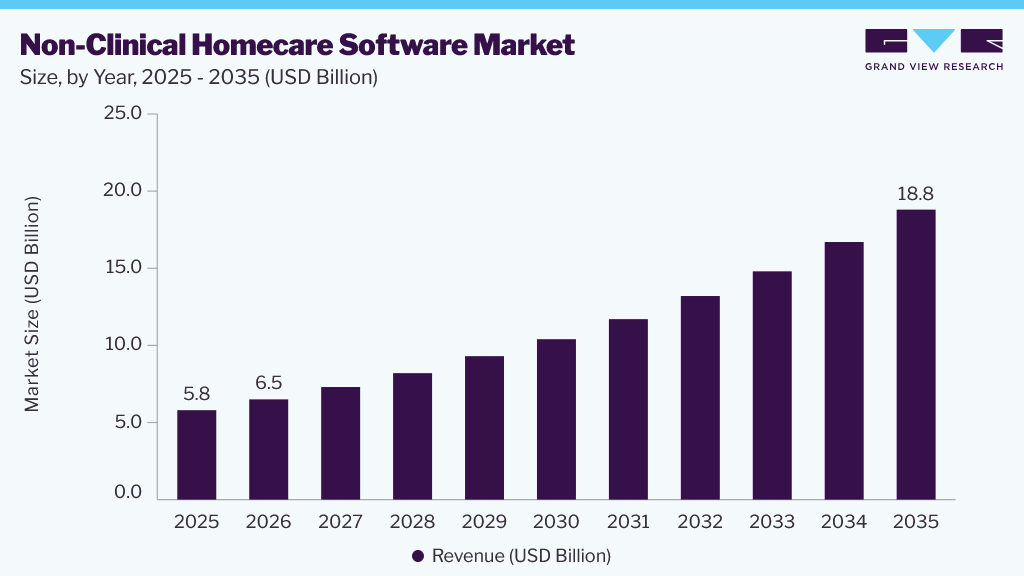 Source: Grand View Research, IR Documents, Primary Interviews, Paid DatabasesTo learn more about this report,
 Download Free Sample Report
The growing focus on non-clinical homecare services and the implications of an aging demographic, with the need to contain overall healthcare costs, continue to increase the number of homecare providers and, in turn, demand for software solutions that enable efficiencies in provider administration. In addition, increased regulations regarding documentation, verification, and reimbursement, along with compliance demands on the workforce, are further surging demand for software solutions and reporting capabilities through a fully integrated platform.
Analyst Perspective
The market is in a transition phase, with homecare providers moving away from fragmented administrative systems toward integrated digital operating platforms. Agency management, scheduling, billing, payroll, administrative staff/field worker interaction, and electronic visit verification are likely to become increasingly interconnected as homecare organizations seek to optimize operational efficiency without sacrificing care quality and compliance. The adoption of managed-care-style population health approaches in home care is projected to expand the addressable software market, particularly as agencies become smaller and manage caregiver workforces across larger geographic distances.
Cloud deployment and mobile support are expected to be the key differentiating factors as caregivers and agency staff access schedules, visit reports, documentation, and communication tools outside traditional agency settings. North America is projected to remain a key market due to its mature homecare industry and regulatory pressures, but North Asia and other developing Asian countries may have substantial growth potential as home-based care programs expand and health systems modernize.
Application Insights
The agency systems segment dominated the market, accounting for the largest revenue share in 2025. This segment integrates key administrative processes, including scheduling, billing, caregiver/client management, payroll, compliance, and reporting, which are beneficial for homecare services that manage large client and caregiver bases. These features of agency systems help homecare agency operators become more customer-centric by harmonizing operational processes. For instance, in March 2025, AxisCare announced that Anodyne selected its home care management software as its enterprise platform, with the implementation covering scheduling, care delivery, compliance, payroll management, and electronic visit verification across Anodyne's home care, adult foster care, and medical staffing operations.
The electronic visit verification (EVV) segment is anticipated to record a notable CAGR over the forecast period. The growing number of regulatory mandates for verifying caregiver visits, along with the need to streamline billing processes and reduce fraud, is fueling the adoption of EVV solutions. Mobile-based visit verification, GPS-enabled visit tracking, time-stamping, and integration with agency management systems have further expanded adoption opportunities for EVV systems. For instance, in March 2025, AxisCare's enterprise implementation for Anodyne included its EVV solution to support compliance with Massachusetts state requirements, illustrating the increasing integration of EVV capabilities into homecare software platforms.
End User Insights
The private home care agencies segment dominated the market, accounting for the largest revenue share in 2025. The increasing use of software by private homecare agencies to coordinate caregivers, manage schedules, handle billing and payroll, document visits, and remain compliant as they serve larger volumes of clients plays a key role in the growth of this segment. Mobile access and centralized dashboards enable homecare agencies to coordinate their office staff and field caregivers more effectively. For instance, Homecare Homebase currently provides an integrated platform that covers scheduling, documentation, billing, analytics, and care coordination for home-based care organizations, underscoring the importance of comprehensive software platforms for agency operations.
The therapy centers segment is anticipated to witness a significant CAGR over the forecast period. A large number of therapy providers are adopting digital platforms to customize and streamline services such as appointment management, document handling, communication, and remote service delivery, thereby enhancing operational efficiency and effectiveness. The continued integration of outpatient rehabilitation and the use of advanced technological tools for delivering therapy services are expected to accelerate software adoption. For instance, CMS expanded Medicare telehealth flexibility for beneficiaries receiving services in their homes beginning January 1, 2025, including allowing two-way, real-time audio-only communication for certain Medicare telehealth services when video is not feasible, or the patient does not consent to video. Such policy developments support the broader use of digitally enabled workflows among therapy and home-based care providers.
Regional Insights
North America dominated the non-clinical homecare software market. It accounted for the largest share of global revenue in 2025, owing to well-established healthcare industry infrastructure, the proliferation of digital technologies among homecare agencies, regulatory mandates, and the presence of several software vendors. Healthcare providers and management agencies in the region are actively adopting cloud-based homecare software, mobile workforce-management systems, EVV, and auto-scheduling to increase efficiency and ensure compliance. For instance, in December 2025, Homecare Homebase highlighted updates related to the CMS CY 2026 Home Health Final Rule and noted product updates to help customers prepare for compliance, underscoring the ongoing importance of regulatory changes and software adaptation in the North American home-based care market.
The North American market is expected to maintain steady growth during the forecast period, as homecare agencies replace fragmented administrative functions with integrated technologies. Growing workforce management needs, EVV implementation, interoperability, and the need for automated scheduling and invoicing are projected to foster more opportunities for software vendors.
Asia Pacific Non-Clinical Homecare Software Market Trends
The non-clinical homecare software market in the Asia Pacific is anticipated to witness the fastest CAGR during the forecast period, driven by an aging population, expanding demand for home- and community-based care, increasing healthcare digitization, and government initiatives supporting digital health infrastructure. WHO reports that the Western Pacific region has more than 245 million people aged 65 years and older, with this population expected to double by 2050. For instance, in September 2025, the WHO highlighted that Japan, the Republic of Korea, Singapore, and other Asia Pacific economies are developing or expanding age-friendly, community-based, and in-home care models, with countries increasingly using digital tools to support these models.
The aging population in the region and greater focus on aging in place are likely to bolster demand for software tools for scheduling, workforce coordination, communication between patients and providers, administrative management, and digitally enabled homecare services. In addition, the WHO's Regional Action Framework on Digital Health in the Western Pacific, published in September 2025, provides a regional framework for expanding digital health strategies and high-impact digital health technologies, further supporting the digitalization environment relevant to homecare software.
Key Non-Clinical Homecare Software Company Insights
The key non-clinical homecare software vendors are enhancing their integrated scheduling, billing, workforce management, electronic visit verification, compliance, and care management offerings, while also improving cloud, mobile, and data-driven tools to streamline execution and meet the rising need for home-based care.
Key Non-Clinical Homecare Software Companies
The following key companies have been profiled for this study on the non-clinical homecare software market:
-
Axxess
-
Alora Health
-
HHAeXchange
-
MatrixCare
-
WellSky
-
Homecare Homebase
-
PointClickCare
-
CareSmartz360
-
AxisCare
Recent Developments
-
In October 2025, Alora launched its first wave of AI-powered solutions for home-based care, introducing intelligent automation capabilities designed to simplify care delivery and improve operational efficiency for home health, home care, and hospice agencies. The development reflects the increasing integration of artificial intelligence into homecare software platforms to automate workflows and support agency staff.
-
In November 2025, AxisCare launched AxisCare Intelligence, a new suite of AI-powered capabilities for home care management. The solution is designed to provide agencies with AI-driven insights and support smarter decision-making across areas such as scheduling, operations, and care management, strengthening the company's focus on data-driven homecare software.
Non-Clinical Homecare Software Market Report Scope
Report Attribute
Details
Market size in 2025
USD 5.8 billion
Estimated market size in 2026
USD 6.5 billion
Projected market size by 2035
USD 18.8 billion
Growth rate
CAGR of 12.5% from 2026 to 2035
Base year estimation
2025
Historical data
2021 – 2024
Forecast period
2026 – 2035
Quantitative units
Revenue in USD billion, and CAGR from 2026 to 2035
Report coverage
Revenue forecast, company ranking, competitive landscape, growth factors, and trends
Segments covered
Application, end user, region
Regional scope
North America; Europe; Asia Pacific; Latin America; MEA
Country scope
U.S.; Canada; Mexico; UK; Germany; France; China; Japan; India; Australia; South Korea; Brazil; Argentina; South Africa; Saudi Arabia; UAE
Key companies profiled
Axxess; Alora Health; HHAeXchange; MatrixCare; WellSky; Homecare Homebase; PointClickCare; CareSmartz360; AxisCare
Customization scope
Free report customization (equivalent to 8 analyst working days) with purchase. Addition or alteration to country, regional & segment scope.
Pricing and purchase options
Avail of customized purchase options to meet your exact research needs. Explore purchase options
Global Non-Clinical Homecare Software Market Report Segmentation
This report forecasts revenue growth at the global, regional, and country levels and provides an analysis of the latest industry trends and opportunities across each sub-segment from 2021 to 2035. For this study, Grand View Research has segmented the global non-clinical homecare software market report based on application, end user, and region:
-
Application Outlook (Revenue, USD Billion, 2021 - 2035)
-
Agency Systems
-
Electronic Visit Verification (EVV)
-
Non-Clinical Health Management Systems
-
Telehealth Systems
-
Others
-
-
End User Outlook (Revenue, USD Billion, 2021 - 2035)
-
Private Home Care Agencies
-
Therapy Centers
-
Rehabilitation Centers
-
Hospice Care
-
Others
-
-
Regional Outlook (Revenue, USD Billion, 2021 - 2035)
-
North America
-
U.S.
-
Canada
-
Mexico
-
-
Europe
-
UK
-
Germany
-
France
-
-
Asia Pacific
-
China
-
Japan
-
India
-
Australia
-
South Korea
-
-
Latin America
-
Brazil
-
Argentina
-
-
Middle East and Africa (MEA)
-
South Africa
-
Saudi Arabia
-
UAE
-
-
Frequently Asked Questions About This Report
The global non-clinical homecare software market size was valued at USD 5.8 billion in 2025 and is estimated at USD 6.5 billion for 2026.
The global non-clinical homecare software market is expected to grow at a CAGR of 12.5% from 2026 to 2035, reaching USD 18.8 billion by 2035
North America dominated with the largest revenue share in 2025.
The agency systems segment accounted for the largest revenue share in 2025.
Key players in the market include Axxess; Alora Health; HHAeXchange; MatrixCare; WellSky; Homecare Homebase; PointClickCare; CareSmartz360; and AxisCare.
About the Author(s)
Healthcare IT Research Team
Healthcare · Healthcare ITThis report was authored by the healthcare it research team at Grand View Research - comprising two research analysts, one senior research analyst, and one industry expert - with specialized expertise in the healthcare it segment of the healthcare industry. All findings are based on proprietary healthcare databases, executive interviews, and regulatory analysis, subject to internal peer review prior to publication.
Last Updated:
Speak to Analyst

Customize this report to your needs - add regions, segments, or data points, with 20% free customization.
Or view our licence options:


ISO 9001:2015 & 27001:2022 Certified
We are GDPR and CCPA compliant! Your transaction & personal information is safe and secure. For more details, please read our privacy policy.


