
- Home
- »
- Advanced Interior Materials
- »
-
Non Grain Oriented Electrical Steel Market Size Report, 2033GVR Report cover

Non Grain Oriented Electrical Steel Market (2026 - 2033)
Size, Share & Trends Analysis Report By End Use (Transformers, Motors, Inductors, Others), By Region (North America, Europe, APAC, Central & South America, MEA), And Segment Forecasts
Market Size, 2025
$22.0BMarket Estimate, 2026
$22.9BMarket Forecast, 2033
$31.0BCAGR, 2026–2033
4.4%Non Grain Oriented Electrical Steel Market Summary
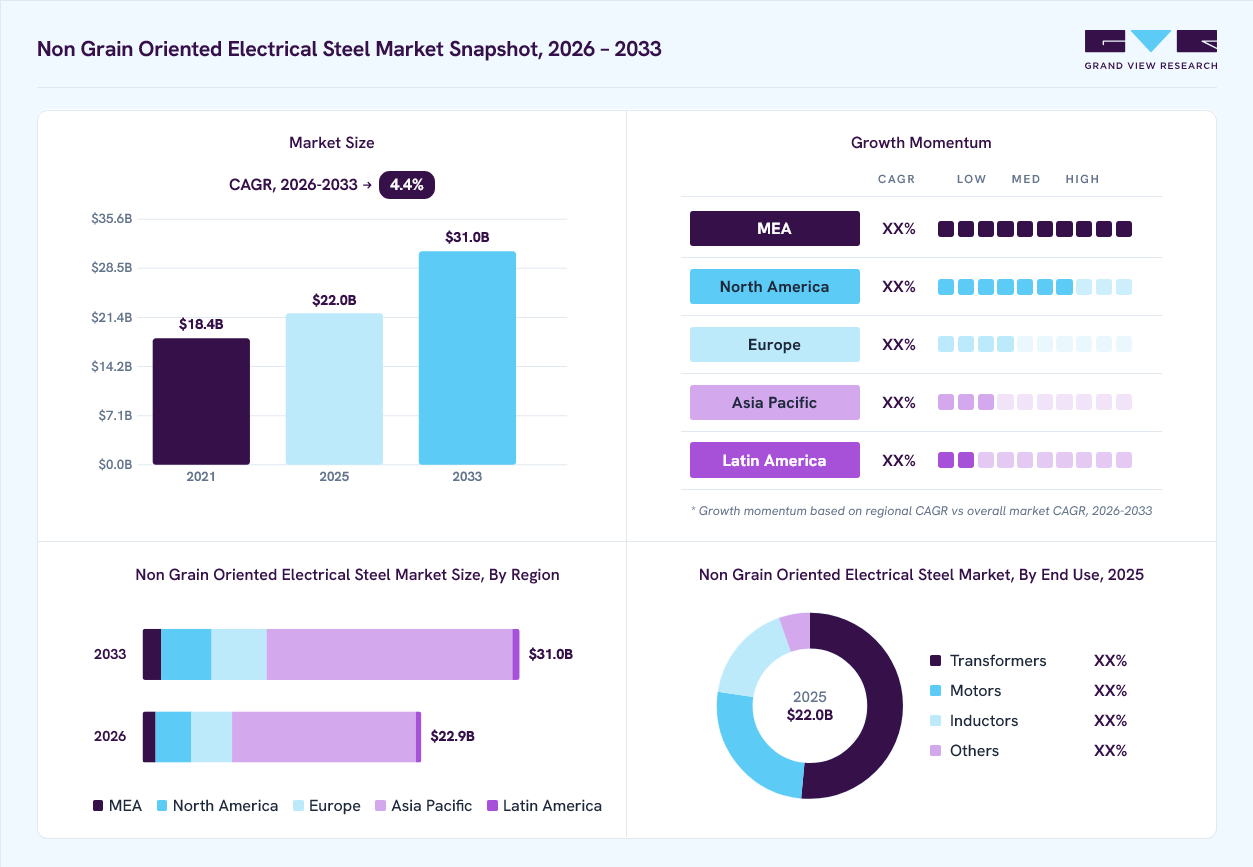
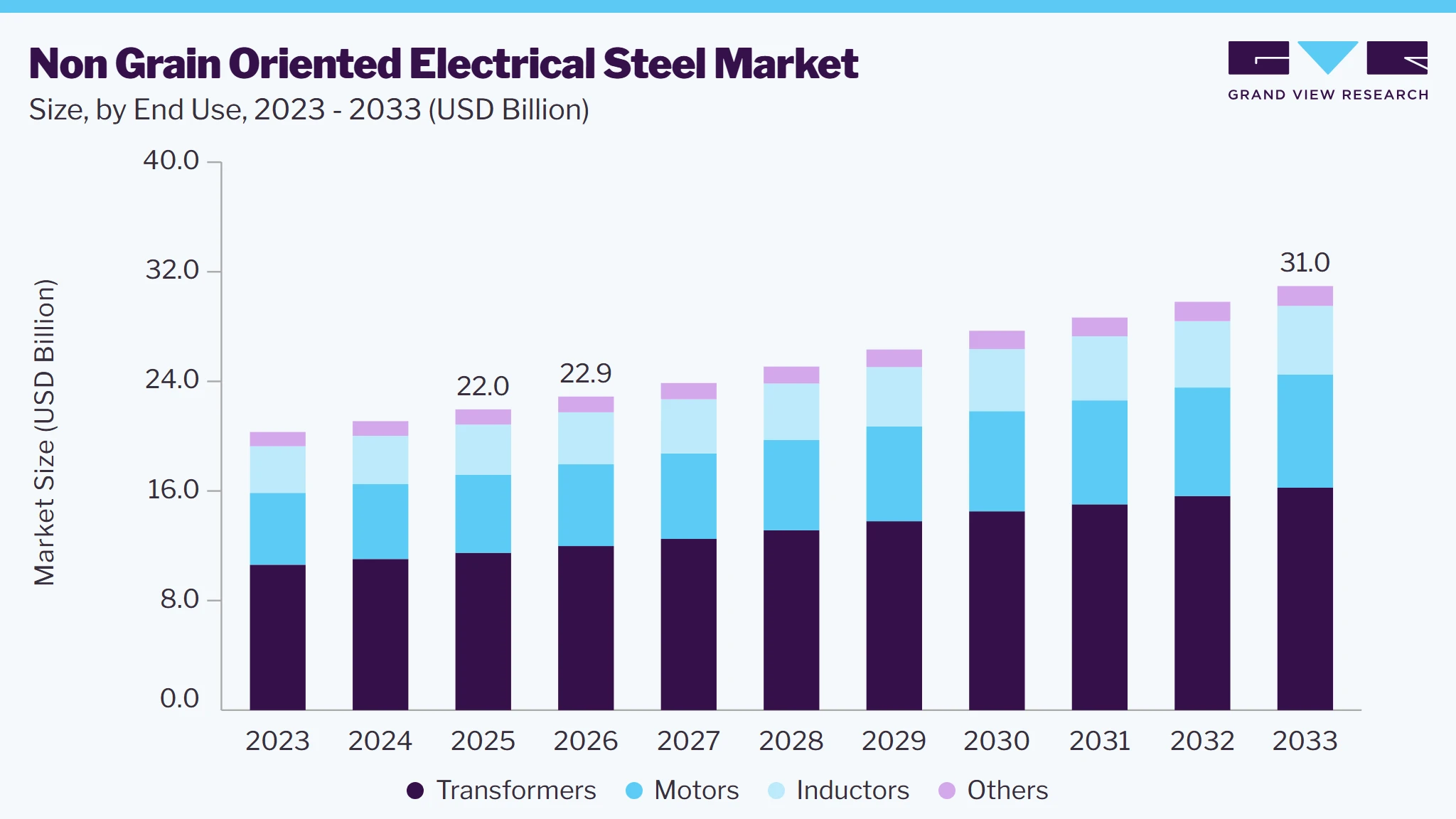
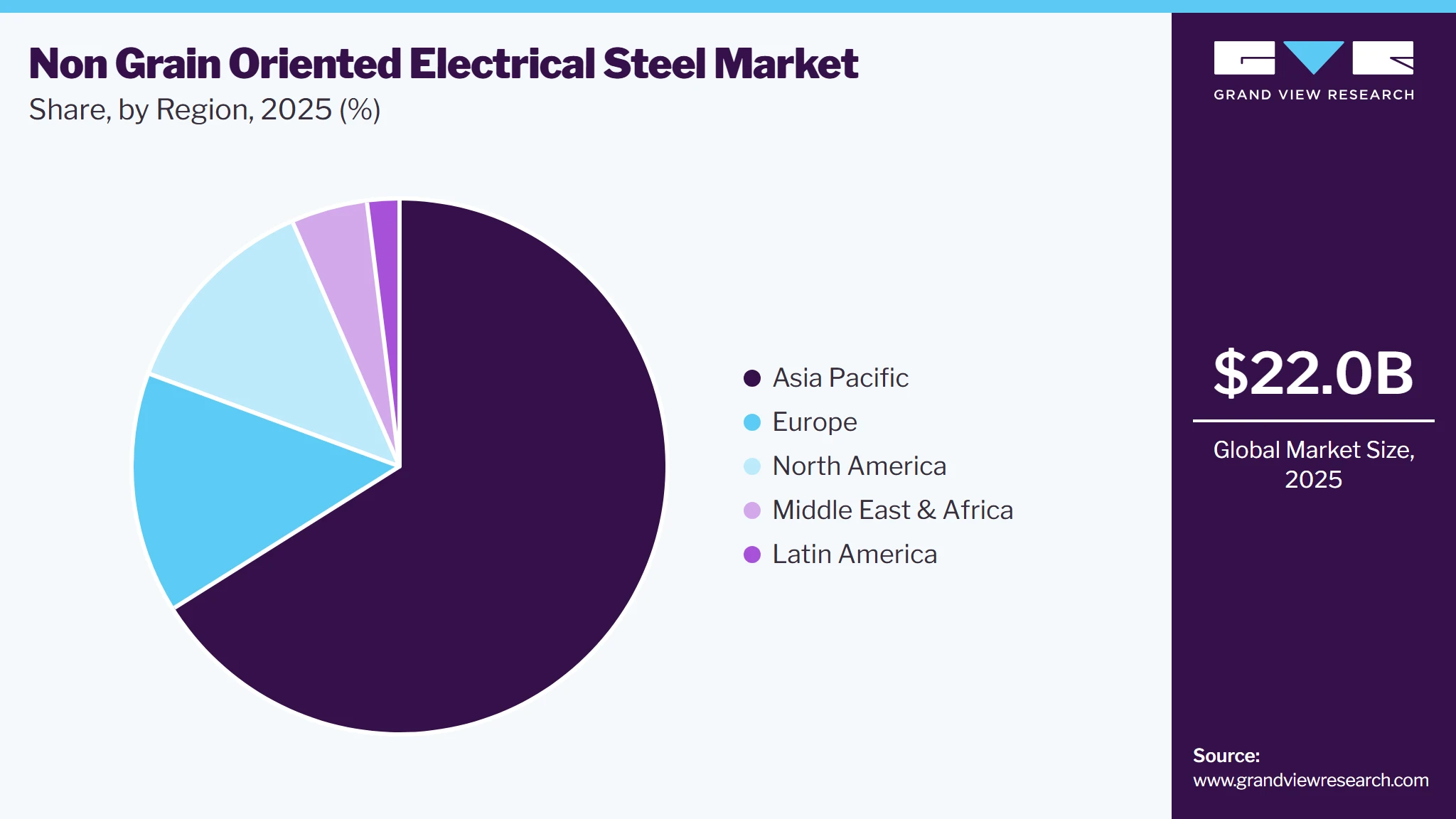
The global non grain oriented electrical steel market size was valued at USD 22.0 billion in 2025 and is projected to grow from USD 22.9 billion in 2026 to USD 31.0 billion by 2033, at a CAGR of 4.4% from 2026 to 2033. The market in Asia Pacific dominated with a revenue share of 66.1% in 2025. Non grain oriented electrical steel, also known as isotropic electrical steel, is primarily used to manufacture electric motors, transformers, and other energy-efficient equipment.
 Source: Grand View Research, IR Documents, Primary Interviews, Paid DatabasesTo learn more about this report,
 Download Free Sample Report
Key Market Trends & Insights
- By end use: Transformers segment held the largest market share of 52.3% in 2025.
- Motors segment is anticipated to register the fastest CAGR over the forecast period.
Regional Highlights
- Largest regional market: Asia Pacific (66.1% revenue share, 2025)
- Fastest-growing regional market: Middle East & Africa (highest CAGR, 2026-2033)
- By country: China held the largest market share in 2025.
Market Size & Forecast
- Market size in 2025: USD 22.0 Billion
- Estimated market size in 2026: USD 22.9 Billion
- Projected market size by 2033: USD 31.0 Billion
- CAGR (2026-2033): 4.4%
Three ways to get this report
Buy it, customize it, or ask a question.Ask an Analyst
Analyst response in 1 business day
- AccessReport author, directly
- Reply timeWithin 1 working day
- No sales callDirect answer only
- FormatEmail reply
- CostFree, no cost
Get the Full Report
What the study covers
- FormatsPDF · Excel · Dashboard
- Timeline2026–2033 annual, 2025 base
- Coverage20+ countries, 5 regions
- Companies10+ key players profiled
Customize the Report
20% free customization
- IncludeCountries, segments, points
- TailorTo your product definition
- ExtendDeeper competitor detail
- OrA fully bespoke study
- Turnaround5–10 working days
As industries and economies strive to reduce their carbon footprint and lower energy consumption, there is an increased need for efficient electrical machines. NGOES play a crucial role in improving the efficiency of electric motors and transformers, making it a critical material for manufacturers focused on meeting stringent energy standards.
 To learn more about this report, Download Free Sample Report
Electric vehicles rely heavily on efficient motors for optimal performance, and NGOES is used to produce high-performance stators and rotors in these motors. As governments across the globe introduce regulations to encourage the adoption of electric vehicles, the demand for NGOES is expected to rise correspondingly. The ongoing advancements in battery technology and motor design further fuel the need for high-quality electrical steel to support more efficient and powerful EV engines, making the automotive sector one of the key drivers in the NGOES market.
The growth of industrialization and infrastructure development, particularly in emerging markets, is driving the demand for NGOES. As countries in the Asia Pacific, the Middle East & Africa expand manufacturing and power sectors, NGOES is increasingly used in transformers and power networks. Its high magnetic permeability makes it ideal for renewable energy technologies like wind and solar power. With ongoing investments in sustainable energy, the demand for NGOES is expected to rise, especially in regions focusing on clean energy infrastructure.
Market Dynamics
The rapid expansion of the electric vehicle industry is one of the primary growth drivers for the non-grain oriented electrical steel (NGOES) market. NGOEs are widely used in traction motors, drive motors, generators, and auxiliary electric motors because of their excellent magnetic properties, low core losses, and high energy efficiency. As global automakers accelerate the production of battery electric vehicles (BEVs), hybrid electric vehicles (HEVs), and plug-in hybrid electric vehicles (PHEVs), demand for high-performance electrical steel continues to rise. Governments in major economies are supporting vehicle electrification through stringent emissions regulations, fuel economy standards, and financial incentives, encouraging manufacturers to adopt premium-grade NGOES to improve motor efficiency and extend driving range.
The rapid expansion of the electric vehicle industry is a major factor driving the NGOES market. Electric vehicles require high-efficiency traction motors that rely on advanced electrical steel to minimize core losses, improve magnetic performance, and maximize energy efficiency. As global automakers continue to expand their electric vehicle portfolios, demand for premium grades of electrical steel has increased significantly. Manufacturers are also investing in thinner gauge materials and higher silicon content grades to enhance motor performance, extend driving range, and improve overall vehicle efficiency. The transition toward electrified transportation across passenger cars, commercial vehicles, buses, and two-wheelers is therefore creating sustained demand for non-grain-oriented electrical steel.
Government policies supporting vehicle electrification are further accelerating market growth. Countries across Europe, North America, and the Asia Pacific are introducing stricter emission regulations, fuel economy standards, and financial incentives to encourage electric vehicle adoption. According to the International Energy Agency (IEA), global electric car sales surpassed 20 million units in 2025, with electric vehicles accounting for more than 20% of total new car sales worldwide, and sales are expected to continue rising in 2026. This strong growth in electric mobility is increasing investments in electric motor manufacturing and production capacity, strengthening long term demand for NGOES across the automotive value chain.
Volatility in raw material prices remains a significant restraint for the NGOES market, as the production of electrical steel depends on key inputs such as iron ore, steel scrap, silicon, ferroalloys, and energy. Prices of these materials are influenced by factors including geopolitical tensions, trade restrictions, mining disruptions, fluctuating energy costs, and changes in global steel demand. Frequent cost fluctuations increase manufacturing expenses and make long term pricing agreements with automotive, industrial equipment, and power generation customers more challenging. Although leading manufacturers often adopt long term procurement contracts and supply chain diversification strategies to reduce risk, persistent raw material price volatility continues to pressure profit margins and can delay investment decisions across the electrical steel value chain.
Growing investments in renewable energy projects present a significant opportunity for the NGOES market, particularly as countries accelerate the transition toward low carbon power generation. NGOES is extensively used in wind turbine generators, hydroelectric generators, and various auxiliary electrical systems because of its high magnetic permeability and low core losses, which improve energy conversion efficiency. Governments and private investors are increasing funding for renewable energy capacity to meet decarbonization targets and strengthen energy security, resulting in greater demand for high efficiency electrical equipment. According to the International Energy Agency (IEA), global renewable electricity capacity additions reached record levels in recent years and are expected to continue expanding through the end of the decade, with wind energy accounting for a substantial share of new installations. This sustained growth in renewable power infrastructure is expected to create long term demand for NGOES across generator manufacturing and power equipment applications.
Analyst Perspective
The non-grain oriented electrical steel (NGOES) market is poised for sustained growth, fueled by the global shift toward electrification, energy efficiency, and clean energy technologies. Rising production of electric vehicles, industrial motors, generators, transformers, and energy-efficient appliances is driving demand for high-performance NGOES, which offer low core losses and excellent magnetic properties. Governments worldwide are promoting vehicle electrification, renewable energy deployment, and stricter energy efficiency standards, encouraging manufacturers to invest in advanced electrical steel grades that improve the performance of motors and power equipment.
End Use Insights
Based on end use, transformers segment led the market with the largest revenue share of 52.3% in 2025. As renewable energy installations increase, the need for transformers to handle and distribute power from these intermittent energy sources grows. NGOES is ideal for use in transformers as it can enhance the overall efficiency of energy conversion, ensuring minimal energy loss during transmission. Moreover, improving grid stability and integrating renewable energy into existing power grids requires advanced transformer technology, which relies heavily on high-quality materials.
Motors are anticipated to register the fastest CAGR over the forecast period. As manufacturing processes become more automated and industries seek to improve productivity, the demand for electric motors continues to rise. NGOES is integral in these applications, as it enhances motor performance, ensuring high efficiency even under demanding operating conditions. With growing industrialization, especially in emerging markets, the demand for motors across various sectors will continue to expand.
Regional Insights
The North America non grain oriented electrical steel industry is anticipated to grow at a significant CAGR over the forecast period. The U.S., Canada, and Mexico automotive industries are transforming, with automakers investing heavily in developing electric and hybrid vehicles. NGOES is a vital material for manufacturing the electric motors used in EVs, which require high-performance materials to ensure efficiency, power density, and reliability. The growing push for cleaner transportation, driven by consumer demand and government policies, continues to elevate the need for NGOES in EV applications, making it a major growth driver for the market.
U.S. Non Grain Oriented Electrical Steel Market Trends
The non grain oriented electrical steel industry in the U.S. is anticipated to grow over the forecast period. As the U.S. government enforces stricter energy efficiency standards through regulations like the Energy Independence and Security Act (EISA), industries are increasingly looking for materials that enhance the performance of electrical equipment. This push for greater energy efficiency in both industrial and consumer sectors is driving higher demand for NGOES in the U.S.
 To learn more about this report, Download Free Sample Report
Asia Pacific Non Grain Oriented Electrical Steel Market Trends
Asia Pacific dominated the NGOES market with the largest revenue share of 66.1% in 2025. The non grain oriented electrical steel industry in Asia Pacific is anticipated to grow over the forecast period. Asia Pacific is a global manufacturing hub, particularly in countries such as China, India, Japan, and South Korea; the need for high-performance materials such as NGO electrical steel to enhance the efficiency and reliability of electrical equipment is increasing. As these economies continue to develop and urbanize, the consumption of electrical steel used in industrial applications is expected to rise, thereby driving market growth.
China Non Grain Oriented Electrical Steel Market Trends
The NGOES market in the China held the largest share in the Asia Pacific region in 2025. China is expected to remain a major demand center for non-grain oriented electrical steel, supported by its large manufacturing base, expanding renewable energy capacity, and continued investments in power infrastructure. Rising production of electric motors, generators, industrial equipment, and electric vehicles is expected to further support demand for non-grain oriented electrical steel.
Europe Non Grain Oriented Electrical Steel Market Trends
The non grain oriented electrical steel industry in Europe is anticipated to grow over the forecast period. As Europe moves toward smart grids and energy-efficient power systems, there is an increasing need for upgraded electrical components, including transformers and generators, which often incorporate NGOES. The region’s efforts to improve grid reliability, reduce energy waste, and integrate renewable energy sources into the existing grid infrastructure have led to greater adoption of high-performance materials to reduce core losses in electrical equipment. With significant investments in smart grid technology, energy storage, and other infrastructure projects, the demand for NGOES is expected to increase. These systems require materials that can operate efficiently at higher frequencies and improve performance.
Central & South America Non Grain Oriented Electrical Steel Market Trends
The non grain oriented electrical steel industry in Central & South America is anticipated to grow over the forecast period. Countries such as Brazil and Chile have invested substantially in wind and solar power generation, which require efficient electrical components to optimize performance. According to IEA, Brazil's commitment to clean energy is evident as it accounted for 7% of the planet's renewable energy production in 2023, which exceeds its global population and GDP shares. The use of NGOES in wind turbine generators and photovoltaic systems enhances their operational efficiency, thereby supporting the overall growth of the renewable energy sector.
Middle East Non Grain Oriented Electrical Steel Market Trends
The Middle East & Africa region is expected to register the fastest growth, driven by rising investments in power generation, transmission, and distribution infrastructure, renewable energy, and industrial development. Increasing electricity demand and grid modernization across the region are supporting the adoption of electrical equipment such as motors, generators, and transformers, thereby strengthening demand for non-grain oriented electrical steel.
The non grain oriented electrical steel industry in the Middle East is anticipated to grow over the forecast period. As countries like South Africa, the UAE, and Egypt continue to invest in industrial sectors such as manufacturing, mining, and construction, the need for energy-efficient motors, transformers, and other electrical equipment is expanding. As industrial activities increase and more businesses adopt automation technologies, the demand for energy-efficient electrical systems powered by NGOES is expected to grow.
Key Non Grain Oriented Electrical Steel Company Insights
Some of the key players operating in the market include ArcelorMittal, POSCO, and others.
-
ArcelorMittal, a global leader in steel and mining, operates in over 60 countries and serves major markets worldwide. The company produces a diverse range of steel products for industries like automotive, construction, and appliances. ArcelorMittal offers both fully processed and semi-processed grades of NGOES, with the fully processed steels ready for immediate use, while the semi-processed grades require additional annealing after punching.
-
POSCO, a South Korean multinational steel producer, is one of the world's largest steelmakers. It serves industries such as automotive, construction, shipbuilding, and energy with a broad portfolio of steel products. POSCO manufactures NGOES with a non-uniform crystal orientation, providing excellent magnetic properties suitable for applications like motors and generators.
Key Non Grain Oriented Electrical Steel Companies
The following key companies have been profiled for this study on the non grain oriented electrical steel market.
-
ArcelorMittal
-
Arnold Magnetic Technologies
-
Baosteel Group Corporation
-
Cleveland-Cliffs Inc.
-
JFE Steel Corporation
-
NIPPON STEEL CORPORATION
-
Nucor Corporation
-
POSCO
-
Thyssenkrupp
-
VIZ-Steel
Competitive Benchmarking
Category
Operating Strategies
Competitive Edge
Weakness
Established Players (e.g. ArcelorMittal, POSCO)
- Mature participants in the non-grain oriented electrical steel (NGOES) market primarily focus on integrated steel production, advanced metallurgical processing, and long term supply agreements with manufacturers of electric motors, generators, compressors, and electric vehicles.
- These companies operate specialized facilities that include steelmaking, hot rolling, cold rolling, annealing, and insulating coating lines to produce NGOES with consistent magnetic properties.
- Established players possess significant competitive advantages through their advanced manufacturing technologies, extensive metallurgical expertise, and large scale integrated production facilities.
- Their ability to consistently produce high quality NGOES with precise magnetic and mechanical properties enables them to meet the stringent requirements of electric motor, generator, and transformer manufacturers.
- Despite their strong market positions, mature players face challenges related to high production costs, capital intensive manufacturing processes, and volatile raw material prices.
- Producing NGOES requires sophisticated rolling mills, annealing furnaces, precision coating lines, and advanced quality control systems, resulting in significant capital investment and operating expenses.
Emerging & Regional Players (e.g., VIZ Steel)
- Emerging participants in the non grain oriented electrical steel market generally focus on regional manufacturing expansion, specialized electrical steel grades, and flexible production capabilities.
- Rather than competing directly with established global manufacturers on production volume, these companies target growing domestic markets for electric vehicles, industrial motors, renewable energy equipment, and household appliances.
- Emerging companies benefit from operational flexibility and the ability to establish manufacturing facilities using modern electrical steel production technologies without extensive legacy infrastructure.
- Their production systems often incorporate advanced automation, digital process monitoring, and energy efficient equipment that improve productivity and product consistency.
- Emerging participants face significant challenges related to limited production capacity, technological complexity, and restricted financial resources.
- Manufacturing NGOES requires advanced metallurgical expertise, precision rolling technology, sophisticated annealing processes, and strict quality control to achieve the required magnetic properties.
Recent Developments
-
In February 2025, ArcelorMittal is set to construct a new, wholly owned electrical steel manufacturing plant in Calvert, Alabama. The facility will produce up to 150,000 metric tons of NGOES annually, catering to the automotive and mobility sectors, renewable energy production, and various industrial applications. Construction is scheduled to begin in the latter half of 2025, with production expected to commence in 2027.
-
In October 2023, U.S. Steel launched its new NGOES line at its Big River Steel facility in Osceola, Arkansas. The new line boasts the largest annual product production capacity in the U.S. and offers sustainable steel solutions like InduX, which is crucial for the expanding electric vehicle market.
Non Grain Oriented Electrical Steel Market Report Scope
Report Attribute
Details
Market definition
The market size represents the apparent consumption of non-grain oriented electrical steel in various applications.
Market size in 2025
USD 22.0 billion
Estimated market size in 2026
USD 22.9 billion
Projected market size by 2033
USD 31.0 billion
Growth rate
CAGR of 4.4% from 2026 to 2033
Base year for estimation
2025
Historical data
2021 - 2024
Forecast period
2026 - 2033
Quantitative units
Revenue in USD million, volume in kilotons, and CAGR from 2026 to 2033
Report coverage
Revenue forecast, volume forecast, company ranking, competitive landscape, growth factors, and trends
Segments covered
End use and region.
Regional scope
North America; Europe; Asia Pacific; Latin America; Middle East & Africa
Country scope
U.S.; Canada; Mexico; Germany; Italy; France; Russia; Turkey; China; India; Japan; South Korea; Brazil; Iran
Key companies profiled
ArcelorMittal; POSCO; Nucor Corporation; Baosteel Group Corporation; NIPPON STEEL CORPORATION; JFE Steel Corporation; thyssenkrupp; Cleveland-Cliffs Inc.; Arnold Magnetic Technologies; VIZ-Steel
Customization scope
Free report customization (equivalent up to 8 analysts' working days) with purchase. Addition or alteration to country, regional & segment scope.
Pricing and purchase options
Avail customized purchase options to meet your exact research needs. Explore purchase options
Global Non Grain Oriented Electrical Steel Market Report Segmentation
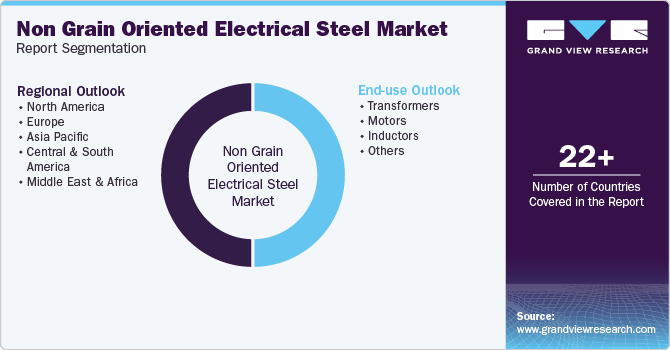
This report forecasts revenue and volume growth at global, regional, and country levels and provides an analysis of the latest industry trends in each of the sub-segments from 2021 to 2033. For this study, Grand View Research has segmented the global non grain oriented electrical steel market report based on end use and region.
 To learn more about this report, Download Free Sample Report
-
End Use Outlook (Volume, Kilotons; Revenue, USD Million, 2021 - 2033)
-
Transformers
-
Motors
-
Inductors
-
Others
-
-
Regional Outlook (Volume, Kilotons; Revenue, USD Million, 2021 - 2033)
-
North America
-
U.S.
-
Canada
-
Mexico
-
-
Europe
-
Germany
-
France
-
Italy
-
Russia
-
Turkey
-
-
Asia Pacific
-
China
-
India
-
Japan
-
South Korea
-
-
Central & South America
-
Brazil
-
-
Middle East & Africa
-
Iran
-
-
Research Methodology
The non grain oriented electrical steel market figures in this report are based on a proven research process that combines executive interviews with secondary research from proprietary databases, company filings, and recognized regulatory and institutional sources. Market size is built through value-chain sizing - reconciling supply-side and demand-side estimates - and triangulated with bottom-up and top-down approaches. Every estimate passes multiple levels of expert validation before publication, with each non grain oriented electrical steel segment quantified using the revenue-capture definitions in the table below.
Segment Definition
End Use
Revenue Capture Definition
Transformers
The transformers segment captures revenue generated from the use of NGOES in power, distribution, and specialty transformers where efficient magnetic performance is required. NGOES helps reduce core losses while supporting reliable energy conversion in applications requiring multidirectional magnetic flux.
Motors
The motors segment represents revenue generated from NGOES used in electric motors for industrial equipment, household appliances, electric vehicles, compressors, pumps, and HVAC systems. Its excellent magnetic permeability and low core loss improve motor efficiency, torque, and overall energy performance.
Inductors
The inductors segment includes revenue generated from NGOES used in inductors, reactors, and other electromagnetic components employed in power electronics and electrical systems. The material provides stable magnetic characteristics that enhance electrical efficiency and minimize energy losses.
Others
The others segment captures revenue generated from NGOES used in generators, magnetic actuators, relays, sensors, and various electrical equipment across industrial, automotive, renewable energy, and consumer applications. These products benefit from the material's superior magnetic properties and mechanical reliability.
Estimation Model
Layer Name
Key Question
Description
Electrification & Industrial Demand Base Layer
What forms the demand base?
Identify global demand from major electricity consuming industries including automotive, industrial manufacturing, renewable energy, consumer appliances, HVAC, and power generation. Assess production volumes of electric motors, generators, compressors, transformers, and electric vehicles to establish the total addressable demand for NGOES.
NGOES Application Penetration Layer
Where is NGOES utilized?
Estimate the penetration of NGOES across key applications including electric motors, generators, traction motors for electric vehicles, compressors, pumps, transformers, and industrial electrical equipment. Analyze the adoption of fully processed and semi processed NGOES grades across automotive, industrial, energy, and consumer appliance sectors in different regions.
NGOES Consumption Intensity Layer
How much NGOES is consumed?
Analyze NGOES consumption intensity based on electric motor production, EV manufacturing, industrial equipment output, renewable energy installations, and appliance manufacturing. Evaluate material usage according to motor capacity, efficiency requirements, magnetic performance, and equipment design. Consumption intensity varies according to energy efficiency regulations, electrification trends, and technological advancements.
Revenue Layer
How is market revenue generated?
Market revenue is quantified through the sale of fully processed and semi processed NGOES sheets and coils supplied to manufacturers of electric motors, generators, transformers, compressors, and other electrical equipment. Revenue generation is driven by demand from automotive, industrial manufacturing, renewable energy, consumer appliances, and power generation sectors. Market value is influenced by steel prices, silicon content, magnetic properties, production volumes, energy efficiency standards, and regional demand dynamics.
Delivered Customizations
This report has been delivered with the following In-depth customizations
Client Request
Customization Delivered
Value Adds
Regional Segmentation
Detailed regional analysis of the NGOES market across North America, Europe, Asia Pacific, Latin America, and Middle East & Africa. Included evaluation of electric motor manufacturing, EV production, industrial automation, renewable energy investments, appliance manufacturing, power equipment production, and government initiatives supporting energy efficient electrical systems.
Identified high growth electric motor manufacturing hubs and emerging NGOES demand centers. Enabled strategic expansion planning based on EV production, industrial electrification, and renewable energy investments. Supported regional demand forecasting and supply chain optimization.
Competitive Benchmarking
Benchmarking analysis of leading NGOES manufacturers based on product portfolio, magnetic performance, manufacturing technology, geographic footprint, research and development investments, sustainability initiatives, quality certifications, downstream customer base, and strategic partnerships. Included comparison of global electrical steel manufacturers supplying automotive, industrial motor, and electrical equipment industries.
Assisted in evaluating competitive positioning, technological strengths, and market leadership opportunities. Supported competitive intelligence, partnership assessments, acquisition evaluations, and strategic differentiation initiatives.
Opportunity Assessment
Identification of high growth opportunities across electric vehicles, industrial motors, high efficiency appliances, renewable energy generators, industrial automation, robotics, HVAC systems, rail transportation, and smart manufacturing.
Enabled prioritization of high return growth segments and emerging regional opportunities. Supported long term investment planning, capacity expansion decisions, product innovation, and strategic business development initiatives aligned with global electrification and energy efficiency trends.
Frequently Asked Questions About This Report
The key factor driving the growth of the global non grain oriented electrical steel market is the rising demand for efficient transformers and electric motors, coupled with the growing emphasis on renewable energy and energy-efficient technologies.
Middle East & Africa is anticipated to register the fastest CAGR over the forecast period.
Based on end use, transformers segment accounted for a market revenue share of 52.3% in 2025.
Based on end use, motors segment is anticipated to register the fastest CAGR over the forecast period.
The key players operating in the non grain oriented electrical steel market are ArcelorMittal; POSCO; Nucor Corporation; Baosteel Group Corporation; NIPPON STEEL CORPORATION; JFE Steel Corporation; thyssenkrupp Steel; Cleveland-Cliffs Inc.; Arnold Magnetic Technologies; VIZ-Steel
The global non grain oriented electrical steel market size was valued at USD 22.0 billion in 2025 and is estimated at USD 22.9 billion for 2026.
The global non grain oriented electrical steel market is expected to grow at a CAGR of 4.4% from 2026 to 2033, reaching USD 31.0 billion by 2033.
Asia Pacific dominated the market with revenue share of 66.1% in 2025.
China dominated the Asia Pacific market with revenue share of 73.5% in 2025.
About the Author(s)
Advanced Interior Materials Research Team
Advanced Materials · Advanced Interior MaterialsThis report was authored by the advanced interior materials research team at Grand View Research - comprising two research analysts, one senior research analyst, and one industry expert - with specialized expertise in the advanced interior materials segment of the advanced materials industry. All findings are based on proprietary advanced materials databases, executive interviews, and regulatory analysis, subject to internal peer review prior to publication.
Last Updated:
Speak to Analyst

Customize this report to your needs - add regions, segments, or data points, with 20% free customization.
Or view our licence options:


ISO 9001:2015 & 27001:2022 Certified
We are GDPR and CCPA compliant! Your transaction & personal information is safe and secure. For more details, please read our privacy policy.


