
- Home
- »
- Homecare & Decor
- »
-
Nonstick Cookware Market Size & Share Report, 2026-2033GVR Report cover

Nonstick Cookware Market (2026 - 2033)
Size, Share & Trends Analysis Report By Product (Pans & Woks, Pots, Griddle, Bakeware), By Coating (Teflon Coated, Enameled, Ceramic Coated), By Application, By Distribution Channel, By Region, And Segment Forecasts
Market Size, 2025
$20.6BMarket Estimate, 2026
$21.8BMarket Forecast, 2033
$32.5BCAGR, 2026–2033
5.9%Nonstick Cookware Market Summary
The global nonstick cookware market size was valued at USD 20.6 billion in 2025 and is projected to grow from USD 21.8 billion in 2026 to USD 32.5 billion by 2033, growing at a CAGR of 5.9% from 2026 to 2033. Europe dominated the nonstick cookware market with the largest revenue share of 37.2% in 2025. Consistently growing spending on healthy kitchenware and the undertaking of kitchen renovation projects are driving up the demand for nonstick cookware, owing to customers' growing preference for modular kitchens.
 Source: Grand View Research, IR Documents, Primary Interviews, Paid DatabasesTo learn more about this report,
 Download Free Sample Report
 Key Market Trends & Insights
- By product: Pan & woks segment dominated the market, with a revenue share of 46.5% in 2025.
- By coating: Teflon coated segment held the largest revenue share of 39.4% in 2025.
- By application: Residential segment segment held the largest market share of 66.4% in 2025.
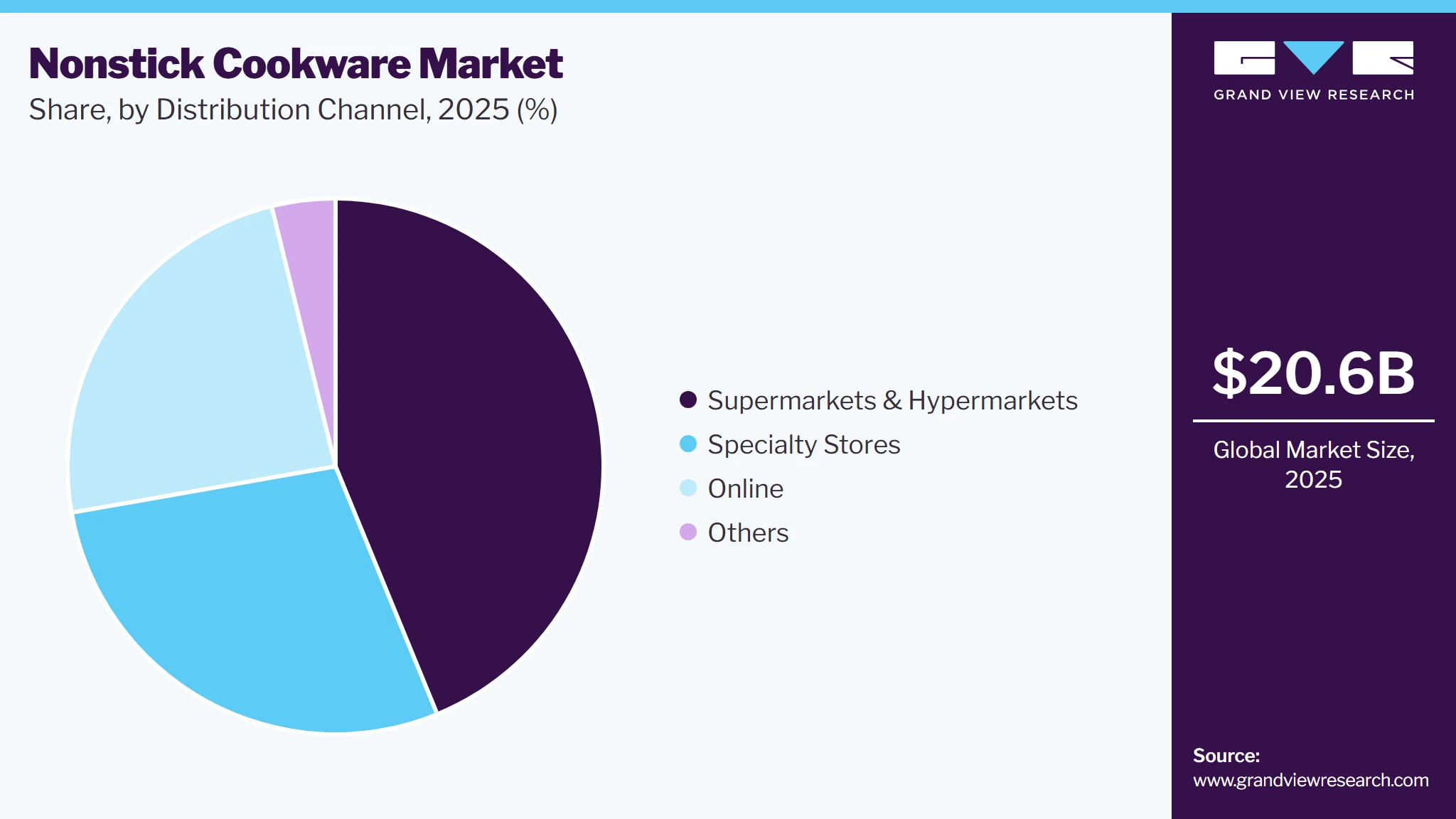
- By distribution channel: Supermarkets & hypermarkets segment dominated the market with revenue share of 43.8% in 2025.
Regional Highlights
- Largest regional market: Europe (37.2% revenue share, 2025)
- Fastest-growing regional market: Asia Pacific (highest CAGR, 2026-2033)
- By country: UK held the largest market share in 2025.
Market Size & Forecast
- Market size in 2025: USD 20.6 Billion
- Estimated market size in 2026: USD 21.8 Billion
- Projected market size by 2033: USD 32.5 Billion
- CAGR (2026-2033): 5.9%
Three ways to get this report
Buy it, customize it, or ask a question.Ask an Analyst
Analyst response in 1 business day
- AccessReport author, directly
- Reply timeWithin 1 working day
- No sales callDirect answer only
- FormatEmail reply
- CostFree, no cost
Get the Full Report
What the study covers
- FormatsPDF · Excel · Dashboard
- Timeline2026–2033 annual, 2025 base
- Coverage20+ countries, 5 regions
- Companies10+ key players profiled
Customize the Report
20% free customization
- IncludeCountries, segments, points
- TailorTo your product definition
- ExtendDeeper competitor detail
- OrA fully bespoke study
- Turnaround5–10 working days
According to the data published by a leading home renovation company called Gallery KBNY, the home renovation sector in the U.S. is expected to witness a growth of 1.2% in 2025 compared to the previous year. Such projects often include renovating the kitchen and buying new non-stick cookware. Besides, the surge in the popularity of home cooking among the young population and growing awareness towards healthy and less oil cooking is further encouraging the growth of the non-stick cookware industry worldwide. To learn more about this report, Download Free Sample Report
 Self-cooked meals are one of the key drivers of the nonstick cookware industry. Consumers are increasingly inclined towards home cooking, especially post-pandemic, According to a report published by the NFRA (U.S.) in 2023, approximately 81% of the consumers in the U.S. prefer to cook at least one meal at home owing to factors such as health, convenience, and cost effectiveness. Besides home cooking, non-stick cookware is also making its way into commercial kitchens. The rapid expansion in cities, particularly in developing economies such as India and China, is paving the way for eateries, restaurants, and food joints, indicating rising growth prospects for nonstick cookware products. The increasing number of meals consumed away from home due to the surge in the working population worldwide will further fuel the market growth, particularly in the commercial segment.
The growing culture of guest hospitality in Western countries is also encouraging the use of nonstick cookware at home, including pans, pots, whisks, and other cookware, to provide quality food to the guests. Additionally, increasing popularity for house catering among millennials due to convenience, customization, and cost effectiveness drives the growth of market. Rising consumer preference for the younger population to eat outside for social gatherings and exploring foods from different cultures is fostering eateries and food joints serving diverse cuisines. These commercial spaces are generating a high demand for nonstick cookware in order to serve customers healthier food in a shorter time without compromising on quality or presentation.
Intense competition and rapidly changing consumer demand are likely to facilitate the development of innovative products, resulting in high R&D investments for manufacturers. With better product availability in the market and dynamic consumer food habits, the demand for non-stick cookware across household and commercial applications is expected to grow consistently over the forecast period.
Market Dynamics
The nonstick cookware market is gaining traction as consumers increasingly seek convenient, time-saving, and healthier cooking solutions for everyday meal preparation. Nonstick cookware products, including frying pans, saucepans, cookware sets, and griddles, offer benefits such as reduced oil consumption, easy food release, simplified cleaning, and enhanced cooking efficiency. These products enable users to prepare a wide variety of meals while supporting healthier dietary habits and reducing kitchen maintenance efforts. The growing focus on healthy cooking, coupled with rising disposable incomes, urbanization, and increasing adoption of modern kitchen appliances and cookware, is expected to continue driving growth in the nonstick cookware market.
The increasing consumer preference for healthy cooking and convenient meal preparation is significantly driving demand for nonstick cookware. Rising health awareness, changing dietary habits, and growing concerns regarding excessive oil and fat consumption have encouraged consumers to adopt cookware that enables low-oil cooking without compromising food quality. Additionally, rapid urbanization, busy lifestyles, and the growing number of working professionals have increased demand for cookware that offers easy food release, faster cooking, and simplified cleaning. The expanding middle-class population, rising disposable incomes, and increasing penetration of modern kitchens and home cooking trends are further supporting the adoption of nonstick cookware across residential households globally.
Concerns related to the safety and durability of nonstick coatings remain a major restraint for the nonstick cookware market. Consumers are increasingly scrutinizing the potential health risks associated with certain coating materials, particularly when cookware is exposed to high temperatures, scratched, or improperly maintained. In addition, growing environmental concerns regarding the production and disposal of coated cookware have led to increased regulatory scrutiny and consumer preference for alternative materials such as stainless steel, cast iron, and ceramic cookware. The relatively shorter lifespan of some nonstick products compared to traditional cookware options also creates replacement concerns, limiting adoption among cost-conscious consumers and affecting long-term market growth.
The growing demand for premium kitchenware and innovative cooking solutions is creating substantial opportunities in the nonstick cookware market. Manufacturers are increasingly investing in advanced coating technologies, ceramic-based nonstick surfaces, and eco-friendly materials to address consumer concerns regarding safety and sustainability. Rising interest in home cooking, gourmet meal preparation, and modern kitchen aesthetics is driving demand for premium cookware collections with enhanced durability and performance. Additionally, the rapid growth of e-commerce platforms is improving product accessibility and enabling brands to reach a wider consumer base. These trends, combined with increasing disposable incomes and demand for high-quality kitchen products, are expected to accelerate growth opportunities in the nonstick cookware market.
Analyst Perspective
The nonstick cookware market sits at a favorable intersection of long-term consumer trends, including growing health consciousness, rising home cooking activity, increasing urbanization, and a sustained shift toward convenience-oriented kitchen solutions. Unlike traditional cookware categories, nonstick products directly address modern consumer priorities by enabling low-oil cooking, reducing cleaning effort, and improving overall cooking efficiency. The market is further supported by premiumization trends, with consumers increasingly seeking durable, aesthetically appealing, and technologically advanced cookware for modern kitchens. The central competitive moat, however, will belong to manufacturers that successfully combine advanced coating technologies, product safety, durability, and brand trust into a differentiated product portfolio - transforming cookware from a functional household necessity into a premium lifestyle and wellness-oriented kitchen investment capable of commanding higher margins and stronger customer loyalty.
Product Insights
Based on product, the pan & woks segment led the market with the largest revenue share of 46.5% in 2025 and is expected to grow at the fastest CAGR over the forecast period. Largest share of the segment is attributed to the rising demand for multi-purpose pans and woks for preparing different cuisines. Pans and woks are considered an ideal solution for various techniques and everyday cooking tasks. This cookware helps in nutrient retention by preserving vitamins and minerals in vegetables or food ingredients and minimizing cooking time. Moreover, pans are a more convenient option for preparing delicately textured food items, including eggs, pancakes, fish, and other items. These factors are expected to contribute for the largest share of the segment.
The Bakeware segment is expected to register the fastest CAGR of 8.1% during the forecast period. Rising demand for healthier options in baked food items primarily contributes to the fastest growth of the segment. Baked products such as cakes, cookies, laminated pastries, and others contain a high level of fats due to the greasing process. The high fat intake is associated with various chronic diseases such as obesity and heart disease. The growing health consciousness among individuals is promoting the use of nonstick bakeware. Nonstick bakeware does not require an extensive greasing agent to avoid sticking of food items to the bakeware surface. Such factors boost the nutritional value of the food products without compromising on taste.
Coating Insights
Based on coating, the teflon coated segment led the market with the largest revenue share of 39.4% in 2025. Because of its stiffness and longevity, cookware with Teflon coating has been the preferred choice of middle-income families. Cookware lined with Teflon develops a frictionless surface, which helps in cooking the food easily. Teflon-coated cookware offers competitive nonstick performance, and it is chemically non-reactive to most food ingredients, thus highly recommended to avoid food spoilage, undesirable flavor, and nutritional value. Additionally, this cookware is affordable and lightweight, which makes it a more convenient option for commercial and residential applications, resulting in the growth of the segment.
The ceramic-coated segment is projected to grow significantly over the forecast period. The growth is attributed to factors such as good nonstick performance, ease of cleaning, even heat distribution, durability, and an environmentally friendly alternative due to its mineral-based composition. Customers are actively looking for substitutes that offer a non-toxic cooking experience as awareness of the possible health hazards connected to other coatings is rising. Additionally, the high compatibility of this cookware with glass top stoves is also a major contributing factor to its fast adoption. Besides, consumers' attention towards maintaining an aesthetic appearance of the kitchen spaces is also expected to promote the adoption of ceramic-coated cookware.
Application Insights
The residential segment dominated the market in 2025. The rising trend of health-conscious living, cost savings, and social media influence have all contributed to the trend toward home-cooked food and increased spending on sturdy, high-quality kitchen necessities. As more people are likely to pursue home cooking and baking as a daily habit, the residential segment is expected to dominate the overall nonstick cookware industry.
The commercial segment is projected to grow significantly over the forecast period. Reduced food waste, easy cleaning and carrying procedures, and cost effectiveness due to low maintenance are the factors influencing the adoption of nonstick cookware in the commercial segment. Additionally, the growing demand for healthier menu options by consumers is encouraging chefs and commercial kitchens to adopt cookware that supports low-oil cooking while maintaining superior heat distribution.
Distribution Channel Insights
The supermarkets and hypermarkets segment dominated the market in 2025. Shopping at a supermarket or hypermarket allows consumers to be selective and observant, as a product on the shelf may readily be compared to those of other brands before making a purchase decision. Nonstick cookware is accessible in a variety of price ranges at supermarkets and hypermarkets, and consumers can choose from a variety of local and worldwide brands.
 To learn more about this report, Download Free Sample Report
 The online segment is projected to grow significantly over the forecast period.The easy availability of cookware across different shopping portals and the increasing penetration of the internet have raised the demand for non-stick cookware through e-commerce sites. Online distribution channels have seen a boom in sales as they allow buyers to access premium and global brands with well-informed information about the product. Similarly, factors such as convenience, availability of wider collection, online discounts, and flexible payment options help consumers to procure nonstick cookware easily. Moreover, the availability of a review & rating system helps consumers in making well-informed purchase decisions.
Regional Insights
The North American held a significant market share of in 2024. This is mainly due to the growing culture of restaurants, cafes, and eateries in the region. According to the National Restaurant Association report published in January 2025, consumers' continuous spending in local restaurants is pushing the growth of the restaurant industry across the states, resulting in a consistent growth of the nonstick cookware industry in the region.
U.S. Nonstick Cookware Market Trends
The U.S. dominated the North American nonstick cookware market in 2024 due to a growing shift in the restaurant industry. According to FoodIndustrydotCom, there are 749,000 restaurants in the U.S. Factors including affordability and convenience drive the adoption of nonstick cookware among restaurants. These factors are contributing to the high adoption of nonstick cookware in the U.S. Besides, the growing trend of home cooking and baking among younger generation consumers is also promoting the demand for nonstick cookware in the country.
Europe Nonstick Cookware Market Trends
Europe dominated the nonstick cookware market with the largest revenue share of 37.2% in 2025. Consumers across the region prefer to buy cookware with innovation and uniqueness through the use of diverse colors and personalized collections. Similarly, shifting trends in eating culture, such as the increasing prominence of social and casual dining, result in the increasing demand for innovative cookware products in the region. Additionally, customers’ priorities towards healthier cooking options, simplicity of cleaning, and convenience are driving the growth of nonstick cookware in Europe due to the rising trend of home-cooked meals.
 To learn more about this report, Download Free Sample Report
 The Germany nonstick cookware market held a substantial market share in 2024 owing to rising health consciousness among individuals, convenience offered by nonstick cookware, and availability of innovative products with non-toxic coatings. Consumers rising preference towards low fat cooked food to avoid unwanted health conditions contributing to the higher adoption of nonstick cookware in the country.
Asia Pacific Nonstick Cookware Market Trends
The Asia Pacific nonstick cookware market is anticipated to grow at a fastest CAGR of 6.9% during the forecast period. This growth is attributed to rising disposable income, urbanization, changing lifestyles, and growing demand for healthier cooking methods. Rising disposable income results in consumer buying behavior in terms of upgrading lifestyles. Additionally, affordability and convenience play major roles in faster adoption in the region.
The China nonstick cookware market held a substantial market share in 2024 owing to rising social media influence due to cooking shows, easy availability and accessibility, and adoption of modern and aesthetic lifestyle. Additionally, rising influence of cooking among younger generation who generally prefers convenience results in the growing demand for nonstick cookware’s in the country.
Key Nonstick Cookware Company Insights
Some of the key companies in the Nonstick Cookware market include Groupe SEB, Newell Brands, Cuisinart, and others. Organizations are focusing on increasing customer base to gain a competitive edge in the industry. Therefore, key players are taking several strategic initiatives, such as mergers and acquisitions, and partnerships with other major companies.
-
Groupe SEB is a household appliances and cookware manufacturing company. The company offer different products types in order to meet consumer’s expectations. The company have wide product portfolio with different brands. Tefal is the company’s nonstick cookware brand which uses new generation technologies to increase the durability and safety of cookware’s.
-
Newell Brands is a consumer products company with different brands such as Graco, Coleman, Oster, Rubbermaid, and Sharpie. The company offers premium cookware solutions through Calphalon brand.
Key Nonstick Cookware Companies
The following are the leading companies in the nonstick cookware market.
-
Groupe SEB (Tefal, All-Clad Group, WMF)
-
Tefal
-
All-Clad Group
-
WMF
-
Newell Brand Inc. (Calphalon)
-
Cuisinart
-
Meyer Corporation
-
TTK Prestige Limited
-
Scanpan USA, Inc.
-
Hawkins Cookers
-
The Cookware Company
Competitive Benchmarking
Category
Operating Strategies
Competitive Edge
Weakness
Established Players (SEB Group, Newell Brands Inc., Meyer Corporation, Fissler GmbH, TTK Prestige Ltd., Hawkins Cookers Ltd., Cuisinart)
- Expand product portfolios across cookware, kitchen appliances, and premium kitchenware segments
- Invest in advanced nonstick coating technologies and PFAS-free product developme
- Strengthen omnichannel distribution through retail stores, specialty kitchen outlets, and e-commerce platforms
- Focus on premiumization, durability, and energy-efficient cookware solutions
- Strong brand recognition and consumer trust built over decades
- Extensive distribution networks with global market presence
- Advanced R&D capabilities in coating technologies and product innovation
- Broad product portfolios catering to multiple price points and consumer segments
- Limited brand awareness compared to established cookware manufacturers
- Lower production scale and restricted global distribution reach
- Dependence on online channels and marketing investments for growth
- Limited financial resources for large-scale expansion and R&D activities
Emerging Players (Caraway Home, Our Place, GreenPan, regional cookware brands, and D2C cookware startups)
- Focus on toxin-free, ceramic-coated, and eco-friendly nonstick cookware products
- Leverage direct-to-consumer (D2C) sales models and digital marketing campaigns
- Target health-conscious and environmentally aware consumers
- Faster innovation cycles and rapid response to evolving consumer preferences
- Strong appeal among younger consumers seeking sustainable cookware solutions
- Agile business models and effective online customer engagement strategies
- Limited brand awareness compared to established cookware manufacturers
- Lower production scale and restricted global distribution reach
- Dependence on online channels and marketing investments for growth
Recent Developments
-
In February 2024 TTK Prestige launched Prestige Ceraglide Ceramic Cookware range. These products come with advanced nonstick properties and enhance customers' cooking experience, blending functionality, and safety.
-
In October 2023, Kyocera launched new line of ceramic cookware. This cookware’s are featured with nonstick ceramic coating and specifically designed for consumer looking for healthier and environment friendly cookware options.
-
In June 2023, Tefal launched RENEW, a range of nonstick ceramic coating pots and pans. This product range comes with Inoceram technology which helps in enhancing the nonstick performance and preserving flavors of food.
Nonstick Cookware Market Report Scope
Report Attribute
Details
Market size in 2025
USD 20.6 billion
Estimated market size in 2026
USD 21.8 billion
Projected market size by 2033
USD 32.5 billion
Growth rate
CAGR of 5.9% from 2026 to 2033
Base year for estimation
2025
Historical data
2021 - 2024
Forecast period
2026 - 2033
Quantitative units
Revenue in USD million/billion and CAGR from 2026 to 2033
Report coverage
Revenue forecast, company ranking, competitive landscape, growth factors, and trends
Segments covered
Product, coating, application, distribution channel, region
Regional scope
North America; Europe; Asia Pacific; Latin America; MEA
Country scope
U.S.; Canada; Mexico; Germany; UK; France; Italy; Spain; China; Japan; India; South Korea; Australia; Brazil; South Africa
Key companies profiled
Groupe SEB (Tefal, All-Clad Group, WMF); Tefal; All-Clad Group; WMF; Newell Brand, Inc. (Calphalon); Cuisinart; Meyer Corporation; TTK Prestige Limited; Scanpan USA, Inc.; Hawkins Cookers; The Cookware Company.
Customization scope
Free report customization (equivalent up to 8 analysts' working days) with purchase. Addition or alteration to country, regional & segment scope.
Pricing and purchase options
Avail customized purchase options to meet your exact research needs. Explore purchase options
Global Nonstick Cookware Market Report Segmentation
This report forecasts revenue growth at global levels and provides an analysis of the latest industry trends in each of the sub-segments from 2021 to 2033. For this study, Grand View Research has segmented the global nonstick cookware market report based on product, coating, application, distribution channel, and region.
-
Product Outlook (Revenue, USD Million, 2021 - 2033)
-
Pans & Woks
-
Pots
-
Griddle
-
Bakeware
-
Others
-
-
Coating Outlook (Revenue, USD Million, 2021 - 2033)
-
Teflon Coated
-
Enameled
-
Ceramic Coated
-
Others
-
-
Application Outlook (Revenue, USD Million, 2021 - 2033)
-
Residential
-
Commercial
-
-
Distribution Channel Outlook (Revenue, USD Million, 2021 - 2033)
-
Supermarkets & Hypermarkets
-
Specialty Stores
-
Online
-
Others
-
-
Regional Outlook (Revenue, USD Million, 2021 - 2033)
-
North America
-
U.S.
-
Canada
-
Rest of North America
-
-
Europe
-
Germany
-
UK
-
France
-
Italy
-
Spain
-
Rest of Europe
-
-
Asia Pacific
-
China
-
Japan
-
India
-
Australia
-
South Korea
-
Rest of Asia Pacific
-
-
Central & South America
-
Brazil
-
Rest of Central & South America
-
-
Middle East and Africa (MEA)
-
South Africa
-
Rest of Middle East and Africa
-
-
Research Methodology
Segment Definition
Segment - Product
Revenue capture definition
Pans & Woks
This segment covers the revenues generated through the sales of the nonstick cookware market for pans and woks, which are widely used for frying, sautéing, stir-frying, and everyday cooking applications. Real-life examples include nonstick frying pans used in households, induction-compatible woks for Asian cuisine preparation, and professional-grade sauté pans used in restaurants.
Pots
This segment covers the revenues generated through the sales of the nonstick cookware market for cooking pots designed for boiling, simmering, stewing, and preparing soups, pasta, and curries. Real-life examples include nonstick stock pots in home kitchens, saucepots used for preparing sauces, and large-capacity cooking pots utilized in commercial foodservice establishments.
Griddle
This segment covers the revenues generated through the sales of the nonstick cookware market for griddles used to cook flat foods and breakfast items with minimal oil. Real-life examples include nonstick griddles used for pancakes and eggs in households, dosa tavas in Indian kitchens, and commercial griddles used in cafés and restaurants.
Bakeware
This segment covers the revenues generated through the sales of the nonstick cookware market for bakeware products designed for baking cakes, cookies, breads, and other confectionery items. Real-life examples include nonstick cake tins, muffin trays, baking sheets, loaf pans, and pizza trays used in homes and bakeries.
Others
This segment covers the revenues generated through the sales of the nonstick cookware market for other cookware products such as casseroles, roasting trays, pressure cooker inserts, and specialty cooking vessels. Real-life examples include nonstick casserole dishes, roasting pans, and multi-purpose cookware sets used in residential and commercial kitchens.
Segment - Coating
Revenue capture definition
Teflon Coated
This segment covers the revenues generated through the sales of the nonstick cookware market for cookware coated with polytetrafluoroethylene (PTFE)-based nonstick surfaces that provide easy food release and convenient cleaning. Real-life examples include Teflon-coated frying pans, saucepans, and cookware sets commonly used in households.
Enameled
This segment covers the revenues generated through the sales of the nonstick cookware market for enameled cookware featuring a protective enamel coating that enhances durability and cooking performance. Real-life examples include enameled pots, Dutch ovens, and casserole dishes used in home kitchens and professional cooking environments.
Ceramic Coated
This segment covers the revenues generated through the sales of the nonstick cookware market for cookware featuring ceramic-based coatings that offer a PFAS-free and environmentally friendly cooking surface. Real-life examples include ceramic-coated frying pans, cookware sets, and griddles marketed as eco-friendly alternatives to traditional nonstick cookware.
Others
This segment covers the revenues generated through the sales of the nonstick cookware market for cookware utilizing alternative coating technologies, including titanium-reinforced, granite-coated, diamond-infused, and hard-anodized nonstick surfaces. Real-life examples include granite-coated cookware sets and titanium-enhanced nonstick pans designed for improved durability.
Segment - Application
Revenue capture definition
Residential
This segment covers the revenues generated through the sales of the nonstick cookware market for residential applications, where cookware is used for everyday meal preparation in households, apartments, and private residences. Real-life examples include nonstick frying pans, pots, and bakeware used in home kitchens for preparing daily meals.
Commercial
This segment covers the revenues generated through the sales of the nonstick cookware market for commercial applications, including restaurants, hotels, cafés, catering services, cloud kitchens, and institutional foodservice operations. Real-life examples include heavy-duty nonstick woks used in restaurants, commercial griddles in cafés, and cookware utilized in hotel kitchens and catering facilities.
Segment - Distribution Channel
Revenue capture definition
Supermarkets & Hypermarkets
This segment covers the revenues generated through the sales of the nonstick cookware market through large-format retail stores that offer a broad range of cookware products under one roof. Real-life examples include cookware sales through stores such as Walmart, Carrefour, and Tesco.
Specialty Stores
This segment covers the revenues generated through the sales of the nonstick cookware market through dedicated kitchenware, home improvement, and cookware retailers that provide specialized product selections and expert guidance. Real-life examples include cookware purchased from kitchenware boutiques, home furnishing stores, and specialty cookware retailers.
Online
This segment covers the revenues generated through the sales of the nonstick cookware market through e-commerce platforms and brand-owned websites that allow consumers to compare, purchase, and receive cookware products directly. Real-life examples include purchases made through Amazon, Flipkart, brand websites, and online home goods marketplaces.
Offline
This segment covers the revenues generated through the sales of the nonstick cookware market through alternative distribution channels such as department stores, discount retailers, direct sales, warehouse clubs, and institutional procurement channels. Real-life examples include cookware sold through department stores, wholesale distributors, membership clubs, and corporate procurement contracts.
Estimation Model
Layer
Key Question
Description
Epidemiology Layer
Who needs nonstick cookware?
Identify households, restaurants, hotels, cafeterias, and foodservice establishments requiring cookware for daily food preparation.
Digital Access Layer
Who can be reached through distribution channels?
Apply penetration of supermarkets, hypermarkets, kitchenware stores, specialty retailers, wholesalers, and e-commerce platforms to determine the reachable customer base.
Behavioural Layer
Who actively purchases nonstick cookware?
Apply cookware replacement cycles, new household formation, home cooking trends, urbanization, and foodservice expansion to estimate active buyers.
Monetisation Layer
How much revenue is generated?
Multiply active buyers by average spending on nonstick cookware across residential and commercial end users to estimate market revenue.
Delivered Customizations
This report has been delivered with the following In-depth customizations
CLIENT REQUEST
CUSTOMIZATION DELIVERED
VALUE ADDS
Healthy Cooking & Low-Oil Food Preparation Trends
Conducted a focused analysis of nonstick cookware demand driven by healthy cooking habits, low-oil meal preparation, home cooking adoption, consumer preference for convenience, and advancements in non-toxic coating technologies.
Helps stakeholders identify high-growth product categories, evaluate evolving consumer cooking preferences, and assess commercialization opportunities in premium and health-focused cookware segments.
Premium Kitchenware & Smart Consumer Lifestyle Adoption Trends
Evaluated adoption trends across premium cookware, induction-compatible products, aesthetically designed kitchenware, multifunctional cookware, and e-commerce-driven purchasing behavior.
Provides insights into emerging kitchenware trends, changing consumer purchasing patterns, and attractive product segments to support innovation, branding, and market expansion strategies.
Sustainable Cookware Innovation & Market Opportunity Assessment
Assessed demand for eco-friendly nonstick cookware, PFAS-free and ceramic-coated products, durable cookware solutions, manufacturing innovations, and regulatory considerations related to consumer safety and environmental sustainability.
Supports investment and expansion strategies by identifying underserved market opportunities, evaluating technology advancements, and highlighting long-term growth prospects in sustainable cookware solutions.
Frequently Asked Questions About This Report
The global nonstick cookware market size was valued at USD 20.6 billion in 2025 and is estimated at USD 21.8 billion in 2026.
The global nonstick cookware market is expected to grow at a CAGR of 5.9% from 2026 to 2033, reaching USD 32.5 billion by 2033.
Key factors that are driving the nonstick cookware market growth include product characteristics & features such as easy cleanliness, excellent scratch resistance, and ability to uniformly distribute heat in the pan.
The residential segment dominated the market share by 66.3% in 2025, supported by increasing home-cooking trends and growing consumer preference for easy-to-clean cookware.
Some key players operating in the nonstick cookware market include Groupe SEB (Tefal, All-Clad Group, WMF); Tefal; All-Clad Group; WMF; Newell Brand, Inc. (Calphalon); Cuisinart; Meyer Corporation; TTK Prestige Limited; Scanpan USA, Inc.; Hawkins Cookers; The Cookware Company.
Pans and Woks accounted for the largest market share 46.5% in 2025 due to their widespread use in everyday cooking.
Europe dominated the nonstick cookware market share by 37.2% in 2025, driven by strong consumer demand for premium cookware, high adoption of modern kitchen products, and increasing preference for healthy, low-oil cooking solutions across the region.
Supermarkets & Hypermarkets held the largest market share of 43.8% in 2025, while online channels are witnessing rapid growth.
Asia Pacific is expected to be the fastest-growing regional market.
About the Author(s)
Homecare & Decor Research Team
Consumer Goods · Homecare & DecorThis report was authored by the homecare & decor research team at Grand View Research - comprising two research analysts, one senior research analyst, and one industry expert - with specialized expertise in the homecare & decor segment of the consumer goods industry. All findings are based on proprietary consumer goods databases, executive interviews, and regulatory analysis, subject to internal peer review prior to publication.
Last Updated:
Speak to Analyst

Customize this report to your needs - add regions, segments, or data points, with 20% free customization.
Or view our licence options:


ISO 9001:2015 & 27001:2022 Certified
We are GDPR and CCPA compliant! Your transaction & personal information is safe and secure. For more details, please read our privacy policy.


