
- Home
- »
- Advanced Interior Materials
- »
-
Nonwoven Filter Media Market Size Report, 2026-2033GVR Report cover
![Nonwoven Filter Media Market (2026 - 2033)Report]()
Nonwoven Filter Media Market (2026 - 2033)
Size, Share & Trends Analysis Report By Technology (Spunbond, Meltblown, Wetlaid, Needlepunch), By Application (Transportation, Manufacturing, HVAC, Healthcare), By Region, And Segment Forecasts
Market Size, 2025
$7.0BMarket Estimate, 2026
$7.5BMarket Forecast, 2033
$13.9BCAGR, 2026–2033
9.2%Nonwoven Filter Media Market Summary
The global nonwoven filter media market size was valued at USD 7.0 billion in 2025 and is projected to grow from USD 7.5 billion in 2026 to USD 13.9 billion by 2033, at a CAGR of 9.2% from 2026 to 2033. The market in Asia Pacific dominated with a revenue share of 48.8% in 2025. The demand for nonwoven filter media is rising steadily due to increasing awareness regarding air and water quality across industrial, commercial, and residential sectors.

Key Market Trends & Insights
- By technology: Spunbond segment held the largest market share of 38.4% in 2025.
- By application: Water filtration segment held the largest market share of 21.6% in 2025.
Regional Highlights
- Largest regional market: Asia Pacific (48.8% revenue share, 2025)
- By country: China held the largest market share in 2025
Market Size & Forecast
- Market size in 2025: USD 7.0 Billion
- Estimated market size in 2026: USD 7.5 Billion
- Projected market size by 2033: USD 13.9 Billion
- CAGR (2026-2033): 9.2%
Rapid urbanization and industrialization have significantly contributed to pollution levels, driving the need for efficient filtration solutions. In addition, the growing prevalence of airborne diseases and contaminants has boosted the adoption of high-performance filtration materials. The expansion of HVAC systems in both developed and emerging economies is further supporting market growth. Increasing regulatory pressure to maintain environmental standards is also pushing industries to adopt advanced filtration systems. Moreover, the rising use of nonwoven materials in automotive cabin air filters is contributing to increased demand. The COVID-19 pandemic also accelerated the use of filtration media in healthcare and personal protective equipment.
Key drivers include stringent environmental regulations regarding emissions and wastewater treatment, especially across developed economies. The automotive industry plays a significant role, as increasing demand for fuel-efficient, low-emission vehicles requires advanced filtration systems. Growth in industrial manufacturing activities has also led to increased demand for filtration in processes such as chemical processing, food & beverage, and pharmaceuticals. The rising adoption of nonwoven materials due to their cost-effectiveness, lightweight nature, and high filtration efficiency is another major driver. Technological advancements in meltblown and spunbond processes have enhanced product performance. Increasing investments in infrastructure and smart buildings are further driving HVAC filtration demand. In addition, rising health consciousness among consumers is boosting demand for clean air solutions.
Governments worldwide are implementing strict environmental regulations to control air and water pollution, significantly impacting the nonwoven filter media industry. Policies such as emission control standards and wastewater treatment mandates are encouraging industries to adopt efficient filtration systems. Initiatives promoting clean air programs in urban regions are also boosting demand for advanced filter media. In emerging economies, government investments in infrastructure and water treatment facilities are creating new opportunities. Regulations related to workplace safety and indoor air quality are further supporting the adoption of filtration systems. In addition, incentives for sustainable and eco-friendly materials are driving innovation in biodegradable nonwoven media. Public health initiatives focusing on reducing airborne diseases have also contributed to increased demand.
Market Concentration & Characteristics
The nonwoven filter media industry is moderately fragmented, with the presence of several global and regional players competing based on product quality, technological innovation, and pricing. Key players focus on expanding their product portfolios and strengthening their global presence through partnerships and acquisitions. The market is characterized by continuous R&D investments to improve filtration efficiency and sustainability. While large companies dominate high-performance filtration segments, small and medium enterprises cater to niche and cost-sensitive markets. Competitive intensity remains high due to the increasing demand across multiple industries. Companies are also investing in capacity expansion to meet rising global demand. The presence of established supply chains gives an advantage to major players.
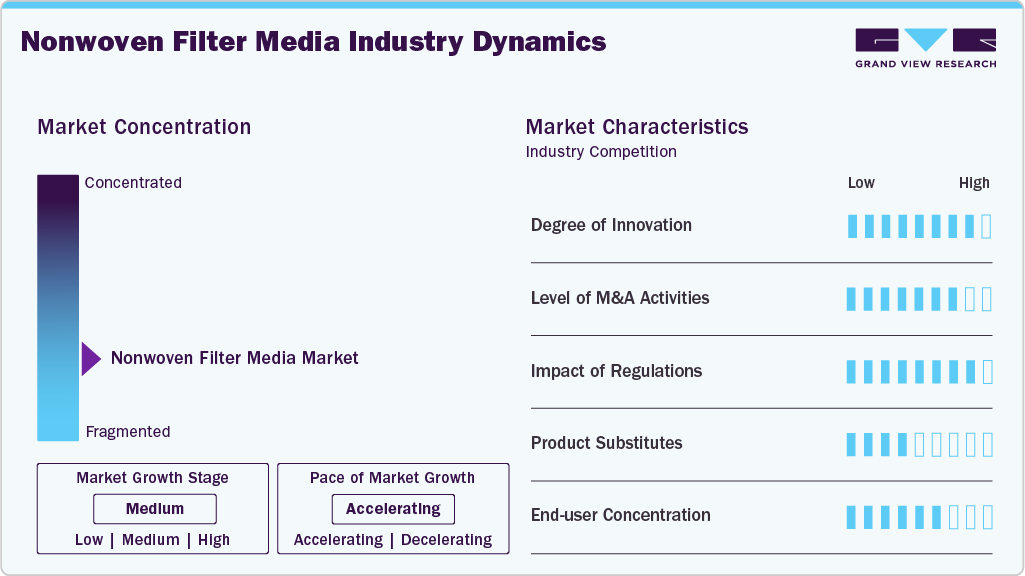
The threat of substitutes in the market is moderate. Alternatives such as woven filter media, foam filters, and membrane-based filtration systems are available in the market. However, nonwoven media offer superior advantages such as lower cost, higher efficiency, and flexibility in design, which limit the adoption of substitutes. Membrane filters provide higher precision but are generally more expensive, restricting their use to specialized applications. Foam filters are reusable but may not provide the same level of filtration efficiency. Continuous advancements in nonwoven technology are further reducing the threat of substitution. However, in high-end industrial applications, membrane technologies still pose a competitive challenge.
Technology Insights
The spunbond segment accounted for the largest revenue share of 38.4% in 2025 and is expected to grow at the fastest CAGR of 9.8% during the forecast period, due to its superior balance of strength, durability, and cost-effectiveness. Spunbond nonwovens offer high tensile strength and uniform fiber distribution, making them highly suitable for applications such as air filtration, liquid filtration, and automotive filters. Their ability to provide consistent performance under varying environmental conditions further enhances their adoption across industrial and commercial sectors. In addition, the scalability of spunbond manufacturing processes enables high-volume production at relatively lower costs, which is a key factor driving its dominance. The material’s compatibility with multilayer filtration systems, especially when combined with meltblown layers, further strengthens its position in high-efficiency filtration applications.
The needlepunch technology is expected to grow at a significant CAGR of 9.4% in 2025, due to its versatility and suitability for heavy-duty filtration applications. Needlepunch nonwoven fabrics are known for their high porosity, durability, and excellent dust-holding capacity, making them ideal for industrial filtration, particularly in sectors such as cement, mining, and power generation. The increasing demand for efficient dust collection and air pollution control systems is a major factor driving the growth of this segment. In addition, needlepunch technology allows for the use of a wide range of fibers, including synthetic and natural materials, enhancing product customization. Its cost-effectiveness compared to other advanced technologies also contributes to its growing adoption. Rising environmental regulations and industrial emission standards are further expected to boost demand for needlepunch-based filter media.
Application Insights
The water filtration segment accounted for the largest revenue share of 21.6% in 2025, due to the growing global need for clean and safe water across residential, industrial, and municipal applications. Increasing concerns regarding water contamination, driven by industrial discharge, urban wastewater, and aging infrastructure, have significantly boosted demand for effective filtration solutions. Nonwoven filter media are widely used in water treatment processes due to their high efficiency, cost-effectiveness, and ability to handle varying flow rates and particle loads. In addition, stringent government regulations related to water quality and wastewater treatment have compelled industries to adopt advanced filtration systems. The expansion of desalination plants and water recycling initiatives further supports segment growth.

The food and beverage segment is expected to grow at a CAGR of 10.1% during the forecast period, due to increasing emphasis on hygiene, product quality, and regulatory compliance. Filtration plays a critical role in ensuring the removal of contaminants during processing stages such as beverage clarification, dairy processing, and edible oil purification. Nonwoven filter media are preferred for their efficiency, flexibility, and cost advantages in handling both liquid and air filtration within production environments. Rising consumer demand for processed and packaged foods, along with the expansion of the global food processing industry, is a key growth driver. In addition, stringent food safety regulations are pushing manufacturers to adopt high-performance filtration systems.
Regional Insights
Asia Pacific nonwoven filter media industry dominated the global market, accounting for the largest revenue share of 48.8% in 2025, driven by rapid industrialization, urbanization, and rising environmental concerns. Countries such as China and India are major contributors due to expanding manufacturing sectors and rising pollution levels. The growing demand for HVAC systems and automotive production further supports market growth. Government initiatives aimed at improving air and water quality are also driving demand. In addition, the presence of low-cost manufacturing facilities and the availability of raw materials strengthen regional dominance. Increasing healthcare infrastructure investments are also contributing to demand.

China nonwoven filter media industry is a key market driven by its large industrial base and strict environmental regulations. The country has implemented stringent emission control policies, boosting demand for filtration systems. Rapid urbanization and increasing air pollution levels have led to higher adoption of air filtration solutions. The expansion of the automotive and manufacturing industries further supports market growth. In addition, China is a major producer of nonwoven materials, providing a strong supply base. Technological advancements and investments in production capacity are also notable trends. Growing exports of filtration products further strengthen China’s market position.
Europe Nonwoven Filter Media Market Trends
Europe nonwoven filter media industry is characterized by strong regulatory policies focused on environmental protection and sustainability. The region has a well-established industrial base, driving demand for filtration systems. Increasing focus on reducing emissions and improving air quality supports market growth. The automotive sector, particularly in countries like Germany, plays a key role. The adoption of sustainable and biodegradable nonwoven materials is gaining traction. In addition, technological innovation and R&D investments are prominent in the region.
Germany is a major contributor within Europe due to its strong manufacturing and automotive industries. The country has strict environmental regulations, driving demand for advanced filtration systems. The presence of leading automotive manufacturers boosts demand for nonwoven filter media. Industrial applications also play a significant role in market growth. In addition, Germany is known for technological innovation and high-quality production standards. Investments in sustainable filtration technologies are increasing.
North America Nonwoven Filter Media Market Trends
North America nonwoven filter media industry is a significant market driven by strict environmental regulations and high awareness regarding air quality. The presence of advanced industrial infrastructure and strong demand from the healthcare sector support growth. The region has seen increased adoption of high-efficiency filtration systems in residential and commercial buildings. The automotive sector also contributes to demand through cabin air and engine filtration applications. Technological innovation and the presence of key market players further enhance market growth. In addition, investments in sustainable filtration solutions are increasing.
U.S. Nonwoven Filter Media Market Trends
The U.S. nonwoven filter media industry is driven by stringent regulatory frameworks related to air and water quality. High adoption of advanced HVAC systems and increasing focus on indoor air quality are key growth factors. The healthcare sector significantly contributes to demand, especially for high-efficiency filtration media. Industrial applications, including food processing and pharmaceuticals, also support market growth. Technological advancements and product innovation are prominent in the U.S. market. In addition, rising awareness regarding health and safety standards boosts adoption. The presence of major manufacturers further strengthens the market.
Central and South America Nonwoven Filter Media Market Trends
Central and South America nonwoven filter media industry is witnessing gradual growth due to increasing industrialization and urbanization. Countries such as Brazil and Mexico are key contributors. Rising awareness regarding environmental protection and air quality is driving demand. The expansion of manufacturing and automotive sectors supports market growth. Government initiatives for water treatment and pollution control are also contributing factors. However, economic fluctuations may impact market expansion. Overall, the region presents moderate growth opportunities.
Middle East & Africa Nonwoven Filter Media Market Trends
The Middle East & Africa nonwoven filter media industry is growing due to increasing investments in infrastructure and industrial development. The demand for filtration systems is rising in sectors such as oil & gas, water treatment, and construction. Harsh environmental conditions, including dust and sand, drive the need for effective air filtration. Government initiatives focused on improving water quality also support market growth. The healthcare sector is gradually expanding, contributing to demand. However, limited technological advancement in some regions may restrain growth. The market is expected to grow steadily over time.
Key Nonwoven Filter Media Company Insights
The market for nonwoven filter media has witnessed an increasing trend of organic and inorganic growth through production expansion, new product launches, product innovation, and mergers and acquisitions. The companies are trying to increase their sales through investment and innovation. Companies are expanding their capacities to facilitate the respective markets.
The market is competitive due to the significant presence of major national and multinational companies involved in product manufacture. The market is characterized by a considerable consumer base across the globe, with companies operating their business through dedicated distribution networks.
Key Nonwoven Filter Media Companies:
The following key companies have been profiled for this study on the nonwoven filter media market.
- 3M
- DuPont
- Ahlstrom
- BASF SE
- Berry Global Inc.
- Cerex Advanced Fabrics, Inc.
- Glatfelter Corporation
- DelStar Technologies, Inc.
- Kimberly-Clark Corporation
- PFNonwovens Holding s.r.o.
- Honeywell International, Inc.
- Cummins Inc.
- Freudenberg Filtration Technologies GmbH & Co. KG
- Sandler AG
- Fitesa S.A.
Recent Developments
-
In November 2024, Johns Manville commissioned a micro-fiberglass filtration production line in Germany to manufacture high-efficiency media capable of capturing ultra-fine particles, including bacteria and viruses.
-
In October 2024, Berry Global Inc. introduced a new range of sustainable nonwoven filter media using eco-friendly raw materials, aimed at meeting stringent environmental standards and improving filtration performance.
-
In April 2023, Ahlstrom introduced a cutting-edge line of eco-friendly and sustainable filtering solutions tailored for automotive applications. Known as Ahlstrom ECOTM, this technology caters to the increasing sustainability demands of the global transportation industry and offers filter manufacturers an innovative and environmentally conscious alternative.
Nonwoven Filter Media Market Report Scope
Report Attribute
Details
Market size in 2025
USD 7.0 billion
Estimated market size in 2026
USD 7.5 billion
Projected market size by 2033
USD 13.9 billion
Growth rate
CAGR of 9.2% from 2026 to 2033
Base year for estimation
2025
Historical data
2021 - 2024
Forecast period
2026 - 2033
Quantitative units
Revenue in USD billion and CAGR from 2026 to 2033
Report coverage
Revenue forecast, company ranking, competitive landscape, growth factors, and trends
Segments covered
Technology, application, region
Regional scope
North America; Europe; Asia Pacific; Central & South America; MEA
Country scope
U.S.; Canada; Mexico; Germany; France; Italy; UK; Spain; China; India; Japan; South Korea; Australia; Brazil; Saudi Arabia; UAE; South Africa
Key companies profiled
3M; DuPont; Ahlstrom; BASF SE; Berry Global Inc.; Cerex Advanced Fabrics, Inc.; Glatfelter Corporation; DelStar Technologies, Inc.; Kimberly-Clark Corporation; PFNonwovens Holding s.r.o.; Honeywell International, Inc.; Cummins Inc.; Freudenberg Filtration Technologies GmbH & Co. KG; Sandler AG; Fitesa S.A.
Customization scope
Free report customization (equivalent up to 8 analyst’s working days) with purchase. Addition or alteration to country, regional & segment scope
Pricing and purchase options
Avail customized purchase options to meet your exact research needs. Explore purchase options
Global Nonwoven Filter Media Market Report Segmentation
This report forecasts revenue growth at global, regional, and country levels and provides an analysis of the latest industry trends in each of the sub-segments from 2021 to 2033. For this study, Grand View Research has segmented the global nonwoven filter media market report based on technology, application, and region:

-
Technology Outlook (Revenue, USD Billion, 2021 - 2033)
-
Spunbond
-
Meltblown
-
Wetlaid
-
Needlepunch
-
Others
-
-
Application Outlook (Revenue, USD Billion, 2021 - 2033)
-
Transportation
-
Water Filtration
-
HVAC
-
Food & Beverages
-
Healthcare
-
Manufacturing
-
Semiconductors and Microelectronics
-
Hydrocarbon Processing
-
-
Regional Outlook (Revenue, USD Billion, 2021 - 2033)
-
North America
-
U.S.
-
Canada
-
Mexico
-
-
Europe
-
Germany
-
France
-
Italy
-
UK
-
Spain
-
-
Asia Pacific
-
China
-
India
-
Japan
-
South Korea
-
Australia
-
-
Central & South America
-
Brazil
-
-
Middle East & Africa
-
Saudi Arabia
-
UAE
-
South Africa
-
-
Frequently Asked Questions About This Report
The global nonwoven filter media market size was valued at USD 7.0 billion in 2025 and is estimated at USD 7.5 billion for 2026.
Asia Pacific dominated with a 48.8% revenue share in 2025.
The water filtration segment led with a 21.6% revenue share in 2025.
The global nonwoven filter media market is expected to grow at a CAGR of 9.2% from 2026 to 2033, reaching USD 13.9 billion by 2033.
The spunbond segment accounted for the largest revenue share of 38.4% in 2025, due to its superior balance of strength, durability, and cost-effectiveness.
Key players include 3M; DuPont; Ahlstrom; BASF SE; Berry Global Inc.; Cerex Advanced Fabrics, Inc.; Glatfelter Corporation; DelStar Technologies, Inc.; Kimberly-Clark Corporation; PFNonwovens Holding s.r.o.; Honeywell International, Inc.; Cummins Inc.; Freudenberg Filtration Technologies GmbH & Co. KG; Sandler AG; Fitesa S.A.
Rising air and water pollution levels, stringent environmental regulations, and increasing demand for high-efficiency filtration across industrial, automotive, healthcare, and HVAC applications are key factors driving the nonwoven filter media market.
About the Author(s)
Advanced Interior Materials Research Team
Advanced Materials · Advanced Interior MaterialsThis report was authored by the advanced interior materials research team at Grand View Research - comprising two research analysts, one senior research analyst, and one industry expert - with specialized expertise in the advanced interior materials segment of the advanced materials industry. All findings are based on proprietary advanced materials databases, executive interviews, and regulatory analysis, subject to internal peer review prior to publication.
Last Updated:
Speak to Analyst


Customize this report to your needs — add regions, segments, or data points, with 20% free customization.
Or view our licence options:


ISO 9001:2015 & 27001:2022 Certified
We are GDPR and CCPA compliant! Your transaction & personal information is safe and secure. For more details, please read our privacy policy.


