
- Home
- »
- Animal Feed and Feed Additives
- »
-
North America Aquaculture Market, Industry Report, 2033GVR Report cover

North America Aquaculture Market (2026 - 2033) Size, Share & Trends Analysis Report By Environment (Marine Water, Fresh Water, Brackish Water), By Fish Species (Carps, Barbels & Other Cyprinids, Brown Seaweeds, Red Seaweeds, Brown Seaweeds, Oysters), By Country, And Segment Forecasts
North America Aquaculture Market Summary
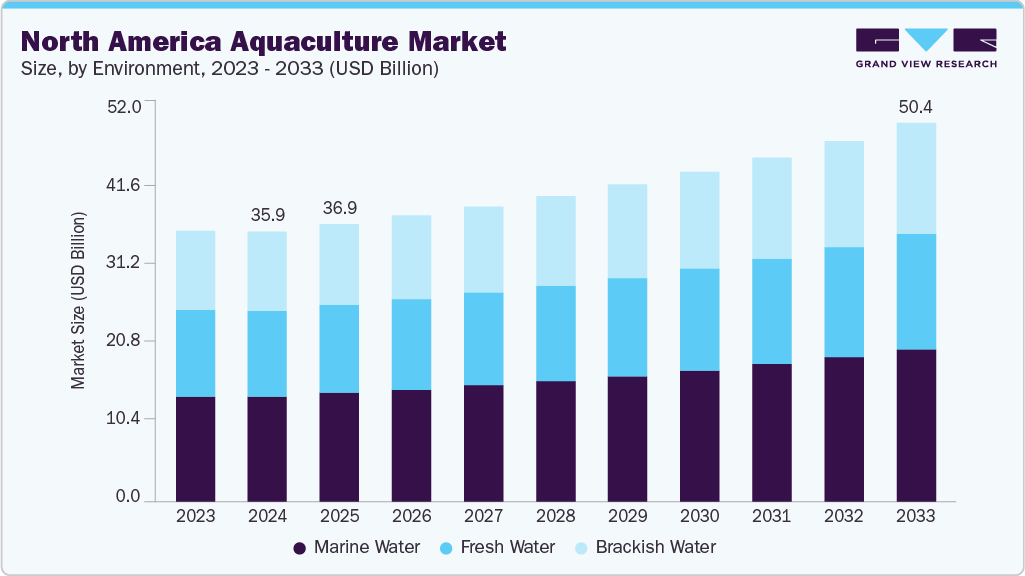
The North America aquaculture market size was estimated at USD 36.95 billion in 2025 and is projected to reach USD 50.46 billion by 2033, growing at a CAGR of 4.1% from 2026 to 2033. The market is primarily driven by the rising demand for sustainable and high-protein seafood, particularly across marine, freshwater, and brackish water environments.
Key Market Trends & Insights
- U.S. dominates the North America region, held the largest revenue share of 85.9% in 2025.
- By environment, the marine water segment dominated the market with a revenue share of around 39.2% in 2025.
- By fish species, the catfish segment accounted for the largest revenue share of 24.4% in 2025.
Market Size & Forecast
- 2025 Market Size: USD 36.95 Billion
- 2033 Projected Market Size: USD 50.46 Billion
- CAGR (2026-2033): 4.1%
- U.S.: Largest market in 2025
- Canada: Fastest growing market
Prism AI by Grand View Research Free to tryAsk a question about the north america aquaculture marketTry asking✓Every figure cited from GVR research Prefer the report? Download free sample →
Increasing consumption of species such as salmon, trout, marine shrimps, tilapia, and catfish is encouraging producers to diversify farming systems and optimize yields across different water types.Technological advancements in recirculating aquaculture systems (RAS), disease management, and feed efficiency are further supporting the production of high-value species such as oysters and seaweed, while also enabling inland freshwater farming. The strong regulatory support and investments in sustainable aquaculture practices are accelerating the adoption of environmentally responsible farming across North America.
 Source: Grand View Research, IR Documents, Primary Interviews, Paid DatabasesTo learn more about this report,
 Download Free Sample Report
The market faces challenges related to environmental concerns, high operational costs, and species-specific vulnerabilities. Marine and brackish water farming often encounter issues such as water pollution, climate variability, and disease outbreaks, particularly affecting shrimp and salmon production. Freshwater aquaculture, while more controlled, requires significant capital investment in infrastructure such as RAS, increasing cost pressures for small and mid-scale producers. The regulatory complexities, licensing delays, and sustainability compliance requirements can hinder expansion, while fluctuations in feed prices and supply chain constraints impact profitability across diverse species segments.
Market Concentration & Characteristics
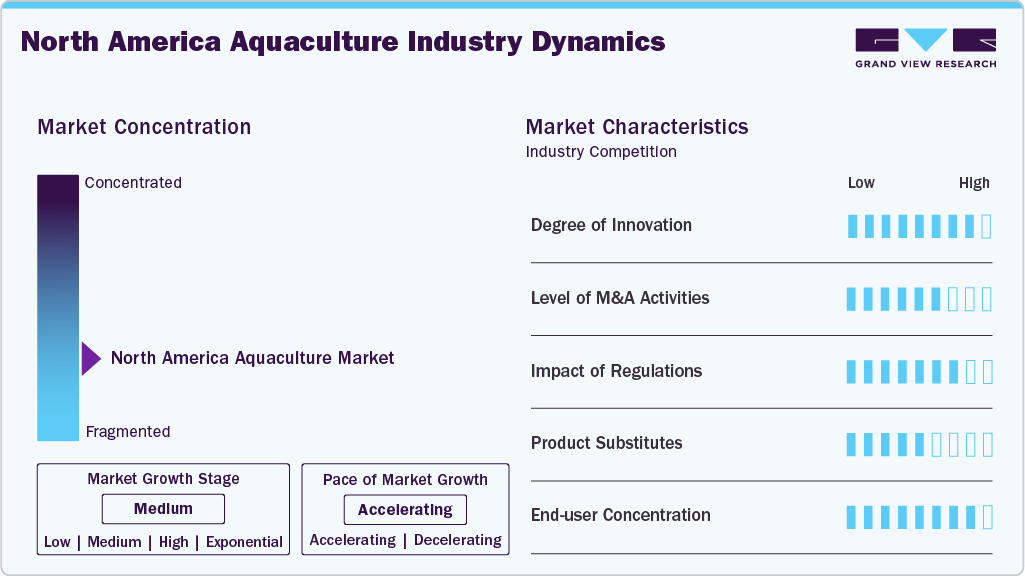
The North America aquaculture market exhibits a moderately concentrated structure, with a mix of large integrated producers and a wide base of small to mid-sized operators. Major companies dominate high-value segments such as salmon, shrimp, and oysters through advanced farming technologies, vertically integrated supply chains, and established distribution networks. The regional and niche players remain active in freshwater species and specialty products, contributing to competitive diversity. Strategic partnerships, acquisitions, and investments in technology are increasingly shaping the competitive landscape, enabling leading firms to expand production capacity and strengthen market positioning.
 To learn more about this report, Download Free Sample Report
The market is characterized by a strong focus on sustainability, technological adoption, and species diversification across marine, freshwater, and brackish environments. Producers are prioritizing efficient resource utilization through innovations such as recirculating aquaculture systems, precision feeding, and disease management solutions. Demand is largely driven by health-conscious consumers seeking reliable, high-protein seafood alternatives, while regulatory frameworks emphasize environmental compliance and traceability. The market demonstrates a shift toward value-added products and premium species, supported by evolving consumer preferences and advancements in aquaculture practices.
Environment Insights
The marine water segment dominated the market with a revenue share of 39.2% in 2025.This dominance is largely supported by the extensive production of high-value species such as salmon, oysters, and marine shrimp, which benefit from established coastal infrastructure and favorable oceanic conditions. In addition, strong export demand and advanced offshore farming technologies continue to reinforce the segment’s leading position.
The brackish water segment is expected to grow at a CAGR of 4.0% during the forecast period.Growth in this segment is being driven by its suitability for farming species such as shrimp and certain shellfish, which thrive in mixed salinity conditions. Increasing adoption of controlled farming systems and improved water management practices are further supporting productivity and scalability in brackish environments.
Fish Species Insights
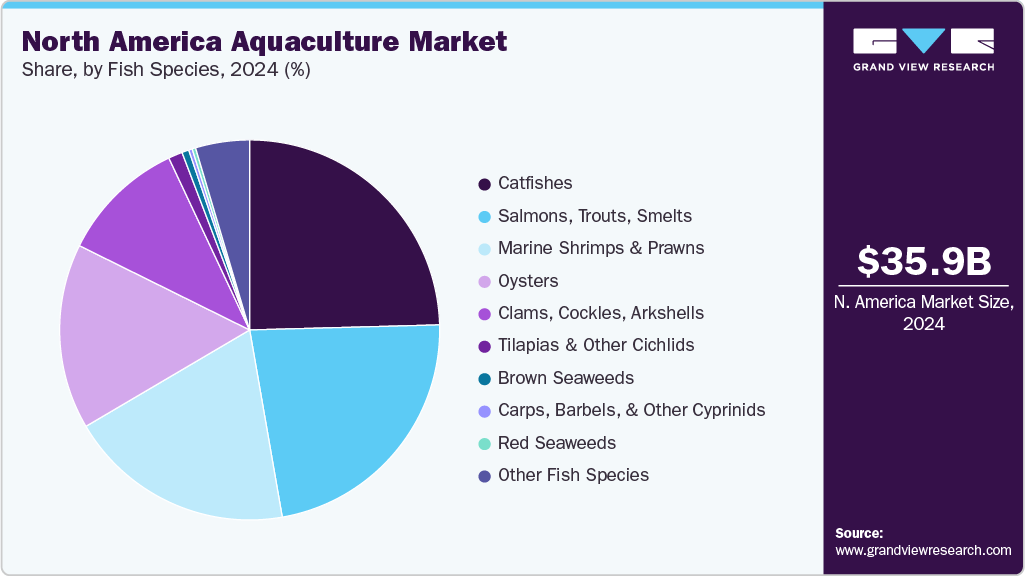
The catfishes segment dominated the market with a revenue share of24.4% in 2025.Its dominance is attributed to strong domestic consumption, particularly in the United States, where catfish is a widely consumed and cost-effective protein source. Efficient farming practices, shorter production cycles, and adaptability to freshwater systems continue to support the segment’s sustained market presence.
 To learn more about this report, Download Free Sample Report
TheBrown seaweeds are expected to grow at the fastest CAGR of 6.7% during the forecast period. This growth is fueled by increasing applications in food, pharmaceuticals, and bio-based products, alongside rising interest in sustainable aquaculture solutions. The segment also benefits from low input requirements and its role in carbon sequestration, making it an attractive option within environmentally focused production systems.
Country Insights
U.S. Aquaculture Market Trends
The U.S. dominates the North America aquaculture market, accounting for a revenue share of 85.9% in 2025. This leadership is driven by advanced aquaculture technologies, efficient supply chains, and strong consumer demand for seafood. Ongoing investments in research, innovation, and sustainable farming practices are enhancing productivity and environmental performance. Supportive regulatory frameworks further strengthen industry growth and compliance. In addition, increasing preference for locally sourced and responsibly produced seafood is boosting demand. Strategic collaborations between public and private sectors continue to reinforce the country’s strong market position and long-term competitiveness.
Canada Aquaculture Market Trends
Aquaculture market in Canada is projected to grow at the fastest CAGR of 5.7% during the forecast period. Growth is supported by rising production of high-value species such as salmon, particularly in coastal regions. Favorable government policies, expanding export opportunities, and strong global demand for premium seafood are key growth drivers. The industry also emphasizes sustainability, adopting environmentally responsible practices and certifications. Technological advancements and improved disease management are enhancing productivity, while continued investments and innovation are positioning Canada as a rapidly expanding player in the North America aquaculture market.
Mexico Aquaculture Market Trends
Aquaculture market in Mexico is steadily expanding, supported by favorable climatic conditions, extensive coastlines, and growing domestic seafood demand. Key species include shrimp, tilapia, and oysters, with shrimp farming dominating production and exports. Government initiatives and investment in modern farming techniques are improving productivity and disease management. Increasing focus on sustainable aquaculture practices and export-oriented production is strengthening Mexico’s position in regional trade. Additionally, rising consumer awareness regarding seafood nutrition and expanding distribution networks are further supporting market growth across both domestic and international markets.
Key North America Aquaculture Company Insights
Some key players operating in the market include Cooke Aquaculture, Cermaq ASA, Blue Ridge Aquaculture, among others.
-
Cooke Aquaculture is one of the largest privately held seafood companies globally, operating a fully vertically integrated business model that spans hatcheries, feed production, marine farming, processing, and distribution. Headquartered in Canada, the company has a strong presence across North America, including the U.S. and Atlantic Canada, with core focus on salmon farming along with diversified species such as seabass and shrimp. Its growth strategy has been heavily acquisition-driven, enabling expansion into multiple geographies and strengthening supply chain control.
-
Cermaq ASA, a subsidiary of Mitsubishi Corporation, is a globally recognized aquaculture company specializing in salmon and trout farming, with significant operations in Canada, Norway, and Chile. The company focuses on sustainable aquaculture practices, including certification standards and innovation-driven farming techniques to improve fish health and productivity. In North America, Cermaq plays a key role through its Canadian operations, particularly around Vancouver Island, supporting regional seafood supply. Its strategic emphasis on sustainability, advanced farming technologies, and global distribution networks strengthens its competitive position in premium salmon markets.
Key North America Aquaculture Companies:
- Cooke Aquaculture
- Cermaq ASA
- Blue Ridge Aquaculture
- Pacific Seafood Group
- Riverence
- Taylor Shellfish Farms
- Atlantic Sapphire
- Mowi USA, LLC
- Cargill, Incorporated
- Alltech
Recent Developments
-
In 2024, MSD Animal Health enhanced its aquaculture portfolio by acquiring Elanco Animal Health aqua business for $1.3 billion, expanding its range of vaccines and health solutions. This move aims to improve efficiency, disease control, and sustainability in global fish and shrimp farming.
-
In 2025, Mitsubishi Corporation expanded its aquaculture footprint through its subsidiary Cermaq Group by acquiring salmon farming operations from Grieg Seafood ASA in Norway and Canada. This move aims to strengthen production capacity and support sustainable seafood supply, addressing growing global demand for low-impact protein sources.
North America Aquaculture Market Report Scope
Report Attribute
Details
Market size value in 2026
USD 38.06 billion
Revenue forecast in 2033
USD 50.46 billion
Growth rate
CAGR of 4.1% from 2026 to 2033
Actual data
2021 - 2025
Forecast period
2026 - 2033
Quantitative units
Volume in kilotons, revenue in USD million/billion, and CAGR from 2026 to 2033
Report coverage
Volume and revenue forecast, company ranking, competitive landscape, growth factors, and trends
Segments covered
Environment, fish species, country
Country scope
U.S.; Canada; Mexico
Key companies profiled
Cooke Aquaculture; Cermaq ASA; Blue Ridge Aquaculture; Pacific Seafood Group; Riverence; Taylor Shellfish Farms; Atlantic Sapphire; Mowi USA, LLC; Cargill Incorporated; Alltech
Customization scope
Free report customization (equivalent to 8 analysts working days) with purchase. Addition or alteration to country, regional & segment scope.
Pricing and purchase options
Avail customized purchase options to meet your exact research needs. Explore purchase options
North America Aquaculture Market Report Segmentation
This report forecasts revenue growth at global, regional, and country levels and provides an analysis of the latest industry trends in each of the sub-segments from 2021 to 2033. For this study, Grand View Research has segmented the North America aquaculture market report based on environment, fish species, and country.
-
Environment Outlook (Volume, Kilotons; Revenue, USD Million, 2021 - 2033)
-
Marine Water
-
Fresh Water
-
Brackish Water
-
-
Fish Species Outlook (Volume, Kilotons; Revenue, USD Million, 2021 - 2033)
-
Carps, Barbels and Other Cyprinids
-
Brown Seaweeds
-
Red Seaweeds
-
Brown Seaweeds
-
Oysters
-
Tilapias and Other Cichlids
-
Catfishes
-
Clams, Cockles, Arkshells
-
Oyster Salmons, Trouts, Smelts
-
Freshwater Fishes Nei
-
Other Fish Species
-
-
Country Outlook (Volume, Kilotons; Revenue, USD Million, 2021 - 2033)
-
North America
-
U.S.
-
Canada
-
Mexico
-
-
Frequently Asked Questions About This Report
The marine water segment accounted for the largest revenue share of 39.2% in 2025.
The North America aquaculture market is characterized by the presence of both established multinational corporations and emerging regional players, contributing to a moderately fragmented competitive landscape. Leading companies such as Cooke Aquaculture, Cermaq ASA, Blue Ridge Aquaculture, Pacific Seafood Group, Riverence, Taylor Shellfish Farms, Atlantic Sapphire, Mowi USA, LLC, Cargill, Incorporated, and Alltech play a critical role in shaping market dynamics through vertical integration, technological innovation, and strategic expansion initiatives
The growth of the North America aquaculture market is driven by a combination of demand-side and supply-side factors. A significant driver is the rising consumer preference for protein-rich and nutrient-dense seafood, particularly species high in omega-3 fatty acids such as salmon and trout. Increasing health consciousness, coupled with a shift toward sustainable and responsibly sourced food products, has accelerated the adoption of aquaculture. The supportive regulatory initiatives and growing investments in sustainable aquaculture practices are strengthening the market’s long-term growth trajectory.
The North America aquaculture market is expected to grow at a compound annual growth rate of 4.1% from 2026 to 2033, reaching USD 50.5 billion by 2033.
The North America aquaculture market size was estimated at USD 36.9 billion in 2025 and is expected to reach USD 38.1 billion in 2026.
About the Author(s)
Animal Feed and Feed Additives Research Team
Specialty & Chemicals · Animal Feed and Feed AdditivesThis report was authored by the animal feed and feed additives research team at Grand View Research - comprising two research analysts, one senior research analyst, and one industry expert - with specialized expertise in the animal feed and feed additives segment of the specialty & chemicals industry. All findings are based on proprietary specialty & chemicals databases, executive interviews, and regulatory analysis, subject to internal peer review prior to publication.
Last Updated:
Speak to Analyst

Customize this report to your needs - add regions, segments, or data points, with 20% free customization.
Or view our licence options:


ISO 9001:2015 & 27001:2022 Certified
We are GDPR and CCPA compliant! Your transaction & personal information is safe and secure. For more details, please read our privacy policy.


