
- Home
- »
- Medical Devices
- »
-
North America Intravenous Solutions Market Size Report 2033GVR Report cover

North America Intravenous Solutions Market (2026 - 2033) Size, Share & Trends Analysis Report By Type (Total Parenteral Nutrition (TPN), Peripheral Parenteral Nutrition (PPN)), By Nutrients (Carbohydrates), By End Use (Hospitals), By Country, And Segment Forecasts
North America Intravenous Solutions Market Summary
The North America intravenous solutions market size was estimated at USD 5.61 billion in 2025 and is projected to reach USD 11.18 billion by 2033, growing at a CAGR of 9.2% from 2026 to 2033. The rising prevalence of chronic diseases, the increasing demand for parenteral nutrition and critical care support, and the presence of advanced healthcare infrastructure, coupled with high surgical volumes across North America.
Key Market Trends & Insights
- The total parenteral nutrition (TPN) segment led the market by type, capturing a 67.0% share in 2025.
- In terms of nutrients, the single-dose amino acid solution segment accounted for the highest revenue share in 2025.
- The home segment emerged as the leading end use category in 2025.
Market Size & Forecast
- 2025 Market Size: USD 5.61 Billion
- 2033 Projected Market Size: USD 11.18 Billion
- CAGR (2026-2033): 9.2%
Prism AI by Grand View Research Free to tryAsk a question about the north america intravenous solutions marketTry asking✓Every figure cited from GVR research Prefer the report? Download free sample →
These factors collectively drive the demand for intravenous solutions across hospitals, intensive care units, and infusion centers. The rising burden of chronic diseases including cancer, chronic kidney disease, and gastrointestinal disorders continues to expand the patient pool requiring long-term intravenous therapy for hydration, drug delivery, and nutritional support. According to the Centers for Disease Control and Prevention published study in 2025, 6 in 10 adults in the U.S. have at least one chronic disease, and 4 in 10 have two or more. This highlights a significant demand for ongoing clinical management. In addition, the American Cancer Society estimates over 2 million new cancer cases annually in the U.S. in 2025, many requiring IV solutions for chemotherapy and supportive care, which drives the need for IV fluid and electrolyte management.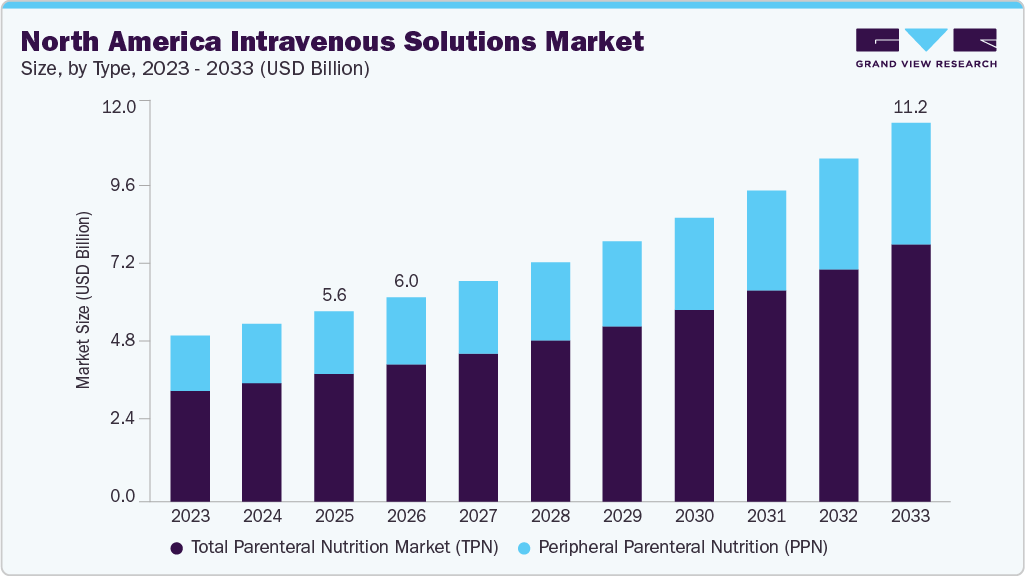 Source: Grand View Research, IR Documents, Primary Interviews, Paid DatabasesTo learn more about this report,
 Download Free Sample Report
Moreover, the increasing demand for parenteral nutrition and critical care support significantly drives the market, especially in intensive care units (ICUs), neonatal care, and post-surgical settings. A growing number of critically ill and malnourished patients require intravenous nutritional support when oral or enteral feeding is not possible. This is particularly true in cases of severe illness, trauma, premature births, and complex surgical recoveries. Therapies such as total parenteral nutrition (TPN) and peripheral parenteral nutrition (PPN) have become essential in patient management, boosting the demand for IV solutions in acute and critical care environments.
In addition, advanced healthcare infrastructure and high surgical volumes in North America contribute significantly to market growth. The region has a well-established network of hospitals, ambulatory surgical centers, and specialized care facilities that routinely use intravenous therapies for many medical procedures. Surgical interventions, from routine to complex, require consistent administration of IV fluids for perioperative stabilization and post-operative recovery. The strong presence of skilled healthcare professionals and broad access to advanced treatment technologies ensure the continued efficient use of IV solutions across clinical settings.
Furthermore, the increasing demand for intravenous fluids is further driven by rising hospital admissions and critical care needs. The growing burden on healthcare systems, especially in acute and emergency care, has intensified the need for a consistent, reliable supply of IV solutions. For instance, in January 2025, Baxter International Inc. increased allocations of two sodium chloride IV solutions to 100% to improve product availability across the U.S. healthcare system. However, the company reported a 1-2-week distribution lag, with some hospitals experiencing delays of 2-3 weeks due to ongoing supply chain constraints. This shows how rising clinical demand is pushing manufacturers to enhance production capacity and streamline distribution networks to ensure uninterrupted supply.
Market Concentration & Characteristics
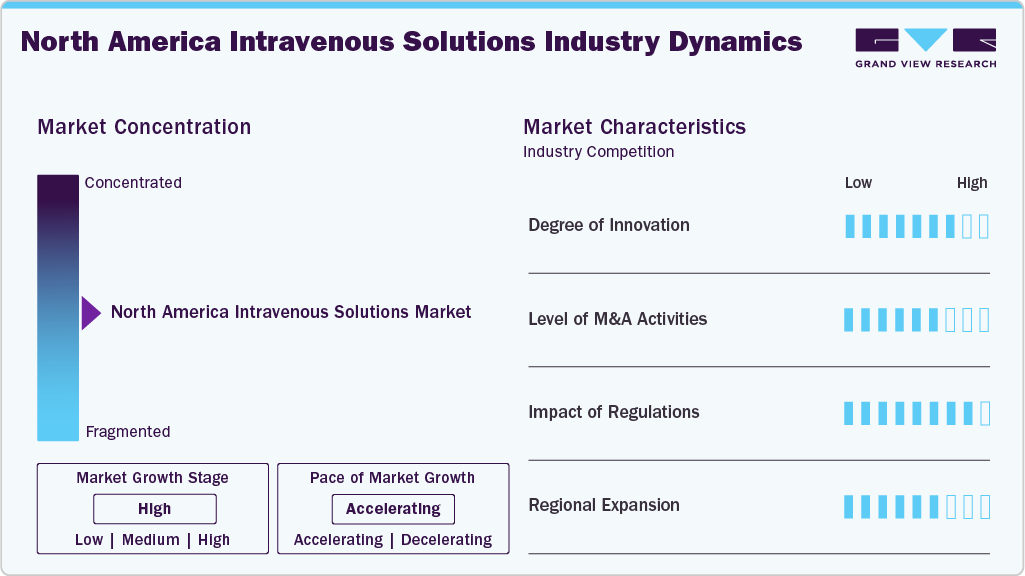
The chart below illustrates the relationship between market concentration, industry characteristics, and industry participants. The x-axis represents the level of industry concentration, ranging from low to high. The y-axis represents various industry characteristics, including industry competition, impact of regulations, level of partnerships & collaborations activities, degree of innovation, and regional expansion. For instance, the intravenous solutions market is slightly fragmented.
Degree of innovation in the North America intravenous solutions market is moderate to high, driven by the need to enhance supply reliability, improve delivery efficiency, and ensure patient safety across clinical settings. Companies are focusing on ready-to-use formulations, advanced packaging technologies, and portfolio expansion to support evolving hospital requirements. For instance, in May 2024, B. Braun Medical Inc. launched Levetiracetam in Sodium Chloride Injection, expanding its IV portfolio in the anticonvulsant segment. The product is available in multiple concentrations and packaged in flexible PAB IV containers, supporting improved supply reliability, storage efficiency, and ease of use in clinical settings.
 To learn more about this report, Download Free Sample Report
The level of partnerships and collaborations in the intravenous solutions market is moderate to high, reflecting a growing focus on strengthening supply chain resilience, expanding manufacturing capacity, and improving product availability across healthcare systems. Companies are increasingly engaging in strategic alliances to enhance production efficiency, ensure consistent supply of IV solutions, and support innovation in infusion therapies and sterile manufacturing processes. For instance, in May 2025, ICU Medical, Inc. and Otsuka Pharmaceutical Factory, Inc. formed a joint venture, Otsuka ICU Medical LLC, to strengthen IV solutions manufacturing and supply chain resiliency in North America. The partnership combines ICU Medical’s U.S.-based production capabilities with Otsuka’s manufacturing network, creating a large-scale IV solutions production system. This collaboration aims to improve supply reliability, expand access to critical IV products, and introduce advanced infusion technologies.
"We are pleased to have successfully completed the formation of this joint venture with ICU Medical. Together, we look forward to bringing innovative IV solutions technologies to the North American market."
- Shuichi Takagi, President and Representative Director of OPF.
Regulatory influence in the intravenous solutions market is high, driven by stringent requirements governing product quality, safety standards, and clinical usage across healthcare settings. Compliance with evolving guidelines from regulatory authorities significantly impacts manufacturing processes, approval timelines, and operational costs. In addition, variations in regulatory frameworks and healthcare policies across regions can pose challenges for large-scale market players, affecting consistency in product distribution and overall scalability.
Regional expansion in the North America intravenous solutions market is moderate, supported by the strong presence of established healthcare infrastructure and mature hospital networks. Companies are increasing their footprint through capacity expansions, distribution network strengthening, and strategic collaborations with healthcare providers. Growth is due to the improved access in underserved and rural areas through decentralized healthcare and improved supply chain reach.
Type Insights
The Total Parenteral Nutrition Market (TPN) segment accounted for the largest market share of over 67.0% in 2025 and is expected to grow at the fastest CAGR of 9.4% from 2026 to 2033. This growth is driven by the increasing prevalence of chronic diseases, rising incidence of gastrointestinal disorders, cancer-related malnutrition, and a growing number of critically ill patients who are unable to meet their nutritional requirements through oral or enteral feeding.
The manufacturers are focusing on expanding and enhancing their parenteral nutrition portfolios in the market. For instance, in July 2025, Fresenius Kabi AG expanded its U.S. intravenous nutrition portfolio by introducing manganese chloride injection as an additive for TPN, supporting adult patients requiring long-term IV nutritional support. This is indicated for use as a supplement in parenteral nutrition formulations, addressing trace element deficiencies in critically ill patients dependent on IV feeding.
The peripheral parenteral nutrition (PPN) segment is expected to grow significantly from 2026 to 2033. This growth is driven by its use for short-term or supplemental nutritional support. Unlike TPN, it is administered through peripheral veins and provides lower nutrient concentrations, making it suitable for patients with partial gastrointestinal function. PPN is commonly used in general wards, outpatient care, and short hospital stays. Its lower complexity and reduced risk compared to central venous administration make it preferred in less critical cases. The rising number of surgical procedures and short-term hospital admissions supports its demand. Growing awareness of early nutritional intervention in patient recovery is also boosting adoption. PPN benefits from cost-effectiveness and ease of administration, making it suitable for broader healthcare settings.
Nutrients Insights
The single-dose amino acid solution segment dominated the North America intravenous solutions market, accounting for the largest share in 2025. This growth is driven by its significant role in parenteral nutrition, particularly in TPN therapy. It supports protein synthesis and recovery in critically ill, malnourished, and post-surgical patients. Widely used in hospitals and ICUs, the demand is due the rising prevalence of chronic diseases and gastrointestinal disorders. In addition, ready-to-use formulations improve efficiency and reduce preparation errors, supporting its continued dominance.
The vitamins and minerals segment (salt and electrolyte) is expected to grow at the fastest CAGR over the forecast period. This growth is driven by increasing recognition of micronutrient deficiencies among hospitalized and critically ill patients. These components are essential for maintaining metabolic balance and supporting recovery, particularly in ICU and post-surgical settings. Growing adoption of TPN and PPN is accelerating demand for comprehensive micronutrient formulations.
End Use Insights
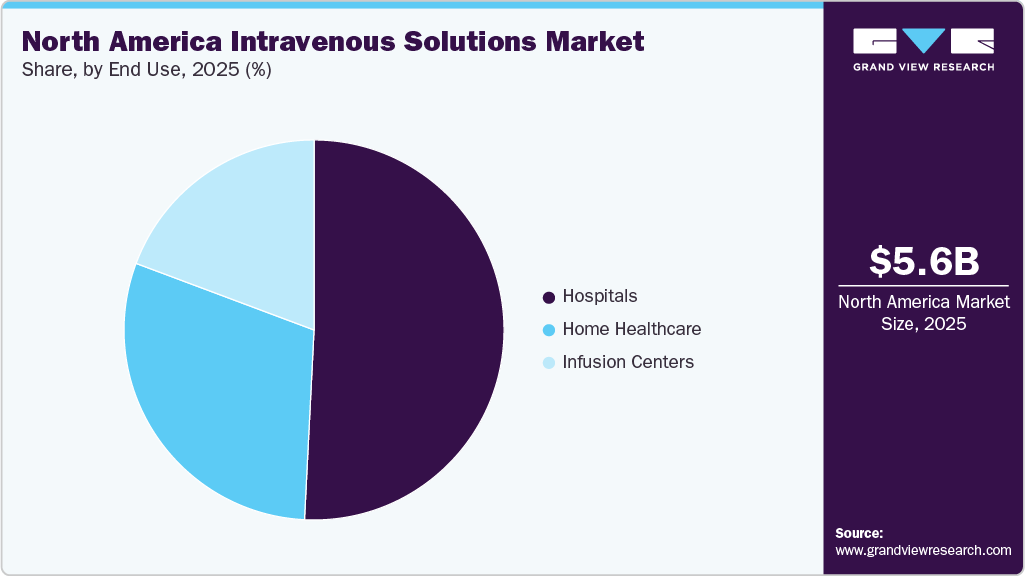
Hospitals held the dominant market share in 2025. The segment growth can be attributed to the high volume of inpatient admissions, increasing number of surgical procedures, and rising prevalence of chronic and critical illnesses requiring continuous intravenous therapy. In addition, the presence of advanced healthcare infrastructure, availability of skilled professionals, and widespread use of IV solutions in emergency, ICU, and post-operative care further support the dominance of this segment.
 To learn more about this report, Download Free Sample Report
The home healthcare segment in the North America intravenous solutions market is expected to witness the fastest growth over the forecast period, driven by the increasing preference for home-based care, rising aging population, and the need to reduce hospital stays and healthcare costs. In addition, the growing adoption of portable infusion systems, expansion of home infusion therapy services, and improved reimbursement support are further accelerating the use of IV solutions in home settings.
Country Insights
U.S. Intravenous Solutions Market Trends
The intravenous solutions market in the U.S. is growing rapidly, driven by the rising prevalence of chronic diseases, including cancer, kidney disorders, and gastrointestinal conditions requiring long-term IV therapy. The increasing number of hospital admissions and surgical procedures is further boosting demand for IV fluids in perioperative and critical care settings. Moreover, ongoing supply chain improvements and product innovations by key players are enhancing availability and efficiency across healthcare facilities.
Canada Intravenous Solutions Market Trends
Canada is expected to grow at a significant rate over the forecast period, driven by the rising number of hospital admissions and surgical procedures. In addition, the expanding use of parenteral nutrition in critical care and home healthcare, and government-supported healthcare systems and improved access to medical services are also driving the adoption of IV therapies.
Key North America Intravenous Solutions Company Insights
Key players in the intravenous solutions market are adopting innovative strategies, including the introduction of personalized infusion formulations, mobile and in-clinic services, and digital booking platforms to enhance accessibility and patient experience. The integration of smart infusion technologies, along with partnerships with wellness centers, fitness facilities, and premium service providers, is further supporting adoption and expanding market reach.
Key North America Intravenous Solutions Companies:
- Baxter
- Fresenius Kabi AG
- B. Braun Medical Inc.
- ICU Medical, Inc.
- Pfizer Inc.
- Otsuka Pharmaceutical Co., Ltd.
- Grifols, S.A.
- JW Life Science
- CSLVifor (formerly Vifor Pharma)
- BD (Becton, Dickinson and Company)
- Terumo Corporation
- Amphastar Pharmaceuticals, Inc.
Recent Developments
-
In December 2025, B. Braun Medical Inc. launched a Supply Assurance Program in the U.S., guaranteeing 45 days of inventory on hand at distributor locations and covering its full product portfolio, including IV solutions and related products.
-
In April 2024, Baxter announced the further expansion of its pharmaceutical’s portfolio with the launch of five injectable products in the U.S., including IV solutions.
“Our Pharmaceuticals teams are relentlessly focused on bringing differentiated products to market that support our customers in helping to address vital patient needs, we look forward to further accelerating our impact with a robust innovation pipeline across our key therapeutic areas, including critical care, anti-infectives, pain and oncology.”
- Alok Sonig, executive vice president and group president, Pharmaceuticals, at Baxter
-
In October 2023, Novartis AG received U.S. FDA approval for an intravenous (IV) formulation of Cosentyx (secukinumab) for treating psoriatic arthritis, ankylosing spondylitis, and related conditions. The approval marks the first new IV treatment option in six years for these diseases, offering healthcare providers greater flexibility with both IV and subcutaneous administration options.
North America Intravenous Solutions Market Report Scope
Report Attribute
Details
Market size value in 2026
USD 6.03 billion
Revenue forecast in 2033
USD 11.18 billion
Growth rate
CAGR of 9.2% from 2026 to 2033
Actual data
2021 - 2025
Forecast period
2026 - 2033
Quantitative units
Market Value in USD million/billion, and CAGR from 2026 to 2033
Report coverage
Revenue forecast, company ranking, competitive landscape, growth factors, and trends
Segments covered
Type, nutrients, end use, and region
Regional scope
North America
Country scope
U.S.; Canada; Mexico
Key companies profiled
Baxter; B. Braun SE; Otsuka Pharmaceutical Co. Ltd.; Grifols, S.A.; Fresenius Kabi AG; ICU Medical, Inc.; Pfizer Inc.; JW Life Science; CSLVifor (formerly Vifor Pharma); BD (Becton, Dickinson and Company), Terumo Corporation; Amphastar Pharmaceuticals, Inc.
Customization scope
Free report customization (equivalent up to 8 analysts working days) with purchase. Addition or alteration to country, regional & segment scope.
Pricing and purchase options
Avail customized purchase options to meet your exact research needs. Explore purchase options
North America Intravenous Solutions Market Report Segmentation
This report forecasts revenue growth at global, regional, and country levels and provides an analysis of the latest industry trends in each of the sub-segments from 2021 to 2033. For this study, Grand View Research has segmented the North America intravenous solutions market report based on type, nutrients, end use and regions:
-
Type Outlook (Revenue, USD Million, 2021 - 2033)
-
Total Parenteral Nutrition Market (TPN)
-
Peripheral Parenteral Nutrition (PPN)
-
-
Nutrients Outlook (Revenue, USD Million, 2021 - 2033)
-
Carbohydrates
-
Single dose amino acid solution
-
Vitamins & Minerals (Salt and electrolyte)
-
Parenteral lipid emulsion
-
Others
-
-
End Use Outlook (Revenue, USD Million, 2021 - 2033)
-
Hospitals
-
Infusion Centers
-
Home Healthcare
-
-
Country Outlook (Revenue, USD Million, 2021 - 2033)
-
U.S.
-
Canada
-
Mexico
-
Frequently Asked Questions About This Report
The North America intravenous solutions market size was estimated at USD 5.61 billion in 2025 and is expected to reach USD 6.0 billion in 2026.
The North America intravenous solutions market is expected to grow at a compound annual growth rate of 9.2% from 2026 to 2033 to reach USD 11.18 billion by 2033
Parenteral nutrition market (TPN) dominated the North America intravenous solutions market with a share of 67.0% in 2025. This is attributable to increasing prevalence of chronic diseases, rising incidence of gastrointestinal disorders, and cancer-related malnutrition.
Some key players operating in the North America intravenous solutions market include Baxter, B. Braun SE, Otsuka Pharmaceutical Co., Ltd., Grifols, S.A., Fresenius Kabi AG, ICU Medical, Inc., Pfizer Inc., JW Life Science, CSLVifor (formerly Vifor Pharma), BD (Becton, Dickinson and Company), Terumo Corporation.
Key factors that are driving the market growth include increasing demand for parenteral nutrition and critical care support, advanced healthcare infrastructure & high surgical volume, rising prevalence of chronic diseases.
About the Author(s)
Medical Devices Research Team
Healthcare · Medical DevicesThis report was authored by the medical devices research team at Grand View Research - comprising two research analysts, one senior research analyst, and one industry expert - with specialized expertise in the medical devices segment of the healthcare industry. All findings are based on proprietary healthcare databases, executive interviews, and regulatory analysis, subject to internal peer review prior to publication.
Last Updated:
Speak to Analyst

Customize this report to your needs - add regions, segments, or data points, with 20% free customization.
Or view our licence options:


ISO 9001:2015 & 27001:2022 Certified
We are GDPR and CCPA compliant! Your transaction & personal information is safe and secure. For more details, please read our privacy policy.


