
- Home
- »
- Medical Devices
- »
-
North America Medical Equipment Rental & Service Market Report 2033GVR Report cover

North America Medical Equipment Rental & Service Market (2026 - 2033)
Size, Share & Trends Analysis Report By Type (Product, Services), By End Use (Personal/Home Care, Hospitals, Other Healthcare Facilities), By Country (U.S., Canada), and Segment Forecasts
Market Size, 2025
$15.8BMarket Estimate, 2026
$16.8BMarket Forecast, 2033
$23.9BCAGR, 2026–2033
5.2%North America Medical Equipment Rental & Service Market Summary
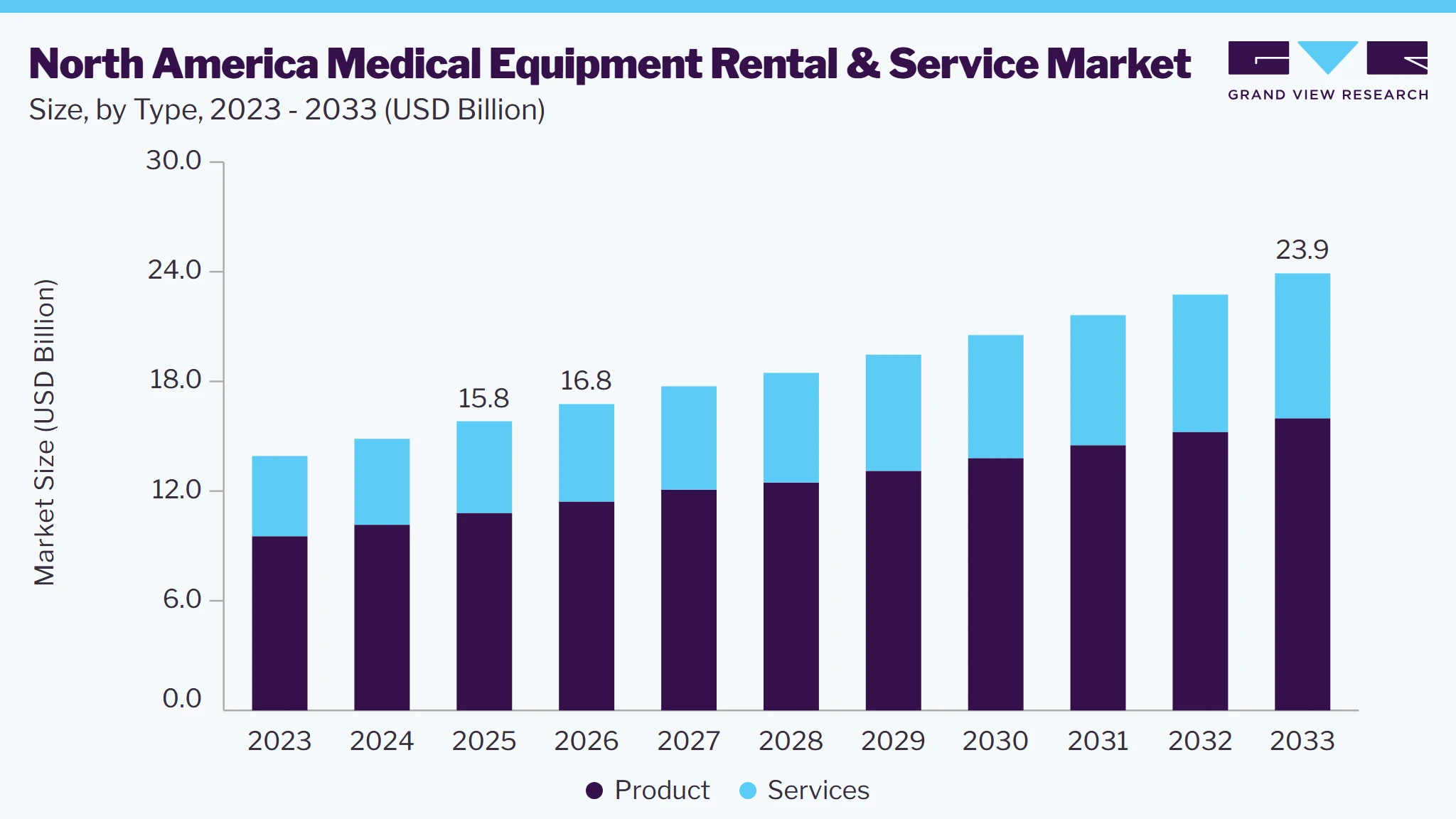
The North America medical equipment rental & service market size was valued at USD 15.8 billion in 2025 and is projected to grow from USD 16.8 billion in 2026 to USD 23.9 billion by 2033, at a CAGR of 5.2% from 2026 to 2033. Demand is supported by the growing population of older adults, the shift of care from hospitals to the home, the preference of hospitals and clinics to rent equipment rather than buy it, and the rising use of service contracts that cover maintenance, repair, and calibration. Providers want to keep their capital spending low, make sure equipment is always available and safe, and hand over the work of cleaning, tracking, and maintaining devices to specialist partners.
Key Market Trends & Insights
- By type: Product segment led the market with a revenue share of 68.3% in 2025.
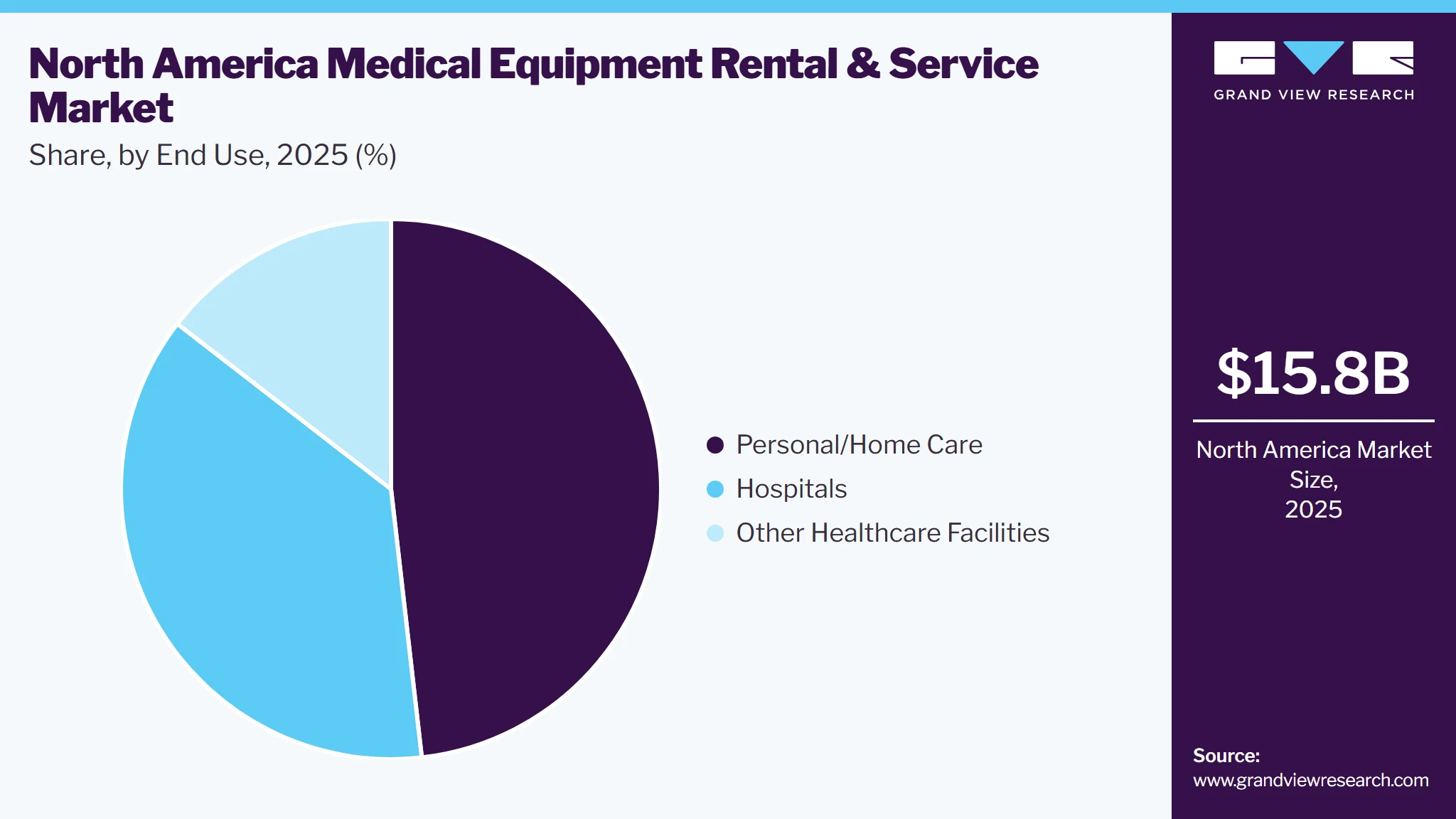
- By end use: Personal/home care segment led the market with the largest revenue share of 48.2% in 2025.
Market Size & Forecast
- Market size in 2025: USD 15.8 Billion
- Estimated market size in 2026: USD 16.8 Billion
- Projected market size by 2033: USD 23.9 Billion
- CAGR (2026-2033): 5.2%
Three ways to get this report
Buy it, customize it, or ask a question.Ask an Analyst
Analyst response in 1 business day
- AccessReport author, directly
- Reply timeWithin 1 working day
- No sales callDirect answer only
- FormatEmail reply
- CostFree, no cost
Get the Full Report
What the study covers
- FormatsPDF · Excel · Dashboard
- Timeline2026–2033 annual, 2025 base
- Coverage20+ countries, 5 regions
- Companies10+ key players profiled
Customize the Report
20% free customization
- IncludeCountries, segments, points
- TailorTo your product definition
- ExtendDeeper competitor detail
- OrA fully bespoke study
- Turnaround5–10 working days
Healthcare providers across North America are seeking flexible alternatives to outright medical equipment purchases to manage capital expenditure and adapt to changing equipment requirements. Rental models allow hospitals, ambulatory surgical centers, long-term care facilities, and other providers to access medical equipment without making substantial upfront investments. This flexibility is particularly valuable for facilities requiring equipment for temporary capacity expansion, maintenance replacement, or fluctuating patient volumes. As healthcare organizations focus on cost management and asset utilization, the preference for flexible equipment acquisition models is supporting demand for medical equipment rental services.
 Source: Grand View Research, IR Documents, Primary Interviews, Paid DatabasesTo learn more about this report,
 Download Free Sample Report
For instance, in May 2026, the U.S. Department of Veterans Affairs awarded a contract to Agiliti Health, Inc., effective June 2026, that provides both purchase and rental options for a broad range of medical equipment, including oxygen concentrators, vital-sign monitors, feeding pumps, acute-care beds, therapeutic mattresses, patient lifts, and stretchers. The contract specifies a 24-hour standard delivery period for rental equipment, compared with 15 days for purchased equipment, demonstrating the use of rental as a flexible, rapid model for acquiring equipment. The contract also includes equipment maintenance and repair services, directly supporting demand across both the rental and service segments. The table below presents the contracted SINs (Special Item Numbers) and their corresponding descriptions for medical equipment and related services.
Contracted SIN's and Descriptions
SIN
Description
A-200
Equipment Maintenance and Repair
A-47
Oxygen Concentrators
A-49
Oxygen Respirators/Resuscitators
A-50A
Vital Signs Monitors
A-50F
Oximeter Monitors
A-64
IV Pumps
A-65
Pumps, Patient Feeding, External
A-69
Acute Care Beds
A-74
Flotation Pads/Mattresses for Therapy
A-77
Patient Transportation Units (Stretchers)
Source: U.S. Department of Veterans Affairs
Increasing patient surges, emergency events, natural disasters, infectious disease outbreaks, and healthcare facility renovations are creating demand for temporary medical equipment across North America. Rental solutions allow healthcare providers to quickly increase capacity by accessing equipment such as patient monitors, respiratory equipment, infusion pumps, beds, and stretchers without purchasing additional units. The ability to rapidly deploy and redeploy equipment also supports continuity of care and operational flexibility. The growing requirements for short-term and emergency capacity are driving demand for medical equipment rental and associated maintenance and support services.
According to the U.S. Consumer Product Safety Commission (CPSC), fireworks caused 15 reported deaths and an estimated 13,000 emergency department-treated injuries in the U.S. in 2025, including approximately 1,300 sparkler-related injuries. Burns accounted for 38% of emergency room visits, with hands and fingers among the most frequently injured areas. The resulting seasonal surge in trauma and emergency-care demand increases the need for temporary medical capacity, supporting demand for rented medical equipment and related maintenance services across North America.
Market Dynamics
The North America medical equipment rental & service market is shaped by population aging, the shift of care to the home, and the need for hospitals and clinics to control capital spending while keeping equipment safe and available. Rental fleets include respiratory devices, hospital beds and support surfaces, infusion and therapy equipment, and monitoring and critical care equipment. The service side of the market, which covers parts, labor, preventive maintenance, calibration, repair, and service contracts, is growing faster than the product side, as providers prefer to outsource upkeep and compliance work to specialist partners. Government payment rules for home medical equipment, along with provincial funding programs in Canada, strongly influence how and where equipment is rented.
The market is affected by the growing need for care outside hospitals. Patients with chronic lung disease, mobility problems, or long recoveries receive oxygen therapy, beds, and support surfaces at home, which are typically rented and serviced by suppliers. In Canada, public programs help with these costs. For example, the Ontario Assistive Devices Program pays for oxygen and oxygen delivery equipment, covering 100% of the cost for adults aged 65 and older, people on social assistance, and residents of long-term care homes, and 75% for all others, and also helps pay for delivery, set-up, and maintenance.
Payment pressure on home medical equipment suppliers is restraining the market. In the U.S., the Centers for Medicare & Medicaid Services (CMS) published the final rule for calendar year 2026 home health and DMEPOS competitive bidding in the Federal Register on December 2, 2025, thereby restarting the competitive bidding program. The rule became effective on January 1, 2026, although the next round of contracts will not start until January 1, 2028. The rule also adds ostomy, tracheostomy, and urological supplies to the items that may be bid. Industry groups such as the American Association for Homecare have warned that the program could increase pressure on home medical equipment providers, as earlier rounds resulted in sharply lower payments and the closure of some suppliers.
The growth of service contracts and digital fleet management presents an opportunity for the medical equipment rental and service market by creating demand for ongoing maintenance, repair, calibration, and equipment performance monitoring. Healthcare facilities require reliable access to rental equipment while minimizing downtime and unexpected maintenance expenses. Service contracts provide scheduled preventive maintenance, technical support, and repair coverage, generating recurring revenue for rental and service providers. Thus, digital fleet management systems help providers track equipment location, utilization, maintenance schedules, and service history, supporting faster equipment allocation and better fleet utilization.
Keeping a large rental fleet safe, clean, and available is a major challenge for the medical equipment rental and service market because equipment requires regular inspection, disinfection, preventive maintenance, and performance testing before being assigned to another healthcare facility. Frequent transportation and repeated use increase the need for repairs and component replacement, while equipment awaiting servicing remains unavailable for rental. Providers also need trained technicians, adequate spare parts, and efficient logistics to manage equipment across multiple locations.
Market Concentration & Characteristics
The North America medical equipment rental & service market covers a wide range of devices and services. On the product side, it includes respiratory equipment, bed frames and therapeutic support surfaces, infusion and therapy equipment, patient monitoring and diagnostic equipment, critical care and emergency equipment, surgical and sterile processing equipment, patient transport equipment, and healthcare furnishings. On the service side, it includes parts, labor, preventive maintenance, calibration, repair services, service contracts, and other services. Customers choose suppliers mainly based on equipment availability, delivery speed, product quality, clinical support, maintenance capability, and price.
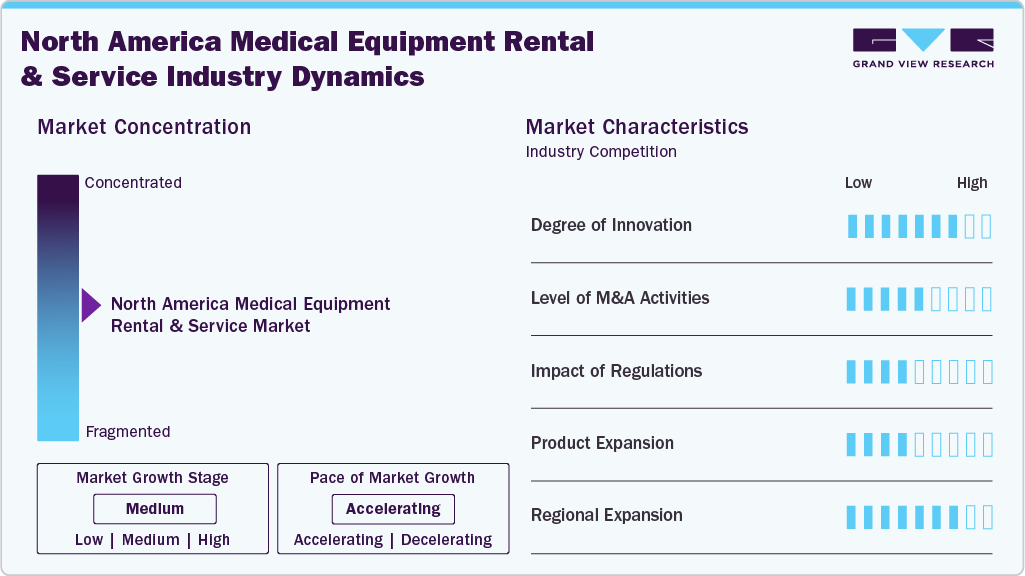
The market has a moderate degree of innovation. Rental companies are adding products that improve patient safety and comfort, such as alternating-pressure support surfaces, smart hospital beds, and connected monitoring devices, as well as digital tools for tracking and fleet maintenance. Innovation is also seen in smaller, lighter, and more portable respiratory devices that support care at home.
 To learn more about this report, Download Free Sample Report
-
In April 2026, Agiliti introduced Capillaire, a low-profile alternating pressure overlay that uses air-filled nodes that inflate and deflate in a continuous cycle to relieve pressure on the skin. It is designed for surgeries lasting more than two hours and can be used with operating-room tables and stretchers.
The level of mergers and acquisitions in the North America medical equipment rental and service market reflects providers’ efforts to expand geographic coverage, strengthen equipment portfolios, and broaden technical service capabilities. Acquisitions provide an avenue for companies to enter new regional markets, establish relationships with additional healthcare facilities, and expand their rental fleets without relying solely on organic expansion. Companies also pursue acquisitions to strengthen equipment maintenance, repair, and lifecycle management services, supporting integrated rental and service offerings. The level of M&A activity is influenced by the availability of suitable acquisition targets, integration costs, fleet maintenance requirements, and the ability to retain existing customer relationships.
Regulatory requirements influence the safety, maintenance, servicing, and operational use of medical equipment within the North America medical equipment rental and service market. In the U.S., equipment supplied through rental services remains subject to applicable U.S. Food and Drug Administration (FDA) requirements based on product classification and intended use. Rental providers must also address applicable electrical safety standards, equipment inspection, preventive maintenance, calibration, and performance verification requirements. In Canada, Health Canada requirements govern medical device licensing and regulatory compliance, while rental and service providers must follow applicable safety and maintenance practices.
End-use concentration in the North America medical equipment rental and service market is distributed across hospitals, personal and home care settings, and other healthcare facilities, including clinics and long-term care facilities. Hospitals require a broad range of rental equipment, including patient monitoring systems, infusion pumps, respiratory equipment, hospital beds, therapeutic support surfaces, and critical care devices to support patient treatment and manage temporary equipment requirements. Personal and home care settings require rental equipment such as oxygen concentrators, hospital beds, mobility support equipment, and respiratory devices for patients receiving care outside hospitals.
Analyst Perspective
The North America medical equipment rental and service market is competitive, with providers differentiated by rental equipment availability, portfolio breadth, geographic coverage, maintenance capabilities, service response times, and customer support. Established companies such as Agiliti, Arjo, Med One Group, US Med-Equip, and AdaptHealth serve different equipment and care requirements through rental services, equipment management, or home medical equipment offerings. Companies also compete through preventive maintenance, equipment repair, calibration, service contracts, and digital fleet management to maintain equipment readiness and reduce downtime. Specialized and regional providers, including Peak Medical Resources, Avante Rental Services, and Westside Medical Supply, focus on specific equipment categories, local delivery networks, or tailored customer requirements.
Type Insights
By type, the product segment led the market with the largest revenue share of 68.3% in 2025. Its dominance is supported by demand for rental medical equipment across hospitals, home care settings, and other healthcare facilities. Equipment such as patient monitors, infusion pumps, respiratory devices, hospital beds, and therapeutic support surfaces addresses temporary patient needs, fluctuating admission volumes, and equipment shortages. Rental arrangements also provide healthcare facilities with access to specialized equipment without requiring direct purchase, while maintenance and servicing support equipment readiness. The broad range of equipment required across different care settings contributes to the product segment’s leading revenue share.
The service segment is expected to be the fastest-growing segment in the North America medical equipment rental and service market, driven by increasing demand for preventive maintenance, equipment repair, calibration, and technical support. Healthcare facilities depend on regular servicing to maintain equipment safety, reliability, and operational readiness throughout rental periods. The growing use of service contracts also supports demand for scheduled maintenance and ongoing technical assistance, while digital fleet management helps providers monitor equipment condition, track service requirements, and reduce downtime.
End Use Insights
Based on end use, the personal/home care segment led the market with the largest revenue share of 48.2% in 2025. The growing need for medical equipment for patients receiving treatment and recovery support at home. Rental equipment such as oxygen concentrators, respiratory devices, hospital beds, therapeutic support surfaces, infusion pumps, and patient mobility equipment supports care for individuals with chronic conditions, post-surgical recovery needs, and limited mobility. Home-based care also creates demand for temporary access to equipment, particularly when patients require specialized devices for a defined treatment or recovery period.
 To learn more about this report, Download Free Sample Report
The hospitals segment is expected to grow significantly in the North America medical equipment rental and service market, driven by the need to manage fluctuating patient volumes, expand treatment capacity, and maintain access to specialized medical equipment. Hospitals require rental equipment such as patient monitors, infusion pumps, respiratory devices, hospital beds, and therapeutic support surfaces to support critical care, surgical procedures, emergency services, and patient recovery. Rental arrangements provide flexibility when hospitals face temporary equipment shortages, seasonal demand changes, or equipment downtime during maintenance and replacement.
Country Insights
U.S. North America Medical Equipment Rental & Service Market Trends
The U.S. medical equipment rental & service market is supported by the growing demand from hospitals, ambulatory surgical centers, long-term care facilities, and home healthcare providers for flexible access to medical equipment. Rising investment in healthcare infrastructure, an aging population, the increasing prevalence of chronic diseases, and the need to manage capital expenditures are encouraging providers to adopt rental and outsourced equipment management models. Demand spans patient monitoring and diagnostic equipment, respiratory devices, infusion systems, critical care equipment, patient transport equipment, surgical equipment, and therapeutic support surfaces. The expanding installed base of medical equipment is increasing demand for preventive maintenance, calibration, repairs, refurbishment, and lifecycle management services.
The large and diverse U.S. hospital network creates sustained demand for medical equipment rental and service solutions, as hospitals require equipment to support high patient volumes, specialized procedures, and fluctuating capacity needs. With 6,100 hospitals, 907,216 staffed beds, and more than 35.6 million annual admissions, the scale of the U.S. hospital system provides a substantial customer base for equipment rental, maintenance, repair, and lifecycle management services.
U.S. Hospitals Statistics 2026
Metric
Number
Total Number of All U.S. Hospitals
6,100
Number of U.S. Community Hospitals
5,121
Nongovernment Not-for-Profit Community Hospitals
2,984
Investor-Owned (For-Profit) Community Hospitals
1,224
State and Local Government Community Hospitals
913
Federal Government Hospitals
210
Nonfederal Psychiatric Hospitals
656
Other Hospitals
113
Total Staffed Beds in All U.S. Hospitals
907,216
Staffed Beds in Community Hospitals
775,297
Total Admissions in All U.S. Hospitals
35,658,583
Admissions in Community Hospitals
33,553,725
Number of Rural Community Hospitals
1,797
Number of Urban Community Hospitals
3,324
Number of Community Hospitals in a System
3,567
Source: American Hospital Association
Canada North America Medical Equipment Rental & Service Market Trends
The Canada medical equipment rental & service market is supported by an aging population, increasing chronic disease burden, and the expansion of home and community-based care. Healthcare providers use rental models to access high-cost, specialized equipment while reducing upfront capital expenditures and managing maintenance requirements. Growing demand for home healthcare is also increasing the need for equipment such as oxygen concentrators, hospital beds, patient monitors, and respiratory equipment. In addition, healthcare facilities are relying on outsourced maintenance and repair services to address equipment complexity and workforce constraints.
Canada’s aging population is increasing the demand for medical equipment used for chronic disease management, long-term care, and home-based care. As the number of older adults requiring ongoing healthcare services grows, healthcare facilities and home-care providers need equipment such as hospital beds, patient monitors, oxygen concentrators, and therapeutic support surfaces. Rental models allow providers and patients to access these devices without significant upfront investments, while service providers support maintenance and replacement. As a result, population aging is driving demand for medical equipment rental and service solutions across Canada.
According to Government of Canada,
-
One in five Canadians (19.5%) was aged 65 and older as of July 1, 2025, highlighting the continued aging of Canada’s population.
-
The proportion of people aged 65+ exceeded 25% in Newfoundland and Labrador, reaching 25.2%, marking the first time a Canadian province or territory surpassed the one-in-four threshold.
Key North America Medical Equipment Rental & Service Company Insights
Companies in the North America medical equipment rental and service market are expanding their rental portfolios and service capabilities to meet the equipment requirements of hospitals, home-care patients, and other healthcare facilities. Providers offer rental equipment across critical care, patient monitoring, infusion therapy, respiratory care, patient transport, hospital beds, and therapeutic support surfaces. Companies are also strengthening preventive maintenance, equipment repair, calibration, and technical support services to maintain equipment availability and operational readiness. Digital fleet management, equipment tracking, and service contract offerings support equipment utilization, maintenance planning, and faster turnaround between rental cycles.
Key North America Medical Equipment Rental & Service Companies
-
Arjo
-
Westside Medical Supply
-
Peak Medical Resources
-
Med One Group
-
InfuSystem Holdings
-
Probo Medical
-
Inogen, Inc.
-
Avante Rental Services
-
US Med-Equip (USME)
-
Hillrom Services Inc. (Baxter)
-
GE HealthCare
-
Nunn's Home Medical Equipment
-
Lincare
-
AdaptHealth
-
Rotech Healthcare
-
Stryker
-
MasVida Health Care Solutions
-
National Seating & Mobility
-
Agiliti Health, Inc.
Competitive Benchmarking
Category
Operating Strategies
Competitive Edge
Weakness
Established Players (Arjo, Med One Group, InfuSystem Holdings, Inogen, Inc., US Med-Equip (USME), Hillrom Services Inc. (Baxter), GE HealthCare, Agiliti Health, Inc.)
- Established companies offer broad rental and service portfolios that cover beds and support surfaces, respiratory equipment, infusion devices, and monitoring equipment for hospitals and home care.
- Companies grow through national branch networks, long-term contracts with health systems and payers, acquisitions, and investments in digital fleet management tools.
- Established players benefit from national coverage, large equipment fleets, strong relationships with hospitals and payers, and in-house maintenance and clinical teams.
- Broad portfolios enable them to offer rental, service, and equipment management under a single contract, supporting standardized purchasing for large health systems.
- Large organizations can be slower to adapt to local needs and may face higher overhead costs.
- Exposure to payment-rule changes, such as competitive bidding for home medical equipment, can put pressure on margins.
Emerging Players (Westside Medical Supply, Peak Medical Resources, Probo Medical, Avante Rental Services, Nunn's Home Medical Equipment, MasVida Health Care Solutions)
- Emerging and regional providers focus on specific products or regions, such as home oxygen, CPAP, and mobility equipment, and offer personal service to patients and local clinics.
- Companies grow through local partnerships, small acquisitions, and registration with provincial or state funding programs.
- Emerging players offer quick delivery, close relationships with local clinicians, and flexible service for patients at home.
- Regional knowledge helps them navigate local funding rules, such as provincial assistive device programs in Canada.
- Emerging players normally have narrower distribution networks and fewer established healthcare relationships than companies with longer market histories.
- Limited product portfolios and smaller service infrastructure can limit their ability to support large, multi-facility procurement requirements.
Recent Developments
-
In June 2026, Inogen announced the launch of Voxi 5, a new stationary oxygen concentrator designed to expand access to oxygen therapy for long-term care patients in the U.S. The product complements the company’s existing portable oxygen concentrator portfolio, broadening its product offering and leveraging established sales channels.
-
In February 2025, Agiliti launched Essentia, a versatile, multi-acuity bed frame designed to accommodate a broad range of patient needs across various hospital care settings.
-
In May 2025, Probo Medical distributes GE HealthCare ultrasound systems, offering an expanded portfolio of new ultrasound equipment across multiple product lines. Its offerings include systems for cardiovascular, general imaging, point-of-care, and portable ultrasound applications, supporting healthcare providers with access to new imaging equipment.
North America Medical Equipment Rental & Service Market Report Scope
Report Attribute
Details
Market size in 2025
USD 15.8 billion
Estimated market size in 2026
USD 16.8 billion
Projected market size by 2033
USD 23.9 billion
Growth rate
CAGR of 5.2% from 2026 to 2033
Base year for estimation
2025
Historical data
2021 - 2024
Forecast period
2026 - 2033
Quantitative units
Revenue in USD million/billion and CAGR from 2026 to 2033
Report coverage
Revenue forecast, company ranking, competitive landscape, growth factors, and trends
Segments covered
Type, end use, and country
Country scope
U.S.; Canada
Key companies profiled
Arjo; Westside Medical Supply; Peak Medical Resources; Med One Group; InfuSystem Holdings; Probo Medical; Inogen, Inc.; Avante Rental Services; US Med-Equip (USME); Hillrom Services Inc. (Baxter); GE HealthCare; Nunn's Home Medical Equipment; Lincare; AdaptHealth; Rotech Healthcare; Stryker; MasVida Health Care Solutions; National Seating & Mobility; Agiliti Health, Inc.
Customization scope
Free report customization (equivalent to up to 8 analysts' working days) with purchase. Addition or alteration to the country & segment scope.
Pricing and purchase options
Avail customized purchase options to meet your exact research needs. Explore purchase options
North America Medical Equipment Rental & Service Market Report Segmentation
This report forecasts revenue growth at the country levels and provides an analysis of the latest industry trends across each sub-segment from 2021 to 2033. For this study, Grand View Research has segmented the North America medical equipment rental & service market report based on type and end use.
-
Type Outlook (Revenue, USD Million, 2021 - 2033)
-
Product
-
Critical Care & Emergency Equipment
-
Anesthesia Equipment
-
Defibrillators / AED
-
NICU Equipment
-
-
Patient Monitoring & Diagnostic Equipment
-
EKG Machines
-
Monitors
-
Telemetry Equipment
-
Ultrasound Equipment
-
-
Infusion & Therapy Equipment
-
Infusion Equipment
-
Feeding Pumps
-
CPM Machines
-
-
Respiratory Equipment
-
Respiratory Equipment
-
Oxygen Concentrators
-
-
Patient Transport Equipment
-
Stretchers
-
Medical Transport Batteries
-
-
Surgical & Sterile Processing Equipment
-
Surgical Equipment
-
Central Supply Equipment
-
-
Bed Frames & Therapeutic Support Surface
-
Bed Frames
-
Therapeutic Support Surfaces
-
Specialty Pediatric Beds
-
Specialty Birthing Beds
-
Bed Ancillaries
-
-
Healthcare Furnishings
-
Customizable Products
-
Casegoods
-
-
-
Service
-
Parts
-
Labor
-
Preventive Maintenance
-
Calibration
-
Repair Services
-
Service Contracts
-
Others
-
-
-
End Use Outlook (Revenue, USD Million, 2021 - 2033)
-
Personal/Home Care
-
Hospitals
-
Other Healthcare Facilities
-
-
Country Outlook (Revenue, USD Million, 2021 - 2033)
-
U.S.
-
Canada
-
Research Methodology
The North America medical equipment rental & service market figures in this report are based on a proven research process that combines executive interviews with secondary research from proprietary databases, company filings, and recognized regulatory and institutional sources. Market size is built through value-chain sizing-reconciling supply-side and demand-side estimates-and triangulated with bottom-up and top-down approaches. Every estimate passes multiple levels of expert validation before publication, with each North America medical equipment rental & service segment quantified using the revenue-capture definitions in the table below.
Segment Definition
Type
Revenue capture definition
Product
Product revenue is the income generated from renting medical equipment to hospitals, home care patients, and other healthcare facilities across North America. It includes rental charges for critical care, patient monitoring, infusion therapy, respiratory care, patient transport, surgical equipment, hospital beds, therapeutic support surfaces, and healthcare furnishings.
Services
Service revenue captures income generated from medical equipment maintenance, repair, calibration, preventive maintenance, labor, spare parts, and service contracts. It includes fees charged for technical support, equipment inspections, performance verification, troubleshooting, and ongoing service arrangements provided to healthcare facilities and other rental customers across North America.
Estimation Model
Bottom-Up Facility & Fleet Utilization Modeling
Top-Down Revenue & Asset-Level Triangulation
Demand-Side Payer & Application Modeling
Supply-Side Fleet & Service Capacity Modeling
Data Triangulation & North America Reconciliation
Estimate installed base of rental equipment (e.g., patient monitors, ventilators, infusion pumps, hospital beds) across regional hospitals, SNFs, outpatient clinics, and home care agencies. Analyze rental fleet sizes of major national (USA/Canada) and regional providers. Build rental event volumes by equipment category, average rental duration per case, and service level (e.g., ad-hoc, long-term). Apply North America-specific facility counts and equipment-per-bed ratios. Multiply rental events by representative rental rates and service fees (on-site, off-site, preventive maintenance, repair) to derive regional market revenue.
Analyze total North American hospital and clinic operational budgets for 'Medical Equipment & Services' expenditures. Reconcile this figure with the public and private rental and service revenue data from key providers (e.g., Hillrom/Baxter, Agiliti, GE HealthCare, Stryker). Calculate revenue shares attributable to specific device classes (e.g., critical care vs. general ward), services (e.g., clinical engineering, asset management), and rental vs. long-term service contracts. Integrate and reconcile key company portfolios and US/Canada regional market splits to develop an aggregate market size.
Assess rental and service demand driven by specific clinical applications and payer models (US Medicare/Medicaid, Canadian Provincial Health Plans). Model rental events linked to procedures (e.g., surgeries, respiratory therapy sessions). Examine demand variations across North American care settings: Acute Care Hospitals, Skilled Nursing Facilities (SNFs), Long-Term Care, Outpatient/Ambulatory Centers, and Home Healthcare. Quantify the 'Rental to Owned' ratio for different device types based on clinical volume variability and facility financial constraints.
Evaluate the North American service and fleet capacity of major national (e.g., Agiliti, US Med-Equip) and key regional rental providers and service organizations. Analyze provider footprints (number of service depots, distribution hubs), fleet composition, technician headcount, and utilization rates for high-demand equipment (e.g., medical carts, monitoring systems, beds). Cross-check service capabilities for OEM vs. third-party equipment and preventive vs. ad-hoc maintenance. Use asset utilization and service-cost data to cross-verify the addressable market size.
Integrate extensive primary research (KOLs, hospital administrators, clinical engineers, fleet managers) with secondary sources (CMS databases, Canadian Institute for Health Information (CIHI), regional health statistics, provider financial reports, industry publications). Conduct specific analysis to account for differences in US and Canadian regulatory and healthcare delivery systems (e.g., FDA vs. Health Canada approvals). Adjust for regional pricing differences and reconcile forecasts into a consistent final market size for North America.
Delivered Customizations
This report has been delivered with the following In-depth customizations
Client Request
Customization Delivered
Value Adds
ASP and Volume Analysis (Historical & Forecast)
Comprehensive analysis of rental rates and equipment volumes across product groups (respiratory, beds and support surfaces, infusion, monitoring, critical care, and others) and end uses (home care, hospitals, other healthcare facilities), including fleet size, utilization, and country-level pricing differences for the U.S. and Canada.
Enables accurate revenue and volume forecasting, pricing strategy, fleet planning, and identification of high-value product categories.
Service Revenue & Contract Analysis
Detailed assessment of service revenue across parts, labor, preventive maintenance, calibration, repair services, and service contracts, including contract length, coverage, and attach rates for different equipment types and end users.
Supports service strategy, bundled contract design, assessment of recurring revenue potential, and identification of fast-growing service areas.
Competitive Benchmarking and Market Share Analysis
Comprehensive competitive assessment of national and regional rental and service providers, including fleet size, product portfolio, service capability, geographic coverage, digital tools, pricing, recent launches, acquisitions, and partnerships
Enables competitive positioning, gap identification, partnership and acquisition evaluation, and geographic expansion planning for established and emerging companies.
About the Author(s)
Medical Devices Research Team
Healthcare · Medical DevicesThis report was authored by the medical devices research team at Grand View Research - comprising two research analysts, one senior research analyst, and one industry expert - with specialized expertise in the medical devices segment of the healthcare industry. All findings are based on proprietary healthcare databases, executive interviews, and regulatory analysis, subject to internal peer review prior to publication.
Last Updated:
Speak to Analyst

Customize this report to your needs - add regions, segments, or data points, with 20% free customization.
Or view our licence options:


ISO 9001:2015 & 27001:2022 Certified
We are GDPR and CCPA compliant! Your transaction & personal information is safe and secure. For more details, please read our privacy policy.


