
- Home
- »
- Specialty & Chemicals
- »
-
Octane Improver Fuel Additives Market Size Report, 2033GVR Report cover

Octane Improver Fuel Additives Market (2026 - 2033)
Size, Share & Trends Analysis Report By Additive (Organometallic, Non-Metallic Organics, Oxygenates / Macro-Blends), By End Use (Agriculture, Automotive, Aviation, Construction & Mining), By Region And Segment Forecasts
Market Size, 2025
$1.9BMarket Estimate, 2026
$2.0BMarket Forecast, 2033
$2.8BCAGR, 2026–2033
4.8%Octane Improver Fuel Additives Market Summary
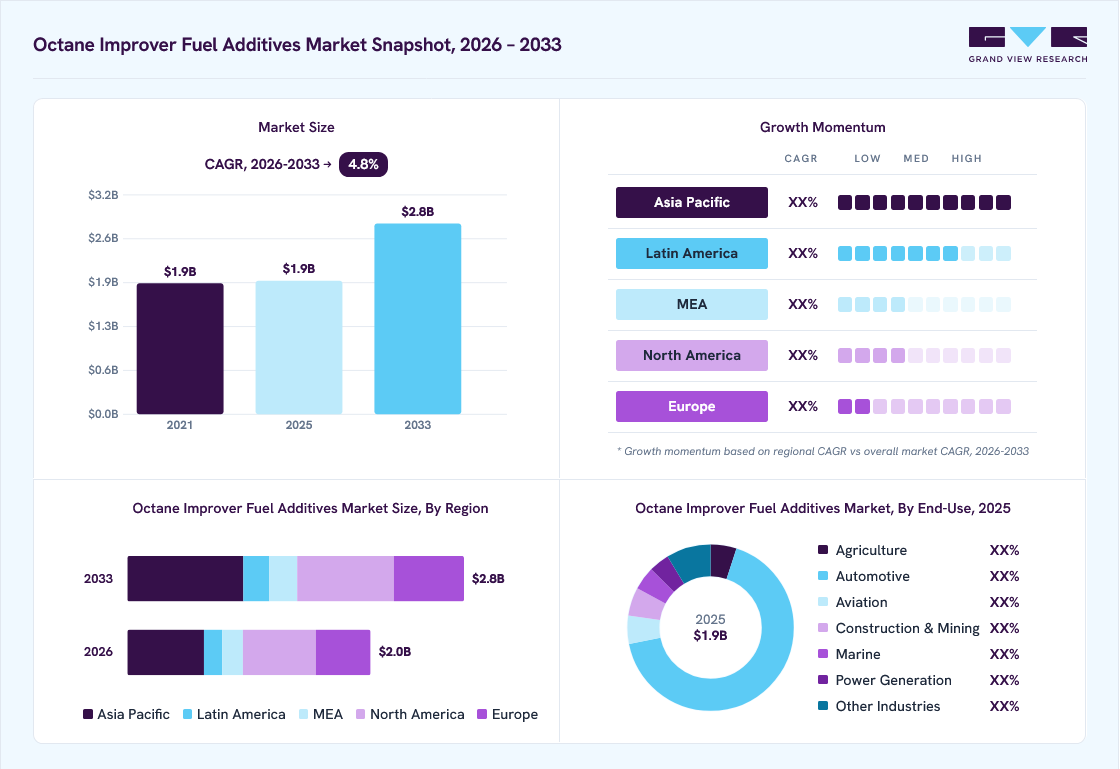
The global octane improver fuel additives market size was valued at USD 1.9 billion in 2025 and is projected to grow from USD 2.0 billion in 2026 to USD 2.8 billion by 2033, at a CAGR of 4.8% from 2026 to 2033. Asia Pacific dominated the market, accounting for a revenue share of 31.1% in 2025. The market growth is supported by rising gasoline consumption, increasing demand for higher fuels, and the growing use of performance-enhancing formulations across automotive, aviation, marine, agriculture, and off-road applications.
 Source: Grand View Research, IR Documents, Primary Interviews, Paid DatabasesTo learn more about this report,
 Download Free Sample Report
Key Market Trends & Insights
- By additive: Organometallic held the largest revenue share of 29.0% in 2025.
- By end use: Automotive segment dominated with a share of 66.7% 2025.
Regional Highlights
- Largest Region: Asia Pacific (31.1% revenue share, 2025)
- By country: China led the APAC market in 2025
Market Size & Forecast
- Market size in 2025: USD 1.9 Billion
- Estimated market size in 2026: USD 2.0 Billion
- Projected market size by 2033: USD 2.8 Billion
- CAGR (2026-2033): 4.8%
GVR research-powered AIAsk Prism AI about the octane improver fuel additives marketGet cited answers from GVR research on market growth, segments, regulations and forecasts.Start with✓ Source-linked answers ✓ Market-specific context ✓ Traceable figuresExplore Prism AI ↗
Growth is supported by continued consumption of vehicles and equipment across automotive, agriculture, construction, mining, marine, and power-generation applications. Refinery operators can also use -enhancing components to optimize pools and manage the balance among quality, processing economics, and available blending streams. Meanwhile, differences in specifications across countries create demand for formulations tailored to local regulatory and engine requirements. The gradual modernization of vehicle fleets and greater emphasis on combustion efficiency are further encouraging suppliers to develop products that deliver consistent performance at optimized treatment levels.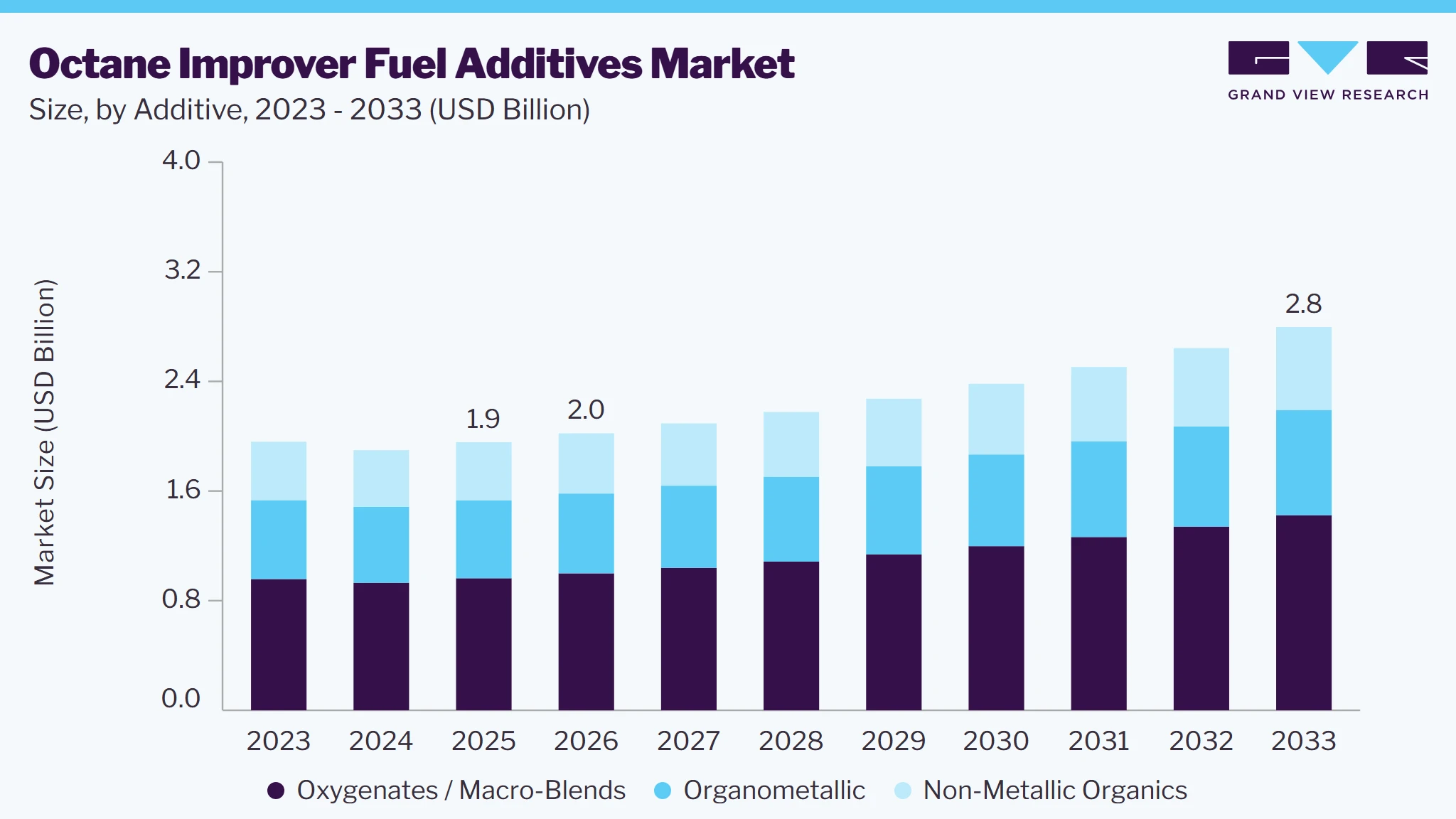 To learn more about this report, Download Free Sample Report
Suppliers can strengthen their market positions by developing high-efficiency products, expanding technical support for refiners and marketers, and establishing regional supply capabilities in markets with rising demand. Opportunities are also emerging through customized solutions for aviation, marine fuels, agricultural machinery, and small-engine applications, where specific requirements can create specialized demand. Strategic partnerships with refiners, distributors, and technology providers, combined with investments in formulation research and testing capabilities, can enable companies to address changing specifications while broadening their presence across the -enhancement value chain.
Market Dynamics
The industry is shaped by consumption, refinery economics, engine-performance, and evolving quality standards. Rising demand for fuels with higher knock resistance encourages refiners and blenders to incorporate enhancing components into formulations. Growth in passenger vehicles, commercial transportation, agricultural machinery, marine equipment, and small-engine applications provides a broad consumption base. At the same time, regulatory scrutiny surrounding composition, emissions, and metallic compounds is influencing product development and encouraging suppliers to diversify their chemistry portfolios. Technological advancements are creating opportunities for efficient formulations that achieve targeted enhancement at optimized treatment levels while maintaining stability and compatibility. Regional differences in specifications and oxygenation can further encourage customized solutions and localized supply strategies. However, volatility in chemical feedstock prices, changing refinery configurations, availability of suitable blending components, and regulatory restrictions can affect production economics and purchasing decisions.
Growing demand for higher- are supporting the use of enhancing components across refinery, blending, and transportation applications. Higher levels control engine knock and support the operating of modern spark-ignition engines, creating a continuing need for effective formulations. Demand is further reinforced by consumption across passenger vehicles, motorcycles, agricultural machinery, marine equipment, generators, and other spark-ignition systems. Oxygenates such as alcohols and ethers can also contribute to enhancement, while some are incorporated to satisfy air-quality.
Refiners and blenders are consequently placing greater emphasis on optimizing gasoline pools through blending components that can achieve the required specification without unnecessarily increasing processing costs. Regional differences in standards and refinery configurations create customized treatment approaches. This environment benefits suppliers capable of providing efficient chemistries, reliable dosage performance, and technical support for formulation optimization.
Regulatory requirements represent a significant constraint as additives must satisfy increasingly detailed requirements concerning combustion emissions, environmental exposure, composition, and vehicle compatibility. In the U.S., additives intended for highway vehicles must be registered, with manufacturers required to assess combustion and evaporative emissions and, where necessary, conduct health-effects testing. Metallic enhancers face additional scrutiny as manganese-containing compounds can contribute to manganese emissions, while historical technical assessments have raised concerns regarding deposits, oxygen sensors, catalytic converters, and emission-control performance. Such conditions can increase product-development expenditure, testing timelines, documentation, and regulatory approval costs. They can also restrict the commercial use of particular chemistries in individual jurisdictions, forcing producers to reformulate products or shift toward alternative organic and oxygenated solutions.
An important commercial opportunity lies in developing non-metallic organic boosters and advanced oxygenated formulations that can provide effective knock resistance while addressing evolving quality and regulatory considerations. Regulatory scrutiny surrounding certain metallic additives creates an incentive for suppliers to expand alternative chemistries. For instance, the U.S. EPA identifies MMT as an enhancer while noting regulatory and health-related considerations associated with manganese exposure. This creates scope for suppliers to differentiate through formulations that combine performance with compatibility, emissions considerations, and application-specifications.
Market Concentration & Characteristics
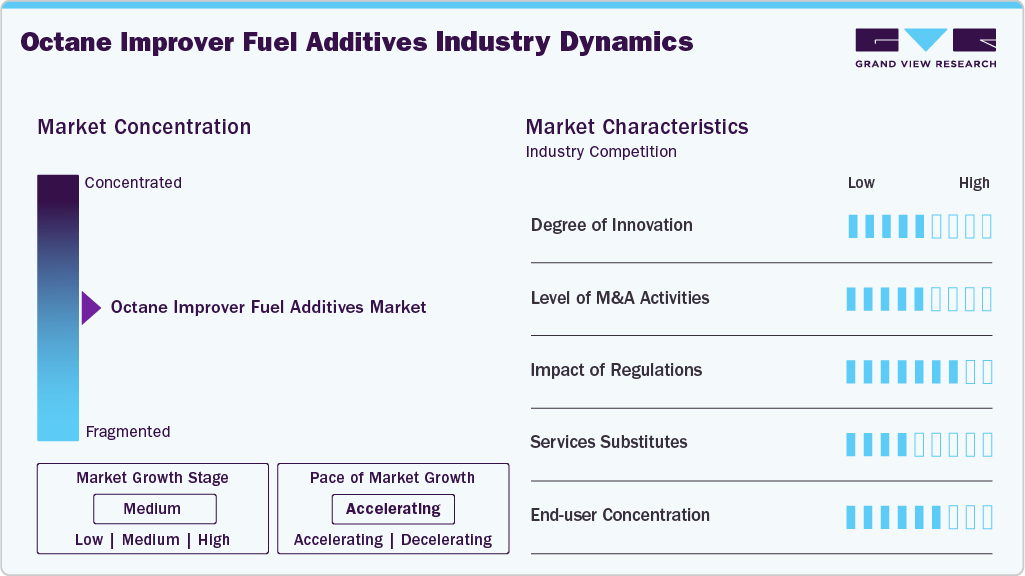
The competitive landscape is characterized by the presence of established additive specialists and diversified chemical manufacturers competing through formulation expertise, product performance, technical services, and geographic reach. Afton Chemical Corporation, Chevron Oronite Company LLC, Innospec Inc., Infineum International Limited, and The Lubrizol Corporation maintain strong positions through broad additive portfolios, customer relationships, application testing capabilities, and established distribution networks. Innospec has a particularly differentiated portfolio of octane-enhancement technologies covering organometallic and non-metallic solutions. TotalEnergies SE, LyondellBasell Industries N.V., Evonik Industries AG, Clariant AG, and Cestoil Chemical Inc. add further competitive diversity through chemical manufacturing capabilities, specialty formulations, and regional market access.
 To learn more about this report, Download Free Sample Report
Competition increasingly centers on the ability to deliver effective enhancement while addressing changing specifications and regulatory expectations. Producers are therefore investing in formulation development, technical validation, customized treatment programs, and alternative chemistries. Product consistency, dosage efficiency, compatibility with formulations, supply reliability, and technical assistance remain important differentiators when serving refiners and blenders. Meanwhile, companies with broader chemical portfolios can leverage manufacturing infrastructure and feedstock expertise to expand into specialized applications.
Analyst Perspective
Automotive applications are expected to remain an important demand base, while aviation, marine, agriculture, and off-road equipment provide additional avenues for consumption. The shift toward efficient, application-specific, and non-metallic formulations is creating room for product differentiation. Regulatory scrutiny of certain additive chemistries likely to encourage suppliers to diversify their technology portfolios and strengthen compliance capabilities. Companies combining reliable supply, formulation expertise, technical support, and regional customer relationships are positioned to capture emerging opportunities.
Additive Insights
Organometallic segment dominated with a revenue share of 29.0% in 2025 reflecting the established use of metal-containing compounds for enhancement. Manganese and iron-based formulations are incorporated to improve knock resistance and achieve the required rating. Their effectiveness at relatively low treatment concentrations makes them relevant to refiners and blenders seeking efficient performance enhancement. Established production capabilities and existing-blending practices continue to support their commercial application across various formulations. Nevertheless, regulatory scrutiny of metallic constituents is encouraging industry participants to explore alternative technologies. This is creating a gradual shift toward solutions that combine performance with evolving environmental and quality.
Non-metallic organics is the fastest growing with a CAGR of 4.7% in the forecast period, supported by increasing interest in enhancing alternatives without metallic constituents. These compounds can improve knock resistance while providing greater flexibility for formulations subject to specific-quality requirements. Growing regulatory attention toward metallic additives is creating additional scope for organic-based technologies. Manufacturers are concentrating on improving treatment efficiency, compatibility, and formulation stability to address requirements from refiners and blenders. Product development tailored to different compositions and regional specifications can further broaden adoption. The segment therefore presents opportunities for technology differentiation as producers seek alternatives capable of meeting performance and regulatory expectations.
End Use Insights
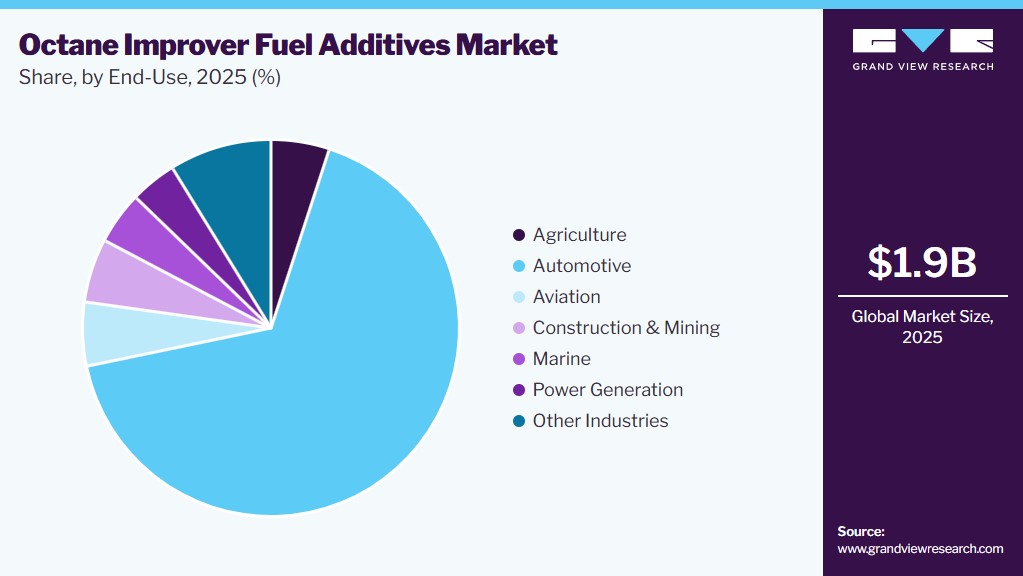
The automotive segment dominated with a share of 66.7% in 2025 primarily reflecting the extensive consumption across passenger vehicles, motorcycles, and light commercial vehicles. Octane-enhancing components are used to achieve appropriate knock resistance and satisfy the requirements of spark-ignition engines. The substantial installed base of vehicles provides a broad and recurring consumption base for these products. Purchasing requirements vary according to vehicle-engine configurations, grades, refinery practices, and specifications. Continued demand for efficient combustion and appropriate quality is expiated to sustain the importance of this application area.
 To learn more about this report, Download Free Sample Report
Power generation is the fastest growing with a CAGR of 5.6% from 2026 to 2033, supported using gasoline-powered generators in backup, portable, commercial, and decentralized power applications. Reliable generator operation depends partly on maintaining characteristics suited to the engine and its operating conditions. Expansion of backup-power requirements, construction activity, remote operations, and distributed electricity systems can increase consumption in this category. Octane-enhancing formulations can assist blenders in achieving the required performance characteristics used in spark-ignition generator engines.
Region Insights
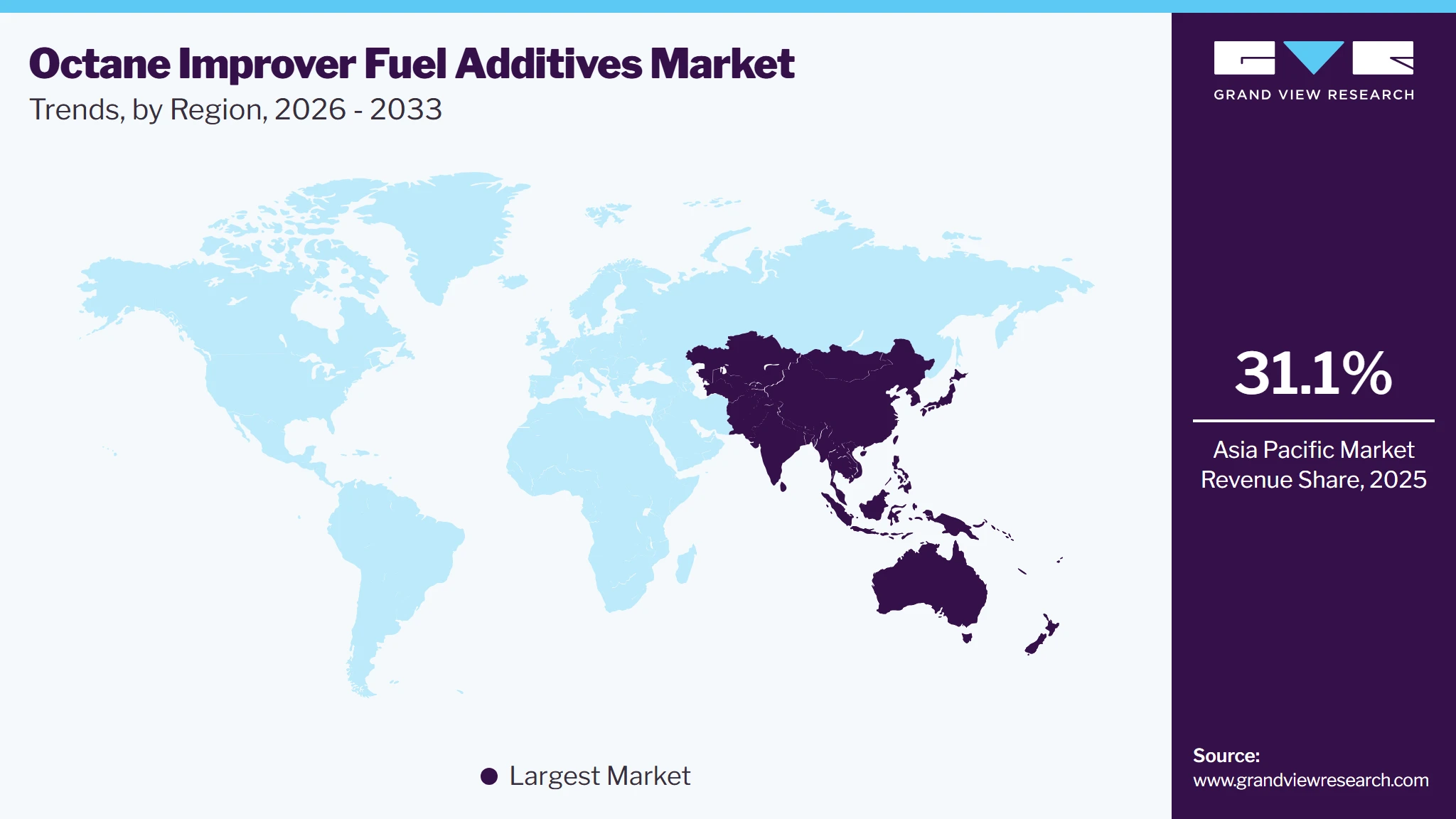
Asia Pacific octane improver fuel additives market dominated the market with a revenue share of 31.1%, in 2025. supported by its substantial refining base, large vehicle population, and extensive consumption across transportation and industrial applications. China, India, Japan, South Korea, and Southeast Asian economies contribute significantly to regional demand and refining activity. The region is also expected to remain an important center for new refining capacity, with the IEA indicating that refinery additions in Asia, particularly China and India, are expected to outpace closures in other major regions through 2030. This expanding processing infrastructure creates opportunities for suppliers of enhancing compounds.
 To learn more about this report, Download Free Sample Report
Octane improver fuel additives market in China is expected to grow with a compound annual growth rate of 6.6%, during the forecast period. Demand is primarily associated with quality requirements across passenger vehicles, commercial transportation, and off-road equipment. The country's refining sector provides a strong foundation for the use of enhancing components, while evolving standards encourage refiners to optimize formulations. At the same time, rapid adoption of electric and hybrid vehicles is gradually altering the conventional transportation- landscape.
North America Octane Improver Fuel Additives Market Trends
North America benefits from a highly developed refining industry, substantial consumption, and sophisticated -formulation infrastructure. The region's demand environment is supported by extensive road transportation, commercial activity, recreational equipment, agriculture, and industrial applications. The United States remains particularly significant due to its large refining network and differentiated specifications across states and regions. Fuel formulations can vary according to seasonal requirements and air-quality programs, creating demand for blending components that can maintain appropriate performance while satisfying regulatory parameters.
U.S. Octane Improver Fuel Additives Market Trends
The U.S. represents a highly developed market characterized by extensive refining capacity and complex specifications. The country's market is also differentiated by federal, state, seasonal, and reformulated- requirements, which influence the selection and economics of blending components. These conditions create opportunities for suppliers offering efficient -enhancing solutions compatible with varying formulations. At the same time, mature vehicle penetration, efficiency improvements, and gradual electrification create constraints on long-term volume expansion.
Europe Octane Improver Fuel Additives Market Trends
Europe represents a mature downstream petroleum market where -quality regulations and decarbonization policies strongly influence product development. Demand for enhancing solutions is therefore increasingly linked to refinery optimization, premium grades, renewable blending components, and compliance with evolving environmental requirements. The region is also experiencing structural pressure from energy-transition policies and slower conventional demand, which is encouraging refiners to reassess capacity and product portfolios.
Octane improver fuel additives market in Germany is an important European market owing to its large automotive industry, extensive road-transport network, and established distribution infrastructure. Demand for enhancing components is consequently linked to passenger vehicles, requirements, refinery operations, and premium gasoline formulations. However, improving vehicle efficiency, electrification, and Germany's broader energy-transition objectives are likely to limit long-term expansion in conventional volumes.
Middle East & Africa Octane Improver Fuel Additives Market Trends
The Middle East & Africa region presents contrasting market characteristics, combining major refining hubs in the Gulf with rapidly developing markets across Africa. African markets offer additional potential through expanding vehicle fleets, urbanization, infrastructure development, and rising transportation- requirements. However, differences in refinery sophistication, standards, import dependence, and distribution infrastructure across individual countries create varied commercial conditions.
Latin America Octane Improver Fuel Additives Market Trends
Latin America offers growth potential supported by expanding transportation activity, established refining systems, and consumption across Brazil, Argentina, Colombia, and other major economies. Brazil is particularly significant because of its large transportation- market and established biofuel infrastructure, creating opportunities for oxygenated blending components. Mexico also represents an important downstream market due to its substantial vehicle fleet and refining operations. At the regional level, changing refinery economics, -import requirements, renewable- policies, and infrastructure investments likely to influence purchasing patterns.
Key Octane Improver Fuel Additives Company Insights
Companies are strengthening their position by investing in differentiated additive chemistries, application testing, and formulation capabilities that address changing specifications and customer requirements. They also emphasize customer-specific technical support, refinery optimization, and -performance validation while expanding solutions that improve treatment economics and compatibility with existing formulations.
-
Afton Chemical has a broad-additive portfolio serving diesel, aviation, and refinery-to-pump applications, with capabilities spanning improvement, quality, and distribution performance. Its -improvement offering includes HiTEC 3062, an MMT-based formulation designed to increase gasoline while supporting refinery flexibility and production economics. The company differentiates through extensive testing capabilities, technical expertise, OEM engagement, and customer collaboration, enabling tailored solutions for refiners, terminals, blenders, and other -industry participants.
-
Cestoil Chemical has a focused position in -performance additives, offering organic boosters designed for gasoline blending without metallic constituents. Its Otex range is positioned around enhancement, compatibility with other additives and -system materials, and application-specific treatment optimization. The company emphasizes evaluating the base, target octane characteristics, blending conditions, and treatment economics before recommending dosage, reflecting a customer-specific approach to formulation. Cestoil also provides standard and customized non-metallic octane boosters for refinery applications, supporting its differentiation within alternative octane-enhancement technologies.
Key Octane Improver Fuel Additives Companies
The following key companies have been profiled for the study on the octane improver fuel additives market.
-
Afton Chemical Corporation
-
Cestoil Chemical Inc
-
Chevron Oronite Company LLC
-
Clariant AG
-
Evonik Industries AG
-
Infineum International Limited
-
Innospec Inc.
-
LyondellBasell Industries N.V
-
The Lubrizol Corporation
-
TotalEnergies SE
Competitive Benchmarking
Operating Strategies
Competitive Edge
Weaknesses
Mature Players: Afton Chemical Corporation, Chevron Oronite Company LLC, Innospec Inc., Infineum International Limited, The Lubrizol Corporation, TotalEnergies SE
- Maintain broad fuel-additive portfolios to serve refiners, fuel marketers, OEMs, and other customers across multiple gasoline applications.
- Invest continuously in formulation research, engine testing, and proprietary technologies to address changing fuel specifications and performance requirements.
- Strengthen global manufacturing, technical-service, and distribution networks to ensure reliable supply across major fuel-consuming markets.
- Develop alternative octane-enhancement technologies, including non-metallic formulations, to address evolving regulatory and environmental requirements.
- Leverage established relationships with refiners, fuel marketers, OEMs, and distributors to secure recurring business and strengthen customer retention.
- Utilize extensive technical expertise and testing infrastructure to develop formulations for complex octane and fuel-quality requirements.
- Offer diverse octane-improver chemistries, enabling customers to select solutions based on fuel composition, dosage, and regulatory conditions.
- Capitalize on established international operations and supply networks to provide consistent product availability across geographic markets.
- Manage higher operational complexity arising from extensive product portfolios, international facilities, and diverse regulatory requirements.
- Face longer development and qualification cycles when introducing specialized formulations because of extensive technical and customer validation requirements.
- Remain exposed to broader fuel and lubricant additive markets, limiting the proportion of business directly attributable to octane-improver products.
- Adapt product portfolios to restrictions or changing preferences surrounding certain metallic antiknock compounds.
Emerging Players: LyondellBasell Industries N.V., Evonik Industries AG, Clariant AG, Cestoil Chemical Inc.
- Focus on targeted applications and specialized fuel-treatment chemistries rather than competing primarily through portfolio breadth.
- Leverage existing chemical manufacturing capabilities and feedstock expertise to develop or supply specialized fuel-performance solutions.
- Develop application-specific formulations tailored to gasoline grades, engine requirements, and regional fuel specifications.
- Build relationships with distributors, fuel suppliers, and technology partners to expand customer access without replicating the infrastructure of established additive specialists.
- Leverage specialized expertise in chemicals, intermediates, performance materials, and formulation technologies to address selected fuel applications.
- Respond flexibly to customer requirements, particularly for customized formulations and niche-volume opportunities.
- Utilize focused portfolios to provide application-specific technical assistance and formulation support.
- Draw on established manufacturing and distribution infrastructure where available to support expansion into fuel-additive applications.
- Operate with less concentrated expertise in octane improvement than companies with long-established dedicated fuel-additive portfolios.
- Face challenges in expanding direct relationships with major refiners, fuel marketers, and large-scale fuel distributors.
- Require significant investment to develop comprehensive engine-testing, validation, and technical-support capabilities.
- Depend more heavily on specialized applications and differentiated technologies to compete against companies with broader portfolios and stronger established customer relationships.
Recent Developments
-
In February 2026, Clariant's HYSOPAR 5000 catalyst was highlighted as a solution for C5/C6 naphtha isomerization and cost-effective octane enhancement. The technology is relevant upstream of gasoline blending because isomerization improves the octane characteristics of refinery streams.
-
In January 2026, Infineum: Infineum signed a strategic framework agreement with Rianlon Corporation to strengthen its Asia-Pacific supply chain. The arrangement combines Infineum's formulation and market expertise with Rianlon's component manufacturing and regional supply capabilities, with the stated objective of improving supply resilience, logistics efficiency, and cost competitiveness.
Octane Improver Fuel Additives Market Report Scope
Report Attribute
Details
Market Definition
The octane improver fuel additives market omprises compounds blended into gasoline to increase octane ratings, enhance knock resistance, and support engine performance. Products include organometallic additives, non-metallic organic boosters, oxygenates, and macro blends supplied across transportation, industrial, marine, aviation, and power-generation applications.
Market size in 2025
USD 1.9 billion
Estimated market size in 2026
USD 2.0 billion
Projected market size by 2033
USD 2.8 billion
Growth rate
CAGR of 4.8% from 2026 to 2033
Base year for estimation
2025
Historical data
2021 - 2024
Forecast period
2026 - 2033
Quantitative units
Revenue in USD billion, Volume, Kilotons and CAGR from 2026 to 2033
Report coverage
Revenue forecast, volume forecast, company ranking, competitive landscape, growth factors, and trends
Segments covered
Additive, end use, region
Regional Scope
North America; Europe; Asia Pacific; Latin America; Middle East & Africa
Country scope
U.S.; Canada; Mexico; Germany; UK; France; Italy; Spain; China; India; Japan; South Korea; Brazil; Argentina; Saudi Arabia; South Africa.
Key companies profiled
Afton Chemical Corporation; Chevron Oronite Company LLC; Innospec Inc.; Infineum International Limited; The Lubrizol Corporation; TotalEnergies SE; LyondellBasell Industries N.V; Evonik Industries AG; Clariant AG; Cestoil Chemical Inc
Customization scope
Free report customization (equivalent up to 8 analysts’ working days) with purchase. Addition or alteration to country, regional & segment scope.
Pricing and purchase options
Avail customized purchase options to meet your exact research needs. Explore purchase options
Global Octane Improver Fuel Additives Market Report Segmentation
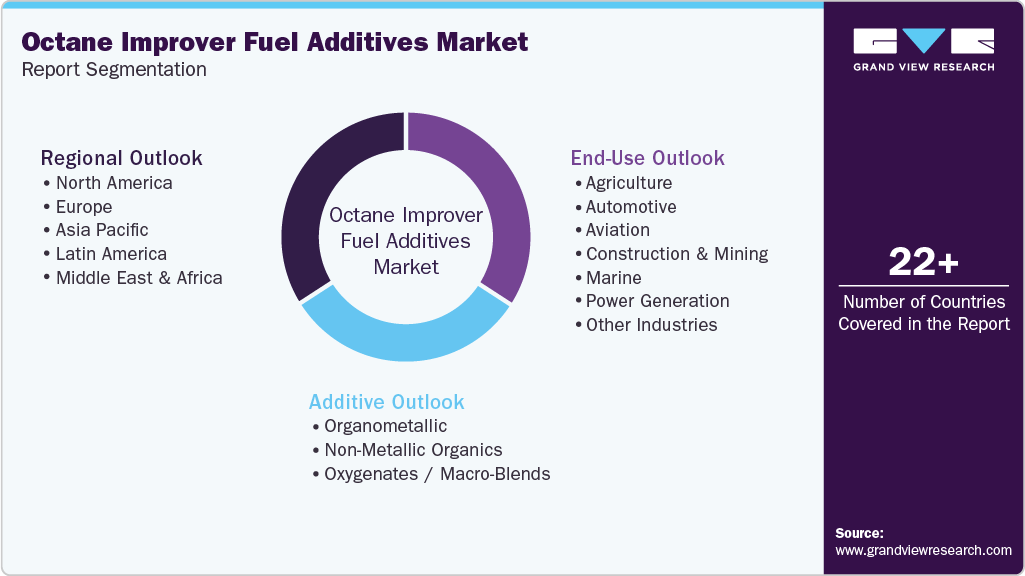
This report forecasts volume & revenue growth at global, regional, and country levels and provides an analysis of the latest industry trends in each of the sub-segments from 2021 to 2033. For this study, Grand View Research has segmented the octane improver fuel additives market report based on additive, end use, and region:
 To learn more about this report, Download Free Sample Report
-
Additive Outlook (Revenue, USD Billion; Volume, Kilotons, 2021 - 2033)
-
Organometallic
-
Non-Metallic Organics
-
Oxygenates / Macro-Blends
-
-
End-Use Outlook (Revenue, USD Billion; Volume, Kilotons, 2021 - 2033)
-
Agriculture
-
Automotive
-
Aviation
-
Construction & Mining
-
Marine
-
Power Generation
-
Other Industries
-
-
Regional Outlook (Revenue, USD Billion; Volume, Kilotons, 2021 - 2033)
-
North America
-
U.S.
-
Canada
-
Mexico
-
-
Europe
-
UK
-
Germany
-
France
-
Italy
-
Spain
-
-
Asia Pacific
-
China
-
Japan
-
India
-
South Korea
-
-
Latin America
-
Brazil
-
Argentina
-
-
Middle East and Africa (MEA)
-
South Africa
-
Saudi Arabia
-
-
Research Methodology
The octane improver fuel additives market figures in this report are based on a proven research process that combines executive interviews with secondary research from proprietary databases, company filings, and recognized regulatory and institutional sources. Market size is built through value-chain sizing - reconciling supply-side and demand-side estimates - and triangulated with bottom-up and top-down approaches. Every estimate passes multiple levels of expert validation before publication, with each octane improver fuel additives segment quantified using the revenue-capture definitions in the table below.
Segment Definition
Segment - Additive
Revenue capture definition
Organometallic
Commercial receipts arise from metal-containing octane improvers, particularly manganese- and iron-based compounds, supplied to refiners, fuel blenders, and gasoline producers. Their economic contribution is tied to the ability to raise octane levels and reduce knock tendency at relatively low treatment concentrations, subject to applicable fuel-quality and regulatory requirements.
Non-Metallic Organics
Sales encompass organic compounds formulated to enhance the antiknock characteristics of gasoline without relying on metallic constituents. Purchasing activity reflects requirements for combustion performance, fuel compatibility, formulation flexibility, and compliance with specifications governing gasoline composition and emissions.
Oxygenates / Macro-Blends
Turnover originates from high-volume oxygenated blending materials, including ethanol and ether-based products, incorporated into gasoline during fuel formulation. Commercial volumes are shaped by blending mandates, refinery economics, feedstock availability, octane requirements, infrastructure compatibility, and regional fuel regulations.
Segment - End-Use
Revenue capture definition
Agriculture
Sales attributable to this category stem from gasoline consumed by tractors, irrigation pumps, harvest equipment, utility engines, and other farm machinery. Usage levels correspond to agricultural mechanization, seasonal equipment operation, gasoline consumption, and the fuel requirements of spark-ignition engines used across farming activities.
Automotive
The segment encompasses gasoline-powered passenger cars, motorcycles, light commercial vehicles, and associated road vehicles. Octane-improving products enter the fuel supply chain through refinery blending, gasoline formulation, and aftermarket applications, with expenditure influenced by vehicle-engine specifications, fuel grades, consumption volumes, and prevailing gasoline standards.
Aviation
Income is associated with aviation gasoline used primarily in piston-engine aircraft and compatible aviation equipment. Product utilization depends on the octane specifications required for aircraft engines, certified fuel formulations, aviation-fuel production, and the operating fleet requiring gasoline-based aviation fuels.
Construction & Mining
Purchases relate to gasoline used by construction machinery, mining equipment, portable pumps, compact engines, and other off-highway systems. Requirements vary with machinery utilization, engine configuration, project activity, fuel consumption, and the operating conditions encountered across construction and extraction sites.
Marine
Business activity covers gasoline-powered boats, outboard motors, personal watercraft, and other marine engines. Consumption of octane-enhancing materials follows marine gasoline requirements, engine technology, vessel populations, recreational activity, commercial operations, and applicable fuel specifications.
Power Generation
This category comprises gasoline-powered generators and stationary spark-ignition systems used for backup, portable, residential, commercial, and industrial electricity production. Product requirements are influenced by generator capacity, engine design, operating frequency, gasoline usage, and the fuel grades recommended for individual generating units.
Other Industries
The segment includes gasoline-dependent applications outside the principal sectors, such as recreational equipment, specialty vehicles, landscaping machinery, utility engines, and miscellaneous industrial systems. Associated sales depend on the installed equipment base, operating intensity, gasoline requirements, and application-specific fuel specifications.
Estimation Model
Layer No.
Layer Name
Key Question
Description
01
Raw Material & Production Layer
What forms the supply base?
Identify the chemical feedstocks and intermediates used to manufacture octane-enhancing fuel additives, including manganese- and iron-containing compounds, organic antiknock components, ethanol, ether-based oxygenates, and other gasoline-blending materials. Examine feedstock procurement, chemical synthesis, refining and purification, blending, formulation, quality testing, storage, and distribution capabilities. The assessment also covers manufacturing capacity, process technology, raw-material availability, product consistency, regulatory compliance, hazardous-material handling, and supply-chain reliability.
02
Application Adoption Layer
Where are octane improver fuel additives utilized?
Evaluate utilization across gasoline-powered automotive, agricultural, aviation, construction and mining, marine, power-generation, and other spark-ignition applications. Determine how octane-enhancing materials enter gasoline through refinery blending, fuel formulation, aftermarket products, and specialized fuel systems. Adoption is influenced by engine specifications, required octane ratings, gasoline formulations, fuel-quality standards, emissions requirements, regional regulations, and the availability of suitable blending components.
03
Consumption Intensity Layer
How extensively are octane improver fuel additives consumed?
Assess consumption according to gasoline production volumes, additive treatment rates, octane requirements, engine population, fuel grade, application type, and blending practices. Intensity varies according to the concentration required to achieve targeted octane enhancement, the characteristics of the base gasoline, refinery configuration, and the specific requirements of spark-ignition engines. Additional influences include changes in vehicle fleets, agricultural and off-road equipment utilization, aviation gasoline demand, marine activity, generator usage, and shifts in regional fuel formulations.
04
Revenue Layer
How is market revenue generated?
Market income originates from the commercial supply of octane-enhancing compounds, formulated additive packages, oxygenated blending components, and related fuel-treatment solutions to refiners, fuel blenders, distributors, fuel marketers, and specialized users. Pricing varies with chemical composition, octane-enhancement efficiency, treatment dosage, purity, production economics, regulatory requirements, order volumes, and contract structures. Higher-value opportunities can arise from specialized formulations, technical formulation support, customized treatment solutions, long-term supply agreements, and products designed to address specific gasoline-performance or regulatory requirements.
Delivered Customizations
This report has been delivered with the following In-depth customizations
Client Request
Customization Delivered
Value Adds
Regional segmentation
The assessment provides country-level market sizing and forecasts, supported by analysis of gasoline consumption, refinery capacity, fuel-production volumes, vehicle fleets, agricultural and off-road equipment, aviation gasoline usage, marine activity, and power-generation requirements. It evaluates regional differences in fuel specifications, octane requirements, oxygenate mandates, additive regulations, refinery configurations, import-export flows, feedstock availability, manufacturing infrastructure, and distribution networks across major countries.
Facilitates geographic prioritization, supply-chain planning, market-entry evaluation, manufacturing-location assessment, distributor selection, and investment allocation by highlighting countries with substantial gasoline demand, expanding refining activity, supportive fuel policies, or growing requirements for octane-enhancing solutions.
Opportunity Assessment
Comprehensive evaluation of growth avenues across automotive, agriculture, aviation, construction and mining, marine, power generation, and other gasoline-dependent applications. The assessment examines opportunities associated with rising gasoline consumption, higher-octane fuel requirements, refinery optimization, demand for non-metallic formulations, oxygenated blending components, aftermarket fuel treatments, and evolving fuel-quality regulations. It also considers engine-efficiency requirements, emissions considerations, alternative fuel development, technological advances, and shifts in gasoline composition.
Helps identify commercially relevant application areas, product chemistries, customer segments, and geographic pockets where additional demand can emerge. Findings can inform portfolio diversification, formulation development, capacity allocation, channel expansion, strategic partnerships, and entry into underserved application segments.
Competitive Benchmarking
Comparative evaluation of major participants based on octane-improver portfolio, additive chemistry, manufacturing footprint, production capabilities, treatment efficiency, application coverage, technical expertise, distribution reach, customer base, and regulatory capabilities. The review also considers new product introductions, manufacturing investments, technology development, licensing arrangements, strategic alliances, acquisitions, and initiatives involving lower-metal or non-metallic fuel solutions.
Provides visibility into competitors' technological capabilities, commercial reach, product differentiation, and strategic priorities. The resulting assessment assists in identifying portfolio gaps, potential technology partnerships, opportunities for formulation enhancement, manufacturing requirements, customer-development priorities, and areas where companies can strengthen their presence within the fuel-additives value chain.
Frequently Asked Questions About This Report
The octane improver fuel additives market size was estimated at USD 1.9 billion in 2025 and is expected to reach USD 2.0 billion in 2026.
Asia Pacific dominated the market with a revenue share of 31.1%, in 2025, supported by its substantial refining base, large vehicle population, and extensive gasoline consumption across transportation and industrial applications.
Key factors driving growth include rising gasoline consumption, increasing requirements for higher-octane fuels, and the need to improve knock resistance in modern spark-ignition engines. Demand is further supported by refinery optimization, evolving fuel-quality specifications, and greater use of gasoline-powered equipment across automotive, agriculture, marine, aviation, and power-generation applications.
Some of the key players operating in the octane improver fuel additives market Afton Chemical Corporation; Chevron Oronite Company LLC; Innospec Inc.; Infineum International Limited; The Lubrizol Corporation; TotalEnergies SE; LyondellBasell Industries N.V; Evonik Industries AG; Clariant AG; Cestoil Chemical Inc.
The octane improver fuel additives market is expected to grow at a compound annual growth rate of 4.8% from 2026 to 2033 to reach USD 2.8 billion by 2033.
The automotive segment dominated with a share of 66.7% in 2025 primarily reflecting the extensive consumption of gasoline across passenger vehicles, motorcycles, and light commercial vehicles.
Organometallic segment dominated with a revenue share of 29.0% in 2025 reflecting the established use of metal-containing compounds for gasoline octane enhancement. Manganese- and iron-based formulations are incorporated into fuel to improve knock resistance and achieve the required octane rating.
About the Author(s)
Specialty & Chemicals Research Team
Research · Specialty & ChemicalsThis report was authored by the specialty & chemicals research team at Grand View Research - comprising two research analysts, one senior research analyst, and one industry expert - with specialized expertise in the specialty & chemicals segment of the research industry. All findings are based on proprietary research databases, executive interviews, and regulatory analysis, subject to internal peer review prior to publication.
Last Updated:
Speak to Analyst

Customize this report to your needs - add regions, segments, or data points, with 20% free customization.
Or view our licence options:


ISO 9001:2015 & 27001:2022 Certified
We are GDPR and CCPA compliant! Your transaction & personal information is safe and secure. For more details, please read our privacy policy.


