
- Home
- »
- Next Generation Technologies
- »
-
Online Food Delivery Market Size, Share Report, 2025-2030GVR Report cover

Online Food Delivery Market (2025 - 2030)
Size, Share & Trends Analysis Report By Type (Restaurant to Consumer, Platform to Consumer), By Product (Grocery Delivery, Meal Delivery), By Payment Method (Online, CoD), By Region, And Segment Forecasts
Market Size, 2024
$288.8BMarket Estimate, 2026
$355.6BMarket Forecast, 2030
$505.5BCAGR, 2025–2030
9.4%Online Food Delivery Market Summary
The global online food delivery market size was valued at USD 288.8 billion in 2024 and is projected to grow from USD 355.6 billion in 2026 to USD 505.5 billion by 2030, at a CAGR of 9.4% from 2025 to 2030. Asia Pacific dominated the market, accounting for a revenue share of 41.6% in 2024. The market is driven by the increasing penetration of smartphones and internet connectivity. With more people gaining access to affordable smartphones and high-speed internet, ordering food online has become more convenient.
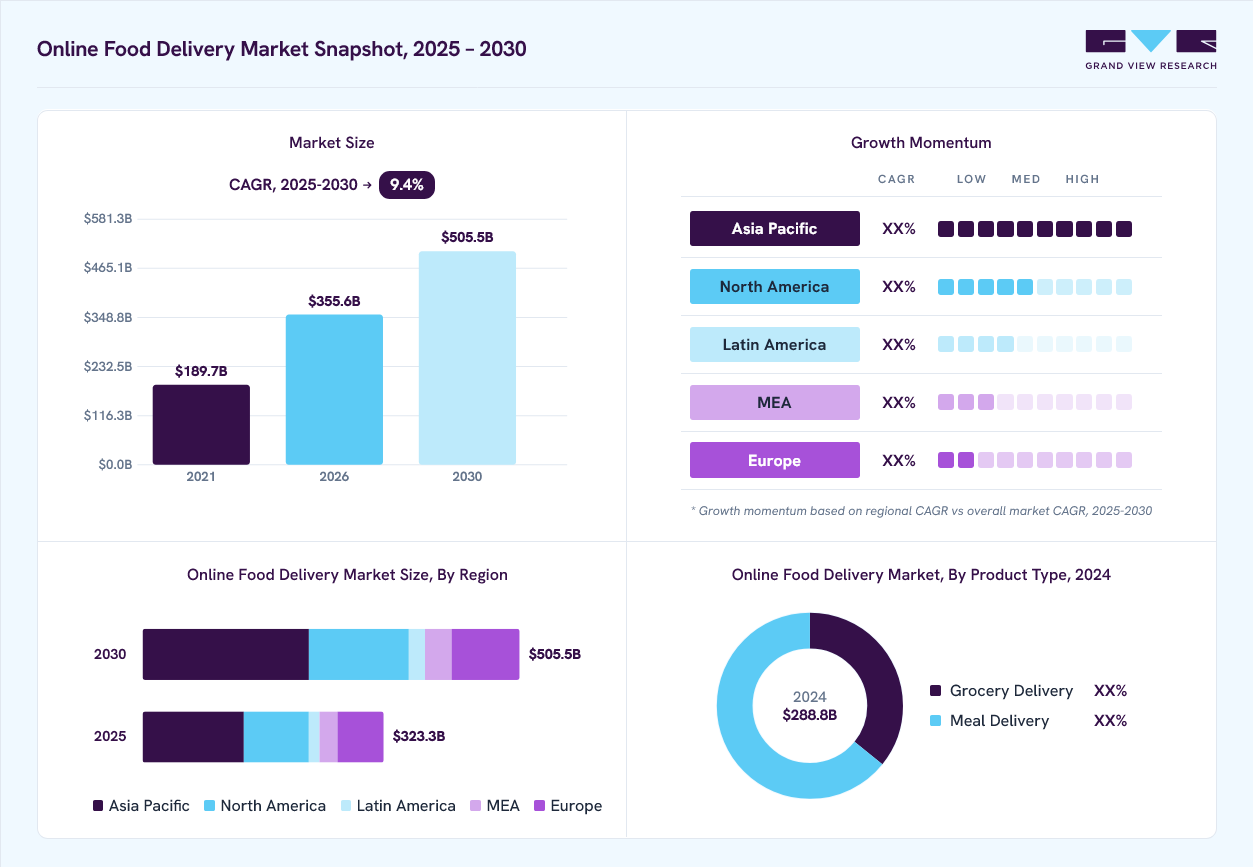 Source: Grand View Research, IR Documents, Primary Interviews, Paid DatabasesTo learn more about this report,
 Download Free Sample Report
 Key Market Trends & Insights
- The online food delivery market in the U.S. is expected to grow significantly at a CAGR of 9.6% from 2025 to 2030.
- In terms of type, the platform to consumer segment dominated the industry and accounted for a revenue share of over 71.0% in 2024.
- In terms of product, the meal delivery segment dominated the market and accounted for a revenue share of over 64.0% in 2024.
- In terms of payment method, the online payment segment dominated the market and accounted for a revenue share of over 67.0% in 2024.
Market Size & Forecast
- 2024 Market Size: USD 288.8 Billion
- 2030 Projected Market Size: USD 505.5 Billion
- CAGR (2025-2030): 9.4%
- Asia Pacific: Largest market in 2024
Three ways to get this report
Buy it, customize it, or ask a question.Ask an Analyst
Analyst response in 1 business day
- AccessReport author, directly
- Reply timeWithin 1 working day
- No sales callDirect answer only
- FormatEmail reply
- CostFree, no cost
Get the Full Report
What the study covers
- FormatsPDF · Excel · Dashboard
- Timeline2025–2030 annual, 2024 base
- Coverage20+ countries, 5 regions
- Companies10+ key players profiled
Customize the Report
20% free customization
- IncludeCountries, segments, points
- TailorTo your product definition
- ExtendDeeper competitor detail
- OrA fully bespoke study
- Turnaround5–10 working days
Mobile apps and user-friendly platforms have simplified the ordering process, allowing customers to browse menus, place orders, and track deliveries with just a few taps. This technological advancement has expanded the customer base, including younger demographics who prefer digital solutions over traditional dining or phone orders. The changing lifestyle and busy schedules of consumers, particularly in urban areas, also contribute to the growth of the industry. With longer working hours and hectic routines, many people lack the time to cook or visit restaurants, making online food delivery an attractive alternative. The convenience of having meals delivered to their doorstep appeals to professionals, students, and families alike. Additionally, the rise of dual-income households has increased disposable income, leading to higher spending on food delivery services. The growing trend of remote work has further boosted demand, as people working from home often rely on delivered meals for lunch or dinner.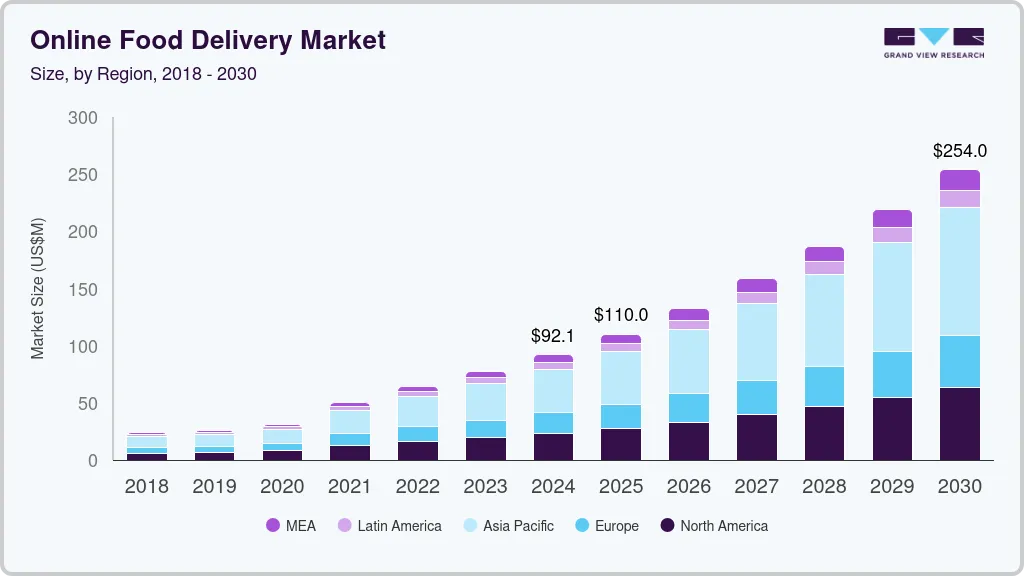 To learn more about this report, Download Free Sample Report
 The expansion of restaurant partnerships and cloud kitchens has also fueled market growth. For instance, in April 2025, Domino’s Pizza Inc. formed a partnership with DoorDash, enabling the pizza chain to expand its customer reach via DoorDash Marketplace while maintaining delivery services through its own drivers. This collaboration aims to enhance Domino’s delivery options and convenience for customers.
Online food delivery platforms have onboarded a wide range of restaurants, from local eateries to high-end chains, providing customers with diverse culinary options. Cloud kitchens, which operate exclusively for delivery, have further increased market supply by optimizing costs and reducing overhead expenses. These virtual brands can experiment with different cuisines and quickly adapt to consumer preferences, enhancing the variety available on delivery apps. Aggressive marketing strategies, including discounts, loyalty programs, and subscription-based offers, have also played a crucial role in attracting and retaining customers.
Type Insights
The platform to consumer segment dominated the industry and accounted for a revenue share of over 71.0% in 2024, driven by the increased digital penetration and smartphone usage. As internet access becomes more widespread, especially in emerging markets, more consumers are turning to food delivery apps that offer convenience, a variety of choices, and real-time updates. Mobile-first strategies by major platforms have made ordering food seamless and intuitive, further encouraging adoption.
The restaurant to consumer segment is anticipated to grow at a CAGR of 5.8% during the forecast period, driven by the digitization of restaurant operations. Many restaurants, especially well-established chains and branded outlets, have invested in their own mobile apps, websites, and order management systems, enabling them to take direct control over the customer experience. For instance, in April 2024, Pickup Coffee, a Philippines-based coffee chain, launched its dedicated mobile application mid-2024, allowing customers to order and receive their beverages directly. This has allowed restaurants to build stronger brand loyalty, offer customized promotions, and retain more profit by avoiding third-party platform fees.
Product Insights
The meal delivery segment dominated the market and accounted for a revenue share of over 64.0% in 2024, driven by the growth of cloud kitchens and centralized food production facilities, which have improved scalability and cost-efficiency for meal delivery companies. By preparing meals in dedicated spaces designed for delivery, businesses can operate without the overhead of traditional restaurants. This allows for better quality control, faster delivery, and competitive pricing, which are crucial for sustaining customer loyalty in a competitive market.
The grocery delivery segment is expected to grow at a significant CAGR over the forecast period due to the rapid expansion of digital infrastructure and mobile app ecosystems. With widespread smartphone usage and improved internet access, particularly in emerging economies, grocery delivery services are now more accessible than ever. E-commerce platforms and food delivery giants have capitalized on this by integrating grocery services into their apps, enabling users to order both meals and everyday essentials through a single interface.
Payment Method Insights
The online payment segment dominated the market and accounted for a revenue share of over 67.0% in 2024, driven by the increasing penetration of smartphones and internet connectivity, especially in emerging markets. As more consumers gain access to mobile apps and high-speed internet, they are naturally inclined toward using digital wallets, UPI, and payment gateways for ordering food online, making online payments a default choice over cash.
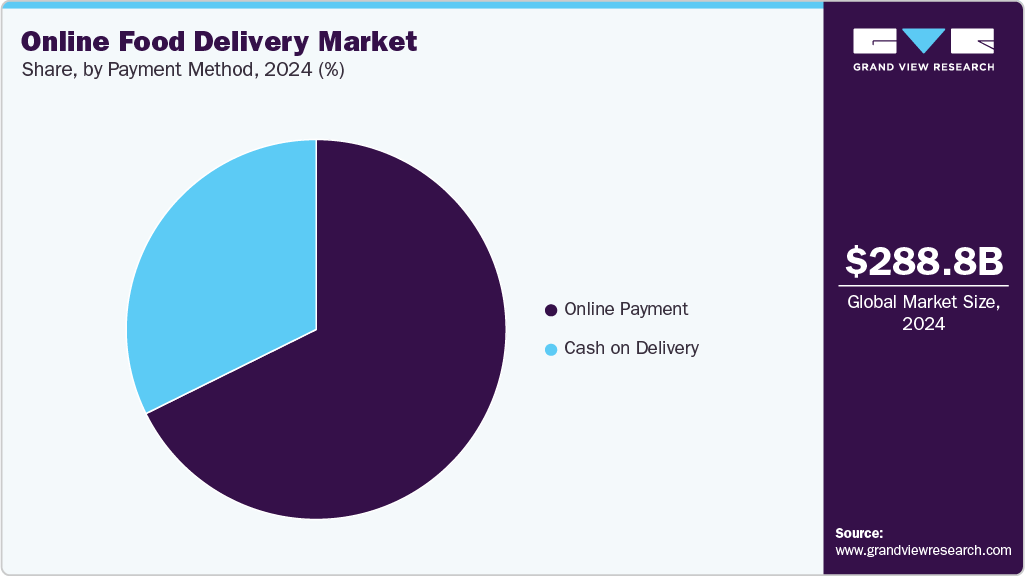 To learn more about this report, Download Free Sample Report
 The cash on delivery segment is expected to grow at a significant CAGR over the forecast period. Many customers, especially in tier 2 and tier 3 cities or rural areas, are more comfortable paying in cash after receiving their orders. This payment method gives them confidence that they will only pay once they see the product, helping build trust in the reliability of online services, especially in regions where logistical inconsistencies or concerns about food quality persist.
Regional Insights
North America online food delivery market held a significant share of over 27.0% in 2024, driven by the high adoption of digital payment solutions and tech-savvy consumers. The region has a well-established logistics infrastructure, enabling fast and reliable deliveries, while subscription-based models (like Amazon Prime and Uber One) incentivize frequent orders. Additionally, the increasing demand for diverse cuisines, including healthy and premium meal options, has expanded the market, with ghost kitchens playing a key role in meeting this demand efficiently.
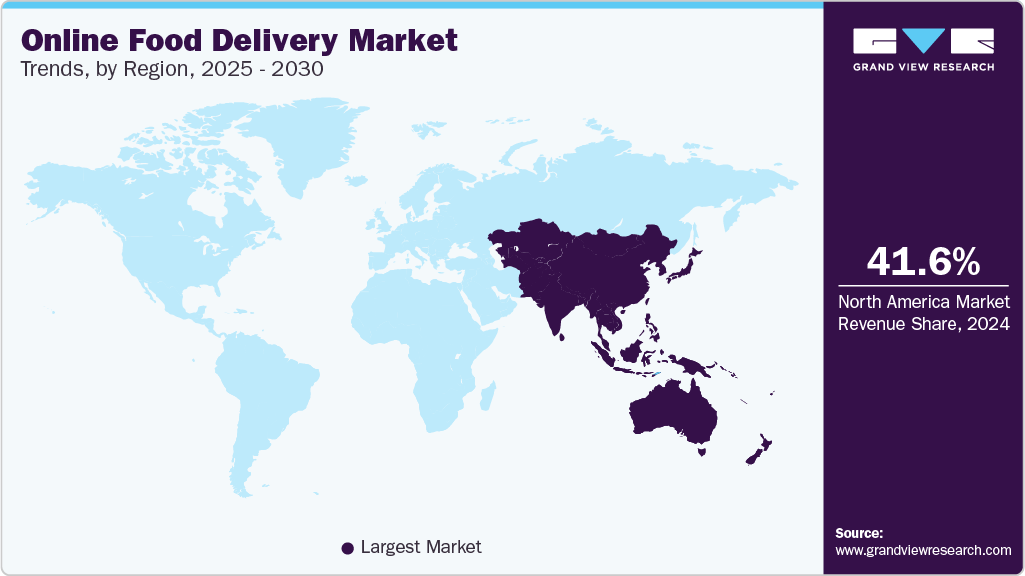 To learn more about this report, Download Free Sample Report
 U.S. Online Food Delivery Industry Trends
The online food delivery market in the U.S. is expected to grow significantly at a CAGR of 9.6% from 2025 to 2030 due to the dominance of major platforms such as DoorDash, Uber Eats, and Grubhub, which continuously innovate with features like real-time tracking and AI-driven recommendations. The culture of convenience and on-demand services, coupled with a strong gig economy supporting delivery personnel, has accelerated growth. Moreover, partnerships with convenience stores and grocery delivery integrations have broadened the scope beyond traditional restaurant meals.
Europe Online Food Delivery Industry Trends
The online food delivery market in Europe is anticipated to register a considerable growth from 2025 to 2030 due to strict food safety regulations and sustainability trends, pushing platforms to adopt eco-friendly packaging and transparent sourcing. The region’s high urban population density makes delivery operations cost-effective, while the popularity of meal kits and ready-to-eat options caters to health-conscious consumers. Government support for digital economies in countries such as France and the Netherlands also contributes to market expansion.
The UK online food delivery market is expected to grow rapidly in the coming years, owing to the high concentration of quick-service restaurants (QSRs) and dark kitchens optimizing delivery efficiency. Consumer preference for contactless payments and subscription loyalty programs (such as Deliveroo Plus) boosts order frequency.
The online food delivery market in Germany held a substantial market share in 2024. The market in the country is supported by its strong e-commerce culture and high smartphone penetration. The market benefits from a preference for cashless transactions and the expansion of regional delivery players like Lieferando. The increasing demand for organic and locally sourced meals has also led platforms to partner with specialty restaurants and health-focused vendors.
Asia Pacific Online Food Delivery Industry Trends
The online food delivery market in Asia Pacific is expected to register the fastest CAGR of 10.4% from 2025 to 2030, due to rapid urbanization, a young population, and the proliferation of super apps (like Grab and Meituan) that integrate food delivery with other services. Low labor costs enable affordable delivery fees, while the popularity of street food and local cuisine being available on apps drives frequent orders.
Japan online food delivery market is expected to grow rapidly in the coming years, driven by due to its aging population, which increasingly relies on convenient meal solutions. The integration of robotics and automation in food preparation and delivery enhances efficiency. Additionally, partnerships with convenience stores allow for 24/7 meal deliveries, catering to the country’s busy workforce.
The online food delivery market in China held a substantial market share in 2024, due to big technology companies like Meituan and Ele.me, which leverage AI and big data for hyper-localized services. The widespread use of digital wallets such as Alipay, WeChat Pay simplifies transactions, while live-streaming food promotions drive impulse purchases. The dense urban population and high demand for late-night snacks further support market growth.
Key Online Food Delivery Company
Key players operating in the online food delivery market are undertaking various initiatives to strengthen their presence and increase the reach of their products and services. Strategies such as expansion activities and partnerships are key in propelling the market growth.
Key Online Food Delivery Companies:
The following are the leading companies in the online food delivery market. These companies collectively hold the largest market share and dictate industry trends.
- Delivery Hero SE
- DoorDash
- Domino's Pizza Inc.
- Ele.me (Alibaba Group Holding Limited)
- Grubhub
- McDonald's
- Deliveroo
- Papa John's International, Inc.
- Pizza Hut
- Just Eat Takeaway.com
- Uber Technologies Inc.
- Waiter.com, Inc.
- Zomato Ltd.
Online Food Delivery Market Report Scope
Report Attribute
Details
Market size in 2024
USD 288.8 billion
Estimated market size in 2026
USD 355.6 billion
Projected market size by 2030
USD 505.5 billion
Growth rate
CAGR of 9.4% from 2025 to 2030
Actual data
2018 - 2024
Forecast period
2025 - 2030
Quantitative units
Revenue in USD million/billion and CAGR from 2025 to 2030
Report enterprise size
Revenue forecast, company share, competitive landscape, growth factors, and trends
Segments covered
Type, product, payment method, region
Regional scope
North America; Europe; Asia Pacific; Latin America; MEA
Country scope
U.S.; Canada; Mexico; UK; Germany; France; China; India; Japan; Australia; South Korea; Brazil; UAE; Kingdom of Saudi Arabia; and South Africa
Key companies profiled
Delivery Hero SE; DoorDash; Domino's Pizza Inc.; Ele.me (Alibaba Group Holding Limited); Grubhub; McDonald's; Deliveroo; Papa John's International, Inc.; Pizza Hut; Just Eat Takeaway.com; Uber Technologies Inc.; Waiter.com, Inc.; Zomato Ltd.
Customization scope
Free report customization (equivalent to 8 analysts working days) with purchase. Addition or alteration to country, regional & segment scope.
Pricing and purchase options
Avail customized purchase options to meet your exact research needs. Explore purchase options
Global Online Food Delivery Market Report Segmentation
This report forecasts revenue growth at the global, regional, and country levels and provides an analysis of the latest industry trends in each of the sub-segments from 2018 to 2030. For this study, Grand View Research has segmented the global online food delivery market report based on type, product, payment method, and region.
 To learn more about this report, Download Free Sample Report
 -
Type Outlook (Revenue, USD Billion, 2018 - 2030)
-
Restaurant to Consumer
-
Platform to Consumer
-
-
Product Outlook (Revenue, USD Billion, 2018 - 2030)
-
Grocery Delivery
-
Meal Delivery
-
-
Payment Method Outlook (Revenue, USD Billion, 2018 - 2030)
-
Online Payment
-
Cash on Delivery
-
-
Regional Outlook (Revenue, USD Billion, 2018 - 2030)
-
North America
-
U.S.
-
Canada
-
Mexico
-
-
Europe
-
UK
-
Germany
-
France
-
-
Asia Pacific
-
China
-
India
-
Japan
-
South Korea
-
Australia
-
-
Latin America
-
Brazil
-
-
Middle East & Africa
-
UAE
-
Saudi Arabia
-
South Africa
-
-
Frequently Asked Questions About This Report
The global online food delivery market size was valued at USD 288.8 billion in 2024 and is estimated at USD 355.6 billion for 2026.
The global online food delivery market is expected to grow at a CAGR of 9.4% from 2025 to 2030, reaching USD 505.5 billion by 2030.
Asia Pacific dominated the online food delivery market, with a share of over 41.0% in 2024. This is attributable to the growing middle class, rapid urbanization, a young population, and the proliferation of super apps that integrate food delivery with other services.
Some key players operating in the online food delivery market include Delivery Hero SE, DoorDash, Domino's Pizza Inc., Ele.me (Alibaba Group Holding Limited), Grubhub, McDonald's, Deliveroo, Papa John's International, Inc., Pizza Hut, Just Eat Takeaway.com, Uber Technologies Inc., Waiter.com, Inc., Zomato Ltd.
Key factors that are driving the online food delivery market growth include the increasing penetration of smartphones and internet connectivity. With more people gaining access to affordable smartphones and high-speed internet, ordering food online has become more convenient.
About the Author(s)
Next Generation Technologies Research Team
Technology · Next Generation TechnologiesThis report was authored by the next generation technologies research team at Grand View Research - comprising two research analysts, one senior research analyst, and one industry expert - with specialized expertise in the next generation technologies segment of the technology industry. All findings are based on proprietary technology databases, executive interviews, and regulatory analysis, subject to internal peer review prior to publication.
Last Updated:
Speak to Analyst

Customize this report to your needs - add regions, segments, or data points, with 20% free customization.
Or view our licence options:


ISO 9001:2015 & 27001:2022 Certified
We are GDPR and CCPA compliant! Your transaction & personal information is safe and secure. For more details, please read our privacy policy.


