
- Home
- »
- Pharmaceuticals
- »
-
Oral Analgesics Market Size & Share Report, 2026-2033GVR Report cover

Oral Analgesics Market (2026 - 2033)
Size, Share & Trends Analysis Report By Drug Class (Non-opioid Analgesics, Combination Analgesics), By Prescription Status, By Formulation, By Distribution Channel, By Region, And Segment Forecasts
Market Size, 2025
$22.5BMarket Estimate, 2026
$23.3BMarket Forecast, 2033
$31.0BCAGR, 2026–2033
4.2%Oral Analgesics Market Summary
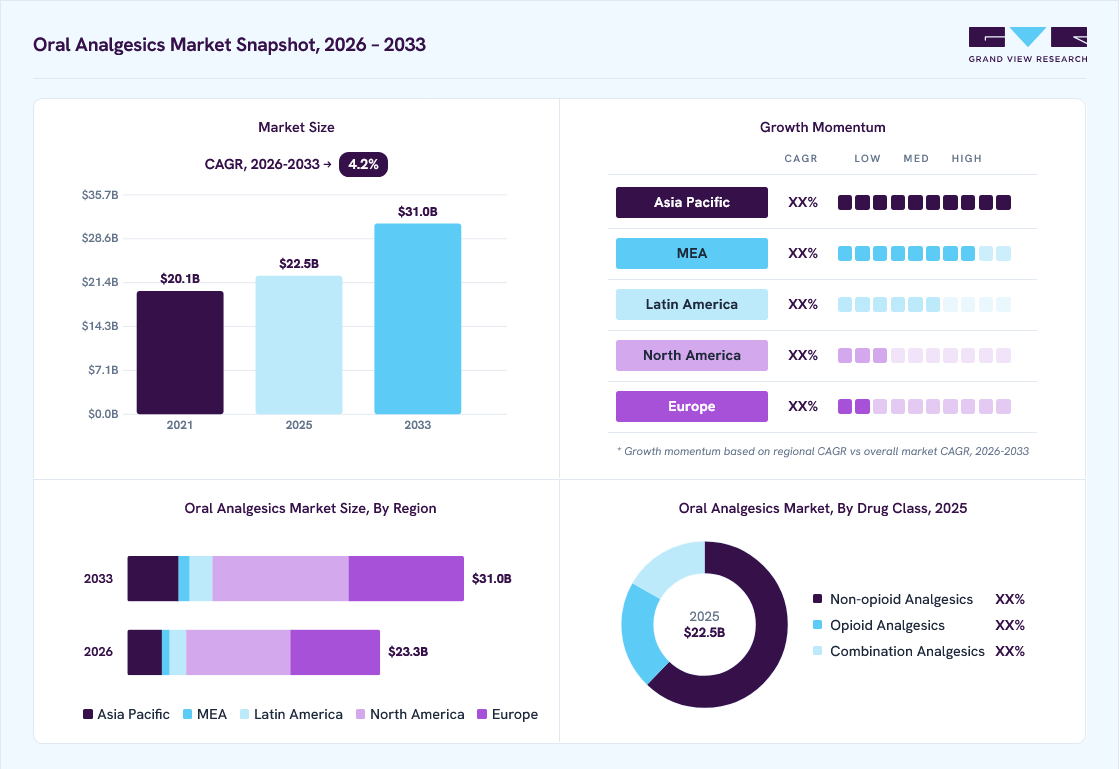
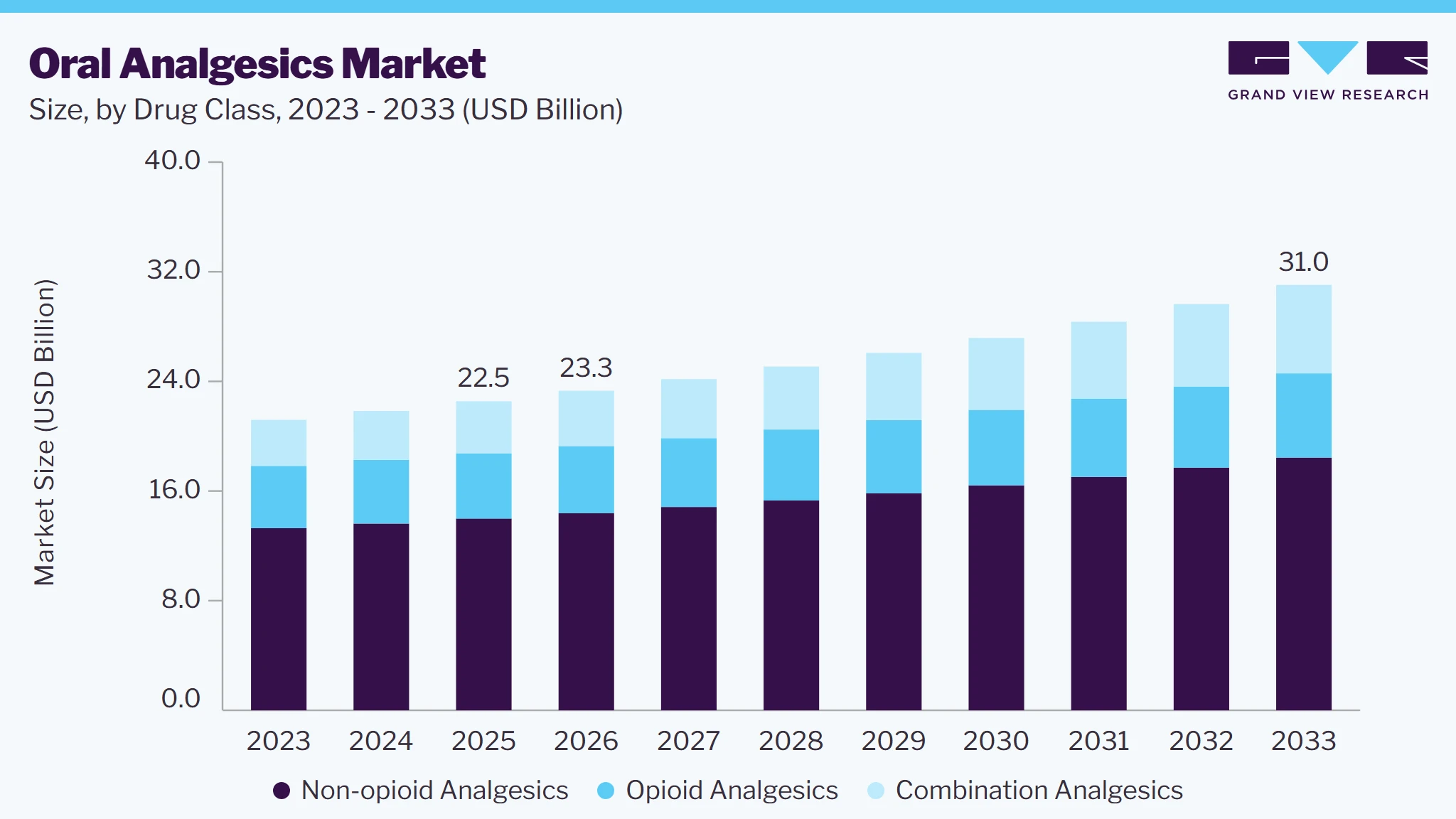
The global oral analgesics market size was valued at USD 22.5 billion in 2025 and is projected to grow from USD 23.3 billion in 2026 to USD 31.0 billion in 2033, at a CAGR of 4.2% from 2026 to 2033. North America dominated the market, accounting for the largest revenue share of 41.2% in 2025. The market is mature, supported by continued demand for medicines used to manage acute and chronic pain, including headache, musculoskeletal pain, dental pain, arthritis, menstrual pain, and postoperative pain.
 Source: Grand View Research, IR Documents, Primary Interviews, Paid DatabasesTo learn more about this report,
 Download Free Sample Report
Key Market Trends & Insights
- By drug class: Non-opioid analgesics segment held the highest market share of 62.1% in 2025.
- By prescription status: OTC segment held the highest market share of 63.4% in 2025.
- By formulation: Tablets/caplets segment held the highest market share in 2025.
- By distribution channel: Retail pharmacies segment held the highest market share in 2025.
Regional Highlights
- Largest regional market: North America (41.2% revenue share, 2025)
- Fastest-growing regional market: Asia Pacific (highest CAGR, 2026-2033)
- By country: The U.S. held the largest market share in 2025
Market Size & Forecast
- Market size in 2025: USD 22.5 Billion
- Estimated market size in 2026: USD 23.3 Billion
- Projected market size by 2033: USD 31.0 Billion
- CAGR (2026-2033): 4.2%
Three ways to get this report
Buy it, customize it, or ask a question.Ask an Analyst
Analyst response in 1 business day
- AccessReport author, directly
- Reply timeWithin 1 working day
- No sales callDirect answer only
- FormatEmail reply
- CostFree, no cost
Get the Full Report
What the study covers
- FormatsPDF · Excel · Dashboard
- Timeline2026–2033 annual, 2025 base
- Coverage20+ countries, 5 regions
- Companies10+ key players profiled
Customize the Report
20% free customization
- IncludeCountries, segments, points
- TailorTo your product definition
- ExtendDeeper competitor detail
- OrA fully bespoke study
- Turnaround5–10 working days
Non-opioid medicines, particularly acetaminophen/paracetamol and nonsteroidal anti-inflammatory drugs (NSAIDs), account for a major part of routine oral pain management because of their broad availability through prescription and over-the-counter channels. Recent U.S. data also show frequent use of acetaminophen, ibuprofen, and aspirin among adults, supporting continued demand for established oral pain medicines.
 To learn more about this report, Download Free Sample Report
At the same time, opioid analgesics remain important for moderate to severe pain but face tighter safety controls due to risks related to misuse, dependence, and overdose. Regulatory focus is therefore shifting toward non-opioid pain medicines, while product development continues to focus on combination formulations, dosing convenience, safety, and longer pain relief.
Market Dynamics
The market is supported by continued demand for medicines used to manage headache, musculoskeletal pain, dental pain, menstrual pain, arthritis, and acute postoperative pain. Acetaminophen and NSAIDs remain widely used because of their established role in pain management and availability through prescription and over-the-counter channels. Demand for non-opioid medicines is also increasing as healthcare providers seek pain treatments without the dependence and misuse risks associated with opioids. For instance, in August 2025, Bayer launched Aspirina in the U.S. for temporary relief of minor aches and pains associated with headache, muscle aches, toothache, menstrual cramps, and minor arthritis pain. The launch expanded access to an oral non-opioid analgesic across several common pain conditions and supported product activity within the consumer pain relief category. The broad use of oral analgesics for common acute and recurring pain conditions continues to support demand across self-care and outpatient treatment. Product availability through pharmacies, retail stores, and online channels also supports access to oral pain medicines. Continued use of established non-opioid products therefore remains an important source of demand within the market.
Safety risks associated with analgesic use remain a major market restraint. NSAIDs are associated with gastrointestinal bleeding, kidney problems, and cardiovascular complications, while excessive acetaminophen use is associated with liver injury. Opioid analgesics carry additional risks related to misuse, dependence, and overdose, resulting in tighter prescribing and dispensing controls in several markets. These risks influence treatment duration, dosage, patient selection, and product choice, particularly for repeated or long-term pain management. Combination oral analgesics also require careful dose management because consumers can use multiple products containing the same active ingredient. Safety considerations increase the importance of dosage instructions, patient education, clinical assessment, and risk monitoring. They also influence product development because manufacturers need to establish appropriate safety information and dosing recommendations. These factors restrict the use of certain analgesics among specific patient groups and support demand for products with different mechanisms of action. Safety concerns therefore remain an important limitation on unrestricted use of oral analgesics, particularly where prolonged treatment or higher doses are involved.
Expansion of oral analgesic formulations provides an opportunity for manufacturers to differentiate established pain medicines through combination products, dosing options, and formulations designed for specific pain conditions. Oral combinations that use established non-opioid ingredients provide treatment options for consumers who require broader pain relief while maintaining an oral route of administration. For instance, in July 2026, Kenvue received U.S. FDA approval for an over-the-counter fixed-dose combination of acetaminophen and naproxen sodium for pain relief. The approval added a new oral combination product and expanded the range of non-opioid treatment options available for pain management. Product development based on combinations also supports dosing convenience and portfolio expansion within the established oral analgesics category. Manufacturers can address different consumer requirements through variations in active ingredients, dose strength, formulation, and duration of relief. This provides a product development opportunity in a mature market where established ingredients remain widely used. Expansion of combination oral analgesics also supports differentiation among consumer health products and strengthens the role of oral formulations in self-care and outpatient pain management.
Market Concentration & Characteristics
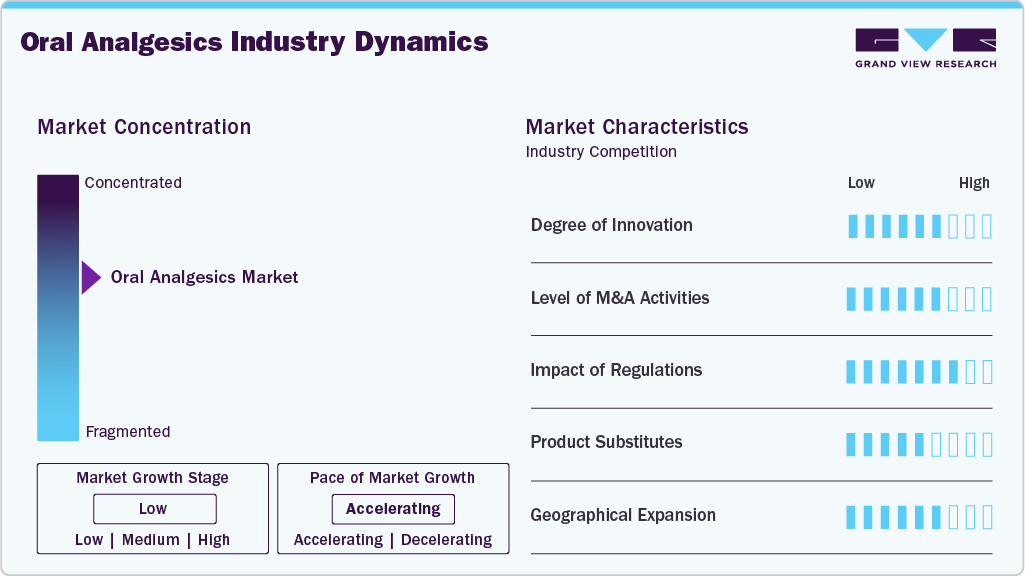
Innovation in the oral analgesics industry is moderate to high, with product development focused on non-opioid mechanisms, combination formulations, dosage convenience, and duration of pain relief. Acetaminophen and NSAIDs remain established treatment options, while research is expanding into alternative mechanisms for pain control. Combination products also support innovation by bringing established active ingredients into single oral formulations. Development includes tablets, capsules, extended-release formulations, and other dosage formats designed around treatment needs. Innovation is therefore focused on both new drug mechanisms and improvements to established products. The mature product category keeps innovation centered on safety, convenience, formulation, and differentiated pain management.
Barriers to entry in the oral analgesics industry are moderate to high due to regulatory requirements, manufacturing standards, product safety requirements, and distribution needs. Prescription products require clinical and regulatory evidence, while OTC analgesics must meet requirements covering active ingredients, dosage, labeling, warnings, and permitted claims. Manufacturers also require quality-controlled production facilities and reliable supply chains. Brand recognition creates an additional barrier in the OTC segment, where consumers often select established products. Access to pharmacy, retail, hospital, and online distribution channels also supports established companies. Generic manufacturers face lower development requirements for established ingredients, but regulatory and quality requirements remain. These factors make entry more difficult for companies without regulatory, manufacturing, supply chain, and distribution capabilities.
 To learn more about this report, Download Free Sample Report
Regulations have a high impact on the oral analgesics industry because product safety, dosage, labeling, manufacturing quality, and promotional claims are subject to regulatory requirements. OTC analgesics require clear directions, warnings, active ingredient information, and dosage limits. Prescription analgesics face additional requirements related to clinical evidence, prescribing information, and post-market safety monitoring. Opioid analgesics face further controls because of misuse, dependence, addiction, and overdose risks. Regulatory requirements also influence product registration, formulation changes, manufacturing processes, and distribution. Differences between countries in OTC classification, prescription requirements, labeling standards, and controlled-substance rules create additional compliance requirements for manufacturers. These factors directly influence product development, availability, and commercialization across the market.
The threat from product substitutes is moderate because several alternatives are available for pain management, including topical analgesics, injectable medicines, physical therapy, heat or cold therapy, and other non-drug interventions. The level of substitution differs according to pain type, severity, duration, and treatment setting. Oral analgesics remain widely used for headache, dental pain, menstrual pain, musculoskeletal pain, arthritis, and other common conditions because of convenient administration and broad availability. Topical products are useful for selected localized pain conditions, while injectable medicines serve specific clinical needs. Non-drug interventions also have a role in selected chronic pain conditions. However, these alternatives do not replace oral medicines across all pain conditions. Therefore, substitution creates competitive pressure while oral formulations retain a broad role in pain management.
Geographical expansion in the oral analgesics industry is moderate to high because pain relief products have broad use across developed and emerging healthcare markets. Oral analgesics are distributed through pharmacies, hospitals, retail stores, supermarkets, and online channels. Expansion is supported by demand for self-care medicines and treatment of common pain conditions. Emerging markets provide opportunities through wider access to pharmacies, healthcare services, and modern retail channels. However, international expansion requires compliance with country-specific requirements for product registration, OTC classification, labeling, dosage, manufacturing, and distribution. Differences in healthcare systems and consumer purchasing behavior also influence product positioning. Local generic manufacturers add competition in markets where lower-priced medicines have a strong role. Established distribution networks therefore remain important for geographic expansion.
Analyst Perspective
The market is supported by continued demand for accessible pain management across acute and chronic conditions. Non-opioid analgesics remain widely used across OTC and prescription channels, while combination products provide additional treatment options. Competition is shaped by established brands, generic manufacturers, product pricing, distribution reach, and formulation options. Product safety and regulatory requirements remain key factors.
Drug Class Insights
The non-opioid analgesics segment dominated the market with the largest revenue share of 62.1%, supported by broad use for headache, musculoskeletal pain, dental pain, menstrual pain, and arthritis. Wide OTC availability through pharmacies and retail channels supports consumer access. Established use of acetaminophen and NSAIDs supports demand across acute and chronic pain. Generic availability supports affordability across developed and emerging markets. Prescription use adds demand for moderate and severe pain management. Increasing use of non-opioid treatment options also supports the segment. Product availability across tablets, capsules, and oral liquids provides options across patient groups. For instance, in March 2025, Haleon plc launched Sonridor in Brazil, a paracetamol-based oral pain relief product using Panadol’s Optizorb technology. The launch expanded Haleon’s oral non-opioid analgesic portfolio and addressed demand for affordable pain relief.
The combination analgesics segment is projected to register the fastest CAGR of 6.9%, supported by increasing use of products that combine two or more analgesic ingredients in a single oral dosage form. These products provide pain relief through different mechanisms, supporting their use across headache, musculoskeletal, dental, and other pain conditions. Fixed-dose combinations reduce the need to take separate medicines, supporting dosing convenience. Product development focuses on combining established analgesic ingredients and providing different dosage options. OTC availability supports consumer access, while prescription combinations serve patients requiring stronger pain control. Combination products also allow companies to extend established analgesic brands through new formulations and product variants.
Prescription Status Insights
The OTC segment dominated the market with the largest revenue share of 63.4%, supported by frequent use for headache, muscle pain, dental pain, menstrual pain, and other common conditions. Easy access through retail pharmacies supports consumer purchases without a prescription. Supermarkets and online pharmacies further expand product availability. Established use of acetaminophen, ibuprofen, naproxen, and aspirin supports repeat demand. Self-care practices support OTC use for mild-to-moderate pain. Generic and branded products provide different price points across consumer groups. Tablets, capsules, and oral liquids also provide product choices for consumers. For instance, in June 2025, Haleon plc completed the acquisition of the remaining stake in Tianjin TSKF Pharmaceutical Co. Ltd., making it a wholly owned subsidiary. TSKF manufactures and distributes OTC pain relief brands including Fenbid, supporting Haleon’s OTC analgesic portfolio in China.
The prescription segment is projected to register the fastest CAGR of 4.9%, supported by increasing demand for prescription treatment for moderate-to-severe acute pain and chronic pain conditions. Prescription analgesics provide treatment options when OTC medicines do not provide sufficient pain relief. Prescription NSAIDs continue to be used for musculoskeletal and inflammatory pain, while prescription opioids serve selected cases of severe pain. Medical supervision supports dosage selection and treatment duration for these products. Development of oral non-opioid medicines is also expanding prescription treatment options for acute pain. Broader diagnosis and treatment of chronic pain conditions further supports prescription product demand. Prescription distribution through hospitals and retail pharmacies provides access through healthcare professionals and pharmacy networks.
Formulation Insights
The tablets/caplets segment dominated the market with the largest revenue share of 65.0%, supported by broad use for headache, dental pain, musculoskeletal pain, arthritis, and menstrual pain. Tablets and caplets are suitable for large-scale manufacturing, supporting product availability and competitive pricing. Their solid form supports convenient storage, handling, and distribution through pharmacies, retail stores, and online channels. Multiple strengths allow dose selection across OTC and prescription products. Extended-release tablets also support longer dosing intervals for selected pain conditions. Established consumer familiarity with tablets and caplets supports repeat use for common pain conditions. For instance, in August 2025, Health Canada issued a Notice of Compliance for Haleon’s Robax Platinum, an oral tablet containing methocarbamol and ibuprofen, supporting the company’s tablet-based oral analgesic portfolio.
The oral liquids segment is projected to grow at a CAGR of 5.1%, supported by demand for dosage forms that are easier to administer to children and people who have difficulty swallowing solid medicines. Liquid formulations allow dose measurement based on age and treatment needs, supporting pediatric pain and fever management. Syrups, suspensions, and oral drops provide flexibility in dosing and administration. Demand for pediatric analgesics supports continued use of oral liquids across pharmacies and retail channels. Product development also focuses on dosing devices and formulation characteristics that support accurate administration. These factors support greater use of liquid formulations within oral pain management, particularly among pediatric users and patients requiring flexible dosing.
Distribution Channel Insights
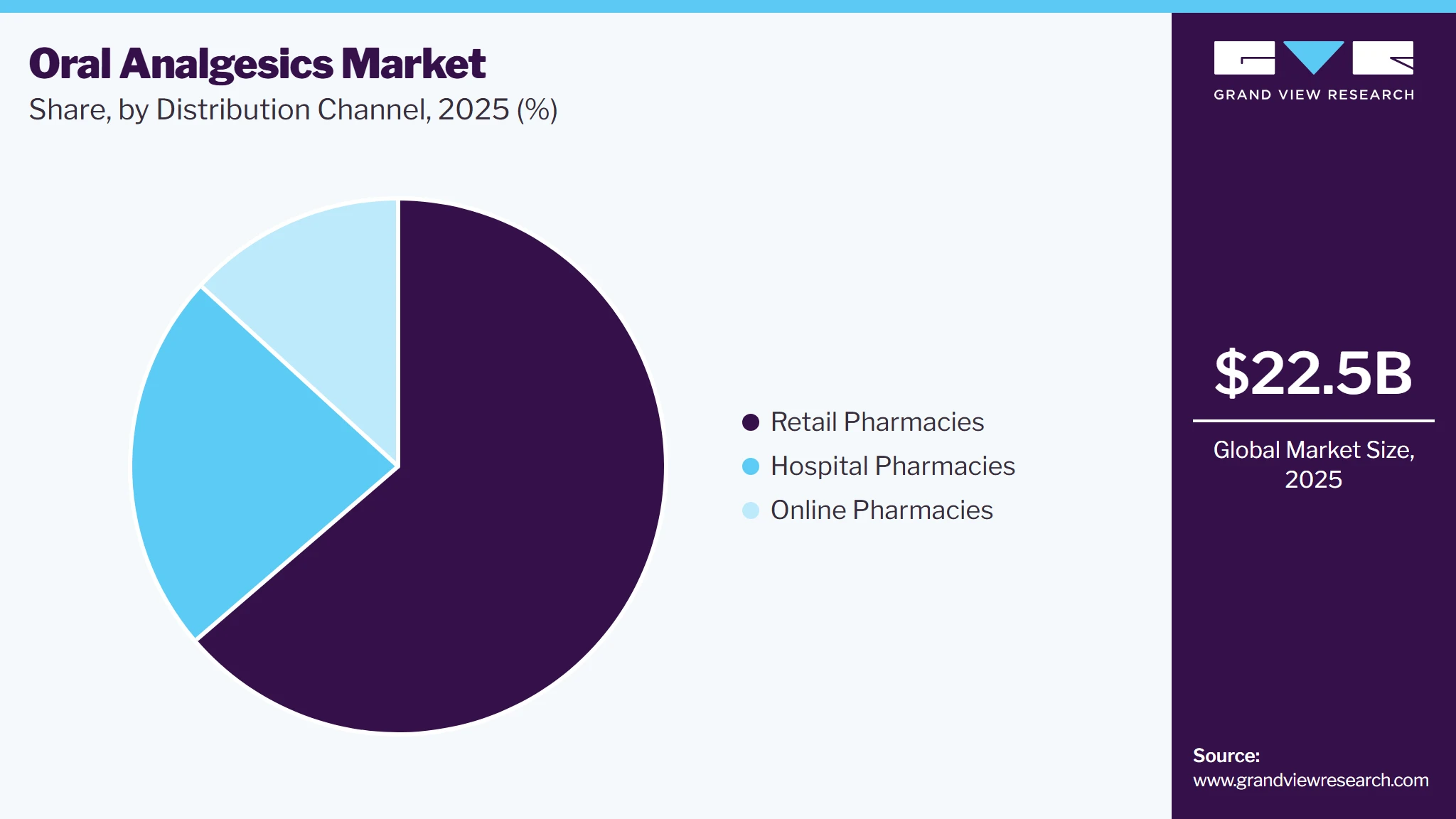
The retail pharmacies segment dominated the market with the largest revenue share of 63.7%, supported by direct consumer access to OTC pain medicines, established pharmacy networks, frequent purchases for common pain conditions, pharmacist guidance, and broad product availability. Retail pharmacies stock branded and generic acetaminophen, NSAIDs, and combination analgesics, providing consumers with different product and price options. Their presence across urban and regional markets supports regular access to pain relief products. Retail pharmacies also dispense prescription analgesics, allowing the channel to serve both OTC and prescription demand. Pharmacy staff can provide guidance on product selection, dosage, and product warnings, supporting appropriate use of oral analgesics. These factors maintain retail pharmacies as the main distribution channel for oral pain relief products.
 To learn more about this report, Download Free Sample Report
The online pharmacies segment is projected to register the fastest CAGR of 9.4%, supported by increasing consumer use of digital purchasing, home delivery, product comparison, and electronic payment services. Online channels provide access outside traditional pharmacy hours and support repeat purchases of commonly used analgesics. Digital platforms also allow consumers to compare brands, strengths, pack sizes, and prices before purchase. Prescription upload and verification services support online dispensing of prescription oral analgesics where permitted. Expansion of e-commerce infrastructure and pharmacy delivery networks further supports this channel. Growing smartphone and internet use also supports digital medicine purchases. Online pharmacies also provide convenient access for consumers who prefer home delivery over visits to physical pharmacies, supporting continued channel expansion.
Regional Insights
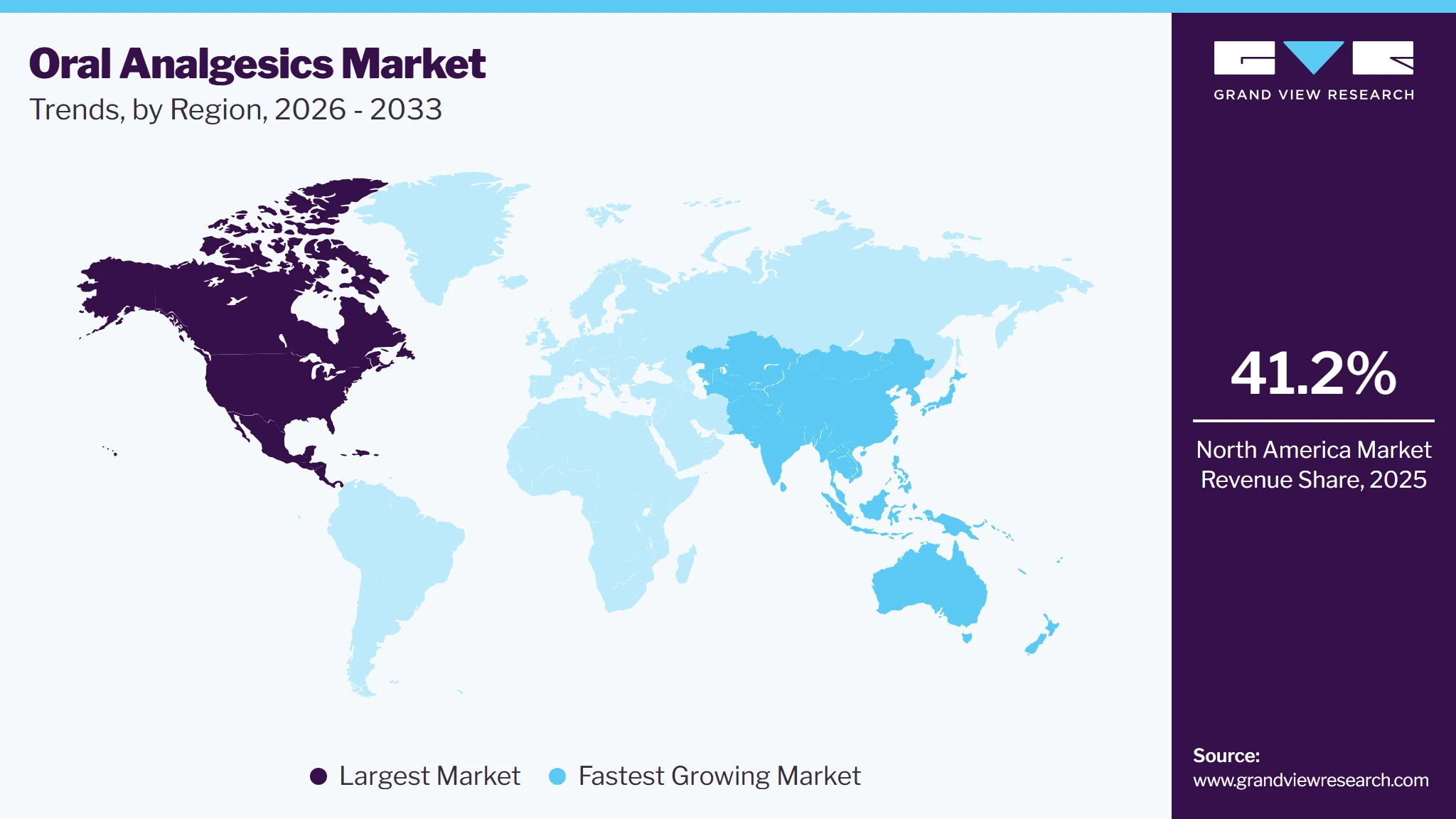
North America dominates the oral analgesics market in 2025 with a market share of 41.2% due to high use of OTC pain relief medicines and established pharmacy and retail distribution. Demand is supported by the high prevalence of headache, arthritis, musculoskeletal pain, and other conditions requiring routine pain management. Consumers have broad access to acetaminophen, ibuprofen, naproxen, and combination analgesics through pharmacies, supermarkets, and online channels. The region also has strong demand for self-care medicines, supporting frequent use of oral analgesics for mild-to-moderate pain. Prescription demand remains relevant for moderate and severe pain, although opioid use is subject to tighter prescribing practices. Product innovation is focused on non-opioid medicines, combination formulations, and convenient dosing options.
 To learn more about this report, Download Free Sample Report
U.S. Oral Analgesics Market Trends
The oral analgesics market in the U.S. represents the largest market in North America, supported by high consumer spending on OTC medicines and wide product availability. Acetaminophen and NSAIDs are commonly used for headache, back pain, arthritis, dental pain, and other acute conditions. The large retail pharmacy network and strong online medicine sales provide broad access to oral pain relief products. Generic medicines create strong price competition, while established consumer brands maintain demand through product recognition and distribution reach. Product development is focused on combination formulations, dosing convenience, and alternatives to opioid analgesics.
Europe Oral Analgesics Market Trends
The oral analgesics market in Europe is well-established, supported by widespread use of OTC medicines and established healthcare distribution systems. Demand is linked to common conditions such as musculoskeletal pain, headache, arthritis, and dental pain across the region. NSAIDs and acetaminophen remain important product categories, while differences in prescription and OTC classification affect product availability across individual countries. Generic medicines have a strong role in several European markets and create price competition among manufacturers.
The UK oral analgesics market is supported by high use of OTC pain relief products through pharmacies, supermarkets, and online retail channels. Self-care practices contribute to regular demand for oral analgesics and reduce the need for medical consultation for mild pain. Prescription analgesics remain important for moderate and severe pain, while opioid prescribing receives greater attention due to dependence and misuse risks. Manufacturers are focusing on accessible formulations, combination products, and non-opioid treatment options.
The oral analgesics market in Germany is large, supported by a broad pharmacy network and strong use of OTC medicines for common pain conditions. Generic medicines have a significant role, creating competition in product availability and price. Consumer preference for self-treatment also supports OTC analgesic use for mild-to-moderate pain. The market is further supported by product development focused on different strengths, dosage forms, combination products, and non-opioid treatment options.
France oral analgesics marketis developed, supported by widespread access to pharmacies and established consumer use of OTC pain medicines. Paracetamol remains a key product for routine pain management, while NSAIDs are used for inflammatory and musculoskeletal conditions. Pharmacy-based distribution provides consumers with access to multiple oral formulations and dosage strengths. Increased attention to appropriate analgesic use supports demand for products with clear dosing information and safety guidance. Product development is focused on formulation variety, combination products, and treatment options that address pain without relying on opioid medicines.
Asia Pacific Oral Analgesics Market Trends
The oral analgesics market in the Asia Pacific records the fastest-growing CAGR of 5.8% during the forecast period, supported by its large population, expanding healthcare access, and wider OTC medicine availability. Rising pharmacy penetration and modern retail development are improving access to branded and generic analgesics. Price-sensitive consumers support demand for generic acetaminophen and NSAIDs. Local pharmaceutical manufacturing also supports product availability and competition across branded and generic categories.
Japan oral analgesics market is mature, supported by an aging population and sustained demand for pain management products. Musculoskeletal disorders, arthritis, headaches, and other age-related conditions support demand for oral analgesics among older adults. OTC pain medicines have established distribution through pharmacies, drugstores, and online channels. Acetaminophen and NSAIDs remain widely used for common pain conditions, while prescription analgesics serve patients with more complex pain needs. Consumer preference for convenient self-care products supports continued use of OTC oral formulations. Manufacturers are also focusing on dosage convenience, combination products, and formulations suited to different age groups and pain conditions.
The oral analgesics market in China is supported by its large population, broad pharmaceutical manufacturing sector, and increasing access to healthcare products. Expansion of retail pharmacies and online medicine platforms has increased access to OTC pain relief products. Generic medicines account for a significant part of product availability and create competition based on price and distribution. Rising healthcare awareness is supporting greater attention to pain management and appropriate medicine use. Domestic pharmaceutical manufacturers also contribute to a wide range of oral analgesic products across different price levels and dosage forms.
Latin America Oral Analgesics Market Trends
The oral analgesics market in Latin America is growing, supported by widespread use of OTC medicines and increasing access to pharmacy-based healthcare. Acetaminophen and NSAIDs are commonly used for headaches, muscle pain, fever-related discomfort, arthritis, and dental pain. Consumer preference for self-treatment supports demand for easily accessible oral formulations. Generic products have a strong role in several countries and improve access to lower-cost pain medicines. Urbanization and expansion of retail pharmacy networks are supporting wider distribution of analgesic products. Local and international manufacturers compete through product availability, pricing, dosage formats, and brand recognition across the region.
Brazil oral analgesics market represents a major market in Latin America, supported by its large population and extensive retail pharmacy network. Acetaminophen, dipyrone, ibuprofen, and other oral analgesics are widely used for headache, fever, musculoskeletal pain, and other common conditions. OTC self-care contributes substantially to demand for oral pain relief products. Generic medicines have strong penetration and provide lower-cost alternatives across common analgesic categories. Expansion of pharmacy chains and online retail channels is improving product access across urban areas. Manufacturers compete through branded products, generic formulations, combination medicines, and different dosage formats, supporting a broad and diverse market.
Middle East & Africa Oral Analgesics Market Trends
The oral analgesics market in MEA is supported by demand for accessible treatment of common pain conditions and gradual expansion of pharmaceutical distribution networks. Pharmacy-based purchasing remains an important channel, while urbanization is supporting the development of modern retail and healthcare services. Demand varies across countries due to differences in healthcare access, purchasing power, and medicine distribution. Generic oral analgesics have an important role in improving product availability at lower price points. Growth in private healthcare services and wider access to pharmacies is supporting continued use of oral pain relief products.
Saudi Arabia oral analgesics market is supported by high pharmacy access and widespread use of OTC medicines for common pain conditions. A growing healthcare sector and increasing access to private pharmacies support product availability across urban areas. The country's large working-age population also supports demand for convenient treatments for routine pain and minor injuries. Online pharmacy services are expanding consumer access to OTC medicines and improving product availability. Competition among branded and generic products remains important, with manufacturers focusing on pricing, product variety, dosage convenience, and distribution reach.
Key Oral Analgesics Company Insights
The market is moderately concentrated, with competition distributed across consumer healthcare, pharmaceutical, and generic drug manufacturers. Haleon plc and Kenvue Inc. maintain strong positions through established OTC pain relief portfolios and broad retail distribution. Bayer AG and Reckitt Benckiser Group plc compete through widely used oral analgesic brands and consumer healthcare products. Teva Pharmaceutical Industries Ltd. and Viatris Inc. strengthen competition through generic and prescription analgesics. Sanofi and Pfizer Inc. contribute established pharmaceutical portfolios, while Sun Pharmaceutical Industries Ltd. and Cipla Limited support competition through branded and generic products across emerging markets. Competitive positions are influenced by brand recognition, product availability, pricing, distribution reach, and portfolio breadth. The presence of multiple global and regional companies limits concentration, while leading players retain established positions across major product categories.
Key Oral Analgesics Companies
The following key companies have been profiled for this study on the oral analgesics market.
-
Haleon plc
-
Kenvue Inc.
-
Bayer AG
-
Reckitt Benckiser Group plc
-
Teva Pharmaceutical Industries Ltd.
-
Viatris Inc.
-
Sanofi
-
Pfizer Inc.
-
Sun Pharmaceutical Industries Ltd.
-
Cipla Limited
Competitive Benchmarking
Operating Strategies
Competitive Edge
Weaknesses
Mature Players: Haleon plc
- Expand established oral analgesic portfolios across acetaminophen, NSAIDs, and combination products to serve different pain conditions.
- Strengthen pharmacy, retail, supermarket, and online distribution to maintain broad product availability across major markets.
- Improve formulations, dosage options, and product convenience while maintaining established brands in the OTC pain relief category.
- Strong brand recognition supports consumer product selection and repeat purchases across OTC pain relief categories.
- Broad manufacturing and distribution networks support product availability across pharmacies, retail stores, hospitals, and online channels.
- Diversified portfolios across pain relief products and other healthcare categories provide multiple distribution channels and customer relationships.
- Face pricing pressure from generic manufacturers and private-label oral analgesic products with similar active ingredients.
- Established products face competition from manufacturers offering comparable formulations at lower prices.
- Large operating structures and broad product portfolios can make product changes and responses to shifts in consumer demand slower.
Emerging Players: Viatris Inc.
- Expand branded and generic oral analgesic portfolios across prescription and OTC product categories to increase product availability.
- Strengthen manufacturing and regional distribution capabilities, particularly across emerging markets with demand for affordable pain relief products.
- Maintain competitive pricing while expanding pharmacy, hospital, distributor, and retail channel coverage for commonly used analgesics.
- Strong generic manufacturing capabilities support access to widely used oral analgesic ingredients and formulations.
- Established pharmaceutical distribution networks provide access to pharmacies, hospitals, distributors, and retail channels across multiple regions.
- Competitive pricing supports product adoption in price-sensitive markets where generic oral analgesics are widely used.
- Face strong price competition from other generic manufacturers offering similar active ingredients and formulations.
- Limited product differentiation can reduce pricing flexibility across widely available analgesic products.
- Dependence on regulatory approvals, manufacturing compliance, and regional distribution networks can increase operating requirements across different markets.
Recent Developments
-
In May 2026, Viatris Inc. announced that the U.S. FDA accepted its New Drug Application for fast-acting meloxicam (MR-107A-02) for the treatment of moderate-to-severe acute pain. The investigational product is an oral non-opioid NSAID formulation designed for faster dissolution and absorption than currently approved oral meloxicam products.
-
In December 2025, Pfizer Inc. and Cipla Limited entered an exclusive marketing and distribution partnership in India covering four Pfizer brands, including Dolonex, a non-steroidal anti-inflammatory drug (NSAID). Cipla received the rights to market, distribute, and sell the products in India, while Pfizer continued to manufacture, source, and supply them.
-
In May 2025, Cipla Limited acquired the Doloneuron and Zolsoma trademarks from Pulse Pharmaceuticals Private Limited. Doloneuron is used in neuropathic pain management, supporting Cipla’s expansion of its pain management portfolio.
Oral Analgesics Market Report Scope
Report Attribute
Details
Market size in 2025
USD 22.5 billion
Estimated market size in 2026
USD 23.3 billion
Projected market size by 2033
USD 31.0 billion
Growth rate
CAGR of 4.2% from 2026 to 2033
Historical data
2021 - 2025
Forecast period
2026 - 2033
Quantitative units
Revenue in USD billion and CAGR from 2026 to 2033
Report coverage
Revenue forecast, company ranking, competitive landscape, growth factors, trends
Segments covered
Drug class, prescription status, formulation, distribution channel, region
Regional scope
North America; Europe; Asia Pacific; Latin America; MEA
Country scope
U.S.; Canada; Mexico; UK; Germany; France; Italy; Spain; Denmark; Sweden; Norway; China; Japan; India; Australia; South Korea; Thailand; Brazil; Argentina; South Africa; Saudi Arabia; UAE; Kuwait
Key company profiled
Haleon plc; Kenvue Inc.; Bayer AG; Reckitt Benckiser Group plc; Teva Pharmaceutical Industries Ltd.; Viatris Inc.; Sanofi; Pfizer Inc.; Sun Pharmaceutical Industries Ltd.; Cipla Limited
Customization scope
Free report customization (equivalent up to 8 analysts working days) with purchase. Addition or alteration to country, regional & segment scope.
Pricing and purchase options
Avail customized purchase options to meet your exact research needs. Explore purchase options
Global Oral Analgesics Market Report Segmentation
This report forecasts revenue growth at global, regional, and country levels and provides an analysis of the latest industry trends in each of the sub-segments from 2021 to 2033. For this study, Grand View Research has segmented the global oral analgesics market report based on drug class, prescription status, formulation, distribution channel, and region:
-
Drug Class Outlook (Revenue, USD Billion, 2021 - 2033)
-
Non-opioid Analgesics
-
Opioid Analgesics
-
Combination Analgesics
-
-
Prescription Status Outlook (Revenue, USD Billion, 2021 - 2033)
-
OTC
-
Prescription
-
-
Formulation Outlook (Revenue, USD Billion, 2021 - 2033)
-
Tablets / Caplets
-
Capsules
-
Oral Liquids
-
Others
-
-
Distribution Channel Outlook (Revenue, USD Billion, 2021 - 2033)
-
Hospital Pharmacies
-
Retail Pharmacies
-
Online Pharmacies
-
-
Regional Outlook (Revenue, USD Billion, 2021 - 2033)
-
North America
-
U.S.
-
Canada
-
Mexico
-
-
Europe
-
UK
-
Germany
-
France
-
Italy
-
Spain
-
Denmark
-
Sweden
-
Norway
-
-
Asia Pacific
-
Japan
-
China
-
India
-
Australia
-
South Korea
-
Thailand
-
-
Latin America
-
Brazil
-
Argentina
-
-
Middle East & Africa
-
South Africa
-
Saudi Arabia
-
UAE
-
Kuwait
-
-
Research Methodology
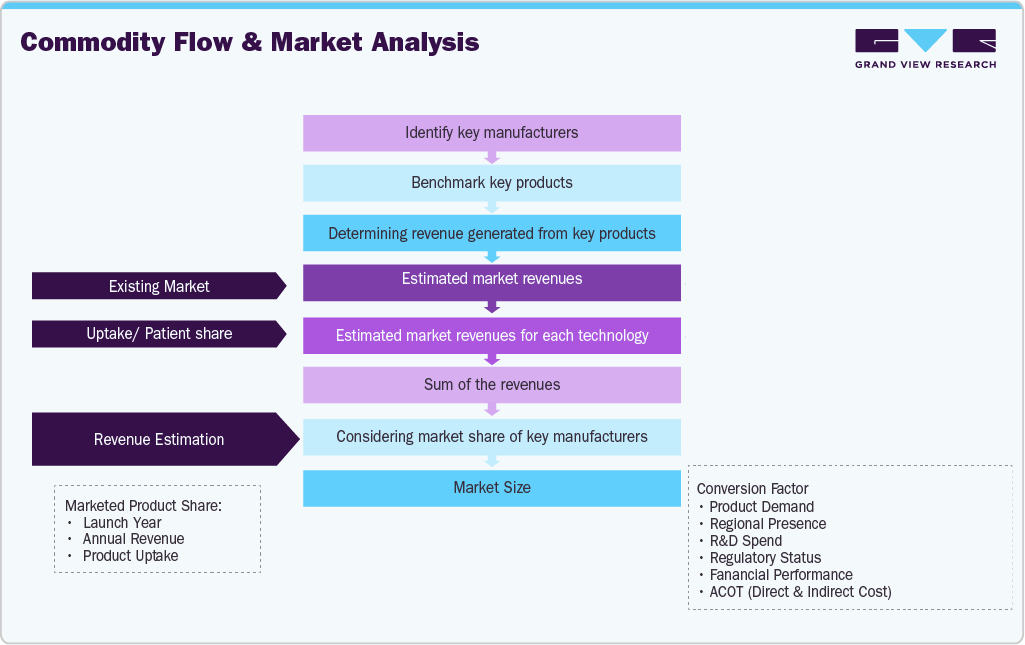
The oral analgesics market size is estimated using a commodity flow and revenue-based model. The process starts with identifying key manufacturers and their oral analgesic products across acetaminophen, NSAIDs, combination products, and other oral formulations. Key products are benchmarked based on product sales, prescription and OTC availability, dosage forms, geographic presence, and product pricing. Revenue generated from relevant oral analgesic products is then identified from company filings, annual reports, product-level disclosures, and other primary sources. Where product-level revenue is unavailable, company portfolio contribution is assessed using product availability, sales information, and prescription or OTC volume indicators. Revenue estimates are developed for each product and aggregated to obtain manufacturer-level values. The combined manufacturer estimates are compared with industry data to assess market coverage. Market share information, distribution trends, product volumes, and pricing data are used to validate the estimates and calculate the overall oral analgesics market size.
Segment Definition
Segment - Drug Class
Revenue capture definition
Non-opioid Analgesics
Oral analgesic products containing a single non-opioid analgesic active ingredient, such as acetaminophen, ibuprofen, naproxen, or aspirin, without an opioid analgesic ingredient. Products classified as combination analgesics with two or more analgesic active ingredients are excluded.
Opioid Analgesics
Oral analgesic products containing a single opioid analgesic active ingredient, such as codeine, tramadol, oxycodone, hydrocodone, or morphine, without another analgesic active ingredient. Products containing two or more analgesic active ingredients are classified under combination analgesics.
Combination Analgesics
Oral analgesic products containing two or more analgesic active ingredients in a single dosage form, including combinations of non-opioid analgesics, opioid and non-opioid analgesics, or multiple analgesic agents. Single-ingredient oral analgesic products are excluded from this segment.
Segment - Prescription Status
Revenue capture definition
OTC
Oral analgesic products legally sold without a prescription for consumer purchase and self-treatment of pain. This segment includes products classified as nonprescription medicines under applicable national requirements, including products sold through pharmacies, retail stores, and authorized online channels.
Prescription
Oral analgesic products that require a prescription from an authorized healthcare professional for dispensing to the patient. This segment includes prescription-only products across hospital, retail, and online pharmacy channels, subject to country-specific prescription requirements and approved conditions of use.
Segment - Formulation
Revenue capture definition
Tablets / Caplets
Oral analgesic products supplied as compressed solid dosage forms intended to be swallowed, including conventional tablets, coated tablets, film-coated tablets, chewable tablets, dispersible tablets, effervescent tablets, and caplets. Products supplied as capsules, oral liquids, or other forms are excluded.
Capsules
Oral analgesic products supplied within hard or soft capsule shells containing the active ingredient in solid, liquid, or semi-solid form for oral administration. Tablets, caplets, oral liquids supplied without a capsule shell, and other dosage forms are excluded.
Oral Liquids
Oral analgesic products supplied in liquid form for administration by mouth, including solutions, suspensions, syrups, and oral drops. Products requiring dissolution or dispersion before administration are classified according to their marketed dosage form rather than their final administered state.
Others
Oral analgesic products supplied in dosage forms other than tablets, caplets, capsules, or oral liquids, including powders, granules, sachets, and other approved oral dosage forms. Products classified under tablets, caplets, capsules, or oral liquids are excluded.
Segment - Distribution Channel
Revenue capture definition
Hospital Pharmacies
Oral analgesic products dispensed through pharmacies operated within hospitals or hospital-owned pharmacy facilities for inpatient or outpatient use. Sales through independent, chain, supermarket, or standalone retail pharmacies and online pharmacies are excluded from this segment.
Retail Pharmacies
Oral analgesic products dispensed or sold through physical community pharmacies, including independent pharmacies, chain pharmacies, and other non-hospital pharmacy outlets. Products purchased through online pharmacy platforms or dispensed through hospital pharmacies are excluded.
Online Pharmacies
Oral analgesic products purchased through authorized digital pharmacy platforms or websites where the order and sale are completed through an online channel, and products are delivered or made available for customer collection. Physical pharmacy sales are excluded.
Estimation Model
 To learn more about this report, Download Free Sample Report
Delivered Customizations
This report has been delivered with the following In-depth customizations
Client Request
Customization Delivered
Value Adds
Global Oral Analgesics Market Opportunity Assessment
Conducted a detailed assessment of oral analgesic demand across the U.S., Europe, Asia Pacific, and emerging markets. The study evaluated product usage, OTC and prescription distribution, pain condition prevalence, pricing patterns, consumer access, generic competition, and product availability across key countries.
Helped the client identify markets with higher demand for oral analgesics, assess product and pricing opportunities, evaluate distribution channels, and support regional expansion planning. The study also provided insights into demand for acetaminophen, NSAIDs, and combination analgesics across major markets.
Oral Analgesics Product Portfolio & Competitive Benchmarking
Delivered a product-level benchmarking analysis covering acetaminophen, ibuprofen, naproxen, aspirin, and combination oral analgesics. The assessment reviewed product portfolios, dosage forms, formulations, OTC and prescription status, distribution networks, brand positioning, and manufacturing capabilities of key companies.
Enabled the client to compare competing product portfolios, identify gaps in oral analgesic offerings, assess formulation and dosage opportunities, and support product portfolio planning. The analysis also provided insights into competitive positioning across major oral analgesic categories.
Emerging Market Oral Analgesics Access & Distribution Assessment
Conducted a country-level assessment of oral analgesic access across selected emerging markets. The study analyzed pharmacy and retail distribution, OTC availability, generic product penetration, pricing, healthcare access, consumer self-medication patterns, local manufacturing, and regulatory requirements affecting product availability.
Supported market entry and distribution planning by identifying access gaps, channel opportunities, pricing considerations, and areas with demand for affordable oral analgesics. The study also helped assess local competition and product availability across emerging markets.
About the Author(s)
Pharmaceuticals Research Team
Healthcare · PharmaceuticalsThis report was authored by the pharmaceuticals research team at Grand View Research - comprising two research analysts, one senior research analyst, and one industry expert - with specialized expertise in the pharmaceuticals segment of the healthcare industry. All findings are based on proprietary healthcare databases, executive interviews, and regulatory analysis, subject to internal peer review prior to publication.
Last Updated:
Speak to Analyst

Customize this report to your needs - add regions, segments, or data points, with 20% free customization.
Or view our licence options:


ISO 9001:2015 & 27001:2022 Certified
We are GDPR and CCPA compliant! Your transaction & personal information is safe and secure. For more details, please read our privacy policy.


