
- Home
- »
- Medical Devices
- »
-
Oral Solid Dosage CDMO Market Size Report, 2026-2033GVR Report cover

Oral Solid Dosage CDMO Market (2026 - 2033)
Size, Share & Trends Analysis Report By Product (Tablets, Capsules, Powder, Granules), By Mechanism (Immediate, Delayed, Controlled), By Drug Potency (High Potent Drugs), By Service, By End Use, By Region, And Segment Forecasts
Market Size, 2025
$46.4BMarket Estimate, 2026
$49.3BMarket Forecast, 2033
$77.1BCAGR, 2026–2033
6.6%Oral Solid Dosage CDMO Market Summary
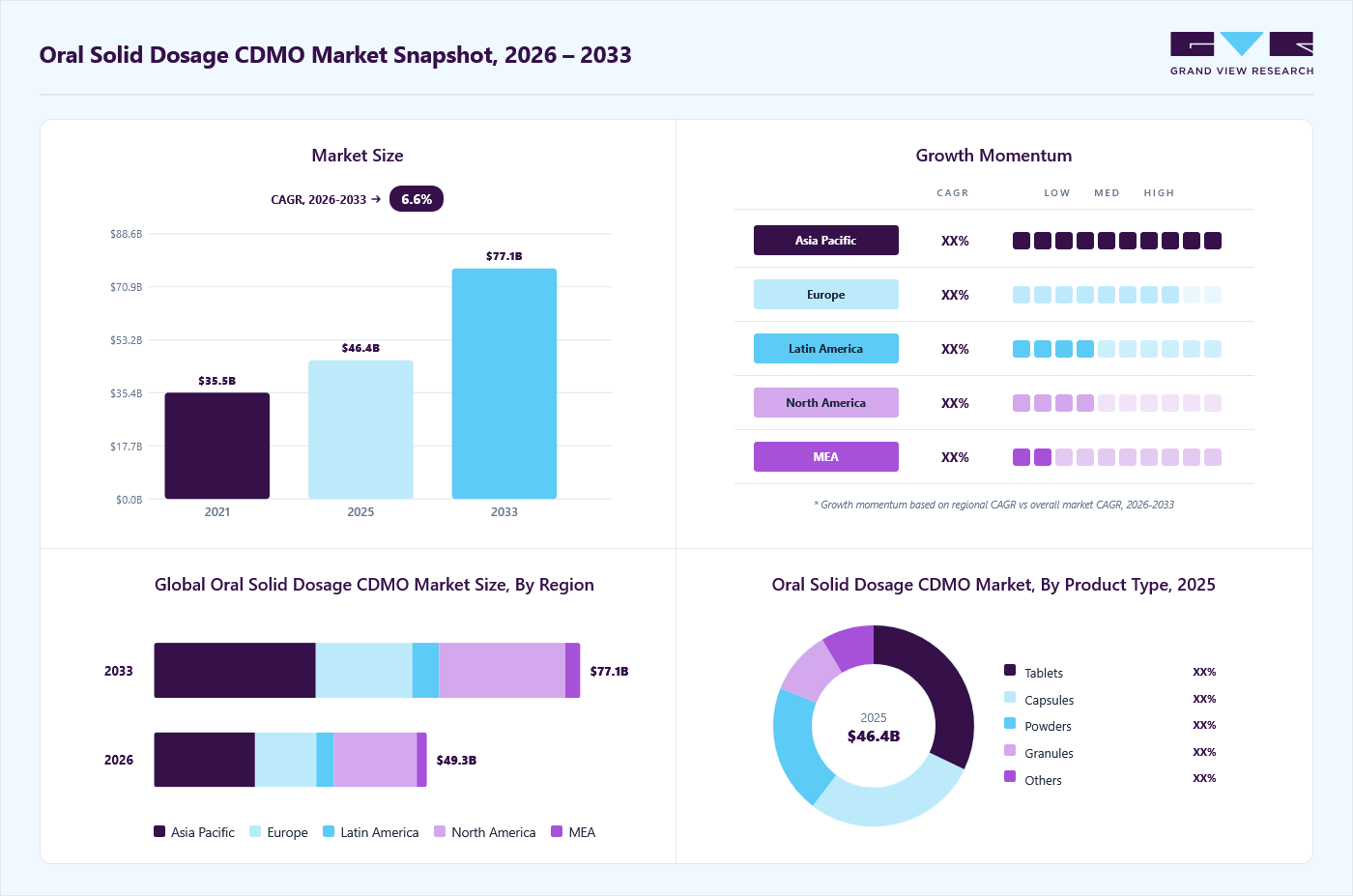
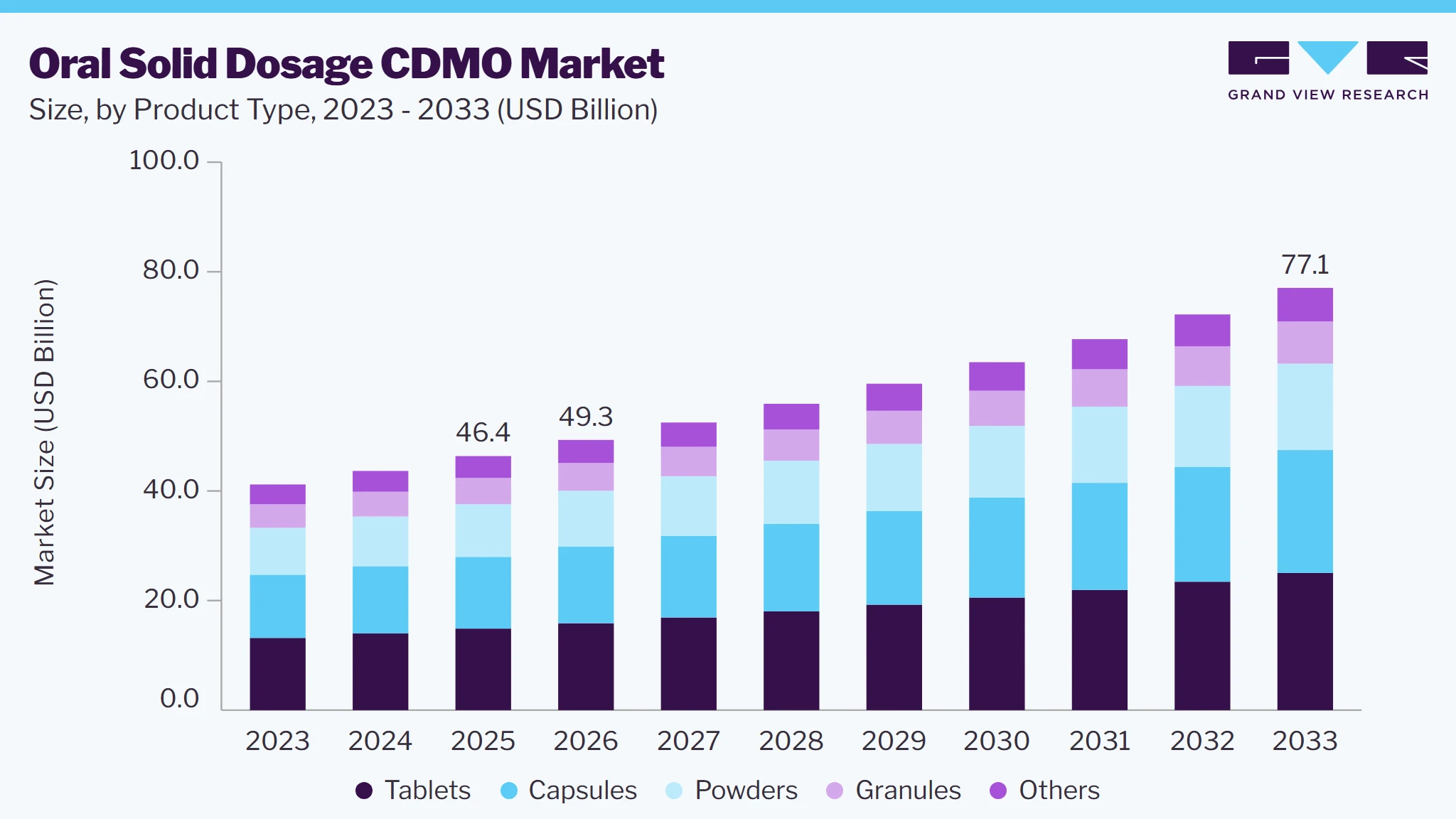
The global oral solid dosage CDMO market size was estimated at USD 46.4 billion in 2025 and is projected to grow from USD 49.3 billion in 2026 to USD 77.1 billion by 2033, growing at a CAGR of 6.6% from 2026 to 2033. The North America market held the largest share of 30.5% of the global market in 2025. The market growth is driven by a rising demand for cost-efficient drug development, increasing outsourcing by pharmaceutical and biotech companies, and growing consumption of tablets and capsules for chronic and lifestyle diseases, owing to ease of administration and precise dosage, which enhances the requirement for oral solid dosage CDMO services.
 Source: Grand View Research, IR Documents, Primary Interviews, Paid DatabasesTo learn more about this report,
 Download Free Sample Report
 Key Market Trends & Insights
- By product type: The tablets segment led the market with the largest revenue share of 32.1% in 2025 and is expected to grow at the fastest CAGR over the forecast period.
- By service: The contract development segment led the market with the largest revenue share of 58.9% in 2025 and is expected to grow at the fastest CAGR over the forecast period.
- By mechanism: The immediate release segment led the market with the largest revenue share of 37.5% in 2025.
- By drug potency: The moderate potent drugs segment led the market with the largest revenue share of 48.7% in 2025.
Regional Highlights
- Largest regional market: APAC (36.9% revenue share, 2025)
- By country: The U.S. held the largest market share in 2025.
Market Size & Forecast
- Market size in 2025: USD 46.4 Billion
- Estimated market size in 2026: USD 49.3 Billion
- Projected market size by 2033: USD 77.1 Billion
- CAGR (2025-2030): 6.6%
Three ways to get this report
Buy it, customize it, or ask a question.Ask an Analyst
A direct answer, usually in 1 working day
- AccessReport author, directly
- Reply timeWithin 1 working day
- No sales callDirect answer only
- FormatEmail reply
- CostFree, no cost
Get the Full Report
What the study covers
- FormatsPDF · Excel · Dashboard
- Timeline2026–2033 annual, 2025 base
- Coverage20+ countries, 5 regions
- Companies10+ key players profiled
Customize the Report
20% free customization
- IncludeCountries, segments, points
- TailorTo your product definition
- ExtendDeeper competitor detail
- OrA fully bespoke study
- Turnaround5–10 working days
Other factors contributing to market growth include the expansion of generic drugs, patent expiries, and the need for flexible manufacturing capacity. Most companies rely on CDMOs to access advanced formulation capabilities, scale up production efficiently, and meet stringent regulatory and quality requirements. In addition, technological advancement and increased reliance on CDMOs for end-to-end OSD development and manufacturing services are expected to drive the market.The growing prevalence of chronic and infectious diseases is a significant factor driving the demand for novel therapies. In addition, the growing geriatric population is contributing to the rising incidence of chronic diseases, further supporting the demand for novel therapies. Another factor contributing to market growth is adverse drug reactions to existing drugs, which have increased the demand for novel treatment options.
Moreover, several solid dosage forms are currently available on the market due to ongoing advancements in drug delivery technology, rising investments by contract development and manufacturing organizations (CDMOs) to expand OSD development, and increasing demand for novel therapies, all of which further contribute to market growth.
 To learn more about this report, Download Free Sample Report
 Furthermore, technological advancements in the development and bulk manufacturing of OSD forms are among the key factors supporting the fast-track commercialization of these products. In addition, the pharmaceutical/biopharmaceutical & nutraceutical industries are focusing on developing OSD forms owing to their convenient consumption, ease of handling, and patient adherence. Moreover, advancements in technology and materials of OSD products are expected to boost the demand for these formulations. The requirement for patient-centric dosage forms has increased in the past few years to improve medication adherence. Thus, the integration of advanced technologies in facilities enables enhanced manufacturing and development capabilities with reduced costs and time.
3D printing in OSD manufacturing enables precise control over drug release and the creation of customized dosage forms, thereby addressing patient-specific needs. This technology supports complex designs, enhancing flexibility in drug development. Controlled-release advancements improve delivery, fostering sustained efficacy and compliance. Digital technologies and data analytics further streamline process monitoring and quality control, making CDMO solutions more transparent and data-driven, further supporting the market. Such factors are expected to drive the market.
Market Dynamics
The oral solid dosage (OSD) CDMO market is witnessing strong growth, supported by rising pharmaceutical outsourcing, increasing generic drug development, and growing demand for cost-efficient manufacturing solutions. Currently, most of the pharmaceutical, specialty pharma, and virtual companies are increasingly partnering with CDMOs to reduce capital expenditure, access GMP-compliant production capacity, and accelerate product development timelines. Besides, the demand is particularly strong among small and mid-sized companies that lack in-house formulation, scale-up, clinical batch, and commercial manufacturing capabilities.
In addition, market expansion is further supported by growing outsourcing of formulation development, tablet and capsule manufacturing, packaging and labelling, regulatory documentation, and technology transfer services. CDMOs are also gaining traction as sponsors seek flexible manufacturing models and integrated development-to-commercial supply support across tablets, capsules, powders, granules, and differentiated oral solid formats. Moreover, the growth opportunities are emerging through regional manufacturing expansion, long-term supply partnerships, lifecycle management support, and end-to-end service models, strengthening CDMOs’ role as strategic outsourcing partners.
The increasing need for complex oral solid formulations is driving growth in the oral solid dosage CDMO market as pharmaceutical companies seek specialized technical expertise beyond conventional tablet and capsule manufacturing. In addition, growing demand for controlled-release, delayed-release, orally disintegrating tablets, bi-layer tablets, sublingual or buccal tablets, high-potency oral solids, and differentiated capsule formats is expected to drive the needs for oral solid dosage CDMO market. As. these products require advanced formulation design, precision granulation, coating technologies, taste masking, low-dose uniformity, stability optimization, and robust scale-up capabilities.
Moreover, many pharmaceutical and specialty pharma companies rely on CDMOs to manage these complexities while reducing internal development timelines and capital investment. CDMOs with strong expertise in modified-release technologies, containment infrastructure, analytical testing, and GMP-compliant manufacturing are gaining higher strategic relevance. As product pipelines become more patient-centric and technically differentiated, complex OSD formulation capability is becoming a key outsourcing driver and competitive differentiator. These factors are expected to drive the market growth over the estimated time period.
Stringent regulatory and quality compliance requirements restrain growth in the Oral Solid Dosage CDMO market by increasing operational complexity, documentation burden, and manufacturing costs. CDMOs must comply with GMP standards, process validation, batch record management, analytical testing, stability requirements, cleaning validation, data integrity, and frequent regulatory audits. These requirements are especially demanding for controlled-release formulations, high-potency oral solids, and products intended for multiple regulated markets. Any quality deviation, inspection observation, or compliance failure can delay product approvals, disrupt supply timelines, and affect client confidence. As a result, CDMOs need continuous investment in quality systems, skilled regulatory teams, validated equipment, and compliance infrastructure, which can limit scalability and increase barriers for smaller service providers.
The expansion of high-potency oral solid manufacturing capabilities represents a high-value opportunity for OSD CDMOs, driven by growing pipelines in oncology, hormonal therapies, immunology, and targeted small-molecule treatments. These products require specialized containment infrastructure, low-dose formulation expertise, robust cleaning validation, cross-contamination controls, operator safety systems, and advanced analytical capabilities.
As many pharmaceutical companies avoid capital-intensive investment in dedicated high-potency facilities, outsourcing to technically equipped CDMOs is becoming increasingly attractive. CDMOs with integrated capabilities across contained granulation, compression, encapsulation, coating, packaging, and regulatory documentation are well-positioned to capture premium contracts. Moreover, growing investment in high-potency suites, flexible batch-scale capabilities, and development-to-commercial service models will strengthen differentiation, improve client retention, and support higher-margin revenue opportunities within the oral solid dosage CDMO market.
Market Concentration & Characteristics
The market growth stage is medium, and the pace of the market growth is accelerating, characterized by an increasing number of M&A activities, the impact of regulations, service expansions, and regional expansions. The oral solid dosage CDMO industry is characterized by a high degree of innovation driven by continuous advancements in manufacturing technology, such as 3D printing, process analytical technology (PAT, and machine learning. Moreover, market participants are focusing on developing novel solutions and methodologies to improve the efficiency and effectiveness of product development processes, including personalized medicine, advanced drug delivery systems, and novel solutions.
High impact of regulations on the oral solid dosage CDMO industry. The OSD CDMO market is highly influenced by regulatory requirements enforced by several regulatory authorities, such as the U.S. FDA and the EMA, among others. Stringent regulations regarding development and manufacturing standards, quality control, and documentation significantly impact overall market dynamics.
 To learn more about this report, Download Free Sample Report
 The medium level of M&A in the oral solid dosage CDMO industry is driven by the growing need for companies to expand their capabilities, geographic presence, and service offerings. For instance, in April 2023, NextPharma acquired a chewable tablets manufacturing facility from Takeda in Norway. This acquisition expanded the company’s operational capabilities in the market.
Several industry participants are undertaking collaborations and partnerships with pharmaceutical companies, research institutions, and technology providers to accelerate service expansions. For instance, in January 2023, Ethicann and Catalent collaborated for the development of Ethicann’s clinical drug pipeline by using Catalent’s ODT technology. Further, Investments in innovative technologies such as continuous manufacturing, automation, and data analytics enable CDMOs to offer better efficiency and cost-effective solutions to their clientele, thereby driving overall market growth.
The oral solid dosage CDMO industry is characterized by a medium impact of regional expansion driven by factors such as chronic disease burden, increasing healthcare expenditures, and high demand for OSD. Several service providers are broadening their presence in emerging markets such as the Asia Pacific and Latin America by establishing manufacturing and R&D facilities and strategic alliances with domestic players to gain market access and new revenue growth avenues.
Analyst Perspective
The oral solid dosage CDMO market is currently witnessing shifting trends from capacity-led outsourcing toward complexity-led partnerships. Recent demand is increasingly concentrated around controlled-release products, high-potency oral solids, ODTs, differentiated capsules, and patient-centric dosage formats, as sponsors seek formulation expertise beyond conventional tablet and capsule manufacturing. CDMOs with advanced containment, coating, granulation, and modified-release capabilities are gaining stronger pricing power and customer stickiness. In addition, continuous manufacturing, digital quality systems, serialization, and sustainable packaging are becoming key operating priorities, supporting efficiency, compliance, and supply chain resilience. Outsourcing demand is also being reinforced by patent expirations, generic competition, and the need for flexible clinical-to-commercial scale-up. Moreover, growing competitive advantage will depend on integrated development-to-manufacturing platforms, regulatory reliability, technology-enabled execution, and the ability to support complex OSD programs across global and regional supply networks.
Technological Advancements
The OSD CDMO market is experiencing significant technological advancements, enhancing drug development and manufacturing processes. Continuous manufacturing has emerged as a pivotal innovation, enabling uninterrupted production flows that improve efficiency, consistency, and cost-effectiveness. This approach reduces transfer steps and contamination risks by integrating multiple unit operations into a single process. In addition, 3D printing technologies, particularly 3D screen printing, are revolutionizing personalized medicine by allowing precise control over drug composition and dosage, thereby facilitating the production of tailored medications tailored to individual patient needs.
Advanced drug delivery systems, such as Self-Microemulsifying Drug Delivery Systems (SMEDDS), are improving the bioavailability of poorly soluble drugs, enhancing therapeutic efficacy. Furthermore, the integration of digital tools, such as predictive modeling and automation platforms, accelerates formulation development, thereby reducing time and resource requirements. These digital advancements enable rapid optimization of tablet formulations, ensuring critical quality attributes are met efficiently.
Pricing Model Analysis
In the oral solid dosage CDMO industry, pricing models play a pivotal role in aligning client expectations with service delivery, risk-sharing, and long-term collaboration. Four key pricing structures commonly employed are milestone-based, value-based, fixed-fee, and subscription/retainer models. This pricing model offers strategic benefits that vary according to project complexity, client size, and engagement duration.
Milestone-based pricing is widely used for complex development or scale-up projects. Payments are linked to the achievement of defined technical or regulatory milestones, helping to mitigate risk for both CDMOs and sponsors. This model fosters accountability but can lead to negotiation complexity and extended timelines if milestone definitions are ambiguous. Value-based pricing is gaining traction as CDMOs aim to align compensation with the therapeutic or commercial value they help generate. This model ties pricing to improved bioavailability, faster time-to-market, or higher yields. It rewards innovation and performance but requires sophisticated metrics and trust between partners.
The fixed-fee model offers predictability, particularly for standardized tasks such as tablet compression or batch manufacturing. It simplifies sponsor budgeting and reduces administrative overhead, though it can disincentivize flexibility and innovation in long-term projects. The subscription or retainer model is emerging for clients seeking ongoing development or manufacturing support. This approach involves recurring monthly or quarterly fees, enabling steady resource allocation and long-term partnership. While beneficial for capacity planning, it may be less suitable for clients with sporadic or project-based needs.
Product Insights
Based on product type, the tablets segment led the market with the largest revenue share of 32.1% in 2025 and is expected to grow at the fastest CAGR over the forecast period. The segment growth is driven by its broad applicability, diverse formulations, patient preference, and global acceptance. The growing integration of technological advancements, such as continuous manufacturing and 3D printing, among facilities is expected to enhance segment growth by improving the efficiency of overall manufacturing processes. Moreover, strategic initiatives by key players, such as capacity expansion, partnerships, and collaborations, are projected to fuel market growth in the near future. For instance, in April 2023, Thermo Fisher Scientific expanded the capabilities of its France site to incorporate early development activities for oral solid dose therapies, including tablets, capsules, and granules. This enabled the company to seamlessly cater to customers’ workflow, from the initial stages of drug development to commercial manufacturing.
On the other hand, the capsules segment is expected to grow at the fastest CAGR over the forecast period. The segment growth is driven by its advantages, such as easy swallowing, faster disintegration, taste masking, and improved absorption. Increased demand for encapsulated formulations, fueled by the growth of the global pharmaceutical sector, is driving the need for specialized CDMOs that efficiently deliver high-quality, customized hard gelatin capsules.
Mechanism Insights
Based on mechanism, the controlled release segment led the market with the largest revenue share of 53.0% in 2025. The segment growth is driven rising demand for formulations that improve dosing convenience, therapeutic consistency, and patient adherence. The segment covers outsourced development and manufacturing of modified-release tablets, capsules, pellets, and multiparticulate systems designed to release active ingredients over the forecast period. Besides, the growth is supported by increasing use of controlled-release formats in chronic disease treatment, lifecycle management of established drugs, and differentiated generic development. CDMOs with formulation expertise and scalable coating technologies benefit the market.
On the other hand, the immediate release segment is expected to grow at the fastest CAGR over the forecast period, driven by increasing demand for rapid drug absorption and the onset of action among patients, fueling segment growth. In addition, continuous advancements in formulation technologies and manufacturing processes offer CDMOs the opportunity to develop immediate-release drugs with enhanced bioavailability and therapeutic efficacy. Besides, the expanding pharmaceutical outsourcing trend and the outsourcing of immediate-release drug manufacturing by pharmaceutical companies to CDMOs are driving the growth of this market segment. Such factors are expected to drive the market growth over the estimated time period.
Drug Potency Insights
Based on drug potency, the low potent drugs segment led the market with the largest revenue share of 48.7% in 2025. The segment growth is driven by high-volume outsourcing demand for conventional tablets, capsules, and granules. These drugs are widely used across chronic disease therapies, including cardiovascular, metabolic, gastrointestinal, and pain management indications, supporting steady commercial-scale manufacturing requirements. Besides, the segment benefits from comparatively simpler containment needs, lower operational complexity, faster technology transfer, and broader CDMO capacity availability. In addition, growing demand for cost-efficient generic and branded oral solid formulations further supporting the market growth.
On the other hand, the high potent drugs segment is expected to grow at the significant CAGR over the forecast period. The segment is driven by increasing outsourcing demand for oncology, hormonal, immunosuppressant, and targeted therapies. Besides, the growth is due to expanding pipelines of potent small molecules, rising demand for niche therapies, and sponsors’ preference for CDMOs with dedicated HPAPI handling expertise and GMP-compliant infrastructure. Such factors are expected to drive the market growth
Service Insights
Based on service, the contract development segment led the market with the largest revenue share of 58.9% in 2025 and is expected to grow at the fastest CAGR over the forecast period. Segment growth is driven by increasing requirements for early-stage formulation, analytical method development, stability testing, and bioequivalence work, which necessitate highly specialized scientific expertise and advanced laboratory infrastructure; thus, many pharmaceutical companies prefer to outsource rather than build in-house capabilities. Regulatory requirements from agencies like the FDA and EMA (e.g., ICH M13 bioequivalence guidance for solid oral forms) further push drug sponsors to rely on experienced development partners to ensure compliance.
The contract manufacturing segment is expected to witness the fastest growth, driven by a growing pharmaceutical pipeline, expanding large-volume commercial production of tablets and capsules as more drugs progress beyond development. Besides, companies are increasingly outsourcing manufacturing to avoid high capital costs, gain supply-chain flexibility, and access specialized high-potency or continuous manufacturing technologies. Such factors are expected to drive the market growth.
End Use Insights
Based on end use, the medium & small size companies segment led the market with the largest revenue share of 72.5% in 2025. The segment growth is attributed to the increasing number of small & medium-sized companies outsourcing their production work to CDMOs and CMOs. Medium and small-sized pharmaceutical companies have limited resources and capabilities in formulation development, process optimization, and manufacturing of oral solid dosage forms. Outsourcing allows them to access specialized expertise, advanced technologies, and state-of-the-art facilities offered by CDMOs without significant upfront investment. Increasing strategic initiatives by business players is another key factor contributing to segment growth. In August 2021, Recro Pharma, Inc., also known as Societal CDMO, acquired IRISYS, a U.S.-based CDMO involved in oral solid dosage contract development and manufacturing. This acquisition broadened the company’s business capabilities to cater to a diverse client base and financial position.
 To learn more about this report, Download Free Sample Report
 The large-sized companies segment is expected to witness the significant growth, driven by an increasing number of large-sized companies outsourcing their production work to CDMOs and CMOs. Large pharmaceutical companies have numerous resources and capabilities in formulation development, process optimization, and the manufacturing of oral solid dosage forms. Outsourcing allows them to access specialized expertise, advanced technologies, and state-of-the-art facilities offered by CDMOs without significant upfront investment. By partnering with CDMOs, these companies can leverage variable cost structures, optimize resource utilization, & reduce overall operational expenses, enabling them to allocate resources more efficiently and focus on core business activities.
Regional Insights
North America dominated the oral solid dosage CDMO market with the largest revenue share of 30.5% in 2025. North America oral solid dosage CDMO market growth can be attributed to growing investments in R&D of new drugs by pharmaceutical companies. The growth of the pharmaceutical industry in the U.S. and Canada is a key factor contributing to market growth. In addition, the substantial presence of key industry players and continuous clinical trials is anticipated to drive market growth. Moreover, within North America, the U.S. market held the largest share in the region. Increasing R&D investments, growing drug development costs, expensive raw ingredients, and a rising need for oral solid dosage products are driving numerous pharmaceutical entities in the U.S. to outsource key aspects of the drug development process. Such factors are expected to drive the market.
 To learn more about this report, Download Free Sample Report
 U.S. Oral Solid Dosage CDMO Market Trends
The oral solid dosage CDMO market in the U.S. held the largest share in the North America region in 2025. The oral solid dosage CDMO market in the U.S. is driven by rising demand for tablets and capsules, increasing prevalence of chronic diseases, and greater outsourcing by pharmaceutical companies to reduce operational costs. Besides, most of the CDMOs are benefiting from expanding generic drug production, the need for specialized formulation capabilities, and stricter quality standards that encourage reliance on expert partners, which is expected to drive the market growth. In addition, the growing need for tablet manufacturing, increasing focus on cost efficiency, and scalability are further contributing to market growth. Moreover, growing advancements in controlled-release technologies, continuous manufacturing, and flexible production capacity further support market expansion as drug developers seek reliable, compliant, and efficient OSD manufacturing solutions. Such factors are expected to drive the market.
Europe Oral Solid Dosage CDMO Market Trends
The oral solid dosage CDMO market in Europe is anticipated to experience significant growth due to the presence of key pharmaceutical companies. The country is driven by a robust pharmaceutical sector, comprising numerous companies engaged in drug discovery, development, and manufacturing. These CDMOs are investing in upgrading existing capabilities to meet the rising demand, divesting their business segments to increase focus on expanding their market reach within the region. Such factors are expected to drive the market.
Germany oral solid dosage CDMO market held the largest share in 2024. This market is driven by robust Technological advancements in pharmaceutical drug product development by CDMOs in the region, which is a significant factor responsible for market growth. The OSD CDMO industry significantly benefits from robust R&D initiatives, advanced early innovation medicine platforms, and numerous clinical trials targeting various disease challenges, which is expected to drive the market growth.
The oral solid dosage CDMO market in the UK is anticipated to grow over the forecast period. This growth is primarily due to the presence of numerous multinational CDMOs in the country. Moreover, the pharmaceutical manufacturers in the UK are focusing on the innovation of various high-value tablet forms in bulk, which has created a demand for oral solid dosage CDMOs in the country. Such factors are expected to drive the market growth.
Asia Pacific Oral Solid Dosage CDMO Market Trends
The oral solid dosage CDMO market in the Asia Pacific held the largest market share of 36.9% in 2025. This growth can be attributed to various factors, including India and China being major OSD CDMO players that offer competitively low prices compared to other regions. Generic drug manufacturing, bolstered by patent expirations, is the second-largest revenue source in the Asia Pacific. Growth in countries such as India and China has been driven by improved social insurance, better economic conditions, and increased manufacturing capacities, distinguishing the region from others in both scale and expansion. China held the largest market share in the Asia Pacific in 2024. Ongoing pharmaceutical advancements and increasing demand for quality are driving market growth. Such factors are expected to drive the market growth.
Japan oral solid dosage CDMO market is the Asia Pacific region's second-largest. The country is strengthening its position in the market by Rapid advancements in drug delivery technology, such as targeted drug delivery and sustained-release dosage forms. Such factors are expected to drive the market.
The oral solid dosage CDMO market in India is expected to experience significant growth at a significant CAGR during the forecast period. The country has become one of the most preferred sites due to its low costs, the availability of industry experts, the presence of WHO-cGMP-compliant facilities, and its high manufacturing capabilities for generic drugs and cost-effective oral solid dosage packaging solutions. As per June 2023 data by PIB, the country ranks third globally in terms. Such factors are expected to drive the market.
Key Oral Solid Dosage CDMO Company Insights
Market players are undertaking various strategic initiatives, such as the launch of new product innovations, collaborations, partnerships, and mergers & acquisitions, to strengthen their service offering and provide a competitive advantage. For instance, in January 2024, Alcami Corporation acquired Pacific Pharmaceutical Services, Inc., a cGMP pharma storage and services provider. Such an acquisition offered numerous growth opportunities to the company in a significant market.
-
Lonza is a leading global CDMO with over 30 sites in Europe, North America, and Asia. It provides end-to-end services for oral solid dosage drugs, including tablets, capsules, and powders. Moreover, its services include the development of drug formulation, clinical supply, commercial manufacturing, and packaging.
Key Oral Solid Dosage CDMO Companies
The following key companies have been profiled for this study on the oral solid dosage CDMO market.
-
Lonza
-
Thermo Fisher Scientific Inc.
-
Cambrex Corporation
-
Catalent Inc.
-
Siegrfried Holding AG
-
Recipharm AB
-
CordenPharma International
-
Boehringer Ingelheim
-
Piramal Pharma Solutions
-
Aenova Group
-
Almac Group
-
Jubilant Pharmova Limited
-
Delpharm
-
AbbVie Contract Manufacturing
-
Next Pharma AB
-
Rubicon Research Pvt. Ltd.
-
Quotient Sciences
-
SPI Pharma
-
DPT Laboratories Ltd.
-
Alcami Corporation
Competitive Benchmarking
Category
Operating Strategies
Competitive Edge
Weakness
Established Players (Lonza; Thermo Fisher Scientific Inc.; Cambrex Corporation)
- Established players focus on integrated CDMO service models, global manufacturing networks, long-term pharma partnerships, and expansion of high-value OSD capabilities.
- They invest in controlled-release technologies, high-potency containment, regulatory compliance, digital quality systems, and capacity expansion to support clinical-to-commercial manufacturing at scale.
- Their key advantage lies in strong regulatory track records, large-scale GMP manufacturing infrastructure, broad dosage-form expertise, and established customer relationships with large pharmaceutical companies.
- Global footprints, advanced formulation capabilities, quality systems, and end-to-end service offerings strengthen their ability to manage complex OSD programs.
- Established players may face higher operating costs, slower decision-making, capacity constraints, and pricing pressure from regional CDMOs.
- Their large infrastructure can reduce flexibility for small-volume or niche projects, while integration challenges, regulatory scrutiny, and dependence on large clients may impact operational agility.
Emerging Players (Next Pharma AB; Rubicon Research Pvt. Ltd.; Quotient Sciences)
- Emerging players focus on niche OSD capabilities, flexible project execution, faster turnaround, and cost-efficient development-to-manufacturing services.
- They often target small and mid-sized pharma clients, specialty formulations, clinical batches, formulation optimization, technology transfer, and regional manufacturing opportunities to build scale and customer stickiness.
- Their competitive strength lies in agility, customized service delivery, competitive pricing, and strong responsiveness to client-specific requirements.
- Many emerging players are well-positioned for small-batch manufacturing, complex formulation development, specialized dosage formats, and early-stage product support, making them attractive to virtual, specialty, and mid-sized pharma companies.
- Emerging players may have limited global manufacturing networks, lower commercial-scale capacity, narrower regulatory exposure, and weaker brand recognition compared to established CDMOs.
- They can face challenges in securing large pharma contracts, funding capacity expansion, maintaining compliance across regions, and competing on advanced technologies such as high-potency containment and controlled-release manufacturing.
Recent Developments
-
In February 2024, Novo Holdings announced the acquisition of Catalent Inc., a prominent CDMO in the healthcare industry. Through this acquisition, Novo Holdings will gain significant market growth opportunities, and Catalent will broaden its operational capabilities.
-
In July 2023, Aenova Group partnered with Galvita to improve the formulation, production, and development of oral dosage forms. This partnership helped to broaden the company’s service offerings in the market.
Oral Solid Dosage CDMO Market Report Scope
Report Attribute
Details
Market size in 2025
USD 46.4 billion
Estimated market size in 2026
USD 49.3 billion
Projected market size by 2033
USD 77.1 billion
Growth rate
CAGR of 6.6% from 2026 to 2033
Historical data
2021 - 2025
Forecast period
2026 - 2033
Quantitative units
Revenue in USD million/billion and CAGR from 2026 to 2033
Report coverage
Revenue forecast, company ranking, competitive landscape, growth factors, and trends
Segments covered
Product, service, mechanism, drug potency, end use, region
Regional scope
North America; Europe; Asia Pacific; Latin America; MEA
Country scope
U.S., Canada, Mexico, UK, Germany, France, Italy, Spain, Denmark, Sweden, Norway, Japan, China, India, Thailand, South Korea, Australia, Brazil, Argentina, South Africa, Saudi Arabia, UAE, Kuwait, Oman, Qatar
Key companies profiled
Lonza; Thermo Fisher Scientific; Cambrex Corporation; Catalent Inc.; Siegrfried Holding AG; Recipharm AB; CordenPharma International; Boehringer Ingelheim; Piramal Pharma Solutions; Aenova Group; Almac Group; Jubilant Pharmova Limited; Delpharm; AbbVie Contract Manufacturing; Next Pharma AB, Rubicon Research Pvt. Ltd., Quotient Sciences, SPI Pharma, DPT Laboratories Ltd., Alcami Corporation
Customization scope
Free report customization (equivalent up to 8 analysts' working days) with purchase. Addition or alteration to country, regional & segment scope.
Pricing and purchase options
Avail customized purchase options to meet your exact research needs. Explore purchase options
Global Oral Solid Dosage Market Report Segmentation
This report forecasts revenue growth at a country level and provides an analysis of the latest industry trends in each of the sub-segments from 2021 to 2033. For this study, Grand View Research has segmented the global oral solid dosage CDMO market report based on product, mechanism, drug potency, service, end use, and region:
-
Product Outlook (Revenue, USD Million, 2021 - 2033)
-
Tablets
-
Compressed Tablets
-
Orally Disintegrating Tablets (ODT)
-
Chewable Tablets
-
Bi-layer or Tri-layer Tablets
-
Sublingual or Buccal Tablets
-
Others
-
-
Capsules
-
Hard Gelatin Capsules
-
Soft Gelatin Capsules
-
-
Powders
-
Granules
-
Others
-
-
Mechanism Outlook (Revenue, USD Million, 2021 - 2033)
-
Immediate Release
-
Delayed Release
-
Controlled Release
-
-
Drug Potency Outlook (Revenue, USD Million, 2021 - 2033)
-
High Potent Drugs
-
Moderate Potent Drugs
-
Low Potent Drugs
-
-
Service Outlook (Revenue, USD Million, 2021 - 2033)
-
Contract Development
-
Contract Manufacturing
-
Packaging and Labelling
-
Regulatory Affairs
-
Logistics & Storage
-
Others
-
-
End Use Outlook (Revenue, USD Million, 2021 - 2033)
-
Large Size Companies
-
Medium & Small Size Companies
-
Others
-
-
Regional Outlook (Revenue, USD Million, 2021 - 2033)
-
North America
-
U.S.
-
Canada
-
Mexico
-
-
Europe
-
UK
-
Germany
-
France
-
Italy
-
Spain
-
Sweden
-
Norway
-
Denmark
-
-
Asia Pacific
-
Japan
-
China
-
India
-
South Korea
-
Australia
-
Thailand
-
-
Latin America
-
Brazil
-
Argentina
-
-
Middle East & Africa
-
South Africa
-
Saudi Arabia
-
UAE
-
Kuwait
-
Oman
-
Qatar
-
-
Research Methodology
Segment Definition
Segment - Product Type
Definition
Tablets
The segment captures revenue generated by providing CDMO services for oral solid tablet product types to end users. The segment includes formulation development, process development, scale-up, compression, coating, packaging support, stability testing, and commercial manufacturing of conventional and advanced tablet dosage forms.
Compressed Tablets
The segment captures revenue generated by providing CDMO services for oral solid compressed tablets to end users. The segment includes direct compression, wet granulation, dry granulation, tablet compression, coating, embossing, stability support, and manufacturing of immediate-release or modified-release compressed tablets.
Orally Disintegrating Tablets (ODT)
The segment captures revenue generated by providing CDMO services for oral solid orally disintegrating tablets to end users. The segment includes formulation development, taste masking, rapid-disintegration technology, compression, lyophilization where applicable, packaging, and manufacturing of tablets designed to dissolve quickly in the mouth.
Chewable Tablets
The segment captures revenue generated by providing CDMO services for oral solid chewable tablets to end users. The segment includes flavoring, sweetening, taste masking, texture optimization, compression, coating where applicable, and manufacturing of tablets designed to be chewed before swallowing.
Bi-layer or Tri-layer Tablets
The segment captures revenue generated by providing CDMO services for oral solid bi-layer or tri-layer tablets to end users. The segment includes formulation of multiple active layers, controlled-release combinations, layer compression, compatibility testing, process scale-up, and manufacturing of multi-layer tablet dosage forms.
Sublingual or Buccal Tablets
The segment captures revenue generated by providing CDMO services for oral solid sublingual or buccal tablets to end users. The segment includes formulation development, rapid dissolution, mucoadhesive technologies, taste masking, compression, packaging, and manufacturing of tablets intended for absorption through the oral mucosa.
Others
The segment captures revenue generated by providing CDMO services for other oral solid tablet product types to end users. The segment includes effervescent tablets, coated tablets, film-coated tablets, enteric-coated tablets, sustained-release tablets, and other specialized tablet formats not classified under the above categories.
Capsules
The segment captures revenue generated by providing CDMO services for oral solid capsule product types to end users. The segment includes formulation development, capsule filling, encapsulation, sealing, coating, packaging support, stability testing, and commercial manufacturing of hard and soft capsule dosage forms.
Hard Gelatin Capsules
The segment captures revenue generated by providing CDMO services for oral solid hard gelatin capsules to end users. The segment includes powder, pellet, granule, or mini-tablet filling, capsule shell selection, encapsulation, polishing, banding where applicable, and manufacturing of hard-shell capsule dosage forms.
Soft Gelatin Capsules
The segment captures revenue generated by providing CDMO services for oral solid soft gelatin capsules to end users. The segment includes formulation of liquid or semi-solid fills, gelatin shell development, encapsulation, drying, sealing, stability testing, and manufacturing of softgel capsule dosage forms.
Powders
The segment captures revenue generated by providing CDMO services for oral solid powder product types to end users. The segment includes blending, milling, particle size optimization, taste masking, sachet or stick-pack filling, bulk packaging, and manufacturing of oral powder formulations.
Granules
The segment captures revenue generated by providing CDMO services for oral solid granule product types to end users. The segment includes wet granulation, dry granulation, fluid-bed processing, coating, blending, sachet filling, capsule filling support, and manufacturing of immediate-release or modified-release granules.
Others
The segment captures revenue generated by providing CDMO services for other oral solid product types to end users. The segment includes pellets, mini-tablets, lozenges, oral films, medicated gums, multiparticulate systems, and other specialized oral solid dosage formats not covered under tablets, capsules, powders, or granules.
Segment - Service
Revenue capture definition
Contract Development
The segment captures revenue generated by providing CDMO services for oral solid dosage to end users. The segment includes pre-formulation studies, formulation development, excipient selection, analytical method development, process development, prototype batch development, bioavailability enhancement, stability studies, scale-up support, and technology transfer for oral solid dosage products.
Contract Manufacturing
The segment captures revenue generated by providing CDMO services for oral solid dosage to end users. The segment includes commercial and clinical-scale manufacturing, blending, milling, granulation, drying, tablet compression, capsule filling, coating, process validation, batch release support, quality control testing, and GMP-compliant production of oral solid dosage forms.
Packaging and Labelling
The segment captures revenue generated by providing CDMO services for oral solid dosage to end users. The segment includes primary packaging, secondary packaging, blister packaging, bottle filling, sachet or stick-pack packaging, serialization, tamper-evident packaging, artwork management, labelling, repackaging, and packaging validation services.
Regulatory Affairs
The segment captures revenue generated by providing CDMO services for oral solid dosage to end users. The segment includes regulatory documentation, CMC dossier preparation, submission support, technical file preparation, compliance consulting, product registration support, regulatory gap assessment, response support for authority queries, and documentation required for clinical, commercial, and post-approval oral solid products.
Logistics & Storage
The segment captures revenue generated by providing CDMO services for oral solid dosage to end users. The segment includes warehousing, controlled-temperature storage, inventory management, GMP-compliant storage, distribution support, batch tracking, cold-chain support where applicable, clinical supply logistics, commercial supply logistics, and shipment coordination for oral solid dosage products.
Others
The segment captures revenue generated by providing CDMO services for oral solid dosage to end users. The segment includes technology transfer, quality assurance support, product lifecycle management, reformulation support, troubleshooting, validation services, clinical trial supply support, serialization support, and other ancillary CDMO services not classified under development, manufacturing, packaging, regulatory affairs, or logistics.
Segment - Mechanism
Revenue capture definition
Immediate Release
The segment captures revenue generated by providing CDMO services for immediate-release mechanism oral solid dosage to end users. The segment includes formulation development, excipient selection, blending, granulation, tablet compression, capsule filling, coating where applicable, scale-up, stability testing, packaging support, and commercial manufacturing of oral solid dosage forms designed to release the active ingredient rapidly after administration.
Delayed Release
The segment captures revenue generated by providing CDMO services for delayed-release mechanism oral solid dosage to end users. The segment includes enteric coating, pH-dependent release formulation, protective coating technologies, pellet or granule coating, capsule or tablet development, process validation, stability testing, and manufacturing of oral solid dosage forms designed to release the drug after a time lag or at a specific site in the gastrointestinal tract.
Controlled Release
The segment captures revenue generated by providing CDMO services for controlled-release mechanism oral solid dosage to end users. The segment includes sustained-release, extended-release, modified-release, matrix-based systems, multiparticulate systems, osmotic release technologies, coating-based release control, formulation optimization, scale-up, analytical testing, and commercial manufacturing of oral solid dosage forms designed to release the active ingredient at a predefined rate over an extended period.
Segment - Drug Potency
Revenue capture definition
High Potent Drugs
The segment captures revenue generated by providing CDMO services for high-potent drug oral solid dosage to end users. The segment includes formulation development, containment-enabled handling, low-dose blending, granulation, tablet compression, capsule filling, coating, potency uniformity testing, occupational exposure control, cleaning validation, stability testing, packaging support, and commercial manufacturing of oral solid dosage forms containing highly potent active pharmaceutical ingredients.
Moderate Potent Drugs
The segment captures revenue generated by providing CDMO services for moderate-potent drug oral solid dosage to end users. The segment includes formulation optimization, controlled API handling, blending, granulation, compression, encapsulation, coating, analytical testing, process scale-up, stability testing, packaging support, and commercial manufacturing of oral solid dosage forms containing APIs requiring standard to moderate containment and handling controls.
Low Potent Drugs
The segment captures revenue generated by providing CDMO services for low-potent drug oral solid dosage to end users. The segment includes conventional formulation development, excipient selection, milling, blending, granulation, tablet compression, capsule filling, coating, quality testing, stability studies, packaging support, and commercial manufacturing of oral solid dosage forms containing APIs with lower potency and routine manufacturing control requirements.
Segment - End Use
Revenue capture definition
Large Size Companies
The segment captures revenue generated by providing CDMO services for oral solid dosage to end users classified as large-size companies. The segment includes services provided to multinational pharmaceutical companies, large biopharmaceutical companies, established generic drug manufacturers, and large consumer healthcare firms for formulation development, clinical and commercial-scale manufacturing, packaging, labelling, regulatory support, technology transfer, and lifecycle management of oral solid dosage products.
Medium & Small Size Companies
The segment captures revenue generated by providing CDMO services for oral solid dosage to end users classified as medium and small-size companies. The segment includes services provided to mid-sized pharmaceutical companies, specialty pharma firms, small generic manufacturers, emerging biopharmaceutical companies, and virtual pharmaceutical companies for product development, pilot-scale manufacturing, scale-up, clinical batch production, commercial manufacturing, packaging, regulatory documentation, and supply support.
Others
The segment captures revenue generated by providing CDMO services for oral solid dosage to other end users not classified under large, medium, or small-size companies. The segment includes services provided to academic institutions, research organizations, government agencies, non-profit organizations, healthcare product developers, and other entities requiring formulation support, small-batch manufacturing, clinical trial supply, packaging, testing, regulatory assistance, or specialized oral solid dosage development services.
Estimation Model
Approach
Description
Top-Down Approach
Estimates the Oral Solid Dosage CDMO market by starting with the broader pharmaceutical CDMO/pharmaceutical outsourcing market and narrowing it by dosage form, service type, region, and end-user contribution. It uses macro-level indicators such as pharmaceutical manufacturing outsourcing share, oral solid dosage penetration, CDMO adoption rate, and regional demand to derive the final market size.
Bottom-Up Approach
Estimates the market by aggregating oral solid dosage CDMO revenues generated by key companies and extrapolating for private, regional, and unorganized players. It considers company service portfolios, tablet and capsule manufacturing capacity, batch volumes, facility utilization, pricing benchmarks, and revenue contribution from development, manufacturing, packaging, regulatory, logistics, and related oral solid dosage services.
Demand-Side Approach
Estimates market size based on outsourcing expenditure by pharmaceutical, biopharmaceutical, generic, specialty, and virtual pharma companies. It evaluates oral solid dosage pipeline products, clinical trial activity, generic launches, lifecycle management needs, formulation complexity, high-potency drug demand, and outsourcing penetration to assess how much end users spend on CDMO services across development, manufacturing, packaging, and support functions.
Data Triangulation Approach
Validates the final market estimate by comparing outputs from the top-down, bottom-up, demand-side, and supply-side models. It reconciles differences between company revenues, capacity estimates, outsourcing demand, service pricing, regional splits, and product-type assumptions. This approach improves reliability by ensuring that final market values are consistent with industry trends, the competitive landscape, and observable CDMO activity.
Delivered Customizations
This report has been delivered with the following In-depth customizations
Client Request
Customization Delivered
Value Adds
Cross-Segmentation Opportunity Assessment
Conducted a detailed cross-segmentation assessment across product formats, including tablets, capsules, powders, and granules, along with release mechanisms, end-use company size, and regional markets.
Enabled identification of high-potential OSD outsourcing segments, complex formulation opportunities, and priority areas for targeted investment and service expansion.
Industry Outlook, Value Chain & Operating Model Review
Assessed the OSD CDMO value chain across formulation development, scale-up, commercial manufacturing, packaging, regulatory support, and outsourcing models for large, mid-sized, and small companies.
Delivered strategic visibility into key revenue drivers, margin expansion opportunities, customer outsourcing behavior, and potential service portfolio extensions.
Regional Expansion & Market Entry Assessment
Evaluated country-level market attractiveness across North America, Europe, Asia Pacific, Latin America, and MEA based on regulatory complexity, CDMO presence, cost competitiveness, and demand maturity.
Supported market entry planning, regional prioritization, partner shortlisting, and investment decision-making for oral solid dosage contract development and manufacturing.
Competitive, Capacity & Volume Benchmarking
Benchmarked leading OSD CDMOs on manufacturing capacity, dosage-form capabilities, controlled-release expertise, technology adoption, batch volume, and customer segment focus.
Enabled competitive positioning, capacity planning, volume opportunity assessment, and identification of growth areas such as high-potency OSD, continuous manufacturing, and complex modified-release formulations.
Frequently Asked Questions About This Report
The global oral solid dosage CDMO market size was estimated at USD 46.4 billion in 2025 and is expected to reach USD 49.3 billion in 2026.
The global oral solid dosage CDMO market is expected to grow at a compound annual growth rate of 6.6% from 2026 to 2033 to reach USD 77.1 billion by 2033.
Key factors that are driving the market growth include technological advancements in oral solid dosage forms, expansion of manufacturing capacity by CMOs & CDMOs for OSD, increasing demand for novel therapies, and growing demand for one-stop-shop CDMOs among others.
Asia Pacific dominated the oral solid dosage CDMO market with a share of 36.89% in 2025. This growth can be attributed to various factors, including India and China being major OSD CDMO players that offer competitively low prices compared to other regions. Growth in countries such as India and China has been driven by improved social insurance, better economic conditions, and increased manufacturing capacities, further contributing to market growth.
Some key players operating in the oral solid dosage CDMO market include Lonza, Thermo Fisher Scientific Inc., Cambrex Corporation, Catalent Inc., Siegrfried Holding AG, Recipharm AB ,CordenPharma International, Boehringer Ingelheim, Piramal Pharma Solutions, Aenova Group, Almac Group, Jubilant Pharmova Limited ,Delpharm ,AbbVie Contract Manufacturing, Next Pharma AB, Rubicon Research Pvt. Ltd. ,Quotient Sciences ,SPI Pharma ,DPT Laboratories Ltd. ,and Alcami Corporation
The tablets segment led the market with the largest revenue share of 32.1% in 2025 and is expected to grow at the fastest CAGR over the forecast period.
The immediate release segment led the market with the largest revenue share of 37.5% in 2025.
The low potent drugs segment led the market with the largest revenue share of 48.7% in 2025.
About the Author(s)
Medical Devices Research Team
Healthcare · Medical DevicesThis report was authored by the medical devices research team at Grand View Research - comprising two research analysts, one senior research analyst, and one industry expert - with specialized expertise in the medical devices segment of the healthcare industry. All findings are based on proprietary healthcare databases, executive interviews, and regulatory analysis, subject to internal peer review prior to publication.
Last Updated:
Speak to Analyst

Customize this report to your needs - add regions, segments, or data points, with 20% free customization.
Or view our licence options:


ISO 9001:2015 & 27001:2022 Certified
We are GDPR and CCPA compliant! Your transaction & personal information is safe and secure. For more details, please read our privacy policy.


