
- Home
- »
- Consumer F&B
- »
-
Organic Banana Market Size And Share Report, 2026-2033GVR Report cover

Organic Banana Market (2026 - 2033)
Size, Share & Trends Analysis Report By Product (Ripe Organic Bananas, Raw/Green Organic Bananas), By Distribution Channel (Supermarkets & Hypermarkets, Convenience Stores), By Region, And Segment Forecasts
Market Size, 2025
$4.2BMarket Estimate, 2026
$4.4BMarket Forecast, 2033
$7.3BCAGR, 2026–2033
7.5%Organic Banana Market Summary
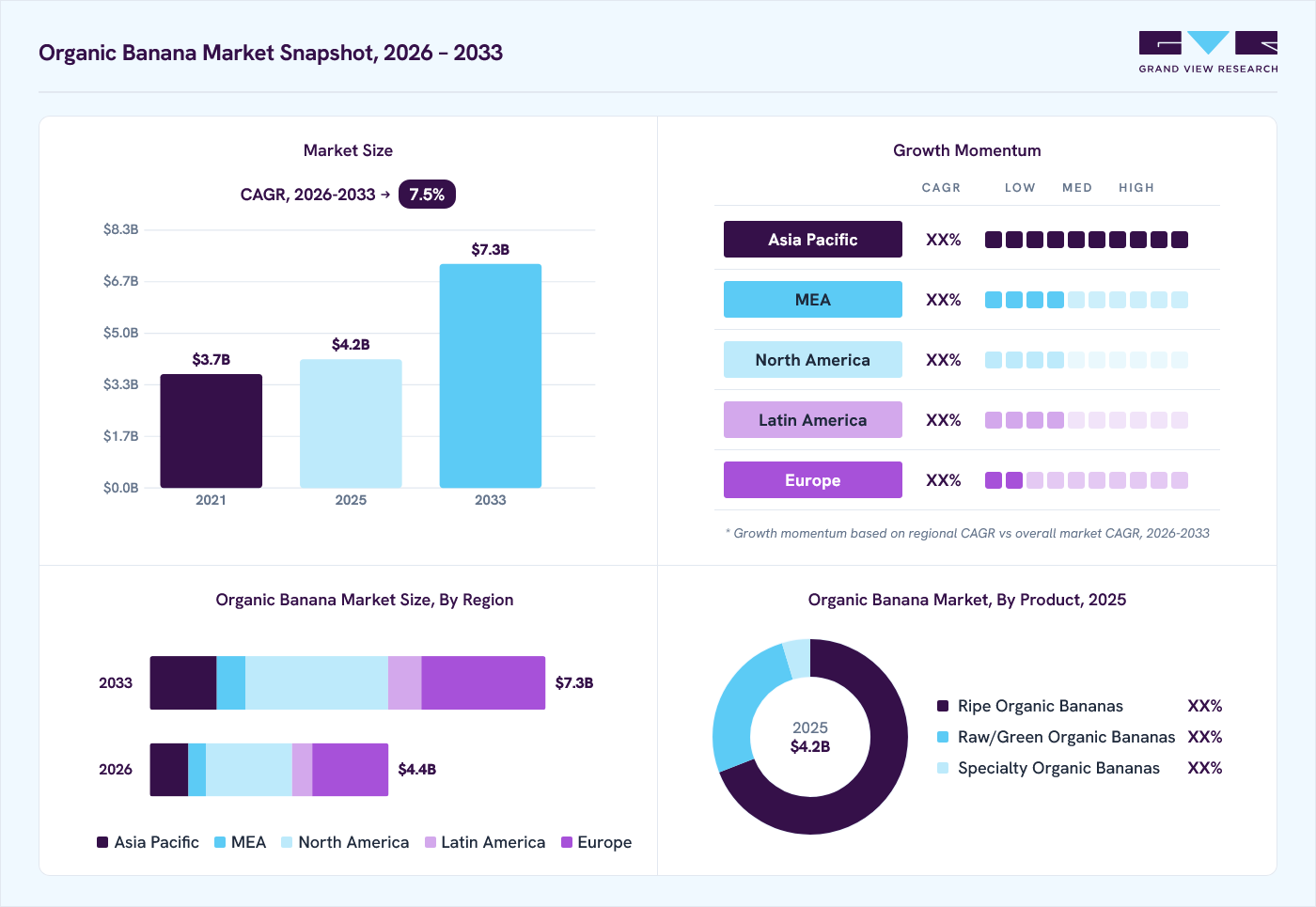
The global organic banana market size was valued at USD 4.2 billion in 2025 and is expected to grow from USD 4.4 billion in 2026 to USD 7.3 billion in 2033, at a CAGR of 7.5% from 2026 to 2033. North America dominated the market, accounting for a revenue share of 36.1% in 2025. The market's growth is primarily driven by rising consumer demand for healthy, chemical-free, and organically grown fruits.
 Source: Grand View Research, IR Documents, Primary Interviews, Paid DatabasesTo learn more about this report,
 Download Free Sample Report
Key Market Trends & Insights
- By product: Ripe organic bananas held the largest revenue share of 69.7% in 2025
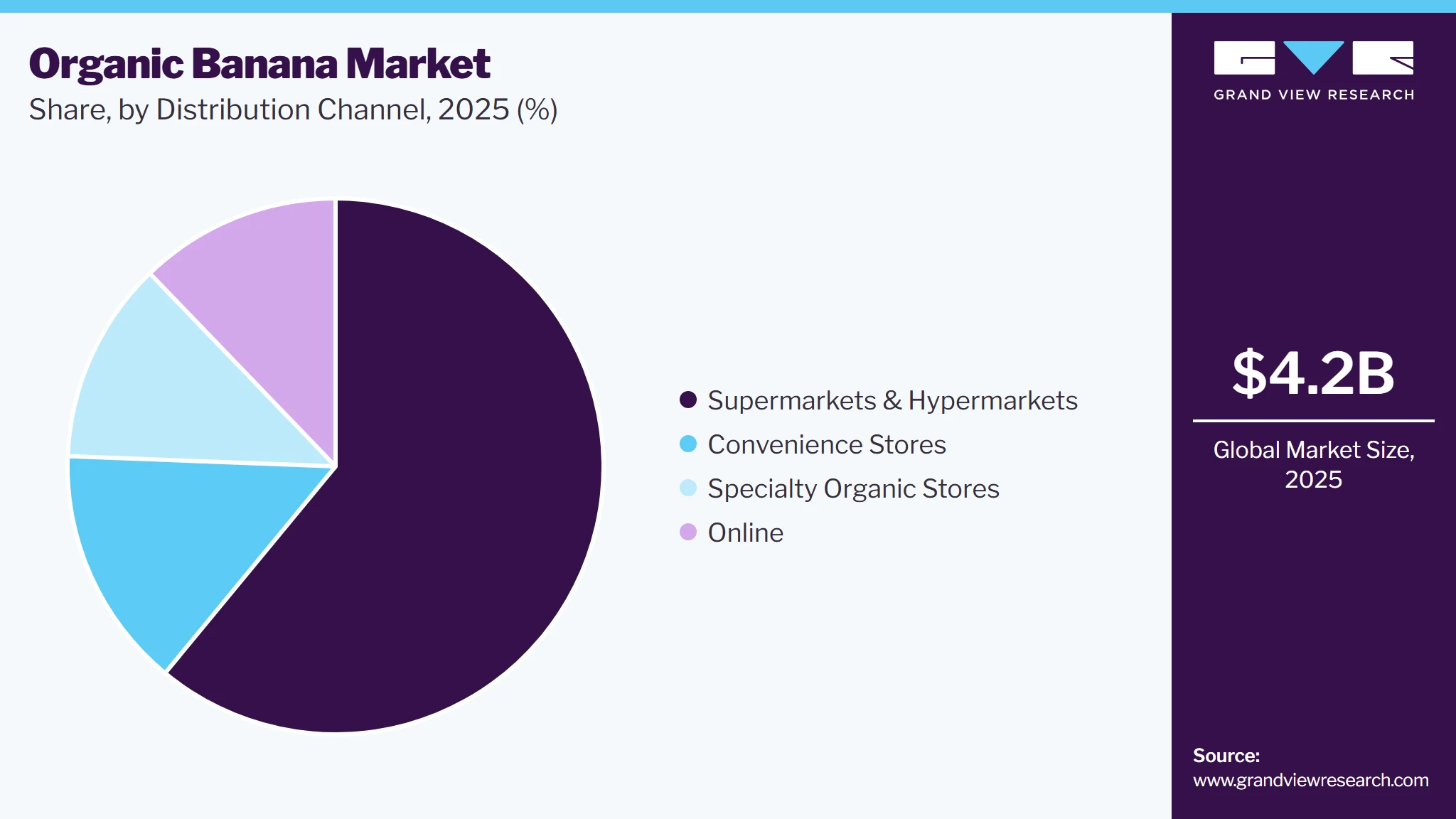
- By distribution channel: Supermarkets & hypermarkets held the largest revenue share of 61.1% in 2025
Regional Highlights
- Largest regional market: North America (36.1% revenue share, 2025)
- Fastest-growing regional market: Asia Pacific (fastest CAGR, 2026-2033)
- By country: The U.S. held the largest market share in 2025.
Market Size & Forecast
- Market Size in 2025: USD 4.2 Billion
- Estimated Market Size in 2026: USD 4.4 Billion
- Projected Market Size by 2033: USD 7.3 Billion
- CAGR (2026-2033): 7.5%
Prism AI by Grand View Research Free to tryAsk a question about the organic banana marketTry asking✓Every figure cited from GVR research Prefer the report? Download free sample →
Increasing awareness about the health benefits of organic food encourages consumers to choose organic bananas. The growth of the organic banana industry is further influenced by the growing availability of organic farming practices and sustainable agricultural methods. Improved supply chains, better storage facilities, and efficient distribution networks help maintain product quality and reduce wastage. Rising environmental concerns are also encouraging farmers and businesses to adopt more eco-friendly production methods.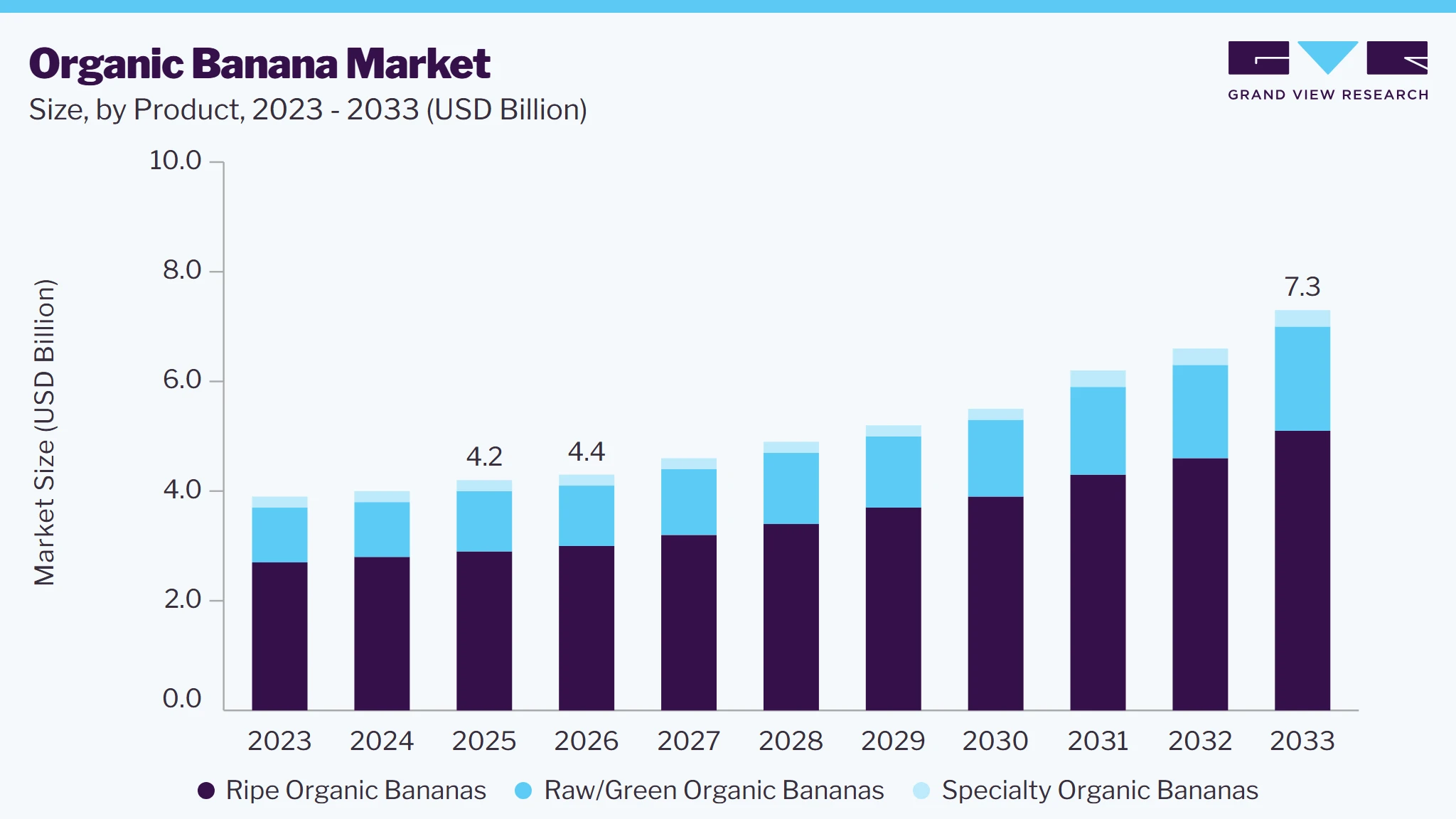 To learn more about this report, Download Free Sample Report
According to FAO data, organic banana production promotes sustainable farming through organic agriculture, reduced pesticide use, and environmental protection. These practices, supported by organic certification and sustainability standards, can strengthen consumer confidence and market opportunities for organic bananas.
International trade and exports are creating new opportunities for organic banana producers. Certification standards and traceability systems help build consumer trust and improve the credibility of organic products. According to the data published in July 2026, certified banana production accounted for 73% of Cameroon’s total banana export volume in 2025, reaching approximately 160,000 metric tonnes annually. This reflects the growing importance of certified and sustainable banana production in Cameroon’s export market and international competitiveness.
Market Dynamics
Growing consumer preference for healthy and chemical-free fruits is a major driver of the organic banana market. Consumers are becoming more conscious of the quality and origin of the food they purchase. According to a survey of 1,521 U.S. consumers, published in February 2025, about 58% of consumers prefer organic products because they tend to contain fewer synthetic chemicals and additives. This shift is increasing interest in fruits produced without synthetic pesticides and fertilizers. Organic bananas are therefore gaining attention among health-focused buyers. As consumer awareness continues to grow, demand for organic bananas is expected to strengthen.
High costs associated with organic certification and compliance can restrict market expansion. Producers must follow specific standards and maintain proper records throughout the production process. Certification procedures can require additional time, documentation, and financial investment. According to the FAO data, organic banana certification requires farmers to meet strict standards, maintain documentation, and undergo regular inspections. The 2-3-year conversion period and annual verification increase the time and administrative burden on producers. These requirements may be particularly challenging for small-scale farmers and producers. Consequently, certification-related expenses can limit the participation of some producers in the market.
The increasing potential for organic banana exports presents an attractive opportunity for producers. International markets can provide access to a broader customer base beyond domestic demand. Producers meeting required quality and certification standards can explore new export destinations. Improved international distribution can also strengthen the position of organic banana suppliers. This creates opportunities for market expansion and greater participation in global trade.
Analyst Perspective
The global organic banana market is experiencing steady growth, driven by increasing interest in sustainably produced and certified fresh produce. Increasing consumer focus on responsible farming, food quality, and environmentally conscious choices is strengthening demand across key markets. Expansion of organic retail channels, improved supply networks, and greater product availability are supporting market penetration. Established producers are strengthening sourcing and distribution capabilities, while emerging players are focusing on specialty varieties and niche consumer segments. Overall, favorable sustainability trends and expanding access to organic produce are expected to support continued market development.
Product Insights
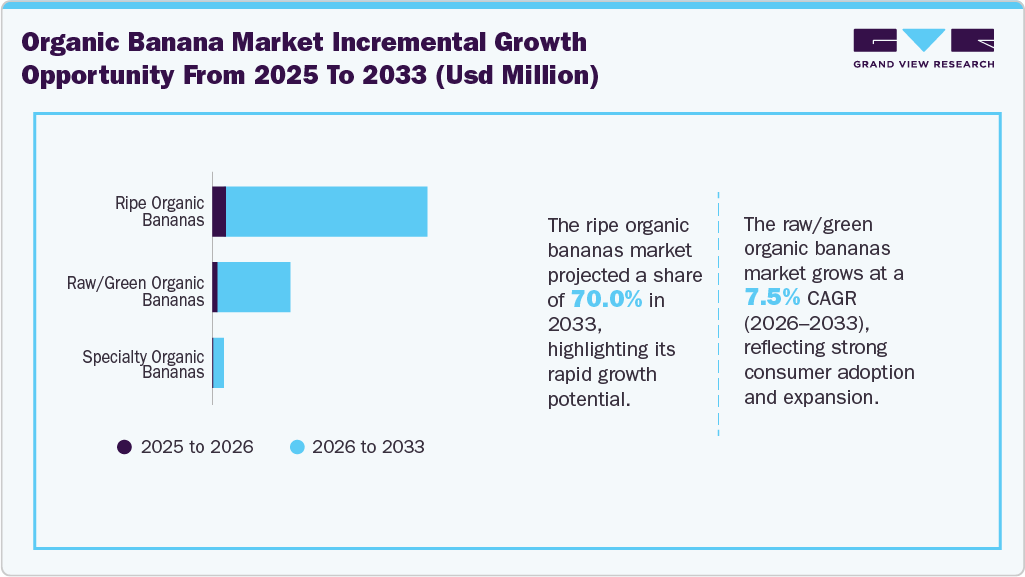
The ripe organic banana segment dominated the organic banana industry, accounting for the largest revenue share of 69.7% in 2025. Ripe organic bananas are widely preferred for direct consumption because they are convenient and ready to eat. Their natural sweetness and soft texture make them suitable for children, adults, and elderly consumers. They are also commonly used in smoothies, desserts, breakfast meals, and bakery products. The growing demand for convenient, ready-to-use fruit products further supports this segment. Strong usage across households and food-service establishments contributes to its market growth.
 To learn more about this report, Download Free Sample Report
The raw/green organic banana market segment is projected to grow significantly at a CAGR of 7.5% from 2026 to 2033. Raw or green organic bananas are increasingly used as versatile ingredients in cooking and food processing. Their firmer texture makes them suitable for frying, boiling, baking, and the preparation of savory dishes. They are also used to produce products such as banana flour and chips, creating additional applications beyond fresh consumption. In 2024, Colombia’s DAABON introduced Banachips, fried organic green banana chips made from organic green bananas and palm oil. The product was developed to explore new market opportunities and received a positive local response. In addition, demand from food manufacturers and commercial kitchens supports this segment. Their longer handling and storage potential compared with ripe bananas also benefits distribution.
Distribution Channel Insights
The supermarkets and hypermarkets channel in the organic banana market accounts for the largest revenue share of 61.1% in 2025. Supermarkets and hypermarkets are important distribution channels because they offer organic bananas in large, well-organized retail spaces. Consumers can easily compare products, packaging, and prices while shopping for other groceries. Regular promotional campaigns and attractive product displays can increase visibility and encourage purchases. Refrigerated and controlled storage facilities also help maintain fruit quality during retailing. Their broad customer reach makes these outlets an important channel for organic banana sales.
 To learn more about this report, Download Free Sample Report
The online channel in the organic banana industry is projected to grow at the fastest CAGR of 7.8% from 2026 to 2033. Online distribution is gaining importance as consumers increasingly use digital platforms for grocery shopping. Customers can order organic bananas from home and have them delivered directly to their doorstep. Digital platforms provide convenient access to product information, including origin, certification, and quality details. Home-delivery services are particularly useful for consumers seeking convenient and time-saving shopping options. The expansion of online grocery services is therefore creating new avenues for organic banana distribution.
Regional Insights
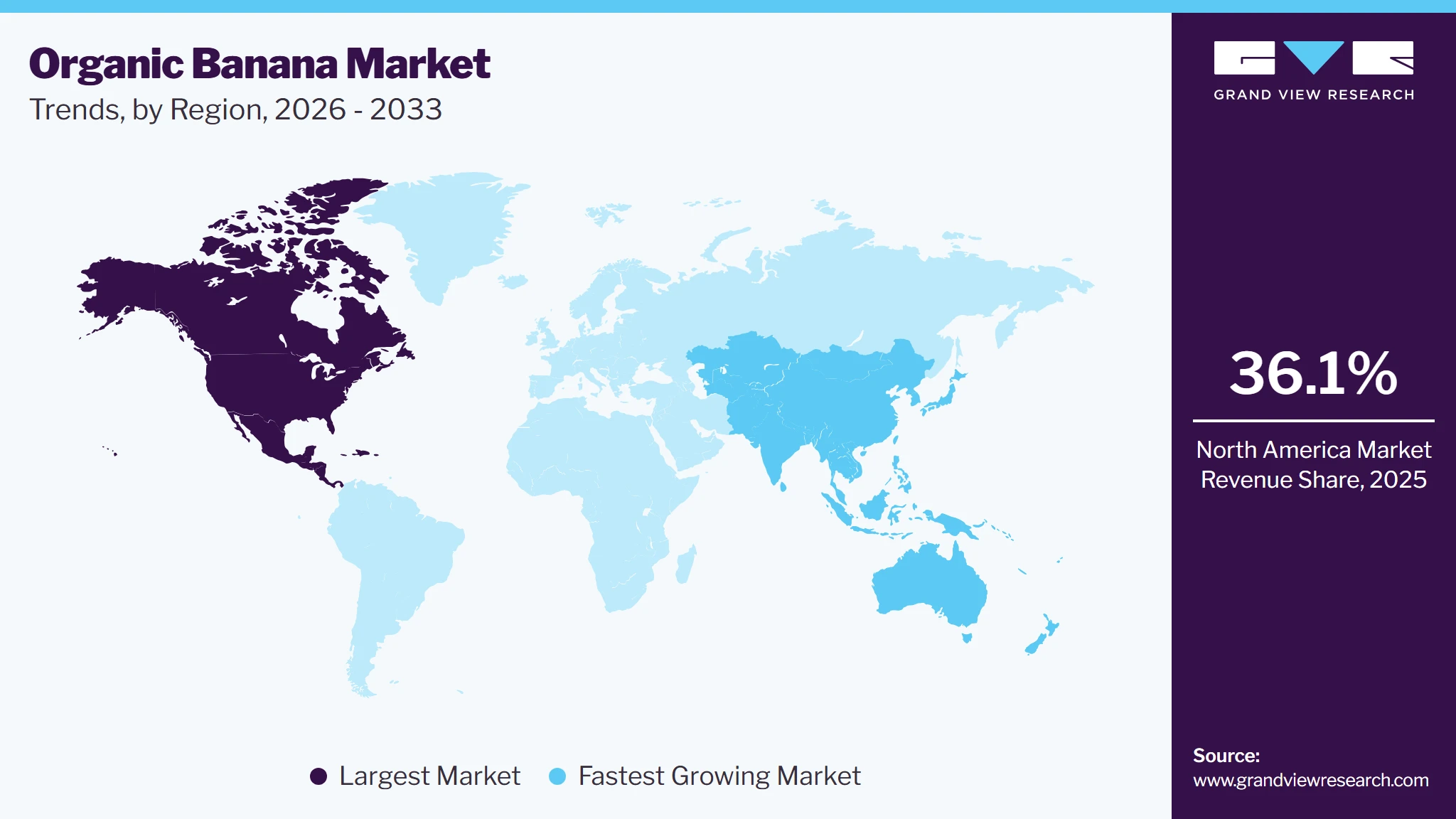
The North America organic banana market accounted for the largest revenue share of 36.1% in 2025. The market growth is supported by the strong presence of health-oriented consumers. Retailers are expanding their organic produce sections to meet changing shopping preferences. Product traceability and transparent sourcing are also becoming important purchasing considerations. Well-developed cold-chain infrastructure helps maintain banana quality during transportation and storage. These factors support consistent demand across the region.
 To learn more about this report, Download Free Sample Report
U.S. Organic Banana Market Trends
The U.S. organic banana industry led North America in 2025, holding the largest revenue share of 81.6%. The U.S. market benefits from the wide availability of organic bananas through established grocery retailers. Consumers increasingly seek products that align with clean-label and environmentally conscious lifestyles. Private-label organic produce offerings are also helping retailers reach different customer groups. Strong household purchasing power supports spending on premium fresh produce. In March 2026, the Organic Trade Association reported that organic banana sales grew 12.6% in 2025 to reach approximately USD 1 billion, demonstrating continued momentum in the U.S. market. Food-service businesses further contribute to demand by using organic ingredients.
Europe Organic Banana Market Trends
The organic banana industry in Europe is projected to grow at a CAGR of 7.2% from 2026 to 2033. Europe is driven by a strong interest in environmentally responsible agriculture and sustainable food consumption. Organic farming standards and established certification systems provide greater confidence in product authenticity. Consumers are increasingly attentive to biodiversity, soil health, and responsible farming practices. Retailers are also incorporating sustainability considerations into their sourcing strategies. These trends create a supportive environment for organic banana consumption.
The UK organic banana market led Europe in 2025, holding the largest revenue share of 23.6%. The market growth is driven by the growing popularity of ethical and responsibly sourced groceries. Consumers often consider farming practices and supply-chain transparency when selecting fresh produce. Supermarkets are increasing the visibility of certified organic products through dedicated ranges and promotions. Demand from environmentally conscious households provides additional momentum. Convenient availability through major grocery chains also encourages regular purchases.
Asia Pacific Organic Banana Market Trends
The Asia Pacific organic banana industry is expected to grow at the fastest CAGR of 8.2% in 2025. Asia Pacific presents strong potential due to expanding urban populations and changing dietary habits. The rising modernization of food retail is improving access to premium fresh produce. Growing interest in healthier lifestyles is encouraging consumers to explore higher-quality fruit options. Improvements in logistics and organized distribution are helping connect producers with urban markets. In September 2025, India and Australia signed a Mutual Recognition Arrangement for organic products, designed to simplify certification requirements and improve market access for certified organic agricultural products.
The China organic banana market led Asia Pacific in 2025, holding the largest revenue share with 32.5% of the region’s total revenue. China's market is benefiting from the rapid development of modern grocery retail and e-commerce. Consumers in major cities are becoming more interested in food safety and product quality. Digital platforms allow suppliers to communicate information about sourcing and production directly to buyers. Expansion of premium supermarkets is increasing the visibility of imported and certified produce. Growing urban consumption provides further opportunities for market development.
Central & South America Organic Banana Market Trends
The Central & South America organic banana industry is projected to grow at a CAGR of 7.6% from 2026 to 2033. The market benefits from favorable climatic conditions that support banana cultivation across several countries. The region has established expertise in banana production and international agricultural trade. Growing investment in sustainable farming can improve the competitiveness of organic producers. Export-oriented supply chains provide opportunities to serve overseas organic markets. Expansion of certification and sustainable agricultural programs can further strengthen regional production.
Middle East & Africa Organic Banana Market Trends
The Middle East & Africa organic banana industry is expected to grow at a CAGR of 7.7% from 2026 to 2033. The market growth is driven by the increasing urbanization and the expansion of modern food-retail networks. Growing tourism and hospitality industries create additional demand for premium fresh fruits. Investments in food distribution and storage infrastructure are improving product availability in urban centers. Rising consumer interest in healthier dietary choices is encouraging demand for organic produce. Import networks also help meet consumption needs in countries with limited local banana production.
Key Organic Banana Company Insights
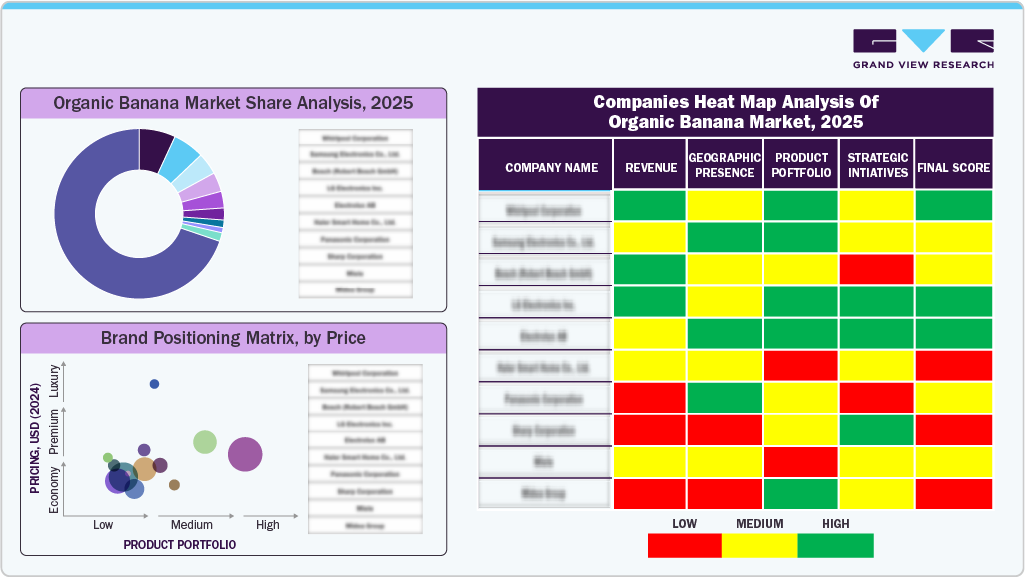
The organic banana industry is experiencing steady growth as consumers increasingly prefer healthier and sustainably produced food products. Market share is influenced by the availability of organic bananas across major retail and online distribution channels. Developed regions maintain a strong position due to established organic food markets and consumer awareness.
Emerging markets are also gaining importance as modern retail and purchasing power expand. Competition among producers and suppliers is expected to increase as the market continues to develop. Product quality, certification, and reliable supply are becoming important factors in maintaining market position.
 To learn more about this report, Download Free Sample Report
Key Organic Banana Companies
The following key companies have been profiled for this study of the organic banana market.
-
Dole plc
-
Chiquita Brands International
-
Fresh Del Monte Produce Inc.
-
Uniban
-
Fyffes.
-
AgroFair Ingredients
-
Compagnie Fruitière
-
AgroAmerica
-
Reybanpac
-
Grupo Noboa
Competitive Benchmarking
Category
Operating Strategies
Competitive Edge
Weakness
Established Players (Dole plc, Chiquita Brands International)
Expand organic sourcing, strengthen retailer partnerships, and invest in sustainable supply chains.
Strong distribution, supplier relationships, and market presence.
Higher operating costs and complex supply-chain management.
Emerging Players (AgroFair, AgroAmerica, Wiberg GmbH)
Target niche markets, develop specialty varieties, and leverage direct-to-consumer channels.
Agility, differentiated offerings, and focused organic positioning.
Smaller scale, limited distribution, and lower brand recognition.
Recent Developments
-
In September 2025, India and Australia signed a Mutual Recognition Arrangement for organic products, designed to simplify certification requirements and improve market access for certified organic agricultural products.
-
In 2024, Colombia’s DAABON introduced Banachips, fried organic green banana chips made from organic green bananas and palm oil. The product was developed to explore new market opportunities and received a positive local response.
Organic Banana Market Report Scope
Report Attribute
Details
Market size in 2025
USD 4.2 billion
Estimated market size in 2026
USD 4.4 billion
Projected market size by 2033
USD 7.3 billion
Growth rate
CAGR of 7.5% from 2026 to 2033
Actuals
2021 - 2025
Forecast period
2026 - 2033
Quantitative units
Revenue in USD million/billion and CAGR from 2026 to 2033
Report coverage
Revenue forecast, company ranking, competitive landscape, growth factors, and trends
Segments covered
Product, distribution channel, region
Regional Scope
North America; Europe; Asia Pacific; Central & South America; Middle East & Africa
Country scope
U.S.; Canada; Mexico; UK; Germany; France; Italy; Spain; China; Japan; India; Australia & New Zealand; South Korea; Brazil; South Africa
Key companies profiled
Dole plc; Chiquita Brands International; Fresh Del Monte Produce Inc.; Uniban; Fyffes; AgroFair; Compagnie Fruitière; AgroAmerica; Reybanpac; Grupo Noboa
Customization scope
Free report customization (equivalent up to 8 analysts’ working days) with purchase. Addition or alteration to country, regional & segment scope.
Pricing and purchase options
Avail customized purchase options to meet your exact research needs. Explore purchase options
Global Organic Banana Market Report Segmentation
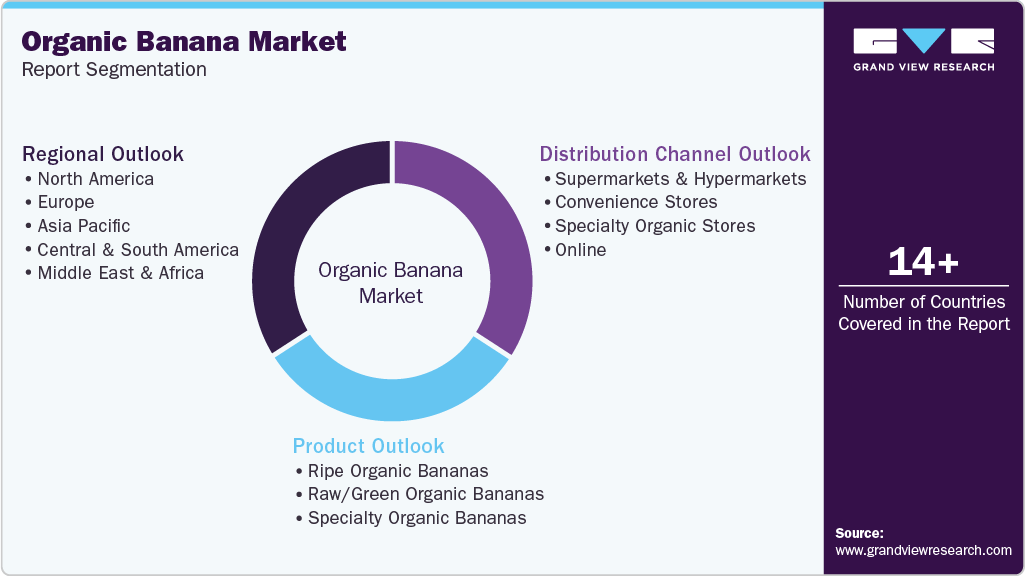
This report forecasts revenue growth at the global, regional & country levels and provides an analysis of the latest industry trends and opportunities in each of the sub-segments from 2021 to 2033. For this study, Grand View Research has segmented the organic banana market report based on product, distribution channel, and region:
 To learn more about this report, Download Free Sample Report
-
Product Outlook (Revenue, USD Million/Billion, 2021 - 2033)
-
Ripe Organic Bananas
-
Raw/Green Organic Bananas
-
Specialty Organic Bananas
-
-
Distribution Channel Outlook (Revenue, USD Million/Billion, 2021 - 2033)
-
Supermarkets & Hypermarkets
-
Convenience Stores
-
Specialty Organic Stores
-
Online
-
-
Regional Outlook (Revenue, USD Million/Billion, 2021 - 2033)
-
North America
-
U.S.
-
Canada
-
Mexico
-
-
Europe
-
UK
-
Germany
-
France
-
Italy
-
Spain
-
-
Asia Pacific
-
China
-
Japan
-
India
-
Australia & New Zealand
-
South Korea
-
-
Central & South America
-
Brazil
-
-
Middle East & Africa
-
South Africa
-
-
Research Methodology
The organic banana market figures in this report are based on a proven research process that combines executive interviews with secondary research from proprietary databases, company filings, and recognized regulatory and institutional sources. Market size is built through value-chain sizing—reconciling supply-side and demand-side estimates—and triangulated with bottom-up and top-down approaches. Every estimate passes multiple levels of expert validation before publication, with each organic banana segment quantified using the revenue-capture definitions in the table below.
Segment Definition
Product
Revenue capture definition
Ripe Organic Bananas
Ripe organic bananas generate revenue through the sale of ready-to-consume fruit to households, retailers, food-service operators, and institutional buyers. Their revenue is captured through fresh produce sales in supermarkets, grocery stores, specialty outlets, and online channels. Demand is supported by their suitability for direct consumption and everyday meal occasions. Value is also generated through different pack sizes and quality grades.
Raw/Green Organic Bananas
Raw/green organic bananas generate revenue through sales to consumers and commercial buyers who use them for cooking and food preparation. Revenue is captured through fresh produce distribution, wholesale transactions, and sales to food-processing businesses. Their use in savory dishes and processed food applications broadens their commercial demand. Bulk purchasing by restaurants and processors can provide additional revenue streams.
Specialty Organic Bananas
Specialty organic bananas generate revenue through the sale of distinctive varieties positioned toward consumers seeking differentiated fruit products. Revenue is captured through premium pricing based on variety characteristics, limited availability, and specialized cultivation. These bananas are distributed through specialty retailers, premium grocery outlets, farmers' markets, and selected online platforms. Their differentiated positioning allows suppliers to target niche consumer segments and generate higher-value sales.
Estimation Model
Layer No.
Layer Name
Key Question
Description
01
Consumption Profile Layer Who buys organic bananas?
Represents consumers seeking naturally produced fresh fruit, with preferences shaped by food quality, responsible sourcing, and dietary choices. This layer captures household buyers, health-focused shoppers, and consumers willing to select differentiated produce.
02
Market Reach Layer Where are organic bananas available?
Covers access through grocery retailers, fresh-produce stores, specialty organic outlets, wholesale markets, and digital grocery platforms. Availability across these channels determines how easily target consumers can purchase the product.
03
Purchase & Retention Layer What encourages repeat purchases of organic bananas?
Focuses on consistent product quality, freshness, reliable availability, attractive pricing, and positive shopping experiences.
04
Value Generation Layer How is revenue generated from organic banana consumers?
Represents value creation through premium fresh-produce pricing, differentiated varieties, quality grades, branded offerings, packaged formats, and specialized retail positioning.
Delivered Customizations
This report has been delivered with the following In-depth customizations
CLIENT REQUEST
CUSTOMIZATION DELIVERED
VALUE ADDS
Global Organic Banana Consumer & Usage Assessment
Evaluated consumption occasions, preferred ripeness, household usage, and purchasing priorities across key consumer groups.
Supports consumer segmentation and helps identify the most attractive demand pockets.
Global Organic Banana Supply & Distribution Assessment
Assessed sourcing patterns, cultivation regions, distribution networks, and availability across major sales channels.
Helps identify supply chain opportunities, channel gaps, and potential market entry areas.
Global Organic Banana Variety & Quality Assessment
Examined demand for specialty varieties, appearance standards, freshness expectations, and quality attributes.
Enables product differentiation, variety selection, and stronger positioning within premium organic produce.
Frequently Asked Questions About This Report
The global organic banana market size was valued at USD 4.2 billion in 2025 and is estimated at USD 4.4 billion for 2026.
The global organic banana market is expected to grow at a CAGR of 7.5% from 2026 to 2033, reaching USD 7.3 billion by 2033.
Key factors include rising health and food-safety awareness, growing demand for pesticide-free and sustainably produced fruits, and increasing consumer preference for organic food products.
The ripe organic bananas segment led with a 69.7% revenue share in 2025.
North America organic banana market led with a 36.1% revenue share in 2025.
Supermarkets & hypermarkets held the largest revenue share of 61.1% in 2025
Key players include Dole plc, Chiquita Brands International, Fresh Del Monte Produce Inc., Uniban, Fyffes, AgroFair, Compagnie Fruitière, AgroAmerica, Reybanpac, and Grupo Noboa.
Asia Pacific is the fastest-growing region over the forecast period.
About the Author(s)
Consumer F&B Research Team
Consumer Goods · Consumer F&BThis report was authored by the consumer f&b research team at Grand View Research - comprising two research analysts, one senior research analyst, and one industry expert - with specialized expertise in the consumer f&b segment of the consumer goods industry. All findings are based on proprietary consumer goods databases, executive interviews, and regulatory analysis, subject to internal peer review prior to publication.
Last Updated:
Speak to Analyst

Customize this report to your needs - add regions, segments, or data points, with 20% free customization.
Or view our licence options:


ISO 9001:2015 & 27001:2022 Certified
We are GDPR and CCPA compliant! Your transaction & personal information is safe and secure. For more details, please read our privacy policy.


