
- Home
- »
- Consumer F&B
- »
-
Organic Tea Market Size, Share & Growth Report, 2026-2033GVR Report cover

Organic Tea Market (2026 - 2033)
Size, Share & Trends Analysis Report By Product (Camellia Sinensis, Herbal), By Taste (Flavored, Plain), By Form (Tea Bag, Liquid), By Distribution Channel, By Region, And Segment Forecasts
Market Size, 2025
$819.9MMarket Estimate, 2026
$954.8MMarket Forecast, 2033
$2,835.3MCAGR, 2026–2033
16.8%Organic Tea Market Summary
The global organic tea market size was valued at USD 819.9 million in 2025 and is projected to grow from USD 954.8 million in 2026 to USD 2,835.3 million by 2033, at a CAGR of 16.8% from 2026 to 2033. The market in Asia Pacific dominated with a revenue share of 34.2% in 2025. Increasing consumer awareness about the health benefits of organic tea, such as its high antioxidant content and absence of harmful chemicals, is a major driver.
 Source: Grand View Research, IR Documents, Primary Interviews, Paid DatabasesTo learn more about this report,
 Download Free Sample Report
 Key Market Trends & Insights
- By taste: Flavored segment held the largest market share of 85.3% in 2025.
- By product: Camellia sinesis segment held the largest market share of 74.6% in 2025.
- By form: Leaf & powder segment held the largest market share of 49.8% in 2025.
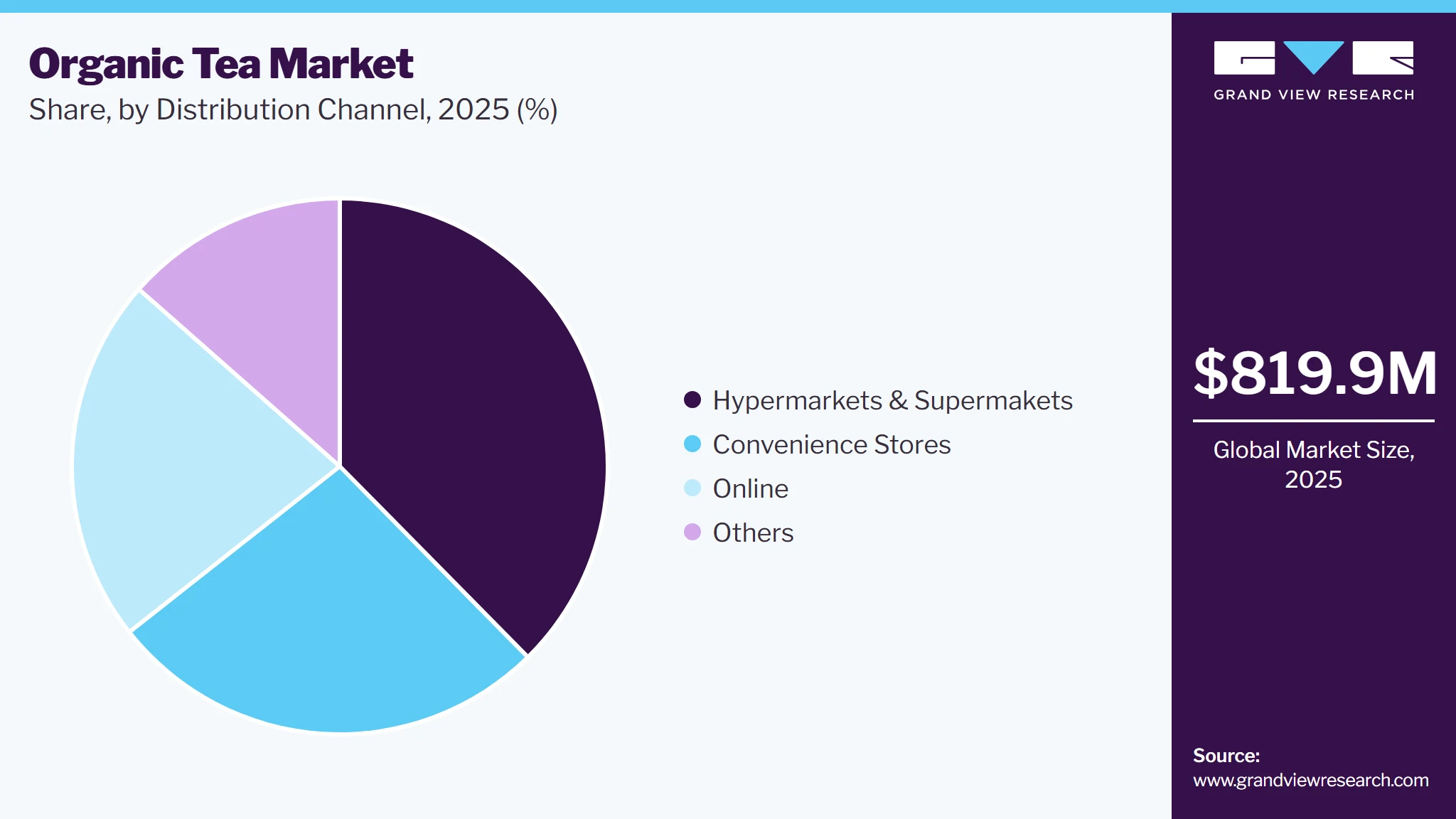
- By distribution channel: Hypermarkets & supermarkets segment held the largest market share of 37.6% in 2025.
Regional Highlights
- Largest regional market: Asia Pacific (34.2% revenue share, 2025)
- By country: China held the largest market share in 2025
Market Size & Forecast
- Market size in 2025: USD 819.9 Million
- Estimated market size in 2026: USD 954.8 Million
- Projected market size by 2033: USD 2,835.3 Million
- CAGR (2026-2033): 16.8%
Three ways to get this report
Buy it, customize it, or ask a question.Ask an Analyst
Analyst response in 1 business day
- AccessReport author, directly
- Reply timeWithin 1 working day
- No sales callDirect answer only
- FormatEmail reply
- CostFree, no cost
Get the Full Report
What the study covers
- FormatsPDF · Excel · Dashboard
- Timeline2026–2033 annual, 2025 base
- Coverage20+ countries, 5 regions
- Companies10+ key players profiled
Customize the Report
20% free customization
- IncludeCountries, segments, points
- TailorTo your product definition
- ExtendDeeper competitor detail
- OrA fully bespoke study
- Turnaround5–10 working days
The rising trend of health and wellness and the growing preference for natural and organic products are significantly boosting demand. Furthermore, growing consumer demand for healthy drinks is anticipated to drive market growth. The expanding middle class, particularly in emerging economies, with higher disposable incomes and an inclination towards premium products, is propelling market growth. The influence of tea culture and traditions in various regions, coupled with the introduction of innovative flavors and blends, is attracting a broader consumer base. Furthermore, the increasing availability of organic tea through various retail channels, including e-commerce, is making it more accessible to consumers. To learn more about this report, Download Free Sample Report
 The aforementioned health benefits are expected to increase the adoption of these products among health-conscious consumers in the near future. Demand for products with low caffeine content has been increasing. The trend has strongly influenced the market growth. Decaffeinated organic tea has been taking a sweep on the market. These products contain less than 2.5% of caffeine, which is beneficial for people suffering from sleep deprivation and disturbance. Over the past few years, the industry has witnessed an increased number of manufacturers selling decaffeinated variants of organic tea. For instance, Twining and Company Limited, a U.K.-based tea company, sells decaffeinated green tea bags, which offer a smooth and balanced combination of taste and flavor.
Market Dynamics
The organic tea market is witnessing sustained growth driven by increasing consumer preference for natural, chemical-free beverages and healthier lifestyle choices. Growing awareness regarding the potential health benefits of organic tea, such as antioxidant properties, digestive support, and immunity enhancement, is encouraging wider consumption across diverse age groups. Demand is further supported by the rising popularity of premium and specialty tea varieties, including herbal, green, and wellness-focused blends. Manufacturers are expanding their product portfolios with innovative flavors, sustainable packaging, and ethically sourced ingredients to attract environmentally conscious consumers.
Increasing consumer preference for natural and chemical-free beverages is a major driver of growth in the beverage industry. Consumers are becoming more health-conscious and are actively seeking products made with natural ingredients, free from artificial colors, flavors, preservatives, and sweeteners. This shift is influenced by rising awareness of the potential health risks associated with synthetic additives and processed foods. As a result, demand for organic juices, herbal drinks, functional beverages, and plant-based alternatives has increased significantly. Beverage companies are responding by introducing cleaner labels and healthier product options to meet changing consumer expectations. In September 2025, Traditional Medicinals expanded its organic herbal tea portfolio by launching Rosy Mood and Stress Ease Calm, two wellness-focused teas designed to support mood enhancement and stress management. The products also mark the company’s first Fair for Life certified tea range, reinforcing its commitment to ethical sourcing and sustainability.
Higher product prices compared to conventional tea act as a restraint on the growth of the organic tea market. Organic tea cultivation requires farmers to follow strict farming practices without synthetic fertilizers or pesticides, which can increase production costs and reduce yields. In addition, obtaining and maintaining organic certifications involves inspection, compliance, and documentation expenses. These added costs are reflected in the final product price, making organic tea more expensive than conventional alternatives. As a result, price-sensitive consumers may be less willing to purchase organic tea, limiting market expansion in some regions.
The organic tea market presents significant growth opportunities driven by increasing consumer interest in functional beverages that support overall health and wellness. Growing demand for herbal, detox, immunity-boosting, and relaxation-focused tea blends is creating avenues for product diversification. Expanding penetration in emerging markets, where awareness of organic products is steadily increasing, offers additional revenue potential. Manufacturers can capitalize on the trend toward sustainable consumption by emphasizing eco-friendly packaging and ethically sourced ingredients. Furthermore, the rapid development of online retail channels enables brands to reach a broader consumer base and strengthen market presence globally.
Analyst Perspective
The organic tea market is witnessing steady expansion as consumers increasingly shift toward healthier and more natural beverage choices. Demand is being reinforced by rising preference for clean-label products that are free from synthetic pesticides, additives, and artificial processing. The category is benefiting from a broader wellness trend, where consumers associate organic tea with preventive health benefits and daily lifestyle balance. At the same time, premiumization is gaining traction, with growing interest in specialty blends, single-origin teas, and functional herbal infusions. However, supply chain constraints and higher production costs continue to influence pricing dynamics and limit mass-market penetration in some regions.
Product Insights
Based on product, the camelia sinesis segment led the market with the largest revenue share of 74.6% in 2025. The rich heritage and widespread popularity of teas made from camellia sinensis significantly boost consumer demand. These teas are renowned for their distinct flavors, aroma, and numerous health benefits, such as high antioxidant content and potential to reduce the risk of chronic diseases. The increasing awareness of these health benefits and the rising trend toward natural and organic beverages are driving consumers to choose organic versions of their favorite teas. Additionally, the expanding availability of organic camellia sinensis teas through various retail channels, including specialty tea shops, supermarkets, and online platforms, is enhancing their accessibility. The introduction of innovative blends and the growing interest in tea culture and rituals further contribute to the substantial revenue share of camellia sinensis in the organic tea market.
The herbal tea segment is expected to grow at the fastest CAGR of 17.8% over the forecast period. Increasing consumer awareness of the health benefits associated with herbal teas, such as improved digestion, enhanced relaxation, and boosted immunity, is significantly boosting demand. Herbal teas, made from various plants, herbs, and spices, are often perceived as natural remedies for various health issues, attracting health-conscious consumers. The rising trend of wellness and holistic health and the growing preference for caffeine-free beverages are further propelling market expansion. The introduction of innovative herbal tea blends and flavors is also attracting a broader consumer base. Additionally, the expanding availability of herbal teas through various retail channels, including online platforms, is making them more accessible to consumers.
Taste Insights
Based on taste, the flavored organic tea segment led the market with the largest revenue share of 85.3% in 2025. The increasing consumer demand for variety and innovative flavors in their beverages is a major driver. Flavored organic teas, which include options such as chamomile, mint, ginger, jasmine, and fruit-infused teas, offer an exciting range of tastes that cater to diverse palates. Additionally, the rising trend of wellness and health-consciousness is encouraging consumers to explore flavored teas that provide additional health benefits, such as enhanced relaxation, improved digestion, and boosted immunity. The availability of a wide range of flavored organic teas through various retail channels, including specialty tea shops, supermarkets, and online platforms, is making these products more accessible to a broader audience.
Plain taste segment is expected to grow at a significant CAGR over the forecast period. Plain organic tea, made from the camellia sinensis plant, offers a pure and authentic tea experience that is highly valued by tea enthusiasts. The absence of added flavors allows consumers to fully appreciate the natural taste and aroma of the tea leaves. Additionally, the increasing awareness of the health benefits associated with plain organic tea, such as its high antioxidant content and potential to support heart health and weight management, is significantly boosting demand. The simplicity and purity of plain tea appeal to health-conscious consumers who prefer natural and unadulterated products.
Form Insights
Based on form, the leaf & powder segment led the market with the largest revenue share of 49.8% in 2025. Leaf and powder forms of organic tea are highly valued for their purity and concentrated flavor, appealing to tea enthusiasts who seek an authentic tea experience. These forms are also preferred for their versatility, allowing consumers to prepare tea according to their preferences, whether it is a strong brew or a light infusion. Additionally, the health benefits associated with whole-leaf and powdered organic tea, such as high antioxidant content and the absence of additives, are significantly boosting demand. The availability of a wide range of leaf and powder organic tea varieties, including premium and specialty teas, through various retail channels, further enhances their accessibility to consumers.
Tea bag is expected to grow at the fastest CAGR over the forecast period. The convenience and ease of use that tea bags offer are major drivers, as they allow consumers to quickly and effortlessly brew a cup of tea without the need for additional equipment. The rising trend of on-the-go lifestyles and the demand for quick and hassle-free beverage solutions are propelling the popularity of tea bags. Additionally, the wide variety of flavors and blends available in tea bag form caters to diverse consumer preferences, further boosting demand. The growing awareness of the health benefits associated with tea consumption, including its antioxidant properties and potential to promote overall well-being, is also contributing to the market expansion.
Distribution Channel Insights
Based on distribution channel, the hypermarkets & supermarkets channels led the market with the largest revenue share of 37.6% in 2025. Hypermarkets and supermarkets offer a convenient one-stop shopping experience, allowing consumers to purchase various products, including organic tea, in a single trip. The extensive shelf space and strategic product placement in these large retail outlets make organic tea easily accessible to a broad range of consumers. Additionally, well-established retail chains with multiple locations in urban and suburban areas ensure wide availability and easy accessibility of organic tea products. Promotional activities, such as discounts, in-store sampling, and loyalty programs, further attract consumers to purchase organic tea from these outlets.
 To learn more about this report, Download Free Sample Report
 The online channel is expected to grow at the fastest CAGR over the forecast period. The increasing popularity of e-commerce platforms and their convenience make it easier for consumers to purchase organic tea from the comfort of their homes. Online platforms provide various options, detailed product descriptions, customer reviews, and ratings, helping consumers make informed decisions. Additionally, the influence of digital marketing and social media advertising is effectively reaching a broader audience, boosting online sales. Exclusive online discounts, promotions, and subscription services further incentivize consumers to shop for organic tea online. The rise of health-conscious consumers seeking natural and organic products is also contributing to the growth of the online channel.
Regional Insights
Asia Pacific dominated the organic tea market with the largest revenue share of 34.2% in 2025. The rich tea culture and tradition in countries such as China, India, and Japan play a crucial role in boosting the demand for organic tea. These countries have a long history of tea consumption and production, which is deeply ingrained in their culture and daily life. The increasing awareness of the health benefits associated with organic tea, such as high antioxidant content and the absence of harmful chemicals, is significantly boosting consumer demand. The rising middle class with higher disposable incomes and a greater focus on health and wellness is also propelling market growth. The influence of traditional tea ceremonies and the popularity of various tea blends further contribute to the strong demand for organic tea in the region. The expanding retail infrastructure, including the growth of e-commerce platforms, ensures wide availability and easy accessibility of organic tea products to a broad range of consumers.
 To learn more about this report, Download Free Sample Report
 Europe Organic Tea Market Trends
Europe organic tea industry held a considerable share in 2025. The increasing consumer awareness about the health benefits of organic tea, such as its antioxidant properties and absence of harmful chemicals, is significantly boosting demand. The strong tradition of tea consumption in countries such as the UK, Germany, and France is also propelling market growth. Additionally, the rising preference for natural and organic products, driven by a growing health-conscious population, is encouraging consumers to choose organic tea over conventional options. The influence of European regulations that ensure high-quality and safe ingredients in organic products further supports market growth.
North America Organic Tea Market Trends
North America organic tea industry is expected to grow at a significant CAGR of 17.4% over the forecast period. Growing consumer focus on health and wellness is a major driver, as more Americans become aware of the health benefits of organic tea, including its high antioxidant content and potential to support overall well-being. The growing trend of natural and organic product consumption is propelling demand for organic tea. Additionally, the rise of specialty tea shops and cafes across the country, offering a wide variety of organic tea options, is attracting a broad consumer base. The influence of health and wellness influencers on social media, who promote the benefits of organic tea, is further boosting consumer interest and adoption. The availability of organic tea through various retail channels, including supermarkets and online platforms, ensures easy accessibility for a wide range of consumers.
U.S. Organic Tea Market Trends
The U.S. organic tea industry is expected to grow significantly over the forecast period. The rising trend of health-conscious and environmentally friendly lifestyles is encouraging consumers to choose organic tea over conventional options. Additionally, the expanding presence of specialty tea shops, health food stores, and e-commerce platforms is making organic tea more accessible to a broader audience. The influence of digital marketing and social media advertising is effectively reaching a larger consumer base, further driving market growth. The growing preference for natural and sustainably-produced products is also propelling demand for organic tea.
Key Organic Tea Company Insights
Some key companies in the organic tea market include Davidson's Organics, Little Red Cup Tea Co., Numi, Inc., PepsiCo, The Coca Cola Company, and others.
-
Davidson's Organics offers a wide range of organic teas, including black, green, white, oolong, herbal teas, organic herbs, spices, cocoa, and gifts. Teas are sourced directly from small tea producers and disenfranchised farmers worldwide, ensuring high quality and fair trade practices. Davidson's Organics is committed to sustainability and eco-responsibility, offering freshly picked "direct-from-garden" teas that reflect the true character of each blend.
-
Little Red Cup Tea Co. is a small, family-owned company based in Brunswick, Maine. It specializes in traditional Chinese loose-leaf teas, which are certified organic by the USDA, and fair trade by Fair Trade U.S.
Key Organic Tea Companies:
The following key companies have been profiled for this study on the organic tea market.
-
Davidson's Organics
-
Little Red Cup Tea Co.
-
Numi, Inc.
-
PepsiCo
-
The Coca‑Cola Company
-
Hain Celestial Group
-
Tielka
-
Unilever
-
Ecotone
-
Tata Consumer Products Limited
Competitive Benchmarking
Category
Operating Strategies
Competitive Edge
Weakness
Established Players (Unilever, Tata Consumer Products Limited, PepsiCo, The Coca-Cola Company, Hain Celestial Group, Ecotone)
- Strong global distribution across retail, supermarkets, and ready-to-drink (RTD) channels; focus on premium organic and clean-label tea product lines; expansion through brand acquisitions and product reformulations.
- High brand equity, extensive supply chain networks, strong retail penetration, and the ability to scale organic offerings globally.
- Higher dependence on mass-market positioning, slower adaptation to niche organic innovations, and premium pricing limitations in price-sensitive markets.
Emerging Players (Numi, Inc., Davidson’s Organics, Tielka, Little Red Cup Tea Co.)
- Focus on certified organic, fair-trade, and herbal tea variants with direct-to-consumer and specialty store-driven models; emphasis on sustainability, ethical sourcing, and wellness positioning.
- Strong brand authenticity, faster innovation in herbal and functional blends, and strong alignment with health-conscious consumer trends.
- Limited global distribution reach, smaller production capacity, and lower brand visibility compared to multinational beverage companies.
Recent Developments
-
In December 2024, Carrington Co., an organic food company, launched the first organic tea with compostable and biodegradable packaging. This innovative packaging, which includes the tea bag and its contents, is designed to fully degrade when composted, contributing to a nearly zero carbon footprint.
-
In June 2024, the Gujarat Cooperative Milk Marketing Federation (GCMMF) is poised to enhance its organic product line by introducing Amul Tea, Sugar, and Jaggery. The federation aims to broaden its portfolio by offering 24 organic products, including wheat flour, rice, and pulses.
Organic Tea Market Report Scope
Report Attribute
Details
Market size in 2025
USD 819.9 million
Estimated market size in 2026
USD 954.8 million
Projected market size by 2033
USD 2,835.3 million
Growth rate
CAGR of 16.8% from 2026 to 2033
Base year for estimation
2025
Historical data
2021 - 2024
Forecast period
2026 - 2033
Quantitative units
Revenue in USD million/billion and CAGR from 2026 to 2033
Report coverage
Revenue forecast, company ranking, competitive landscape, growth factors, and trends
Segments covered
Product, Taste, Form, Distribution Channel, region
Regional scope
North America; Europe; Asia Pacific; Latin America; MEA
Country scope
U.S.; Canada; Mexico; UK; Germany; France; Italy; Spain; Thailand; Japan; India; Australia & New Zealand; South Korea; Brazil; South Africa
Key companies profiled
Davidson's Organics, Little Red Cup Tea Co., Numi, Inc., PepsiCo, The Coca‑Cola Company, Hain Celestial Group, Tielka, Unilever, Ecotone,
Tata Consumer Products Limited
Customization scope
Free report customization (equivalent up to 8 analysts' working days) with purchase. Addition or alteration to country, regional & segment scope.
Pricing and purchase options
Avail customized purchase options to meet your exact research needs. Explore purchase options
Global Organic Tea Market Report Segmentation
This report forecasts revenue growth at global, regional, and country levels and provides an analysis of the latest industry trends in each of the sub-segments from 2021 to 2033. For this study, Grand View Research has segmented the global organic tea market report based on product, taste, form, distribution channel, and region:
-
Product Outlook (Revenue, USD Million, 2021 - 2033)
-
Camelia Sinesis
-
White
-
Black
-
Green
-
Oolong
-
Others
-
-
Herbal
-
-
Taste Outlook (Revenue, USD Million, 2021 - 2033)
-
Flavored
-
Plain
-
-
Form Outlook (Revenue, USD Million, 2021 - 2033)
-
Tea Bag
-
Leaf & Powder
-
Liquid
-
-
Distribution Channel Outlook (Revenue, USD Million, 2021 - 2033)
-
Hypermarkets & Supermarkets
-
Convenience Stores
-
Online
-
Others
-
-
Regional Outlook (Revenue, USD Million, 2021 - 2033)
-
North America
-
U.S.
-
Canada
-
Mexico
-
-
Europe
-
Germany
-
UK
-
France
-
Italy
-
Spain
-
-
Asia Pacific
-
China
-
Japan
-
India
-
Indonesia
-
-
Latin America
-
Brazil
-
Argentina
-
-
Middle East and Africa (MEA)
-
South Africa
-
UAE
-
-
Research Methodology
The organic tea market figures in this report are based on a proven research process that combines executive interviews with secondary research from proprietary databases, company filings, and recognized regulatory and institutional sources. Market size is built through value-chain sizing - reconciling supply-side and demand-side estimates - and triangulated with bottom-up and top-down approaches. Every estimate passes multiple levels of expert validation before publication, with each organic tea segment quantified using the revenue-capture definitions in the table below.
Segment Definition
Segment - Product
Revenue capture definition
Camellia sinensis
This refers to the plant species from which traditional true teas such as green, black, white, and oolong tea are derived. Products made from this plant undergo varying levels of oxidation and processing, and when grown organically, they are cultivated under chemical-free farming systems to ensure natural quality and flavor.
Herbal Tea
Herbal teas are infusions made from herbs, flowers, fruits, or spices rather than the Camellia sinensis plant. They are naturally caffeine-free in most cases and are often consumed for functional wellness benefits such as relaxation, digestion support, or immunity enhancement.
Estimation Model
Layer Name
Key Question
Description
Consumption Universe Layer
Who consumes organic tea globally?
Represents the total base of health-conscious consumers who prefer natural, minimally processed, and chemical-free beverages.
Access & Availability Layer
Who can access organic tea products?
Covers consumers who can obtain organic tea through supermarkets, specialty organic stores, cafés, and e-commerce platforms.
Purchase & Usage Layer
Who actively consumes organic tea regularly?
Includes consumers who intentionally choose organic tea as part of their daily routine for wellness, taste preference, or lifestyle alignment.
Revenue Conversion Layer
How is revenue generated from organic tea users?
Revenue is generated through repeat purchases of packaged organic teas and premium pricing for certified products. Additional value comes from subscriptions and expanding demand for herbal blends and ready-to-drink organic beverages.
Delivered Customizations
This report has been delivered with the following In-depth customizations
Client Request
Customization Delivered
Value Adds
Organic Tea Market Consumption & Lifestyle Trends
Analyzed increasing adoption of organic tea driven by health-conscious lifestyles, preference for clean-label beverages, and rising shift toward natural antioxidant-rich drinks across urban consumers.
Helps identify evolving wellness-driven consumption patterns and increasing preference for natural beverage alternatives.
Organic Tea Distribution Channel Dynamics
Analyzed distribution performance across supermarkets, specialty organic retailers, cafés, and e-commerce platforms, including the growing role of direct-to-consumer brands and digital wellness marketplaces, alongside increasing penetration of premium retail channels.
Provides insights into channel expansion potential, evolving consumer purchasing behavior, and strategies to optimize reach and improve market accessibility for organic tea products.
Organic Tea Product Innovation & Premiumization Trends
Assessed product innovation trends such as herbal-infused organic blends, functional wellness teas (digestion, immunity, relaxation), single-origin premium teas, and sustainable packaging solutions aligned with eco-conscious consumer preferences.
Helps brands identify differentiation opportunities, strengthen premium positioning, and align product development with evolving health, sustainability, and lifestyle-driven consumption patterns.
Frequently Asked Questions About This Report
The camelia sinesis segment led with a 74.6% revenue share in 2025.
The leaf & powder segment led the market with the largest revenue share of 49.8% in 2025.
The hypermarkets & supermarkets channel held the largest share (over 37.0%) in 2025, and the online distribution channel is the fastest-growing.
Davidson's Organics, Little Red Cup Tea Co., Numi, Inc., PepsiCo, The Coca‑Cola Company, Hain Celestial Group, Tielka, Unilever, Ecotone, and Tata Consumer Products Limited.
The global organic tea market size was valued at USD 819.9 million in 2025 and is estimated at USD 954.8 million in 2026.
The global organic tea market is expected to grow at a CAGR of 16.8% from 2026 to 2033, reaching USD 2,835.3 million.
Key factors include growing health consciousness among consumers, rising preference for pesticide-free and environmentally sustainable beverages, and increasing demand for products made with natural and organic ingredients.
Asia Pacific dominated with a 34.2% revenue share in 2025.
Central & South America are the fastest-growing regions over the forecast period.
About the Author(s)
Consumer F&B Research Team
Consumer Goods · Consumer F&BThis report was authored by the consumer f&b research team at Grand View Research - comprising two research analysts, one senior research analyst, and one industry expert - with specialized expertise in the consumer f&b segment of the consumer goods industry. All findings are based on proprietary consumer goods databases, executive interviews, and regulatory analysis, subject to internal peer review prior to publication.
Last Updated:
Speak to Analyst

Customize this report to your needs - add regions, segments, or data points, with 20% free customization.
Or view our licence options:


ISO 9001:2015 & 27001:2022 Certified
We are GDPR and CCPA compliant! Your transaction & personal information is safe and secure. For more details, please read our privacy policy.


