
- Home
- »
- Consumer F&B
- »
-
Packaged Salad Market Size And Share Report, 2026-2033GVR Report cover

Packaged Salad Market (2026 - 2033)
Size, Share & Trends Analysis Report By Product (Vegetarian, Non-Vegetarian), By Processing (Organic, Conventional), By Type (Packaged Greens, Packaged Kits), By Distribution Channel (Offline, Online), By Region, And Segment Forecasts
Market Size, 2025
$14.3BMarket Estimate, 2026
$15.2BMarket Forecast, 2033
$26.0BCAGR, 2026–2033
7.7%Packaged Salad Market Summary
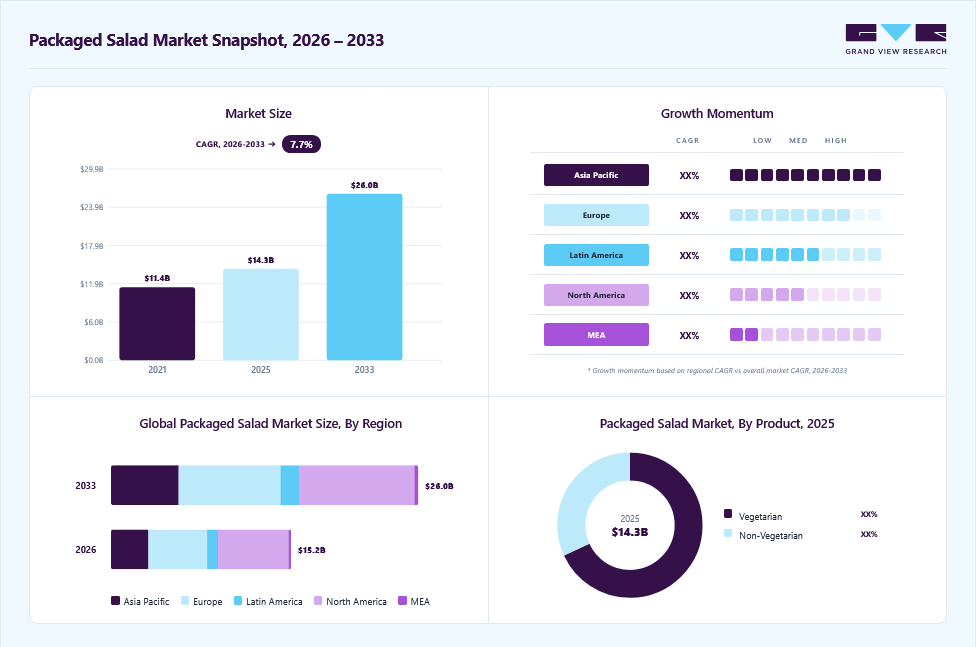
The global packaged salad market size was valued at USD 14.3 billion in 2025 and is projected to grow from USD 15.2 billion in 2026 to USD 26.0 billion by 2033, at a CAGR of 7.7% from 2026 to 2033. North America dominated the global market with the largest revenue share of 39.4% in 2025. An increasing emphasis on health and wellness has prompted consumers to seek nutritious meal options, making packaged salads the preferred choice for health-conscious individuals.
 Source: Grand View Research, IR Documents, Primary Interviews, Paid DatabasesTo learn more about this report,
 Download Free Sample Report
 Key Market Trends & Insights
- By product: Vegetarian segment led the market with the largest revenue share of 68.6% in 2025.
- By processing: Conventional segment led the market with the largest revenue share of 66.8% in 2025.
- By distribution channel: Offline segment led the market with the largest revenue share of 79.0% in 2025.
- By type: Packaged Greens segment led the market with the largest revenue share of 62.4% in 2025.
Regional Highlights
- Largest regional market: North America (39.4% revenue share, 2025)
- Fastest-growing regional market: Asia Pacific (highest CAGR, 2026-2033)
- By country: The U.S. held the largest market share in 2025.
Market Size & Forecast
- Market size in 2025: USD 14.3 Billion
- Estimated market size in 2026: USD 15.2 Billion
- Projected market size by 2033: USD 26.0 Billion
- CAGR (2026-2033): 7.7%
Three ways to get this report
Buy it, customize it, or ask a question.Ask an Analyst
Analyst response in 1 business day
- AccessReport author, directly
- Reply timeWithin 1 working day
- No sales callDirect answer only
- FormatEmail reply
- CostFree, no cost
Get the Full Report
What the study covers
- FormatsPDF · Excel · Dashboard
- Timeline2026–2033 annual, 2025 base
- Coverage20+ countries, 5 regions
- Companies10+ key players profiled
Customize the Report
20% free customization
- IncludeCountries, segments, points
- TailorTo your product definition
- ExtendDeeper competitor detail
- OrA fully bespoke study
- Turnaround5–10 working days
According to the data published in May 2024, each U.S. consumer ate about 39 salads during the 12 months ending in February, a 4% increase from last year. Furthermore, packaged salads, being pre-washed and pre-cut, save consumers time and effort in meal preparation. This convenience factor is expected to drive the growth for packaged salad industry. Rising health-consciousness among consumers, along with increasing awareness about numerous health benefits associated with fruits and leafy vegetables, has been driving the packaged salad market globally. In recent years, there has been a noticeable shift in consumer preferences towards choosing fruits and other fresh, unprocessed ingredients over fast foods and packaged snacks. This trend is driven by the increasing emphasis on weight management, a response to the growing levels of obesity worldwide. Fruits and vegetables, with their naturally low-calorie content, are emerging as a popular choice for health-conscious individuals seeking effective weight management solutions. To learn more about this report, Download Free Sample Report
 The growing inclination toward convenience foods is a significant driver of the packaged salad industry. Convenience has become paramount in consumers' food choices due to evolving lifestyles and busy schedules. According to the data published in May 2024, most salads (56%) are consumed at dinner, followed by lunch (39%). Salads serve as a main dish 52% of the time and as a side dish or appetizer 47% of the time. Packaged offerings from some major produce suppliers make it easy and convenient for consumers to make their own salads.
The increasing working population, especially working women, is also anticipated to drive the market. The young and working-class population does not want to compromise on health, flavor, or taste despite their busy schedules. This shift in consumer behavior has led to an increasing demand for easily accessible and ready-to-eat options, and packaged salads perfectly fit this criterion.
One of the primary reasons for the popularity of packaged salads is the time-saving aspect. With packaged salads, consumers can quickly assemble a healthy and fresh meal without the need for extensive washing, chopping, or food preparation. This convenience resonates with working professionals, students, and busy families who often struggle to find the time to prepare a nutritious meal from scratch. Packaged salads offer a hassle-free way to incorporate more vegetables into one's diet, and this time-saving feature is driving the packaged salad industry growth.
Based on consumer trends and preferences, Dole has introduced new kits, including the Creamy Greek Chopped Kit, Sweet Corn Chopped Kit, and a twist on the classic Italian sandwich with the Chopped Italian Sub Salad Kit, Austin said. Moreover, according to the data published in May 2024, 88.7% of restaurant menus feature salads, ranging from 77.1% in quick-serve restaurants to 96.9% in fine dining establishments.
Market Dynamics
The packaged salad market is expanding steadily as consumers increasingly prioritize healthy eating, convenience, and fresh food consumption. Ready-to-eat salad products offer a practical solution for busy lifestyles while supporting demand for nutrient-rich and minimally processed foods. Growth is further supported by expanding retail distribution, product innovation, and rising interest in plant-based diets. As consumers continue to seek convenient meal options with clean-label ingredients, demand for packaged salads is expected to remain strong across both developed and emerging markets.
Increasing consumer focus on wellness and balanced nutrition, coupled with time-constrained lifestyles, is accelerating demand for ready-to-eat packaged salads. These products offer a convenient and nutritious meal solution, aligning with evolving preferences for fresh, healthy, and minimally processed food options, thereby supporting sustained market growth.
The highly perishable nature of packaged salads requires efficient refrigerated storage and transportation. Dependence on cold-chain infrastructure increases operational costs and can limit distribution efficiency.
Manufacturers are increasingly introducing value-added packaged salads featuring premium ingredients, functional benefits, and enhanced nutritional profiles to address evolving consumer preferences. The growing demand for protein-rich, organic, and customized salad solutions is creating new opportunities for product differentiation and premiumization. For instance, in March 2026, Taylor Farms launched an 11-product protein-focused range, including salad kits and bowls enriched with protein-based dressings, toppings, and ingredients, reflecting the industry's focus on nutrient-enhanced and functional packaged salad offerings.
Analyst Perspective
The packaged salad market is experiencing steady growth driven by rising health consciousness, increasing demand for convenient meal solutions, and growing preference for fresh, nutrient-rich foods. Consumers are increasingly seeking ready-to-eat products that align with healthy lifestyles while minimizing meal preparation time. Premium, organic, protein-enriched, and value-added salad offerings are gaining traction, creating new revenue opportunities for manufacturers. Companies that strengthen cold-chain capabilities, expand distribution across online and offline channels, and offer differentiated products with freshness, quality, and clean-label attributes are expected to enhance their competitive positioning and capture long-term market growth.
Consumer Insights For The Packaged Salad Market
Consumer trends in the packaged salad industry are being shaped by demand for convenience, health optimization, clean-label transparency, and sustainability. Time-constrained urban consumers are demonstrating a strong preference for ready-to-eat, pre-washed, and portion-controlled salad kits that reduce meal preparation time while supporting balanced diets. According to the United States Department of Agriculture, per capita consumption of fresh vegetables in the U.S. has remained substantial, with lettuce and leafy greens ranking among the most consumed vegetables, reinforcing demand for value-added packaged formats.
 To learn more about this report, Download Free Sample Report
 Additionally, consumers are prioritizing nutrient-dense ingredients such as kale, spinach, arugula, and protein-enhanced toppings aligned with plant-based and functional nutrition trends. Clean-label expectations, free from artificial preservatives and additives, are influencing purchasing decisions, while recyclable and eco-friendly packaging has become a key preference driver due to rising environmental awareness. Transparency in sourcing, food safety assurance, and locally grown produce claims are further strengthening brand trust and repeat purchase behavior across both retail and online grocery channels.
Product Insights
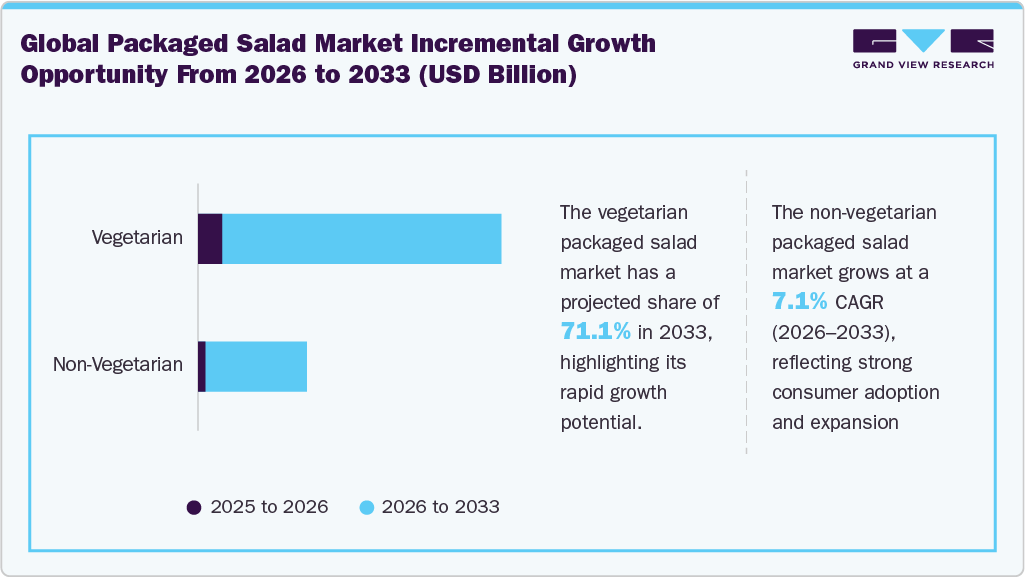
Based on product, the vegetarian segment led the market with the largest revenue share of 68.6% in 2025. Factors such as a rise in the number of vegan and vegetarian populations are fueling the demand for vegetarian packaged salads. The increasing emphasis on health and wellness has led many consumers to seek healthier food options. Packaged salads are seen as a nutritious choice as they typically consist of fresh vegetables and greens, which are rich in essential vitamins, minerals, and fiber.
 To learn more about this report, Download Free Sample Report
 The non-vegetarian packaged salad segment is projected to grow at a significant CAGR of 7.1% from 2026 to 2033. The shifting consumer focus toward protein-enriched diets to achieve their desired body figure or shape has been contributing to the worldwide demand for non-vegetarian packaged salads. Brands offering non-vegetarian packaged salads typically market their products as a wholesome choice for today's active lifestyle. In July 2025, Pret A Manger introduced larger, premium “Super Plates” salads featuring protein-rich ingredients targeted at office workers, with prices going up to around £12.95 (USD 17.16). The newly launched non-vegetarian options include items like a miso salmon version, made with roasted salmon, avocado, black rice, quinoa, broccoli, and edamame soybeans.
Processing Insights
Based on processing, the conventional segment led the market with the largest revenue share of 66.8% in 2025. Packaged salads processed through conventional farming methods differ from organic salads. The National Organic Program, a federal regulatory framework in the U.S., places limitations on the use of genetically modified organisms (GMOs), while conventionally processed packaged salads may include GMOs. Generally, conventionally produced salads are more affordable than their organic counterparts because conventional farming tends to be less costly than organic farming.
 To learn more about this report, Download Free Sample Report
 The organic packaged salad segment is projected to grow at the fastest CAGR of 9.1% from 2026 to 2033. Organic processing systems adhere to precise production standards to attain sustainable agroecosystems that are economically, ecologically, and socially viable. Organically processed packaged salads receive proper certification from an authorized regulatory body. The criteria for organic processing of organic packaged salads differ from conventionally processed items in their reduced reliance on external inputs for preservation and their avoidance of synthetic ingredients or chemicals. In October 2024, Hippo Harvest introduced a new line of USDA-certified organic packaged salad products grown using controlled-environment agriculture to ensure consistent quality and sustainability. The range features fresh, ready-to-eat greens produced with fewer resources, offering convenient and environmentally friendly salad options.
Type Insights
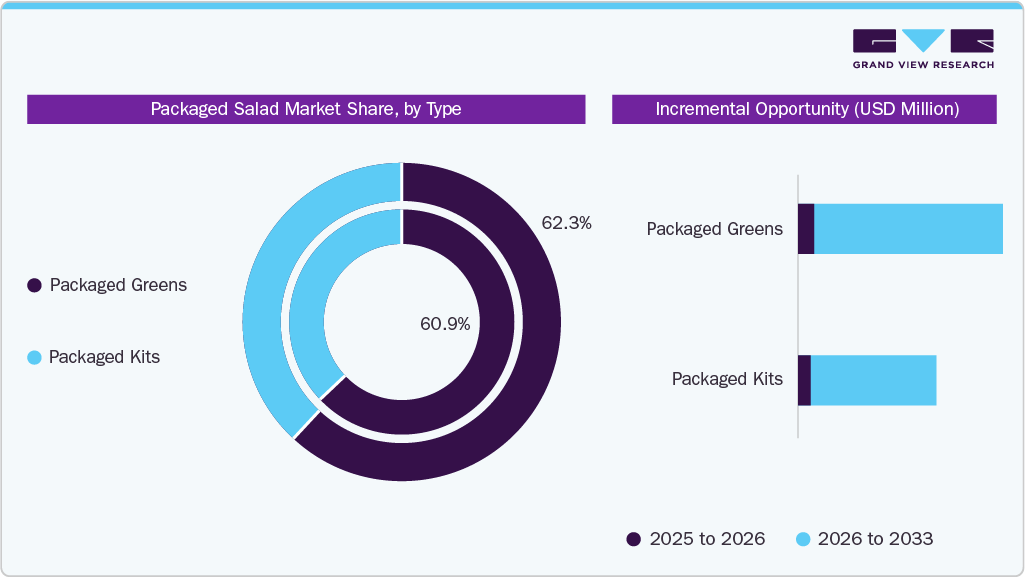
Based on type, the Packaged Greens segment led the market with the largest revenue share of 62.4% in 2025. Packaged greens have been gaining popularity owing to their raw taste without the addition of any type of seasonings, dressings, or condiments. Growing consumer preference for raw packaged salads has encouraged key players as well as new entrants to launch a number of products in the global market. People across the globe are increasingly adopting packaged greens in order to cut down their intake of extra calories, sugar, and fat. Such types of consumer preferences are driving the demand for packaged greens in the global market. In September 2025, Fresh Express launched its Mediterranean Herb Chopped Kit, a new ready‑to‑eat green salad featuring kale, cabbage, lettuce, and other crisp greens with chickpeas, feta, and a lemon‑oregano vinaigrette for bold Mediterranean flavor.
 To learn more about this report, Download Free Sample Report
 The packaged salad kits industry is projected to grow at the fastest CAGR of 8.4% from 2026 to 2033. As the number of single-person households continues to rise, many individuals living alone encounter challenges in maintaining a healthy diet. Busy lifestyles often lead them to rely on fast food and restaurant meals, which are typically considered detrimental to long-term health. Consequently, individuals who live alone or those with limited time for meal preparation have been exploring healthier alternatives, such as packaged salad kits, which offer a nutritious and tasty option.
Distribution Channel Insights
Based on distribution channel, the offline segment led the market with the largest revenue share of 79.0% in 2025. Supermarkets and hypermarkets are prominent distribution channels for packaged salads worldwide. Target and Walmart continue to dominate this space. Unlike grocery stores, orders placed through supermarkets and hypermarkets are typically larger. While grocery stores help packaged salad brands stay customer-focused, supermarkets and hypermarkets allow brands to increase sales by providing access to a considerably larger customer base. In May 2024, Tesco launched in-store Salad Creations bays that let shoppers easily build custom salads with a variety of greens, add-ins, and toppings. The setup includes sections for bases, extras including avocado, and dressings, with a Clubcard offer of four items for the price of three.
Packaged salad sales through online channels are projected to grow at a significant CAGR of 10.3% from 2026 to 2033. The industry is yet to adopt e-commerce widely compared to other sectors, such as household products and consumer electronics. The perishable nature of packaged salads with unique logistics and storage requirements is a key factor slowing down the distribution of these products through online/e-commerce channels. However, recent consumption patterns and shifting shopper sentiments indicate that the online category is poised for robust growth.
Regional Insights
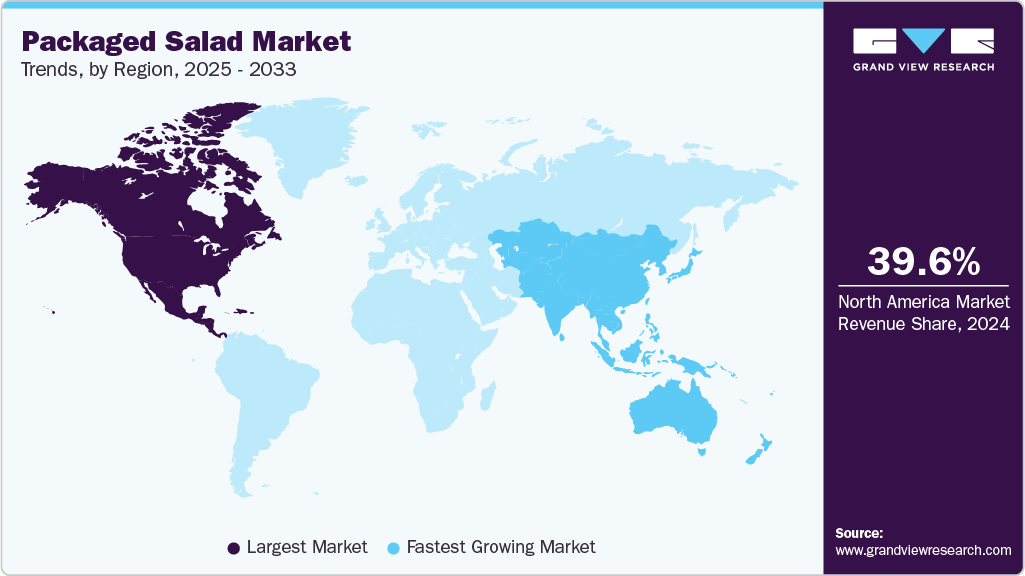
North America dominated the packaged salad market with the largest revenue share of 39.4% in 2025. The North American market is experiencing notable growth, driven by the growing awareness among North Americans regarding the importance of a healthy diet. This has led to an increase in the consumption of more fruits and vegetables. Salads are considered a convenient way to incorporate fresh vegetables into daily meals, contributing to the increased demand for packaged salads in the region. To cater to this growing demand and appeal to health-conscious consumers, major brands are updating their offerings and presentation. In August 2025, Dole Fresh Vegetables refreshed the packaging for its DOLE packaged salad kits with a modern design aimed at attracting Millennial and Gen Z shoppers, featuring vibrant colors and clearer ingredient visuals. The new look launched in North America, appearing on 31 chopped, premium, and classic salad kits in supermarkets across the U.S. and Canada.
 To learn more about this report, Download Free Sample Report
 U.S. Packaged Salad Market Trends
The packaged salad market in the U.S. held the largest share in the North America region in 2025. Growing demand for packaged salads has inspired the launch of new products in the region. For instance, Fresh Express, a U.S.-based consumer packaged salad manufacturer, introduced its newest salad kit, French Blue Cheese, along with three new offerings in its best-selling line of chopped salad kits: Smokehouse, French Bistro, and Twisted Caesar Enchilada. These additions expand its line of more than 100 fresh and convenient salad kits and blends.
Europe Packaged Salad Market Trends
The packaged salad industry in Europe held a significant market share in the global packaged salad market. Growing demand for healthy and convenient food products and a rising emphasis on sustainably sourced products are key factors boosting the regional market. The fast-paced lifestyles of many Europeans have led to a surge in demand for convenient, ready-to-eat food options. Packaged salads are a convenient choice for individuals with busy schedules, as they offer a healthy meal solution that requires minimal preparation. This has led to several companies launching salad kits in the region.
The UK packaged salad market is expected to grow at a CAGR of 7.9% during the forecast period. The U.K. was identified as a lucrative region for the packaged salad market. The availability of various-sized salad kits helps consumers buy the required number of kits and prevent wastage, which is a common challenge when purchasing fresh raw salad ingredients. Moreover, the availability of a wide range of salad brands, such as Florette, Tesco, and Morrisons, in the U.K. has been influencing consumers to purchase these products. Advancements in technology are also anticipated to drive the packaged salad market.
Asia Pacific Packaged Salad Market Trends
The packaged salad market in Asia Pacific is expected to expand at the fastest CAGR of 8.8% from 2026 to 2033. The high consumption of vegetables and fruits is expected to boost the demand for packaged salads in this region. Consumers in countries like China and India consume a significant number of vegetables due to their high production and ready availability. Moreover, the increasing popularity of packaged food in these countries has encouraged consumers to explore packaged salads, which offer convenience, health benefits, and time-saving options for working professionals.
China packaged salad market held the largest revenue share of 34.3% in 2025. In China, rapid urbanization and busy lifestyles are encouraging consumers, especially in major cities like Beijing and Shanghai, to seek ready-to-eat packaged salads as quick, nutritious meal choices. Rising health consciousness and awareness of food safety are shifting preferences from loose produce to branded salad products with reliable quality standards. E‑commerce platforms and modern retail expansion are improving access to packaged green salads and premium blends nationwide. Premium and organic salad offerings are gaining traction as disposable incomes rise and younger consumers pursue weight management and international eating habits.
The packaged salad market in India is expected to grow at a CAGR of 9.7% during the forecast period. In India, growing awareness of healthy eating and nutrition is prompting more consumers to consider packaged salads as a convenient way to include fresh vegetables in meals. Rising disposable incomes and expanding urban middle‑class lifestyles are increasing demand for convenient, ready‑to‑eat foods that fit hectic daily routines. Online grocery platforms and modern retail outlets are making packaged green salads more accessible beyond traditional markets. In July 2025, Massive Restaurants Pvt. Ltd. launched Salad Life in India, a chef‑curated healthy food brand offering flavor‑forward salads, bowls, wraps, and more tailored for health‑conscious, on‑the‑go urban consumers. The delivery‑first concept is available via Zomato and Swiggy in Delhi NCR, with a diverse menu spanning vegan, vegetarian, and non‑vegetarian options designed to make healthy eating convenient and tasty.
Central & South America Packaged Salad Market Trends
The packaged salad market in Central & South America is expected to grow at a CAGR of 7.8% during the forecast period. In Central and South America, growing health awareness and urban lifestyles are encouraging consumers in cities such as São Paulo to choose convenient, ready‑to‑eat packaged salads over traditional meal options. Rising supermarket penetration and modern retail expansion are increasing the availability of green salad mixes and salad kits in major stores, making these products easier to buy. Local producers are also creating regionally inspired blends that combine familiar ingredients with ready‑to‑eat convenience to appeal to younger shoppers. Improvements in logistics and refrigerated supply are helping reduce spoilage and support wider distribution across urban and suburban areas.
Middle East & Africa Packaged Salad Market Trends
The packaged salad market in the Middle East & Africa is expected to grow at a CAGR of 6.6% during the forecast period. In the Middle East and Africa, packaged salads are gaining traction as urbanization, modern retail growth, and rising expatriate populations drive demand for convenient, healthy foods. Major urban centers such as Dubai, Riyadh, and Johannesburg are seeing increased supermarket chill‑aisle space for green salads and premium kits, reflecting a shift toward Western‑influenced eating habits. Improved cold‑chain infrastructure and imported salad products help meet year‑round freshness expectations despite warmer climates. Additionally, hospitality, tourism and quick‑service restaurant growth in the Gulf region fuels demand from both residents and visitors seeking ready‑to‑eat vegetable options.
Key Packaged Salad Company Insights
Key companies in the global packaged salad market include major players such as Dole Fresh Vegetables, Fresh Express, Taylor Farms, Earthbound Farm, and Ready Pac Foods, which together dominate retail shelf space across North America, Europe, and other regions. Dole and Fresh Express consistently lead consumer preference surveys, capturing significant market share through wide distribution of salad kits, bagged greens, and value‑added blends.
These companies leverage strong brand recognition, extensive supply chains, and innovation in flavors and packaging to maintain a competitive advantage. Smaller and regional players also contribute to market diversity, particularly in organic, premium, and locally sourced salad segments.
 To learn more about this report, Download Free Sample Report
 Key Packaged Salad Companies
The following key companies have been profiled for this study on the packaged salad market.
-
Bonduelle
-
Dole Food Company Inc.
-
Fresh Express, Incorporated
-
Earthbound Farm
-
Mann Packing Co., Inc.
-
organicgirl
-
Misionero
-
Eat Smart
-
BrightFarms, Inc.
-
Gotham Greens
Competitive Benchmarking
Category
Operating Strategies
Competitive Edge
Weakness
Established Players (Bonduelle, Dole Food Company Inc., Fresh Express, Earthbound Farm, Mann Packing Co., Inc.)
- Expand value-added packaged salad portfolios through organic, ready-to-eat, and meal-kit offerings.
- Strengthen retail penetration via strategic partnerships with supermarkets, club stores, and food service channels.
- Strong brand equity and extensive distribution networks across domestic and international markets.
- Large-scale sourcing, processing, and supply chain capabilities enabling operational efficiency.
- High operational costs associated with cold-chain logistics and fresh produce management.
- Vulnerability to raw material price fluctuations and agricultural supply disruptions.
Emerging Players (organicgirl, Misionero, Eat Smart, BrightFarms, Inc., Gotham Greens)
- Focus on premium, locally sourced, organic, and sustainability-driven salad offerings.
- Increase market presence through direct-to-retail partnerships and controlled-environment agriculture investments.
- Ability to rapidly innovate and align products with evolving consumer health and sustainability preferences.
- Strong differentiation through freshness, traceability, and environmentally responsible production models.
- Limited geographic reach and production scale compared to established competitors.
- Lower brand recognition and relatively constrained financial resources for expansion initiatives.
Recent Developments
-
In March 2026, Fresh Express launched four new Unexpected Chopped Salad Kits featuring bold, globally inspired flavor profiles, from umami to island‑influenced combinations. The kits are designed to bring creative, restaurant‑style tastes to the produce aisle as convenient, ready‑to‑eat options.
-
In January 2025, Fresh Del Monte Produce, through its Mann Packing division, launched the Newman's Own Salad Kits featuring four culinary-inspired flavors, each crafted with high-quality lettuce.
Packaged Salad Market Report Scope
Report Attribute
Details
Market size value in 2025
USD 14.3 billion
Market size value in 2026
USD 15.2 billion
Revenue forecast in 2033
USD 26.0 billion
Growth rate
CAGR of 7.7% from 2026 to 2033
Base year for estimation
2025
Historical data
2021 - 2024
Forecast period
2026 - 2033
Quantitative units
Revenue in USD million/billion and CAGR from 2026 to 2033
Report coverage
Revenue forecast, company ranking, competitive landscape, growth factors, and trends
Segments covered
products, processing, distribution channel, type, region
Regional scope
North America; Europe; Asia Pacific; Central & South America, Middle East & Africa.
Country scope
U.S.; Canada; Mexico; Germany; UK; France; Italy; Spain; China; Japan; Australia; India; South Korea; Brazil; Saudi Arabia
Key companies profiled
Bonduelle; Dole Food Company Inc.; Fresh Express, Incorporated; Earthbound Farm; Mann Packing Co., Inc.; organicgirl; Misionero; Eat Smart; BrightFarms, Inc.; Gotham Greens
Customization scope
Free report customization (equivalent up to 8 analysts' working days) with purchase. Addition or alteration to country, regional & segment scope.
Pricing and purchase options
Avail customized purchase options to meet your exact research needs. Explore purchase options
Global Packaged Salad Market Report Segmentation
This report forecasts revenue growth at the global, regional and country levels and provides an analysis of the latest industry trends and opportunities in each of the sub-segments from 2021 to 2033. For this study, Grand View Research has segmented the global packaged salad market report on the basis of product, processing, type, distribution channel, and region.
-
Product Outlook (Revenue, USD Billion, 2021 - 2033)
-
Vegetarian
-
Non-Vegetarian
-
-
Processing Outlook (Revenue, USD Billion, 2021 - 2033)
-
Organic
-
Conventional
-
-
Type Outlook (Revenue, USD Billion, 2021 - 2033)
-
Packaged Greens
-
Packaged Kits
-
-
Distribution Channel Outlook (Revenue, USD Billion, 2021 - 2033)
-
Offline
-
Online
-
-
Regional Outlook (Revenue, USD Billion, 2021 - 2033)
-
North America
-
U.S.
-
Canada
-
Mexico
-
-
Europe
-
UK
-
Germany
-
France
-
Italy
-
Spain
-
-
Asia Pacific
-
Japan
-
India
-
China
-
Australia
-
South Korea
-
-
Central & South America
-
Brazil
-
-
Middle East & Africa
-
Saudi Arabia
-
-
Research Methodology
The packaged salad market figures in this report are based on a proven research process that combines executive interviews with secondary research from proprietary databases, company filings, and recognized regulatory and institutional sources. Market size is built through value-chain sizing - reconciling supply-side and demand-side estimates - and triangulated with bottom-up and top-down approaches. Every estimate passes multiple levels of expert validation before publication, with each packaged salad segment quantified using the revenue-capture definitions in the table below.
Segment Definition
Segment - Products
Revenue capture definition
Vegetarian
This segment includes the sales of packaged salad products made with vegetables, fruits, grains, legumes, nuts, seeds, cheese, and other non-meat ingredients.
Non-Vegetarian
This segment includes the sales of packaged salad products containing animal-based ingredients such as chicken, turkey, ham, bacon, seafood, eggs, and other meat proteins.
Estimation Model
Layer
Question
Description
Consumer Base Layer
Who is likely to purchase packaged salads?
Identify the target consumer base, including health-conscious individuals, fitness enthusiasts, weight-management consumers, and convenience-seeking households that prefer ready-to-eat meal solutions.
Accessibility Layer
Who can access packaged salad products?
Apply retail penetration, supermarket and hypermarket presence, convenience store coverage, online grocery availability, and cold-chain distribution reach to estimate the addressable consumer base.
Adoption Layer
Who actively purchases packaged salads?
Apply category adoption rates across fresh-cut vegetables, ready-to-eat salads, salad kits, and protein-based salads. Factor in preferences for healthy eating, convenience, and premium fresh food consumption.
Monetisation Layer
How much revenue is generated?
Multiply active consumers by average annual spending on packaged salads across retail and online channels. Incorporate premium, organic, functional, and value-added salad offerings to estimate total market revenue.
Delivered Customizations
This report has been delivered with the following In-depth customizations
Client Request
Customization Delivered
Value Adds
Cross-Segmentation Analysis for Packaged Salad Products Across Channels
Detailed cross-segmentation analysis of the packaged salad products such as vegetarian and non-vegetarian across offline and online distribution channels. Analysis includes sales performance, consumer purchasing behavior, pricing trends, product preferences, and channel adoption patterns.
Identify high-growth product-channel combinations, support channel optimization strategies, and strengthen product positioning across key consumer segments.
Regulatory Compliance Analysis
Comprehensive assessment of regulatory frameworks governing packaged salads, including food safety standards, labeling requirements, ingredient traceability, packaging regulations, shelf-life compliance, and distribution requirements across key markets.
Support regulatory risk assessment and market entry planning. Help companies align product development, labeling, packaging, and commercialization strategies with evolving food safety and compliance requirements.
Company Share Analysis
Detailed analysis of company-wise market share, competitive positioning, product portfolio presence, pricing strategies, and distribution strength of packaged salad market.
Benchmark competitive landscape, identify leading market participants, and support strategic expansion, partnership evaluation, and market positioning decisions.
Frequently Asked Questions About This Report
The conventional segment accounted for the largest share of 66.8% of the revenue in 2025, while organic is the fastest growing segment.
The offline channel accounted for the largest share of 79.0% of the revenue in 2025, while online is the fastest growing distribution channel.
Asia Pacific is the fastest growing regional market over the forecast period.
North America dominates with 39.4% revenue share in the 2025.
The global packaged salad market is expected to witness 7.7% revenue growth from 2026 to 2033 to reach USD 26.0 billion by 2033.
The vegetarian packaged salad market accounted for the largest share of 68.6% of the revenue in 2025, & significantly growing market.
The global packaged salad market size was estimated at USD 14.3 billion in 2025 and is expected to reach USD 15.2 billion in 2026.
Growth in the packaged salad market is being primarily driven by an increasing emphasis on health and wellness has prompted consumers to seek nutritious meal options, making packaged salads the preferred choice for health-conscious individuals.
The key market players in the packaged salad market includes Bonduelle; Dole Food Company Inc.; Fresh Express, Incorporated; Earthbound Farm; Mann Packing Co., Inc.; organicgirl; Misionero; Eat Smart; BrightFarms, Inc.; Gotham Greens
About the Author(s)
Consumer F&B Research Team
Consumer Goods · Consumer F&BThis report was authored by the consumer f&b research team at Grand View Research - comprising two research analysts, one senior research analyst, and one industry expert - with specialized expertise in the consumer f&b segment of the consumer goods industry. All findings are based on proprietary consumer goods databases, executive interviews, and regulatory analysis, subject to internal peer review prior to publication.
Last Updated:
Speak to Analyst

Customize this report to your needs - add regions, segments, or data points, with 20% free customization.
Or view our licence options:


ISO 9001:2015 & 27001:2022 Certified
We are GDPR and CCPA compliant! Your transaction & personal information is safe and secure. For more details, please read our privacy policy.


