
- Home
- »
- Plastics, Polymers & Resins
- »
-
Packaging Labels Market Size And Share Report, 2026-2033GVR Report cover

Packaging Labels Market (2026 - 2033)
Size, Share & Trends Analysis Report By Material (Paper, Plastic), By Label Type (Pressure Sensitive Labels, Shrink Labels), By End-use (Food & Beverages, Pharmaceuticals), By Region, And Segment Forecasts
Market Size, 2025
$56.2BMarket Estimate, 2026
$58.6BMarket Forecast, 2033
$79.1BCAGR, 2026–2033
4.4%Packaging Labels Market Summary
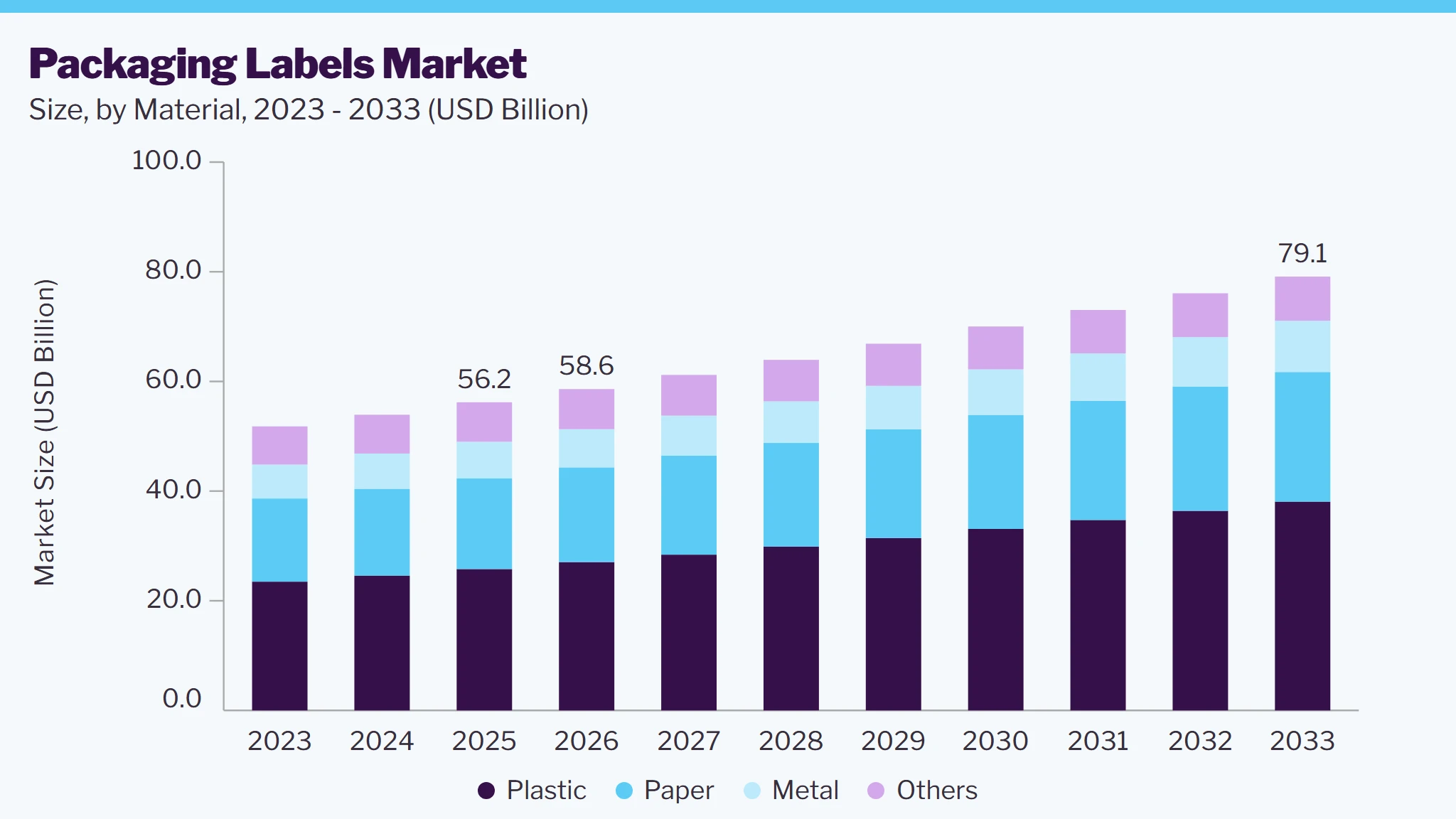
The global packaging labels market size was valued at USD 56.2 billion in 2025 and is projected to grow from USD 58.6 billion in 2026 to USD 79.1 billion by 2033, at a CAGR of 4.4% from 2026 to 2033. North America dominated the market, accounting for a revenue share of 31.1% in 2025. Governments worldwide are enforcing stricter labeling regulations, especially in industries like food, pharmaceuticals, and chemicals, to ensure consumer safety and transparency.
 Source: Grand View Research, IR Documents, Primary Interviews, Paid DatabasesTo learn more about this report,
 Download Free Sample Report
Key Market Trends & Insights
- By material: Plastic segment dominated the market, with a revenue share of 45.9% in 2025.
- By label type: Pressure sensitive labels segment held the largest market share of 40.9% in 2025.
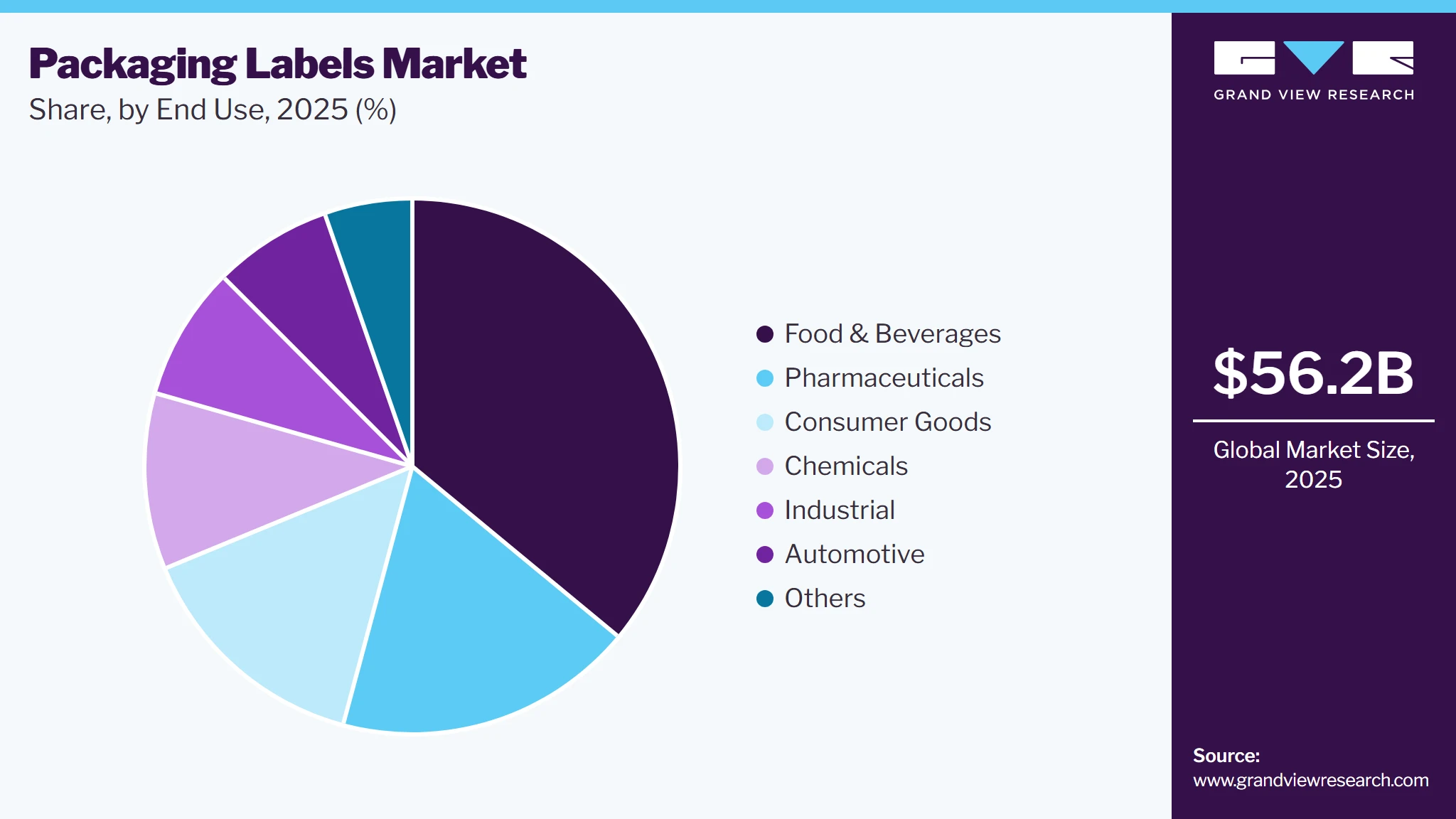
- By end use: Food & beverages segment held the largest revenue share of 36.0% in 2025.
Regional Highlights
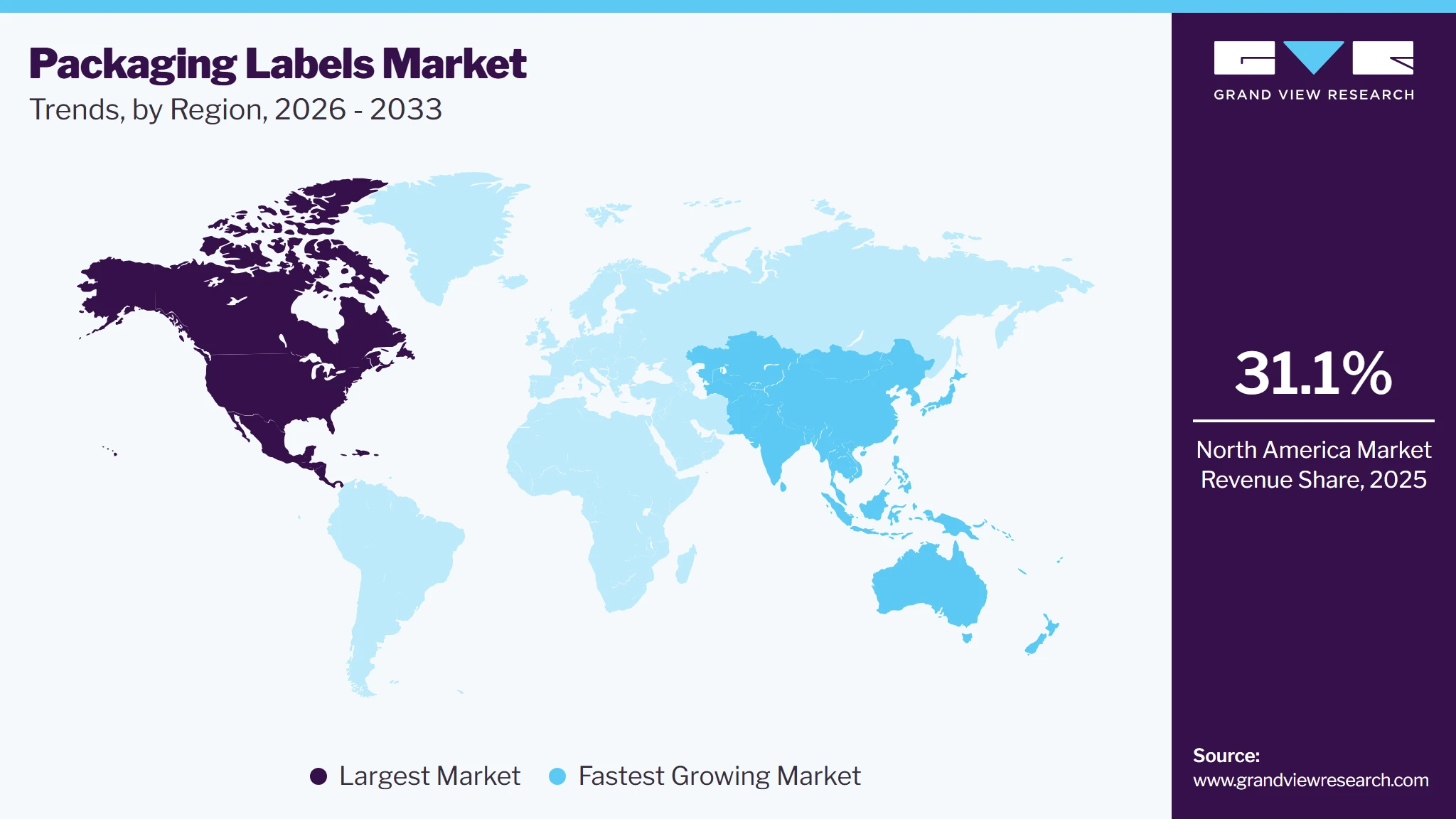
- Largest regional market: North America (31.1% revenue share, 2025)
- Fastest-growing regional market: Asia Pacific (highest CAGR, 2026-2033)
- By country: The U.S. held the largest market share in 2025.
Market Size & Forecast
- Market size in 2025: USD 56.2 Billion
- Estimated market size in 2026: USD 58.6 Billion
- Projected market size by 2033: USD 79.1 Billion
- CAGR (2026-2033): 4.4%
Three ways to get this report
Buy it, customize it, or ask a question.Ask an Analyst
Analyst response in 1 business day
- AccessReport author, directly
- Reply timeWithin 1 working day
- No sales callDirect answer only
- FormatEmail reply
- CostFree, no cost
Get the Full Report
What the study covers
- FormatsPDF · Excel · Dashboard
- Timeline2026–2033 annual, 2025 base
- Coverage20+ countries, 5 regions
- Companies10+ key players profiled
Customize the Report
20% free customization
- IncludeCountries, segments, points
- TailorTo your product definition
- ExtendDeeper competitor detail
- OrA fully bespoke study
- Turnaround5–10 working days
 To learn more about this report, Download Free Sample Report
This is driving demand for compliant labels with clear ingredient lists, expiration dates, and hazard warnings. The packaging labels industry is witnessing a shift towards smart and sustainable labeling solutions. Brands are increasingly incorporating RFID tags, QR codes, and NFC technology into labels to enhance product traceability, authentication, and consumer engagement. At the same time, sustainability concerns are driving the adoption of eco-friendly labeling materials such as biodegradable films, recycled paper, and water-based adhesives. Regulations around waste reduction and circular economy initiatives in regions like Europe and North America are accelerating this trend, compelling manufacturers to invest in digital printing technologies that minimize material waste and improve efficiency.Market Dynamics
The packaging labels market is experiencing steady growth, driven by rising demand for product identification, regulatory compliance, and brand differentiation across food & beverages, pharmaceuticals, personal care, and consumer goods. Advancements in digital printing, smart labeling technologies, and sustainable label materials are enhancing traceability and consumer engagement, while the expansion of e-commerce is further boosting demand. However, raw material price volatility and evolving labeling regulations present challenges. Overall, increasing adoption of sustainable and intelligent labeling solutions is expected to support market growth over the forecast period.
The increasing consumption of packaged food & beverages and consumer goods is one of the primary drivers of the packaging labels market. Rapid urbanization, changing lifestyles, and growing preference for convenience products have significantly increased the demand for packaged products worldwide. Every packaged product requires labels to display essential information such as ingredients, nutritional facts, expiration dates, usage instructions, and barcodes, making labels an indispensable component of modern packaging. As manufacturers continue to expand their product portfolios, the demand for high-quality, durable, and visually appealing labels continues to rise.
Brand owners are increasingly utilizing packaging labels as a tool for product differentiation and consumer engagement in highly competitive retail and e-commerce environments. Premium label designs, digital printing, QR codes, and smart labeling technologies help enhance shelf appeal while improving product traceability and authenticity. The growing emphasis on regulatory compliance, sustainability, and transparent product information is further driving the adoption of advanced labeling solutions across food & beverages, pharmaceuticals, personal care, and household products, supporting sustained growth of the packaging labels market.
Fluctuations in the prices of key raw materials such as paper, plastic films, adhesives, inks, and specialty coatings represent a significant restraint for the packaging labels market. Price volatility is influenced by changes in crude oil prices, supply chain disruptions, inflation, and fluctuations in pulp and chemical costs, making production expenses unpredictable for label manufacturers. These rising input costs can reduce profit margins, particularly for small and medium-sized companies, while frequent price adjustments may affect long-term supply contracts. Moreover, increasing demand for sustainable and recyclable label materials, which often carry higher production costs, further adds to pricing pressures and can limit widespread adoption of advanced labeling solutions.The increasing adoption of smart and sustainable packaging labels presents a significant growth opportunity for the packaging labels market. Rising consumer demand for product transparency, traceability, and environmentally responsible packaging is encouraging manufacturers to invest in QR code-enabled, RFID, NFC, and other smart labeling technologies that enhance supply chain visibility and consumer engagement. Simultaneously, growing regulatory support for recyclable and eco-friendly packaging is driving the development of labels made from recycled, biodegradable, and renewable materials. As brands increasingly prioritize digital connectivity and sustainability, demand for innovative labeling solutions is expected to create substantial opportunities for market expansion across food & beverages, pharmaceuticals, personal care, and retail industries.
Analyst Perspective
The packaging labels market is expected to witness steady growth, driven by rising demand for packaged goods, stringent labeling regulations, and increasing focus on product traceability and brand differentiation. Advancements in digital printing, smart labeling technologies, and sustainable label materials, along with the expansion of e-commerce, are expected to further support market growth.
Material Insights
Based on material, the plastic segment led the market with the largest revenue share of 45.9% in 2025. The growing need for durable, moisture-resistant, and flexible labeling solutions is driving the demand for plastic-based labels. Industries such as chemicals, automotive, and personal care prefer plastic labels due to their ability to withstand harsh environmental conditions, including exposure to water, oils, and extreme temperatures. The increasing adoption of synthetic label materials like BOPP (biaxially oriented polypropylene) and PET (polyethylene terephthalate) is further fueled by their excellent printability, tear resistance, and compatibility with various adhesive types. As more brands focus on long-lasting and premium packaging, plastic labels continue to dominate high-performance labeling applications.
The shift towards sustainable packaging solutions is significantly boosting the demand for paper-based labels. Governments and regulatory bodies are enforcing stricter environmental laws, pushing brands to replace plastic labels with biodegradable, compostable, or FSC-certified paper alternatives. Consumer preferences are also shifting, with eco-conscious buyers favoring recyclable and plastic-free packaging, especially in segments like organic foods and luxury goods. Additionally, advancements in water-resistant coatings and durable paper substrates are making paper labels a viable alternative, even in industries where plastic labels were traditionally dominant.
Label Type Insights
Based on label type, the pressure sensitive labels segment led the market with the largest revenue share of 40.9% in 2025. The rise in premium product branding and high-end packaging is driving demand for pressure-sensitive labels with advanced coatings. These labels offer superior adhesion, versatility, and high-quality print finishes, making them ideal for luxury goods, personal care, and specialty beverages. UV-curable and tactile coatings enhance aesthetic appeal by adding gloss, matte, or textured effects, improving brand differentiation on retail shelves.
Brands are increasingly adopting shrink labels to achieve full-body, high-impact branding on irregularly shaped packaging. The ability of shrink labels to conform seamlessly to complex containers in industries like beverages, personal care, and home care has made them a preferred choice for premium and visually striking packaging.
End-use Insights
Based on end use, the food & beverages segment led the market with the largest revenue share of 36.0% in 2025. The food and beverage industry is driving the need for intelligent and interactive labeling solutions to enhance consumer engagement and regulatory compliance. QR codes, NFC tags, and temperature-sensitive inks are increasingly integrated into labels to provide real-time product information, traceability, and authentication. Growing consumer demand for transparency in ingredient sourcing, nutritional details, and expiration tracking is further accelerating the adoption of smart labeling. With global food safety regulations tightening, manufacturers are also incorporating tamper-evident and freshness-indicating labels to ensure product integrity and build consumer trust.
 To learn more about this report, Download Free Sample Report
Regulatory authorities worldwide are mandating stricter serialization and track-and-trace systems to combat counterfeit drugs, making advanced pharmaceutical labeling a critical industry requirement. Serialization-ready labels with barcodes, RFID tags, and tamper-proof features are now essential for compliance with laws such as the U.S. Drug Supply Chain Security Act (DSCSA) and the European Falsified Medicines Directive (FMD). The demand for high-security labeling solutions is also rising due to the increasing threat of drug counterfeiting, ensuring that only genuine, safe medications reach consumers. As pharmaceutical companies invest heavily in supply chain transparency and patient safety, the market for advanced labels continues to expand.
Regional Insights & Trends
North America dominated the packaging labels market with the largest revenue share of 31.1% in 2025, which is attributable to the increasing focus on sustainability and government-backed circular economy policies. Major brands and retailers are under pressure to adopt biodegradable, recyclable, and compostable labeling materials in response to both consumer demand and regulatory initiatives. The U.S. and Canada have introduced extended producer responsibility (EPR) programs, pushing companies to reduce packaging waste and use environmentally responsible labeling solutions.
 To learn more about this report, Download Free Sample Report
The growing concerns over product authenticity, safety, and regulatory compliance are driving strong demand for tamper-evident and security labels in North America. Industries such as pharmaceuticals, food, and high-value consumer goods are integrating advanced labeling solutions to prevent counterfeiting, unauthorized access, and product tampering. With the rise of e-commerce and direct-to-consumer shipping, brands are increasingly adopting holographic labels, void-seal adhesives, and serialized tracking codes to enhance product security and traceability.
U.S. Packaging Labels Market Trends
The packaging labels market in U.S. held the largest share in the North America region in 2025. The packaging labels market in the U.S. is witnessing a surge in demand for smart labeling technologies as companies seek greater supply chain visibility and efficiency. With the rapid expansion of e-commerce and omnichannel retail, businesses are investing in RFID-enabled labels, QR codes, and NFC tags to track products in real time, prevent counterfeiting, and enhance inventory management. Major industries, including food, pharmaceuticals, and logistics, are adopting intelligent labels that provide traceability and regulatory compliance.
Europe Packaging Labels Market Trends
Europe’s packaging labels market is primarily driven by the region’s strict regulatory environment, which enforces standardized labeling requirements across multiple industries. The EU’s Packaging and Packaging Waste Directive (PPWD) and the European Green Deal are pushing manufacturers to use recyclable materials and clear labeling to improve consumer awareness and waste management.
Asia Pacific Packaging Labels Market Trends
The packaging labels industry in the Asia Pacific is anticipated to grow at the fastest CAGR from 2026 to 2033. The packaging labels market in the Asia Pacific region is experiencing strong growth in the packaging labels market due to rapid industrialization and increasing demand for cost-effective labeling solutions. Countries such as China, India, and Southeast Asian nations are witnessing a surge in manufacturing activities across industries like food & beverage, pharmaceuticals, and consumer goods, driving large-scale adoption of economical yet high-quality labeling materials.
Additionally, rising middle-class populations and growing urbanization are boosting demand for packaged products, leading companies to seek affordable and scalable labeling solutions that balance cost-efficiency with branding needs. As local businesses expand their global presence, investments in digital and variable data printing technologies are also increasing to support high-volume and customized labeling requirements.
Key Packaging Labels Company Insights
The packaging labels industry is highly competitive, with several key players dominating the landscape. Major companies include All4Labels, CCL Industries, Amcor Plc, Avery Dennison, Multi-Color Corporation, Mondi plc, Huhtamaki Group, Neenah, Inc, Berry Global, and 3M. The packaging labels market is characterized by a competitive landscape with several key players driving innovation and market growth. Major companies in this sector are investing heavily in research and development to enhance the performance, cost-effectiveness, and sustainability of their types.
Key Packaging Labels Companies
The following key companies have been profiled for this study on the packaging labels market.
- All4Labels
- CCL Industries
- Amcor Plc
- Avery Dennison
- Multi-Color Corporation
- Mondi plc
- Huhtamaki Group
- Neenah, Inc
- Berry Global
- 3M
Competitive Benchmarking
Category
Operating Strategies
Competitive Edge
Weakness
Established Players (All4Labels, CCL Industries, Amcor plc, Avery Dennison, Multi-Color Corporation, Mondi plc, Huhtamaki Group, Berry Global, and 3M)
- Focus on expanding global manufacturing capacity and strengthening regional distribution networks through acquisitions and strategic partnerships.
- Invest in sustainable label technologies, digital printing, RFID-enabled smart labels, and premium customization to address evolving regulatory and brand-owner requirements.
- Extensive product portfolios, strong R&D capabilities, and established relationships with global FMCG, pharmaceutical, and industrial customers enable large-scale project execution.
- Robust financial resources, integrated supply chains, and worldwide production facilities support operational efficiency, innovation, and consistent product quality.
- Large operational structures and legacy manufacturing assets can reduce flexibility in responding to rapidly changing customer demands and niche market opportunities.
- High dependence on raw material prices and substantial capital investments can exert pressure on profitability during periods of supply chain disruption or economic uncertainty.
Emerging Players (Neenah, Inc.)
- Concentrate on specialty and value-added label solutions while targeting niche applications requiring customized materials and premium print quality.
- Expand market presence through customer-centric product innovation, strategic collaborations, and investments in advanced converting and digital printing technologies.
- Greater organizational agility enables faster product development, customized offerings, and quicker response to evolving customer requirements.
- Strong expertise in specialized label materials and focused market positioning helps differentiate offerings in selected application segments.
- Limited global manufacturing footprint and comparatively lower financial resources restrict large-scale expansion and international market penetration.
- Smaller customer base and narrower product portfolio reduce competitiveness against established multinational packaging label manufacturers across diverse end-use industries.
Recent Developments
-
In January 2024, How2Recycle launched a new "How2Recycle Plus" label that includes a QR code powered by The Recycling Partnership's Recycle Check. Scanning the QR code allows consumers to enter their zip code and instantly see if an item is accepted for recycling in their local community.
-
In November 2024, Resource Label Group created a new division focusing on specialty packaging. This unit will concentrate on providing unique packaging solutions, expanding the company's offerings beyond traditional labels.
Packaging Labels Market Report Scope
Report Attribute
Details
Market size in 2025
USD 56.2 billion
Estimated market size in 2026
USD 58.6 billion
Projected market size by 2033
USD 79.1 billion
Growth rate
CAGR of 4.4% from 2026 to 2033
Base year for estimation
2025
Historical data
2021 - 2024
Forecast period
2026 - 2033
Quantitative units
Revenue in USD million/billion and CAGR from 2026 to 2033
Report coverage
Revenue forecast, company ranking, competitive landscape, growth factors, and trends
Segments covered
Material, label type, end use, region
Regional scope
North America; Europe; Asia Pacific; Central & South America; MEA
Country scope
U.S.; Canada; Mexico; Germany; UK; France; Italy; Spain; China; Japan; India; South Korea; Australia; Brazil; Argentina; Saudi Arabia; South Africa; UAE
Key companies profiled
All4Labels; CCL Industries; Amcor plc; Avery Dennison; Multi-Color Corporation; Mondi plc; Huhtamaki Group; Neenah, Inc; Berry Global; 3M
Customization scope
Free report customization (equivalent up to 8 analysts' working days) with purchase. Addition or alteration to country, regional & segment scope.
Pricing and purchase options
Avail customized purchase options to meet your exact research needs. Explore purchase options
Global Packaging Labels Market Report Segmentation
This report forecasts revenue growth at global, regional, and country levels and provides an analysis of the latest industry trends in each of the sub-segments from 2021 to 2033. For the purpose of this study, Grand View Research has segmented the global packaging labels market report based on the material, label type, end-use, and region:
 To learn more about this report, Download Free Sample Report
-
Material Outlook (Revenue, USD Million, 2021 - 2033)
-
Paper
-
Plastic
-
Metal
-
Others
-
-
Label Type Outlook (Revenue, USD Million, 2021 - 2033)
-
Pressure Sensitive Labels
-
Shrink Labels
-
Stretch Labels
-
Wet Glue Labels
-
Others
-
-
End-use Outlook (Revenue, USD Million, 2021 - 2033)
-
Food & Beverages
-
Pharmaceuticals
-
Consumer Goods
-
Chemicals
-
Automotive
-
Industrial
-
Others
-
-
Regional Outlook (Revenue, USD Million, 2021 - 2033)
-
North America
-
U.S.
-
Canada
-
Mexico
-
-
Europe
-
Germany
-
UK
-
France
-
Italy
-
Spain
-
-
Asia Pacific
-
China
-
India
-
Japan
-
South Korea
-
Australia
-
-
Central & South America
-
Brazil
-
Argentina
-
-
Middle East & Africa
-
Saudi Arabia
-
UAE
-
South Africa
-
-
Research Methodology
The Packaging labels market figures in this report are based on a proven research process that combines executive interviews with secondary research from proprietary databases, company filings, and recognized regulatory and institutional sources. Market size is built through value-chain sizing - reconciling supply-side and demand-side estimates - and triangulated with bottom-up and top-down approaches. Every estimate passes multiple levels of expert validation before publication, with each Packaging labels segment quantified using the revenue-capture definitions in the table below.
Segment Definition
Segment - Material
Revenue capture definition
Paper
Revenue generated from the sale of paper-based packaging labels, including coated, uncoated, kraft, and specialty paper labels used for branding, product identification, and regulatory information across food & beverages, pharmaceuticals, consumer goods, and retail applications.
Plastic
Revenue generated from the sale of plastic packaging labels manufactured from materials such as polypropylene (PP), polyethylene (PE), polyester (PET), and PVC. This segment includes durable, moisture-resistant labels used in food & beverages, personal care, chemicals, automotive, and industrial packaging.
Metal
Revenue generated from the sale of metal-based packaging labels, including aluminum and stainless-steel labels designed for high durability, chemical resistance, and long-term product identification. This segment includes labels used in automotive, industrial equipment, chemicals, and asset tracking applications.
Others
Revenue generated from the sale of packaging labels manufactured using alternative materials such as fabric, wood, biodegradable substrates, synthetic composites, and other specialty materials for niche, premium, or sustainable packaging applications.
Segment - Label Type
Revenue capture definition
Pressure Sensitive Labels
Revenue generated from the sale of self-adhesive packaging labels that require only pressure for application without heat or water. This segment includes labels used extensively across food & beverages, pharmaceuticals, personal care, logistics, and consumer goods packaging.
Shrink Labels
Revenue generated from the sale of heat-shrinkable packaging labels that conform tightly to the shape of containers, providing 360-degree branding and product information. This segment includes labels used for beverages, personal care products, household products, and premium packaging.
Stretch Labels
Revenue generated from the sale of elastic packaging labels designed to stretch over containers without the use of adhesives or heat. This segment includes labels commonly used for beverage bottles, dairy products, and reusable packaging applications.
Wet Glue Labels
Revenue generated from the sale of packaging labels applied using liquid adhesive during the labeling process. This segment includes labels widely used for glass bottles, canned foods, beverages, and other high-volume packaging applications requiring cost-effective labeling.
Others
Revenue generated from the sale of other packaging label types, including in-mold labels, wrap-around labels, sleeve labels, RFID-enabled labels, and specialty labels developed for unique packaging and identification requirements.
Segment - End Use
Revenue capture definition
Food & Beverages
Revenue generated from the sale of packaging labels used for food, beverage, dairy, frozen food, confectionery, and alcoholic and non-alcoholic beverage packaging requiring branding, nutritional information, traceability, and regulatory compliance.
Pharmaceuticals
Revenue generated from the sale of packaging labels used for prescription medicines, over-the-counter drugs, vaccines, medical devices, and healthcare products requiring dosage information, serialization, traceability, and regulatory compliance.
Consumer Goods
Revenue generated from the sale of packaging labels used for personal care, cosmetics, household products, electronics, and retail goods requiring product identification, branding, promotional messaging, and barcode labeling.
Chemicals
Revenue generated from the sale of packaging labels used for industrial chemicals, agrochemicals, lubricants, paints, coatings, and hazardous materials requiring durable construction, safety warnings, and regulatory information.
Automotive
Revenue generated from the sale of packaging labels used for automotive parts, lubricants, batteries, tires, and vehicle components requiring durable identification, tracking, and product specification labeling.
Industrial
Revenue generated from the sale of packaging labels used in manufacturing, logistics, warehousing, machinery, and industrial equipment for inventory management, asset identification, shipping, and operational tracking.
Others
Revenue generated from the sale of packaging labels used across additional industries, including textiles, agriculture, e-commerce, stationery, and other specialized packaging applications not covered under the above segments.
Estimation Model
Layer Name
Key Question
Description
Packaging Demand Base Layer
What forms the demand base?
Identify the global consumption of packaged products across major end-use industries, including food & beverages, pharmaceuticals, consumer goods, chemicals, automotive, industrial, and other sectors. This layer establishes the total addressable demand for packaging labels based on packaging production volumes and labeling requirements across product categories.
Label Adoption & Penetration Layer
Where are packaging labels solutions utilized?
Estimate the penetration of different label materials and label types across packaging formats, industries, and geographic regions. Assess the adoption of paper, plastic, metal, and specialty labels, along with pressure-sensitive, shrink, stretch, wet glue, and other labeling technologies based on application requirements, branding needs, and regulatory compliance.
Label Consumption Intensity Layer
How many packaging labels are consumed?
Analyze average label consumption per packaged product, replacement frequency, SKU diversity, packaging production volumes, and labeling intensity across industries. Label demand is influenced by packaging type, product lifecycle, regulatory labeling requirements, e-commerce growth, and brand differentiation strategies.
Revenue Layer
How is market revenue generated?
Market revenue is quantified through the sale of packaging labels across material types, label technologies, and end-use industries. Revenue is generated from standard and customized labeling solutions, including smart labels, sustainable labels, security labels, and value-added printing services, supported by recurring demand from packaged goods manufacturers, pharmaceutical companies, consumer goods producers, industrial manufacturers, and chemical companies worldwide.
Delivered Customizations
This report has been delivered with the following In-depth customizations
Client Request
Customization Delivered
Value Adds
Regional Segmentation Analysis
Delivered an in-depth regional assessment of the packaging labels market across North America, Europe, Asia Pacific, Central & South America, and the Middle East & Africa, highlighting market size, growth trends, regulatory developments, demand patterns, and country-level opportunities.
Enabled identification of high-growth regions, regional demand variations, investment priorities, and expansion strategies based on market maturity and industry dynamics.
Cross-Segmentation Analysis
Provided detailed cross-segmentation analysis by Material (Paper, Plastic, Metal, Others), Label Type (Pressure Sensitive Labels, Shrink Labels, Stretch Labels, Wet Glue Labels, Others) and End Use (Food & Beverages, Pharmaceuticals, Consumer Goods, Chemicals, Automotive, Industrial, Others) across major regions.
Helped identify high-growth product combinations, evolving end-use demand, niche application opportunities, and targeted market segments for portfolio expansion and business growth.
Competitive Benchmarking
Benchmarked leading packaging label manufacturers based on product portfolio by material and label type, end-use industry focus, geographic presence, manufacturing capabilities, sustainability initiatives, strategic partnerships, innovation pipeline, and competitive positioning.
Supported competitive intelligence, identification of market leaders and challengers, strategic gap analysis, and benchmarking against industry best practices.
Frequently Asked Questions About This Report
The global packaging labels market size was valued at USD 56.2 billion in 2025 and is estimated at USD 58.6 billion for 2026.
The global packaging labels market is expected to grow at a CAGR of 4.4% from 2026 to 2033, reaching USD 79.1 billion by 2033.
North America dominated the packaging labels market with a 31.1% revenue share in 2025.
Asia Pacific is the fastest-growing region in the packaging labels market with a CAGR of 5.0% over the forecast period.
Key factors driving the packaging labels market include rising demand for packaged goods, increasing regulatory labeling requirements, growing adoption of smart and sustainable labels, advancements in digital printing technologies, and the rapid expansion of e-commerce and retail packaging.
The plastic segment led the packaging labels market with a 45.9% revenue share in 2025.
The pressure sensitive labels segment led the packaging labels market with a 40.9% revenue share in 2025.
The food & beverages segment led the packaging labels market with a 36.0% revenue share in 2025.
Key players in the packaging labels market include All4Labels; CCL Industries; Amcor plc; Avery Dennison; Multi-Color Corporation; Mondi plc; Huhtamaki Group; Neenah, Inc; Berry Global; 3M.
About the Author(s)
Plastics, Polymers & Resins Research Team
Bulk Chemicals · Plastics, Polymers & ResinsThis report was authored by the plastics, polymers & resins research team at Grand View Research - comprising two research analysts, one senior research analyst, and one industry expert - with specialized expertise in the plastics, polymers & resins segment of the bulk chemicals industry. All findings are based on proprietary bulk chemicals databases, executive interviews, and regulatory analysis, subject to internal peer review prior to publication.
Last Updated:
Speak to Analyst

Customize this report to your needs - add regions, segments, or data points, with 20% free customization.
Or view our licence options:


ISO 9001:2015 & 27001:2022 Certified
We are GDPR and CCPA compliant! Your transaction & personal information is safe and secure. For more details, please read our privacy policy.


