
- Home
- »
- Renewable Chemicals
- »
-
Palm Oil Market Size, Share & Trends Report, 2026-2033GVR Report cover

Palm Oil Market (2026 - 2035)
Size, Share & Trends Analysis Report By Nature (Organic, Conventional), By Product (Crude Palm Oil, Palm Kernel Oil, RBD Palm Oil), By Application, By Region, And Segment Forecasts
Market Size, 2025
$75.5BMarket Estimate, 2026
$78.3BMarket Forecast, 2035
$113.9BCAGR, 2026–2035
4.3%Palm Oil Market Summary
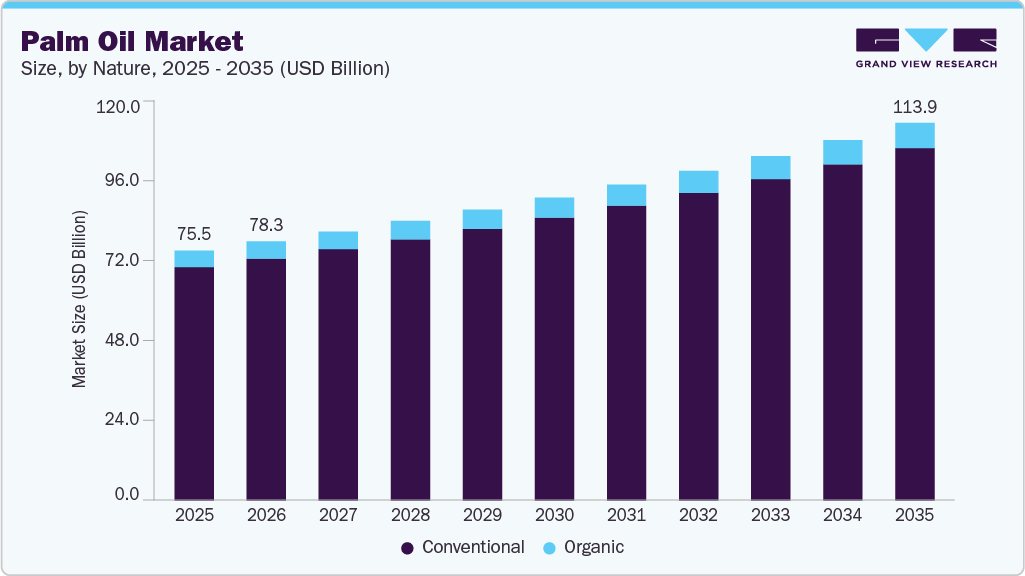
The global palm oil market size was valued at USD 75.5 billion in 2025 and is projected to grow from USD 78.3 billion in 2026 to USD 113.9 billion by 2035, at a CAGR of 4.3% from 2026 to 2035. The Asia Pacific held the largest share of 74.1% of the global market in 2025. The global palm oil industry is primarily driven by the growing demand from the food and beverage sector.
 Source: Grand View Research, IR Documents, Primary Interviews, Paid DatabasesTo learn more about this report,
 Download Free Sample Report
 Key Market Trends & Insights
- By nature: Conventional segment held the largest market share of 93.4% in 2025.
- By product: Crude palm oil segment held the largest market share of 76.7% in 2025.
- By application: Food & beverage segment accounted for the largest revenue share of 72.7% in 2025.
Regional Highlights
- Largest regional market: Asia Pacific (74.1% revenue share, 2025)
- Fastest-growing regional market: Asia Pacific (fastest CAGR, 2026-2033)
- By country: Indonesia held the largest revenue share in Asia Pacific in 2025.
Market Size & Forecast
- Market size in 2025: USD 75.5 Billion
- Estimated market size in 2026: USD 78.3 Billion
- Projected market size by 2035: USD 113.9 Billion
- CAGR (2026-2035): 4.3%
Three ways to get this report
Buy it, customize it, or ask a question.Ask an Analyst
Analyst response in 1 business day
- AccessReport author, directly
- Reply timeWithin 1 working day
- No sales callDirect answer only
- FormatEmail reply
- CostFree, no cost
Get the Full Report
What the study covers
- FormatsPDF · Excel · Dashboard
- Timeline2026–2035 annual, 2025 base
- Coverage20+ countries, 5 regions
- Companies10+ key players profiled
Customize the Report
20% free customization
- IncludeCountries, segments, points
- TailorTo your product definition
- ExtendDeeper competitor detail
- OrA fully bespoke study
- Turnaround5–10 working days
Palm oil’s versatility, low cost, and long shelf life make it a preferred ingredient in bakery, confectionery, and processed food products. Its widespread use as a cooking oil and in margarine and instant noodles continues to support market growth. The expanding global population and rising consumption of packaged foods are further amplifying this demand.Another key driver for the global palm oil industry is the increasing use of palm oil in biodiesel production. Governments across Asia, Europe, and Latin America are promoting biofuel blending mandates to reduce carbon emissions and dependence on fossil fuels. Palm oil’s high yield and energy efficiency make it a popular feedstock choice for biodiesel manufacturers. This trend is creating strong demand from the energy sector, especially in Indonesia and Malaysia.
 To learn more about this report, Download Free Sample Report
 A major opportunity in the global palm oil industry lies in the growing demand for sustainably sourced and certified palm oil. Increasing consumer awareness about environmental and social impacts is pushing companies to adopt RSPO-certified and traceable supply chains. This trend is opening new growth avenues for producers investing in eco-friendly cultivation, deforestation-free sourcing, and transparent trade practices. As global brands prioritize sustainability commitments, the market for certified palm oil is expected to expand significantly.
Market Dynamics
Palm oil continues to witness strong demand owing to its extensive utilization across the food processing and edible oil industries. Its cost-effectiveness, high oxidative stability, and versatile functional properties make it widely suitable for applications including cooking oils, bakery products, confectionery, processed foods, margarine, and packaged snacks. Rising global consumption of processed and convenience foods, particularly in developing economies, is significantly boosting palm oil demand worldwide.
Population growth, changing dietary habits, and increasing urbanization across Asia Pacific, Africa, and Latin America are further strengthening edible oil consumption trends. Food manufacturers increasingly prefer palm oil due to its longer shelf life and favorable processing characteristics in large-scale industrial food production. In addition, the rapid expansion of quick-service restaurants, packaged food manufacturing, and bakery industries continues to create sustained growth opportunities for the global palm oil market over the forecast period.
The palm oil industry continues to face growing scrutiny associated with deforestation, biodiversity loss, and greenhouse gas emissions linked to plantation expansion activities. Environmental concerns surrounding land conversion practices and habitat destruction have resulted in increasing pressure from governments, environmental organizations, and sustainability-focused consumers globally.
Several international food manufacturers and consumer goods companies are strengthening sustainable sourcing requirements and adopting stricter traceability standards for palm oil procurement. Compliance with sustainability certifications, responsible plantation management practices, and environmental regulations continues to increase operational and supply chain costs for producers. These factors may create long-term challenges for market participants operating within environmentally sensitive regions.
Market Concentration & Characteristics
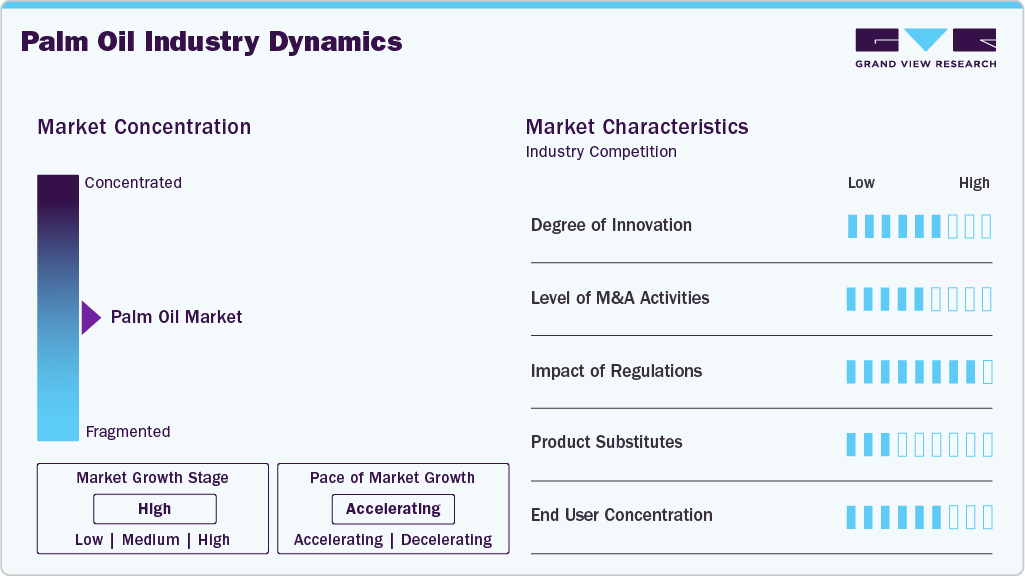
The global palm oil industry is moderately concentrated, with a few major players such as Wilmar International, ADM holding a significant share. These companies dominate due to their integrated operations, from cultivation and processing to refining and global distribution. However, the presence of several regional producers and smallholders across Southeast Asia, Africa, and Latin America maintains a competitive balance in the market.
 To learn more about this report, Download Free Sample Report
 The palm oil industry is characterized by high production volumes, cost efficiency, and strong trade flows across developing and developed economies. It is highly influenced by agricultural productivity, climatic conditions, and government policies on exports and sustainability. In addition, the market exhibits cyclical price trends linked to supply fluctuations and crude oil prices, while growing emphasis on traceability and sustainability is reshaping operational standards globally.
Nature Insights
The conventional segment led the market with the largest revenue share of 93.4% in 2025. The market is supported by its high production efficiency, cost-effectiveness, and widespread availability. It remains the preferred choice for food processing, industrial use, and biodiesel production due to its consistent quality and lower price compared to organic alternatives. The dominance of conventional palm oil is also reinforced by established supply chains across major producing countries like Indonesia and Malaysia, which cater to global demand at scale.
The organic segment is anticipated to grow at the fastest CAGR of 4.5% during the forecast period, driven by rising consumer awareness of sustainability and health concerns. Growing demand for chemical-free, traceable, and ethically sourced products is encouraging food, cosmetic, and personal care brands to adopt organic palm oil. Certification standards such as RSPO and Fairtrade are further boosting trust and market acceptance. As eco-conscious consumers and global retailers shift toward clean-label products, the organic palm oil segment is expected to gain significant traction in the coming years.
Product Insights
The crude palm oil segment led the market with the largest revenue share of 76.7% in 2025. The market is primarily driven because of its high production volume and versatility across food, biofuel, and industrial applications. Its cost-effectiveness and widespread availability make it the primary choice for large-scale manufacturers, sustaining its dominant position in the market.
The palm kernel oil segment is anticipated to grow at the fastest CAGR of 4.4% during the forecast period. Growth is driven by rising demand in specialty food products, cosmetics, and personal care applications. Innovations in PKO derivatives and their suitability as a substitute for cocoa butter are expanding their market adoption globally.
Application Insights
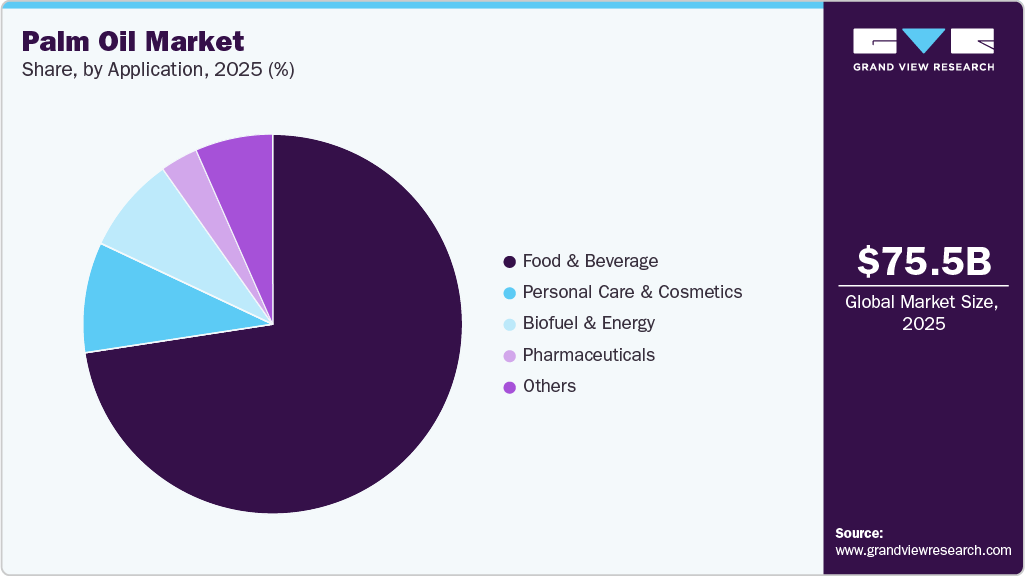
The food & beverage segment led the market with the largest revenue share of 72.7% in 2025, fueled by its extensive use in cooking oils, bakery products, snacks, and processed foods. Palm oil’s stability at high temperatures and long shelf life make it a preferred ingredient for manufacturers worldwide. Increasing consumer demand for affordable and versatile edible oils continues to reinforce its leading position.
 To learn more about this report, Download Free Sample Report
 The biofuel & energy segment is anticipated to grow at the fastest CAGR of 4.2% during the forecast period. The segment is growing as governments and industries adopt sustainable energy solutions. Palm oil-derived biodiesel is gaining traction due to its renewable nature and potential for carbon reduction. Supportive policies and rising energy security concerns are further driving global investments in this space.
Regional Insights
The palm oil market held a significant share in 2025, growing due to rising demand in processed foods, snacks, and bakery products. The increasing adoption of convenience foods and the expansion of fast food chains are driving consumption. In addition, investments in sustainable sourcing and certifications are shaping the market while enhancing supply chain transparency.
U.S. Palm Oil Market Trends
The palm oil market in the U.S. is growing at a rapid pace, fueled by strong growth in the food processing and personal care industries. Rising consumer demand for plant-based and multifunctional ingredients is driving growth. Strategic import channels and partnerships with leading producers ensure a steady supply, supporting the country’s market expansion.
Asia Pacific Palm Oil Market Trends
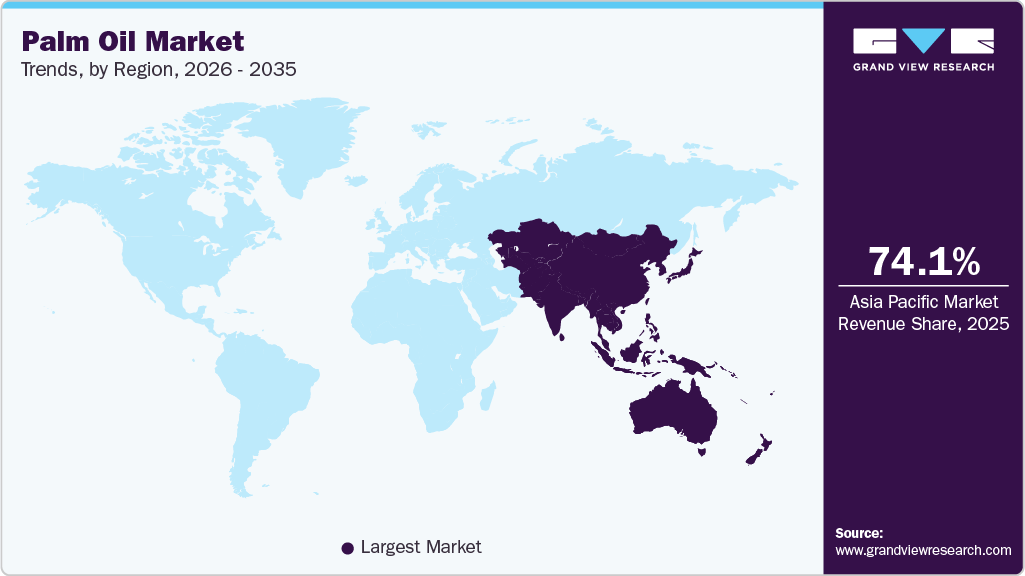
Asia Pacific dominated the global palm oil market with the largest revenue share of 74.1% in 2025 and is expected to grow at the fastest CAGR during the forecast period. Rising demand for edible oils and processed food products is directly driving growth in the Asia Pacific palm oil market. The expansion of food processing industries, coupled with large-scale production capacities in Indonesia and Malaysia, is boosting supply to meet both domestic and international demand, making the region the most dominant globally.
 To learn more about this report, Download Free Sample Report
 The palm oil market in Indonesia accounted for the largest market revenue share of 42.1% in the Asia Pacific in 2025. Indonesia is the largest producer and exporter of palm oil, supported by extensive plantations and an ideal tropical climate. Efficient, high-yield cultivation practices and advanced processing infrastructure ensure a reliable supply for both domestic consumption and global markets. Strong international demand, combined with supportive government policies and strategic investments in sustainable practices and value-added derivatives, solidifies its leadership in the region.
Europe Palm Oil Market Trends
The palm oil market in Europe is anticipated to grow at a significant CAGR during the forecast period, driven by growing demand in biofuels, processed foods, and personal care products. Stringent sustainability regulations and increasing consumer preference for certified and traceable palm oil are shaping market dynamics. Investment in green energy initiatives and adoption of renewable feedstocks are key factors propelling growth across the region.
The Germany palm oil market is a leading within Europe, fueled by its strong biofuel sector and large-scale food processing industry. Rising environmental awareness and policies promoting sustainable sourcing are driving the demand for certified palm oil. In addition, Germany’s strategic position in Europe enables it to serve as a hub for distribution and innovation in palm oil-derived products.
Latin America Palm Oil Market Trends
The palm oil market in Latin palm oil market is gaining traction due to expanding food processing and edible oil industries. Rising demand for affordable cooking oils and growing urban populations are driving consumption. Strategic investments in local cultivation and processing facilities are enabling countries in the region to gradually reduce import dependency.
Middle East & Africa Palm Oil Market Trends
The palm oil market in the Middle East & Africa is primarily driven by increasing demand for edible oils and biofuels, supported by growing industrial and food manufacturing sectors. Rapid urbanization, rising disposable incomes, and trade partnerships with major producers are boosting imports. Additionally, government initiatives to secure reliable edible oil supply chains are shaping market growth across these regions.
Key Palm Oil Company Insights
ADM and Wilmar International Ltd. dominate the palm oil industry due to their extensive global supply chains and large-scale production capacities. Their strong distribution networks and diversified product portfolios ensure consistent market leadership.
-
ADM is engaged in procuring, transporting, storing, processing, and merchandising agricultural commodities. The company operates through four business segments, namely agricultural services, corn processing, oilseed processing, and wild flavors & specialty ingredients.
-
Wilmar International Ltd is a global manufacturer of palm oil and related products with business operations in food products, feed & industrial products, plantations, and fertilizers. Its product offerings include consumer products, specialty fats, and oleo chemicals.
Key Palm Oil Companies:
The following are the leading companies in the palm oil market. These companies collectively hold the largest Market share and dictate industry trends.
- ADM
- Wilmar International Ltd.
- IOI Corporation Berhad
- Kuala Lumpur Kepong Berhad
- United Plantations Berhad
- Kulim (Malaysia) Berhad
- PT Sampoerna Agro, Tbk
- Univanich Palm Oil Public Company Ltd.
- PT. Bakrie Sumatera Plantations tbk
- Asian Agri.
- Oleopalma
- Natural Habitats
- Agropalma
- Cargill, Incorporated
- AEN Parm Oil
Competitive Benchmarking
Operating Strategies
Competitive Edge
Weaknesses
Mature Players: ADM, Wilmar International Ltd., IOI Corporation Berhad, Kuala Lumpur Kepong Berhad, United Plantations Berhad, Kulim (Malaysia) Berhad, Asian Agri., Cargill, Incorporated, Agropalma
- Focus on expanding vertically integrated plantation and refining operations while strengthening sustainable palm oil production and traceability initiatives.
- Invest in downstream edible oil processing capabilities and long-term supply partnerships with food manufacturers and consumer goods companies.
- Possess extensive plantation assets, integrated supply chain infrastructure, and diversified edible oil product portfolios across global markets.
- Strong export capabilities, established distribution networks, and sustainability-focused operational strategies support competitive positioning.
- Exposure to fluctuations in crude palm oil pricing and changing weather conditions affecting plantation productivity and yield stability.
- Increasing environmental compliance obligations and sustainability certification requirements continue to raise operational costs.
Emerging Players: PT Sampoerna Agro, Tbk, Univanich Palm Oil Public Company Ltd., PT. Bakrie Sumatera Plantations tbk, Oleopalma, Natural Habitats, AEN Parm Oil
- Emphasize regional plantation expansion and development of sustainable sourcing practices targeting food processing and specialty oil applications.
- Strengthen local distribution partnerships and customer-focused supply capabilities to improve regional market penetration.
- Operational flexibility and ability to cater to niche edible oil and specialty palm-based product demand across regional markets.
- Growing focus on sustainable cultivation practices and traceability initiatives supports differentiation within evolving supply chains.
- Limited global refining and distribution infrastructure compared to established multinational palm oil producers.
- Challenges associated with scaling plantation operations, meeting international sustainability standards, and expanding export market presence.
Recent Developments
-
In November 2025, GS Caltex and POSCO unveiled a mega palm oil refinery in Balikpapan, Indonesia, to convert crude palm oil into refined edible oils and biodiesel feedstock with 500 kilotons annual capacity, boosting bioenergy output.
-
In October 2024, Wilmar International introduced the PROSPEK program, aiming to empower 26,000 palm oil smallholders in Indonesia. This initiative builds upon previous developmentefforts and underscores Wilmar's commitment to sustainable practices and community support in the palm oil sector.
Palm Oil Market Report Scope
Report Attribute
Details
Market size in 2025
USD 75.5 billion
Estimated market size in 2026
USD 78.3 billion
Projected market size by 2035
USD 113.9 billion
Growth rate
CAGR of 4.3% from 2026 to 2035
Base year for estimation
2025
Historical data
2018 - 2024
Forecast period
2026 - 2035
Quantitative units
Volume in kilotons, Revenue in USD million/billion, and CAGR from 2026 to 2035
Report coverage
Revenue forecast, volume forecast, competitive landscape, growth factors, and trends
Segments covered
Nature, product, application, region
Regional scope
North America; Europe; Asia Pacific; Latin America; Middle East & Africa
Country scope
U.S.; Canada; Mexico; Germany; UK; France; Italy; Spain; Russia; Indonesia; Malaysia; China; India; Japan; South Korea; Brazil; Argentina; Colombia; Saudi Arabia; South Africa
Key companies profiled
ADM; Wilmar International Ltd.; IOI Corporation Berhad; Kuala Lumpur Kepong Berhad; United Plantations Berhad; Kulim (Malaysia) Berhad; PT Sampoerna Agro; Tbk; Univanich Palm Oil Public Company Ltd.; PT. Bakrie Sumatera Plantations tbk; Asian Agri; Oleopalma; Natural Habitats; Agropalma; Cargill; Incorporated; AEN Parm Oil
Customization scope
Free report customization (equivalent up to 8 analyst’s working days) with purchase. Addition or alteration to country, regional, and segment scope.
Pricing and purchase options
Avail customized purchase options to meet your exact research needs. Explore purchase options
Global Palm Oil Market Report Segmentation
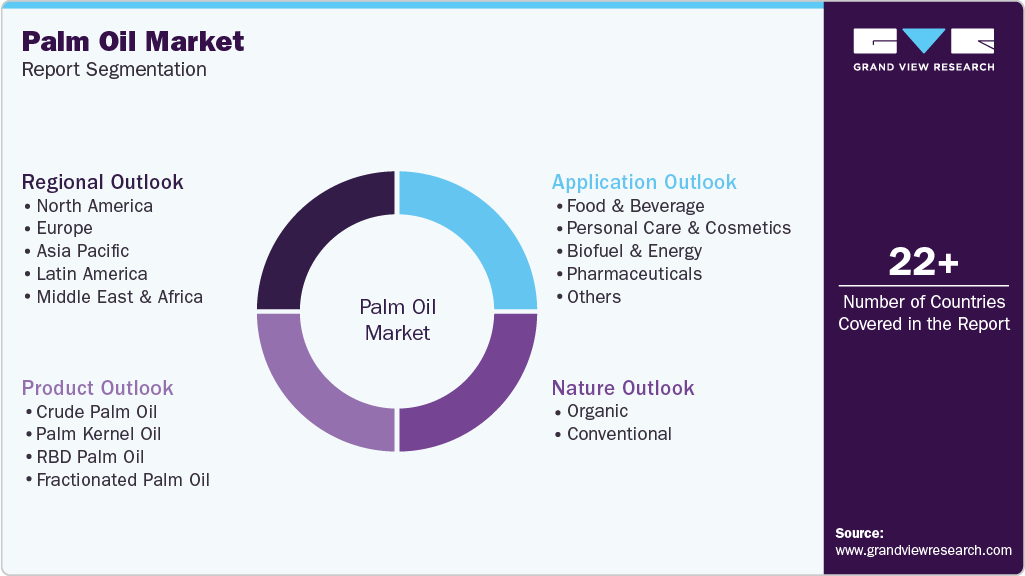
This report forecasts revenue growth at global, regional, and country levels and provides an analysis of the latest industry trends in each of the sub-segments from 2018 to 2035. For this study, Grand View Research has segmented the global palm oil market report based on product, nature, end use, and region
 To learn more about this report, Download Free Sample Report
 -
Nature Outlook (Volume, Kilotons; Revenue, USD Million, 2018 - 2035)
-
Organic
-
Conventional
-
-
Product Outlook (Volume, Kilotons; Revenue, USD Million, 2018 - 2035)
-
Crude Palm Oil
-
Palm Kernel Oil
-
RBD Palm Oil
-
Fractionated Palm Oil
-
-
Application Outlook (Volume, Kilotons; Revenue, USD Million, 2018 - 2035)
-
Food & Beverage
-
Personal Care & Cosmetics
-
Biofuel & Energy
-
Pharmaceuticals
-
Others
-
-
Regional Outlook (Volume, Kilotons; Revenue, USD Million, 2018 - 2035)
-
North America
-
U.S.
-
Canada
-
Mexico
-
-
Europe
-
Germany
-
UK
-
Italy
-
Spain
-
France
-
Russia
-
-
Asia Pacific
-
Malaysia
-
Indonesia
-
China
-
Japan
-
South Korea
-
India
-
-
Latin America
-
Brazil
-
Argentina
-
Colombia
-
-
Middle East & Africa
-
Saudi Arabia
-
South Africa
-
-
Delivered Customizations
This report has been delivered with the following In-depth customizations
Client Request
Customization Delivered
Value Adds
Competitive Benchmarking
Comprehensive comparative analysis of palm oil producers based on plantation area, refining capacity, sustainability certifications, regional presence, export capabilities, and downstream integration strength.
Supports supplier evaluation, sourcing strategy development, and competitive positioning analysis through improved visibility into operational capabilities and sustainability performance.
Cross-Segmentation
Detailed assessment of palm oil demand across edible oils, processed foods, bakery products, confectionery, personal care, and industrial applications across major regional markets.
Helps identify high-growth consumption clusters, evolving end-use demand patterns, and strategic expansion opportunities across food and industrial sectors.
Opportunity Assessment
In-depth evaluation of growth opportunities associated with rising processed food consumption, sustainable palm oil adoption, and increasing demand for traceable edible oil supply chains globally.
Enables identification of long-term investment opportunities and emerging market trends aligned with food industry expansion and sustainability-driven procurement practices.
Frequently Asked Questions About This Report
The global palm oil market size was valued at USD 75.5 billion in 2025 and is estimated at USD 78.3 billion in 2026.
The global palm oil market is expected to grow at a CAGR of 4.3% from 2026 to 2035, reaching USD 113.9 billion by 2035.
The conventional segment led the market with a 93.4% revenue share in 2025, while the organic segment is expected to grow at the fastest CAGR during the forecast period.
The crude palm oil segment held the largest revenue share of 76.7% in 2025, while the palm kernel oil segment is expected to grow at the fastest CAGR during the forecast period.
The food & beverage segment held the largest revenue share of 72.7% in 2025, while the biofuel & energy segment is expected to grow at the fastest CAGR during the forecast period.
Asia Pacific dominated the global palm oil market with a 74.1% revenue share in 2025.
Some of the key players operating in the palm oil market include ADM, Wilmar International Ltd., IOI Corporation Berhad, Kuala Lumpur Kepong Berhad, United Plantations Berhad, Kulim (Malaysia) Berhad, PT Sampoerna Agro, Tbk, Univanich Palm Oil Public Company Ltd., PT Bakrie Sumatera Plantations tbk, Asian Agri., Oleopalma, Natural Habitats, Agropalma, Cargill and AEN Parm Oil.
Key factors driving the palm oil market include growing demand from the food and beverage sector and rising use of palm oil in biodiesel production.
About the Author(s)
Renewable Chemicals Research Team
Specialty & Chemicals · Renewable ChemicalsThis report was authored by the renewable chemicals research team at Grand View Research - comprising two research analysts, one senior research analyst, and one industry expert - with specialized expertise in the renewable chemicals segment of the specialty & chemicals industry. All findings are based on proprietary specialty & chemicals databases, executive interviews, and regulatory analysis, subject to internal peer review prior to publication.
Last Updated:
Speak to Analyst

Customize this report to your needs - add regions, segments, or data points, with 20% free customization.
Or view our licence options:


ISO 9001:2015 & 27001:2022 Certified
We are GDPR and CCPA compliant! Your transaction & personal information is safe and secure. For more details, please read our privacy policy.


