
- Home
- »
- Automotive & Transportation
- »
-
Pantograph Charger Market Size & Share Report, 2026-2033GVR Report cover

Pantograph Charger Market (2026 - 2033)
Size, Share & Trends Analysis Report By Component (Hardware, Software, Services), By Charging Type, By Charging Infrastructure Type, By Region (North America, Europe, Asia Pacific, Middle East & Africa), And Segment Forecasts
Market Size, 2025
$4.2BMarket Estimate, 2026
$4.9BMarket Forecast, 2033
$25.9BCAGR, 2026–2033
26.8%Pantograph Charger Market Summary
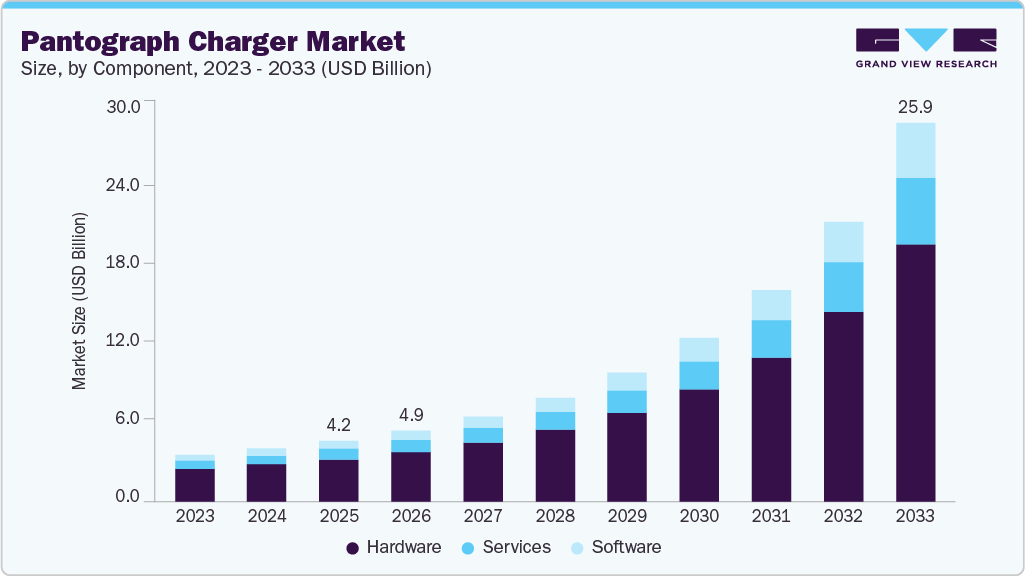
The global pantograph charger market size was valued at USD 4.2 billion in 2025 and is projected to grow from USD 4.9 billion in 2026 to USD 25.9 billion by 2033, at a CAGR of 26.8% from 2026 to 2033. The Asia Pacific held the largest share of 36.1% of the global market in 2025. The rising electrification of public transport fleets is driving market growth.
 Source: Grand View Research, IR Documents, Primary Interviews, Paid DatabasesTo learn more about this report,
 Download Free Sample Report
 Key Market Trends & Insights
- By component: The hardware segment held the largest market share of 69.7% in 2025.
- By charging type: Direct current fast charging (DCFC) accounted for the largest market share in 2025.
- By charging infrastructure type: The off-board top-down pantograph segment accounted for the largest market share in 2025.
Regional Highlights
- Largest regional market: Asia Pacific (36.1% revenue share, 2025).
- By country: U.S. held a dominant market position in 2025.
Market Size & Forecast
- Market size in 2025: USD 4.2 Billion
- Estimated market size in 2026: USD 4.9 Billion
- Projected market size by 2033: USD 25.9 Billion
- CAGR (2026-2033): 26.8%
Three ways to get this report
Buy it, customize it, or ask a question.Ask an Analyst
Analyst response in 1 business day
- AccessReport author, directly
- Reply timeWithin 1 working day
- No sales callDirect answer only
- FormatEmail reply
- CostFree, no cost
Get the Full Report
What the study covers
- FormatsPDF · Excel · Dashboard
- Timeline2026–2033 annual, 2025 base
- Coverage20+ countries, 5 regions
- Companies10+ key players profiled
Customize the Report
20% free customization
- IncludeCountries, segments, points
- TailorTo your product definition
- ExtendDeeper competitor detail
- OrA fully bespoke study
- Turnaround5–10 working days
Transit agencies are increasingly adopting battery-electric buses and other commercial EVs that require high-power, automated charging to minimize downtime and maintain route efficiency. Pantograph systems are well aligned with opportunity charging models because they enable rapid energy transfer at depots, terminals, and selected route stops, improving vehicle utilization and reducing reliance on prolonged plug-in charging.Automation, interoperability, and smart charging integration are key technological trends shaping the market. Modern pantograph charging systems are increasingly designed around automated connection, high-power charging, and communication protocols that enhance charging precision, safety, and fleet scheduling efficiency. Industry and technical sources indicate that pantograph charging is being aligned with standards such as IEC 61851 and ISO 15118, while OppCharge continues to support interoperability for electric bus charging ecosystems. These advances are improving system reliability and making pantograph chargers more suitable for large-scale fleet deployments.
 To learn more about this report, Download Free Sample Report
 Infrastructure funding and investments in fleet electrification are also accelerating market development. Public and private stakeholders are allocating capital to electric bus charging depots, on-route charging assets, and grid-connected infrastructure to support automated overhead charging systems. Real-world deployment examples, such as multi-bus inverted pantograph charging facilities, illustrate that transit operators are moving beyond pilot projects toward scalable infrastructure rollouts.
The regulatory landscape is increasingly favorable, particularly as zero-emission transit mandates and EV charging standards become more defined. Pantograph charging deployments are benefiting from broader decarbonization policies, public procurement support for electric buses, and efforts to standardize charging communication and safety requirements. Technical frameworks aligned with IEC 61851, ISO 15118, and OppCharge are helping reduce interoperability risk and support broader commercial adoption across fleets and charging networks. A more standardized regulatory and technical environment is improving buyer confidence and lowering adoption barriers for transit authorities and fleet operators.
High upfront costs, grid integration challenges, and deployment complexity are restraining market growth. Installation of overhead high-power charging systems requires substantial capital outlay for chargers, civil works, electrical upgrades, and route-level planning, which can slow adoption among budget-constrained operators. Academic and industry research also highlights challenges in charger placement optimization, grid impact, operational uncertainty, and long-term trade-offs between battery and infrastructure costs. These factors can delay project execution and complicate procurement decisions, particularly in markets where public funding or utility coordination remains limited.
Component Insights
The hardware segment accounted for the largest share of 69.7% in 2025. The rapid deployment of electric buses and other commercial EV fleets, which require high-power, automated charging infrastructure, is driving segment growth. Pantograph systems rely on physical components, including overhead contact rails, current collectors, power electronics, transformers, switchgear, cooling units, and structural mounting assemblies. Transit agencies are expanding opportunity charging at terminals, depots, and bus stops, increasing demand for robust and durable hardware capable of supporting repeated high-voltage charging cycles with minimal manual intervention.
The software segment is expected to grow at the fastest CAGR during the forecast period. The growing complexity of connected high-power charging networks is driving the segment growth. Pantograph charging systems are evolving beyond standalone assets. They are increasingly being integrated into broader smart charging ecosystems that rely on software for charger monitoring, energy management, scheduling, diagnostics, communication, and load balancing. Fleet operators deploying more chargers across depots and route locations are creating stronger demand for software that can coordinate charging sessions, reduce peak power demand, and maintain charger availability. The rising need for intelligent control is further increasing demand for backend platforms and charger management applications.
Charging Type Insights
The direct current fast charging (DCFC) segment held the largest market share in 2025. Improved fleet economics and greater operational flexibility are supporting the growth of the DCFC segment in the market. Research on battery-electric bus systems shows that opportunity charging via pantograph chargers can offer a cost advantage over end-station charging, while also influencing fleet size, battery capacity planning, and charger deployment strategies. Faster DC charging enables operators, in some cases, to use smaller battery packs, reducing vehicle weight and procurement costs while enhancing route-planning flexibility. These advantages are encouraging wider adoption of DCFC-enabled pantograph systems across public transport electrification projects.
The level 2 charging segment is expected to grow at a significant CAGR during the forecast period. Lower infrastructure burden and improved energy management are driving the growth of the segment. Compared to high-power DC fast charging, lower-power charging places less stress on the local grid, reduces peak demand charges, and supports more predictable depot energy planning. Studies on EV charging infrastructure and bus charging scheduling emphasize the importance of balancing charging demand, grid impact, and operational costs, which favors slower charging strategies in suitable use cases. This advantage is particularly relevant for fleet depots where multiple vehicles can be charged in a staggered manner over extended periods, thereby driving growth of the pantograph bus charger market.
Charging Infrastructure Type Insights
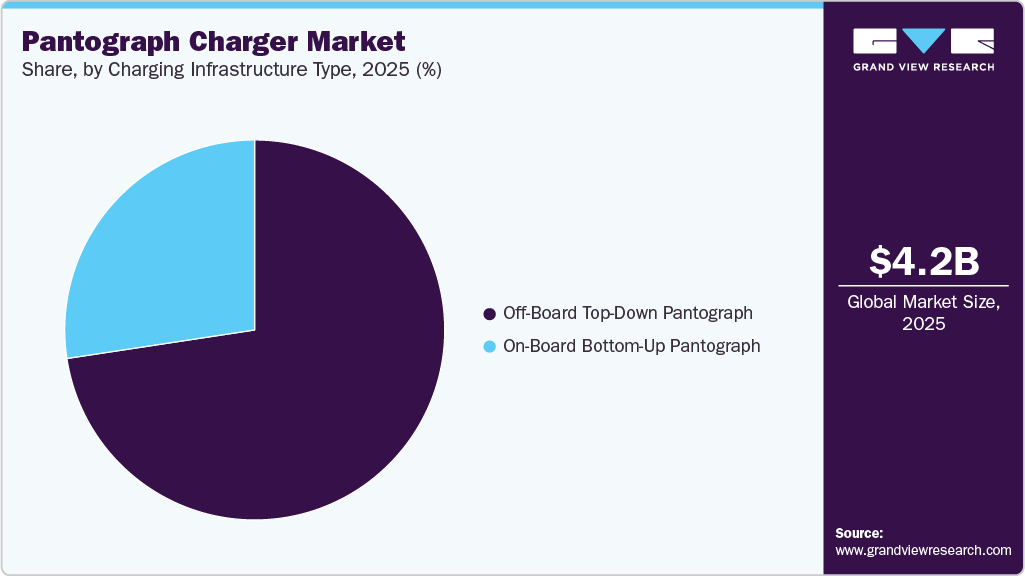
The off-board top-down pantograph segment dominated the market in 2025. Lower vehicle weight and reduced onboard equipment complexity are driving the growth of the segment. Installing the pantograph mechanism in the charging station rather than on the bus roof allows vehicle manufacturers to reduce the amount of charging hardware mounted on the vehicle. This configuration helps optimize vehicle design, reduce maintenance requirements on the bus side, and improve energy efficiency and payload management. The model is particularly beneficial for transit agencies aiming to standardize infrastructure across fleets while simplifying vehicle architecture.
 To learn more about this report, Download Free Sample Report
 The on-board bottom-up pantograph segment is projected to grow at the fastest CAGR of 27.4% over the forecast period. Greater route flexibility and charging-point interoperability are driving the growth of the on-board, bottom-up pantograph segment in the market. The pantograph is mounted on the vehicle and rises to connect with the charging interface, enabling buses to use compatible charging stations across different locations. This setup is particularly valuable for operators managing vehicles across multiple routes or charging environments because the charging mechanism moves with the vehicle.
Regional Insights
The North America pantograph charger market held a significant share in 2025. Rising investments in zero-emission public transit are supporting the steady market growth in North America. Transit agencies across major metropolitan areas are increasingly evaluating automated high-power charging systems to improve fleet utilization, reduce depot downtime, and support route-based opportunity charging.
 To learn more about this report, Download Free Sample Report
 U.S. Pantograph Charger Market Trends
The pantograph charger market in the U.S. held a dominant position in 2025, driven by strong public transit electrification programs. The market is being shaped by investments in electric bus fleets, the development of charging corridors, and the need for automated charging systems to support high-frequency urban operations. Transit operators are increasingly prioritizing pantograph-based solutions for their ability to reduce manual charging dependency and enable faster turnaround times at depots and route terminals.
Europe Pantograph Charger Market Trends
The pantograph charger market in Europe was identified as a lucrative region in 2025. Stringent emissions regulations and mature public transport electrification strategies are supporting market expansion. The region is characterized by strong policy alignment toward decarbonization, growing deployment of battery electric buses, and increasing investment in smart charging infrastructure across urban transit systems.
The UK pantograph charger market is expected to grow rapidly in the coming years due to fleet decarbonization initiatives and the push toward cleaner urban mobility. Transit authorities are increasingly exploring charging configurations that improve the total cost of ownership, enhance route reliability, and reduce vehicle idle time. A recent study focused on UK transport economics found that fast pantograph opportunity charging can be economically attractive relative to alternative bus technologies, supporting interest in this infrastructure model.
The pantograph charger market in Germany held a substantial market share in 2025. Strong industrial capability and aggressive transport decarbonization goals are positioning Germany as a leading market for pantograph charger deployment in Europe. The country benefits from advanced EV infrastructure planning, high institutional focus on sustainable public transportation, and strong participation from technology providers and engineering-led mobility companies.
Asia Pacific Pantograph Charger Market Trends
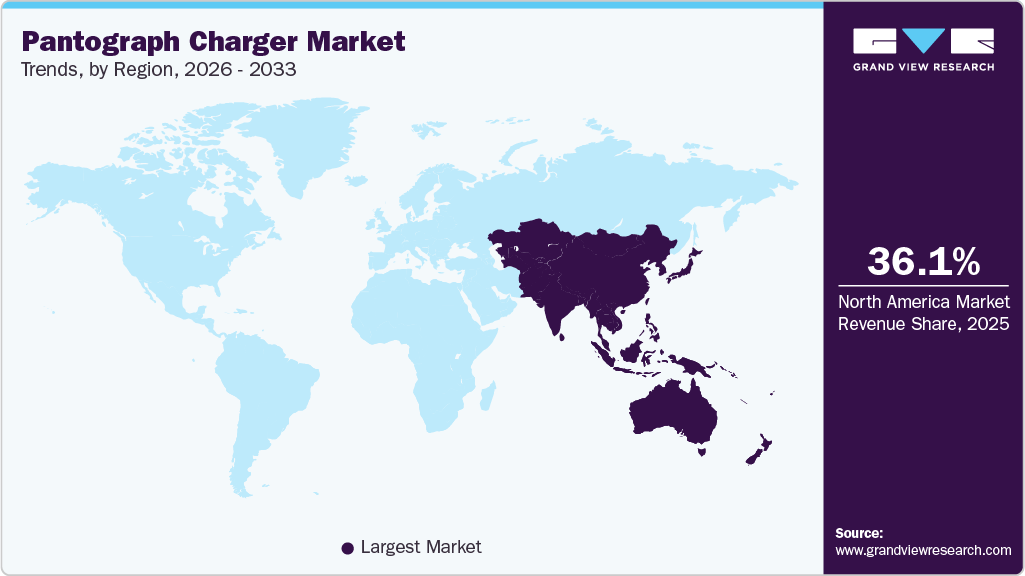
Asia Pacific pantograph charger market accounted for a 36.1% share of the overall market in 2025. The pantograph charger market in the Asia Pacific is anticipated to grow at a CAGR of 27.5% during the forecast period. Large-scale electric bus deployment and strong government-led electrification programs are enabling the Asia Pacific to emerge as the dominant regional market for pantograph chargers. The region benefits from high urban population density, rapid expansion of public transport networks, strong domestic manufacturing capacity, and cost advantages in the EV ecosystem.
India pantograph charger market is expected to grow rapidly in the coming years, fueled by government support for EV charging infrastructure and public transport electrification. National policy initiatives, including FAME-linked funding support for charging infrastructure, are helping establish the foundation for broader deployment of electric bus charging systems. Pantograph chargers are expected to gain relevance in India as state transport undertakings expand electric bus fleets and seek high-throughput charging solutions for dense urban routes and depot operations.
The pantograph charger market in China held a substantial market share in 2025. Massive adoption of electric buses and a highly developed EV supply chain are driving the market in China. The country has established a strong leadership position in electric public transportation, supported by large-scale fleet deployment, manufacturing integration, and continuous investment in charging infrastructure. China’s scale advantage creates favorable conditions for pantograph charging systems, particularly in high-density urban transit networks where fast automated charging can improve asset utilization and reduce operational disruption.
Key Pantograph Charger Company Insights
Some of the key companies in the market include ABB, Siemens Mobility, Schunk Transit Systems, Heliox Energy, and others. Organizations are focusing on increasing their customer base to gain a competitive edge in the industry. Therefore, key players are taking several strategic initiatives, such as mergers and acquisitions, and partnerships with other major companies.
-
ABB is a technology provider specializing in electrification and automation solutions. The company operates in segments such as electrification, motion, process automation, and robotics, serving industries from power generation to data centers with products such as switches, motors, drives, and advanced charging systems. In the context of pantograph chargers, ABB's E-mobility division provides cutting-edge infrastructure, including the Terra 184 series of high-power pantograph systems (up to 1.2 MW), enabling ultra-fast overhead charging for electric buses and trucks.
-
Schunk Transit Systems, a division of the Schunk Group, is a technology provider specializing in advanced power transmission and charging solutions for rail and road mobility. Renowned for pioneering pantograph technologies, the company supplies durable carbon-based systems for high-speed trains, subways, and monorails, alongside its Schunk Smart Charging portfolio for electric vehicles, including roof-mounted and inverted pantographs that enable automated, ultra-fast charging for e-buses and e-trucks in depots or on route.
Key Pantograph Charger Companies:
The following key companies have been profiled for this study on the pantograph charger market.
- ABB
- Siemens Mobility
- Schunk Transit Systems
- Heliox Energy
- Kempower
- Medha
- Wabtec Corporation
- Dekon Power
- ChargePoint, Inc.
- Dalian Luobinsen Power Equipment Co., Ltd.
Recent Developments
-
In September 2025, Daimler Buses installed a complete charging infrastructure at the Stuttgart-Möhringen depot of Stuttgarter Straßenbahnen AG (SSB), enabling up to 28 electric buses to charge simultaneously overnight via 28 pantograph points, each delivering up to 180 kW using "panto down" technology, where pantographs lower onto roof rails for automated, efficient charging. As general contractor, Daimler supplied the turnkey system, including steelwork, electrical installation, Sinos charging management software for load optimization, and a three-year service contract with 24/7 support, supported by Baden-Württemberg state funding to advance SSB's electrification goals.
-
In January 2026, the City of Alexandria's DASH transit agency partnered with ABM Industries to install key EV charging infrastructure, including an in-route pantograph charger, power cabinets, electrical systems, and civil foundations, enabling electric buses to recharge without leaving service and extending route flexibility for the system's 15,000 daily riders. This first-phase project under NASPO ValuePoint procurement reduces downtime, emissions, and operational costs while improving reliability, with ABM's Technical Solutions division providing turnkey delivery and future scalability for depot or additional in-route chargers.
Pantograph Charger Market Report Scope
Report Attribute
Details
Market size in 2025
USD 4.2 billion
Estimated market size in 2026
USD 4.9 billion
Projected market size by 2033
USD 25.9 billion
Growth rate
CAGR of 26.8% from 2026 to 2033
Historical data
2021 - 2025
Forecast period
2026 - 2033
Quantitative units
Revenue in USD million/billion and CAGR from 2026 to 2033
Report charging type
Revenue forecast, company ranking, competitive landscape, growth factors, and trends
Segments covered
Component, charging type, charging infrastructure type, region
Regional scope
North America; Europe; Asia Pacific; Latin America; MEA
Country scope
U.S.; Canada; Mexico; Germany; UK; France; China; Japan; India; South Korea; Australia; Brazil; KSA; UAE; South Africa
Key companies profiled
ABB; Siemens Mobility; Schunk Transit Systems; Heliox Energy; Kempower; Medha; Wabtec Corporation; Dekon Power; ChargePoint, Inc.; Dalian Luobinsen Power Equipment Co.,Ltd
Customization scope
Free report customization (equivalent up to 8 analysts working days) with purchase. Addition or alteration to country, regional & segment scope.
Pricing and purchase options
Avail customized purchase options to meet your exact research needs. Explore purchase options
Global Pantograph Charger Market Report Segmentation
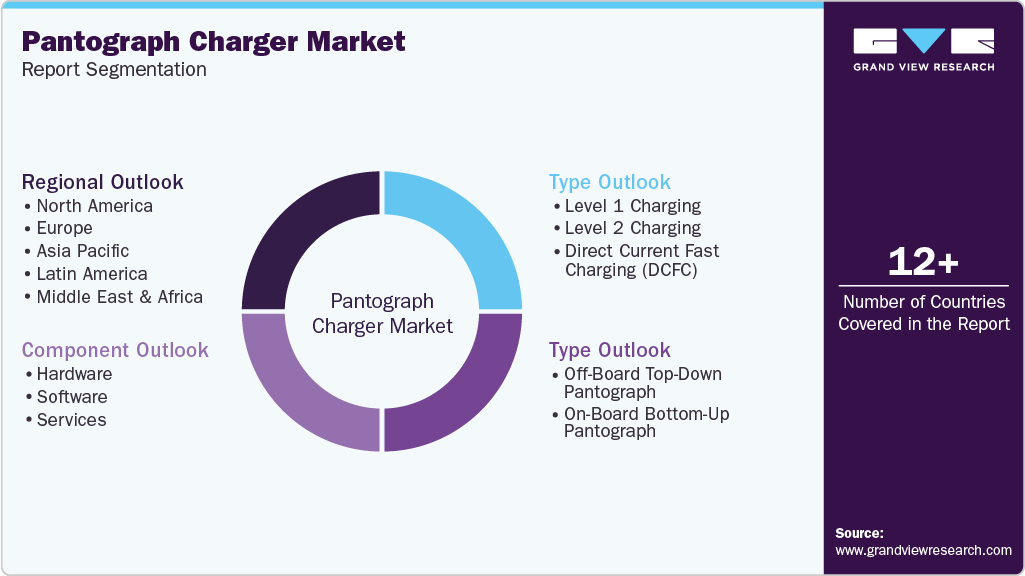
This report forecasts revenue growth at global, regional, and country levels and provides an analysis of the latest industry trends in each of the sub-segments from 2021 to 2033. For this study, Grand View Research has segmented the global pantograph charger market report based on component, charging type, charging infrastructure type, and region.
 To learn more about this report, Download Free Sample Report
 -
Component Outlook (Revenue, USD Million, 2021 - 2033)
-
Hardware
-
Software
-
Services
-
-
Charging Type Outlook (Revenue, USD Million, 2021 - 2033)
-
Level 1 Charging
-
Level 2 Charging
-
Direct Current Fast Charging (DCFC)
-
-
Charging Infrastructure Type Outlook (Revenue, USD Million, 2021 - 2033)
-
Off-Board Top-Down Pantograph
-
On-Board Bottom-Up Pantograph
-
-
Regional Outlook (Revenue, USD Million, 2021 - 2033)
-
North America
-
U.S.
-
Canada
-
Mexico
-
-
Europe
-
Germany
-
UK
-
France
-
-
Asia Pacific
-
China
-
Japan
-
India
-
South Korea
-
Australia
-
-
Latin America
-
Brazil
-
-
Middle East and Africa (MEA)
-
KSA
-
UAE
-
South Africa
-
-
Frequently Asked Questions About This Report
The global pantograph charger market size was valued at USD 4.2 billion in 2025 and is estimated at USD 4.9 billion for 2026.
The global pantograph charger market is expected to grow at a CAGR of 26.8% from 2026 to 2033, reaching USD 25.9 billion by 2033.
The hardware segment led the market with a 69.7% share in 2025, while the software segment is expected to grow at the fastest CAGR during the forecast period.
Some of the key players operating in the pantograph charger market include ABB, Siemens Mobility, Schunk Transit Systems, Heliox Energy, Kempower, Medha, Wabtec Corporation, Dekon Power, ChargePoint, Inc., and Dalian Luobinsen Power Equipment Co., Ltd.
Key factors driving the pantograph charger market include the rising electrification of public transport fleets and the increasing deployment of battery-electric buses.
The direct current fast charging (DCFC) segment held the largest market share in 2025.
The off-board top-down pantograph segment dominated the market in 2025, while the on-board bottom-up pantograph segment is projected to grow at the fastest CAGR of 27.4% over the forecast period.
Asia Pacific dominated the global pantograph charger market with a revenue share of 36.1% in 2025.
About the Author(s)
Automotive & Transportation Research Team
Technology · Automotive & TransportationThis report was authored by the automotive & transportation research team at Grand View Research - comprising two research analysts, one senior research analyst, and one industry expert - with specialized expertise in the automotive & transportation segment of the technology industry. All findings are based on proprietary technology databases, executive interviews, and regulatory analysis, subject to internal peer review prior to publication.
Last Updated:
Speak to Analyst

Customize this report to your needs - add regions, segments, or data points, with 20% free customization.
Or view our licence options:


ISO 9001:2015 & 27001:2022 Certified
We are GDPR and CCPA compliant! Your transaction & personal information is safe and secure. For more details, please read our privacy policy.


