
- Home
- »
- Consumer F&B
- »
-
Global Pasta Sauce Market Size & Share Report, 2020-2027GVR Report cover
![Pasta Sauce Market Size, Share & Trends Report]()
Pasta Sauce Market (2020 - 2027) Size, Share & Trends Analysis Report By Product (Tomato Based & Marinara, Alfredo & Four Cheese), By Base (Vegetable Based, Meat Based), By Distribution Channel, And Segment Forecasts
Pasta Sauce Market Summary
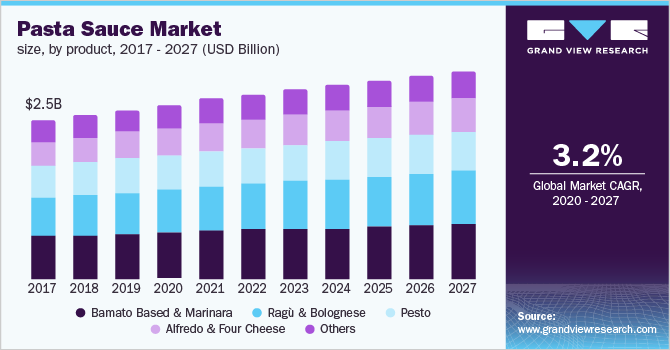
The global pasta sauce market size was estimated at USD 13,465.0 million in 2019 and is projected to reach USD 17,331.3 million by 2027, growing at a CAGR of 3.2% from 2020 to 2027. The growing popularity of pasta as an alternative to rice and other staple meals at the global level is expected to remain a favorable factor for industry growth.
Key Market Trends & Insights
- In terms of region, Europe was the largest revenue generating market in 2019.
- By product, tomato-based and marinara accounted for a share of more than 25.0% in 2019.
- By distribution channel, hypermarkets and supermarkets accounted for more than 50.0% share of the global revenue in 2019.
- By Base, the vegetable-based segment accounted for more than 60.0% share of the global revenue in 2019.
Market Size & Forecast
- 2019 Market Size: USD 13,465.0 Million
- 2027 Projected Market Size: USD 17,331.3 Million
- CAGR (2020-2027): 3.2%
- Europe: Largest market in 2019
- Asia Pacific: Fastest growing market
The use of packaged pasta sauce reduces the time required for collecting every single ingredient required for the sauce, processing it, and preparing the dish drastically. As a result, such products are expected to gain popularity among students and working-class professionals. Over the past few decades, the globe has been witnessing a significant increase in the middle-class population, which has led to its high dependency on imported food and farm products. Increasing the middle-class population, coupled with rapid urbanization, has boosted demand for convenience packaged foods, including pasta.
Fast-casual food chains like Pasta Flyer, Olive Garden, and Maggiano have enhanced the rapid adoption of the delicacy among the common mass. Thus, people along with enjoying a variety of pasta outside also prefer cooking it back at home with the assistance of readymade sauce available in most grocery stores. Freshness, organic, and low sodium have become some of the prime attributes of creating a valued product in the market for pasta sauce makers as these contribute to the health aspect of the food. The development of products with reference to customized requirements is expected to maintain the company’s market size over the next few years. Additionally, the pasta sauce manufacturing firms are projected to offer discounts on their products, which will expand their consumer reach over the next few years.
In August 2019, D’Amore’s Pizza, launched Pizza Girl, a line of USDA certified-organic ingredients sourced with integrity from the local farms and ethically bottled. These include three varieties of pizza sauce, including marinara, puttanesca, and vodka sauces. Each of these is available in glass jars of 24 ounces at all the Bristol Farms locations for USD 9.99.
Market Dynamics
The growing consumer preference for restaurant-style dining experiences at home is one of the key factors driving the growth of the global pasta sauce market. Increasing urbanization, busy lifestyles, and the growing popularity of convenient meal preparation have encouraged consumers to purchase premium and ready-to-use pasta sauces that replicate authentic restaurant flavors. Consumers are increasingly experimenting with international cuisines and gourmet cooking, particularly among millennials and younger households seeking high-quality yet time-saving meal solutions. This trend has significantly accelerated the demand for specialty pasta sauces such as vodka sauce, truffle Alfredo, roasted garlic marinara, and fusion-based variants.
Innovation in premium pasta sauce flavors is accelerating in response to evolving consumer preferences. According to the news article published by Allrecipes, premium pasta sauce brand Sauz expanded into Whole Foods and Sprouts with new fusion-style products such as Miso Garlic Marinara and Brown Butter Alfredo sauces, reflecting the growing consumer inclination toward gourmet and globally inspired pasta experiences at home.
Growing consumer concern regarding the high sodium, sugar, and preservative content in packaged pasta sauces is one of the major factors restraining the growth of the global pasta sauce market. Many commercially available pasta sauces contain elevated levels of sodium, added sugars, and artificial stabilizers to enhance shelf life and flavor. Increasing health consciousness among consumers, coupled with the rising prevalence of obesity, hypertension, and cardiovascular diseases, has encouraged consumers to scrutinize ingredient labels more carefully and shift toward fresh or homemade alternatives. This trend particularly affects conventional mass-market pasta sauce brands that rely heavily on processed ingredients and preservatives.
According to the article published by Harvard Health Publishing, packaged and processed foods remain among the largest contributors to excessive sodium intake globally. This growing awareness regarding unhealthy ingredient profiles has led many consumers to prefer clean-label, preservative-free, or homemade pasta sauces over conventional packaged options.
Pasta Sauce Market Trends
The pasta sauce demand has grown significantly in emerging economies due to the rising popularity of western meal dishes, intercontinental cuisines, and tangy foods. For instance, the rising popularity of pasta on a global level as a substitute for quick foods like rice and grains has driven the market.
An increase in awareness about health among people has driven the demand for nutrient-dense and well-balanced food options. Many hotels, cafes, and restaurants have adopted gluten-free and natural food ingredients-based sauces to attract more customers.
Many taste additions and innovations are being introduced by the chefs across the globe with various cuisines to diversify the range of sauces. Such trends are anticipated to create lucrative growth opportunities for the industry players to strengthen their foothold in the global market.
The unexpected outbreak of COVID-19 disrupted shipping systems, adversely affecting raw material prices of pepper chili, jalapenos, hollandaise, and tomatoes, resulting in price variations. The outbreak has impacted raw material exporters. This is predicted to eventually result in a market scarcity and, as a result, constitute a market growth limitation.
Product Insights
Tomato-based and marinara accounted for a share of more than 25.0% in 2019. A variety of tomato-based pasta sauces are available in the market, which includes tomato basil pasta sauce, tomato garlic pasta sauce, tomato roasted garlic pasta sauce, keto marinara, and garlic marinara. The sauce is usually seasoned with onions and herbs, such as garlic, oregano, or basil. The sauce has the taste and juice of tomato and has a velvety texture with a rich bite of olive oil. The sauce has become a part of various recipes across the globe, and thus a regional version of the recipe has evolved in the last couple of years, thereby increasing its adoption across the globe.
The alfredo and four cheese segment is expected to witness the fastest growth during forecast years with a CAGR of 4.1% from 2020 to 2027. The preference for rich and creamy sauce has been growing across most South Asian countries, where the launch of the sauce has been pretty recent.
Distribution Channel Insights
Hypermarkets and supermarkets accounted for more than 50.0% share of the global revenue in 2019. Most customers prefer buying in these supermarkets as these offer a large variety of goods at one common space.
The online stores and D2C is expected to witness the fastest growth during forecast years with a CAGR of 4.2% from 2020 to 2027. Most e-commerce sites have virtual assistants that give automated answers to most queries of the customers. The use of chatbots helps in sorting out issues regarding the purchase of the product. Online shopping offers a free pass from queuing in front of the checkout counters. The trend has become even more valuable amidst the COVID-19 situation where social distancing has become the new norm.
Base Insights
The vegetable-based segment accounted for more than 60.0% share of the global revenue in 2019. Vegetable sauces have been dominating the market as most people cooking pasta back at home prefer adding fresh pieces of meat. Additionally, most of the store-bought sauces are vegetable-based. Furthermore, the aforementioned product is suitable for a large part of the mass with vegetarian and vegan diet preferences. Consumers have been looking to include only plant-based items in their meals to reduce the impact on the environment as well as support animal welfare. Increasing health complications resulting from the regular consumption of meat are compelling people to opt for a vegetarian diet.
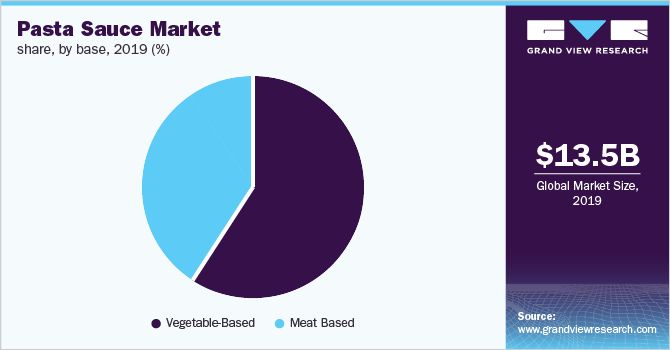
The meat-based segment is expected to witness the fastest growth during forecast years with a CAGR of 3.6% from 2020 to 2027. Some of the most popular meat-based sauces include carbonara, barese ragù, bolognese, neapolitan ragù, and ragù alla salsiccia.
Regional Insights
Europe dominated the market for pasta sauce and held over 30.0% share of the global revenue in 2019. The emergence of pasta in the region and its wide penetration in the European countries have been fueling the market growth in the region.
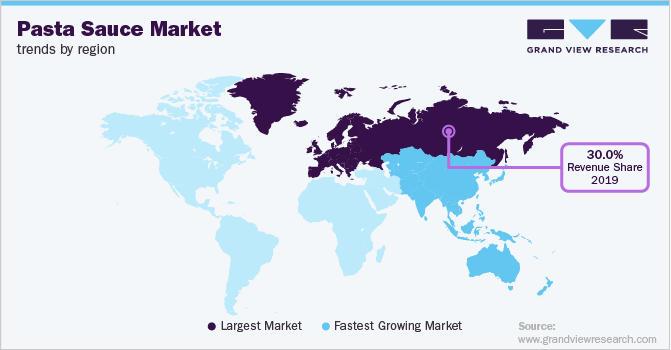
Asia Pacific is expected to register the fastest CAGR of 4.7% from 2020 to 2027. The globalization of food has created a wide penetration of pasta and pasta sauce in the region. Fast-food chains have also played a supporting role in creating the penetration for pasta. As pasta has been occupying the main league of diet, pasta sauce has been gaining popularity in the region.
Key Companies & Market Share Insights
The market for pasta sauce is competitive owing to the presence of a large number of players with a wide geographic presence, strong brand image, and vast distribution network. With the growing presence of retail giants, such as Carrefour, coupled with the rising popularity of shopping malls, companies operating in the market have been focusing on increasing their shelf space in offline distribution/retail channels. Moreover, they have been focusing more on sponsorships and partnerships as these strategies significantly help them target the right audience. Thus, the industry participants are expected to get into partnerships with the local distributors for ensuring continuous product access to the buyers over the next few years. In addition, product sustainability and brand popularity help companies generate more revenues.
Recent Developments
-
In November 2021, Campbells announced its new science-based targets (SBT) for reducing greenhouse gas emissions. The Science Based Targets initiative (SBTi), which specifies and supports best practices in carbon reductions, has accepted its targets
-
In November 2021, Barilla launched its Barilla agriBosco, to describe what lies underlying all of the Parma-based company's products, where sustainable agriculture coexists with nature. It's a celebration of Barilla's place in the world, with a focus on high-quality, environmentally friendly products and raw resources
-
In April 2022, Hemmer, a Brazilian food company, signed a deal with Kraft Heinz. CADE, Brazil's antitrust authority, approved the deal without conditions; the acquisition accelerates Kraft Heinz's Taste Elevation plan in a key growth area
Some of the prominent players in the pasta sauce market include:
-
Barilla G. e R. Fratelli S.p.A
-
Bertolli
-
Conagra Brands.
-
CSC Brands LP
-
Del Monte Food, Inc.
-
Frontier Co-op
-
International Gourmet Specialties
-
Mizkan America, Inc.
-
No Limit, LLC
-
Trader Joe’s
Competitive Benchmarking
Operating Strategies
Competitive Edge
Weaknesses
Mature Player: Bertolli
- Mature players in the pasta sauce market focus on expanding their product portfolios across premium, organic, clean-label, and ready-to-use sauce categories. They emphasize large-scale manufacturing capabilities, strong retail distribution networks, product innovation, strategic partnerships with supermarkets and foodservice operators, and investments in sustainable packaging and ingredients.
- Established manufacturers maintain a competitive advantage through strong brand recognition, vertically integrated supply chains, extensive retail shelf presence, advanced production infrastructure, large-scale procurement capabilities, and long-term partnerships with retailers, distributors, and foodservice companies.
- High dependency on commodity-based raw materials, rising packaging and logistics costs, slower product innovation cycles, and increasing pressure to reformulate products with lower sodium and preservative content may impact operational efficiency and profitability for large-scale manufacturers.
Emerging Player: Frontier Co-op
- Emerging players adopt innovation-driven and niche-focused strategies by offering artisanal, preservative-free, vegan, and globally inspired pasta sauces. These companies leverage flexible production models, direct-to-consumer sales channels, regional retail partnerships, and differentiated flavor positioning to strengthen market penetration and brand visibility.
- Emerging companies compete through product differentiation, rapid flavor innovation, clean-label positioning, premium ingredient sourcing, agile product development, and the ability to address evolving consumer demand for organic, gourmet, and health-focused pasta sauces.
- Limited manufacturing scalability, lower brand recognition, restricted distribution reach, and higher production costs associated with premium or organic ingredients may constrain commercial expansion and competitive positioning in highly competitive retail markets.
Pasta Sauce Market Report Scope
Report Attribute
Details
Market size value in 2020
USD 13.97 billion
Revenue forecast in 2027
USD 17.33 billion
Growth Rate
CAGR of 3.2% from 2020 to 2027
Base year for estimation
2019
Historical data
2016 - 2018
Forecast period
2020 - 2027
Quantitative units
Revenue in USD billion and CAGR from 2020 to 2027
Report coverage
Revenue forecast, company ranking, competitive landscape, growth factors, and trends
Segments covered
Product, base, distribution channel, region
Regional scope
North America; Europe; Asia Pacific; Central & South America; Middle East & Africa
Country scope
The U.S.; Germany; The U.K.; Italy; China; Japan; Brazil
Key companies profiled
Bertolli; International Gourmet Specialties; Mizkan America, Inc.; Barilla G. e R. Fratelli S.p.A; CSC Brands LP; No Limit, LLC; Trader Joe’s; Conagra Brands.; Del Monte Food, Inc; Frontier Co-op
Customization scope
Free report customization (equivalent up to 8 analysts working days) with purchase. Addition or alteration to country, regional & segment scope.
Pricing and purchase options
Avail customized purchase options to meet your exact research needs. Explore purchase options
Global Pasta Sauce Market Segmentation
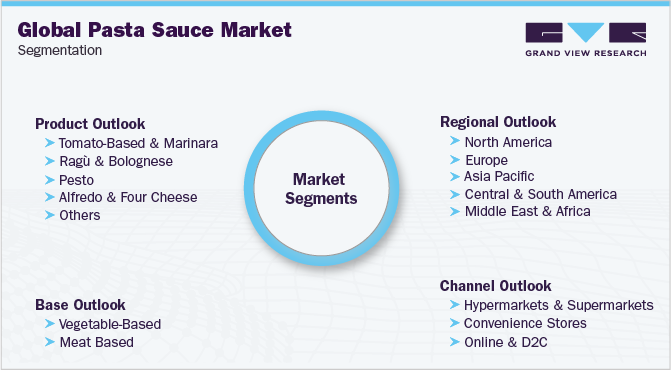
This report forecasts revenue growth at the global, regional, and country levels and provides an analysis of the latest industry trends and opportunities in each of the sub-segments from 2016 to 2027. For the purpose of this study, Grand View Research has segmented the global pasta sauce market report on the basis of product, base, distribution channel, and region.
-
Product Outlook (Revenue, USD Billion, 2016 - 2027)
-
Tomato-Based & Marinara
-
Ragù & Bolognese
-
Pesto
-
Alfredo & Four Cheese
-
Others
-
-
Base Outlook (Revenue, USD Billion, 2016 - 2027)
-
Vegetable-Based
-
Meat Based
-
-
Distribution Channel Outlook (Revenue, USD Billion, 2016 - 2027)
-
Hypermarkets & Supermarkets
-
Convenience Stores
-
Online & D2C
-
-
Regional Outlook (Revenue, USD Billion, 2016 - 2027)
-
North America
-
The U.S.
-
-
Europe
-
The U.K.
-
Germany
-
Italy
-
-
Asia Pacific
-
China
-
Japan
-
-
Central & South America
-
Brazil
-
-
Middle East & Africa
-
Delivered Customizations
This report has been delivered with the following In-depth customizations
Client Request
Customization Delivered
Value Adds
Regulatory and food labeling compliance analysis
Region-specific assessment of food safety regulations, ingredient restrictions, sodium/sugar labeling norms, organic certifications, and packaging compliance requirements.
Country-wise regulatory framework, labeling requirement comparison, compliance risk analysis, certification mapping, and market entry recommendations.
E-commerce and quick-commerce sales channel assessment
Evaluation of online grocery, D2C, and quick-commerce platforms for pasta sauce sales across target markets.
Channel share analysis, platform benchmarking, pricing comparison, consumer buying trends, delivery model assessment, and growth opportunity mapping.
Clean-label and organic pasta sauce trend assessment
Analysis of consumer demand for preservative-free, organic, vegan, and natural ingredient-based pasta sauces.
Consumer trend insights, product innovation tracking, competitor benchmarking, ingredient trend analysis, premium pricing assessment, and future opportunity identification.
Frequently Asked Questions About This Report
The global pasta sauce market size was estimated at USD 13.46 billion in 2019 and is expected to reach USD 13.97 billion in 2020.
The global pasta sauce market is expected to witness a compound annual growth rate of 3.2% from 2020 to 2027 to reach USD 17.33 billion by 2027.
Europe dominated the pasta sauce market with a share of 30.2% in 2019. This is attributed to the high consumption of Italian foods in a region.
Some key players operating in the pasta sauce market include Bertolli, International Gourmet Specialties, Mizkan America, Inc., Barilla G. e R. Fratelli S.p.A, CSC Brands LP, No Limit, LLC, Trader Joe’s, Conagra Brands., Del Monte Food, Inc, and Frontier Co-op.
Key factors that are driving the market growth include rising consumption of pasta and new product launches.
About the Author(s)
Consumer F&B Research Team
Consumer Goods · Consumer F&BThis report was authored by the consumer f&b research team at Grand View Research - comprising two research analysts, one senior research analyst, and one industry expert - with specialized expertise in the consumer f&b segment of the consumer goods industry. All findings are based on proprietary consumer goods databases, executive interviews, and regulatory analysis, subject to internal peer review prior to publication.
Last Updated:
Speak to Analyst


Customize this report to your needs — add regions, segments, or data points, with 20% free customization.
Or view our licence options:


ISO 9001:2015 & 27001:2022 Certified
We are GDPR and CCPA compliant! Your transaction & personal information is safe and secure. For more details, please read our privacy policy.












