
- Home
- »
- Biotechnology
- »
-
Perfusion Bioreactors Market Size, Growth Report, 2026-2033GVR Report cover

Perfusion Bioreactors Market (2026 - 2033)
Size, Share & Trends Analysis Report By Type (Small Scale, Large Scale), By Application (Biopharmaceutical Production, Tissue Engineering, Stem Cell Research), By End Use, By Region, And Segment Forecasts
Market Size, 2025
$430.5MMarket Estimate, 2026
$462.5MMarket Forecast, 2033
$839.8MCAGR, 2026–2033
8.9%Perfusion Bioreactors Market Summary
The global perfusion bioreactors market size was valued at USD 430.5 million in 2025 and is projected to grow from USD 462.5 million in 2026 to USD 839.8 million by 2033, at a CAGR of 8.9% from 2026 to 2033. North America dominated the global market, accounting for the largest revenue share of 48.3% in 2025. This growth is primarily driven by increasing demand for high-yield, continuous bioprocessing in biopharmaceutical manufacturing, rising production of monoclonal antibodies, vaccines, and recombinant proteins, and the expanding pipeline of cell and gene therapies.
 Source: Grand View Research, IR Documents, Primary Interviews, Paid DatabasesTo learn more about this report,
 Download Free Sample Report
 Key Market Trends & Insights
- By type: Small-scale perfusion bioreactors segment held the highest market share in 2025.
- By application: Biopharmaceutical production segment held the highest market share of 51.5% in 2025.
- By end use: Biopharmaceutical companies segment held the highest market share in 2025.
Regional Highlights
- Largest regional market:North America (48.3% revenue share, 2025)
- Fastest-growing regional market:Asia Pacific (highest CAGR, 2026-2033)
- By country: The U.S. perfusion bioreactors industry is a major contributor to the global market.
Market Size & Forecast
- Market size in 2025: USD 430.5 Million
- Estimated market size in 2026: USD 462.5 Million
- Projected market size by 2033: USD 839.8 Million
- CAGR (2026-2033): 8.9%
Three ways to get this report
Buy it, customize it, or ask a question.Ask an Analyst
Analyst response in 1 business day
- AccessReport author, directly
- Reply timeWithin 1 working day
- No sales callDirect answer only
- FormatEmail reply
- CostFree, no cost
Get the Full Report
What the study covers
- FormatsPDF · Excel · Dashboard
- Timeline2026–2033 annual, 2025 base
- Coverage20+ countries, 5 regions
- Companies10+ key players profiled
Customize the Report
20% free customization
- IncludeCountries, segments, points
- TailorTo your product definition
- ExtendDeeper competitor detail
- OrA fully bespoke study
- Turnaround5–10 working days
 To learn more about this report, Download Free Sample Report
 Increasing demand for continuous and high-yield bioprocessing
The increasing demand for continuous and high-yield bioprocessing is a key driver of the perfusion bioreactors industry, as biopharmaceutical manufacturers focus on improving productivity and meeting the rising demand for complex biologics. Unlike traditional batch and fed-batch systems, perfusion bioreactors enable continuous nutrient supply and waste removal, allowing cells to remain viable for longer durations and achieve higher cell densities. This leads to enhanced volumetric productivity, consistent output, and more efficient large-scale manufacturing.
Benefits of Perfusion for Biomanufacturing
Benefit
Description
Higher cell densities
Enables continuous cell growth, resulting in higher cell densities and increased productivity compared to batch or fed-batch processes
Stable product quality
Maintains a consistent culture environment, ensuring uniform product quality over extended production periods
Reduced footprint
Achieves similar production output with smaller bioreactors, reducing facility size requirements
Longer production runs
Supports continuous operation, minimizing downtime and improving overall throughput
Flexibility
Allows easy scaling of output without major process or infrastructure changes, suitable from clinical to commercial production
Improved process economics
Reduces manufacturing costs when integrated with continuous downstream processing
Source: Evotec, Secondary Research, Grand View Research
In addition, perfusion systems offer several advantages that support their growing adoption, including stable product quality due to controlled culture conditions and the ability to run processes for extended periods with minimal downtime. They also reduce facility footprint while providing flexibility to scale production without significant infrastructure changes. Moreover, when integrated with continuous downstream processing, perfusion bioreactors improve overall process economics by lowering manufacturing costs, making them an attractive solution for modern biomanufacturing needs.
Rising production of biologics
The rising production of biologics, including monoclonal antibodies (mAbs), vaccines, and recombinant proteins, is a significant driver of the industry. Biologics have become a key component of modern therapeutics due to their high specificity in treating complex and chronic diseases, driving global demand and pushing biopharmaceutical manufacturers to adopt more efficient, scalable production technologies. Perfusion bioreactors address this need by enabling continuous processing and supporting high-cell-density cultures, thereby increasing productivity and ensuring consistent output.
Moreover, the expanding pipeline of biologics and biosimilars is accelerating the adoption of advanced bioprocessing technologies. Perfusion systems offer advantages such as enhanced product quality, improved process control, and greater flexibility for long-duration production runs. These features make them highly suitable for both clinical and large-scale commercial manufacturing, thereby supporting overall market growth.
Market Concentration & Characteristics
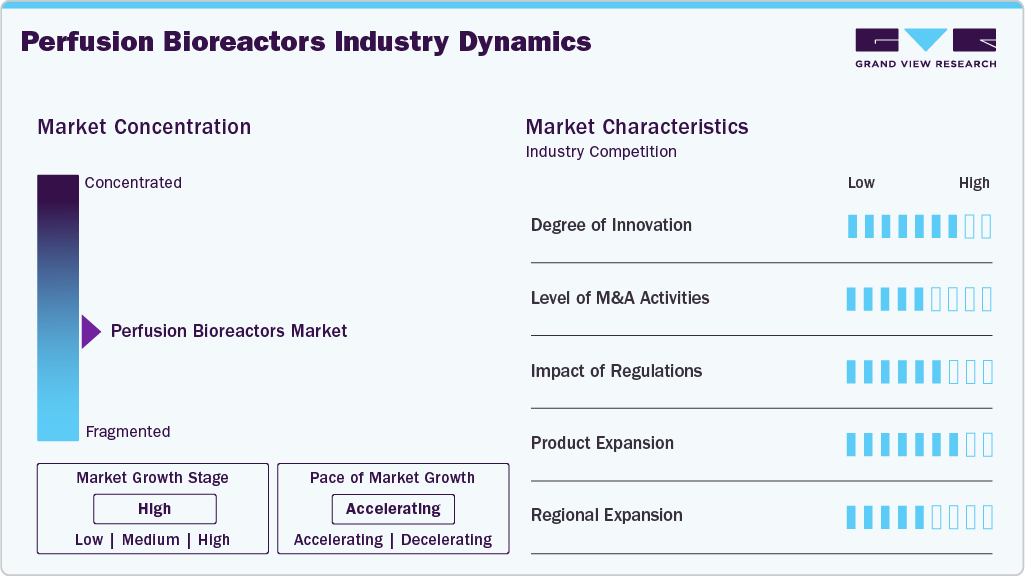
The industry exhibits significant innovation, driven by advancements in single-use systems, cell retention technologies (ATF, TFF), and process monitoring that enhance scalability, efficiency, and product quality. Additionally, improvements in process intensification, automation, and integration with continuous downstream processing are reducing operational complexity and enabling more flexible, efficient biologics manufacturing. For instance, in August 2023, Sartorius and Repligen introduced an integrated Biostat STR and XCell ATF system, combining bioreactor and cell retention technologies to streamline perfusion processes, enhance process intensification, improve cell culture efficiency, and enable simplified, scalable continuous biomanufacturing.
The industry is witnessing a low-to-moderate level of M&A activity, as companies mainly prioritize organic growth, technological innovation, and strategic collaborations over large-scale acquisitions. Selective deals focus on strengthening capabilities in bioprocessing technologies, cell retention systems, and single-use solutions, while partnerships are globally used to integrate complementary technologies and enhance process efficiency. Overall, consolidation remains limited and cautious, with a greater emphasis on expanding product portfolios, geographic reach, and supporting continuous biomanufacturing through innovation-driven collaborations rather than aggressive acquisition strategies. For instance, in December 2022, MilliporeSigma acquired Erbi Biosystems, enhancing its upstream bioprocessing portfolio by integrating micro-bioreactor technology to support scalable perfusion systems and accelerate continuous biomanufacturing development.
 To learn more about this report, Download Free Sample Report
 Regulations significantly influence the industry by guiding product development, manufacturing standards, and adoption in biopharmaceutical production. Compliance with GMP, ISO standards, and regulatory frameworks ensures safe, scalable, and contamination-free processes with proper validation and traceability. While these requirements increase costs and approval timelines, they improve product reliability, ensure global market access, and encourage innovation in standardized perfusion bioreactor technologies.
Product expansion in the industry is driven by the increasing demand for efficient, scalable, and continuous bioprocessing solutions in biopharmaceutical manufacturing. Companies are expanding their portfolios with advanced single-use bioreactors, integrated perfusion systems, and enhanced cell retention technologies such as ATF and TFF to support high-density cell culture and improved process control. The focus is on improving productivity, operational flexibility, and ease of use to meet evolving manufacturing requirements for biologics production. In addition, manufacturers are increasingly offering fully integrated, automated solutions that streamline upstream and downstream processes, enabling more efficient, cost-effective continuous biomanufacturing.
Regional expansion in the industry is driven by the increasing adoption of advanced biopharmaceutical manufacturing technologies across both developed and emerging regions. Key players are strengthening their presence in high-growth markets such as Asia-Pacific, Latin America, and the Middle East & Africa through partnerships, collaborations, and local manufacturing and service facilities. This expansion is supported by rising investments in biopharma infrastructure, growing demand for biologics, and increasing adoption of continuous bioprocessing technologies, thereby accelerating market penetration and the adoption of perfusion bioreactor systems.
Type Insights
The small scale perfusion bioreactors segment accounted for the largest market share of 62.2% in 2025 and is expected to maintain its dominance over the forecast period. This growth is primarily driven by their extensive use in process development, early-stage research, and pilot-scale production in biopharmaceutical applications. Their lower cost, operational flexibility, and suitability for optimizing cell culture conditions and scaling strategies have supported global adoption. In addition, increasing focus on process intensification and rapid development of biologics and cell therapies is further strengthening demand for small-scale systems.
The large scale perfusion bioreactors segment is expected to grow at the fastest CAGR during the forecast period, driven by rising demand for commercial-scale biologics manufacturing and continuous production systems. Increasing investments in large-scale biopharmaceutical facilities, along with the need for high productivity, consistent output, and efficient resource utilization, are supporting segment growth. Moreover, advancements in single-use technologies, automation, and integrated perfusion systems are enabling scalable, cost-effective production, making large-scale bioreactors essential to meet the growing global demand for biologics.
Application Insights
The biopharmaceutical production segment dominated the market in 2025, with a 51.5% share, driven by its extensive use in the manufacturing of monoclonal antibodies, vaccines, and recombinant proteins. The increasing demand for high-quality biologics, along with the shift toward continuous bioprocessing, has significantly supported segment growth. Perfusion bioreactors enable higher cell densities, consistent product quality, and improved productivity, making them highly suitable for large-scale biologics manufacturing and strengthening the segment’s leading position.
The stem cell research segment is expected to grow at the fastest CAGR during the forecast period, driven by increasing focus on regenerative medicine and advanced cell-based therapies. Perfusion bioreactors provide controlled environments for efficient cell expansion and maintenance, which is critical for stem cell cultivation. In addition, rising investments in cell therapy research and growing collaborations between research institutes and biopharmaceutical companies are accelerating the adoption of perfusion systems in this segment.
End Use Insights
The biopharmaceutical companies segment dominated the market in 2025, with a 46.8% share, driven by the extensive use of these systems in large-scale biologics manufacturing. The increasing demand for monoclonal antibodies, vaccines, and recombinant proteins, along with the shift toward continuous bioprocessing, has significantly supported segment growth. In addition, strong investments in biomanufacturing infrastructure and the adoption of advanced upstream technologies continue to reinforce the segment’s leading position.
 To learn more about this report, Download Free Sample Report
 The CROs & CMOs segment is expected to grow at the fastest CAGR during the forecast period, driven by the rising trend of outsourcing biopharmaceutical manufacturing and process development activities. The increasing demand for flexible, scalable production solutions, coupled with expanding biologics pipelines, is accelerating the adoption of perfusion bioreactors among these organizations. Moreover, growing collaborations with biopharma companies and advancements in contract manufacturing capabilities are driving rapid growth in this segment.
Regional Insights
North America perfusion bioreactors market dominated with a 48.3% share in 2025, supported by advanced biopharmaceutical manufacturing infrastructure, strong investments in biologics production, and the presence of leading biotechnology and pharmaceutical companies. The region’s early adoption of continuous bioprocessing technologies, increasing focus on monoclonal antibodies, vaccines, and cell and gene therapies, and well-established supply chains have strengthened its market leadership.
 To learn more about this report, Download Free Sample Report
 U.S Perfusion Bioreactors Market Trends
The perfusion bioreactors market in the U.S. is highly advanced and innovation-driven, supported by a strong biopharmaceutical ecosystem and global adoption of continuous bioprocessing technologies. The market is focused on high-efficiency, scalable, and automated perfusion systems that enhance productivity in biologics manufacturing, particularly for monoclonal antibodies, vaccines, and cell and gene therapies. Strong investments in biopharma R&D, rising demand for advanced therapeutics, and the presence of leading bioprocessing companies continue to reinforce the country’s dominant position in the global market.
Europe Perfusion Bioreactors Market Trends
The perfusion bioreactors market in Europe is witnessing steady growth, supported by strong biopharmaceutical R&D investments, advanced healthcare infrastructure, and increasing adoption of continuous bioprocessing technologies. Rising demand for monoclonal antibodies and vaccines is driving the uptake of advanced perfusion systems across research and commercial manufacturing. In addition, growing focus on process intensification, sustainability in biomanufacturing, and increasing regulatory support for high-quality biologics production further strengthen the region’s position as a key market for perfusion bioreactors.
The UK perfusion bioreactors market is driven by a strong bioprocessing research base and rapid adoption of advanced upstream technologies in biopharmaceutical development. The country’s focus on accelerating biologics manufacturing efficiency, particularly for cell and gene therapies, is supporting increased use of perfusion-based systems in both academic and industrial settings. In addition, rising investments in translational biomanufacturing hubs and strong academia-industry collaboration are accelerating the adoption of process intensification technologies, reinforcing its position in advanced bioprocess innovation.
The perfusion bioreactors market in Germany is driven by the growing focus on process intensification, continuous manufacturing, and the integration of micro- and large-scale bioreactor systems, which is enhancing efficiency in therapeutic protein and cell therapy development while supporting faster, more streamlined bioprocessing workflows. For instance, in December 2022, Merck acquired Erbi Biosystems, strengthening its upstream bioprocessing portfolio by integrating micro-bioreactor technology to enable scalable perfusion-based cell culture from the laboratory to industrial scale and to advance continuous biomanufacturing capabilities.
Asia Pacific Perfusion Bioreactors Market Trends
The perfusion bioreactors market in Asia-Pacific is expected to witness the fastest growth, with a CAGR of 12.1%, driven by the rapid expansion of biopharmaceutical manufacturing capabilities and the increasing adoption of advanced bioprocessing technologies. Rising investments in local biologics production, the growing presence of contract development and manufacturing organizations (CDMOs), and supportive government initiatives are strengthening regional capacity for large-scale production of monoclonal antibodies, vaccines, and cell and gene therapies, thereby accelerating the adoption of perfusion-based systems across emerging biopharma hubs in the region.
The China perfusion bioreactors market is expanding rapidly, supported by strong investments in biopharmaceutical manufacturing capacity and increasing focus on self-sufficiency in biologics production. The country is witnessing growing adoption of advanced upstream bioprocessing technologies to enhance productivity and support large-scale production of monoclonal antibodies, vaccines, and cell therapies. In addition, the presence of a strong domestic biopharma ecosystem and the expansion of CDMO facilities are accelerating the shift toward continuous and high-efficiency perfusion-based manufacturing systems.
The perfusion bioreactors market in Japan is supported by its strong precision biomanufacturing ecosystem and emphasis on high-quality, reproducible biologics production. Adoption of perfusion systems is increasing in niche and high-value applications such as regenerative medicine and complex biologics, where tight process control and consistent cell culture performance are critical. In addition, integration of compact, automated bioreactor platforms in research and pilot-scale facilities is supporting more efficient process development and scale-up.
MEA Perfusion Bioreactors Market Trends
The perfusion bioreactors market in the MEA region is witnessing steady growth, supported by increasing investments in biopharmaceutical infrastructure and expanding biologics manufacturing capabilities. The growing focus on strengthening local vaccine production, biosimilar development, and contract manufacturing services is driving the adoption of advanced perfusion-based upstream technologies.
The Kuwait perfusion bioreactors market is developing steadily, driven by the expansion of healthcare infrastructure and the growing focus on biologics production. Increasing emphasis on vaccine readiness and collaborations with global biopharma firms is supporting early adoption of advanced perfusion-based bioprocessing technologies.
Key Perfusion Bioreactors Companies Insights
The perfusion bioreactors market is characterized by several established players who dominate through strong product portfolios, advanced bioprocessing technologies, and global manufacturing and distribution capabilities. Companies such as Sartorius AG, Cytiva (Danaher Corporation), Thermo Fisher Scientific Inc., and Eppendorf AG maintain a significant market presence due to their expertise in single-use bioreactors, perfusion systems, and integrated upstream processing solutions, supported by continuous investment in innovation and large-scale biomanufacturing infrastructure.
In addition, specialized and emerging players such as Cell Culture Company, CELLEC BIOTEK AG, Synthecon Inc., Zellwerk GmbH, Infors HT, and 3D Biotek LLC are strengthening their position by offering niche perfusion technologies, scalable bioreactor platforms, and customized cell culture solutions. Their focus on flexibility, process intensification, and cost-efficient systems enables them to address specific research and clinical manufacturing needs across the biopharmaceutical industry.
Market leaders in the perfusion bioreactors space maintain their dominance through advanced continuous bioprocessing technologies, automation, and integrated upstream solutions, supported by strong global supply networks. Their leadership is further reinforced by sustained R&D investments, compliance with stringent biopharmaceutical quality standards, and strategic collaborations that enable efficient, scalable, and high-yield biologic production.
Key Perfusion Bioreactors Companies:
The following key companies have been profiled for this study on the perfusion bioreactor market.
- Sartorius AG
- Cell Culture Company
- Cytiva (Danaher Corporation)
- CELLEC BIOTEK AG
- Synthecon Inc.
- Getinge (Applikon Biotechnology B.V)
- Zellwerk GmbH
- Thermo Fisher Scientific Inc.
- Eppendorf AG
- Infors HT
- 3D Biotek LLC
Recent Developments
-
In May 2025, Sunflower Therapeutics delivered and installed the Daisy Petal perfusion bioreactor system at BioBuilder’s Learning Lab, advancing accessible biomanufacturing education and enabling scalable, automated continuous protein production for training and research in biotechnology applications.
-
In September 2022, Terumo BCT launched the Quantum Flex Cell Expansion System, a hollow-fiber perfusion bioreactor platform designed to enhance cell and gene therapy manufacturing by enabling scalable, automated, closed-system cell expansion and improving process efficiency from development to commercialization.
Perfusion Bioreactors Market Report Scope
Report Attribute
Details
Market size in 2025
USD 430.5 million
Estimated Market size in 2026
USD 462.5 million
Projected Market size by 2033
USD 839.8 million
Growth rate
CAGR of 8.9% from 2026 to 2033
Base year for estimation
2025
Historical data
2021 - 2024
Forecast period
2026 - 2033
Quantitative units
Revenue in USD million/billion and CAGR from 2026 to 2033
Report coverage
Revenue forecast, company ranking, competitive landscape, growth factors, and trends
Segments covered
Type, application, end use, region
Regional scope
North America; Europe; Asia Pacific; Latin America; MEA
Country scope
U.S.; Canada; Mexico; UK; Germany; France; Italy; Spain; Denmark; Sweden; Norway; India; China; Japan; Australia; South Korea; Thailand; Brazil; Argentina; Saudi Arabia; UAE; South Africa; Kuwait
Key companies profiled
Sartorius AG; Cell Culture Company; Cytiva (Danaher Corporation); CELLEC BIOTEK AG, Synthecon Inc.; Getinge (Applikon Biotechnology B.V); Zellwerk GmbH, Thermo Fisher Scientific Inc.; Eppendorf AG; Infors HT; 3D Biotek LLC
Customization scope
Free report customization (equivalent up to 8 analyst’s working days) with purchase. Addition or alteration to country, regional & segment scope.
Global Perfusion Bioreactors Market Report Segmentation
This report forecasts revenue growth at the global, regional and country levels and provides an analysis of the latest trends in each of the sub-segments from 2021 to 2033. For this study, Grand View Research has segmented the global perfusion bioreactors market report on the basis of type, application, end use, and region.
 To learn more about this report, Download Free Sample Report
 -
Type Outlook (Revenue, USD Million, 2021 - 2033)
-
Small Scale Perfusion Bioreactors
-
Large Scale Perfusion Bioreactors
-
-
Application Outlook (Revenue, USD Million, 2021 - 2033)
-
Biopharmaceutical Production
-
Tissue Engineering
-
Stem Cell Research
-
Others
-
-
End Use Outlook (Revenue, USD Million, 2021 - 2033)
-
Biopharmaceutical Companies
-
Academic and Research Institutes
-
CROs & CMOs
-
-
Regional Outlook (Revenue, USD Million, 2021 - 2033)
-
North America
-
U.S.
-
Canada
-
Mexico
-
-
Europe
-
Germany
-
UK
-
France
-
Italy
-
Spain
-
Denmark
-
Sweden
-
Norway
-
-
Asia Pacific
-
China
-
India
-
Japan
-
South Korea
-
Australia
-
Thailand
-
-
Latin America
-
Brazil
-
Argentina
-
-
Middle East and Africa (MEA)
-
South Africa
-
Saudi Arabia
-
UAE
-
Kuwait
-
-
Frequently Asked Questions About This Report
Asia Pacific is the fastest-growing region over the forecast period.
The small scale perfusion bioreactors segment led with a 62.2% revenue share in 2025, while large scale perfusion bioreactors is the fastest-growing type.
The biopharmaceutical production segment led with a 51.5% revenue share in 2025, while stem cell research is the fastest-growing application.
Biopharmaceutical companies segment held the largest share (over 46.0%) in 2025, while CROs & CMOs is the fastest-growing segment.
The global perfusion bioreactors market size was valued at USD 430.5 million in 2025 and is estimated at USD 462.5 million for 2026.
The global perfusion bioreactors market is expected to grow at a CAGR of 8.9% from 2026 to 2033, reaching USD 839.8 million by 2033.
North America dominated the perfusion bioreactors market with a 48.3% share in 2025, supported by advanced biopharmaceutical manufacturing infrastructure, strong investments in biologics production, and the presence of leading biotechnology and pharmaceutical companies.
Key players include Sartorius AG; Cell Culture Company; Cytiva (Danaher Corporation); CELLEC BIOTEK AG, Synthecon Inc.; Getinge (Applikon Biotechnology B.V); Zellwerk GmbH, Thermo Fisher Scientific Inc.; Eppendorf AG; Infors HT; 3D Biotek LLC.
The market growth is primarily driven by increasing demand for high-yield, continuous bioprocessing in biopharmaceutical manufacturing, rising production of monoclonal antibodies, vaccines, and recombinant proteins, and the expanding pipeline of cell and gene therapies.
About the Author(s)
Biotechnology Research Team
Healthcare · BiotechnologyThis report was authored by the biotechnology research team at Grand View Research - comprising two research analysts, one senior research analyst, and one industry expert - with specialized expertise in the biotechnology segment of the healthcare industry. All findings are based on proprietary healthcare databases, executive interviews, and regulatory analysis, subject to internal peer review prior to publication.
Last Updated:
Speak to Analyst

Customize this report to your needs - add regions, segments, or data points, with 20% free customization.
Or view our licence options:


ISO 9001:2015 & 27001:2022 Certified
We are GDPR and CCPA compliant! Your transaction & personal information is safe and secure. For more details, please read our privacy policy.


