
- Home
- »
- Animal Health
- »
-
Pet Dental Nutrition Market Size, Share, Trends Report, 2033GVR Report cover

Pet Dental Nutrition Market (2026 - 2033)
Size, Share & Trends Analysis Report By Pet (Dogs, Cats), By Product (Dental Food, Dental Chews & Treats, Powders/ Granules), By Indication, By Route Of Administration, By Usage, By Sales Channel, By Region, And Segment Forecasts
Market Size, 2025
$545.8MMarket Estimate, 2026
$584.8MMarket Forecast, 2033
$966.3MCAGR, 2026–2033
7.4%Pet Dental Nutrition Market Summary
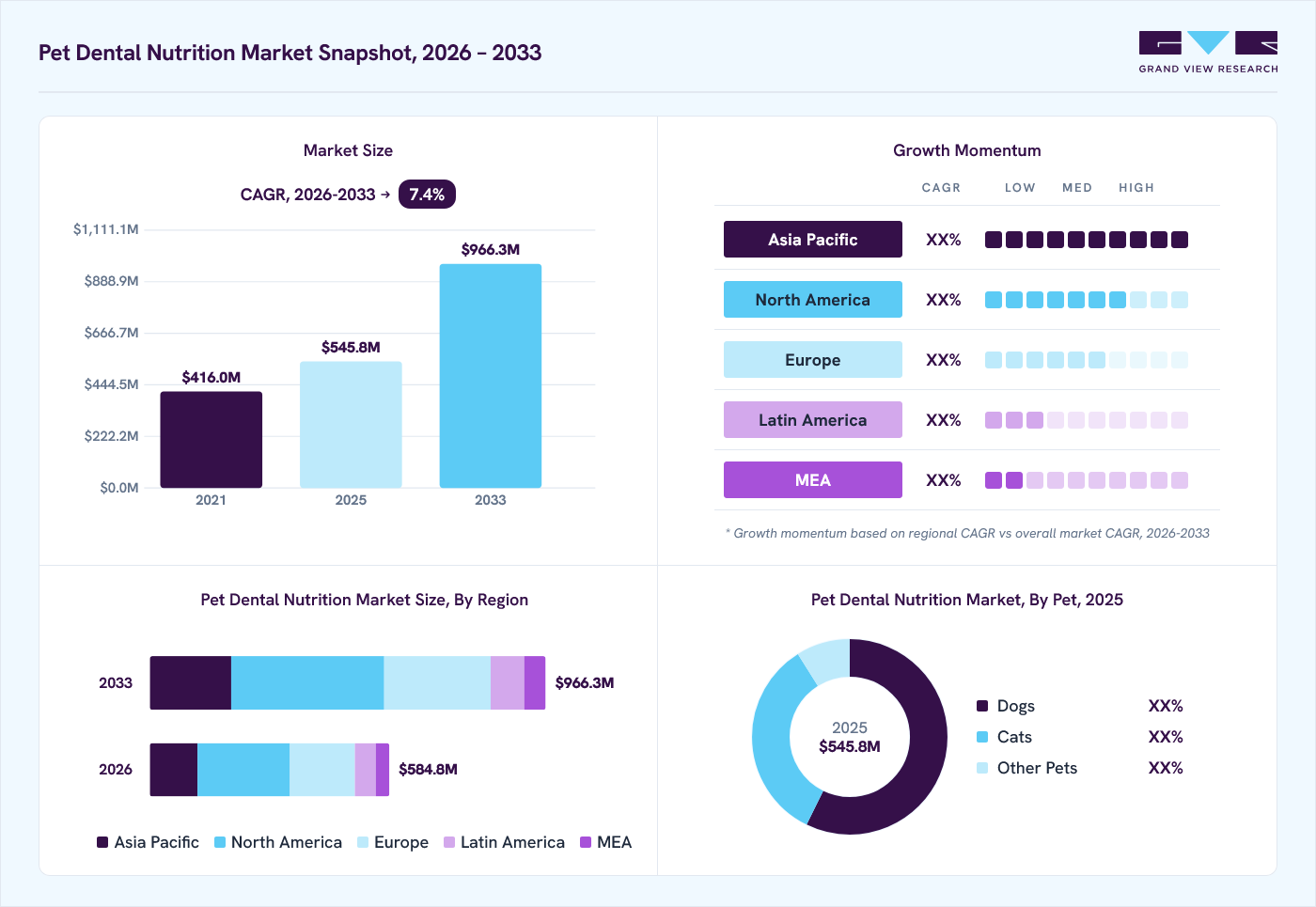
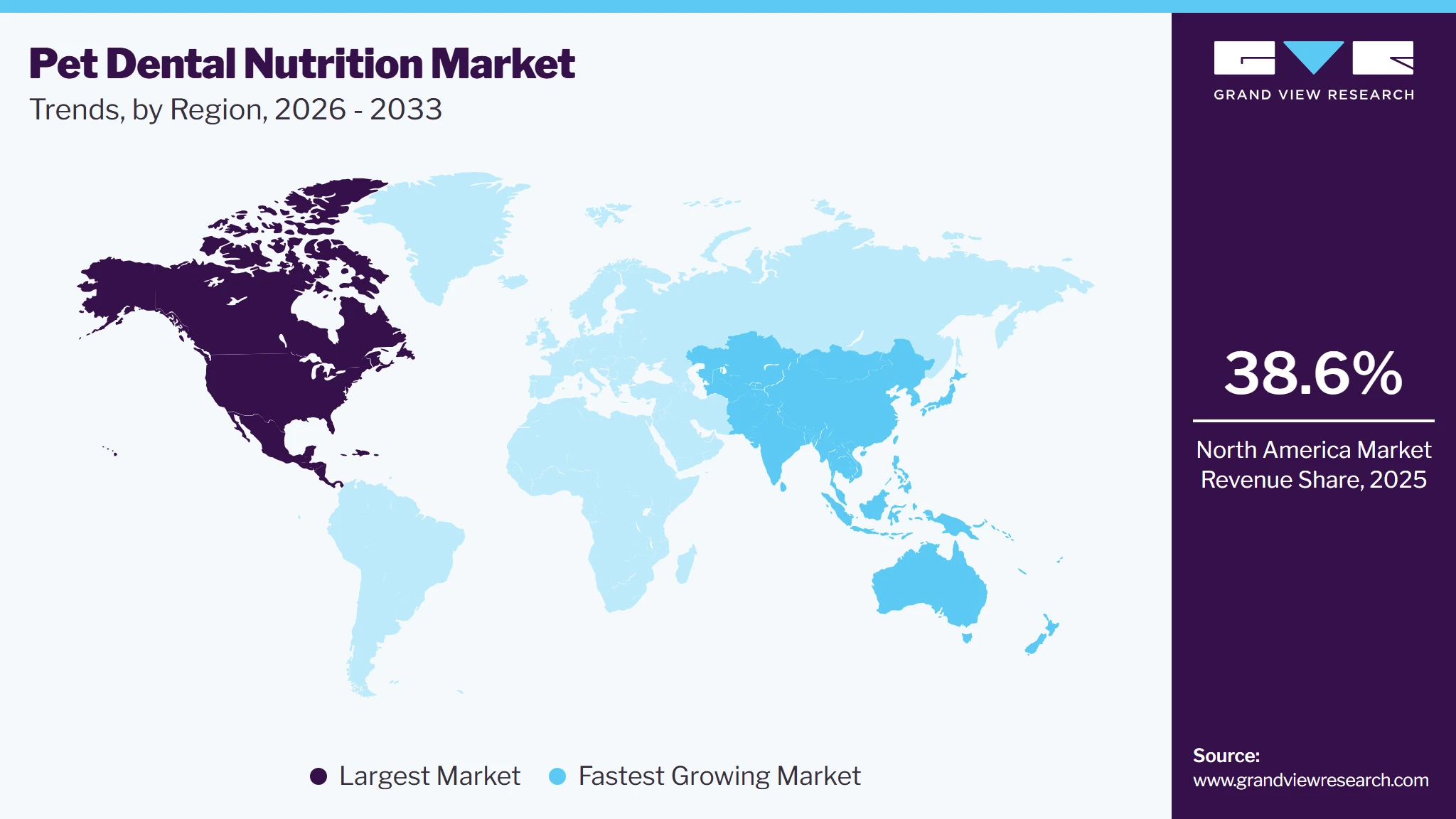
The global pet dental nutrition market size was valued at USD 545.8 million in 2025 and is projected to grow from USD 584.8 million in 2026 to USD 966.3 million by 2033, at a CAGR of 7.4% from 2026 to 2033. North America dominated the market, accounting for the largest revenue share of 38.6% in 2025. The market is primarily driven by key factors such as rising periodontal disease prevalence in pets, expanding VOHC clinical validation pipeline, accelerating e-commerce distribution infrastructure, and diversifying delivery formats beyond direct chews.
 Source: Grand View Research, IR Documents, Primary Interviews, Paid DatabasesTo learn more about this report,
 Download Free Sample Report
 Key Market Trends & Insights
- By pet: Dogs segment led the market with the largest revenue share of 57.2% in 2025.
- By product: Dental chews & treats segment led the market with the largest revenue share of 45.4% in 2025.
- By indication: Breath freshening segment is expected to grow at the fastest rate over the forecast period.
- By route of administration: Water/liquid segment is expected to grow at the fastest rate over the forecast period.
- By usage: Retail segment led the market with the largest revenue share of 78.3% in 2025
Regional Highlights
- Largest regional market: North America (38.6% revenue share, 2025)
- Fastest-growing regional market: Asia Pacific (highest CAGR, 2026-2033)
- By country: The U.S. held the largest market share in 2025.
Market Size & Forecast
- Market size in 2025: USD 545.8 Million
- Estimated market size in 2026: USD 584.8 Million
- 2033 Projected Market Size: USD 966.3 Million
- CAGR (2026-2033): 7.4%
Three ways to get this report
Buy it, customize it, or ask a question.Ask an Analyst
Analyst response in 1 business day
- AccessReport author, directly
- Reply timeWithin 1 working day
- No sales callDirect answer only
- FormatEmail reply
- CostFree, no cost
Get the Full Report
What the study covers
- FormatsPDF · Excel · Dashboard
- Timeline2026–2033 annual, 2025 base
- Coverage20+ countries, 5 regions
- Companies10+ key players profiled
Customize the Report
20% free customization
- IncludeCountries, segments, points
- TailorTo your product definition
- ExtendDeeper competitor detail
- OrA fully bespoke study
- Turnaround5–10 working days
 To learn more about this report, Download Free Sample Report
 Market Dynamics
The pet dental nutrition market is being reshaped by four converging forces. Rising periodontal disease prevalence is converting an occasional treat purchase into a scheduled preventive routine, expanding VOHC clinical validation is compressing the credible-competitor set, accelerating e-commerce infrastructure is eroding the distribution advantage held by incumbent retail and clinic relationships, and diversifying delivery formats are extending the category beyond dogs and beyond direct-chew administration. Together, these dynamics are shifting competitive advantage away from shelf presence alone and toward clinical substantiation, format innovation, and channel agility, positioning nutrition-based oral care as a structurally growing adjunct to professional veterinary dentistry rather than a discretionary accessory purchase.
Formulation advances in water additives and powders/granules, designed for pets that resist direct handling or brushing, are opening the category to segments historically underserved by chews and treats, including cats and smaller companion animals. Water Additives is the fastest-growing product segment in this model, expanding well ahead of the category average, which signals that ease-of-administration is becoming as commercially significant as ingredient efficacy. Product launches built around microbiome and probiotic mechanisms of action, such as ADM's postbiotic research on canine dental plaque reduction, are giving manufacturers a second efficacy narrative beyond mechanical abrasion. This supports premiumization in the Oral Microbiome & Probiotic indication and gives multi-indication players a wedge into cat-owning households that have historically under indexed on dental products relative to dog-owning households, positioning format diversification as a route to total addressable market expansion rather than share rotation within the existing base.
Chews and treats are typically engineered around canine jaw structure, bite force, and chewing behavior, which is why product assortments and veterinary certification pipelines skew heavily toward dog-focused formats relative to feline offerings. Cats present a narrower palatability window and a smaller, more delicate jaw structure, which limits how far manufacturers can extend a chew-format product without compromising either acceptance or safety. This is a structural reason why water- and food-based administration routes carry disproportionate weight for the feline segment compared to canine, where direct chews remain viable.
Manufacturers attempting to stretch existing dog-chew formats into feline or small-mammal lines without re-engineering size, texture, and hardness specifications risk both poor repeat-purchase performance, since resistant pets are simply not fed the product a second time, and choking-hazard liability exposure that invites regulatory scrutiny. This constraint concentrates innovation spend in reformulated water additive, powder, and topical gel delivery rather than in simple chew-format line extensions, and it favors companies that maintain cross-format product development capability over those specializing narrowly in a single delivery mechanism.
The volume of pet oral health products entering formal clinical evaluation is expanding meaningfully, with ingredient suppliers and formulators moving beyond anecdotal efficacy claims toward peer-reviewed, placebo-controlled trial designs. For instance, in April 2026, Nutritional Outlook reported that enzyme-based formulations are gaining regulatory and veterinary credibility on the strength of randomized, double-blind clinical trials demonstrating measurable reductions in plaque, gingival inflammation, and oral malodor. Furthermore, ingredient developers such as Kingdom have published multiple peer-reviewed studies in veterinary dental journals on postbiotic formulations, documenting shifts in the canine oral microbiome and reductions in odor-causing bacteria, with the ingredient already adopted across a range of pet food and supplement brands.
This growing evidentiary base is repositioning clinical substantiation as a baseline expectation for veterinary-channel credibility rather than a premium differentiator reserved for a handful of established players. Companies that invest early in rigorous, publishable trial design, particularly across multiple indications such as microbiome balance, gingival health, and malodor, stand to convert that research investment into durable veterinary endorsement and channel trust that is difficult for competitors relying on unvalidated marketing claims to replicate quickly.
Market Concentration & Characteristics
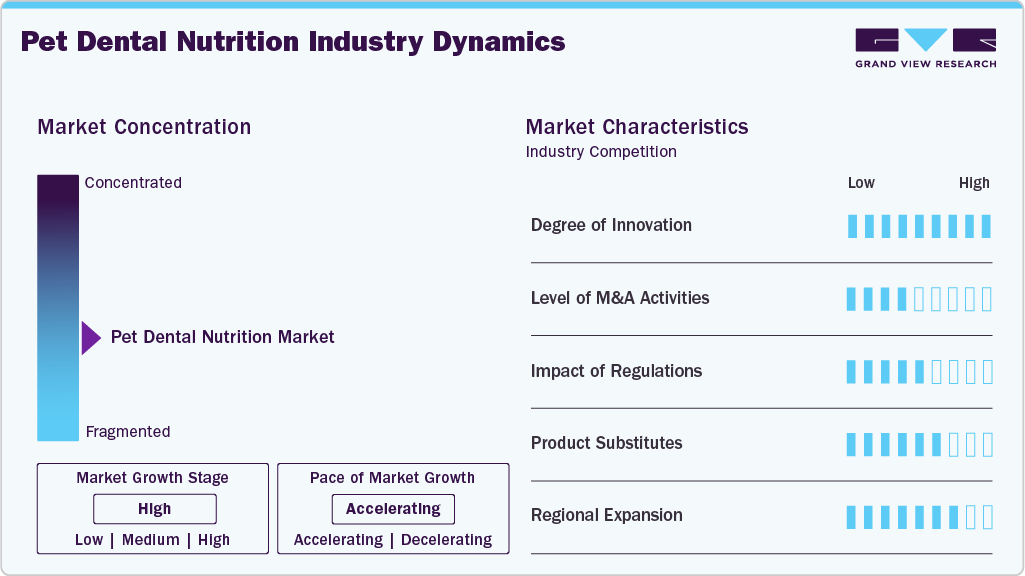
The competitive base spans established animal health majors alongside a dense tier of specialty and direct-to-consumer challengers, keeping the sector fragmented at the manufacturer level despite consolidated distribution through a handful of major retail and e-commerce platforms. No single company commands outsized control over the category, positioning fragmentation as structurally durable rather than a transitional phase preceding near-term consolidation.
Innovation is concentrated in formulation science rather than mechanical design, with postbiotic, enzyme-based, and microbiome-targeting ingredients displacing simple abrasive mechanics as the primary efficacy lever. Peer-reviewed, placebo-controlled trials are becoming a genuine competitive differentiator rather than a marketing afterthought, positioning companies with real clinical development capability ahead of competitors that continue to rely on unsubstantiated claims.
 To learn more about this report, Download Free Sample Report
 Consolidation activity remains selective rather than sweeping, concentrated around distribution and brand acquisitions that extend an acquirer's channel reach or portfolio breadth rather than large-scale roll-ups. This pattern positions M&A as a tool for incumbents to absorb clinically credible or digitally native challenger brands, rather than a signal of broader sector maturation or margin pressure forcing widespread exits.
Regulatory frameworks governing companion animal oral-health claims remain considerably less standardized than those covering human dietary supplements, creating variability in product quality assurance and label substantiation across the sector. Independent veterinary clinical certification has emerged as a de facto private-sector benchmark, positioning certified products with a credibility advantage in a landscape where formal governmental oversight has not kept pace with product growth.
Professional veterinary dental cleaning under anesthesia remains the principal substitute and clinical benchmark, positioning nutrition-based solutions as adjunctive rather than replacement care. Manual tooth brushing, though clinically effective, suffers from persistently low owner compliance, which continues to redirect demand toward lower-effort alternatives. This compliance gap, rather than product efficacy alone, is what sustains the sector's growth against brushing as the substitute of first resort.
Company expansion is increasingly geographic and channel-led rather than purely product-led, with brands extending digital and subscription infrastructure into underpenetrated regions and buyer types beyond traditional retail. This shift is positioning companies to capture incremental growth outside historically saturated distribution channels, broadening the sector's footprint well beyond its original retail and veterinary-clinic base.
Analyst Perspective
The pet dental nutrition market is shifting from a chew-and-treat commodity category to a clinically substantiated wellness category, and this transition now separates durable competitors from vulnerable incumbents. Established consumer health majors retain volume leadership through retail scale and legacy trust, but the exposure sits in formats, conventional chews, that are growing slower than water additives and functional powders. Specialized formulators and digitally native challengers are exploiting this gap, pairing microbiome and enzyme-based innovation with e-commerce distribution that bypasses shelf-space constraints entirely. VOHC certification is becoming the decisive credibility threshold across channels, not a premium add-on, which structurally favors companies investing early in clinical trial infrastructure over those relying on unsubstantiated marketing claims.
Pet Insights
The dogs segment accounted for the largest market share of 57.2% in 2025. Dogs' dominant share reflects decades of veterinary dental awareness built specifically around canine periodontal disease, a deep installed base of VOHC-certified chews and dental foods engineered for canine bite mechanics, and higher per-capita dog ownership across mature markets. Retail and e-commerce assortments remain disproportionately weighted toward canine formats, reinforcing purchase habits and making dogs the default entry point for nearly every new product launch entering the category.
The cats segment is anticipated to grow at the fastest CAGR over the forecast period. Cats' accelerating growth is driven by rising urban feline ownership, growing veterinary recognition that feline periodontal disease has historically been underdiagnosed relative to canine cases, and expanding water-additive and topical gel formats that finally accommodate feline handling resistance. Narrower palatability tolerance and smaller jaw structure previously limited direct-chew options for cats, so format innovation, not imitation, is now unlocking category growth in this segment.
Product Insights
The dental chews & treats segment dominated the market in 2025 with a share of 45.4%. Segment growth is driven by deep consumer familiarity, established retail and e-commerce shelf presence, and the broadest bench of VOHC-accepted formulations of any format, giving it the strongest clinical credibility base in the category. Integration into existing treat-giving routines removes adoption friction entirely, and veterinary recommendations continue to default to chews as the first product suggested to owners beginning a dental care regimen.
The water additives segment is anticipated to grow at the fastest CAGR over the forecast period. Water additives are growing fastest because the format requires no direct handling of the pet's mouth, suits multi-pet and free-feeding households sharing a common water source, and increasingly carries functional postbiotic and enzyme-based claims that extend beyond mechanical plaque removal. This makes the format the preferred entry point for owners of dental-resistant pets, particularly cats, for whom chew-based formats have historically underperformed in repeat use.
Route of Administration Insights
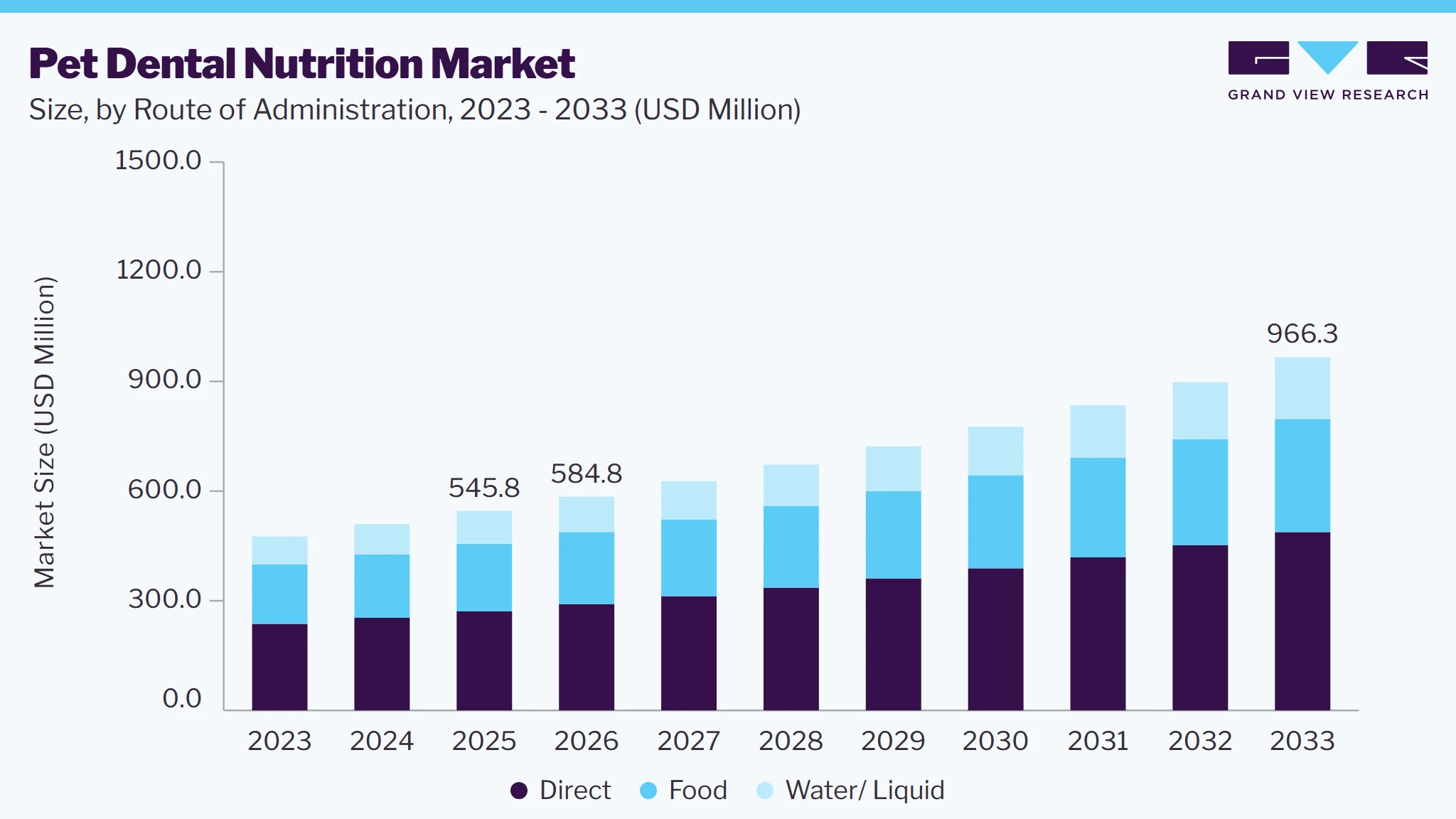
The direct segment accounted for the largest market share of 44.8% in 2025. This segment is driven by chews and treats that require no preparation, integrate seamlessly into existing treat-giving habits, and carry the deepest bench of VOHC-certified products of any administration route. Veterinary and retail-channel recommendations continue to default to direct formats, and consumer familiarity with treat-based products in other pet categories, such as training treats, lowers the adoption barrier considerably for owners new to purchasing dental-specific products.
The water/liquid segment is the fastest-growing, with the highest CAGR over the forecast period, because it demands no direct handling of the animal, making it viable for cats and other behaviorally resistant pets that reject chewing or brushing entirely. The format also fits naturally into multi-pet households sharing a single water source, allowing simultaneous dosing across several animals without the effort of individualized administration, a convenience advantage no other route currently offers.
Usage Insights
The supportive/ management segment accounted for the largest market share of 78.3% in 2025. This is due to periodontal disease already being highly prevalent by the time most owners seek a dental product, making adoption reactive to an existing veterinary diagnosis rather than anticipatory. Veterinarians routinely prescribe management-oriented regimens following a diagnosis of plaque, tartar, or gum disease, and this clinical entry point gives the segment a broader, more established base of veterinary-recommended products than newer, wellness-oriented positioning has yet to achieve.
The preventive segment is the fastest-growing, with the highest CAGR over the forecast period, since rising periodontal disease awareness is shifting owner behavior toward routine, pre-symptomatic maintenance rather than waiting for a veterinary diagnosis to act. Veterinary messaging increasingly frames dental care as ongoing wellness comparable to routine grooming, and pet humanization trends have normalized daily or near-daily maintenance routines that mirror human oral hygiene habits, pulling younger, health-conscious owners into the category earlier.
Sales Channel Insights
The retail segment accounted for the largest market share of 38.3% in 2025. This is owing to the strength of established relationships on pet specialty and mass-retail shelves, in-store veterinary product endorsement, and impulse-purchase visibility that online channels cannot fully replicate for first-time buyers. Physical shelf placement also allows packaging and price comparison at the point of decision, which remains particularly influential for owners purchasing a dental product for the first time without a prior brand preference
The e-commerce segment is the fastest-growing, with the highest CAGR over the forecast period because subscription and auto-replenishment models suit a recurring-use category well, and digitally native challenger brands can build scale without first securing physical retail shelf space. Online reviews, veterinary-influencer content, and social proof increasingly substitute for in-store discovery, giving smaller and newer brands a viable path to visibility that would have been foreclosed by retail distribution constraints alone a decade ago.
Indication Insights
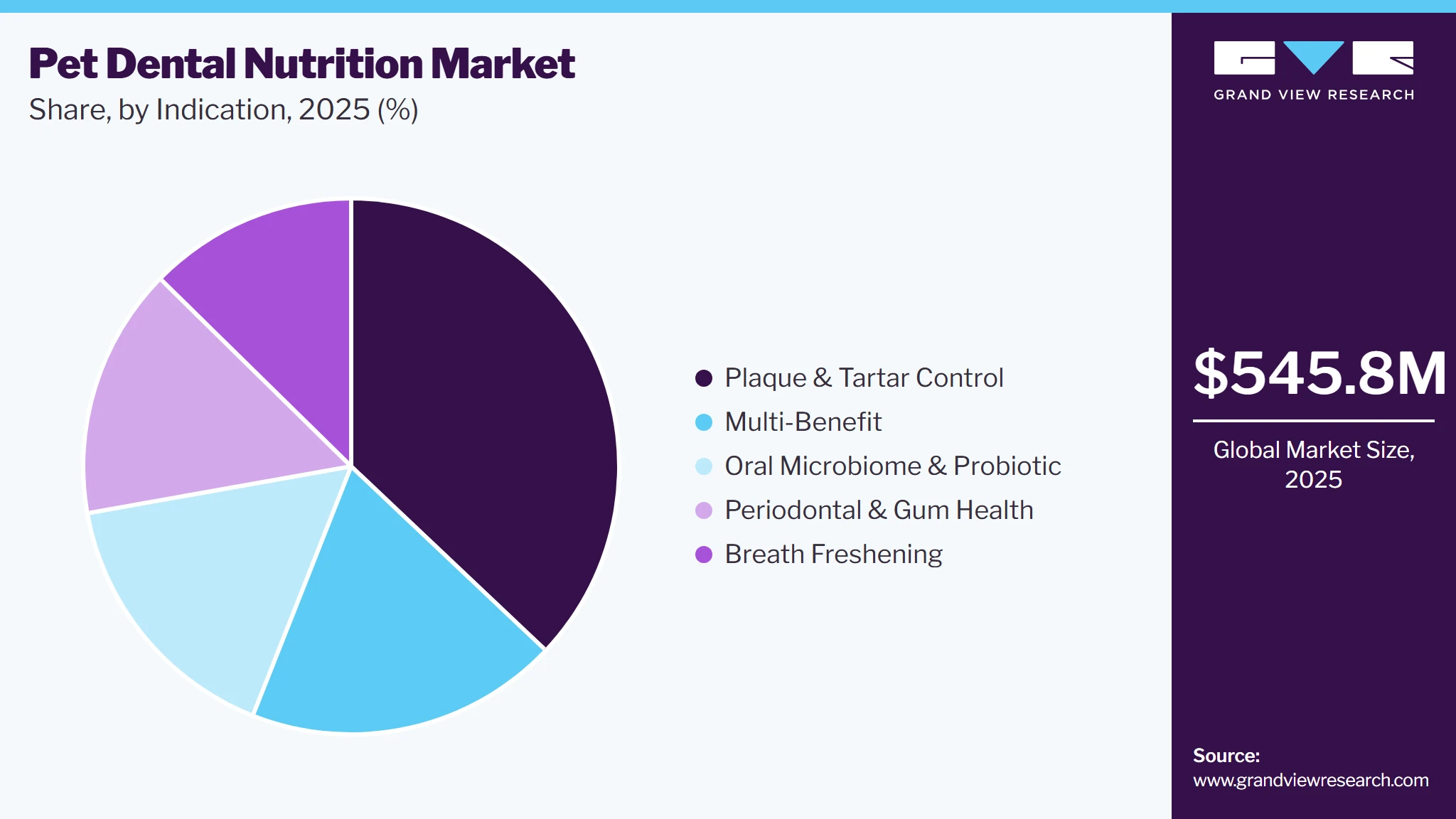
The plaque and tartar control segment dominated the market with a share of over 37.1% in 2025. Dominance here stems from addressing the most visible, veterinarian-diagnosed symptom of periodontal disease, anchoring the oldest and most clinically substantiated product claims in the category. Because plaque and tartar accumulation is the baseline metric used in nearly all clinical trials, this indication carries default positioning across almost every product format, from chews to water additives, giving it structural breadth that newer indications have yet to match.
 To learn more about this report, Download Free Sample Report
 The breath freshening segment is expected to grow with highest CAGR over the forecast period. This can be owed to halitosis being the symptom owners notice first, without needing a veterinary diagnosis to prompt a purchase, making it the lowest-friction entry claim in the category. Postbiotic and enzyme-based formulations increasingly target breath as a quick, perceptible outcome, and this immediacy of noticeable results is proving more effective at converting first-time buyers than slower-to-observe claims like gum health.
Regional Insights
North America pet dental nutrition market held the largest revenue share of 38.6% in 2025,driven by high pet ownership rates across the U.S. and Canada, a well-established veterinary infrastructure that routinely incorporates dental screening into wellness visits, and mature retail and e-commerce networks that give the region the deepest product assortment of any geography. Strong consumer awareness of periodontal disease, reinforced by decades of veterinary and brand-driven education, has normalized dental nutrition as a standard household purchase rather than a discretionary add-on, sustaining the region's lead even as faster-growing markets narrow the gap.
 To learn more about this report, Download Free Sample Report
 U.S. Pet Dental Nutrition Market Trends
The pet dental nutrition market in the U.S. held the largest share in the North America region in 2025. The U.S. market benefits from the largest absolute pet-owning population in the region, the deepest concentration of VOHC-certified product launches, and the most active innovation pipeline for postbiotic and enzyme-based dental formulations. Strong e-commerce and subscription infrastructure, led by digitally native challenger brands, is accelerating category penetration beyond traditional retail, while veterinary dental awareness campaigns continue to convert reactive treatment purchases into routine preventive spending.
The Mexico pet dental nutrition market is estimated to grow at the fastest CAGR during the forecast period,driven by rapidly rising pet ownership among a growing urban middle class, increasing veterinary clinic density in major metropolitan areas, and expanding retail and e-commerce access to international pet-care brands that were previously difficult to source domestically. Pet humanization trends are accelerating faster than in more mature North American markets, giving Mexico substantial headroom for category penetration relative to its still-developing veterinary dental infrastructure.
Europe Pet Dental Nutrition Market Trends
The Europe pet dental nutrition market is witnessing steady growth, driven by rising pet ownership across both Western and Northern Europe, increasingly stringent veterinary and consumer product-safety expectations that favor clinically substantiated formulations, and growing retailer commitment to dedicated pet dental care assortments across specialty and mass channels. Regulatory harmonization across the EU is also giving manufacturers a clearer, more consistent path to cross-border product launches than in more fragmented emerging regions, supporting steady category expansion.
The pet dental nutrition market in the UK held the largest share in 2025, fueled by high pet ownership density, a well-established veterinary referral culture that actively promotes preventive dental care, and strong consumer willingness to spend on premium pet wellness products relative to other European markets. A mature e-commerce and pet specialty retail infrastructure further reinforces the UK's position as the region's most developed market for dental nutrition products.
The Rest of Europe pet dental nutrition market is expected to grow at the fastest rate over the forecast period. The market is driven by smaller and emerging European pet markets catching up to Western European ownership and spending norms, supported by rising disposable income, expanding veterinary infrastructure, and growing retail and e-commerce penetration in markets that historically lagged the UK, Germany, and France in dedicated pet dental product availability.
Asia Pacific Pet Dental Nutrition Market Trends
Asia Pacific is expected to grow at the fastest CAGR over the forecast period, driven by rapidly rising pet ownership across urbanizing middle-class households, growing veterinary infrastructure investment across China, India, and South Korea, and increasing exposure to Western pet-care norms through e-commerce and social media, which is accelerating awareness of preventive dental health. The region's comparatively low current penetration relative to its population base gives it substantially more growth headroom than more saturated Western markets.
TheChina pet dental nutrition market held the largest share in Asia Pacific in 2025, driven by the country's large and rapidly expanding pet-owning population, aggressive e-commerce platform investment in pet-care categories, and growing domestic manufacturing capability that is making dental nutrition products more accessible and affordable to a broader consumer base. Rising pet humanization among younger, urban consumers is also driving faster adoption of premium and imported dental care brands.
India pet dental nutrition market is estimated to grow at the fastest growth rate over the forecast period, driven by a rapidly expanding urban pet-owning population, increasing veterinary clinic availability in major cities, and rising disposable income that is enabling first-time adoption of dedicated pet dental products in a market that has historically relied on general pet food rather than condition-specific formulations. E-commerce platforms are playing an outsized role in introducing Indian consumers to international dental nutrition brands.
Latin America Pet Dental Nutrition Market Trends
The Latin America pet dental nutrition market is expected to grow significantly during the forecast period, driven by rising pet ownership across the region's largest economies, expanding veterinary infrastructure in urban centers, and growing retail and e-commerce access to international pet-care brands. Increasing consumer awareness of periodontal disease as a treatable wellness concern, rather than an inevitable condition, is gradually shifting purchasing behavior toward dedicated dental nutrition products.
Brazil pet dental nutrition market held the largest share in Latin America in 2025, driven by the largest pet-owning population in Latin America, a rapidly maturing veterinary sector concentrated in major metropolitan centers, and an increasingly sophisticated pet specialty retail and e-commerce infrastructure that gives consumers reliable access to dedicated dental nutrition products. Rising urban pet humanization and growing consumer willingness to spend on preventive pet healthcare continue to reinforce Brazil's position as the region's largest market.
Middle East & Africa Pet Dental Nutrition Market Trends
The Middle East & Africa pet dental nutrition market is experiencing steady growth, driven by rising pet ownership among urban, higher-income households, growing investment in veterinary infrastructurein Gulf Cooperation Council countries, and increasing consumer exposure to international pet-care standards through travel and social media. Retail and e-commerce access remains uneven across the region, concentrating current growth in wealthier urban centers while leaving substantial headroom in less-penetrated markets.
The South Africa pet dental nutrition market held the largest share in Middle East & Africa in 2025, driven by well-established veterinary sector relative to the rest of the region, higher urban pet ownership rates, and a more developed pet specialty retail infrastructure that gives consumers reliable access to dedicated dental nutrition products. Growing pet humanization among South Africa's urban middle class continues to drive steady category adoption, outpacing other MEA markets.
Key Pet Dental Nutrition Company Insights
The global pet dental nutrition market is fairly competitive, with share split across established consumer health majors, veterinary-channel animal health specialists, and specialized formulators. Companies pursue product development toward microbiome-based and enzyme-driven alternatives as clinical validation becomes a baseline expectation in the veterinary channel, extending established pet nutrition portfolios into dedicated dental chews, foods, and functional water-additive formats to capture growing preventive-care demand.
Key Pet Dental Nutrition Companies
The following key companies have been profiled for this study on the pet dental nutrition market.
-
Boehringer Ingelheim Animal Health USA
-
Virbac
-
Colgate-Palmolive Company (Hill's Pet Nutrition Inc.)
-
Mars Petcare (Royal Canin)
-
HealthyMouth LLC
-
SwedenCare
-
Ceva Animal Health, LLC
-
Nestlé
-
Dechra
-
General Mills Inc. (Blue Buffalo Company, Ltd.)
-
Farmina Pet Foods
-
PetLabCo
-
Pet Honesty
-
VetriScience
-
Oxyfresh
Competitive Benchmarking
Category
Operating Strategies
Competitive Edge
Weaknesses
Established Global Leaders (Colgate-Palmolive Company/Hill's Pet Nutrition Inc.; Mars Petcare/Royal Canin; Nestlé; Boehringer Ingelheim Animal Health; Virbac)
- Pursue portfolio breadth across core pet nutrition and dedicated dental categories, extending existing food, treat, and veterinary-channel relationships into direct-chew, dental food, and combination formats while integrating manufacturing scale with animal-health formulation expertise.
- Capability-driven expansion into microbiome and enzyme-based categories runs alongside legacy chew and food lines, positioning these companies to carry veterinary trust built originally in core nutrition into the faster-growing dental-specific category.
- Virbac's continued VOHC Seal expansion across sticks, toothpaste, and combination products signals this cross-category extension in practice. Regulatory and clinical-trial investment is pursued proactively as VOHC certification becomes a veterinary-channel baseline expectation..
- Scale across retail, veterinary, and institutional channels allows amortization of clinical-trial and certification infrastructure across a wider product base than single-category competitors.
- Established veterinary and mass-retail relationships enable faster adoption of new formulations, positioning this group to defend share against category entrants in the largest indication and product segments, including Plaque & Tartar Control and Dental Chews & Treats.
- Breadth across pet type, product format, and channel increases organizational complexity and slows prioritization of any single product line.
- Heavier legacy exposure to conventional chew and food formats leaves this group more directly affected by the shift toward Water
- Additives and Powders than competitors purpose-built around those formats.
Emerging/Specialized and Technology-Focused Players (SwedenCare; HealthyMouth LLC; Oxyfresh; VetriScience; PetLabCo; Pet Honesty; Farmina Pet Foods)
- Concentrate on defined product formats or indications, water additives, powders, postbiotic and enzyme-based supplements, or direct-to-consumer specialty lines, rather than pursuing multi-species, multi-channel scale.
- Invest R&D into microbiome-based and functional technologies, and pursue VOHC clinical validation aggressively, positioning for early share as certification becomes a category-wide baseline expectation.
- Focused technical expertise enables faster development cycles for non-mechanical efficacy claims and specialty companion formulations than diversified competitors managing broader portfolios, a direct advantage as feline and small-mammal owners seek dental-resistant-pet formats that legacy chew makers have been slower to prioritize.
- Category concentration allows quicker response to emerging indications, such as microbiome and gum-health claims, ahead of competitors with wider portfolio priorities.
- Narrower category or format focus limits cross-selling relative to diversified leaders capable of bundling dental, nutrition, and broader wellness lines into a single retail or veterinary account.
- Smaller commercial and distribution scale increases dependence on e-commerce platforms and specialty retail relationships to reach buyers, a channel layer that vertically integrated leaders can bypass through owned retail and veterinary-channel relationships.
Recent Developments
-
In August 2026, Dr. Tim's Pet Food launched Dental Dust, a sprinkle-on daily oral nutrition supplement for dogs and cats built around a functional protein ingredient studied for plaque reduction and oral microbiome support. The format is designed to fold dental care into a pet's existing mealtime routine, positioned as an alternative to chews or brushing.
-
In June 2026, Prodogi launched a dissolvable dental strip for dogs that coats the full oral cavity, using liposomal-encapsulated ingredients for slow-release contact rather than the surface-only action of chews or powders. A company-sponsored clinical study reported an 80% reduction in volatile sulfur compounds within 14 days, along with greater breath improvement, plaque-bacteria reduction, and performance in hard-to-reach teeth compared with a widely used dental supplement.
Pet Dental Nutrition Market Report Scope
Report Attribute
Details
Market size in 2025
USD 545.8 million
Estimated market size in 2026
USD 584.8 million
Projected market size by 2033
USD 966.3 million
Growth rate
CAGR of 7.4% from 2026 to 2033
Actual data
2021 - 2025
Forecast period
2026 - 2033
Quantitative units
Revenue in USD million/billion, and CAGR from 2026 to 2033
Report coverage
Revenue forecast, company ranking, competitive landscape, growth factors, and trends
Segments covered
Pet, product, indication, route of administration, usage, sales channel, region
Regional scope
North America; Europe; Asia Pacific; Latin America; MEA
Country scope
U.S.; Canada; Mexico; UK; Germany; France; Italy; Spain; Denmark; Sweden; Norway; Japan; China; India; Thailand; South Korea; Australia; Brazil; Argentina; South Africa; UAE; Saudi Arabia; Kuwait; Qatar; Oman
Key companies profiled
Boehringer Ingelheim Animal Health; Virbac; Colgate-Palmolive Company (Hill's Pet Nutrition Inc.); Mars Petcare (Royal Canin); HealthyMouth LLC; SwedenCare ; Ceva Animal Health, LLC; Nestlé; Dechra; General Mills Inc. (Blue Buffalo Company, Ltd.); Farmina Pet Foods; PetLabCo; Pet Honesty; VetriScience; Oxyfresh
Customization scope
Free report customization (equivalent up to 8 analysts working days) with purchase. Addition or alteration to country, regional & segment scope.
Pricing and purchase options
Avail customized purchase options to meet your exact research needs. Explore purchase options
Global Pet Dental Nutrition Market Report Segmentation
This report forecasts revenue growth at global, regional, and country levels and provides an analysis of the latest industry trends in each of the sub-segments from 2021 to 2033. For this study, Grand View Research has segmented the global pet dental nutrition market report based on pet, product, indication, route of administration, usage, sales channel, and region.
-
Pet Outlook (Revenue, USD Million, 2021 - 2033)
-
Dogs
-
Cats
-
Other Pets
-
-
Product Outlook (Revenue, USD Million, 2021 - 2033)
-
Dental Food
-
Dental Chews & Treats
-
Powders/ Granules
-
Water Additives
-
Other Products
-
-
Indication Outlook (Revenue, USD Million, 2021 - 2033)
-
Plaque & Tartar Control
-
Oral Microbiome & Probiotic
-
Breath Freshening
-
Periodontal & Gum Health
-
Multi-Benefit
-
-
Route of Administration Outlook (Revenue, USD Million, 2021 - 2033)
-
Direct
-
Food
-
Water/ Liquid
-
-
Usage Outlook (Revenue, USD Million, 2021 - 2033)
-
Preventive
-
Supportive/Management
-
-
Sales Channel Outlook (Revenue, USD Million, 2021 - 2033)
-
Hospitals & Clinics
-
Retail
-
E-commerce
-
Other Sales Channel
-
-
Regional Outlook (Revenue, USD Million, 2021 - 2033)
-
North America
-
U.S.
-
Canada
-
Mexico
-
-
Europe
-
UK
-
Germany
-
France
-
Italy
-
Spain
-
Denmark
-
Sweden
-
Norway
-
-
Asia Pacific
-
Japan
-
China
-
India
-
Australia
-
Thailand
-
South Korea
-
-
Latin America
-
Brazil
-
Argentina
-
-
Middle East & Africa
-
South Africa
-
UAE
-
Saudi Arabia
-
Kuwait
-
Qatar
-
Oman
-
-
Research Methodology
The pet dental nutrition market figures in this report are based on a proven research process that combines executive interviews with secondary research from proprietary databases, company filings, and recognized regulatory and institutional sources. Market size is built through value-chain sizing-reconciling supply-side and demand-side estimates-and triangulated with bottom-up and top-down approaches. Every estimate passes multiple levels of expert validation before publication, with each pet dental nutrition segment quantified using the revenue-capture definitions in the table below.
Segment Definition
Sub-segments
Definitions
Dogs
Dental nutrition products specifically formulated, marketed, or labeled for canine oral-health maintenance, including dental foods, chews, powders, and water additives.
Cats
Dental nutrition products specifically formulated, marketed, or labeled for feline oral-health maintenance and supporting plaque, tartar, gum, or oral microbiome health.
Other Pets
Dental nutrition products intended for rabbits, small mammals, and other companion animals beyond dogs and cats.
Dental Food
Complete or complementary pet food specifically formulated to support oral health through nutritional composition, kibble characteristics, texture, or functional ingredients targeting dental health.
Dental Chews & Treats
Edible chews, treats, snacks, or functional bite-sized products designed to support oral hygiene through mechanical cleaning or dental-health ingredients.
Powders/Granules
Dry nutritional formulations added directly to pet food or administered according to dosage recommendations to support oral health, including plaque, tartar, gum, or microbiome management.
Water Additives
Nutritional or functional liquid formulations diluted into drinking water to support pet oral health, including plaque, tartar, breath, gum, or microbiome-related benefits.
Other Products
Dental nutrition products not classified above, including edible strips, flakes, dental drops, and other specialized oral-health nutritional formats.
Plaque & Tartar Control
Products primarily positioned to reduce, control, or prevent accumulation of dental plaque and tartar/calculus on pet teeth.
Oral Microbiome & Probiotic
Products primarily formulated to support oral microbial balance through probiotics, prebiotics, postbiotics, or other microbiome-targeting nutritional ingredients.
Breath Freshening
Products primarily marketed to reduce or manage unpleasant oral odor or halitosis through nutritional, functional, or microbiome-supporting ingredients.
Periodontal & Gum Health
Products primarily intended to support healthy gums and periodontal tissues or nutritional management of gingival and periodontal health.
Multi-Benefit
Products positioned with multiple significant dental-health benefits where no single indication can reasonably be identified as the primary product positioning.
Direct
Products administered directly to the pet's mouth or consumed directly without requiring incorporation into food or drinking water, including chews, treats, strips, and applicable dental drops.
Food
Products administered by mixing or incorporating them into the pet's food, including powders, granules, and applicable nutritional formulations.
Water/Liquid
Products administered through drinking water or another liquid medium at a specified concentration or dosage.
Preventive
Dental nutrition products used routinely to help maintain oral health or prevent development or accumulation of plaque, tartar, odor, or other oral-health concerns.
Supportive/Management
Dental nutrition products used to support ongoing management of existing oral-health concerns or as an adjunct to professional veterinary dental care.
Hospitals & Clinics
Revenue generated from dental nutrition products sold or dispensed through veterinary hospitals, clinics, and other professional veterinary healthcare facilities.
Retail
Revenue generated through physical retail outlets such as pet specialty stores, supermarkets, hypermarkets, and retail pharmacies.
E-commerce
Revenue generated through online marketplaces, brand-owned websites, online pet stores, and other digital platforms selling directly to consumers.
Other Sales Channel
Revenue generated through non-traditional channels, including animal shelters, rescue organizations, institutional customers, boarding/daycare facilities, and pet subscription services.
Estimation Model
BOTTOM-UP MARKET ESTIMATION
TOP-DOWN MARKET ESTIMATION MODEL
DEMAND-SIDE MARKET ESTIMATION MODEL
SUPPLY-SIDE ESTIMATION MODEL
- Estimates the pet dental nutrition market by aggregating country-level revenues built from pet population, periodontal disease incidence, and dental product adoption assumptions across dogs, cats, and other companion animals.
- Country revenues are derived from national pet ownership data, veterinary clinic density, product-format penetration, and VOHC or equivalent certification adoption rates, sourced from pet industry associations and veterinary trade databases.
- Estimates are validated through expert interviews with formulators, veterinary dental specialists, and retail procurement teams across major producing markets.
- Country-level revenues are consolidated into regional and global estimates while accounting for regulatory maturity differences between certification-driven and less-regulated markets.
- Begins with the overall companion animal nutrition and wellness market before determining the contribution of dental-specific products.
- Market shares are allocated based on pet type, product format, and indication using secondary research, VOHC filing records, and industry publications.
- Estimates are cross-checked against parent-market growth trends while considering production volumes, certification pipeline activity, and product-launch timelines.
- The model incorporates regional variation in certification stringency and retail infrastructure maturity to forecast future market demand.
- Estimates market size by evaluating adoption of dental foods, chews, powders, and water additives among veterinary hospitals, pet specialty retailers, e-commerce platforms, and institutional buyers.
- Demand is calculated using pet population statistics, periodontal disease incidence rates, veterinary recommendation adoption, and average dental-product spending per pet.
- The model incorporates market-maturity indexing, pet-type mix, and regulatory-certification factors, weighting demand by each country's veterinary infrastructure and pet-ownership spending power.
- Evaluates pet food and supplement manufacturing capacity, dental product shipment volumes, distribution-channel throughput, and sales performance of leading formulators.
- Market estimation incorporates VOHC certification counts, active-ingredient sourcing volumes, and functional-ingredient licensing across key producing and importing regions.
- Primary interviews with manufacturers, distributors, and veterinary retailers validate shipment volumes, pricing, and channel penetration while accounting for microbiome and enzyme-based ingredient adoption, certification filing activity, and expansion into feline and other-pet categories.
Delivered Customizations
This report has been delivered with the following In-depth customizations
Client Request
Customization Delivered
Value Adds
Market Intelligence & Stakeholder GTM Study: North America (Dogs, Cats, Other Pets)
Detailed evaluation of integrated U.S. and Canadian veterinary hospital networks, pet specialty retailers, e-commerce platforms, and institutional buyers. Covers procurement behavior, VOHC certification dependency, format preference by pet type, and unmet demand for water additive and microbiome-based formulations across large-scale retail and mid-tier veterinary operations. Includes stakeholder prioritization scoring and a phased market-entry roadmap.
This supports market-entry sequencing, identifies priority retail and veterinary-channel segments for early engagement, strengthens positioning against clinically-unvalidated incumbents, and enables development of a phased go-to-market strategy aligned with VOHC certification timelines and channel-specific compliance deadlines.
Regulatory & Trade-Flow Assessment: Pet Dental Nutrition Import Corridors
In-depth assessment of pet food and supplement import tariff structures, veterinary drug residue thresholds, functional-claim versus supplement classification rules, and VOHC or equivalent certification requirements across key destination markets. Includes country-level regulatory scoring, comparative approval-timeline analysis by product category (dental foods, chews, water additives, powders), and identification of feed additive bottlenecks affecting time-to-market for new entrants.
It helps organizations select the optimal product category and formulation format for market entry, anticipate regulatory approval timelines such as VOHC or FDA/EU review cycles, minimize compliance risk, and structure distributor partnerships that navigate certification and labeling restrictions more efficiently than direct market entry alone.
Competitive Benchmarking: Global Pet Dental Nutrition Suppliers in Emerging Asia-Pacific Markets
Delivered detailed competitive profiling of established and emerging pet dental nutrition suppliers active or expanding into Asia-Pacific markets, covering species focus, product-category portfolio depth (chews, water additives, powders, food), certification and clinical-filing capabilities, distribution partnerships, pricing positioning, and recent product launch or certification activity. Includes SWOT analysis, operating-strategy benchmarking, and identification of white-space opportunities by format and indication.
This enables clients to identify competitive gaps in the Asia-Pacific pet dental nutrition landscape, evaluate distributor or retail-partnership opportunities, benchmark pricing and certification-filing positioning against incumbents, and formulate differentiated market-entry strategies supported by region-specific competitive intelligence.
Frequently Asked Questions About This Report
The global pet dental nutrition market is expected to grow at a CAGR of 7.4% from 2026 to 2033, reaching USD 966.3 million.
Key factors include rising periodontal disease prevalence in pets, expanding VOHC clinical validation pipeline, accelerating e-commerce distribution infrastructure, and diversifying delivery formats beyond direct chews.
North America dominated with a 38.6% revenue share in 2025
Asia Pacific is expected to be the fastest-growing region over the forecast period.
The dental chews & treats segment dominated the market in 2025 with a share of 45.4%, while water additives segment is anticipated to grow at the fastest CAGR over the forecast period.
The plaque and tartar control dominated the market with share of over 37.1% in 2025, while breath freshening segment is expected to grow with highest CAGR over the forecast period.
Key players include Boehringer Ingelheim Animal Health, Virbac, Colgate-Palmolive Company (Hill's Pet Nutrition Inc.), Mars Petcare (Royal Canin), HealthyMouth LLC, SwedenCare, Ceva Animal Health, LLC, Nestlé, Dechra, General Mills Inc. (Blue Buffalo Company, Ltd.), Farmina Pet Foods, PetLabCo, Pet Honesty, VetriScience, and Oxyfresh.
The global pet dental nutrition market size was valued at USD 545.8 million in 2025 and is estimated at USD 584.8 million for 2026.
The retail segment accounted for the largest market share of 78.3% in 2025, preventive segment is the fastest-growing, with the highest CAGR over the forecast period.
About the Author(s)
Animal Health Research Team
Healthcare · Animal HealthThis report was authored by the animal health research team at Grand View Research - comprising two research analysts, one senior research analyst, and one industry expert - with specialized expertise in the animal health segment of the healthcare industry. All findings are based on proprietary healthcare databases, executive interviews, and regulatory analysis, subject to internal peer review prior to publication.
Last Updated:
Speak to Analyst

Customize this report to your needs - add regions, segments, or data points, with 20% free customization.
Or view our licence options:


ISO 9001:2015 & 27001:2022 Certified
We are GDPR and CCPA compliant! Your transaction & personal information is safe and secure. For more details, please read our privacy policy.


