
- Home
- »
- Pharmaceuticals
- »
-
Pharmaceutical Contract Manufacturing Market Report, 2033GVR Report cover

Pharmaceutical Contract Manufacturing Market (2026 - 2033) Size, Share & Trends Analysis Report By Service, By Product (Small Molecule, Biologics), By Drug, By Scale Of Operation, By Workflow, By Application, By End Use, By Company, By Region, And Segment Forecasts
Market Size, 2025
$141.7BMarket Estimate, 2026
$155.1BMarket Forecast, 2033
$310.9BCAGR, 2026–2033
10.4%Pharmaceutical Contract Manufacturing Market Summary
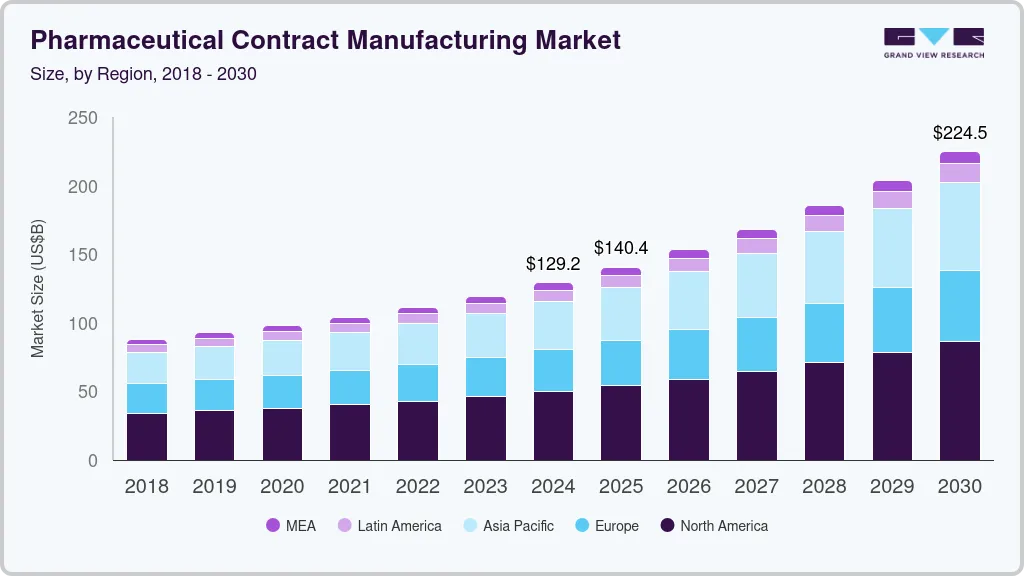
The global pharmaceutical contract manufacturing market size was valued at USD 141.7 billion in 2025 and is projected to grow from USD 155.1 billion in 2026 to USD 310.9 billion by 2033, at a CAGR of 10.4% from 2026 to 2033. North American paccounted for the largest share of 38.44% in 2025. The demand for contract manufacturing is gaining momentum due to a surge in clinical as well as commercial workflow realignment among pharmaceutical manufacturers.
 Source: Grand View Research, IR Documents, Primary Interviews, Paid DatabasesTo learn more about this report,
 Download Free Sample Report
 Key Market Trends & Insights
- By service: API manufacturing segment held the largest market share of 70.68% in 2025.
- By product: Small molecule segment held the largest market share in 2025.
- By drug: Generics segment accounted for the largest market share in 2025.
- By scale of operation: batch segment dominated the market in 2025.
- By workflow, Commercial segment dominated the global market in 2025.
- By application: Oncology segment dominated the global market and accounted for a largest revenue share in 2025.
Regional Highlights
- Largest regional market: North America (38.4% revenue share, 2025)
- Fastest-growing regional market: Asia Pacific (highest CAGR, 2026-2033)
- By country: The pharmaceutical contract manufacturing industry in the U.S. held the largest revenue share in North America.
Market Size & Forecast
- Market size in 2025: USD 141.7 Billion
- Estimated market size in 2026: USD 155.1 Billion
- Projected market size by 2033: USD 310.9 Billion
- CAGR (2026-2033): 10.4%
Three ways to get this report
Buy it, customize it, or ask a question.Ask an Analyst
Analyst response in 1 business day
- AccessReport author, directly
- Reply timeWithin 1 working day
- No sales callDirect answer only
- FormatEmail reply
- CostFree, no cost
Get the Full Report
What the study covers
- FormatsPDF · Excel · Dashboard
- Timeline2026–2033 annual, 2025 base
- Coverage20+ countries, 5 regions
- Companies10+ key players profiled
Customize the Report
20% free customization
- IncludeCountries, segments, points
- TailorTo your product definition
- ExtendDeeper competitor detail
- OrA fully bespoke study
- Turnaround5–10 working days
The pharmaceutical industry is witnessing a shift toward assigning complex manufacturing processes to specialized partners like contract manufacturing organizations (CMOs), reinforcing the growth of the market.
Furthermore, most small-to-mid-sized pharmaceutical companies benefit from CMOs, which support them focus on their core competencies and tackle the complexities of production for a company contracting them. In addition, most contract manufacturing providers specialize in the availability of various sterile filling equipment that supports increased production, further enhancing the process of drug production without compromising quality. Besides, the surge in drug discovery techniques and growing focus on quality control systems to ensure that products meet industry standards drive the market growth.
 To learn more about this report, Download Free Sample Report
 Moreover, rapid technological advances are also reshaping contract manufacturing to improve efficiency while enabling effective drug customization. Technological advancements such as advanced manufacturing technologies, data analytics and artificial intelligence (AI) and quality by design (QbD) and process analytical technology (PAT) support continuous evolution and demand for new manufacturing capacities to accelerate drug development timelines. For instance, data analytics and AI are transforming various aspects of the pharmaceutical industry by harnessing major amounts of data generated throughout the manufacturing process, it can further support optimizing production, predict equipment failures, and ensure regulatory compliance. Moreover, CMOs with expertise in formulation development and clinical trial production are expected to boost the AI-driven discoveries into real-world treatments. Moreover, growing requirement for branded and generic drugs is one of the significant factors for the growth of the market.
Thus, the role of contract manufacturing (CMOs) in the pharmaceutical industry offers a comprehensive range of tailored solutions from pharmaceutical development to commercial services, further accelerating drug development, minimizing the cost, and improving efficiency.
Market Dynamics
The growing clinical and commercial emphasis on biologic medicines and their biosimilar counterparts is driving significant changes in pharmaceutical manufacturing strategies across the globe. Biologic therapies, which include monoclonal antibodies and complex proteins, are increasingly used to treat chronic and life‑threatening diseases, and their biosimilar versions are gaining broader regulatory approval and commercial traction globally.
According to data published by Fierce Pharma in January 2026, U.S. regulators had approved 80 biosimilars across 19 distinct biologic molecules by September 2025, with 58 launched in the U.S., highlighting the expanding pipeline of complex biological products in late‑stage development and commercialization. Thus, these expansions are prompting regional manufacturing players to actively expand their infrastructure and capabilities. For instance, in April 2025, Samsung Biologics announced acceleration of its biomanufacturing capacity by bringing its new Plant 5 online as part of a wider Bio Campus II expansion to serve increased global biologic production needs and support advanced services such as antibody‑drug conjugates. Similarly, in March 2025, Syngene International announced the acquisition of its first U.S. biologics facility, which will more than double its large‑molecule process capacity, enhancing its development and manufacturing offerings for biologics partners. This confluence of broader biosimilar approvals and targeted capacity investments reflects the intensified focus on biologic and biosimilar production, strengthening these molecules as a key driver of pharmaceutical manufacturing evolution.
Supply chain disruptions and shortages of critical raw materials significantly restrain the pharmaceutical contract manufacturing market. Contract manufacturers depend on a consistent supply of active pharmaceutical ingredients (APIs), excipients, packaging materials, and specialized components sourced from global suppliers. Disruptions arising from geopolitical tensions, trade restrictions, transportation delays, or fluctuations in raw material availability can adversely affect production timelines and operational efficiency. In addition, the growing reliance on complex biologics and specialty drugs has increased demand for highly specialized raw materials, which are often in short supply and costly to procure. Such disruptions can lead to increased manufacturing costs, delayed product deliveries, and reduced profitability for Contract Manufacturing Organizations (CMOs) and Contract Development and Manufacturing Organizations (CDMOs), ultimately hindering overall market growth.
Market Concentration & Characteristics
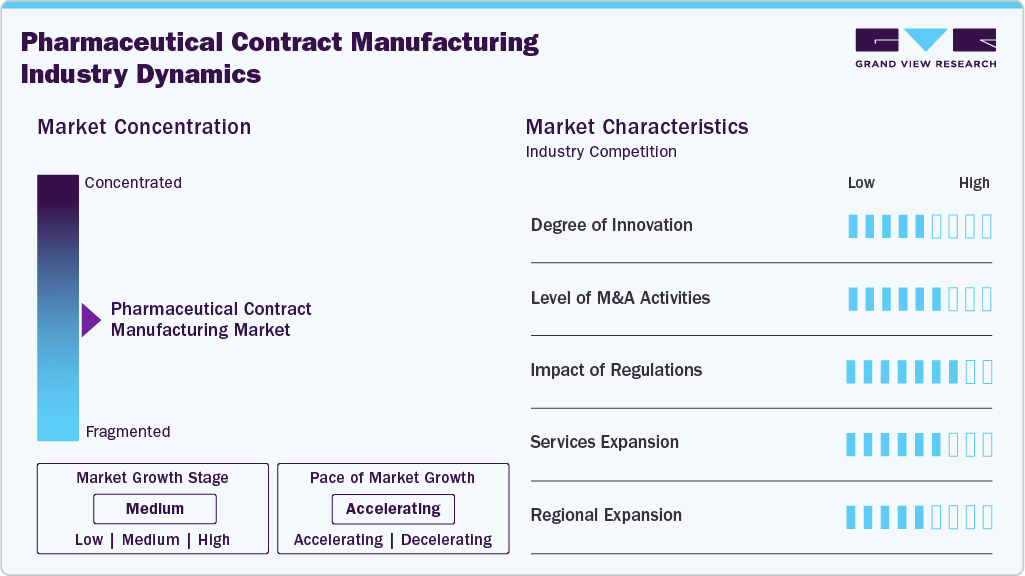
The pharmaceutical contract manufacturing industry growth stage is medium, and growth is accelerating. The market is characterized by the level of merger & acquisitions activities, degree of innovation, regulatory impact, product expansion, and regional expansions.
Pharmaceutical contract manufacturing is adopting innovation through continuous manufacturing, AI-driven process optimization, single-use technologies, and advanced biologics production. These advancements improve efficiency, enhance quality control, and allow for better scalability, positioning CMOs as essential partners in the evolving global pharmaceutical landscape.
 To learn more about this report, Download Free Sample Report
 Stringent global regulatory standards and the need to comply with agencies FDA, EMA, and ICH regulations drive quality, compliance, and transparency in pharmaceutical contract manufacturing. GMP requirements, data integrity standards, and evolving regulatory frameworks impact CMOs operations, ensuring safe, high-quality drug production while increasing costs, complexity, and supply chain scrutiny.
Mergers and acquisitions (M&A) in pharmaceutical contract manufacturing are surging, driven by technological advancements, and expanding service portfolios. In addition, the CMOs are acquiring specialized firms to enhance biologics, HPAPI, and sterile manufacturing capabilities, strengthening global supply chains and competitiveness.
The market for pharmaceutical contract manufacturing remains fragmented, with numerous CMOs catering to small molecules, biologics, and specialty drugs. Besides, cost advantages, and regulatory compliance have led the market competitive fragmentation.
Pharmaceutical contract manufacturing is witnessing rapid regional expansion, with CMOs investing in developed and developing economics to leverage cost efficiencies and favorable regulations, which further fuel market growth.
Service Insights
Based on service segment, the market is segmented into API Manufacturing, finished drug product manufacturing, and packaging services. Finished drug product manufacturing further includes oral solids, liquids, topical, and others. The API manufacturing segment captured the largest market share of 70.68% in 2025. This significant growth can be attributed to rising outsourcing trends, cost efficiency, and the need for regulatory compliance. Producing active pharmaceutical ingredients (APIs) is one of the most critical processes in pharmaceutical production, as it helps create lifesaving medications for patients.
The packaging services segment is expected to grow at the fastest CAGR over the forecast period. The growth is due to increasing demand for lifesaving pharmaceuticals and the rising partnerships among pharmaceutical companies and contract manufacturing organizations (CMOs) to provide a range of services, including manufacturing and packaging. In addition, the need for cost-effective packaging solutions and the requirement for packaging of lifesaving medications are crucial in ensuring that these products reach patients effectively.
Innovations in the primary packaging industry are also becoming more prevalent, particularly for small-batch production. Furthermore, pharmaceutical contract manufacturing has emerged significantly, leading to increased production capacity and reduced time-to-market for new product launches. This segment offers various packaging options, including blister packaging, bottle and vial packaging, ampoule and capsule packaging, tubes, sachets, pouches, and stick packs. These solutions help pharmaceutical companies enhance efficiency and maintain product integrity throughout the supply chain, from primary packaging and labeling to shipping, storage, and distribution to end users. This trend is expected to drive market growth over the estimated time.
Product Insights
Based on product segment, the market is segmented into small molecules and biologics. Biologics further includes monoclonal antibodies, vaccines, recombinant proteins, and others. The small molecules segment dominated the global market in 2025. Small-molecule drugs have been the backbone of the pharmaceutical industry for nearly a century. The segment growth is driven by the increasing volume of small molecule production; growing advantages CMOs offer will simplify manufacturing compared to large molecule biologics.
The biologics segment is expected to grow at significant CAGR over the forecast period. This growth is attributed to high investments and ongoing innovation in therapeutic & other medications. In addition, the increasing adoption of advanced technologies such as artificial intelligence, the rising outsourcing trends, and the growing research and development (R&D) activities by pharmaceutical companies are key factors propelling the segment's growth.
Drug Insights
On the basis of drug segment, the market is segmented into generics and branded. The generics segment accounted for the largest market share in 2025. The segment growth is driven by rising patent expirations, increased outsourcing by pharmaceutical companies, and rising requirements for cost-effective medicines. Besides, continuous manufacturing trends and technological advancement have led the segment to grow. Furthermore, the low manufacturing costs have encouraged various pharmaceutical companies in developed economies to outsource their manufacturing activities to CMOs.
The branded segment is expected to grow at a considerable CAGR during the forecast period. The branded drug contract manufacturing market is experiencing steady growth as pharmaceutical companies increasingly outsource production to Contract Manufacturing Organizations (CMOs). Moreover, due to the rising complexity of drug formulations, most pharmaceutical manufacturers producing branded drugs are turning to contract manufacturing organizations for their expertise in advanced formulations, biologics, sterile injectables, and novel drug delivery systems.
Scale of Operation Insights
On the basis of the scale of the operation segment, the market is segmented into batch and continuous segments. The batch segment dominated the market in 2025. A key trend in the market is batch outsourcing, as it offers smaller companies the opportunity to save operational costs and significantly reduces the preparation and adjustment of equipment before commencing the production of each batch. Such factors are anticipated to drive the segment growth.
The continuous segment is expected to experience significant growth at a specific (CAGR) during the forecast period. Pharmaceutical continuous manufacturing (CM) is considered a crucial technology in the pharmaceutical contract manufacturing process, with a growing emphasis on producing innovative drugs. The segment growth can be attributed to greater efficiency, cost reduction, and improved product quality.
Workflow Insights
On the basis of the workflow segment, the market is segmented into clinical and commercial. The commercial segment dominated the global market in 2025 owing to a strong pipeline for pharmaceutical drug development, and large-scale commercial manufacturing, among others. In addition, several pharmaceutical companies are turning to commercial contract manufacturing to access advanced infrastructure and expertise due to the increasing influx of novel therapies & orphan drugs and higher returns on approved products.
The clinical segment is anticipated registering a significant CAGR during the forecast period. The segment is driven by growing number of clinical trials and increasing demand for specialized CMO services. Such factors are anticipated to drive the market.
Application Insights
On the basis of the application segment, the market is segmented into oncology, infectious diseases, neurological disorders, cardiovascular diseases, metabolic disorders, autoimmune diseases, respiratory diseases, ophthalmology, gastrointestinal disorders, hormonal disorders, hematological disorders, and others.
The oncology segment dominated the global market and accounted for a largest revenue share in 2025. The segment is expected to grow due to the increasing number of cancer cases worldwide. For instance, the Cancer Atlas mentioned that there will be 29 million cancer cases across the globe by 2040. Recent trends in pharmaceutical products have shifted with growing R&D for cancer treatments.
The cardiovascular diseases segment is expected to experience significant growth at a specific (CAGR) during the forecast period. The segment is driven by the increasing prevalence of cardiovascular diseases, which has fueled the segment's growth. For instance, according to World Heart Report 2023, it revealed that over half a billion people globally are affected with cardiovascular diseases, resulting in nearly a million deaths. Hence, the growing innovation of pharmaceutical products is expected to propel market growth.
End Use Insights
On the basis of the end use segment, the market is segmented into pharmaceutical and biotechnology companies. The pharmaceutical companies segment dominated the market in 2025 owing to the increasing trend of outsourcing end-to-end services, especially among small and mid-sized pharmaceutical companies that lack expertise in drug development.
The biotechnology companies’ segment is expected to experience significant growth at a specific (CAGR) rate during the forecast period. Increasing preference for outsourcing among biotechnology, midsized biotechnology, and emerging companies to gain better knowledge of outsourcing pharmaceutical drugs has led the growth of market. Likewise, an increasing number of new pharmaceutical drugs contribute to market growth.
Company Size Insights
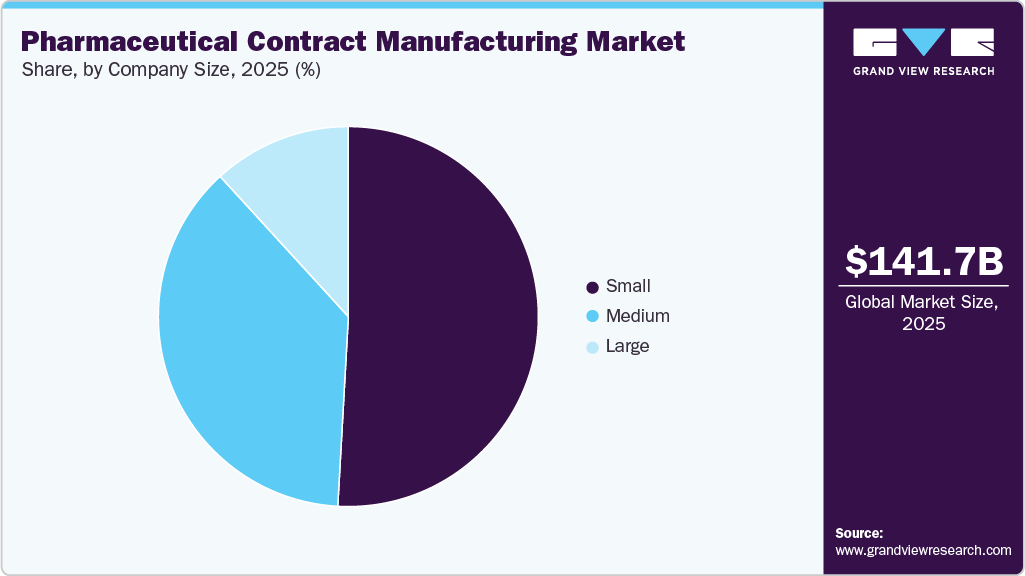
On the basis of the company size segment, the market is segmented into small, medium, and large. The small company size segment dominated the market with the largest revenue share in 2025. The high growth of the segment is mainly due to the presence of growing employee strengths, facilities and increasing venture funding.
 To learn more about this report, Download Free Sample Report
 The medium segment is expected to grow at a significant CAGR during the forecast period. Most medium or “midsized” companies have 100 to 500 employees participating in the end-to-end development of innovative drugs; however, their concentration is limited to specific therapy areas.
Regional Insights
North America Pharmaceutical Contract Manufacturing Market Trends
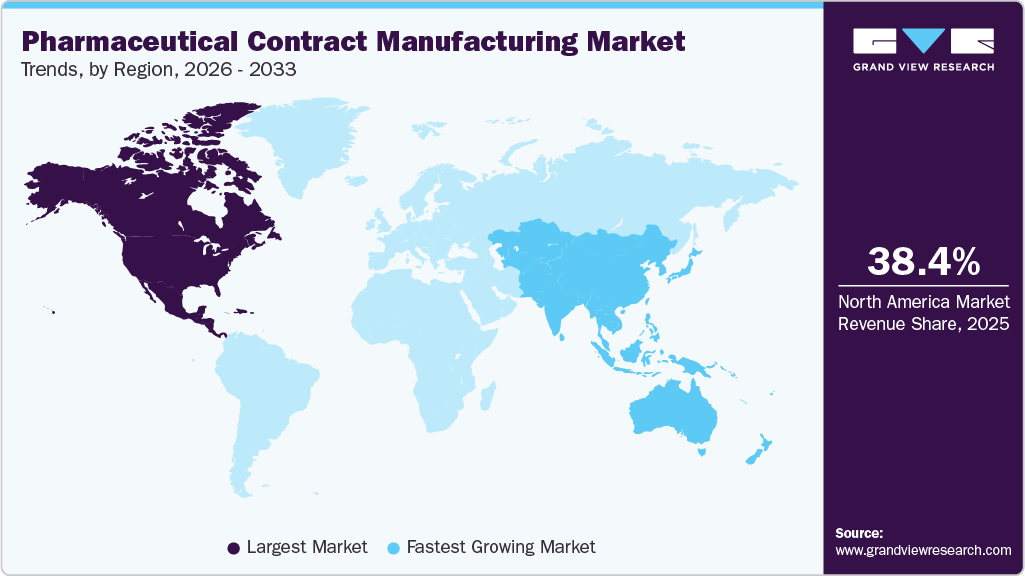
The North American pharmaceutical contract manufacturing industry accounted for the largest share of 38.44% in 2025. This can be attributed to several factors, including technological advancements, growing demand for pharmaceutical products, and the increasing outsourcing of pharmaceutical production to third-party manufacturers.
 To learn more about this report, Download Free Sample Report
 U.S. Pharmaceutical Contract Manufacturing Market Trends
The pharmaceutical contract manufacturing industry in the U.S. held the largest share in 2025. This growth is driven by the expansion of the overall drug market and increasing trends in outsourcing. In addition, the development of generics has significantly benefited the market, as pharmaceutical manufacturers outsource as much as 80% of their production to contract manufacturing organizations (CMOs).
Furthermore, CMOs significantly enhance the existing pharmaceutical product portfolio of pharmaceutical companies. The market provides state-of-the-art facilities, quality control measures, and resilient supply chains for production. Hence growing need for innovative drugs, the rising prevalence of diseases, and the increasing presence of pharmaceutical companies have all led to a increased demand for CMOs services.
Europe Pharmaceutical Contract Manufacturing Market Trends
The pharmaceutical contract manufacturing industry in Europe is anticipated to experience significant growth due to stringent regulatory requirements and an increasing demand for biologics & specialty drugs. This trend has emphasized the need for innovation capabilities, which fuels the demand for pharmaceutical contract manufacturing services in the region.
Germany's pharmaceutical contract manufacturing industry held the largest share in 2025. This market is primarily driven by the expanding pharmaceutical industry and the increasing demand for contract manufacturing organization (CMO) services that support the production of life-saving medications for regional healthcare markets.
The UK's pharmaceutical contract manufacturing industry is anticipated to grow over the forecast period. This growth is primarily due to the growing need for contract manufacturing for efficient and increased pharmaceutical production to reduce the time to market, further fueling the market growth.
Asia Pacific Pharmaceutical Contract Manufacturing Market Trends
Asia Pacific pharmaceutical contract manufacturing industry is projected to register a significant CAGR during the forecast period. This growth can be attributed to various factors, such as growing pharmaceutical product requirements, the presence of well-established pharmaceutical companies, technology adoption, and several opportunities in this region that drive market growth.
China's pharmaceutical contract manufacturing industry held the largest share in 2025. The Chinese CMO market is driven by the rapidly expanding pharmaceutical drug industry and the advantages offered by contract manufacturing organizations (CMOs). The advantages include cost-effectiveness and advanced manufacturing capabilities to innovate new drugs.
Japan pharmaceutical contract manufacturing industry is the second-largest in Asia Pacific region, and it is expected to provide a robust opportunity for pharmaceutical contract manufacturing services thereby driving market growth. The country is experiencing an increasing aging population and a rising incidence of diseases, leading to a rising requirement for various pharmaceutical drugs and contract manufacturing services.
The pharmaceutical contract manufacturing industry in India is expected to experience significant growth at a significant CAGR during the forecast period. This growth is driven by an increasing focus on research and development (R&D) to support the pipeline of generics, biologics, biosimilars, and personalized medicines, along with a rising demand for cost-efficient production services.
Key Pharmaceutical Contract Manufacturing Company Insights
Market players are undertaking various strategic initiatives, such as the launch of new product innovations, collaborations, partnerships, and mergers & acquisitions, to strengthen their service offering and provide a competitive advantage. For instance, in March 2024, Tonix Pharmaceuticals Holding Corp. mentioned that it has selected two CMOs including Almac Pharma Services, to potentially produce Tonmya for commercial use in the U.S. The company is excited to move its first internally developed program toward NDA submission & to collaborate with CMOs for commercial supply and potential launch of Tonmya.
Key Pharmaceutical Contract Manufacturing Companies:
The following key companies have been profiled for this study on the pharmaceutical contract manufacturing market.
- AbbVie Contract Manufacturing
- Almac Group
- Boehringer Ingelheim BioXcellence
- Catalent
- Dr. Reddy's Laboratories
- Fareva
- Fujifilm Diosynth Biotechnologies
- Jubilant HollisterStier
- Lonza Group
- Patheon (Thermo Fisher Scientific)
- Pfizer CentreOne
- Prakruti Life Science
- Recipharm
- Samsung Biologics
- Siegfried Holding AG
- Vetter Pharma
- WuXi AppTec
Competitive Benchmarking
Operating Strategies
Competitive Edge
Weaknesses
Mature Players: Lonza Group
- Mature players increasingly focus on expanding global manufacturing capacity, strengthening biologics and sterile manufacturing capabilities, and offering integrated end-to-end CDMO services.
- These players emphasize long-term partnerships with pharmaceutical and biopharmaceutical companies, strategic acquisitions, advanced manufacturing technologies, and regulatory compliance.
- Mature players possess strong competitive advantages through extensive global manufacturing networks, diversified service portfolios, and established regulatory expertise across multiple regions.
- Their ability to provide integrated development and manufacturing solutions, large-scale production capacity, advanced biologics capabilities, and reliable supply chain management strengthens customer retention.
- Mature pharmaceutical contract manufacturers often face challenges related to high operational and infrastructure costs, complex organizational structures, and slower decision-making processes.
Emerging Players: Jubilant HollisterStier
- Emerging pharmaceutical contract manufacturers focus on expanding niche manufacturing capabilities, regional market penetration, and cost-effective production services.
- Many emerging players adopt flexible manufacturing models and competitive pricing strategies to attract small and mid-sized pharmaceutical companies seeking affordable and scalable outsourcing solutions.
- Emerging players gain competitive advantages through lower operational costs, faster decision-making, and greater manufacturing flexibility compared to established global CDMOs.
- Their ability to provide customized solutions, competitive pricing, and rapid project execution attracts emerging biopharmaceutical and generic drug companies.
- Emerging pharmaceutical contract manufacturers often face limitations related to smaller manufacturing capacities, limited global presence, and lower brand recognition compared to established CDMOs. Restricted financial resources may hinder large-scale technology investments and facility expansion.
Recent Developments
-
In October 2024, Samsung Biologics mentioned a contract manufacturing partnership with an Asian pharmaceutical company. This partnership is valued at USD 1.24 billion, making it one of the most significant contracts signed by a single client to date. In addition, the production will take place in South Korea at Samsung Biologics' biomanufacturing facility, and the partnership will run through December 2037. With the agreement, Samsung Biologics' total contracts for 2024 have exceeded USD 3.3 billion.
-
In March 2023, Pfizer mentioned a USD 183 million contract manufacturing partnership with Samsung Biologics. In addition, after two years, the Samsung Biologics mentioned the agreement to manufacture COVID-19 vaccines for Moderna, as well as for other leading mRNA vaccine producers, including Pfizer. This is the first time Korea's top conglomerate Samsung Group's biotechnology unit unveiled its CMO contract with Pfizer.
Pharmaceutical Contract Manufacturing Market Report Scope
Report Attribute
Details
Market size in 2025
USD 141.7 billion
Estimated market size in 2026
USD 155.1 billion
Projected market size by 2033
USD 310.9 billion
Growth rate
CAGR of 10.4% from 2026 to 2033
Historical Year
2021 - 2024
Forecast period
2026 - 2033
Quantitative units
Revenue in USD billion and CAGR from 2026 to 2033
Report coverage
Revenue forecast, company ranking, competitive landscape, growth factors, and trends
Segments covered
Service, product, drug, scale of operation, workflow, application, end use, company size, region
Regional scope
North America; Europe; Asia Pacific; Latin America; MEA
Country scope
U.S.; Canada; Mexico; UK; Germany; France; Italy; Spain; Denmark; Sweden; Norway; Japan; China; India; Thailand; South Korea; Australia; Brazil; Argentina; South Africa; Saudi Arabia; UAE; Kuwait; Oman; Qatar
Key companies profiled
AbbVie Contract Manufacturing; Almac Group; Boehringer Ingelheim BioXcellence; Catalent; Dr. Reddy's Laboratories; Fareva; Fujifilm Diosynth Biotechnologies; Jubilant HollisterStier; Lonza Group; Patheon (Thermo Fisher Scientific); Pfizer CentreOne; Prakruti Life Science; Recipharm; Samsung Biologics; Siegfried Holding AG; Vetter Pharma; WuXi AppTec
Customization scope
Free report customization (equivalent up to 8 analysts working days) with purchase. Addition or alteration to country, regional & segment scope.
Pricing and purchase options
Avail customized purchase options to meet your exact research needs. Explore purchase options
Global Pharmaceutical Contract Manufacturing Market Report Segmentation
This report forecasts revenue growth at global, regional, and country levels and provides an analysis of the latest industry trends in each of the sub-segments from 2021 to 2033. For this study, Grand View Research has segmented the global pharmaceutical contract manufacturing market report based on service, product, scale of operation, workflow, application, end use, company size, and region:
-
Service Outlook (Revenue, USD Million, 2021 - 2033)
-
API Manufacturing
-
Finished Drug Product Manufacturing
-
Oral Solids
-
Liquids
-
Topical
-
Others
-
-
Packaging Services
-
-
Product Outlook (Revenue, USD Million, 2021 - 2033)
-
Small Molecule
-
Biologics
-
Monoclonal Antibodies
-
Vaccines
-
Recombinant Proteins
-
Others
-
-
-
Drug Outlook (Revenue, USD Million, 2021 - 2033)
-
Generics
-
Branded
-
-
Scale of Operation Outlook (Revenue, USD Million, 2021 - 2033)
-
Batch
-
Continuous
-
-
Workflow Outlook (Revenue, USD Million, 2021 - 2033)
-
Clinical
-
Commercial
-
-
Application Outlook (Revenue, USD Million, 2021 - 2033)
-
Oncology
-
Infectious Diseases
-
Neurological Disorders
-
Cardiovascular Disease
-
Metabolic Disorders
-
Autoimmune Diseases
-
Respiratory Diseases
-
Ophthalmology
-
Gastrointestinal Disorders
-
Hormonal Disorders
-
Hematological Disorders
-
Others
-
-
End Use Outlook (Revenue, USD Million, 2021 - 2033)
-
Pharmaceutical Companies
-
Biotechnology companies
-
-
Company Size Outlook (Revenue, USD Million, 2021 - 2033)
-
Small
-
Medium
-
Large
-
-
Regional Outlook (Revenue, USD Million, 2021 - 2033)
-
North America
-
U.S.
-
Canada
-
Mexico
-
-
Europe
-
UK
-
Germany
-
France
-
Italy
-
Spain
-
Denmark
-
Sweden
-
Norway
-
-
Asia Pacific
-
Japan
-
China
-
India
-
Thailand
-
South Korea
-
Australia
-
-
Latin America
-
Brazil
-
Argentina
-
-
Middle East & Africa
-
South Africa
-
Saudi Arabia
-
UAE
-
Kuwait
-
Oman
-
Qatar
-
-
Delivered Customizations
This report has been delivered with the following In-depth customizations
Client Request
Customization Delivered
Value Adds
Market Variable & Trends Analysis
Provided focused analysis on the trends in pharmaceutical contract manufacturing, including insights on biologics outsourcing, the expansion of integrated CDMOs, specialty drug production, and advancements in drug delivery technologies. In addition, delivered pharmaceutical outsourcing strategies, pricing dynamics, regulatory changes, and the growing demand for dosage forms in global pharmaceutical markets. This analysis supports strategic outsourcing and vendor evaluation decisions.
Enabled the client in identifying high-growth outsourcing sectors, new opportunities in biologics, and changing trends in pharmaceutical manufacturing. The analysis facilitated strategic planning by providing actionable insights on technology adoption, outsourcing trends, competitive positioning, and future investment opportunities within the global pharmaceutical contract manufacturing landscape.
Manufacturing Capabilities & Production Analysis
Delivered comprehensive customization covering manufacturing capabilities, production capacity analysis, tech transfer and scale-up feasibility, cost competitiveness, and country attractiveness across pharmaceutical contract manufacturing facilities. The study assessed operational scalability, manufacturing efficiency, regulatory ecosystem, regional investment potential, and CMO readiness for commercial-scale production, while identifying expansion opportunities and strategic regional advantages supporting evolving outsourcing and supply chain requirements.
Assisted the client in efficiently shortlisting potential outsourcing partners based on scalability, technical expertise, manufacturing flexibility, and regulatory readiness. The capability assessment accelerated vendor identification, improved supplier evaluation efficiency, and supported informed outsourcing decisions aligned with commercial production and long-term business expansion objectives.
Regional Segmentation
Delivered extensive regional analysis covering pharmaceutical imports and exports trends, key manufacturing hubs, regulatory environments, cost advantages related to labor, and the competitiveness of regional CMOs. The report further focused on the dynamics of pharmaceutical imports across the NA, EU, APAC, LATM & MEA and identified significant outsourcing destinations for biologics and finished dosage form manufacturing in both emerging and developed pharmaceutical markets.
Assisted the client in assessing regional outsourcing opportunities by analyzing manufacturing infrastructure, compliance requirements, operational expenses, and supply chain accessibility. These regional insights aided in identifying strategic outsourcing locations and enhanced the understanding of competitive advantages, potential for market expansion, and availability of vendors in different areas.
Frequently Asked Questions About This Report
Asia Pacific is the fastest-growing region over the forecast period.
The global pharmaceutical contract manufacturing market size was valued at USD 141.7 billion in 2025 and is estimated at USD 155.1 billion for 2026.
Key factors driving the pharmaceutical contract manufacturing market growth include the surge in clinical and commercial workflow realignment among pharmaceutical manufacturers. The pharmaceutical industry is witnessing a shift toward outsourcing complex manufacturing processes to specialized partners, such as contract manufacturing organizations (CMOs), which is driving market growth.
The API manufacturing segment led with a 70.7% revenue share in 2025, while packaging services is the fastest-growing segment.
Oncology segment dominated the global market and accounted for a largest revenue share in 2025.
The small molecule segment accounted for the largest market share in 2025.
Generics segment dominated the global market and accounted for a largest revenue share in 2025.
The global pharmaceutical contract manufacturing market is expected to grow at a CAGR of 10.4% from 2026 to 2033, reaching USD 310.9 billion.
North America dominated with a 38.4% revenue share in 2025. This is attributable to several factors, including technological advancements, growing demand for pharmaceutical products, and the increasing outsourcing of pharmaceutical production to third-party manufacturers.
Key players include AbbVie Contract Manufacturing; Almac Group; Boehringer Ingelheim BioXcellence; Catalent; Dr. Reddy's Laboratories; Fareva; Fujifilm Diosynth Biotechnologies; Jubilant HollisterStier; Lonza Group; Patheon (Thermo Fisher Scientific); Pfizer CentreOne; Prakruti Life Science; Recipharm; Samsung Biologics; Siegfried Holding AG; Vetter Pharma; WuXi AppTec.
About the Author(s)
Pharmaceuticals Research Team
Healthcare · PharmaceuticalsThis report was authored by the pharmaceuticals research team at Grand View Research - comprising two research analysts, one senior research analyst, and one industry expert - with specialized expertise in the pharmaceuticals segment of the healthcare industry. All findings are based on proprietary healthcare databases, executive interviews, and regulatory analysis, subject to internal peer review prior to publication.
Last Updated:
Speak to Analyst

Customize this report to your needs - add regions, segments, or data points, with 20% free customization.
Or view our licence options:


ISO 9001:2015 & 27001:2022 Certified
We are GDPR and CCPA compliant! Your transaction & personal information is safe and secure. For more details, please read our privacy policy.


