
- Home
- »
- Food Additives & Nutricosmetics
- »
-
Pharmaceutical Grade Lactose Market Report, 2026-2033GVR Report cover

Pharmaceutical Grade Lactose Market (2026 - 2033)
Size, Share & Trends Analysis Report By Product (Crystalline Monohydrate Lactose, Inhalation Lactose, Granulated Lactose, Spray Dried Lactose), By Route Of Administration, By Region, And Segment Forecasts
Market Size, 2025
$2.2BMarket Estimate, 2026
$2.4BMarket Forecast, 2033
$3.3BCAGR, 2026–2033
5.2%Pharmaceutical Grade Lactose Market Summary
The global pharmaceutical grade lactose market size was valued at USD 2.2 billion in 2025 and is projected to grow from USD 2.4 billion in 2026 to USD 3.3 billion by 2033, at a CAGR of 5.2% from 2026 to 2033. The market in Europe dominated with a revenue share of 35.6% in 2025. This growth is driven by rising demand for oral solid dosage formulations, increasing adoption of dry powder inhalers, and expanding pharmaceutical manufacturing activities worldwide.
 Source: Grand View Research, IR Documents, Primary Interviews, Paid DatabasesTo learn more about this report,
 Download Free Sample Report
 Key Market Trends & Insights
- By route of administration: Oral solid dosage forms segment held the largest market share of 72.9% in 2025.
- By product: Inhalation lactose segment held the largest market share of 34.8% in 2025.
Regional Highlights
- Largest regional market: Europe (35.6% revenue share, 2025)
- Fastest-growing regional market: Middle East & Africa (highest CAGR, 2026-2033)
- By country: Germany held the largest market share in 2025
Market Size & Forecast
- Market size in 2025: USD 2.2 Billion
- Estimated market size in 2026: USD 2.4 Billion
- Projected market size by 2033: USD 3.3 Billion
- CAGR (2026-2033): 5.2%
Three ways to get this report
Buy it, customize it, or ask a question.Ask an Analyst
Analyst response in 1 business day
- AccessReport author, directly
- Reply timeWithin 1 working day
- No sales callDirect answer only
- FormatEmail reply
- CostFree, no cost
Get the Full Report
What the study covers
- FormatsPDF · Excel · Dashboard
- Timeline2026–2033 annual, 2025 base
- Coverage20+ countries, 5 regions
- Companies10+ key players profiled
Customize the Report
20% free customization
- IncludeCountries, segments, points
- TailorTo your product definition
- ExtendDeeper competitor detail
- OrA fully bespoke study
- Turnaround5–10 working days
The growing investments in drug development, coupled with the increasing use of high-quality excipients in advanced drug delivery systems. Healthcare spending reached nearly USD 9 trillion in 2021, accounting for about 11% of global GDP, reflecting sustained investment in medical infrastructure, drug development, and access to treatment. Major markets such as the U.S., China, India, Japan, Germany, and France continue to expand public and private spending, directly supporting excipient demand. The U.S. remains the largest contributor, while Asian economies, particularly China and India, are witnessing accelerated growth driven by industrial expansion and policy support. China is rapidly emerging as a dominant hub, while India’s strong position in generics, vaccines, and cost-efficient manufacturing further reinforces global supply chains. To learn more about this report, Download Free Sample Report
 The emergence of personalized medicine is creating significant growth opportunities within the pharmaceutical excipients landscape. This has accelerated the shift toward patient-centric therapies tailored to individual physiological and therapeutic requirements. Research conducted by DFE Pharma in collaboration with the Netherlands Organization for Applied Scientific Research (TNO) demonstrates that pharmaceutical-grade lactose can be effectively utilized in 3D-printed tablets. With optimized excipient selection and process parameters, lactose-based formulations can achieve performance characteristics approaching conventional standards, reinforcing their potential in next-generation drug delivery systems.
Market Concentration & Characteristics
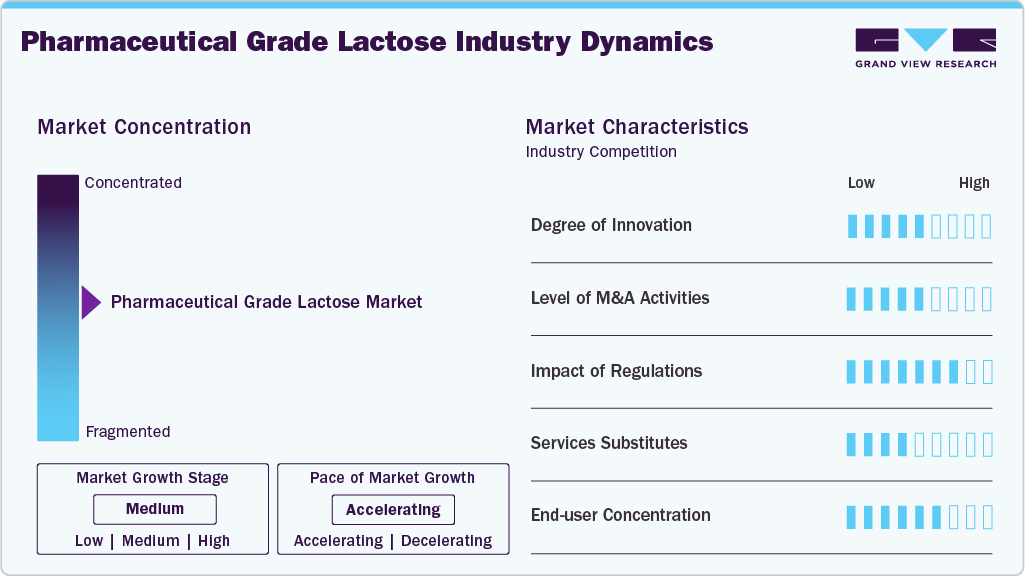
The market exhibits a moderately consolidated competitive structure, led by a combination of multinational excipient specialists and regional manufacturers. Prominent companies such as DFE Pharma, MEGGLE GmbH & Co. KG, Kerry Group plc, and Royal FrieslandCampina maintain strong positions through diversified product portfolios, robust quality standards, and established global supply chains. These players focus on developing high-performance grades, particularly for inhalation and direct compression applications, while investing in process optimization and regulatory compliance.
 To learn more about this report, Download Free Sample Report
 At the same time, regional manufacturers such as Lactose (India) Limited and Fengchen Group Co., Ltd are expanding their presence by offering cost-effective solutions and targeting emerging markets. Competitive differentiation is primarily driven by product consistency, innovation in excipient functionality, and the ability to meet stringent regulations.
Product Insights
Inhalation lactose dominated the market with a revenue share of 34.8% in 2025, supported by its specialized application in DPI formulations. This grade is engineered to meet stringent requirements for particle size distribution, purity, and flow properties, ensuring optimal drug delivery performance. The segment’s growth is closely linked to rising demand for respiratory treatments and increasing investments in inhalation-based drug development.
Spray-dried lactose is expected to grow with a CAGR of 5.8% in the forecast period due to its superior flowability and compressibility, making it highly suitable for direct compression processes. Its uniform particle structure enhances manufacturing efficiency and ensures consistent tablet quality. Growing adoption of continuous manufacturing techniques and the need for cost-effective, high-performance excipients are expected to drive demand.
Route of Administration Insights
The oral solid dosage forms segment dominated the market with a revenue share of 72.9% due to their widespread use in tablets, capsules, and sachets. Lactose is extensively utilized as a filler and binder owing to its excellent compressibility, stability, and compatibility with a wide range of active pharmaceutical ingredients (APIs). The continued growth of generic drugs, coupled with high patient preference for oral medications and cost-effective manufacturing processes, is reinforcing demand in this segment.
 To learn more about this report, Download Free Sample Report
 Pulmonary drug delivery is expected to grow the fastest, with a CAGR of 6.4% from 2026 to 2033, driven by the increasing prevalence of respiratory diseases such as asthma and COPD. Lactose plays a critical role as a carrier in dry powder inhalers (DPIs), enabling efficient drug dispersion and delivery to the lungs. Technological advancements in inhalation therapies and the rising adoption of targeted drug delivery systems are expected to sustain strong growth momentum in this segment.
Regional Insights
Europe held the largest revenue share of 35.6% in 2025, supported by its well-established manufacturing base and strong regulatory framework. The region benefits from the presence of major excipient producers and advanced drug development capabilities. High demand for generic medicines, coupled with significant investments in research and development, continues to drive consumption. The stringent quality standards and compliance requirements reinforce the adoption of high-purity excipients across applications.
 To learn more about this report, Download Free Sample Report
 Germany Pharmaceutical Grade Lactose Market Trends
The pharmaceutical grade lactose market in Germany represented a key contributor within Europe, driven by its strong focus on innovation. The country hosts several leading excipient manufacturers and benefits from advanced production technologies and a highly regulated environment. Increasing R&D expenditure, particularly in biologics and complex drug formulations, is supporting demand for specialized grades. Germany’s export-oriented pharmaceutical sector further strengthens its role as a major hub for high-quality excipients.
Asia Pacific Pharmaceutical Grade Lactose Market Trends
The pharmaceutical grade lactose market in the Asia Pacific was closely trailing Europe in terms of revenue market share. Rapid expansion of manufacturing, particularly in emerging economies, along with increasing healthcare expenditure, is driving demand. The region’s strong presence in generic drug production and contract manufacturing activities further supports market growth. Favorable government initiatives and investments in healthcare infrastructure are expected to sustain long-term expansion.
China pharmaceutical grade lactose market is a major growth contributor within the Asia Pacific, supported by its large-scale manufacturing capacity and expanding domestic healthcare market. The country is witnessing investments in drug innovation and production capabilities, alongside policy reforms aimed at improving drug quality and accessibility.
The pharmaceutical grade lactose market in India is witnessing significant growth due to the country’s expanding pharmaceutical industry, rising generic medicine exports, and increasing investments in healthcare infrastructure. Increasing adoption of advanced drug delivery systems and growing export potential are driving demand, particularly in high-volume and cost-sensitive applications.
North America Pharmaceutical Grade Lactose Market Trends
The pharmaceutical grade lactose market in North America represented a mature market, driven by strong innovation and high healthcare spending. The region benefits from advanced drug development pipelines, including biologics and specialty drugs, which require high-quality excipients. Regulatory rigor and a well-established healthcare ecosystem further support consistent demand. The presence of leading companies and ongoing investments in R&D continue to sustain market growth.
The U.S. pharmaceutical grade lactose market dominated North America, supported by its position as the world’s largest pharmaceutical industry. High levels of healthcare expenditure, coupled with strong demand for both branded and generic drugs, drive excipient consumption. The country’s focus on innovation, including personalized medicine and advanced drug delivery technologies, is increasing the need for specialized grades.
Middle East & Africa Pharmaceutical Grade Lactose Market Trends
The pharmaceutical grade lactose market in MEA is the fastest-growing region with a CAGR of 6.4% during the forecast period, supported by increasing healthcare investments and efforts to strengthen domestic production. Expanding population, rising prevalence of chronic diseases, and improving access to healthcare services are driving demand for pharmaceutical products. While the market remains relatively small, ongoing infrastructure development and government initiatives aimed at boosting local manufacturing are expected to create gradual growth opportunities.
Latin America Pharmaceutical Grade Lactose Market Trends
The pharmaceutical grade lactose market in Latin America experienced growth, driven by improving healthcare access and expanding manufacturing capabilities. Countries in the region are increasingly focusing on local drug production to reduce dependency on imports. Rising demand for generic medicines and supportive government initiatives are contributing to market expansion, although regulatory variability and economic fluctuations remain key challenges.
Key Pharmaceutical Grade Lactose Company Insights
Companies in the industry are prioritizing capacity expansion, advanced processing technologies, and the development of high-purity, application-specific excipients to enhance product differentiation. They are also forming strategic partnerships with manufacturers and investing in regulatory compliance and quality certifications to strengthen global market access. Firms are expanding their presence in emerging markets through localized production and distribution networks to capture growing demand.
-
ARMOR PROTEINES is a France-based company engaged in the production and marketing of dairy-derived ingredients, including milk powders, caseins, caseinates, and lactose. It functions under the Savencia Fromage & Dairy group and delivers a diverse portfolio of specialty ingredients tailored to pharmaceutical and nutritional applications. With a presence in over 50 countries, the company leverages its global distribution network to meet the evolving requirements of international customers.
-
BASF Corporation operates as the regional arm of BASF SE, a Germany-headquartered chemical conglomerate. The company offers an extensive portfolio encompassing chemicals, plastics, coatings, agricultural solutions, and performance materials. With operations spanning more than 90 sites across North America, BASF Corporation supports a broad range of industries through its diversified product offerings and strong regional manufacturing footprint.
Key Pharmaceutical Grade Lactose Companies:
The following key companies have been profiled for this study on the pharmaceutical grade lactose market.
- ARMOR PROTEINES
- BASF Corporation
- Charotar Casein Company
- DFE Pharma
- Fengchen Group Co., Ltd.
- Alpavit
- Kavya Pharma
- Kerry Group plc
- Lactalis Ingredients
- Lactose (India) Limited
- MEGGLE GmbH & Co. KG
- Royal FrieslandCampina
- Surfachem Group Ltd.
Recent Developments
-
In January 2026, Lactose (India) Limited expands into specialized pharmaceutical excipients through an investment of ₹15 crore.
-
In February 2025, Brenntag Specialties entered an exclusive distribution partnership with MEGGLE Excipients for the supply of pharmaceutical-grade lactose across the Benelux and Nordic regions.
Pharmaceutical Grade Lactose Market Report Scope
Report Attribute
Details
Market size in 2025
USD 2.2 billion
Estimated market size in 2026
USD 2.4 billion
Projected market size by 2033
USD 3.3 billion
Growth rate
CAGR of 5.2% from 2026 to 2033
Historical data
2021 - 2025
Forecast period
2026 - 2033
Quantitative units
Revenue in USD million/billion, volume in kilotons, and CAGR from 2026 to 2033
Report coverage
Revenue forecast, volume forecast, company ranking, competitive landscape, growth factors, and trends
Segments covered
Product, route of administration, region
Regional scope
North America; Europe; Asia Pacific; MEA; Latin America
Country scope
U.S.; Canada; Mexico; Germany; UK; France; Italy; Spain; China; India; Japan; South Korea; Brazil; Argentina; South Africa; Saudi Arabia.
Key companies profiled
ARMOR PROTEINES; BASF Corporation; Charotar Casein Company; DFE Pharma; Fengchen Group Co., Ltd.; Alpavit; Kavya Pharma; Kerry Group plc; Lactalis Ingredients; Lactose (India) Limited; MEGGLE GmbH & Co. KG; Royal FrieslandCampina; Surfachem Group Ltd.
Customization scope
Free report customization (equivalent up to 8 analysts’ working days) with purchase. Addition or alteration to country, regional & segment scope.
Pricing and purchase options
Avail customized purchase options to meet your exact research needs. Explore purchase options
Global Pharmaceutical Grade Lactose Market Report Segmentation
This report forecasts volume & revenue growth at global, regional, and country levels and provides an analysis of the latest industry trends in each of the sub-segments from 2021 to 2033. For this study, Grand View Research has segmented the global pharmaceutical grade lactose market report based on product, route of administration, and region:
 To learn more about this report, Download Free Sample Report
 -
Product Outlook (Volume, Kilotons; Revenue, USD Million, 2021 - 2033)
-
Crystalline Monohydrate Lactose
-
Grounded/Milled
-
Sifted
-
Micronized
-
-
Inhalation Lactose
-
Granulated Lactose
-
Spray Dried Lactose
-
Anhydrous Lactose
-
Other Products
-
-
Route By Administration Outlook (Volume, Kilotons; Revenue, USD Million, 2021 - 2033)
-
Oral Solid Dosage Forms
-
Tablets
-
Capsules
-
Sachets
-
-
Pulmonary Drug Delivery
-
Dry Powder Inhalers (DPIs)
-
-
Parenteral Formulations
-
Intravenous (IV)
-
Injectable formulations
-
-
Topical Formulations
-
Ointments
-
Creams
-
-
Other Route of Administrations
-
-
Regional Outlook (Volume, Kilotons; Revenue, USD Million, 2021 - 2033)
-
North America
-
U.S.
-
Canada
-
Mexico
-
-
Europe
-
Germany
-
UK
-
France
-
Italy
-
Spain
-
-
Asia Pacific
-
China
-
India
-
Japan
-
South Korea
-
-
Middle East & Africa
-
Saudi Arabia
-
South Africa
-
-
Latin America
-
Brazil
-
Argentina
-
-
Frequently Asked Questions About This Report
The global pharmaceutical grade lactose market size was valued at USD 2.2 billion in 2025 and is estimated at USD 2.4 billion for 2026.
Europe dominated with a 35.6% revenue share in 2025.
Middle East & Africa is the fastest-growing region over the forecast period.
The inhalation lactose segment led with a 34.8% revenue share in 2025.
The global pharmaceutical grade lactose market is expected to grow at a CAGR of 5.2% from 2026 to 2033, reaching USD 3.3 billion by 2033.
The oral solid dosage forms segment held a dominant position in the market, accounting for 72.9% of revenue in 2025. This is primarily due to the widespread use of lactose as a filler and binder in tablets and capsules.
Key players include ARMOR PROTEINES; BASF Corporation; Charotar Casein Company; DFE Pharma; Fengchen Group Co., Ltd.; Alpavit; Kavya Pharma; Kerry Group plc; Lactalis Ingredients; Lactose (India) Limited; MEGGLE GmbH & Co. KG; Royal FrieslandCampina; Surfachem Group Ltd.
The pharmaceutical-grade lactose market is largely driven by the ongoing growth of theindustry and the increasing production of generic medicines. Pharmaceutical lactose is commonly used as a filler, binder, and carrier in tablets, capsules, and dry powder inhalers due to its excellent compressibility, stability, and compatibility with active ingredients.
About the Author(s)
Food Additives & Nutricosmetics Research Team
Specialty & Chemicals · Food Additives & NutricosmeticsThis report was authored by the food additives & nutricosmetics research team at Grand View Research - comprising two research analysts, one senior research analyst, and one industry expert - with specialized expertise in the food additives & nutricosmetics segment of the specialty & chemicals industry. All findings are based on proprietary specialty & chemicals databases, executive interviews, and regulatory analysis, subject to internal peer review prior to publication.
Last Updated:
Speak to Analyst

Customize this report to your needs - add regions, segments, or data points, with 20% free customization.
Or view our licence options:


ISO 9001:2015 & 27001:2022 Certified
We are GDPR and CCPA compliant! Your transaction & personal information is safe and secure. For more details, please read our privacy policy.


